You are currently browsing the tag archive for the ‘Life’ tag.
So for those of you who’ve read some of my stories – especially those who have read the stories in the category of “Stupid things that Papa did when he was Little.” – understand that as my son was growing up I would tell him these kinds of stories – honestly, as bedtime stories – because they made him laugh, and I did it in large part because I didn’t want him thinking that I was perfect in any way – I wanted him to understand that I was human, and could (and did) screw up.
He liked (and still likes) these stories because generally something (bad/amusing/result of a stupid decision/peer pressure) happens in them that allows him to see the benefit of others mistakes, without having to make them on his own…
In fact, when he was little, he asked me in all honesty, after I’d told him quite a few of these stories, “Papa? When I grow up, will I make mistakes too? Or have you made them all?”
How on earth do you answer a question like that? “Well, Michael, you live in a different time, I’m sure you will make creative, new, and exciting mistakes that I would never have dreamed of…”
That satisfied him.
Now that he’s older, and capable of making some of those bigger mistakes all by himself, he’s thinking of these stories in a different light… After I told him one story, he looked at me, mouth agape, having heard as complete and utter stupidity what I was simply relaying as history, (think about that) – and said, “How did you get old enough to breed?”
Hearing that from your kid is a little mind bending…
And I thought I had a dull childhood…
He’s also told me that if he does something stupid, I can’t complain, because it’s clear that I’ve done stupider things. In fact, he says that the following story shows just how high I set the stupidity bar – and he would have an awful lot of trouble coming close to that.
So from time to time when he was little, he would ask me to tell him some of his favorite stories, and, given that yesterday (as I write this) was the 33rd anniversary of this story, I thought I’d share.
So one day he asked, “Papa, can you tell me the story about you and your friend Paul?”
Well, there’s only ONE story about my friend Paul and me.
It involved a 1973 Pinto station wagon, a hot summer afternoon, some ducks, a cannon shell, and Elvis Presley.
Actually, in that order.
First some background…
I grew up in Roy, Washington, a small speed trap – er, town – south of Tacoma that’s surrounded on three sides by Fort Lewis, the local Army Base. One of the benefits for a boy growing up there was that you got to see lots of military hardware all the time, because it drove, flew, or traveled in a parabolic arc right past the house. (you’ll get it, just keep reading)
This, to put it succinctly, was cool.
I’ve learned I’m the only person I know who thought a .30 caliber machine gun being fired or cannons going off are peaceful sounds. But, that’s what I grew up with, and hearing them meant that all was right in the world.
The cannons and machine guns got to the point of being background noise, which meant unless we were listening for it, we didn’t really notice it. You’d hear this “Thump” in the distance, (the cannon, or mortar, had been fired, north of town) and about 22 seconds later, from the firing range, west of town, you’d hear a muffled, “BOOM!” as the shell hit and exploded. On especially quiet days you could actually hear the shell as it flew, making kind of a whistling “shewwewewewewew” sound as it flew by in that parabolic arc that cannon shells fly in…
It was pretty predictable, and the one thing we could count on was that the Army didn’t shoot on Sundays, so we had one day where things were relatively quiet, and though I didn’t mind the sounds of the Army, the silence was nice.
As one of my instructors in college said, “You will see this material again.”
They also shot at night, and to light things up, they shot up flares, which came down on parachutes.
One of the things we did for fun was to go out on the firing range (where the targets are – think about that one for a moment) and gather up the parachutes and other things we found as souvenirs. We’d tie the parachutes to the backs of our bicycles to use as drag chutes to slow us down after careening down “school hill”…
This was far more than “slightly” illegal, as we had to pass at least two signs saying:
“KEEP OUT! Artillery Impact Area”.
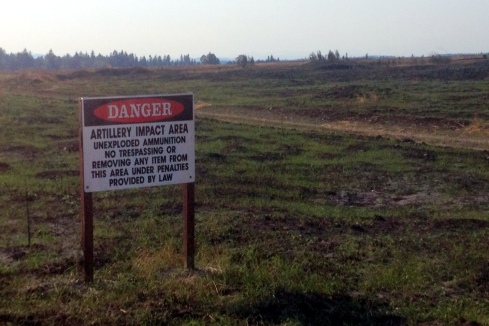
The signs are official now – used to be stenciled onto a 4 x 8 sheet of plywood
There was some, shall we say, ‘evidence’ of cannon shells hitting, like holes the size of houses, so they really didn’t want you gathering ‘souvenirs’. You did have to be smart as to what you took. Getting parachutes was safe, getting cannon shell duds wasn’t. There was a fellow who found a dud out there that had been sitting there for a number of years, the explosive getting unstable for the whole time… He took it home where it apparently dried out, and took out half of his house.
His parents weren’t pleased.
But this isn’t his story…
Paul and I went out there, he doing the driving because I didn’t have a driver’s license and me wanting to show off a little by showing this friend something he hadn’t seen before.
He read the first warning sign and stopped the car cold.
“What do you mean “Artillery Impact Area? I’m not going in there!”
Understand – I’d lived out there – driven past signs liked that that said “Small Arms Impact Area: Keep Out” (when you read that sign, do you think of bullets? Or little arms with little fingers falling out of the sky?) We’d drive past the hand grenade range, and see all sorts of things so often we just didn’t think about them.
But Paul had never seen that sign, and wasn’t moving the car an inch.
“But Paul, they don’t shoot on Sundays, don’t worry about it, we’ll be fine!”
After awhile, he took his foot off the brake, and we drove past it.
Sometime later there was the second one, and Paul skidded to a stop again, his eyes darting back and forth between the sign and me, trying to decide which was crazier. Images of hundreds of pounds of high explosives hurtling toward him at 500 miles an hour were going through his head and I was telling him to keep driving…
“Really, they DON’T shoot on Sundays.”
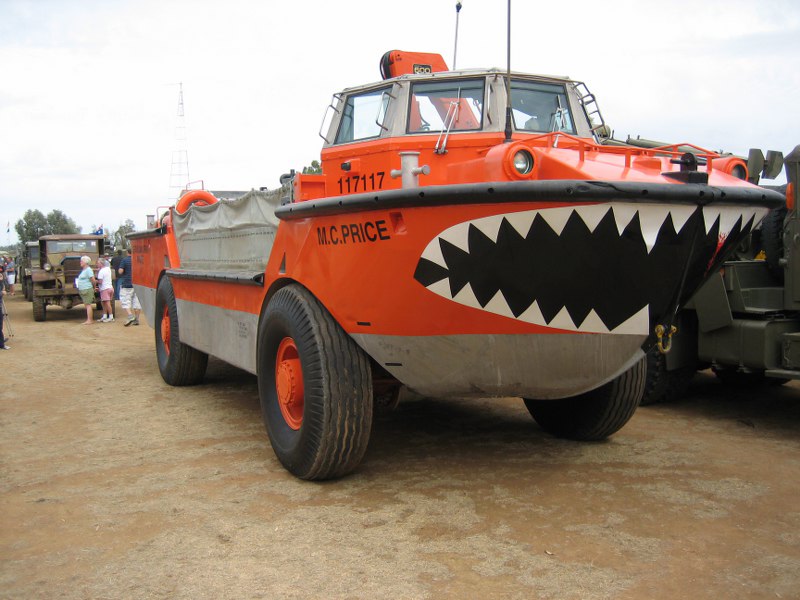
We went further, and found five of these things the Army calls “Ducks” – which are huge crosses between trucks and boats. I’ve never seen this kind before or since. They’re not the kind you see used for tourism, and the closest I’ve come is this. But they were basically huge bare aluminum boats about 40 feet long, with what seemed like 4 – 6 foot tires on them, so they could be driven on land or in the water. And they’d been driven there quite recently, since the grass was still flat from their tire tracks. Somehow they’d been knocked over onto their sides, the hulls near the back had been cut through with a blowtorch, the pans and crankshafts had been taken out of the engines so no one could drive them away…
Hmmm…
We went to the other side, and found a very large black number 3 painted on it. From where we were, we could see the other four, each with a number painted on it.
We were on the edge of a rather large plain, with a tree line visible about a mile away or so, so we felt pretty safe, feeling we’d see someone before they saw us.
We climbed up into the cab of the thing and saw all these cool instruments on the dashboard. We were members of an otherwise reputable search and rescue organization and decided we could get instruments for a communications truck our unit was making, so we set on removing them with the large variety of specialized disassembly instruments we had available to us.
We learned that it’s quite difficult to do precision disassembly on an armored instrument panel when your precision disassembly tools are of the igneous, metamorphic, and sedimentary varieties.
We moved on.
One of the engine parts they’d left was the cover of the air filter, which was a large, round, bright red fiberglass thing that looked like an oversized Frisbee (I suppose I should put an ® here for their lawyers)
Since we’d had less than sterling success with the instruments, we spent some time tossing the air filter cover around. I mean, it was a nice, warm August afternoon, the sun was shining, the birds were singing, the bees were buzzing, and –
“Thump”
– and there was a thump in the distance.
No problem, I heard this sound every day.
But somewhere, deep in the recesses of my mind, I recognized that sound was what is technically known as “a bad thing”.
I mean, let’s see if we can figure this out:
We’re out there on the artillery impact range.
On this duck that’s got a HUGE number painted on it.
This would indicate that we are standing on a target.
Not near a target.
On a target.
That has just been fired on.
By a cannon.
It took just about 20 seconds to come to this conclusion.
The Screaming/Howling/OncomingFreightTrain sound of a real cannon shell as it comes in on the position you’re standing on is simply not describable. I’ve seen “Private Ryan”, and “Band of Brothers” and a few other films – and the sounds you hear in war movies, while they try, don’t come close to reproducing the sound accurately. The sounds you hear in movie theatres also aren’t accompanied by a tree getting vaporized about 75 feet away.
I turned to tell Paul to look at that tree, but he was gone.
In fact, he was halfway to the car by then.
Joining him seemed like an exceptionally good idea at the time.
We’d parked at this little ‘y’ intersection on a dirt road, about 100 yards south of the Ducks, and I got there just after he’d done one of those U-turns you only see on “Dukes of Hazzard” – which is hard to do in a Pinto, but Paul seemed to have enough adrenaline going through his system to overcome this limitation in the car.
This adrenaline seemed to have Paul functioning at hyperspeed, and the car, Pinto or not was rapidly approaching its version of the same thing.
To do this in a Pinto station wagon on a weaving, hilly dirt road isn’t necessarily the smartest thing to do, but since our actions were initially unencumbered by the thought process, now didn’t seem to be a particularly important time to change that.
We came to this hill, went up, and, had we been traveling at a sane speed, would have gone down and around the curve to the left on the other side.
However, sanity absolutely not being part of the picture, the car didn’t quite get airborne, but it came awfully close, to the point where the wheels were about as useful to the car as opposable thumbs are to fish…
As the road (and world) turned, and while Paul hit the brakes and turned the steering wheel hard left, the car, pondering the ramifications of fish and opposable thumbs, went straight ahead into a dirt embankment, which stopped it in ways that the brakes couldn’t have.
Ever.
Now some things to note about driving a station wagon at high speed on a dirt road.
- It pulls a large cloud of dust behind it, so the cloud is, for the first little bit, traveling at roughly the same speed as the car. Since it was a hot August afternoon, we had the windows wide open, the front ones rolled down, the back ones, hinged at the front, were flipped open at the back.
- Now this cloud that was following the car didn’t have the benefit of dirt embankments to stop it, so when we stopped, the windows acted like large scoops as the cloud continued rapidly ahead and enveloped the car, coming in through the windows and covering us from head to toe.
We were fine, the car however, needed some help, We had to wait until we could see, at which point I jumped out and pulled the fender to unhook it from where it was jammed up against the right front tire. I hopped in, Paul started the dust cloud and the Pinto up again, and only stopped after we were past the second sign, what had been the first one on the way in.
We got out of the car, hearts still thumping at what I remember as being one of the machine gun ranges (which wasn’t being used… Really!) , and as we got out and tried to calm down a little bit on that warm, sunny, Sunday afternoon, we heard nothing but Elvis Presley’s music on the radio. Turned out, the previous Wednesday, on August 16, 1977, Elvis Presley had gone to the great Tabloid in the sky…
After awhile, we slowly drove back home, and Paul, to my knowledge, never mentioned it to anyone.
…
There are two corollaries to this story:
20 years later, a group of us (which included Paul and me) from this “otherwise reputable Search and rescue organization” managed to get together from the four corners of the globe and met together at a restaurant to catch up on things.
I got there late, and as I stood there in the doorway trying to find the group, Paul saw me, the first words out of his mouth after 20 years, which I heard all the way at the door, were, “Well Hello there MISTER ‘They don’t shoot on Sundays’!”
Seems he hadn’t forgotten, and I – well, I think this one will take some time to live down.
…
Number two: I told this story to a friend who’d retired as a colonel in the army, and he started laughing so hard I thought he was going to have a stroke. I was actually quite worried about him.
It turns out that he (having had experience as a soldier) was thinking of the other end of this little exchange.
See, just because they didn’t shoot on Sundays doesn’t mean they weren’t out there.
Just because I couldn’t see them didn’t mean they couldn’t see me (this is why the Army has whole schools developed to teach the art of camouflage).
So imagine a couple of bored soldiers, could have been ROTC cadets, could have been National Guard on their one weekend a month, I don’t know – but imagine those few bored soldiers on a warm summer Sunday afternoon whose job it was to watch these five fresh targets they’d seen delivered and had to wait until Monday before they could blow them to smithereens.
And while they were looking through their rangefinders, they saw a small car dragging a cloud of dust along where it shouldn’t be – not quite into their sights, but awfully close…
I can just see it as one of them nudges the other one, “Hey, Jim! Look at this!”
I mean, two obvious civilians (us) throwing this bright red thing (the air filter cover) back and forth and up into the air wasn’t really the best way to keep people from seeing us…
And by then, not only were we in their sights, we were practically dancing on their targets… Well, climbing all over them and beating on things with rocks – heh – we were rocking out… (sorry)
I have to wonder how many trigger fingers got real itchy all of a sudden…
They needed to let us know we’d been seen, and it had to be done very soon so it was absolutely, positively, unmistakably clear who, actually was boss out there.
I would love to have heard the conversation that went back and forth between them and their commanding officer, and finally, someone decided to get our attention by “firing a shot across the bow”.
We didn’t actually hear it (we were thrashing the Pinto on that dirt road) but I can imagine them laughing their heads off as we saw the shell hit and the panic that followed.
It would be fun to find these soldiers sometime to hear their side of the story.
///
Michael really likes it when I tell this story, and when I get done telling it, he (after he’s done laughing) looks at me, shakes his head, and says, “Papa, you made a bad decision in going past that sign…”
–and I wonder, does this mean he’s going to do what the signs in his life say and try to stay safe?
Or is he going to go past them in hopes of coming up with weird stories to tell his little boy when he has one?
Hmmm…
==
Note: I originally wrote this story as a note to my mom and dad when he was 7. He’s now 19, and when I told him yesterday, “Hey, 33 years ago yesterday…” – he finished the sentence for me, “…was a day of extremely high caliber stupidity…” He didn’t realize the bad pun until I started groaning.
So…
If I ever catch him doing something stupid, I know I’ll hear back, “You’re out there on a LIVE artillery range, DANCING ON THE FREAKING TARGETS, and you’re worried that I’M going to do something stupid?”
Well… yeah… I am…
I do hope I’ve set the bar too high for him to ever reach the levels of dancing on targets on an artillery firing range… but Lordy, I know stupidity of that magnitude is definitely possible.
Sigh…
I worked for the Muskegon Chronicle, in Muskegon, Michigan for a time, and the weather there is very different from here in Washington State where I live now. You’ve likely heard of the reputation western Washington has for rain, and it is in large part true. The weather in Michigan, however, is that “middle of the continent” kind of stuff where you have thunderstorms, tornadoes, poofy clouds that you just don’t have here closer to the coast. One of the things that happened a lot was those thunderstorms, and they would always come in off Lake Michigan (all the weather came in from the west, thunderstorms were no exception). Every now and then we’d see one coming, and as I was always on the lookout for new and exciting pictures, I headed down to the lake to see if I could set up and get a shot for the paper.
I drove around for awhile, looking for a good vantage point so I could have something visible in the foreground to get a sense of how big the lightning bolt was, and settled on an unmanned lighthouse, and put it in the bottom right of my frame.
I could see the lightning hitting, and had a lens on the camera that could see a good field of view (not good to have a telephoto lens focused on the wrong patch of sky) – and so, considering that this was a) night, and b) lightning – I figured that the chance of me actually getting something was dramatically improved by having the camera on a tripod and taking long exposures, so I did, and I started shooting…
I’d open the shutter – leave it open for about 20 seconds – just long enough, I figured, for the light in the lighthouse to burn a hole in the film (not really, but it would make it hard to print) – and if there wasn’t any lightning – then I’d close the shutter and go to the next frame. I did this for about 28 frames or so, and just as I was closing the shutter on that 28th frame, a big, hurking bolt of lightning came down, and I wondered if I’d gotten it.
More importantly, my brain started functioning about then.
See, I was standing on a beach.
Which meant I was the highest object around.
And I was holding a metal cable release attached directly to my camera, on a metal tripod.
And that tripod was, as you might imagine, was well grounded.
Which meant…
– I’m not sure if the hair standing up on the back of my neck was from the realization of what could be happening, or from what was clearly about to happen – regardless, I’ve never packed up my gear so fast.

I got back to the paper and developed the film – and all but the last frame were blank (except for the lighthouse) – that last frame had a big bolt of lightning just on the left side.
And it also had a story behind it…
Many years ago, my mom and dad decided they wanted a fish pond in the back yard. Now since fish ponds aren’t something you can just get at the local hardware store, it had to be “assembled” and “installed”.
Now installing a fish pond involves removing a lot of dirt out from where the fish pond is about to be, and it is definitely one of those things that involves sweat equity. By the time you’re done, those fish better dang well be happy they’re there, because it took a lot of work to get them there. She’d done a good bit, if not all of the work to do the installation – and had a vested interest in keeping those fish alive.
On the flip side of things, while gold fish aren’t really all that expensive, the idea of something taking the fish that, say, hadn’t earned the fish with that sweat equity, that just – well – it irritated mom.
A lot.
And one day, a poor, unfortunate creature made the incredibly bad decision to go fishing.
Now some of the creatures that had gone fishing in mom’s fish pond were raccoons, and they were moderately successful. Some of the creatures were neighborhood cats, who just couldn’t seem to ignore the little orange – what would you call them, “containers of food”? – swimming around in there.
Note – the image you have in your mind of these creatures fishing does not involve little raccoons or kitty cats sitting there in little kitty sized chairs, with kitty or raccoon sized fishing poles, waiting for the little fishies to bite. They got a little more intimately involved than that, and got very close to the water, and then just scooped the fish out with their claws. Kind of like combing some grunk out of your hair, only instead of hair, it was water, and instead of grunk it was a fish.
But this day was different.
This day the creature was running a little short on claws, and actually, a little short on fur. See, one of the creatures that apparently liked hanging around mom’s fish pond watching said fish was a fairly large garter snake.
Now garter snakes aren’t poisonous, we used to play with them when we were kids, my cousin, bless her fuzzy little heart, would find baby ones and put them in her pocket, then come into the house with her hands full (note: her hands were ALWAYS full in these situations) and ask her mom, “Mommy, can you get the dime out of my pocket?” (it didn’t matter what she asked for – the goal was to get her mom’s hands in her pocket.) Just so you know, her mom HATED snakes. Her mom reached into her pocket expecting to find a dime, and instead found something that gave her an absolutely astonishing case of the heebie jeebies as she found, with her fingers, an itty bitty snake.
The polite thing to say here at this point is that my cousin laughed.
A lot.
And my aunt freaked…
A lot.
It’s one of those things you can look back on and laugh.
Well, my cousin can, not sure if my aunt can.
And that’s the kind of stuff we did as kids with garter snakes.
But… this is my mom’s story…
My mom was a little different when it came to snakes, and one day she’d found that not only was her fish pond short one fish, but the creature that had gone fishing had done so without a pole of any kind…
It was the snake.
And it most definitely upset mom. That was HER fish, from HER pond, and no dang snake was going to take that fish from her without a fight.
So she did the first thing she knew she needed to do.
She got her camera, and took a picture – just to prove she wasn’t telling a “fish tale”.
Then she got the pitchfork – mom’s goal was to scoop the snake up and fling it away from the fish pond.
However, snakes are very good at slithering, and slithering snakes sneak stealthily away from (quick, what’s a word for pitchfork that starts with ‘s’?”). Okay, let’s see if we have all this right…
- Get picture of snake trying to eat goldfish… Check…
- Got goldfish out of snake and back in water…. In progress.
- Oh – yeah… Wail on snake with pitchfork… Not checked…
See, it was only then, after she’d gotten a picture of it that she realized scooping said snake up was not going to work, and the snake made what might have been a bit of a mistake somewhere in there.
See, mom wanted the snake gone… She didn’t necessarily want it dead, she just wanted it gone. She had more invested in her fish (by a couple of bucks) than she did in the snake, and so among other things, it was simple economics…
The snake needed to go.
But the snake didn’t go, and then it looked up at her, and then, suddenly, thousands of years of history of women and snakes converged into one moment in time. I’m sure that if Eve had had the same pitchfork Mom did, the whole Garden of Eden thing would have been a WHOLE lot different.
Mom started absolutely wailing on that snake as if it was the son of Beelzebub himself. (Come to think of it…J).
This snake did not know what hit it.
In fact this snake didn’t know what KEPT hitting it, but it most definitely let go of the fish.
The slithering snake dropped the goldfish right about then – so she snagged it and threw it back into the pond, where it swam speedily away…
Mom tossed the fish back into the pond, then grabbed the snake by the tail. It was as long as from her waist to the ground. It then made the mistake of looking up at her – with goldfish scales in its mouth – and it hissed.
Bad snake…
And the pitchfork was used, once again, for a purpose for which it was not designed, but was quite suitable for.
The snake, by that point, was getting to be pretty ambivalent about the whole thing. In fact, with apologies to Johnny Hart, trying to slither with 432 slipped disks was a bit of a challenge, and it was then that she carried it a few hundred feet away – across a little creek, and hucked the snake over there like Indiana Jones would have flung his whip.
And the funny thing is – that snake never bothered mom or her fish again…
Go figure.
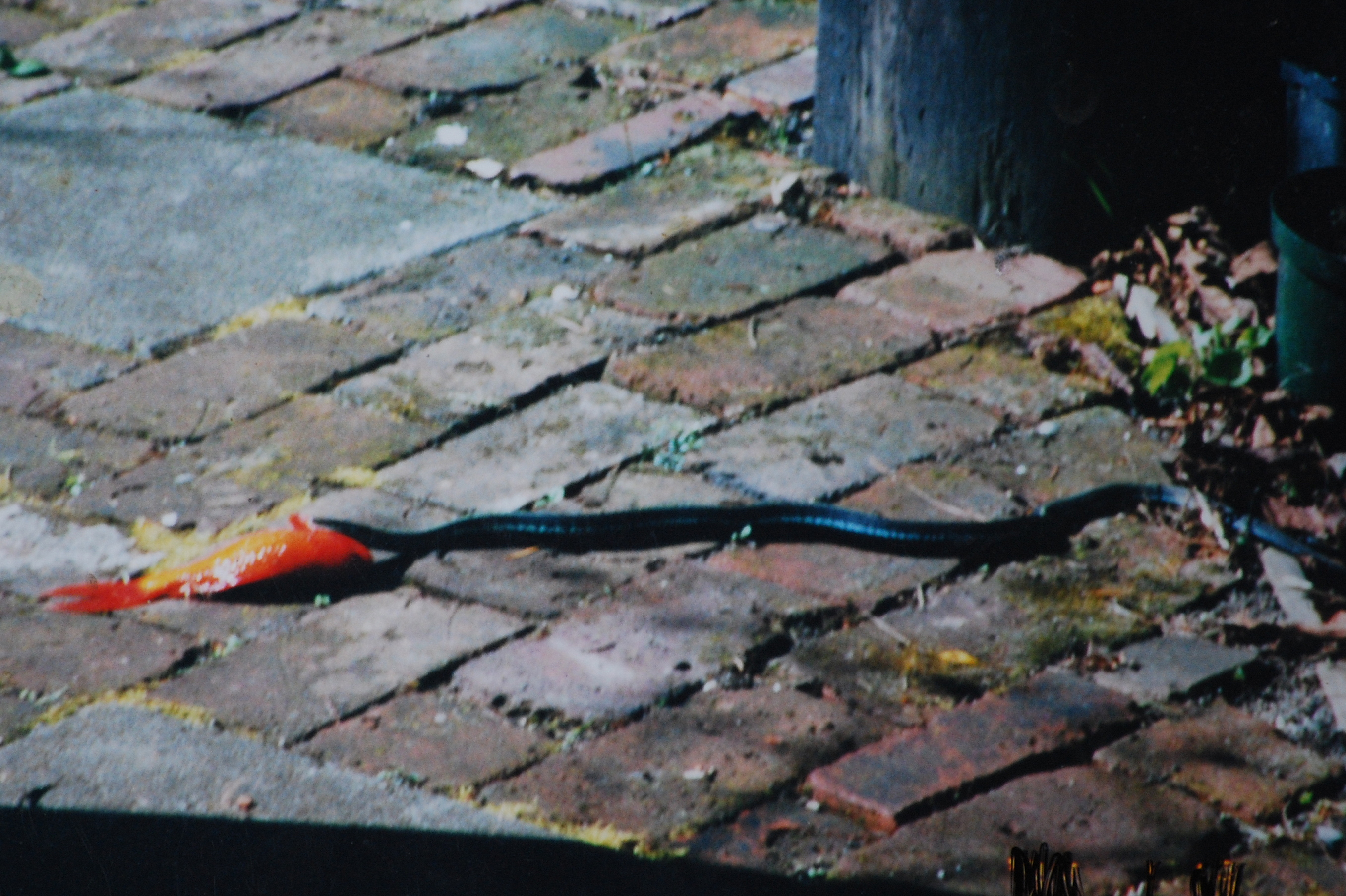
One live snake… One live goldfish… (this will soon change)
I was talking to my mom the other day about an email we’d both received – about an American soldier in WWII and how he had done brave things on the battlefield. For example, killing the enemy, saving his compatriots, just doing what soldiers do.
And she, having grown up in Germany during World War II, sent me this note:
You know Tom-Son, looking at war and the so-called ‘victories’ from both sides, something became clear to me during that war. I was between 10 and 14. In school we talked about how many air planes had been shot down, how many ‘Panzer’ (tanks) or ‘Gefangene’ (captured, how many ‘enemy soldiers’ were killed, until…
Pastor Gotthilf Hoelzer one day somberly made the remark
“THEY WERE ALL THE SON OF A MOTHER”
That brought those ‘victories’ into perspective.
During the war, there was no TV. Everyone who had one huddled around a radio in the evenings to hear the “special bulletins”, the “Sondermeldungen”, to hear how the war was going.
Mom was born in 1929, in Germany, at the height of the Depression. This is the Depression that Hitler got Germany out of. The Depression where he convinced many people that he was the right person to be their “leader” – their “Führer” – before things went completely crazy. The unemployment situation was absolutely dire, and mom’s parents – my grandparents – had found employment by working at the milk “Sammelstelle” – a collection station where the farmers would bring their milk to be processed and sent to the larger dairies.
Mom told me just a short paragraph of a story – a story that boils down to six words, but at the same time, could not be told in a hundred lifetimes:
“I remember one family on our ‘milk run’ in Hanseatenstrasse. Their soldier was there when Stalingrad was surrnounded and was expected to be taken by the Russians. The German troops were trapped. The adults of that family were huddled around their radio to listen to the ‘Sondermeldungen,’ knowing that they would not see their man come back. They were all crying. Their little girl did not understand and she said : “Lasset me doch au mit-heula’. (essentially: “Tell me what’s going on so I can cry with you”) She sensed that all those hearts around her were breaking and she wanted to know why…
It was most likely that the adults were crying about her Dad.”
And a flood of images came to my mind.
…the chores still needed to be done, but they were rushed so that everyone could gather around the radio to hear the news of the day. The husband, the father, the brother, the son of someone in that room, was in Stalingrad. Hitler himself had ordered that there would be no surrender. The 6th Army of the Wehrmacht, which had stormed into the city that summer was either decimated or being left there to die.
In that moment, the adults realized that their son would not come home. His father, who up until that moment had been looking forward to sitting down with him and hearing his stories, and in hearing them, would relive some of his own battles in WWI. But he realized as he listened to this news, that he would not hear them, or his son’s voice, ever again. He remembered back, remembered seeing his wide open, trusting eyes as he, like all fathers, tossed his little boy into the air and caught him again and again, his laughter ringing like a joyous bell. He remembered his birthdays, his baptism and confirmation in the church, and his marriage at the little town church flooded his mind as the tears flooded his eyes. He remembered how he was able to sit down, after a hard day’s work, and celebrate that German tradition of ‘Feierabend’ which, while hard to translate into English, can best be summarized by the meaning behind the phrase “It’s Miller Time” .The work is done, it’s time to rest. He’d been looking forward to the end of the war, to be able to have a huge Feierabend with his son, because the work – the war, would be over.
But there would not be any more Feierabends with his son.
Not now.
Not ever.
And he wept.
Unashamedly, he wept.
For the companionship he would no longer have with his son, for the laughter they would no longer share, for this stupid war that was taking thousands of sons from their fathers.
The enormity of what he was hearing on the radio was too much to bear. He tried to read his wife’s expression, and saw the sorrow of a mother who’s being told she’s lost her only son. She was inconsolable. The words she heard from the radio, those of victories for the fatherland, of bravery and sacrifice, were overcome by her own memories. As she sat there, the words turning into a dull buzz in the background, she remembered the moment when she knew she was going to have a son, the first spark of life inside her. She remembered waiting to be sure, and then remembered the simultaneous look of shock, doubt, surprise, and joy in her husband’s eyes as he realized he was going to be a father. She remembered sharing that special communion a mother has with her child as she nursed him. She remembered his first day of school and his last. She remembered the gleam in his eye when he told her about that very special girl, the one he wanted to become his wife. She remembered their wedding day, and how this girl became part of their family.
She remembered his laugh, that belly laugh that can only come from the absolute, unrestrained joy of a little boy, and how it had gotten so much lower in tone over the years, but still, the joy was there. She loved to watch, and listen, as he and that special girl laughed together.
And she realized that she would never hear that laugh again, not from her son, and not from that special girl.
Not now.
Not ever.
And she wept.
Unashamedly, she wept.
For the companionship she would no longer have with her son, for the laughter they would no longer share, for this stupid war that was taking thousands of sons from their mothers.
She held that special girl in her arms, trying to support her, as she was lost in her own thoughts of him.
He’d been in her class, in school. They’d grown up together. They’d laughed and had a history together that started long before the day they walked down the aisle. And as her vision blurred with tears, she saw images she knew she’d never see again.
She remembered the bashful look in her husband’s eyes the first time he talked to her, the nervous look on the day he proposed to her, and the confident, anything but bashful, look on the day they were married. A part of her smiled at that memory.
She remembered the moment when she realized she was going to have his child. She remembered waiting to be sure, and then remembered the simultaneous look of shock, doubt, surprise, and joy in her husband’s eyes as he realized he was going to be a father.
She remembered seeing her daughter’s wide open, trusting eyes as he, like all fathers, tossed his little girl into the air and caught her again and again, her laughter ringing like a joyous bell. She remembered the tough times, and how hard he worked to keep food on the table, and a roof over their heads and how he, despite the Depression, had kept them fed. She remembered quiet evenings sitting by lamp light, quietly sewing, or reading, no words, just companionship, and how much that meant to her.
She remembered when everyone had chipped in and bought the radio, and how it had filled the room with music and laughter; how they had invited friends over and they were able to dance as if they had their own orchestra.
She remembered the light in his eyes as he saw his daughter take her first steps, and how once that happened, there was no stopping her.
And she remembered trying to decide whether to be proud or horrified, or both, when the draft notice came in the mail. She remembered her guarded tears as a train took him to parts unknown for basic training, and the anguished tears she shared with his mother after the train was gone, and they knew he wouldn’t see them.
She remembered that first visit home – how he’d changed, and how proud he looked in that uniform. There was still a sense of pride in her, but there was also an uneasiness that that took quite a bit of strength to keep from turning into outright terror at the things that can happen to a soldier, both to him and by him.
She remembered looking at his hands, the ones that had recently held a new life, wondering if they would be asked – or ordered – to take a life.
She remembered the next trip – the last one – in spring, when he wasn’t allowed to tell her where he was going. She remembered holding him fiercely, and how, as she looked into his eyes, she saw the love, the caring, the gentleness of the man she knew, and she remembered, how the sound of the train whistle changed that completely. She saw the eyes of her husband turn from the look of one who gives and nurtures life, into the look of a soldier, one who takes it.
She remembered recoiling at the shock of this transformation, and how he had pulled away from her. Both of them had brave faces, both had heavy hearts. He turned, walked toward the train, and only once turned to look back. In that moment, she saw, for a split second, the eyes of her husband saying goodbye. Neither of them knew it would be their last .
At first, the radio reports and the newspaper accounts were all full of victories and successes. Then, as the months wore on, September came and went. Hitler had said that Stalingrad would have fallen by then, but it hadn’t. October came, November came, the Russian winter came, and the news then was that the 6th army had been cut off and surrounded. The news reports confidently said that a relief force was fighting its way down to help them, but the Russians fought them off. Then Goering said he’d resupply what remained of the army with 750 tons of supplies a day, by air. But there weren’t enough airplanes left to even get one third of that, and like so many other things in this war that they’d been led to believe were necessary and would succeed, this had failed as well.
They’d been listening warily to every news report, wondering how much of what they were hearing was the truth and how much was lies. They would get bits and pieces of information about what was happening, and it would, all culminate in an overwhelming sense of dread as the news reports came in. Every night, they sat by the radio – the thing that had brought so much joy, laughter, and music, but now it brought nothing but strident propaganda and death.
And then the news reports stopped altogether.
She wasn’t sure exactly of the moment it happened, but somewhere in those weeks of silence from the eastern front that cold winter, she knew. She knew she would never see her husband again. She knew she would never hear his laughter again, or see the look of love in his eyes as she felt his love inside her. She knew she would raise their daughter without him. She knew that she would never again be able to drowsily reach over to his side of their bed and feel his warmth, or hear his soft breathing. She knew now that she would miss even his irritating habits, like cutting his fingernails with his pocket knife. She would never have to ask him to clean up the cut off fingernails again, or clean his dishes off the kitchen table after dinner. She knew she’d never hear him say grace in that wonderful way he said it, thanking God for the simplest of meals, as if it were a feast, fit for a king. He made her so proud when he did that. He was grateful, even for the little things. She remembered that. Oh, what she’d do for those little things – to hear him say grace again, to hear his breathing, to hear him tell her what a good breakfast she’d made, to feel him lift her off the floor in that all enveloping hug he’d always used to say good bye. And she realized, with a start, that when he’d said goodbye that last time, at the train station, that he hadn’t lifted her up like he always did as he said goodbye…
Somehow she knew that from that moment, nothing would ever be the same.
The news reports 3 weeks later confirmed it.
She would not hear his voice again.
Not now.
Not ever.
And she wept.
Unashamedly, she wept.
For the companionship she would no longer have with her husband, for the laughter they would no longer share, for this stupid war that was taking thousands of husbands from their wives.
She remembered her first married Christmas without him, just a few weeks earlier. They were supposed to be done with Stalingrad by September, and here it was more than 3 months later. They did what they could to make it a joyous Christmas, with Mama, and Oma, and Opa, but it seemed hollow. Through it all, the church service on Christmas Eve, and the “Heiliger Abend” later at home, her – their – daughter kept looking at the door, and kept asking, “Wo ist Papa?” (Where’s Papa?)
Christmas and New Year’s came and went, and still no news.
Finally, in late January, there was news.
No, not just news.
The News.
The regular radio programming was interrupted by music, and then, The News.
The relief force had failed.
Goering’s Luftwaffe had failed.
Stalingrad had fallen.
It was so hard to look her daughter in the eye as she tried to give her the news that so many mothers had had to give their children over the last few years, that their father had joined the thousands, the millions, who had “fallen” in the war. They used that word, in their dialect, “Er isch g’falla” – “Er ist gefallen” – “He fell”.
It didn’t mean that he’d fallen.
It meant, quite simply, that he’d been killed.
Stalingrad had fallen.
A son, a husband, a father, had fallen.
And she wept – for him, how cold and brutal it must have been – she couldn’t imagine and didn’t want to.
She wept, for her daughter, who would never again feel the gentle touch of her father’s rough, work worn hand, hear his laugh, hear his deep voice call her name.
She wept for his parents, now across the room together, but each suffering their own world of pain, realizing their legacy was at an end.
And she wept for herself, that she would not be able to grow old together with him.
And as her daughter said, “Lasset me doch au mit-heula” – “Lass mich doch auch mit heulen” – “Tell me what’s going on, so I can cry with you” – she held her, hugged her, lifted her up off the floor like her father used to, like her husband used to, and as the radio droned on in the background, mother and daughter melted into each other, and the little girl finally understood.
She would not hear his voice again.
Not now.
Not ever.
And she wept.
Unashamedly, she wept.
For the companionship she would no longer have with her Papa, for the laughter they would no longer share, for this stupid war that was taking thousands of Papas from their little girls.
Her mother realized she would not be the only child who lived through that war who lost a father. But even still – for months afterwards, the little girl would stand at the window every day, waiting for her Papa. She wanted her Papa to know that he wasn’t alone, that she was there, waiting for him, that his little girl hadn’t forgotten him.
The finality of it all, the stupidity of it all, the arrogance of it all, was just too much. Every day there’d been reports of so and so many thousands of the enemies killed – and she realized, that for every one of them, every one of them, this act was being played out, too… Every day, in Germany, in Russia, in countries far and wide in this war, in living rooms and kitchens, in barns and shops, in factories and train stations, someone was getting news that a beloved part of their life had been savagely torn from their heart.
Of the million soldiers in the Wehrmacht, The German 6th Army, 750,000 had been killed or wounded. Many more simply froze or starved to death. After the siege, the 91,000 left in the city had surrendered. Of those, only 6,000 would ever see what they knew as the fatherland again.
Mom went on:
On the one side of the house was Karl Beisswenger (with 3 children) and on the other, my cousin Karl Klotz (2 children, Kurt u. Elsbeth), who never came back from that war. And upstairs, it was Paule Rosenberger’s father.
That’s the face of war.
No, only part of the face of war.
That’s not mentioning the dead from the ‘Bomben-angriffe’. (Bombing attacks)
I better not get into that.
War is Hell.
On both sides.
Mom
The images came unbidden – in the blink of an eye, if you will. A story that could be told in six words – but at the same time, could not be told in a hundred lifetimes.
After a wonderfully busy Saturday that made me want to spend Sunday being comatose, Michael (my six year old) came up to me, with far more energy than children should be allowed to have on a Sunday afternoon, and said, “I want to go treasure hunting.”
“…and just where do you want to do this?” said I (trying to maintain my important job of holding one end of the couch down)
“In the back yard. You draw the map.”
— Now let’s see if we can follow the logic here…
“I draw the map, put an “x-marks” on it somewhere, and we dig there and we find treasure?”
“Yes, we find treasure there.”
“So what if I put an “x-marks” over here?, will we find treasure?”
“Uh huh.”
“So if I draw a bunch of maps, each with an “x-marks” in a different place, we’ll find treasure all over the place, right?”
“Right.”
I could feel my hold on the couch slipping…
“So even without a map, there would be treasure anywhere we dig under the back yard…”
I drew a map.
I had him go out and measure off paces, from the gate, to the sandbox, to the slide, to the fence, and as he came back each time, we made one more measurement on the map.
We went out, got our digging tools, and started pacing. We ended up in the shade by the fence in the back yard, in a spot where he’d dug many times before, and started digging.
He dug a bit, then I dug, and we chatted about life, how things were going, the boat ride we’d taken Saturday (where he’d actually driven the boat). Since it was hot, we decided to put some water into the hole, so many trips with buckets later, we had it full.
I asked him if he wanted to take his shoes off.
He knew what that meant, and with a big smile he took his shoes and socks off and stuck his little feet into the muddy water.
I joined him a couple of minutes later (having gotten a couple more buckets of water in the meantime)
So we sat there, our feet invisible under the surface, talking, giggling about how icky our feet were, what mom would say if she saw us, why there were pine needles growing out of our toes, stuff like that…
And I realized something…the time we were spending together on a warm, lazy, sunny Sunday afternoon, was wonderful.
Michael was right.
There was treasure in our back yard, anywhere we dug.
Because the treasure wasn’t gold or silver…
…it was time.

 Tom Roush's Blog