You are currently browsing the tag archive for the ‘Friends’ tag.


At first Heidi didn’t know what she was part of that evening.

She refilled our glasses, she kept the food and drink coming, and then she did what all good waitresses do.

She left us alone.

We were sitting in a nondescript restaurant, the three of us, sharing stories, memories, and laughing ourselves silly.

The last time the three of us had been together was about 32 years earlier, and I got to pondering about the journeys we’d all not only taken, but survived to get to this table in this restaurant.  What had brought us together was a funeral, the death of J.C. Masura…
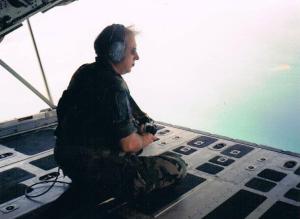
J.C. as we knew him, looking out the back of a C-130 high over somewhere.

J.C. as we knew him, looking out the back of a C-130 high over somewhere.   Photo copyright by and used with permission of the Masura Family.

…who’d been our commander many years earlier when we were all in the same Civil Air Patrol Squadron on what was then McChord Air Force Base.  J.C. had been a loadmaster on C-130’s and C-141’s, back in the day, and up until recently had run an aviation maintenance facility at an airfield near his home.

Of the three of us there in that restaurant after the funeral and reception, there was Aaron.

He told a story of being up on Mount Rainier during his Civil Air Patrol days, trying to put his tent together and it being a tangle of poles and cloth.  He told of J.C. coming over, and being relieved that he’d have help to solve this problem.  J.C. did help.  He said, “Son, if you don’t get this tent up, you’re gonna die. So you’d better figure it out.”

And Aaron did.

The most vivid memory I have of Aaron was when we were trying to ram him through the bushes (<–story) on one of our searches.  This evening, however, he was sitting across the table from me, in a uniform that spoke of honor, valor and courage.  A uniform that spoke of someone who no longer needed to be pushed through bushes, but led people through walls.

As we sat there, reminiscing, and as Heidi kept our water glasses and plates full, Aaron told stories that had us laughing, and shaking our heads in amazement.

He told of coming back from one of many missions to a country in the Middle East, ‘the sandbox’, exhausted to the core, and climbing onto a ubiquitous, anonymous Air Force cargo plane that was to take him home, only to find himself being welcomed onto the plane by a loadmaster with the familiar name of Masura stitched to his uniform.  It seems J.C’s oldest son (we knew him as Jimmy) had followed in his father’s footsteps, and was now a loadmaster himself, with enough stripes on his arm to put the fear of God into even the highest ranking officer.

Aaron, the highly decorated soldier, slept most of the flight home, watched over not by a stranger, but by a friend.

Heidi came by about then to refill our glasses, and it was obvious to her that she was seeing, and was part of, something very special.  It was obvious we hadn’t seen each other in a long time.  Typical of such reunions, she said, was folks from college getting back together.  She was amazed to hear that we hadn’t seen each other since high school, and even more amazed that we’d gotten together at all.

Then there was Bill, who I’d been able to keep in touch with a little more.  I have many memories of Bill, some of which have actually been written down.  One of those involved our Civil Air Patrol Squadron, a regional Drill competition (<–story) in Oregon, and the memories of the looks on people’s faces when they saw us beating them at their own game.

Bill was dressed in a suit jacket and tie for the funeral, had become a world traveler, working as a biologist and traveling to every continent on the planet, and some places that don’t come remotely close to being continents.  Bill told a story about going back to Antarctica, where before they could study the penguins, and the wildlife, one of the first orders of business was getting things habitable, and during that time it was discovered that the ‘facilities’ had been buried in 7 feet of snow since they were last there. By the time they got everything dug out and opened up for use, they discovered several inches of frost on the toilet seat.

No. Really.

All you have to do if your kids complain about a cold toilet seat is show them this one.  "When I was your age..."

It was chilly. (photo copyright and courtesy of William Meyer)

We laughed about the “when I was your age” stories that would grow into: “When I was your age, we didn’t have these fancy things called toilets, we had to dig through 7 feet of snow just to get to a seat with a hole in it.  And it had FROST on it.  And we had to melt that off ourselves…”

“With our Butts.”

Yeah, I can see that…

We’d get post cards from Bill every now and then, telling of his adventures in warmer climates, too.  He told one story – and it wasn’t even a story, but just a vignette, of writing one of his post cards, in this case to his sister, sitting under a tree somewhere in Africa, and writing it by candle light, because it was all he had.  When a scorpion crawled across the postcard as he was writing it, looking for bugs that might have been attracted by the candle, he decided it was time to call it a night.

Heidi came back and checked on us, and the stories continued.

I’d had some of my own adventures – some of which I’ve written about, some not, and we marveled, literally, not just about the various journeys we’d gone on to get to this table, in this restaurant, but the fact that we’d survived them all.  Even though we were there for hours, each one of us had stories that there wasn’t time to share that evening, and each one of us had stories of adventure and danger, as well as growth and promise that we realized would have to wait for another day.

We pondered that, and found ourselves all taking a collective breath. As we did, we realized the restaurant had grown quiet. There was no conversation, no bustling of waiters.  In fact, the only sounds we heard were those of clinking dishes as the staff cleaned up the restaurant, which had closed around us.

We were the last customers in the place, and the doors were locked.

Heidi, bless her, came by one last time, and let us out…

…and stood in the parking lot for another half hour, talking and shivering in the dark, but vowing that we would get together again without someone having to die in order for it to happen.

There were friends who were not able to make it this time, and friends who would not make it, ever.

And it got me thinking…

Why do we wait so long?

One person asked me, “Why is it we wait till we have nothing but weddings and funerals to get together?”

Why do we often just get stuck in our little ruts and miss out on some of the cool stuff of life, like sharing stories and laughing, and – why does it take something *more* special than just getting together to get us to get together? (yeah, I read that a couple of times myself too before I let it go, but it works…)

I mean – the three of us hadn’t been together in over 3 decades.

Me surrounded by two world travelers, Bill on the left, and Aaron on the right.

Not a week later I had occasion to go to a friend’s birthday party.  I was fighting off a bug and wasn’t feeling too well yet, but for heaven’s sake, it had been years since I’d seen him, so I went.  He’d hit the big 5 decade mark, and wondered the same thing… why do we get stuck in our little ruts?

I know the answer to this – and there’s a story in it, which I’ll tell later, but in a nutshell, it’s because it takes more energy to get out of a rut than it does to fall into one.

Sometimes that energy comes because you see patterns and realize if you don’t change something, the pattern is pretty predictable.  Sometimes the energy comes in the adrenaline fueled by the sudden, tragic realization that nothing lasts forever, and everything, everything comes to an end, whether we want to believe it or not.

So – and I’m realizing I’ve been ending a lot of stories with this theme: Make sure you let the ones you love know that while you can.

Hug your husband/wife.

Hug your kids.

Hug your parents.  Even if it’s a verbal hug, with a phone call, card, or email.

Just do it.

A friend wrote recently that he’d found out another friend had passed away, and somehow 10 years had slipped by since they’d talked.  You never know when your last words with someone will indeed be your last words with someone.

Sometimes a telephone call will reopen doors to old friendships.  Sometimes you’ll find those doors have closed and it’s time to move on.  That might hurt, but regardless the door’s position, at least you’ll know, and you’ll be able to open or close it yourself.  And you’ll actually have a chance to know what those last words with someone will be. Make sure they’re good ones.

In the end, what changed is that I did just that.

I picked up the phone and checked up on some old friends and kept in touch with them more.  I found some doors opened wide again, and found some doors closed – I write all this from experience, both joyful and painful.

And I tried, as best I could, when I saw that one of those doors had closed, to make my last words good ones.

So take care of yourselves.  This is the one time we have through this life.

Take care of each other, too.  You never know when you’ll need each other.

Oh, and if you happen to meet a waitress named Heidi, working at the Outback Steakhouse in Puyallup, Washington, who keeps your glasses full and allows you to enjoy your reunion time with your friends, give her a good tip.

She deserves it.

===

Footnotes:

It’s been a year since the events in this story unfolded, and it took this long to think them through, get some perspective, apply some of the lessons I learned,  and be ready to share them with you.  That might make a little more sense now that you’ve read it.

Aaron is still in the Army – he invited us to help celebrate his promotion recently, and we shared more stories, more laughs.  We kept the promise to get together more often, and made more promises to do it again.

Bill and I got together the day after my birthday last year along with another friend, Mark, and have kept in touch more.  He’s doing a little less exploring, but still doesn’t have a “desk” job.  He couldn’t make it to the promotion party because he was strapped into a small airplane, flying around the hinterlands of the country in an airplane, counting Elk.

Jimmy’s still in the Air Force, I saw him at Aaron’s celebration, and they got along like the old friends they are, not with the stuffy formality you might expect of an officer and an enlisted man.  It was fun to see that.

J.C.’s wife – well – widow – hard to write that, but it’s true –  is doing all the things you do when you’ve lost a loved one.  That first year, I can tell you from experience, is a hard one.  I’ve kept in touch with them as I could over the last 12 months, not as much as I’d like, but far more than the previous 30 years or so.

And as time, and the years, go on, I’m realizing more and more that the things that are valuable to me are less and less the things that gather dust, or rust, or whatever.  They’re the relationships I treasure with friends old and new.

Now go out there, and find some treasure. (and then come back and share what you found, you might help other people get out of their ruts with your stories.)

Take care,

Tom


It’s funny what happens when the phone rings in our house.  There are the usual calls from family and friends, the usual telemarketers that get ignored, and the usual wrong numbers. But every now and then we get a call that just has to be remembered.

The other day I got a call from a friend of my dad’s, who had worked with him in the Air Force over half a century ago. He told me a story from his youth that had stuck with him all these years, and – well…

…fade back with me

… to a long time ago, in a country far, far away, where a shepherd had members of his village both enthralled and in disbelief at how he had fought off two fire breathing beasts who had been attacking his flock of sheep.  The beasts were bigger that he was, stronger than he was, and much, much faster than he was.

The beasts were metal, he said, and attacked over and over, terrifying the sheep, scattering them all across the meadow on the mountainside they were on.

And yet he fought them off.

And won.

And they never, ever bothered his sheep again.

Some people doubted him, but he stuck with his story, resolute in his claim that he was telling the truth.

But there is more to this tale.

See the job of being a shepherd is one of those jobs that is necessary, requires wisdom, bravery, and an understanding of a particularly unpredictable type of animal.  But given those parameters, it hasn’t changed much in millennia.  In fact, there are stories in the Bible about sheep, and shepherds, dating back thousands of years.  The Christmas Story very clearly involves shepherds, get this, “Keeping watch over their flocks, by night”.  It means the only thing predictable about the sheep was that they would get into trouble.  The only thing unpredictable was what kind of trouble that might be.  Given that, even at night the sheep couldn’t even be left alone without being protected or watched.  The Bible doesn’t say whether the shepherds were protecting the sheep from poachers (likely) or predators (also likely) or their own stupidity (no, really).  It should be simple, right? You keep the sheep happy, you keep the sheep where they can have food and water, you keep them out of danger, and keep the predators away from them.

And that should be it, right?

Well, to quote the author Gary Paulsen (in his book Haymeadow)

Things just happen to sheep. I don’t know why it is, but if you have 15 horses, 20 cows and one sheep standing on a hill and a thunderstorm comes, lightning will hit the sheep. Every time.”

And in this case, the lightning came in the form of…

…well, again, let’s step back a bit, no, not just a bit, let’s travel, you and I, to a place completely foreign to the world of the mountain meadow.

There is no grass in this world.

There are no trees in this world.

There aren’t even parts of any sheep in this world, other than the wool that had been used to make the uniforms being worn in what was known as the ready room of a military airbase.

Those uniforms, when cared for, made young men look sharp, and two of the best of the bunch were very, very proud to wear them.

I’m sure you’ve heard the phrase, “Clothes make the man” – and at some level, they do. The right clothes can make a young man look far more mature than one might expect, and in this case, when the two young men in question were barely out of their teens at 24, if you took the uniforms away, you’d have two young men who looked very much like they could be seen playing volleyball on a beach, or out for an evening with a lovely lady on each arm, without a care in the world.

This time, in a young man’s life, is a strange combination of development, with the body in almost peak condition, but not all of the brain has caught up with that peak condition of the body… See, the frontal lobe of the brain, the one dealing with responsibility and mature thinking, acknowledging the consequences of one’s actions and the like, especially for boys growing into young men, that’s just not all there yet.

And yes, it is safe to make the assumption that this plays into the story.

See, this is the time when a young man often somehow manages to put a lot of money either making or buying a car or motorcycle far more powerful than he has any right to be driving, but these young men weren’t recklessly riding motorcycles with 50 horsepower or driving cars with 200.  No, these young men had been trained by the military to fly the F-100 Super Sabre, which had two fully afterburning turbojet engines powerful enough to push the plane past the speed of sound.

That meant if the plane were flying at you,  you’d have no warning that it was coming, because it was flying faster than the sound it was making.  When it flew past, all the noise it had been making would show up in an instant in a sonic boom, and then you might hear it roar off, and that would be that.

So, the military could teach them how to fly, but only time (and experience) would teach them how to fly wisely.

Let’s go back to the ready room, where we join those on active duty, and those working maintenance, but who couldn’t do anything till the planes came back, all chatting, playing board games or cards, or studying maintenance manuals to help them understand the complex machines they would be repairing.  In one corner, an old refrigerator grumbled as it kept drinks cool.  The sound of the games and laughter going on inside was accompanied by a bass line of activity outside.  Turboprops rumbled and turbojets whined as planes taxied to the end of the runway, and roared as they accelerated planes to takeoff speed and onto their missions.  And, as was the custom, one man in the ready room had a hand held radio tuned to the tower frequency, just in case a pilot radioed something like this:

“EMERGENCY! We need to get in, losing hydraulic fluid!”

Emergency?

EMERGENCY?!

Chairs, cards, and manuals scattered across the floor as everyone rushed outside to see what they could do.  Of course, there were procedures for this… They’d been practicing them for months, but this time it was clearly for real.  The tide of humanity rushed back in through the one door.  Manuals were pulled off shelves, checklists were consulted, and all aircraft not declaring the emergency were cleared from the area.  All  had to land at other airports, some barely had enough fuel to get there, but an emergency was an emergency, and at the risk of creating another possible emergency, the pattern had to be clear for the one they were sure about.

Eventually, those in the tower with binoculars looked downwind and saw two planes, one rock steady, and another one clearly struggling to keep the pointy end forward and wings level.

By this time, all other airborne aircraft had been redirected and the runways and approach patterns were clear.  The fire engines were already growling their way out to their appointed positions near the runway in case they were needed.  There were still 75 fighters parked in rows outside that there wasn’t time to move out of the way, but both planes managed to make a safe landing, and they taxied to the flight line, shutting down without incident.

The pilots climbed out, and both of them gathered around the crippled plane. One kneeled down and saw a huge dent, then a gaping hole in the bottom of the fuselage, leading to the main hydraulic pump where the lines and pump itself were mangled.  They knew what had happened, the question now was explaining it.  As they were trying to figure that out, standing there looking at the growing puddle of the last of the hydraulic fluid, the squadron commander, a, dignified man, his maturity showing in his bearing, his spotless uniform, and the graying of closely cropped hair at his temples,  came out to find out what the nature of the emergency was.

Understand, that to get to his position in that country, and in the military in general, he had to have some experience in letting people know what kind of behavior was acceptable and what was not.  He also had to have some experience getting his thoughts across succinctly, with very little room for interpretation.  He took one look at the plane, which, despite the fact that they were not at war with anyone, looked like it had been hit by anti-aircraft fire.  As commander of the squadron, this plane was his responsibility.  Any damage to it would be expensive, both financially and in the terms of someone’s career.  The consequences of those thoughts came out succinctly, and with little room for interpretation.

“What? Am I going mad? What happened to the plane?”

The two young pilots looked at each other, and clearly had to explain something.  The only question was how.  The looks on their faces were the looks of young boys with their hands caught in the world’s biggest cookie jar.  One of them cautiously tried to explain:

“We… we were intercepted.”

The look the commander gave them could have easily blistered paint.

“You were what? Intercepted? By whom? The Enemy? Where were you? Who intercepted you?”

The other pilot, before he could think of something that sounded more sane, blurted out, “The shepherd.”

“The what? You were intercepted by a shepherd?”

There followed a long diatribe about the logic of a supersonic jet fighter being intercepted by an old shepherd who was supposed to be watching a flock of clearly subsonic sheep.

Slowly but surely the story came out.

It seems that inside the uniforms of those two first lieutenants were indeed two 24 year old kids, who might otherwise be driving fast cars and chasing pretty girls.

Instead, they were flying fast planes and chasing thousands of sheep.

They’d seen them on the way back from a mission, and decided to have a little fun, so they dove down on the sheep, pulling up at the last second, low enough to singe the wool on the sheep that hadn’t scattered, and then they lit their afterburners to accelerate and climb, leaving their own thunder to fade as the sound and smell of scattered, panicked, and smoldering sheep spread all over the hillside. Time after time they climbed to altitude, then dove on the sheep, laughing behind their oxygen masks,

Eventually, the shepherd, neither he nor his sheepdogs able to defend against this kind of attack, in an act of desperation and pure defiance, waited until the plane came again, and heaved the biggest rock he could find up at it.

The Super Sabre, flying over 400 mph as it buzzed the sheep, flew directly into the rock just as it was pulling up, and the rock took out enough of the hydraulic system to immediately cause a Christmas tree of warning lights to flash brightly on the instrument panel.  There were clearly some serious, immediate problems, and being that close to the ground was not the place to be with problems, so they climbed up for as much altitude as they could get and headed back to base, declaring their emergency to anyone who would listen.

The pilots were reprimanded, and were given quite a bit of time in the brig on base to allow the frontal lobes of their brains to be realigned with reality so they would understand the consequences of their actions. The cost of all those planes that had been diverted, the crew and staff who ended up at bases not their own, all the fuel that had been burned getting them there, passengers who had missed connections, meetings, and flights, cargo that hadn’t been delivered, plus the cost of the repair, refit, and testing of the airplane, which was a figure far more than the two pilots made in a decade, much less a year, slowly sunk in over the weeks and months.

But the plane was repaired and flew again.

The pilots eventually learned their lessons and flew again.

The shepherd and the sheep, on the other hand, were all but forgotten.

And that bit – that little bit about the shepherd – got me thinking.

See, one of the things I’ve learned over the years takes me back to one of those first things I mentioned about shepherds.    For the most part, the sheep are unaware of them, unless or until they’re needed, like when there’s danger, or when there’s trouble.

Then the sheep are very aware.

Kind of like us.

I found myself thinking back to the Christmas Story – where the shepherds were watching their flocks – who should have been sleeping – but the sheep were so valuable that the owner felt they were worth protecting, so he made sure there was someone watching them, protecting them, guarding them, 24/7.  And understand, just because the shepherds were out there with what looked like a peaceful postcard image doesn’t mean they were weak.

Oh no, not at all…

The shepherds were there to protect the sheep, because sometimes, the sheep needed to be protected from predators.

Kind of like us.

The shepherds were there to protect the sheep, because sometimes, the sheep got themselves into trouble and had to be searched for and found.

Kind of like us.

And sometimes, like us, they had to be protected from themselves.

Hmmm…

Kind of like us…

Day or night.

I thought some more…

If we’re not careful and either wander out of sight of the Shepherd, or get so involved in our own lives and our own pursuits that we lose sight of the Shepherd who protects us from fire breathing beasts, we do run the risk of being burned by those flames.

It makes me thankful for that Shepherd we have, the One who protects us when we don’t even know it…

For that matter, especially when we don’t know it.

It gave me a far greater understanding, and respect, for shepherds, and for our Shepherd.

===

And I found my thoughts drifting back to a small village in a country, far, far away, where now live the grandchildren of a shepherd who was revered by the villagers for a story he told, how he fought off two enemies much bigger, much stronger, and much, much faster than he was.

With nothing more than a rock.

And I realize that on many levels, it’s a true story.

© 2013 Tom Roush, all rights reserved


We were in Eastern Washington a few weeks ago, and brought home a couple of boxes of the world famous Washington State Apples.  It got me thinking about all the wonderful things you can do with apples.  You know, apple sauce, apple pie, my favorite apple crisp, or just simply baked apples.

You don’t need anything special to bake apples, You can bake them in a dutch oven over a fire, or in a regular oven, or like my sister did a while back, in a microwave.  She cored them, put raisins and brown sugar in the hole, then nuked them in the microwave for a few minutes.  The smell was absolutely divine, the kind of smell you want to come home to – and the smell would make even the rattiest shack feel like home, no matter where it was.  I found myself pondering, and realized my mind had drifted off to a story my dad told about another box of apples and a baked apple recipe that had some rather special requirements.

You see – well, let me take you back to the late 1950’s or so…

Dad was in the Air Force, and worked in Crypto, that is, codes for the first few years there.  The Air Force had trained him, and then sent him to where codes would be used, a lot.  Now given that this was during the Cold War, the hot place to be code-wise was actually a very cold place to be geographically, and that was as near as possible to the transmitters where the codes were being transmitted from. That place was from what was then the Soviet Union.

The closest thing the US had to those transmitters were some of what were the most inhospitable hunks of real estate on the planet, that being a part of Alaska known as the Aleutian Island chain.  The hunk of real estate dad was stationed on was an island almost at the west end of the Aleutians.

The messages that dad intercepted were often encoded and then sent by machine.  Dad would sit there, with a headset plugged into a receiver, and transcribe these messages that were sent out in Morse Code on an old manual typewriter.  Understand, he might be able to decode what the coded messages said, but not what they meant, and it was often someone else’s job to decode that level of it, so dad would sit there with his eyes closed, and type out into letters the short and long beeps he heard in his headsets. It got to the point where he’d learned the code so deeply that that part of his brain was essentially on autopilot (this would come into play over 40 years later – in a story yet to be written).  His fingers were typing out the letters, while his brain was thinking about something else, anything else, for that matter, anywhere else, as the Aleutian Islands were about as far as you could get from the “Lower 48” of the United States and still be in the country.  For those of you who don’t know anything about them, a short history lesson:

The Aleutian Islands came as a package deal with Alaska when the US Secretary of State William H. Seward bought it from the Russian Government in 1867 for a little more than $7.2 million, or about 2 cents an acre.  There were some who thought that was a touch expensive for the land once they saw it.  In fact, there were some who thought the land was so remote that it would be too expensive even if it were a straight-out gift.

However, Alaska proved its value in the gold rush of 1896, and the Aleutians were also considered valuable strategically – even as far from anything as they were.  I mean seriously, the Aleutian chain goes out west so far that you can see tomorrow from the end.  In all reality, today should be tomorrow in the middle of them, but the International Date Line zigzags around them so they can all at least be on the same calendar day as the rest of the United States.  Not only that, some of the islands of Alaska are so far west, and thus so close to Russia that you can see it from there.

No, really.

They were fought over by the US and the Japanese during WWII, and there have been persistent rumors that some of the islands had a few visitors from Russia during the Cold War.

It’s hard to grasp how far away Shemya is from – oh – anywhere, but one fellow stationed there put it into perspective.  See, using the common denominator of a McDonalds as a sign of how close or far you are from what we consider “civilization”,  in the lower 48 states (that is, the continental United States) it is physically impossible to be farther than 115 miles from a McDonalds restaurant.  But there’s a sign on the east end of Shemya that makes it very clear that a Big Mac is not in your immediate future.  At that point, you’re 1500 miles from the nearest McDonalds.

If that doesn’t put it into perspective, let’s try this: If you were in Seattle, would you drive to Des Moines, Iowa, for a Big Mac? That’s the distance…

That’s how far out there Shemya is.
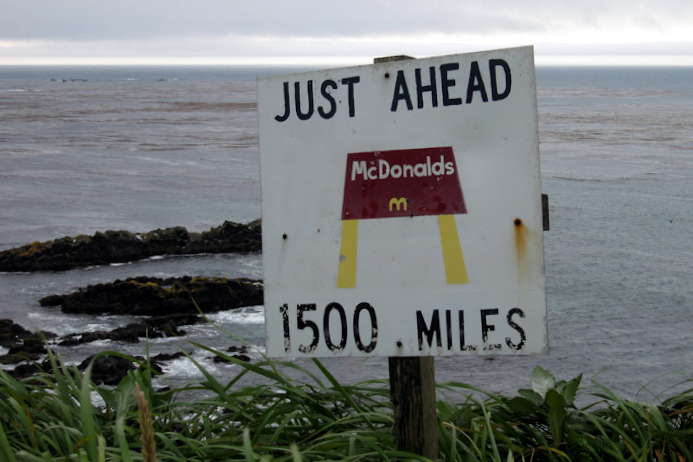
A Big Mac was not in your near future.

On the East end of Shemya is a reminder of how far from Civilization you really are.
(Photo courtesy of and © Lucas Payne Photography, used with permission)

So because of this remoteness, and because supplies had to be shipped thousands of miles across the North Pacific, they had to be ordered months in advance of their planned use, and given the quantities needed and the difficulties in delivering them (due to both distance and the often inhospitable weather), they were brought in infrequently by barges in loads that included up to a six month supply of everything from food and fuel to paint and paperclips.

One barge bringing in fuel was grounded in bad weather and was simply left there. The fuel was pumped out, and over the years, what remained of the barge was cut up; the usable pieces were cut away to be used for repairs that required hunks of steel. The old adage of “Use it up, wear it out, make it do or do without” was very much a part of life on the Aleutians at that time, and soldiers, sailors, and airmen learned to make do with what they had, even if it showed up as steel in the form of a grounded barge.

What they had back then were either the bare basics, and sometimes even those were hard to come by, or an astonishing amount of stuff worn out from use or weather left over from World War II that was cheaper to leave there than it was to take back to the lower 48.

Early on, heat was a challenge (namely because there wasn’t any). And solving the heat problem created new, different problems. The preservation of food, which had been easy in the lower temperatures, became difficult when the heat (in the form of oil burning stoves) was on. The food couldn’t just be left outside.  While that would have kept it cool, the wildlife would have considered it a buffet, and given the barge schedule, feeding the animals wasn’t something anyone could afford.  Another solution was needed, so, with nothing but time on their hands when they weren’t working, the guys who wanted cold sodas or beers went back to the way some of their parents had solved problems like this without electricity–they nailed the crates some of their supplies had come in to the sides of buildings with the open ends facing into the windows, built supports under them so they’d stay, and went inside.  They opened the windows inside the heated building, and–voila!–their own little crate refrigerators. (Modern versions of these persisted even into the ‘70’s)

The heat that was welcomed by humans created another problem.  It was also welcomed by some of the local wildlife:

Rats.

They got into everything, chewing through walls and getting into supplies.  Some, searching for warmth, even got in bed with some of the soldiers stationed there.

They had to be dealt with.

And when you get a bunch of bored young men out in the middle of nowhere together with a problem to solve, they can often get pretty creative in solving those problems. Remember how infrequently supplies were delivered?  That went for any kind of entertainment at the time as well, which explains how early on, before things got too civilized, one intrepid group of soldiers developed their own way of dealing with the rats. They decided that, instead of killing them outright, they’d have some fun with them, so when the rats chewed holes into the buildings and popped their heads up, looking for either heat or food, they got sprayed with varying colors of spray paint that had come up with the supplies. Each guy got a different color, and then the group took bets on whose rat would show up next.  The image of a group of bored soldiers on one side of an oil stove, facing off with a rainbow of rats on the other, is hard to get out of my mind…

Over time, as more and more equipment was brought out, the various outposts in the Aleutians became more ‘civilized’ – but there was no letup on the fact that you were far from home.

By the time my Dad got up there, buildings were made of brick and cement and were definitely built to handle the weather and climate. He spent a little bit of time on an island called Adak (where the rainbow of rats were), but spent most of his time further west, on an island called Shemya.  And out there, the weather was routinely so bad that the standard issue wind sock had worn out and had been replaced with a far more durable one.
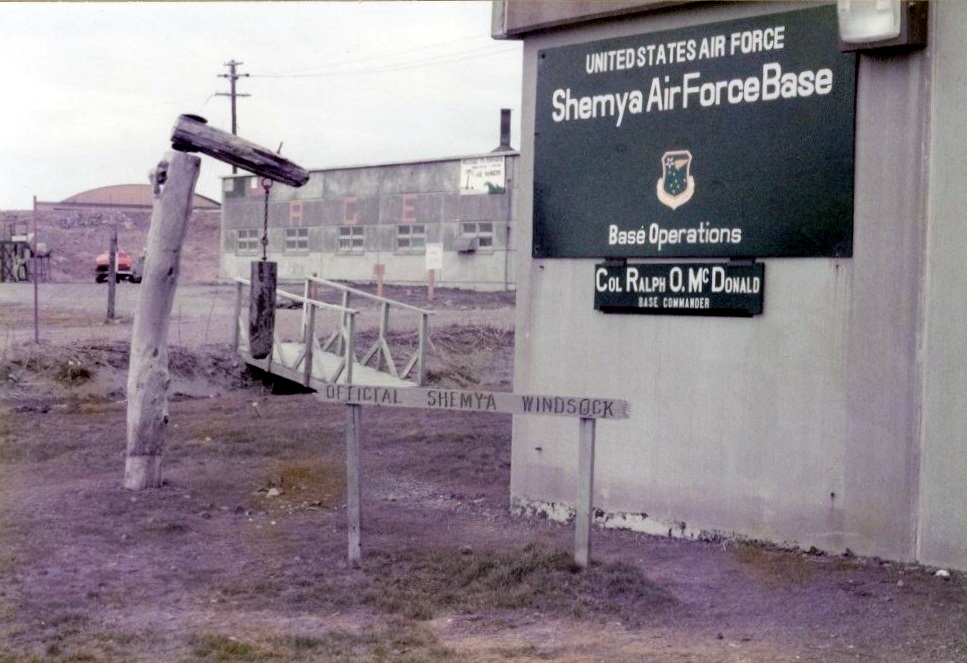
USAF Wind Sock, Shemya, Heavy Duty, One Each

USAF Wind Sock, Shemya, Heavy Duty, One Each
(click to enlarge) Photo courtesy of and © Buck Woody , used with permission

The reason dad was out there was because out there was some of the most advanced and powerful electronic equipment of its time. Not only were there electronic listening posts (receivers), but there were electronic transmitters, and on Shemya, there was a radar unit.

This radar unit was huge.

There were several there over the years, but one in particular held some fascination for my dad and his compatriots.  It was the radar known as the AN/FPS-17 – at the time it was among the most powerful radars in the world.

Now because of all the tremendously expensive electronics that were out there, the buildings and control rooms they were in had to be dry.  In fact, the various buildings were heated by a combination of all the electronics that were in them, the huge oil burning heaters that were running constantly, or both.  So as cool and damp as the air was on the outside of the buildings, it was warm and dry, although a bit stuffy, on the inside, since they recirculated the air they’d warmed up.

So if it’s not clear yet, because of the remoteness of the location, the complexity of resupply, and the incredibly unpredictable weather, they were very conservative with their supplies, trying hard not to waste anything, and given that weather, the radar unit took several years to build, so remember that they only had what had been brought up on the latest barge.

If, for example, one of them got a hankering for a hamburger, and there wasn’t any beef on the island, there wouldn’t be any burgers in the buns.

If, on a cold day, one of them wanted a mug of hot chocolate, and it was stuck on the barge that was waiting for the weather to clear, well, he went without the hot chocolate.

And if there were times when the desire for something as simple as hot chocolate was almost palpable, and you just wanted something warm…

…like when the fog was so thick you’d need a chainsaw to get through it.

…or when the mist was so heavy you needed to lift it with jacks just to walk under it.

…or when the cold was so bone chilling that the fact that you were out in the middle of nowhere was overpowering, and as much as you might have just wanted something simple from home back then, if it wasn’t on the island, you weren’t getting it unless months before, someone had thought to put whatever that was onto a barge to be shipped up to Shemya for the once or twice yearly resupply missions.

So… whether you liked it or not, the options were pretty limited, and you made do.

But the longing for something familiar, the homesickness – even though they’d never call it that, would just get to be so overpowering as to be debilitating.  Everyone from the commander all the way down to dad and his fellow airmen realized that keeping morale up was important, that bad morale could be dangerous that far from anywhere, so jumping on any bout of homesickness right away was pretty important all the way around.

The routine there was as simple as it was monotonous: Day after day, dad would do his shift, typing the codes that came into his headphones while his mind was elsewhere.  The headphones dad wore shielded some of the constant hum of the electronics, and the only break from the routine was to go outside, where he’d brave the weather or the fog monster, and he’d go just for a change of scenery.  Later, there was more entertainment and recreation, but while he was up there, he, like all the others before him, had to make do with what he had…

And going outside helped sometimes.

The air was so much fresher than the dry, overheated, electric air inside the control building around the radar and communication processing equipment.  For the most part, you could walk anyplace that wasn’t fenced in.  You could go down to the beaches, or on the north side, to the cliffs.  There were caves to find, of all things, gemstones in.  One of the fellows stationed there found some Jade in one that he made into earrings for his wife.  Another found a walrus tusk on the beach that he gave to his wife.  Both still have them to this day.  So you had a lot of freedom to ‘get away from it all’, as much as you can have on an island, but even outside, if you got close to the radar antenna, you could actually feel the electricity.  In fact, along that note, the instructions had been pretty clear: you stayed out of the radar beam, and as they were testing it, after the thing had been on for a while, it became clear to even the least technical of them that there was one place on the island you didn’t want to be, and that was in front of that radar antenna.

Why?

Well, it was simple things, like the grass on the hillside in front of the radar dying after it was turned on.

And when there was snow everywhere else, there wasn’t snow in front of the radar antenna.

Someone also noticed that seagulls tended to drop dead if they hung around too long in front of the radar antenna.

And with the weather occasionally socking the place in with, sometimes you were stuck inside and couldn’t go out at all, even if all you wanted to do was watch the seagulls.   About that time, the combination of the boredom and the isolation got to one of the fellows.

The almost constant fog, the cold, (it rarely got above 50 degrees, even in August), the wind, even though it brought some of the cleanest air on the planet (that is, when no one was testing Atom bombs in the vicinity) started getting to him. It was just so isolated, and after a number of months of mind numbing work, boredom, and loneliness, the fellow was simply homesick, and mentioned that he had a craving for the one thing that reminded him of home, and that was the smell of baked apples.

The other fellows, my dad included, realizing the beginnings of that homesickness, thought, “Baked apples our friend wants, baked apples we can provide.”  So one fellow took the four wheel drive pickup they had down to the mess hall and got a crate of apples.  The others pondered which of the hot pieces of electronic equipment they could use to warm the apples up on.

And then, as they talked, they looked around and realized what they were standing next to, started putting two and two together, and realized that thousands of miles away, Dr. Percy Spencer, the inventor of the magnetron tube that was used in the huge radars on the island, had melted a candy bar in his pocket just a few years earlier just by standing next to one of the very first ones made. Curious about the candy bar, he tried it again with popcorn.  This time with it not in his pocket, he blew popcorn all over the lab he was working in, and later literally got egg on the face of one of his coworkers as he exploded the very first egg with microwaves.

And then…

Well, no one’s sure anymore who came up with the idea, but given the rudimentary supplies they had available to them (remember, what was up there came on a barge, and not very often, at that…) they started thinking of Dr. Spencer’s invention and realized that he was dealing with an itty bitty magnetron tube that was melting candy bars, popping corn, and blowing up eggs from several inches away.  Dad and his buddies were seeing dead grass, cooked seagulls, and melted snow a half mile away, and without even taking the apple crate out of the truck, they devised a cunning plan to perform some ‘emergency maintenance’ on the radar unit with the dead grass and seagulls in front of it, and it was shut off.

The constant humming that had become background noise completely disappeared. The crackle in the air was gone, and that feeling you get of just being around so much electricity was simply not there.  The huge Fairbanks-Morse diesel generators that had been straining to create the electricity to run this radar were suddenly just loafing.  You could hear the wind whispering through the antennas.  You could hear the seagulls calling.  Over the hill, if the breeze was right, you could just barely hear the ocean, and the walruses and sea lions arguing about whose turn it was to be on that particular hunk of rock.

It was… Peaceful.

For a moment.

And then all that gentle background noise was shattered by the sounds of a rusted out muffler on a four wheel drive Dodge Powerwagon firing up and three guys blasting out along the edge of a cliff in it, out to where the dead grass and seagulls were, where they dropped off the crate of apples, and then hightailed it back to the building that had all the controls and the radiation shielding in it.
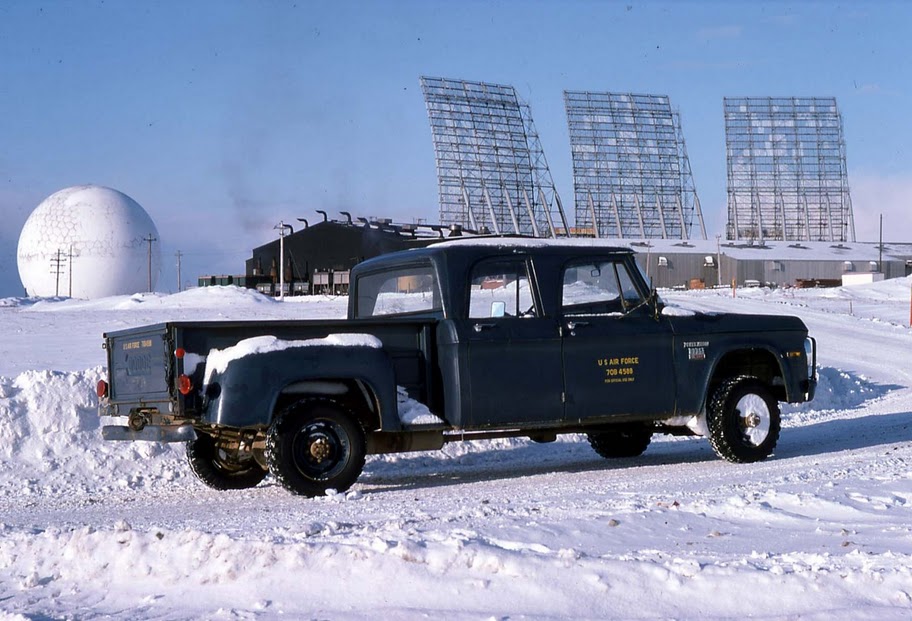
A Dodge Powerwagon, similar to the one mentioned in the story, with the Radar Antenna and the generator building in the background.
(Photo courtesy of and © Don Erdeljac, used with permission)

Once they were all safely away from the radar beam, the switches were thrown, and the generators lugged as they once again struggled to generate the 1.2 megawatts of electricity needed to power up the radar again, and the electrons surged through massive copper wires, tubes, capacitors, and finally the antennas as that crackling hum came back.

About twenty minutes later, they decided that the apples ought to be done, so there was another reason for ‘maintenance’, and once again the four wheel drive truck raced out to pick up the crate of apples.

They were surprised to find the metal parts of the crate were hot.

They were surprised, and delighted that some of the apples had popped and oozed syrupy apple juice all over the ones below.

And they were overjoyed when the apples that done were smelled exactly like baked apples should smell.  They got some gloves off the dashboard where they’d been warming up and loaded the crate into the truck and took it back to the control building, where the homesick friend was trying, with marginal success, to keep his head in his work.  Dad grabbed one end of the crate, another fellow grabbed the other end, and a third one held the door open as they all came piling in.  That smell, that wonderful, sweet, syrupy smell of baked apples came wafting in with them, and at first, their homesick friend thought he was imagining things, but then he looked up, and saw the crate, and smelled the apples, and he smiled, and then he laughed.

They did indeed smell like baked apples should smell.

Not only that, but they tasted just like baked apples should taste.

And dad said he never had any as good as those baked on a windswept hillside on a remote island in the North Pacific, by a radar half a mile away.

===

In researching this story, and it took a couple of years of it, off and on, it became clear to me that not only did my dad use a radar that required enough power to run about 300 homes to bake apples a half mile away, but while most of the radar we think about is designed to find airplanes several miles away, the one that my dad and his buddies were using to cook apples was designed to find missiles…

In space.

===

(And now, seriously, unlike most of my stories, where I do all the research, all the writing, all the editing, so many people helped with the research on this one that I simply have to roll the credits. While my dad told me the original story many years ago, it was missing enough context, likely by design, to keep me from knowing exactly when and where it all was, since the location he’d been in was a pretty secure military installation, and most of what he was doing there was stuff he simply couldn’t talk about. I could not have written it down and made it make sense without the help of all the people below who willingly shared their memories with me, gave me their time, their own stories, and graciously allowed me to use their photographs to help tell this story from over 50 years ago.  I have tried hard to bring this story to life as much as I could while I still had the access to these people and I trust those who were up on Shemya and the Aleutians who shared with me first hand thoughts about what it was like to be there. If there are any inaccuracies in the story, they are mine.)

Don B., whose widow Brenda took time out of her day to listen to questions coming out of the blue about her husband, and then told me the story about the rainbow colored rats on Adak.

Michael: You were the first to point me in the direction of Shemya.  I’d heard stories of Adak, and had been focusing all my attention there – thank you so much for taking a fading memory and pointing me down a path that actually let me see the hillside my dad had talked about.  Until that point, I didn’t even know what island out in the Aleutians to look for.

Tom – Your pictures, your detail, your encouragement all helped get me pointed in the right direction.  Your stories (including your Saab stories) helped bring life to the story I was trying to write, especially when the stories he was telling included references to cooking seagulls that had strayed too long into the beam of the radar. 🙂

Don E. – Many, many thanks for digging through your memories, sharing your stories, your patient explanation of everything, and the use of the photo in this story.

Lucas – This picture of McDonalds Point did such a good job of putting into context how remote Shemya is.  I’m hoping the combination of it for those who were right brained, and the data I was able to get from Von (for the left brained types) helped to make the picture complete. For those of you curious to see some amazing images from up north, take a look at Lucas’s site – there are some wonderful images up there.

Von – Thank you for the willingness to help out with the information showing how far Shemya is from something so ubiquitous that we take it for granted.  I’m hoping our information along with Lucas’s picture above help drive the point home just a bit…

Buck – Thank you for your feedback, your friendship, the photos, and relating your experiences, they made it come alive, and made a very big world feel like a very, very small place.

Barbara – thank you for your input, your thoughts, and all the items and stories on your website.  They helped me see a place I could only see in my imagination.

Of course, my dad, who remembered the story well enough to tell me so I could share it with you.

And last but certainly not least, my family, whose patience as I researched and wrote it over the years can’t be overstated.

Thank you.  I couldn’t have done this one without you.


So this is my 100th story, and it’s not so much a story, as it is a look back on the first 99…

I had no idea I had so many inside me, but they’re here.

For those of you who’ve commented on them and helped me get better at writing through your critiques, thank you.

For those of you who were unwitting characters in some of them, I thank you.

For my sister who created this blog in the first place and felt I needed to get my writing out there, thank you.

For my family who often saw nothing but the back of my laptop as I was writing – I’m working on that – and thank you – really.

And to some very special people who decided I was worth keeping around – thanks for your help in all of that.  You know who you are.

As for the stories – I think the most fun stories for me to write were the ones where you, the reader, figure out whatever punchline was coming, just about the time your eyes hit it.

All of the stories are true.  Some took an astonishing amount of research, ballooned into huge, huge stories, then were often allowed to simmer for some time until I could edit them down to whatever the essence of the story actually was.  I have one unpublished one that has so much research it that it’s ballooned to 12 pages when there’s really only about 3 pages of story in there, but that’s how the writing process is… Find what you need. Distill it down to its very core, then take that and make it better.

I did a little looking through the stories and found some little snippets that made me think – and made me smile as I read through them all.  They’re below – in the order they were published (not the order they were written in), so the subject matter and themes are pretty random, but there was a reason for each one of them.  So, cue the music, and here’s a selection of quotes and thoughts from the stories (with links to the originals) that made me smile, or laugh, or think, or sometimes just cry.

1.       From the story: “Cat Piss and Asphalt

“Pop, is it possible for the memory of something to be better than the event itself?”

This was when my son went to Paris.  In Springtime. And he had memories he needed to share. I listened, and smiled, and I wrote.

2.     I wrote a story about a friend named Georgiana – who taught me so more about writing software code than any book I ever read, any class I ever took, and more than she could possibly have imagined.

3. Then there was the storyHave you ever been in a dangerous situation and had to drive out of it? when I was trying to jack up a car with a flat tire, in a forest fire, next to a burning ravine, on a hill on a one lane road the water tanker trucks were using, “Most of the things that I would have used to brace the car to keep it from rolling were on fire, so that limited my options a bit. “

4. There’s the story I calledPoint and Click – which really isn’t about pointing, or clicking – but is very much about – well, it’s short – you’ll get it – and even if you don’t, that’s okay.  I hope you don’t have to.

“This time, there’s a loud “click” of the hammer slamming down on an empty chamber.”

5. On managing to borrow a car, and within a couple of telephone calls finding myself taking pictures of an F-4 Phantom out of the back of a KC-135 tanker over Missouri.

It had to be harder than this…”

The look on the face of a classmate as I was printing the pictures that evening was absolutely priceless.

6. Then there was the story called Salty Sea Dogs – just one of the weird little things that seems to happen to me when I go out for walks…

“Into this nautical environment walk two characters straight out of central casting for Moby Dick”

7. There was just a little snapshot of a conversation between two people, one of whom really understood what was going on, and the other who didn’t.  And the funny thing is, I’m not sure which one was which.  It’s just something that happened On the Bus…

8. Sometimes stories happen in the blink of an eye – or in the ever so slight smile of a spandex covered cyclist riding past.

9. I wrote about a lesson I learned about plumbing once, (water doesn’t ONLY flow downhill – and it’s not just water)- which my kids still laugh about.

10. There was the story where I wasn’t sure whether my daughter was complimenting me or insulting me – or a little of both, but it made it in here in the story Compliment? Insult? You decide…

11.   And somehow, I managed to get phrases from the movies “The Lion King”, Monty Python’s “Meaning of Life”, and both the old and new Testaments of the Bible into the same story, combining them with a sermon I heard and an attitude from my boss that all ended up in the lesson you can find in the story The view from the Balcony… Forgiveness, Writing in the dirt, and “No Worries”

 12. I learned, and wrote about, buried treasure – and it’s often not buried, and it’s not what you think it might be.

 13. I had a story bouncing around in my head for years before I finally wrote it down, and was astonished when the right brained creative side of me finally let go of it and the logical left brain started analyzing it.  if I’m wrong on the numbers, I’d be happy to have someone prove me wrong, but when you hit a certain set of railroad tracks at a certain speed in a 1967 Saab, you will catch air, and a lot of it.  It was the first of many Saab Stories…

 14. I remember a story that came out of a single sentence.  This one is called, simply, Stalingrad – and is about – well, here’s the quote – it’s: “a story that boils down to six words, but at the same time, could not be told in a hundred lifetimes” – it was also one of the first stories that caused me to cry as I wrote it.  I wasn’t expecting that, and I think it was interesting that people asked me to put “hankie warnings” on the stories I’d written from that one.

 15. That one was hard to write – emotionally, so for the next one – I wanted to have a little fun – and this story, too, came from only a few sentences my dad told me, but it, too, required a surprising amount of research and I figured out the rest, and realized there were three stories inside this one, and I decided I’d try to braid them together in such a way that they came together – ideally, not in just one word, but the same syllable of that one word.  You’ll find that story called “B-52’s, Karma, and Compromises…”.

16. I learned that one person can do something stupid, but if you get a few guys together, even without alcohol, not only does the quantity of the stupidity go up, but the quality is almost distilled to a concentration that you couldn’t make up… in the story Synergistic Stupidity, The Marshmallow Mobile, and the Little Tractor that Could…   I learned that I could help people, I could do something stupid with a friend, then, while trying to figure out how to un-stupidify this thing, watch as several others got involved, ending up in exactly the same spot we’d gotten ourselves into, break the law, ‘borrow’ a tractor, and in the end, put everything back where I found it, and my grampa, whose tractor it was that I’d ‘borrowed’ – didn’t find out about it till years later.  You’ll find that in the story, along with a map of where it happened.  Really.

17. I often learned as I wrote – the story about The Prodigal Father took me back a few thousand years, to standing beside another dad, waiting for his son, and I suddenly understood a whole lot more about what he must have been feeling.

 18. Some stories were just silly.  I mean, Water Skiing in Jeans?

 19. Or Jump Starting Bottle Rockets… ? With Jumper cables attached to a 40 year old car?

Yup… I did that.

20. But it’s not just my generation.  I wrote a story about my mom, who – well, let’s say she has a healthy dislike for snakes.  Not fear, mind you. Dislike.  And when they started getting into the goldfish pond and eating her goldfish – well, she armed herself.  First with a camera to prove it – and then with a pitchfork to dispatch it.  And sure enough, 432 slipped disks later (Thank you Johnny Hart for that quote), that snake was no longer a threat, and mom, bless her, was quite satisfied…

21. I never think of my mom as a feisty little old lady, she’s my mom – but she’s awfully close in age (well, in the same decade) as another feisty little old lady named CleoI never thought I would get airborne trying to take a picture of an 88 year old woman emptying a mop bucket, but I did, and it made for a wonderful story, and a wonderful image.

22. I took a little break from writing actual stories and spent a little time explaining why in the “story” Scalpels, sutures, and staples, oh my… It was a hard “non-story” to write – but it was what was happening that week, and I was a little too busy living life in the moment to be able to write much about something that had happened in the past.

 23. As some of you know, I spent a few years as a photojournalist, and as I was going through some of my old images in a box in the garage one day, I found they were a time machine – taking me back to when I was younger, and when there was so much of life still ahead of me.  I remember sitting across a parking lot from a dad trying to teach his daughter how to rollerskate at Saltwater State Park between Seattle and Tacoma, just knowing she was going to fall, and as I sat there and waited to capture the image as she fell, her dad, unseen behind her, was there waiting to capture her.  I had a little ‘aha’ moment about God right then.  How many times things have looked like they were going the wrong way, and yet, He was in the background, orchestrating stuff to make it right in the end?  (I don’t know the answer to that question, just know it’s worth asking)

 24. Another “Proving Darwin Wrong” moment – as my son says – I was working for the Muskegon Chronicle in Michigan, and these thunderstorms would come in off the lake, and I wanted a lightning picture with a lighthouse in it.  Now I’ll be the first to tell you that it’s not the best lightning shot in the world out there, but there was, shall we say, a flash of inspiration that came rather suddenly as the film was exposed – the only frame, the 28th one (yes, shot on film), in Lightning bolts, metal tripods, and the (just in time) “Aha!” moment…

25. Sometimes the most profound bits of wisdom come from the simplest things.  I was astonished to find out how many people read the story Mowing dandelions at night…” – and what they thought about it.  Some of those comments are on the blog – some were sent directly to me, but they were all fun to read, and to ponder.

26. I am constantly astonished at the amount of wisdom that can come from simple things.  I remember – again – being in the garage, and finding an old, cracked cookie jar – and as I looked at it, and held it gently, I could almost feel the stories it held, and as I started writing – it gave me more and more detail for the stories that I was able to write and share.

27. The next story published was one I actually wrote in 1998, but happened in 1977, and it was then that the phrase, “Really, they don’t shoot on Sundays…” entered into my vocabulary. It was also the story that inspired my son to ask me the question, “How did you get old enough to breed?”

Hearing that from anyone is a little weird.

Hearing that from your own offspring is a little mind bending…

So should you be interested, the story involved a 1973 Pinto station wagon, a hot summer afternoon, some ducks, a cannon shell, and Elvis Presley.

Actually, in that order.

28. I then found myself writing about a cup of coffee, and the friends involved in making it.  I’ve lost touch with Annie – but LaRae is now an amazing photographer, Stevie can still make an incredible cup of coffee, but is making a much better living in the transportation business.

 29. I was trying to write a story a week around this time, and had no idea how much time it would take, and found myself staring at Father’s day on the calendar, and realizing how, as hard as our relationship often was (I think an awful lot of father-son relationships have their rocky moments, and I remembered back to the time I taught both of my kids to ride a bike.  There was this moment, I realized, where you have to let go of the saddle – and as I talked to more and more dads about this, I realized that they all, instinctively held their right hand down by their hip, palm out, fingers curled, as though they were, indeed, Letting go of the saddle….  I have to warn you – this story took a turn toward the end that I wasn’t expecting, and it was very, very hard to finish.  You’ll understand when you get there.  I found this story crossed cultural barriers, age barriers, gender barriers, and I ended up putting a hankie warning on this one as well.

30. I needed a little levity, and a smile after that story (remember, they were coming out once a week, but they were taking more than a week to write – so I had spent quite a bit of time on this one, so I, writing, needed a break, and remembered a song we used to sing when I was growing up – and the dawning horror in my wife’s eyes as she realized what it actually meant. (Think German sense of humor (heard of Grimm’s Fairy Tales?) and leave it at that).

The thing about these stories is they just come.  In fact, they’re all there – all I have to do is listen, and they’ll come…

31. The next story required listening for something that’s very hard to hear, and listening for about 20 years before it all came together.  It ended up being two stories that morphed into one, and started out as a story about old Saabs, and ended up being a story about listening to God in the weirdest places.  At the time, I had no idea that God talked to people in Junkyards, but, it turns out, He does.  He talks to us everywhere – if we’re willing to listen.  I have to say this one’s one of my favorites – it was fun to write, fun to search for the right words, fun to put the little vignettes together (there’s a bit about Harley Davidsons in there that I really like) and it was fun to see it all come together.  I hope you enjoy it – even if you aren’t a fan of old Saabs, or maybe haven’t heard God in a junkyard.  Believe me, I was just as blown away by that as you might expect.  If you end up reading the story – let me know what you think, I’d love to hear your thoughts.

 32. And we go back into the time machine (in the garage, looking suspiciously like an old box of black and white photos) where I found the picture behind the story “Fishing, Gorillas, and Cops with – well, just read on…”  I like the story – love the picture – I think, because it’s just a normal day – nothing special about it except that – well, that it was so normal, and if you’re looking, you can find beauty everywhere, even if it’s an old guy fishing.  (actually not far from where I took that lightning shot a few stories up)

 33. My next story brought me a little closer to home, and my mom had just made some jelly.  I always joked with her that the jars of Jelly were Time Capsules of Love…– and they were.  It was neat to be able to finally write a story about them and what they meant to me.  I even took a picture of one of those jars for the story.

34. I’d broken my leg that spring, and found myself in an amusing, cross cultural situation afterwards – which ended up in the story, “Knocking down walls with an old brown purse…”  I still wonder how the fellow in the story’s doing.  I did print out a copy there and leave it with people who could get it to him.

35. I’d written a few stories about my son, and decided that it was time to write a couple about my daughter – and the wisdom you can learn about yourself and your kids showed up in two stories, one ostensibly about greasy fingerprints (and Infinite Teenage Wisdom ®)

36. …and one about Pizza – and finances, and if you’re not careful in college (or in life), how prioritizing one over the other can affect things in a significant way…

37. I wrote about letting go – something hard to do – but with a smile in the story, and letting go in a location you might not expect.

38. I wrote about Veteran’s day – and memories of my dad, crossed with a scene I’d seen when I was a newspaper photographer years earlier, and I suddenly understood what the family whose privacy and grief I chose not to invade were feeling. There is a lot of pain in that story.  Writing it down finally helped me to let some of it go.

39. And I needed a smile, so I wrote about Fifi…This is one of my favorite stories, in which I simply chatted with folks and talked my way onto the only B-29 in the world, but at the same time, talked the photo editor of a paper I’d never seen into holding space on the front page for me because I was going to get a picture from the plane as I flew to the town where that paper was.  it was an all or nothing thing from both sides, and was truly an incredible experience.  I recently took a training class in “Win Win Negotiations” – and that one was held up as an example of how to do it.

40. There’s a story I wrote about rear view mirrors, and it actually has very little to do with mirrors.

41.   and another I wrote about pouring a cup of coffeewhich, surprisingly, has a lot to do with pouring a cup of coffee.

42. ….and my favorite prank of all, a story about (and yet not about) spinach.

43. My daughter got mad at me for the next one, called “Playing Digital Marco Polo in Seattle…” – which happened over lunch one day. “Why do these things keep happening to you? – I want things like this to happen to me, and they don’t – and yet here you go out for lunch and get… “ and she trailed off, not sure how to finish it.  As it was happening – it had all the drama of a spy thriller – and I wasn’t sure what I’d walked into – but it was fun.

44. By this time it was near Christmas, and we as a family had worked our Boy Scout Troop’s Christmas tree lot for years, and something special happened this time that made both my wife and an old veteran cry.  Tears of joy and gratitude – for having the privilege of being part of something special – but nonetheless tears.  And I wrote…

45. We’d gone to Arizona that spring to tape me doing some presentations, and I realized there was a story that needed to be written about not that, but about a very special thing that happened down at the Pima Air Museum, as well as McChord Air Force Base many years earlier, so I shifted gears to write a story for the “Stupid things that Papa did when he was Little” series, it’s the story called “Can I help you, sir?”

46. There was a sad story about a fellow with hope, on the bus – made me realize that as bad as things were sometimes, they could always get worse, but this fellow wasn’t feeling sorry for himself, he was just taking things one day at a time.  From the story:  “He said he’d take anything for work, but right now there just wasn’t anything.”

47. I pondered electrons, and the monthly “Patch Tuesday” we have at work, and my thoughts wandered from very small things like electrons to the really, really big picture of Who made them., and what it all means.

48. Those of you who’ve been around me for some time have heard me use the term Butthead… and one day I decided to just write the story down about how and why that term came about, and what it means.  (it’s usually a term of endearment, delivered with all the warmth of a cuff upside the head.)

49. At one point, my guardian angels were sharing pager duty, and all their pagers went off when I was miles from anything, no radio station in range, just, for a rare moment, bored out of my mind, crossing North Dakota one year in that old Ford I had.  And I did something to pass the time that apparently set the pagers off. I still wonder, sometimes, how I survived some of these things – or whether they were as crazy as they seem when I write them, or if they were just me paying attention to things other folks just let slide.

50. Often the stories are just from oddities that happen in life.  I never thought a broken TV would make a story – but sure enough, it did.

From the story: “Now Michael, because I have educated him in the ways of complex electronics repair, performed the first task one always does when troubleshooting and/or repairing electronics, which is to smack the living crap out of it.”

51. And then there was the story about my friend Betty…  and I have to tell you, that was one hard, hard thing to write.  It was her eulogy, and it took me a week to recover emotionally from writing it, much less giving it.  I still miss her.

From the story: “I’d come into that room, with that pile of trampled masks outside the door…”

52. I wrote about my son’s and my time in Boy Scouts – with trips to Norwegian Memorial one year and Shi Shi beach the next year.  The places aren’t much more than 15 miles apart, but the experiences were literally night and day.  And after months of pondering I learned that while there was absolute joy in the trip to Norwegian, there was so much more in the way of life lessons from the trip to Shi Shi. They were completely different, but I wouldn’t trade either of them for anything.

The thing about these stories is they’re just out there in the order they come into my mind… Some get finished quickly, some slowly.  Some are written in a couple of minutes – some take decades to live and weeks to write.  Some I don’t even remember myself until I read them again, and at that point, they’re just as fun (or painful) for me to read as they were the very first time…

53. There was the story of Humpty Dumpty in Winter… – (because we all know he had a great fall) – and I think it’s safe to say that that particular story was the epitome of understatement.  It’s just the absolute tip of the iceberg from when I broke my leg.

54. I didn’t write for awhile after that, and when I did, needed something to cheer me up a little, and wrote a story called What Heaven must be like… about an afternoon that was both planned and spontaneous, and I did something that I had never done before.  I met new friends, I saw a smile from my son I wish I’d actually caught (there’s a picture in the story *after* he stopped smiling – I was trying to hold the camera steady while we were still coasting toward him at a good clip and missed how big that wonderful smile actually was.  That story is very much in my top ten favorites – assuming I have a list like that…

55. And then… for a little fun, I wrote a story that was a combination “Saab Story” and a date with a young lass who shall remain nameless, but who – well, here’s the title: Old Saabs, Big puddles, and Bad dates. You’ll figure it out.

56. Not long after that, my friend Beth wanted me to go out and do something fun, and take pictures to prove it.  It was also a time when my friend Greg wondered out loud whether I embellished my stories.  I’d heard that question before, and given how weird some of the stories are, I understood the reason behind it.  I told him no, I didn’t embellish them, and then, to Greg’s incredible shock, he walked right into one of the stories with me, literally as it happened.  The look on his face when he realized what was happening is something that will live on with me for a long time.  He insisted I write it down, and that I could most definitely put his name in it, so here it is… There were three main parts to the story – and they all made it into the title: Blackbirds, Blue Saabs, and Green Porta Potties

57.   Some of my stories are what I guess you’d call a ‘profile’ of a person – and in this next case, it was of a fellow who was a stranger, was assigned to be my officemate, became a friend,  I followed him to another company where he became my boss, and as we grew older and professionally went our separate ways, we still remained friends, and I still have a lot of fondness for the memory of that first meeting of my friend Jae…

58. Then there was the time when my mom used a phrase I’d never, ever heard her use – and I’d only heard used one other time in my life.  But that time had a story wrapped around it so tight that you couldn’t hear the words without going into the story.  And, as is often the case, the story spans a couple of generations, some youthful stupidity, global warming, and how difficult it can be to keep a straight face when being asked a simple question… You’ll find all that in An “Inconvenient Truth” – and how important asking the right questions is.

59. I went back several years on the next story, which was called, simply, Bathtime…  I didn’t realize how – much that little activity with your kid could change your life, but it does, and the story still brings a smile.  (yes, there are pictures, but no, they weren’t included in the story, for reasons that will become obvious as you read it)

60. I did quite a bit of thinking as I wrote Dirty Fingernails, Paint Covered Overalls, and True Friends – and liked the way it came out.  Life lessons that took a number of years to happen actually came together in an ‘aha’ moment as I was writing this story – and it just made me smile.  I opened up a bit more in this one than I had in others, I thought, but it was all true.  I found myself happy with the result.

61. Amazing Grace simmered in my brain for several years before I felt it was ready.  It was one that happened as it’s described in the story – but I spent quite a bit of time trying to be absolutely sure the images described in the story were written correctly so that whoever read it could not only see them, but feel them.  It was an experience, on so many levels, physical, emotional, spiritual.  I hope that feeling comes through.  Let me know how it affects you.

62. I changed pace completely with the next story.  Shock and Awwwwww… took place in the lobby of Building 25 on Microsoft’s main campus.  It’s the classic story of “Boy Meets Girl” but there’s a twist… it’s not just a Boy… It’s a Nerd.  And it’s not just a Girl, but a drop dead gorgeous girl in the eyes of said Nerd.  Everything is going fine until the paperclip enters the picture, and then sparks literally fly.

63. Over the years I’ve found that chocolate has totally different effects on men than it does on women.  I mean, if it’s chocolate from Germany, or Switzerland (both are kinds I had when I grew up) then it’s okay.  Other than that, I generally don’t go out of my way to find it.  I don’t have a reverence for it like you see in some ads, and simply didn’t understand the whole “oh, it’s so WONDERFUL” idea one mother’s day weekend when we went to Cannon Beach in Oregon – and there, I learned that strange things happen when you put Men, Women, Cannon Beach, and Chocolate in the same story.

64. And then I had a week in which – well, I couldn’t quite write a story.

65. There was so much going on, a little fun  – but then so much teetering at the edge of life and death thing that it was hard to think of something fun or funny to write about. Life was happening, and I needed to deal with it.  I didn’t realize how personal this would become in the next little bit. I was hoping to write a story about graduation for the young people I knew who were graduating, but a lot of the echoes of what had recently happened to me followed in the next few posts,

 66. And I wrote a story about Graduation, dodging bullets, and other life lessons… that seemed to encompass all I needed to say, plus telling the young graduates something that might help them along their way.

 67. And then, of course, there was the 4th of July – a holiday that carries with it many memories that would have my son convinced that Darwin was completely wrong.  In this case, the story was about Rockets, Styrofoam airplanes, the Fourth of July, and Jimi

68. And an example of how some stories come from the weirdest places – all I can do is point you to this one: TEOTWAWKI* (if you’re an arachnid) – so if you’re a spider, you might not want to read this one.

69.   And then, in a story about an event my mom found out about literally as she read my story about it, and, as she told me, had her heart beating a little because she didn’t remember it and wasn’t quite sure of the outcome.  Again, proving Darwin wrong, we have what happens when you Take one teenager, add horsepower, and get…  It’s entirely possible that that’s when my Guardian Angels were issued their first pagers.

70. After that, I found a couple of stories I’d asked my dad to write.  He’d written four of them on the computer and printed them out – just before the computer was stolen.  I wrote a ‘wrapper’ around the stories to put them in context, but otherwise, they are exactly as written.  I did that with three of his stories, and they are One act of kindness that’s lasted more than a lifetime,

71.   Puff balls and Pastries  – in which – well, a little mishap caused a problem that had some surprising consequences.

72. …and Some things matter, and some things don’t.  I was truly stunned at the world he was describing in this one, in large part because there was something in it that was considered by the people of that time and place to be “normal”.  I often wonder about his friend there, what happened to him.

73. By this time it was summer – and it was time for the kids to visit the grandparents back east, and it got me thinking about that time many years ago when I had to do some Rat sitting while they were gone, so I wrote about that one, and smiled at the memory.

74.   And then, a story that had been in my head for years, and I think by far the most read story on the blog, and it was a simple story about Tractors, Old Cars, and a Farmer named Harry

I checked with his family first, having a long conversation with his son before I published this, and got their approval. I heard from his friends, I heard from people who didn’t know him, and because of the story, felt they did or wished they had. I had no idea what an impact a story like that could make – but it clearly did, and I felt it was – and had been – a privilege to know Harry and his family.

75. The next story took place in church – where often children are supposed to be quiet – but one child made her presence known in a totally different way in

Thump.  Thump… ThumpThumpThumpThump!

76. Writing the story about Harry made me think of Grad School, and I found myself humming the song “Try to remember the kind of September…” and wrote a story around that – my first couple of days in Athens Ohio – what a cultural shift it was, and simultaneously, what a neat and terrifying experience it was to do this (go 2500 miles from home, to a place where you knew no one, and see how much of a success you can make of yourself…)

77. That got me reminiscing a bit, and the next story was from when I was about 12, when I spent part of a summer Haying, growing up, and learning to drive a clutch…   It was a fun summer – and both trucks, the ’66 Dodge and the ’54 Ford, the truck that could pull the curves in the Nisqually River straight in the story still exist.  They were sold to a neighbor who still uses both of them.  And my uncle’s back has completely healed.

78. “The only thing missing was an old Jeep and mugs of bad Army coffee.”  I found myself thinking about how God reaches for us in some of the strangest places – and remembered thinking this as we were walking back from a Civil Air Patrol Search.   It was our first real search instead of a practice one – and we were quite excited about actually being able to put our training to use… The combination of all of those things brought me to the story God, Searches, and ramming Aaron through the bushes

79.   Lest anyone think I’m so incredible (you should know better) that God talks to me like He talked to Moses – there was a little story about – well, it fell squarely into the middle of the “Stupid things that Papa did when he was Little” series.  I learned a lot about keeping the fire (and, come to think of it… starting the fire) in the stove.

80. If you’ve been reading the stories, you might remember that I took a trip down memory lane – on the Autobahn, to Munich, at 110 mph, in the story Octoberfests, Museums, and Bavarian Waitressess – it combined almost getting kicked out of one museum, getting locked out of a second, and trying to drown our sorrows in a very famous place, Munich’s Hofbräuhaus.  …and – I wonder if the waitress (in the story) is still there… Whether she is or not, she made a memory that’s lasted over 30 years…

81. Taking risks…

“…there was nothing but air between me and the roof about 30 feet below, and had I slipped, I would have rolled down, then off the roof and fallen another 40 feet or so before becoming one with the pavement” Yeah, there’s a story that wouldn’t have happened if the scaffolding hadn’t held, if the receptionist hadn’t called the janitor, or if, simply, I hadn’t thought to ask if I could climb out on the roof of the courthouse to get a closer shot of the construction going on.  Sometimes, to get what you want, you have to be bold, step out of your comfort zone, and ask for EXACTLY what you want.  You’ll be astonished at how often you’ll actually get it.  And sometimes, you might even have proof that you asked…

82. We go from the top of the courthouse to sitting in the shade on Mr. Carr’s front stoop.  And I never thought that I would (or could) write a story about a sandwich, but this one was worth writing about.  I still remember how cool that water was, how moist the – oh, I’d better stop, pretty soon you’ll want your own Mr. Carr’s Sandwich

83. A story about my friend Jill – including the only picture I was ever able to take of her, as well as the line, “WHAT have you DONE to my CAR?” – said in a way you might not expect.

84. The story behind my son’s famous quote, “Sometimes, things go wrong…” There’s a lesson there that we could all learn a lot from.

85. In the story A tale of Three Christmas Trees, and a little bit more… you’ll find the line,

“In fact, it’s safe to say, that in that year, God did not have Christmas trees falling out of the sky for us.  Well, actually… I take that back.  He did.”

And it’s true.  But there’s much more to that story, involving things like how much character you get from being poor – and learning to not take things for granted, and making things on your own.  All amazing stuff in and of itself, but together, wow.

86. Every now and then, a dream will show a startling reality in a way that simply can’t be explained in words.  It was new year’s day – and I wrote of a dream I’d had – and the lesson in it in A New Year’s thought, of flashlights, warm hands, and a wish…

87. …and then – a story that had happened a decade earlier finally made it into print, and I wrote about Meeting Howard Carter in the back of the Garage… If you don’t know who Howard Carter is – read the story – you’ll find out.  There are links to him there – but what’s interesting is the story has very little to do with Howard Carter, and much more to do with a dishwasher, and a ‘70’s era Plymouth that was big enough to put a small village in the trunk of.

88. Michael and I, in dire need of a break from everything, hit the road in the story Road Trip! (and Mermaids… and the Gates of Mordor) – and crammed just about as much as we could cram into one 24 hour period as we could, in two states.  We combined Horses (a couple of brown ones and a mustang), and music, and too many spices, and old, fun music, and theatre, and sports, and an excellent impression of the Four Yorkshiremen, and it all melted into one afternoon/evening/morning/next afternoon that was a tremendous amount of fun.

89. Even as this next one was happening, and I was smelling a truckload of gasoline in a place I’d never thought I’d smell it, and blocking traffic in the last place I wanted to block traffic,  I found myself wondering if this was going to make it into a story.  It did.  It’s here: Caffeine, Clean Engines, and Things that go Whoomp in the Night…

90. If you remember the story about “Transmissions from God”, you know that occasionally I hear God’s still, small voice telling me to do something.  Sometimes I hear Him in a junk yard, sometimes I hear him  in the balcony at church, and sometimes in Safeway parking lots in Ballard.

91. If you’re keeping track, this next story, in the order they were written, was Norwegian… – though it happened a year before the Shi Shi Beach story.  It ranks as one of the top camping trips I’ve ever been on.

92. And this next story was literally a dream.  If you’ve gotten this far, you know that occasionally I’ll remember one, and for whatever reason it will have something significant in it.  I called this one Jungles, White Helicopters, and Long Journeys – because when I had that dream, I thought I was near the end of a long journey – but in reality, – well, if you’ve ever gone through a challenging time – and you can pick your challenge.  The story fits.  Let me know what you think.  I’d love to hear your thoughts on it.

93. And after I wrote that one, I got to wandering down memory lane a bit – sometimes with a smile, sometimes with a hankie – sometimes both.  It’s funny how a certain smell rocketed me back to Sidney, Ohio and this story: Black and White, and Read all over… – and it’s written pretty much how I told it to my son on the way home one evening.  It still brings a smile.

94. While I was in the neighborhood, so to speak – I remembered the time I wandered into a radio station just outside of Sidney, because no one told me I couldn’t – and making a new friend with the DJ there.  I smile every time I think about that time, and the story Radio Stations, Paul Simon, and Blue Moons came out of it.

95. I’ve had stories take on a life of their own – and this next one was one of them.  I started off just writing a story about me doing something that had unexpected results, and it suddenly turned into something more.  Something much, much more.  You’d never think that Carburetor Cleaner, Hot Water, and a Cold Sprite could be mentioned in the same sentence and have a common theme – but they were – they do, and I feel, honestly, honored to have been a part of the story.

I will miss Dan.  He’s one of the best.

It took me awhile to figure out what to do next… the story about Dan was published, along with some of the other “Saab Stories” in the Saab Club Magazine – and I just had to let it simmer a little bit, as it was, if you read it – a hard story to finish.

96.   The next story was one I’d written a year earlier, and was one of those things that my daughter would say just happens to me.  I don’t know why, maybe because I pay attention?  I’m not sure… In this case, I was out for a walk, and a little dog interrupted that walk and melted my heart for a good while.  When I found out the dog’s name, I was stunned, and did lots of research into the name, just to understand it.  I think it’s because of all the research I did that my mind was completely overwhelmed with the name and what it represented, and I didn’t like the story at all.  But – a year went by, and I read it again, and sure enough it made me smile.  It turns out that Fuzz Therapy with Rasputin is cheaper than any other kind of therapy.

97.   Sometimes therapy comes in different packages.  I remember one time, years ago, my son was sick, it had been an exhausting day, and I’d just gotten him to bed, but he wasn’t sleepy.  I was sitting there, in the tired exhaustion felt by all parents of youngsters at the end of a long day, trying to figure out what I could do to make him comfortable enough so that he would go to sleep.  Of course, if he went to sleep, that meant I could sleep, too.  While I was pondering this, I heard his voice cut through the thoughts, “Papa? Tell me a story…”

A story.  It was like I’d been in a dream, and he’d pulled me out of it.  A story.  I tried to think, and knowing he liked dragons, I figured I’d start somewhere and see where it took me.  I’d had a class years ago where we wrote a story, one sentence at a time, but the professor wrote a word on the board, and we had to write a sentence around it.  Then he’d write another word, we’d write another sentence.  Eventually, we’d have a story, but we wouldn’t know, from one sentence to the next, where the story was taking us.

And that’s how I started…  Blindly going where no story teller had gone before, I started off with my first sentence: “Fred was a Dragon.” – and I went on from there, the story slowly taking shape until it became the story you can read as: Of Dragons, Knights, and Little Boys…  Let me know what you think when you can.

98. I put this next one out on Father’s day.  It’s a Saab story, but it’s more than that… it was a trip my son and I took to visit my mom on the fourth of July – and an adventure that had a fun quote come out of him.  It made me smile, and – wow – 6 years later, I finally wrote it down.  It became the story called …if Will Smith drove a Saab 96

And – it’s still July as I write this…  I’ve been going through a lot of these stories, trying to find my favorites – find the ones that made me smile – that still make me smile, and also find the ones that made me think, or helped me learn something…

Sometimes I learn things that people show me, or teach me, or from some mistake I made.

Sometimes I learn from things God puts in front of me and gives me the privilege of seeing, and learning from.

And sometimes I learn from stories that have made me cry, in living them, in writing them, and again in reading them.

There’s a little of every one of them in there.  There’s tales of youthful stupidity, there’s the story in which my son says I’ve simply proved Darwin wrong – that it’s not survival of the fittest – it’s survival of the luckiest – and often there’s an element of truth to that.  The phrase that sticks with me is the one he said after I told him one of my “Stupid Things that Papa did when he was Little” stories.  I heard words I’d never, ever have thought to hear from my own offspring, “How did you get old enough to breed?”

99. So to finish that off – a tale that involves a uniquely American holiday, youthful stupidity, a good bit of luck, and the sound of Guardian Angel’s pagers going off yet again… It’s the memories of July 4th… When I was a kid…

Thanks for being with me through these first 99 – well, 100 stories.  I hope you’ve enjoyed them as much as I have.

Take care & God bless,

Tom


It’s almost Independence Day here in the US, which we celebrate on July 4th.

July 4th, when I was a kid, was a lot – shall we say, louder, than it is today.

For me, it has always involved:

  • anything that could explode (or be made to explode)
  • anything that could fly (or be made to fly),
  • or anything that could make lots of sparks (or be made to make lots of sparks). 

Of course, if I was able to make something that combined all three, that was a serious bonus.

So – oh – fair warning, if you think about this for just a couple of seconds (me writing about something that involves things that go boom in the night) this story falls squarely in the middle of the “Stupid things that Papa did when he was Little” category – a series of stories I told my son as he was growing up, in hopes that he would not do those stupid things.

Note… that’s known in the trade as “foreshadowing” – you have been warned.

So part of my standard Fourth of July routine when I was a teenager was to drive around with some of my friends either from school or from Civil Air Patrol and watch some of the air shows in the area (usually the one that started at Commencement Bay, in Tacoma, Washington) – and somehow or other, we’d find some of the fireworks that, depending on where you were, might have been a little on the slightly less than legal side of things.

One year, there were at least 4 of us in my folk’s 1967 Opel Kadett station wagon – the version with the 1.1 liter engine (with a power output roughly equivalent to 2.5 hypercaffeinated rabid squirrels) – and we bombed (yes, I used that word on purpose) around the greater Tacoma area, watching and contributing to the fireworks… My friend Bruce, sitting behind me was lighting bottle rockets and dropping them out the back window (the kind that flips out at the bottom, not the kind that rolls down), where they would occasionally add a little excitement to the festivities being, um, ‘enjoyed’ by people whose houses we drove past. For some reason, at one point he decided to throw a firecracker out MY window, and instead of going out the window, it bounced off the door pillar and landed on my shoulder belt, right next to my left ear.

Where it exploded before it could fall any farther.

The words I used to describe my thoughts about that particular action – while I couldn’t hear them because my left ear was ringing (as it did for several hours afterwards) – made it clear to Bruce that putting lit firecrackers next to the ear of the driver of the car you’re riding in gets aaaawfully close to the top ten list of stupid things you can do on the Fourth of July.

(Note, this closely resembled something I read about years later in Chuck Shepherd’s “News of the Weird” column, but with a larger ‘firecracker’)

Bruce resumed throwing smoke bombs and bottle rockets out the window. I made sure my window was rolled all the way down, *just in case* he chose to do something else…

…and – as I ponder this, while I’m writing – I suppose that given that I’m a little older now, if I saw kids doing that, I’d be a little torn between wanting to yell at them for doing something stupid, and yet remembering what it was like to drive around with my friends, doing stuff that was fun, didn’t damage anything but my eardrums (though I’m sure it could have gotten a *bit* more dangerous), or – oh who the HECK am I kidding? – we were driving around, throwing explosives out of the car… wouldn’t that be considered more than just a little dangerous?

Oh, if my son only knew of this one… his take is that I have set the stupidity bar so high that he either

a) has no chance on the planet of reaching it, or

b) it gives him such room that I have to cut him a stunning amount of slack, given what I managed to get away with and/or survive….

Sigh… the trials of parenting.

But hey – stupidity at that level – no – surviving stupidity at that level – is making for stories years later.

Anyway – over the years, our July 4th forays would take us over from one house (Bruce’s – who knew how to siphon gas out of his Grampa’s truck) to another (Bill’s – who knew how to siphon gas out of his dad’s VW 411) and we would just drive around Tacoma, enjoying the sights, watching and/or adding to the fireworks, and in general, having a good time.

Rather cheaply.

I wonder if Bill’s dad and Bruce’s Grampa ever noticed that their vehicles got worse gas mileage around the first week of July.

Now at some point, some of the people reading this who are now parents will have that little phrase “it’s all fun and games until someone gets hurt,” going through their heads.

I need you to stop, because you’re getting ahead of me.

(Remember that ‘foreshadowing’ bit?  Right… this is more of it…)

So another year, it was our friend Doug, with Bill and me, and that year several of us were way, WAY into model rockets, and Bill, having much experience with them, decided that bottle rockets weren’t anywhere NEAR powerful enough… I mean, they ignite for maybe a 10th of a second, coast for a bit, then go bang.

Yay.

No, Bill decided we needed to go to his house and get something significantly bigger, and he found either a D or an E rocket engine that we ended up using. I remember his excitement as he taped about 10 firecrackers to the front of the rocket engine, with the fuses wadded up inside, and then taped the whole assembly to a hunk of bamboo he found lying around somewhere.

It was, we concluded, long before Saddam Hussein used a term like it, “The Mother of all Bottle Rockets”.  We handled it gently, and Bill knew of a ball field near his house that appeared to be suitable for launching rockets, so we piled into the car and headed over. We’d grabbed sodas at Bill’s house, so we all had aluminum cans and various aerial instruments of mayhem as we got out and headed out to the baseball diamond to let things loose. Bill jammed the stick end of his rocket into the ground and wiggled it so it’d be loose, so when lit – the rocket would go up.

Now since Bill had learned all about rockets and had built this one, we deferred to him to do the actual launch.

And I don’t know if you’ve ever launched a model rocket at night before – but they launch rather dramatically. They launch loud, and it seems that they run forever, compared to the bottle rockets we’d been launching.

I mean, in comparison, we’d have a bottle rocket:

Fffffffffffftttt!………………..bang!

Whee.

A good one might go up 100 feet or so.

But as Bill lit the fuse and told us to stand back – in case it tipped over, he said – we asked him how far that one would go.  He did some quick calculating in his head as the fuse burned, realizing that the motor wasn’t lifting anything more than itself and 10 firecrackers taped to a stick, and said something like, “More than 1,000 feet, for sure”.

About then the fuse actually lit – it roared and shot up so fast we could barely swing our heads fast enough to keep up with it.

And the engine kept burning, and burning, and burning, for what seemed like eternity.  I remember thinking it looked like a star up there, and then, the star went out, as if someone hadn’t paid their light bill. Bill said, “Keep watching” – and then we saw a bunch of little sparkles – which threw me, until a few seconds later, we heard, “bang!…… Bubububang! Bang!” as the sound from the 10 firecrackers actually got to us about 1,000 feet below…

We were pretty stoked, and were going to shoot some more stuff when Bill reminded us of one of those little pesky laws of physics – namely that what goes up, must come down…

So we looked up…

Nothing.

We looked up some more…

Still nothing…

Tapping our toes and looking at our watches, we waited some more…

Still nothing…

Then, faintly, we heard this sound coming from roughly where we’d last seen the rocket:

shw shw shw shw shw shw shw shw shw shw

It was the stick of bamboo, with a dead rocket engine still taped to it, twirling down. It landed – and stuck in the ground – about 50 feet from where we were. Bill was glad it hadn’t landed on the roofs of any of the houses in the area. So, of course, were we – but we didn’t know, until that point, that we needed to be.

We weren’t done yet.

We still had quite a few bottle rockets left over – and so we started lighting them off. But they just weren’t anywhere close to what we’d experienced with the big one – so, one thing led to another, and we found ourselves shooting a little more horizontally.

Now remember, we were out on a baseball diamond… (I think this is it here – though there was a baseball diamond there that was, as I recall, closer to the tennis courts at the time.) I was standing on second base – Bill was standing on first, and our friend Doug was kind of where shortstop would be.  Bill, at that point, thought he’d fire a rocket between Doug and me.  (note – in case it’s not obvious, this is about 1:00 in the morning – July 5th now – and the only light on the field was from streetlights at the edges. It was about as dark as it could get in Tacoma.)

I heard his rocket go off, then felt what could charitably be described as a pretty significant sensation as it hit me right in the lower lip from Bill’s direction, flew a few more feet and exploded.

I looked at Bill.

No, that’s not nearly descriptive enough.  I glared at Bill. My eyes were focused on burning holes into his.

“You shot me! You freaking shot me!”

“I didn’t mean to – I was trying to shoot between you and Doug!”

At that point, I was in just a bit of pain, and tasted blood, in more ways than one. I found there was a second use for the mug root beer can I had, which was, if you held it just right after you put a lit bottle rocket into it – just like holding the handle of a pistol – so I lit it and aimed at Bill – he’d come over to see if I was okay – but once he saw the bottle rocket aimed his way, he started to run.  I remember just tracking him as the rocket lit off – the top of the can acting as a blast shield.  The rocket lit, sparks flew, and it tracked straight at him, but I wasn’t leading enough, so it flew over his left shoulder and blew up about 10 feet past him…

…and about then we realized that it was clearly time to call it a night.  We were no longer thinking straight, and besides, the root beer now tasted vaguely of gunpowder.

Everyone gathered to see how badly I’d been injured (a piece of my lower lip had gone with the bottle rocket as it hit – but what I really got out of it was a pretty fat lip.  This thing swelled up almost instantly.

Doug reassured me that these things swell up pretty fast, and not to worry.  I think there may have been an element of CYA there as we all decided that we were lucky and blessed not to have gotten caught, or worse yet, injured at the level of stupidity (also known as “Infinite Teenage Wisdom ®”) we were operating under.

By then, the pain was starting to sink in, and the thing I wanted to do was just get home and go to bed.  I’d often worked the closing shift at a restaurant in high school, so my folks were used to me coming in late.  However, this was somewhere between two and three o’clock in the morning, and despite my trying to be quiet, I managed to wake my mom up as I was trying to wedge my toothbrush around that bottle rocket-provided, formerly lip shaped obstacle in front of my teeth.

She was more than a little concerned that I was coming home with a fat, bloody lip at 2:30 in the morning, and wanted to know what had happened.  She was, as moms all over the world are, worried that I was hurt – and of course, I wasn’t telling her the whole story right then.

She kept asking questions, and I kept trying to turn away from her so she wouldn’t see the fat lip (it was pretty hard to hide, and was about as useful to me as the last time I’d spent several hours in the dentist’s chair, with half of my face numb and just hanging there.  It was just a touch hard to talk without it being obvious that there was something wrong) – but she was persistent, and wanted to see if I was okay.  Eventually I showed her, she was satisfied that I’d be okay – and suggested I get to bed.

And of course, it’s only later, as I think about what *could* have gone wrong, that I realize how much overtime my guardian angels were putting in.

Oh – it should be noted, by the way, that alcohol was not involved in any of these adventures.

Everything we did was done stone cold sober.

Which meant we remembered it all…

© 2012 Tom Roush


One of the things I’ve noticed about owning an old Saab is that everything, and I mean EVERYTHING has a story around it.

The Saab this story’s about is my 1968 Saab 96. It’s been in a few stories, brought me through more than a few adventures, and in general, been a pretty dependable car.

It came with a V-4 engine (half a V-8) and a one barrel carburetor that got me about 27 miles per gallon.  It was enough for smooth power, but not a lot of it.

One of the things I’d wanted to do for years was put a two barrel carb on it – which would allow the engine to ‘breathe’ more easily.  Allowing an engine to breathe more easily made it more efficient, (it also meant more power 🙂 …and if you’re thinking of cars, and breathing, between the carburetor, which did the inhaling, and the engine, which needed the air, was a hunk of metal known as an intake manifold.  This was basically a cast collection of tubes that allowed the air from the carburetor to be divvied up and sent to each of the four cylinders that needed the air and provided the power.  The one thing I needed in addition to the two barrel carburetor was one of these intake manifolds so all the pieces could come together.  So over a few years I managed to find a manifold – as I recall, it came from a junkyard in Germany.  I then found a carb on ebay, and was going to put the two together only to find that the carb was old and in desperate need of rebuilding.

It turns out that everything that could be worn out on this carb, was worn out on this carb.  And… it had been dropped, and that meant it would have a bit of a vacuum leak if I wasn’t able to fix it.  (that’s known, in technical terms, as a bad, but fixable thing). But, it was worth a try, so I bought a gallon of carburetor cleaner like I’d seen in a shop years ago, and just soaked the carb in it.  That way everything that the cleaner could get to, would be gotten to, and then I could start this whole rebuilding process with clean parts and a rebuild kit.  I needed good weather for it because you generally don’t work on car parts on the kitchen table (don’t ask why I know this, but it involves a friend’s motorcycle and the kitchen door catching fire… but that’s another story for another time), and one day, when it was sunny outside and I had some free time, I decided I’d actually do the cleaning bit, so to get started, I read the instructions on the can…

…and the thing that gets me about reading labels like that is “Why do the contents of the can only cause cancer in laboratory rats in California?  I mean, is there something magical about laboratory rats in Seattle?”

Sigh…

Right.  Bottom line, stay upwind of the stuff, don’t get any on you, and for heaven’s sake, don’t get any in the house.

I read a bit more, and found that the cleaner was to be used between 70 and 110 degrees.

The problem was it was 20 degrees outside.

Fahrenheit.

No more, no less…

But 20 degrees was clearly on the “a little too cool” side of making this stuff effective, so I tried to figure out a way to warm it up without causing problems… I mean, the stuff’s evil, nasty, flammable, whatever… I had to come up with some way of heating it carefully so that I could get it up to operating temperature.  After some thought, I got a pot of water and put it on to boil, figuring that the cleaner had been sitting there in the garage for weeks, and it’d take some heat to warm it up to somewhere between the required 70 and 110 degrees to make it work.  I figured I’d just put the gallon can of carb cleaner into a 5 gallon bucket, then put the hot water in the bucket and safely heat everything up.

Right?

Oh, if you’re reading this, you know dang well that there’s a story here…

I poured the first pot of water into the bucket, it covered the bottom of the bucket up to a couple of inches.  Figuring that wasn’t enough, I went inside to heat up some more water.

It took a little bit to heat that second batch up, and I took it outside as soon as it was ready, but by the time I got out there with the water, the gallon of carb cleaner was boiling out over the top of the can inside the bucket, and it was well into eating the label off the can. (see picture).
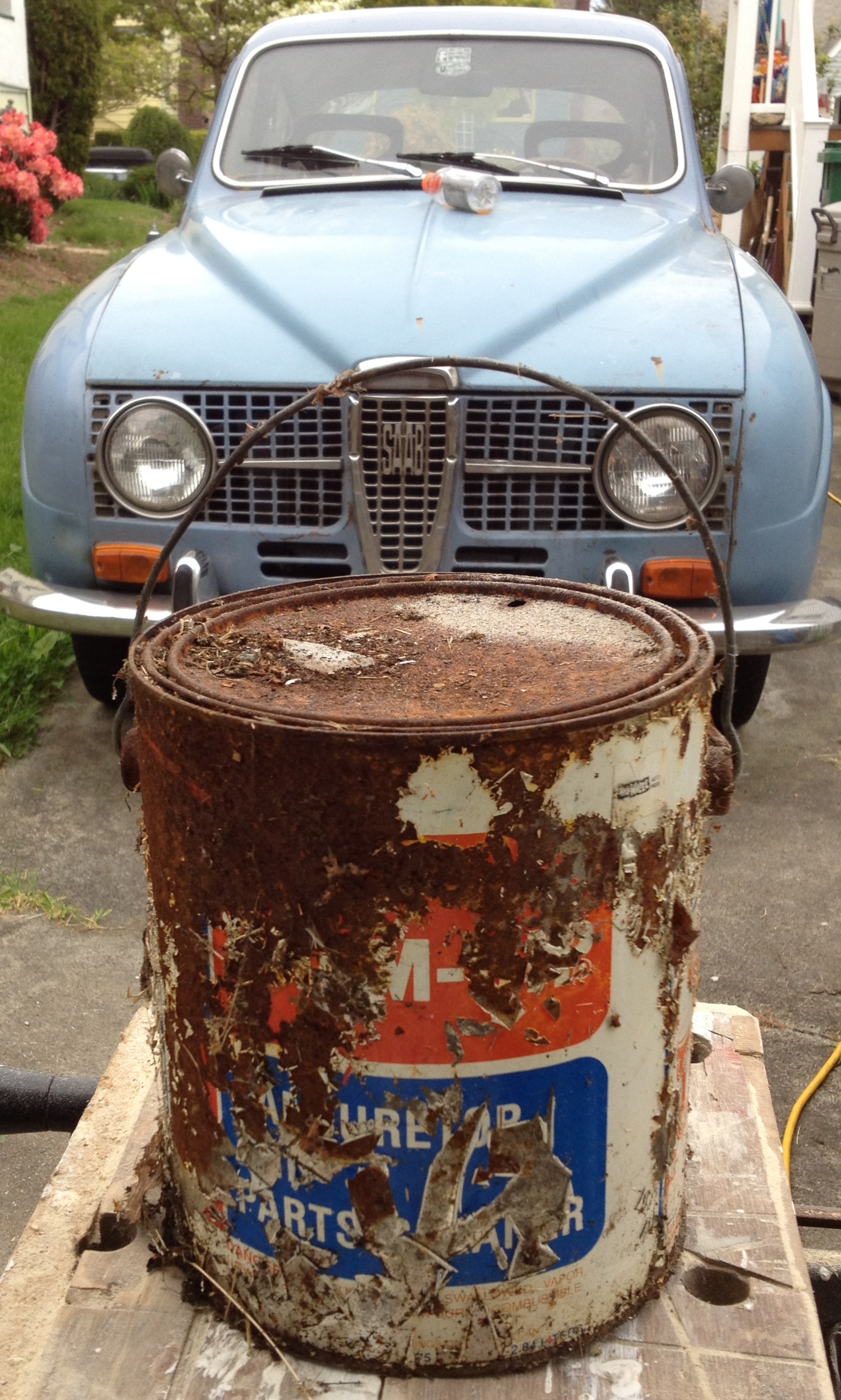
The can was in the garage for awhile until I ran into it recently. It has been safely disposed of, and yes, the carburetor cleaner did eat the label off the can, as you can see.

It became fairly clear that the reason for the 110 degree limit was that that was the boiling temperature of carb cleaner – and if it ate the label off the freaking can, I didn’t want anything to do with it…

For whatever reason, the plastic bucket didn’t care about the carb cleaner, and the cleaner that had boiled over was sitting down at the bottom of the bucket – under the water.  But gosh, you’d think they’d make the label out of something a little more durable or something…

I ended up putting the bucket in the very back of the Buick station wagon we had at the time to take it to a hazmat place here in the city.  It was a little surreal to be driving there in the station wagon, with my son, who was still in a car seat at the time, just chatting away, only to get out and hand the bucket to a guy who was dressed in a full-on hazmat suit.

But we got rid of it, and that was a good thing.

I later put the carb itself on E-bay, wrapped in several layers of plastic that it didn’t dissolve, with a warning that it would smell like carburetor cleaner…

As I recall, a fellow in Utah bought it along with the rebuild kit I’d gotten for it, because, as it turned out, it would fit his Lotus.  I told him everything about it, and he still wanted it.  In the end, he was happy, because it made his car run.  I was happy because the carburetor was miles away, and I was to the point where I didn’t want to have anything to do with it.

Later, I just bought a new carburetor instead of trying to rebuild the old one, and put that on the intake manifold.  I worked with Rob at Scanwest Autosport to make a linkage for it, and the car could inhale, deeply.

Now I had to figure out how to get it to exhale fully.

I’d learned that having an MSS (Motorsport Services) exhaust system on a Saab V4 was worth about 10 horsepower, and since the exhaust was pretty toasted anyway, I saved up my money and ordered one.  The problem was that, if you’ve ever owned a Saab with a V-4 engine, there’s kind of a metal donut between the heads of the engine and the exhaust manifolds that allows everything to fit together. But the holes didn’t quite match up right. The exhaust came out of each head of the engine through a hole that was about 1 ¼ inch in diameter.  The gasket that was between the head and our donut had a 2 inch hole in it. The diameter of the exhaust headers was also 2 inches, but the hole inside the donut was only 1 ¼ inch, all that breathing-exhaling stuff we were doing was nothing but huffing and puffing until that was fixed (because the car was trying to push lots of exhaust through 1 ¼ inch holes when it had a 2 inch pipe it could go through – it’s like putting your thumb over a garden hose) so that had to be fixed… I figured that if the gasket were the right size, then everything else should be that size, including that 1 ¼ inch donut hole.

I wasn’t sure how to do this, I didn’t have a machine shop, but then I found a fellow named Dan who did this kind of work.

On big engines.

I’d taken the heads off my Saab engine to get them down there to him to get hardened valve seats put in there so the car would run on unleaded gas, and he laughed as he looked at the valves that came off them. They looked like little toys in comparison to the engines he normally worked on.  Some of the valve stems on the engines he normally worked on were 14 inches long, and the valves themselves were, I’m going to guess about 4 inches across. (by comparison, the valve stems on the Saab engine were about 5 inches long, and the valves 1 1/2 inches across).

The thing I learned quickly about Dan was that he came across as gruff as all get-out on the outside, but was a marshmallow on the inside.
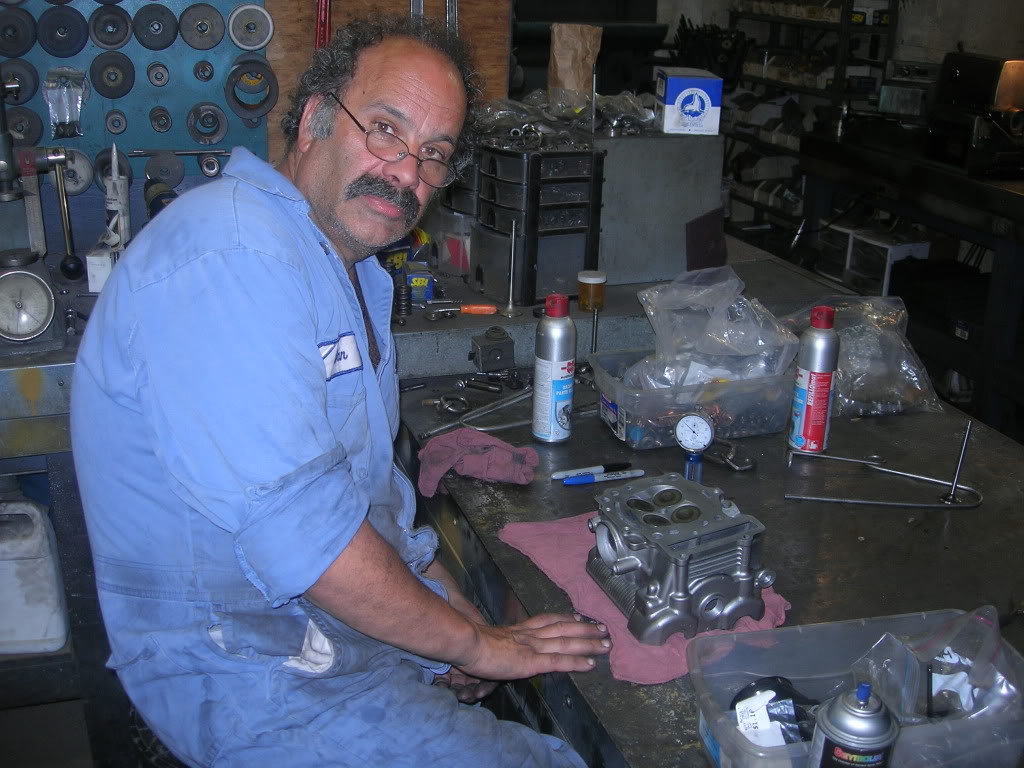
Dan, doing what he did best
© Cale Johnson – used with Permission

I found out he liked Sprite, so I made it a point to stop by the shop on the way home from work a couple of nights a week, just to see how things were going.  I wasn’t in a hurry, in fact, I was more interested in learning about the magic of turning a hunk of metal into something useful than getting it done fast, and Dan was a willing teacher.

And we talked… about life, about our families, about work, and friends, and how important it was to have them.  I remember telling him how much fun it was to just be there in a machine shop, where things were actually made, which was so different from being in an IT department as a database administrator, which I was at the time.

To see him use all those tools he had at his disposal and make useful things out of raw metal was a treat.  I mean, he could point to something and say, “I made that.”

He could reach out and touch it.

It was real.

But he kept saying I had to be smarter than he was because I worked with computers.

I told him, “Dan, you take these hunks of metal that are just that, hunks of metal, and you MAKE something of them.  I work all day pissing off electrons.  You tell me who’s smarter.”

He laughed, but I was serious.

It took a while, but I think it sunk in.  I mean, I worked very hard at making sure the right electrons got pissed off, but at the end of the day, I just didn’t have anything to show for it, so chatting with Dan, in his shop, surrounded by all his tools, not a computer in sight, was a real treat for me.  Not only did he teach, but he let me do some of the work myself.   In one case, he was looking for the right drill bit in the mass of bits and taps and dies and all sorts of things he had on massive workbenches, and the sound of him rummaging around was so close to the sound of a kid looking through a pile of Legos that I just had to smile.

Eventually he did find the right drill bit, wiped it on his overalls, and popped it into the drill for me, then stood there, patiently, as I drilled out the new brass valve guides that he’d hammered into the heads.

One day when I came in with the can of Sprite, he was almost done.  He’d installed the hardened valve seats and ordered valves to fit the extra-large holes he’d let me drill, and about a week later, the heads were finished.  I put them on the car, where they are to this day.

But on that last day, when I was picking them up, I asked him what I owed, and he just waved me off.

“Don’t worry about it.”

“What?”

“This was fun for me.  Don’t worry about it.”

And he wouldn’t take my money.

I was floored.  I couldn’t believe what he was doing, but it turned out that for Dan there was more value in something as simple as conversation than there was in a collection of little oval pictures of dead presidents.

I put the engine back together, and in doing so, was able to combine the heads on my Swedish car with the intake manifold from that junkyard in Germany and that two barrel carburetor from wherever it was made, along with the MSS exhaust system from Jamestown, New York, and I drove it down to the shop to show him, so he could hear how his work that connected all the different parts came together.

He listened to the rough idle, hearing music he’d helped make, and smiled as I revved it and it smoothed out.  And I thanked him and shook the hand of a true craftsman.

For some time afterwards, I’d stop by every now and then to say hi, and if he wasn’t there, I’d just leave a can of Sprite sitting on the doorknob for him to let him know I was thinking about him.

A few years passed, I changed jobs, his shop wasn’t on the way to work anymore, and life happened.  I didn’t see him for a long time, but a few months ago, my son had a problem with a metal part he was working on, and I thought it was time to introduce him to someone who could make metal do anything, so we got a cold can of Sprite and headed down the road to see Dan.

But it turned out Dan wasn’t there anymore.

His son was, and told us that his dad had had to give up the shop, and that it was going to be sold to their biggest customer in the next few months.

I looked around, and while I could sense his presence in all of his tools, and in no small way, in his son, standing there in front of me, I realized the spirit of the place had changed. Not only wouldn’t I see Dan again, at least the Dan I knew, but the shop, with all its familiar machinery, would soon be gone, too.

My son didn’t quite understand the catch in my voice as I asked Dan’s son if he’d take the Sprite to his dad and tell him it was from an old friend, the one with the little blue Saab. The one that he’d made go a lot better, a little faster, and just a touch louder.

© Tom Roush, 2012


One of the things about small towns in West Central Ohio is that they often have their own radio stations.  Sidney was no different, and had a little radio station that played an astonishing variety of what the people in that area needed.  You got the farm report, you got yard sale advertisements, you got the sports all the kids in the area did, and you got music.

It was a simple radio station, meaning it had exactly what it needed and no more.   In this case, at that time, that meant a mike, a transmitter, a couple of turntables, and a supply of records (yes, vinyl).  I’d already had one experience in shooting someone with turntables, and by now the car had aired itself out, which was very good.

Now one of the things I did in my job as a photojournalist was to be the eyes of the county I worked and lived in, and it pretty much gave me free rein to go anywhere I wanted, within reason.

One day I was driving past the radio station, which I had playing in the car, and figured, simply, “How hard can it be?”…to talk my way into a radio station and take pictures, in the studio, that was on the air at the time.

Questions like that have never stopped me, much less slowed me down.  I barely had time to put the blinker on before I pulled into the parking lot, where was only one other car.  I wandered in with my cameras clattering against each other and the camera bag slung over my right shoulder.

The speakers in what could have been considered the lobby were playing what the DJ was saying, and he waved me to come on in as he put on a song and swung the mike out of the way.

He stood up, leaned over the console and shook my hand as I introduced myself, and we chatted for a bit before he stole a quick glance at the clock and asked me to hang on a second, he had to do the weather report.

He glanced out the window, which was, mind you, open, and told all of Shelby County that the weather was clear and there wasn’t a cloud to be seen.  I’d never, ever heard such an accurate, and simple, weather report, but there wasn’t one thing wrong with it.  I’d been in studios before, but they were usually isolated beyond comprehension.  To have a window in this one, that opened, mind you, blew me away.

We talked for a bit, and I got another shot of someone with turntables (but better this time than in the other story) and he told me about how he’d almost gotten fired one time for playing In A Gadda Da Vida (the full length version) one evening just before going off the air, and how much fun the job could be when you just let it be fun.

He asked me if I had any favorite songs, and I had to admit that I really, really liked “Blue Moon” by the Marcels and Kodachrome, by Paul Simon.

After that, we’d run into each other every now and again, and I’d stop by the station between assignments just to say hi, often late at night when he wasn’t too busy, and he was always glad to see me, and was often the only one there.  I could sense that there was a loneliness inside that was covered up by a gregarious persona on the air, and the times I stopped by were times he could “let his hair down” so to speak.  We both had a lot of fun just chatting on those evenings.

And I noticed that Kodachrome and Blue Moon were played a little more often after that.

I’d be going off to shoot something in a nearby town, and while I was driving there, it was nice to hear a friendly voice from the radio, “and up next, for our photographer from the Sidney Daily News on his way to shoot another assignment you’ll see soon enough, is a song I’m sure he, and you, will appreciate.” – and out would waft “Kodachrome”.

And it got me thinking…

He and I both worked for and with the public, but we did it, for the most part, alone, and even though many other people heard it over the airwaves, when I heard that voice come out of the radio, it was one lonely person talking to another one, letting him know that somewhere, someone cared, and wanted to share a smile in a language both people understood.

And in that 1979 Ford Fairmont, driving alone on a dark country road to my next assignment, I did smile.


Six years ago last weekend, my son Michael and I had a new word enter our vocabulary.

Just one word…

“Norwegian.”

It’s a word that brings back memories that are still filled with wonder, laughter, awe, and not an insubstantial amount of reverence.  It was the first hike for me after a long time of recovery, and was kind of a celebration of sorts, to prove that we could go out and do something more than just ‘recover’.  By way of introduction, Michael was a Boy Scout at the time, and, it turned out, this was a traditional camping trip that our Scoutmaster, Paul, did on President’s day weekend.

Every year.

You might be thinking, “But President’s Day weekend is in February!”

Yup.

It is.

Every year.

The Norwegian Memorial was a 5 hour drive to get to from Seattle.
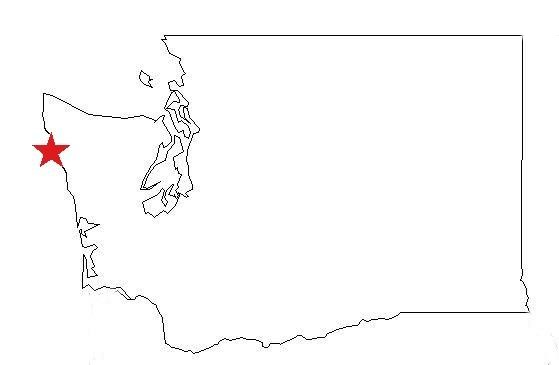
it’s way out there…

It was out west of Forks, Washington, long before any TV show brought attention to it, and after you got there, there was a hike in. I had to work Friday and couldn’t get away, and it was a hike not recommended to do in the dark.

Note: What happens in this story (note: all of it is true) is what caused us to go out the next year – the adventures of which you can read in the Shi Shi beach story.  It’s in that story we learned about hiking in the dark – and if you read that, you might get a better picture of why this doesn’t happen often.

So Michael and I headed west, in the Saab (1968 Saab 96 Deluxe, with the V-4 Engine).  He navigated, I drove.  At one point we were bombing down a gravel logging road, and having watched bits and pieces of the Paris-Dakar Rally on TV some time earlier, he’d commented that that would be fun to do, and it didn’t take me long to realize that we were doing just that.

We were doing about – oh, 30 or so, which on a road that had simply been bulldozed through the forest actually felt pretty quick.  I yelled at him over the roar of the engine, the tires sliding sideways every now and then just enough to throw gravel up against the bottom of the car, “Hey Michael! you know what we’re doing?”

“What?!”

“We’re Rallying!”

And the thing was, we kind of were…
The road was a little rough in places

I took a picture (hey, it’s me, what would you expect?)

We had a rough set of instructions that would get us into the right neck of the woods, so to speak, but we didn’t have any more detail than that… There were areas we had to travel slowly and carefully on, but there were some parts, the straight and gently curved stretches of the gravel road that we traveled down just fast enough to make it fun and exciting, without being so fast that we’d damage the car or ourselves if we got ourselves stuck.  And there was the fact that this was the kind of road I’d learned to drive on (and it was a Saab I’d learned in.)  So I knew the limitations of the car from a few decades of driving experience.

It was, to put it mildly, fun. (in fact, I’m still smiling about it as I write this)

Not on the map was our primary goal, which was, “Find Paul’s truck”, because if we found that, we’d find the trailhead, so that’s what we did.  By the time we got there, it was 3:00, so we didn’t have too much daylight left.  We’d been told it was a mile to get in, but Paul had developed this reputation that meant we had to convert “Paul Miles” into “Standard Miles” so we figured it might be a bit longer than a standard mile, and so we scarfed some snacks and started hiking in.  The trail was barely distinguishable from the surrounding forest, but we figured if we kept heading west, eventually we’d hit this big patch of water called the Pacific, and we’d be able to find things from there.  After some time, we took a break and sat down on a log to rest for a little bit.  By this time, we’d learned two things about the trail:

  1. If it was muddy and you got stuck in it, chances are you were on the trail.
  2. If it was impassable, chances are, you were off the trail, and had to get back to the mud.

It was nice to have things clear and simple like that.

We got up and hiked for another half hour or so with Michael leading the way, and somewhere in there I realized the brand new tent I’d been focusing on, the one that was tied to his backpack, wasn’t there anymore.

Um…

Let’s see…

Sun going down in the west, nothing but trees and the beginning traces of darkness, and maybe a tent to the east.

Thing is, we still had light, we just didn’t know how far (and thus how long) we had to walk, so we didn’t know how much time we had to go look for a lost tent.

We decided he’d go back for no more than 10 minute to look for it, and it’s good we had radios with us to communicate, otherwise the trees absorbed  ALL sound.  It was truly eerie how loud he could yell from just a few feet away and it just didn’t penetrate the trees.

At all.

Later I took a picture at that place, because it was suddenly so easy to understand how someone might get totally lost and never come out…
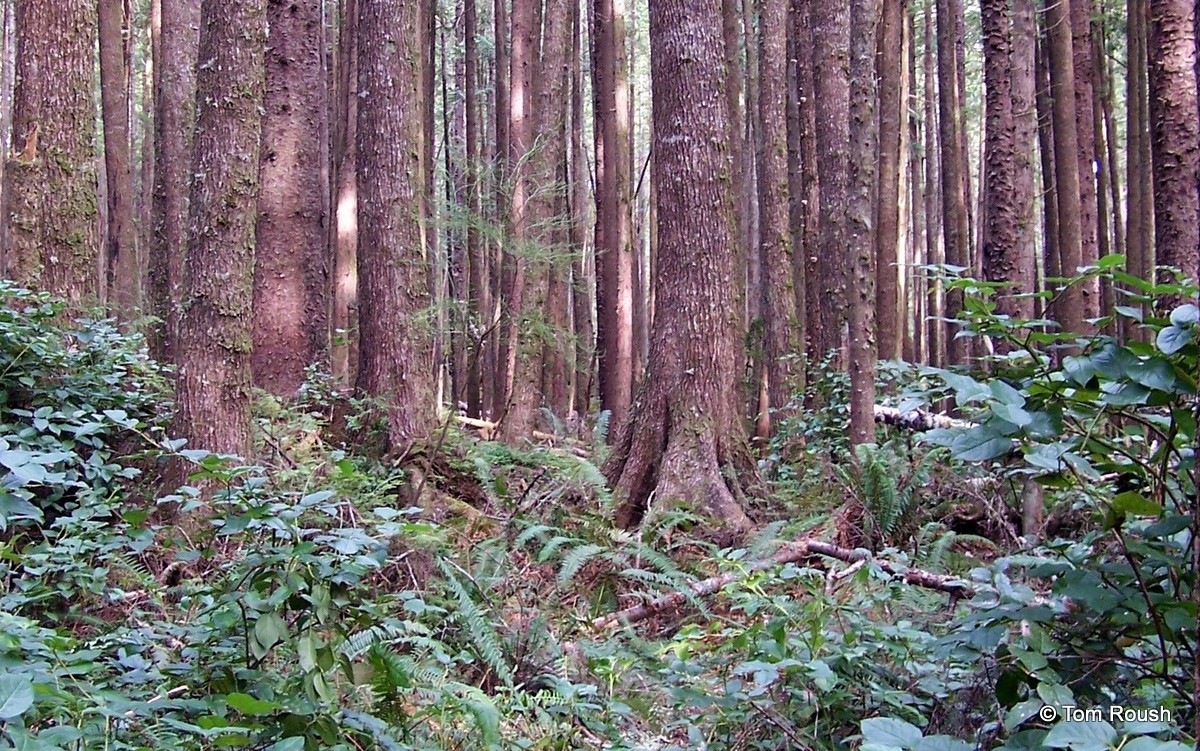
Find the trail if you can. If you got lost, you couldn’t hear someone yelling from 100 feet away.

We were glad we’d each brought a tent of our own.  It gave us a spare.

We kept walking, and eventually the trail started going sideways downhill toward the beach and we could hear the surf in the distance.  We found where a tree had fallen and blocked the trail.  It was too big to climb over, too low to the ground to crawl under as we were, and since we were on a hillside, we couldn’t really go around.  So we took our packs off and crawled under, then kind of lobbed the packs over the top of the trunk laying there and put them on when we’d gotten to the other side.  It was nice that we succeeded in that, it meant not having to climb into the tree to get our backpacks back down.  After that, the trail was pretty clear.  In fact, when we got to the bottom of the trail, it was next to impossible to miss…

This part of the trail could actually be hiked in pitch black darkness.  Here – take a look…

Now THIS was an easy trail to follow.

I also took this one looking back on the way out but this is roughly what we saw on the way in.

Some of the scouts saw us and were both surprised and delighted that we’d made it. One took my pack off my shoulders for the last few feet, and of course when that happens, you just feel like you’re floating, so I floated over to the campsite (just left of center in the picture above, and it was right…

on…

the beach…

It was amazing.

When we finally got there, there was a small fire on the beach (okay, small, relative to the size of the beach) –
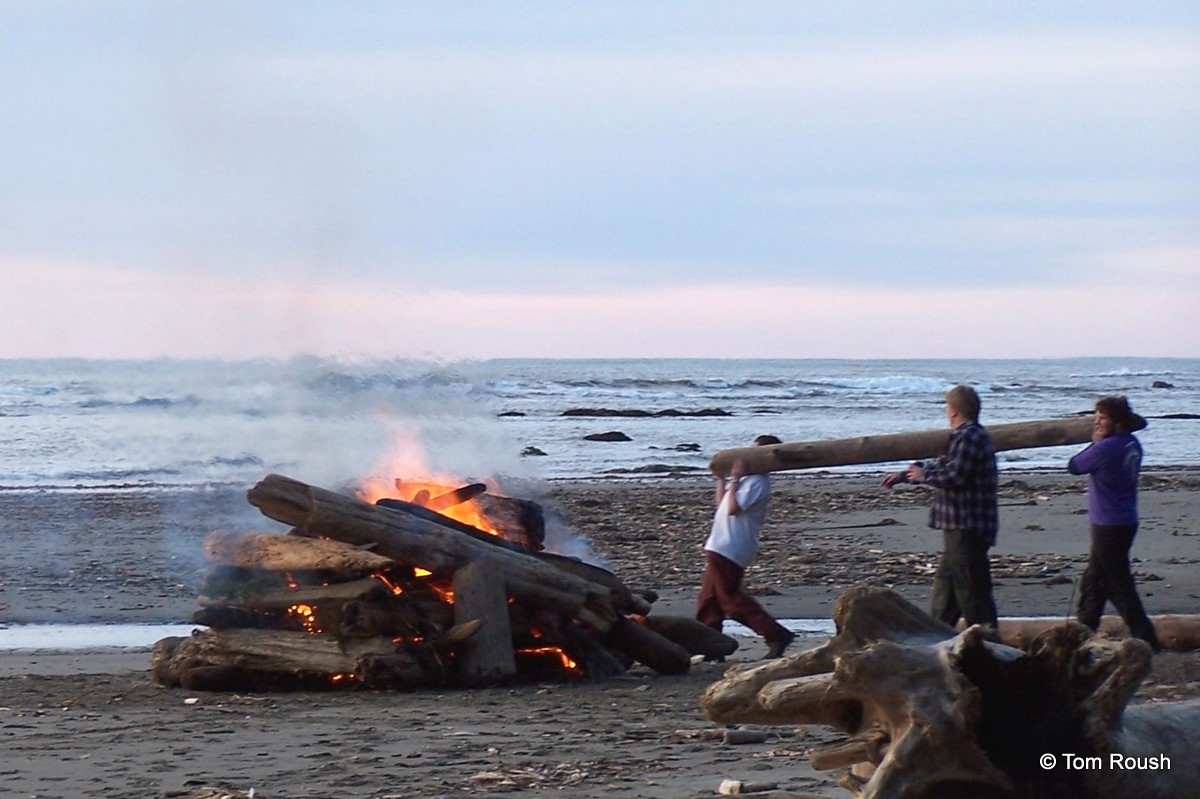
reminds me of the song, "Put another log on the fire... brew me up another cup o' tea..."

…the fire needed a little more wood…

There was only rule about the fire, and that was that if it could burn, and you could lug it to the fire, it got burned.  As you can see, they were stoking the fire with a couple of small sticks as we walked up.
Many hours were spent like this.

The fire was worth its weight in gold for all the time spent just staring into it, focusing on everything, and nothing…

The Beach, near where the end of the story takes place.

Michael had time to just wander and be by himself

There was time to walk on the beach, and just be alone with your thoughts, whatever they were,

We were glad to have brought my little tent

and even though the weather was so cold, there was a chance to sleep in a warm sleeping bag, in the same old tent that we’d slept in at Fort Ebey years ago when Michael was a Webelos Scout.  We did see evidence of some strange wildlife out there, causing us to wonder where genetic engineering had gone drastically wrong.
Genetic engineering gone awry...

Obviously a native Washingtonian

It was a wonderful place…

There was time for pondering, and reflection…
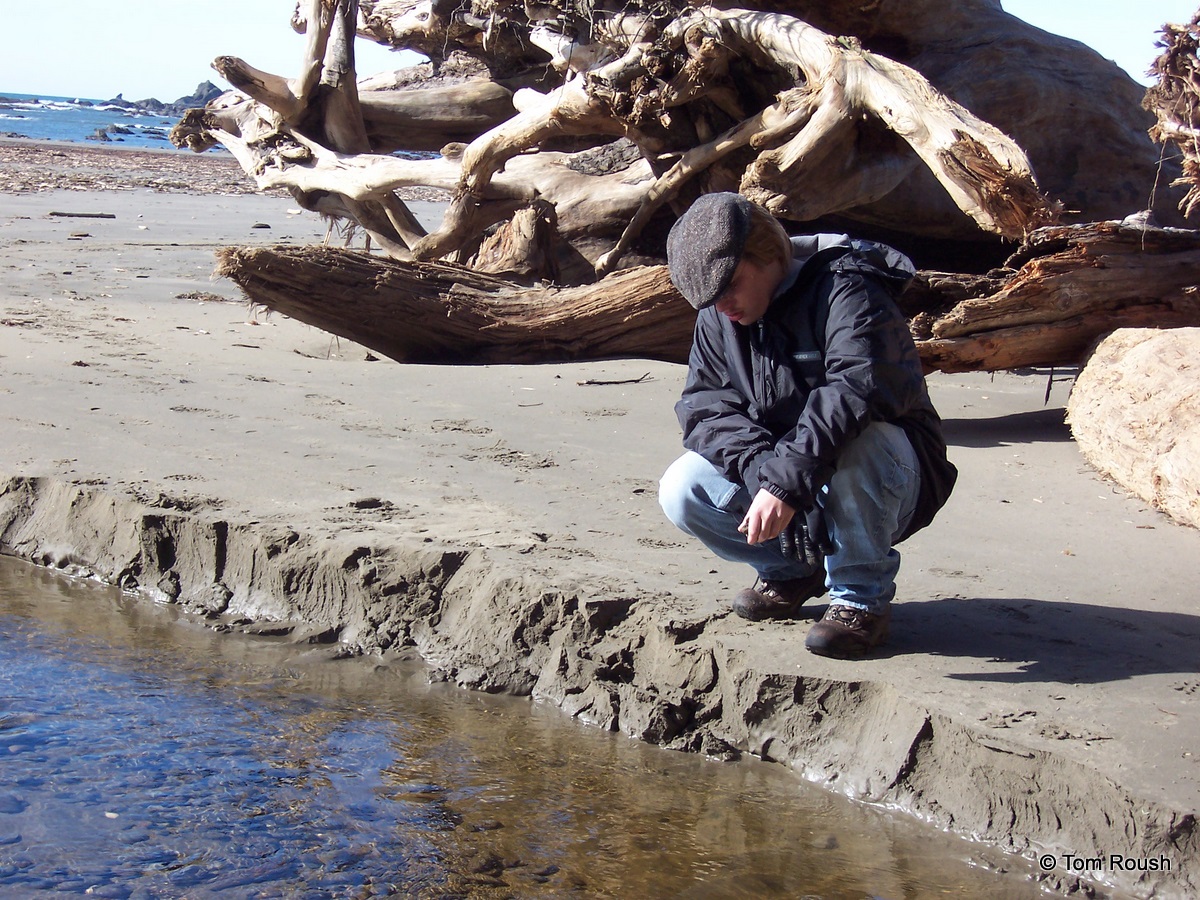
…reflecting, on many levels…

There was time to etch your autograph anyplace you could find to put it.

Writing on one rock, with another…

There was always a pot of water on…
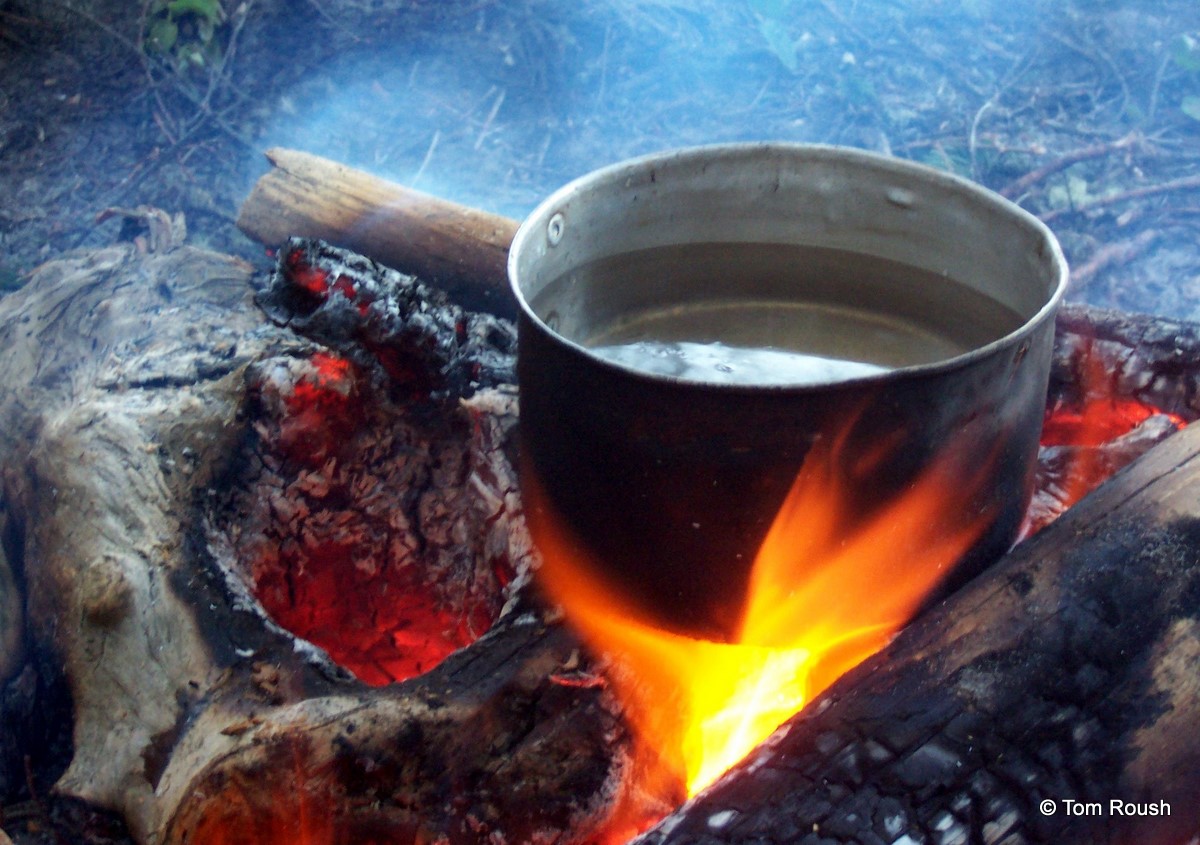
Nothing tastes like fresh coffee made with water heated by campfire

… for hot chocolate or coffee…

Some of the coffee was a little chewy…

We had some guests for dinner, and found all sorts of things on the beach…
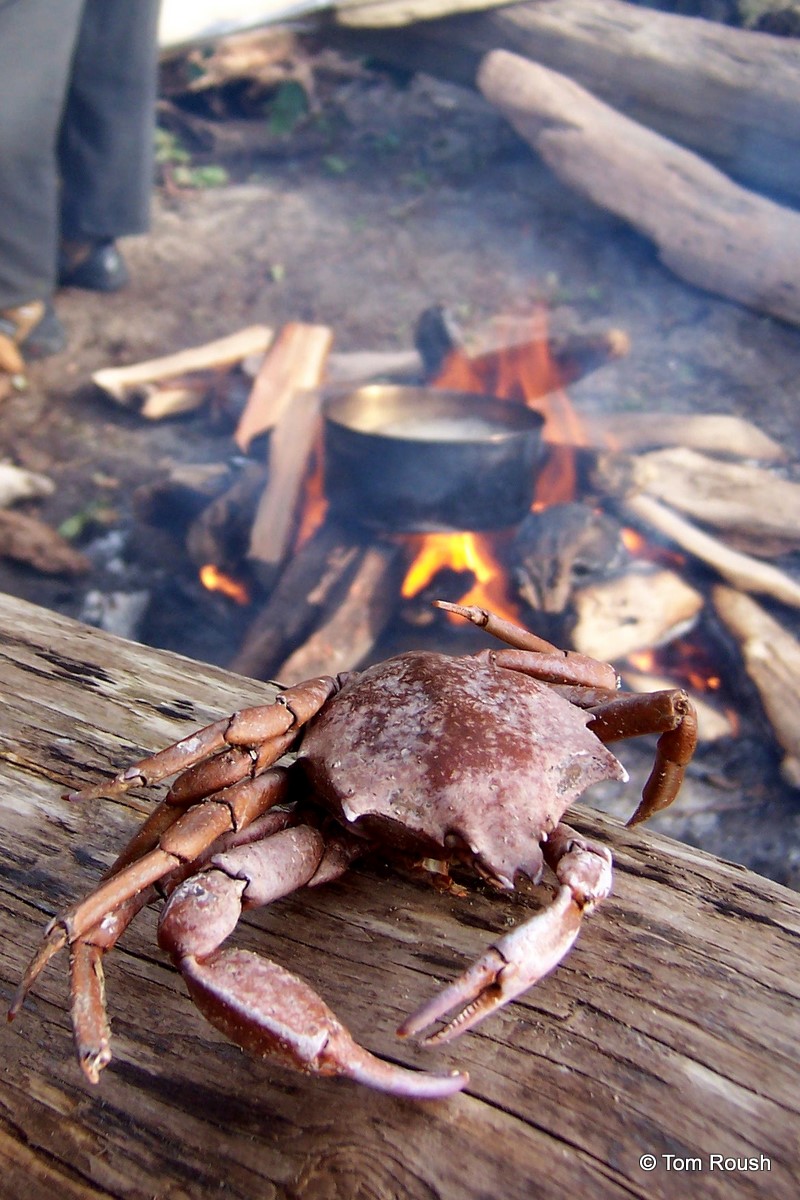
Guess who’s coming to dinner?

We never had any problem with food spoiling that weekend.  Of course, the fact that it didn’t get much above 27 degrees in the daytime might have helped that particular issue out just a bit.  It wasn’t windy, wasn’t rainy, just clear and bracingly cold.

It was amazing how the metal just fell apart

There was an abandoned silver mine south of Norwegian by a couple of miles.  We hiked down there with the rest of the scouts who’d gone and stopped to see some of the decaying machinery, where what had once been a boiler of steel able to harness the power of steam had been scoured by the salt air for so long that the steel could be peeled away with your fingernails.

Since we’d gotten there late, Michael and I took a hike up north, to the actual Norwegian Memorial, hidden away off the beach, a memorial to the sailors who died in a shipwreck many years ago.

On our way to see the memorial, we saw many downed trees, and this one…

The concept of ‘size’ is different out there.

…was truly a Goliath among them, making all of the others look positively tiny in comparison.

We kept walking, not really knowing where exactly what we were looking for, but eventually we found it, nestled deep in the trees,  away from the beach, in a place you could easily miss.

Our Scoutmaster, Paul, had been keeping it tidy once a year…
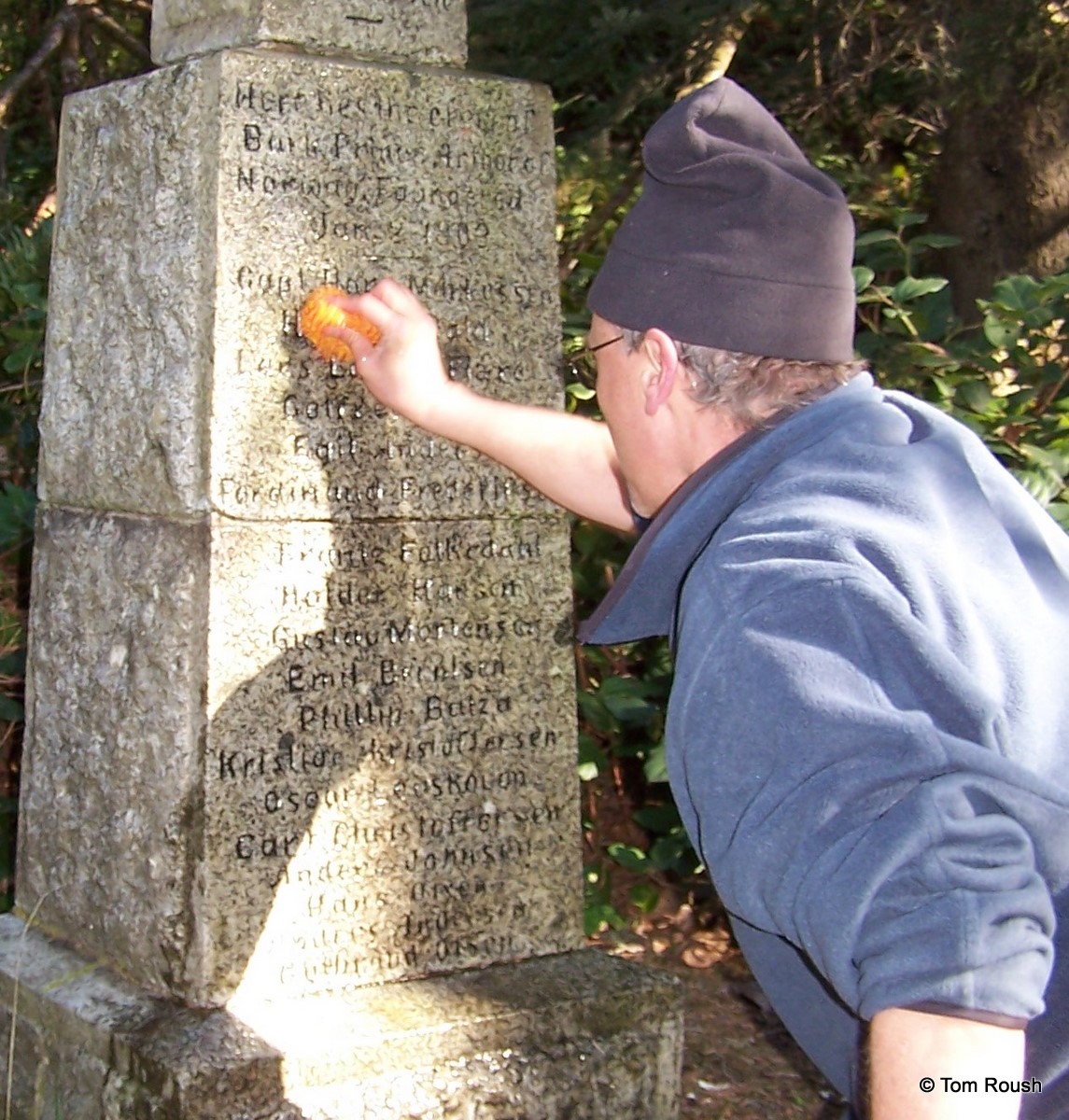
Scoutmaster Paul kept the place neat at least once a year

…for the last thirty years or so as part of being with the Norwegian Fishermen’s Association in Ballard, where we live.

The mussels we had for dinner one night simply covered a huge rock.  It was impossible to walk anywhere without stepping on them.  And it didn’t take long at all to gather enough for dinner.
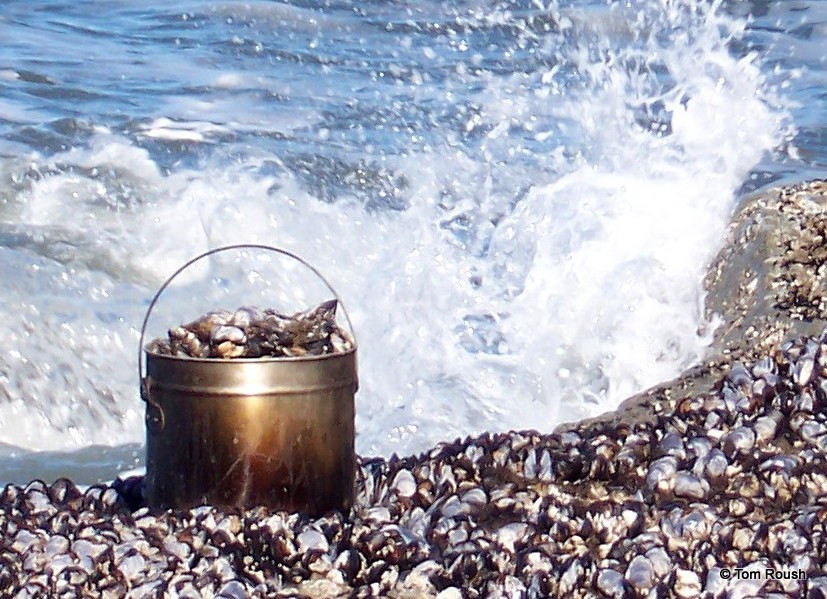
There were zillions of mussels out there

Once we got back to the campfire, we had what was again, amazing food.  We learned that you can make something called Cioppino in a dutch oven, and since I’d spent a few years playing with cameras, we decided we’d take a picture of it.  Of course, trying to take a picture of a dutch oven over a fire likely wouldn’t win any awards, and since we didn’t have any studio lighting, we just used the campfire for light and I think a couple of flashlights. We waved them around until we thought we might have something, and who knew that you could come up with a picture like this with just a couple of flashlights and a campfire?
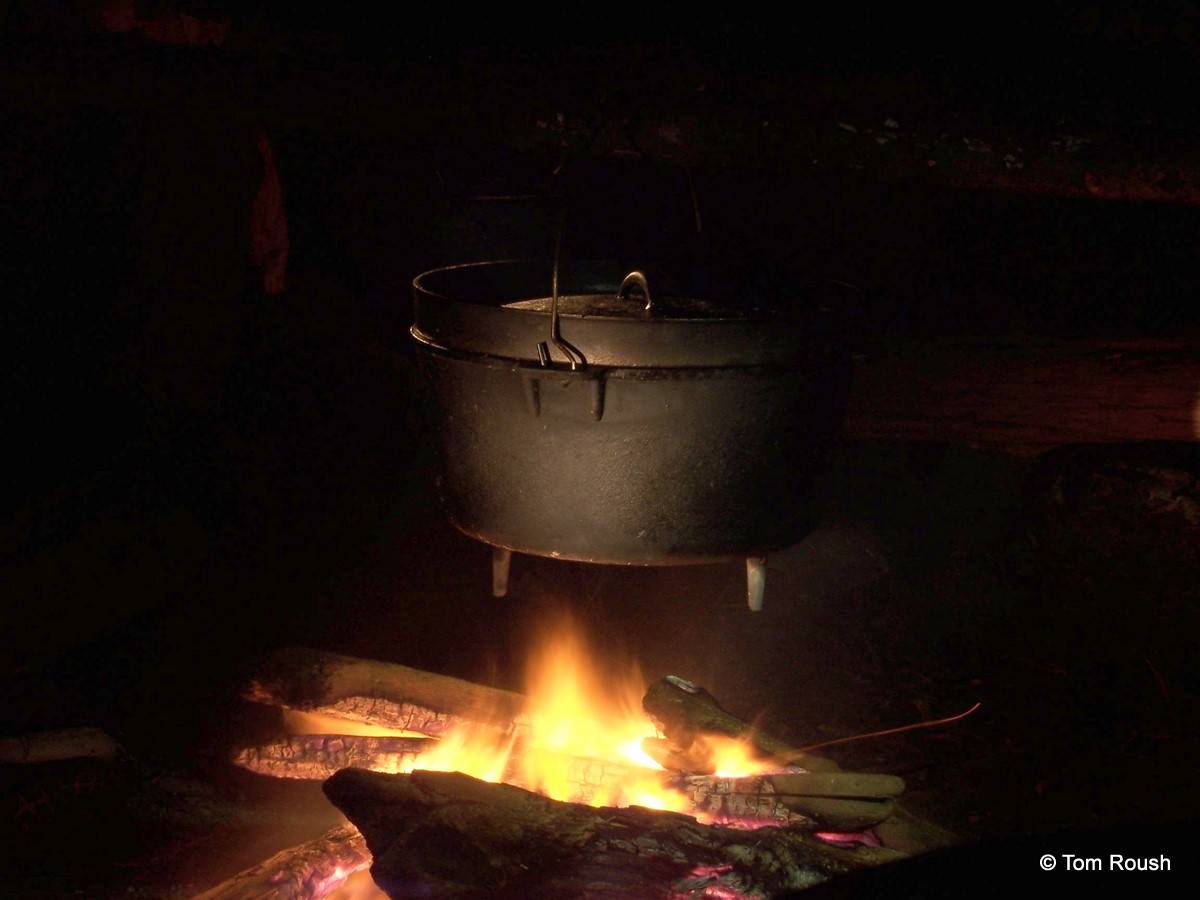
A campfire, a couple of flashlights, and a 3 second exposure… Oh, and steady hands.

Come to think of it, who knew mussels made pearls?

And, Pop Quiz:

When you’re eating them, how do you know the difference between the sand in them and those pearls?
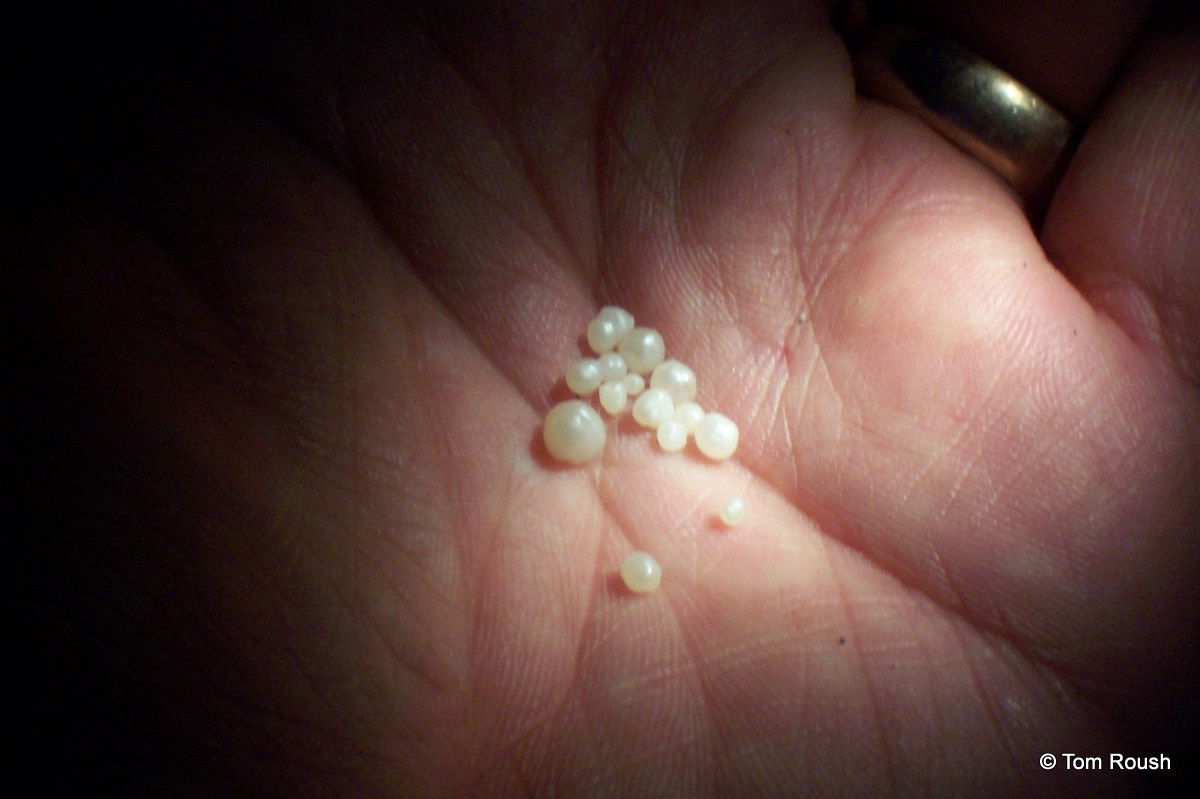
Years later I put these in a pendant for my wife

Answer:

If it’s sand, your teeth crunch it…

If it’s pearls, it’s the other way around…

(That particular lesson only takes one time to actually sink in…)

The temperature was cold, but no wind and so that evening a huge cargo net served as a wonderful hammock for two to relax and watch the sun set,
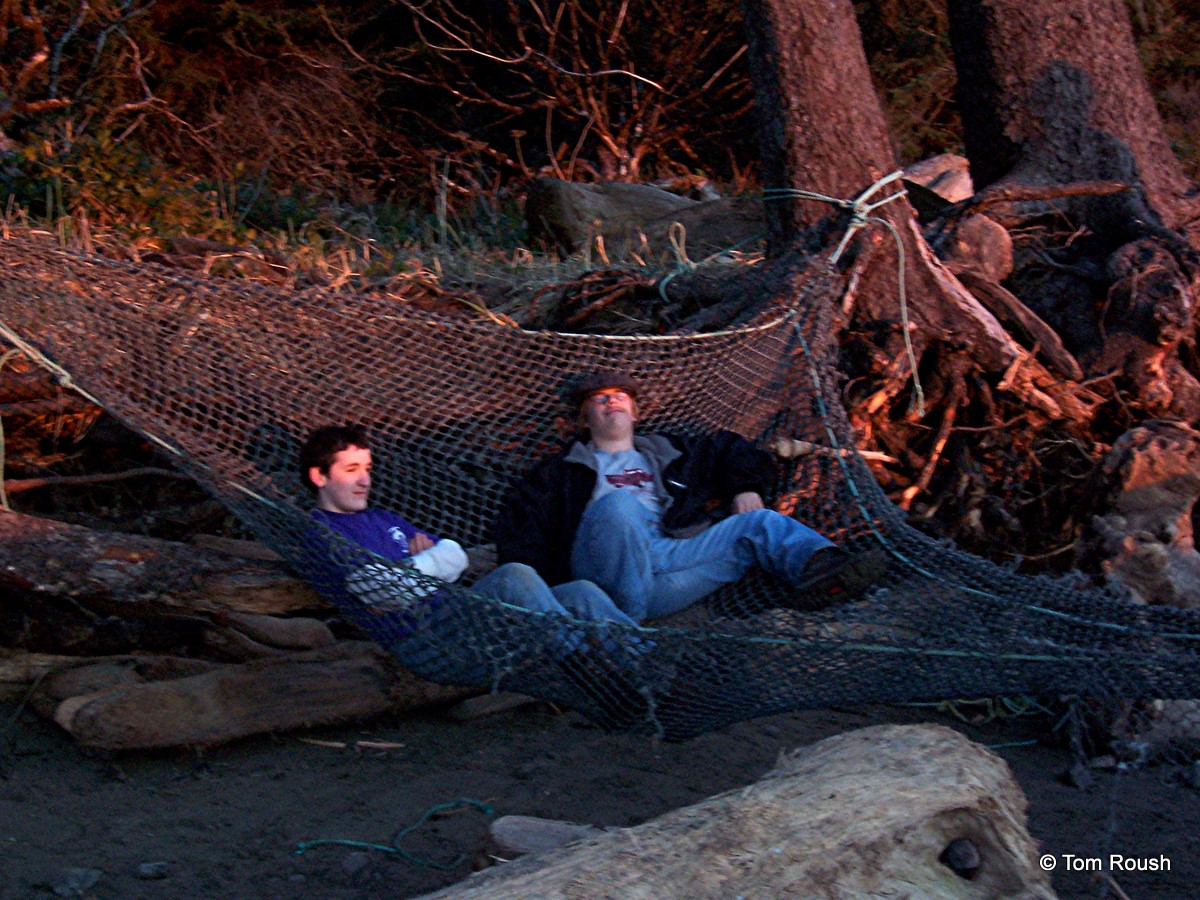
It just didn’t get any better than this… (or did it?)

and watch the fire burn to embers.
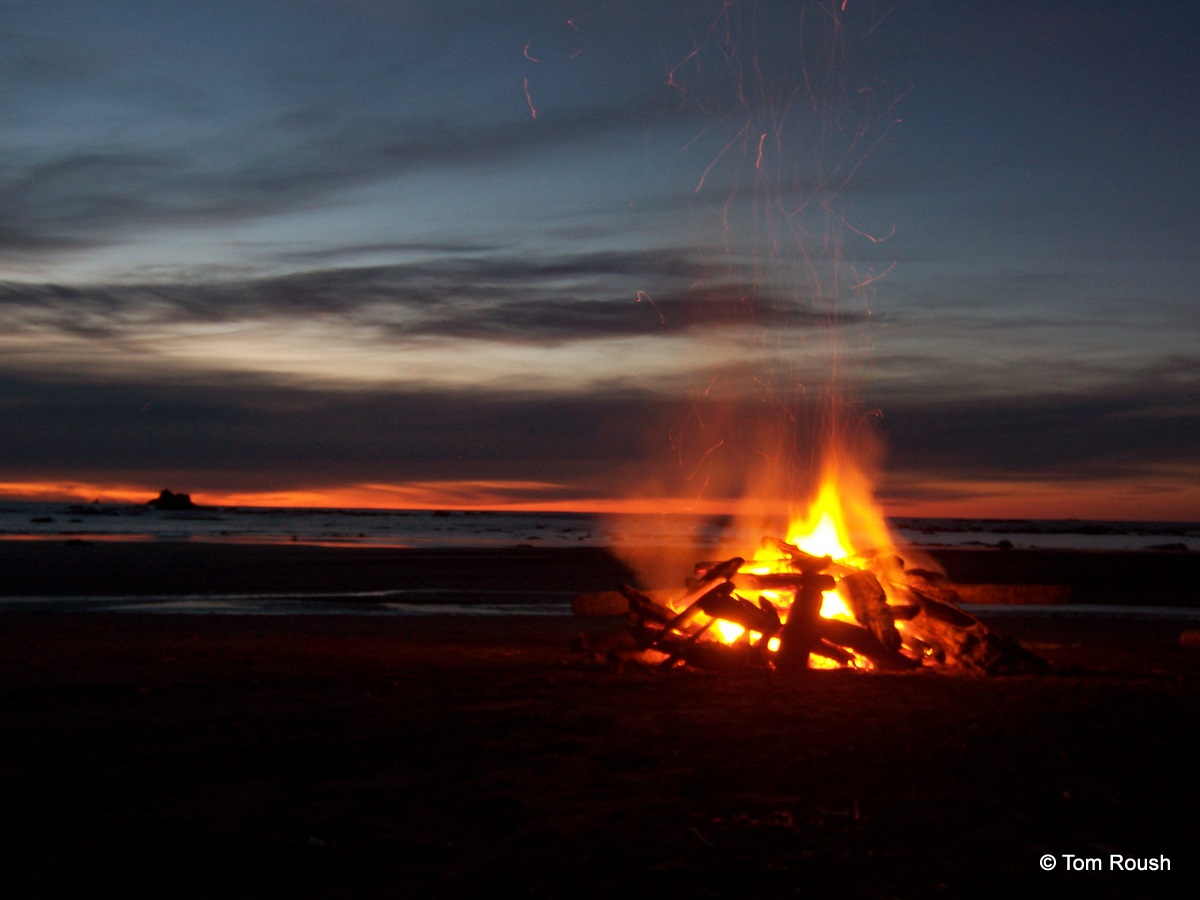
The campfire, at sunset, was amazing.

But the most incredible part of it all was something not in any photographs.

As I said, it was 27 degrees in the daytime.  After dark, it got colder still.  One night, we went out onto the wide, wide beach for a walk.  The beach was mostly flat, so we walked and walked, and as we got further away from the light of the campfire, and our eyes got adjusted to the dark (there was no moon that night) we found that we could see, literally, in the dark.  It’s because the stars were brighter than we’d ever seen, and even Orion, huge in Seattle, was small in comparison to all the other stars now visible.

We kept walking, our eyes in the heavens, as wide as children seeing those stars for the very first time.

It was only when the sand we were walking on became a little slippery, and a little soft, like crème brulée, crunchy on the top, soft underneath, that we slowed and stopped.  It took about three steps or so, and we all looked down…

…and found ourselves in a world that words cannot adequately describe.

The salt water had frozen as the tide went out, and the beach we’d been on had been transformed into ice that extended as far as we could see in front of us, and far enough left and right to feel like it went to the horizon.

As I looked back up, I noticed that I could see Orion again, not once, but twice.  Once upside down below the horizon, once right side up above.

Wait a minute…

I looked left and right, up and down, and still saw stars.

I kind of skootched my feet around a little to be sure I wouldn’t fall and realized we were not standing under the stars, we were standing among the stars.   We were standing on a mirror, stars visible above us, below us, and all around us.

As our eyes registered it all, and our brains struggled to comprehend the magnitude of what we were seeing, the sound of the waves to our right faded away with the tide.  We were quite literally in awe.

We stood there for a few minutes, in silent reverence for the creation before us and around us.

We weren’t standing on ice, on a beach, we’d been transported into the heavens.

We were standing in the stars.

It was Amazing.

It was Magical.

It was…

Norwegian.


Some time ago, my family and I went through a journey I hope none of you have to go through, but statistics being what they are, some of you will.  As I’m looking forward to this new year, I got to thinking, and I found this piece I’d written a few years ago about that situation and thought I’d share.  Understand, this was written about something specific to me, but the lessons can be applied almost anywhere.

During this – and it’s fairly safe to call it a crisis – there were many times when I wanted to know from people who would, and should have the answers, “What should I expect?” – and without fail, I was told, “Everyone’s different…”.

Bottom line, “I can’t tell you what it will be like because I don’t know…”

Bottom line: “The mind being what it is, I don’t want to tell you what it will be like because these things can easily become self fulfilling prophecies, so if I give you bad news, it could make things worse for you.”

Bottom line: “I don’t know if you can handle knowing what you’re up against now.  If I tell you it’s going to be bad, just telling you might affect the outcome. If I tell you it’s going to be good, and it isn’t, then – well, then you would rightfully be upset with me, so the answer is…”

“Everyone’s different.”

In all of this – I had a dream…

A father and young son are going down a steep, rocky path.  The father has a flashlight and is guiding the son.  The father sees things in the dark, at the edges of the light, that he knows would scare the child, and so, doesn’t shine the light on them.  The child sees enough to keep moving forward, but not enough to know that the path they’re walking on is on the edge of a cliff.

The child has to trust that the father knows what he’s doing, and where he’s going.  And as long as the child holds his Father’s hand, no matter how long the journey, or how difficult, the Father will be with him, beside him to help him when he stumbles, to support him when he is weak, to encourage him when he is tired, to cheer when he is sad.

This does not mean the journey will be easy, nor will the way be smooth, but the Father will be alongside.

Always.

May God bless you this new year.

…and in this New Year, may you not be alone, may you have a hand to hold, and may you be able to trust the Light that guides you.


I went for a walk with my friend Greg a few weeks ago, and we walked past Mr. Carr’s house.  We stopped, standing in the middle of the street, and my mind went back a few years and I told Greg about a time when I’d worked for Mr. Carr, and experienced a moment that has stayed with me to this day.

Now I’m sure Mr. Carr had a first name, but I never knew what it was.  He had grown up, as I recall, in the Ozarks, and was the kind of guy who could speak intelligently about absolutely anything.  At the time I knew him, he was old.  I wouldn’t say he was older than dirt, but I’m sure he watched some of the first dirt being made.

There are people on this planet who make stuff, and there are people on this planet who do stuff.  And then there are the people on this planet who know how to make stuff to do stuff.

This was Mr. Carr.

If you’ve ever seen the movie “Shooter” – and heard the fellow say the line, “…still got the shovel…” that’s a lot what Mr. Carr looked and sounded like.  You just knew  that he knew far, far more than his simple life would tell you.

He had a sky blue 1962 Ford Falcon that he changed the oil on every 1200 miles, whether it needed it or not.  I don’t know if he ever drove it faster than 35 mph, though I suppose he might have on some of the straighter roads out there.  The car had been in mint condition until someone backed into the left front fender.  He had it replaced with one from a black 1962 Ford Falcon, and that’s the way I remember the car.  There was no reason, in his mind, to paint the car.  The fender did what it was supposed to do, so that’s how it was left.

He rented half a duplex from my grandparents, and had lived in this duplex for as long as I could remember.

It had an oil stove in it, an old black and white TV, and a rocking chair and a couch.  His kitchen could be seen from the living room, and the kitchen windows looked out over his little garden, where he had his tomatoes, his corn, and his beans.

The light coming into the kitchen lit up the old porcelain sink and an empty dish strainer on the counter. A simple cutting board was next to it, and the towel that he’d used to dry the dishes was hanging from a little hook.  The dishes were put away, nowhere to be seen.

Standing in the kitchen, looking out to the right, you could see the Falcon in the carport.  Beside the Falcon in the carport was an old hoe, with a handle that had been marinated smooth from years of well-earned sweat.

The handle on the hoe made me look back at the garden.

There were no weeds in it.

At all.

Mr. Carr wanted for nothing.  That is to say, he had what he needed, and to be honest, he didn’t need much, but one day, it seems, the duplex needed to be painted, and my grampa was willing to hire me, an eager teenager to do it.  As I recall, my job that day involved scraping the side of the duplex in preparation for the painting that was to come later, so it wasn’t hard work, just tedious.  I got there and started working on the west side while it was still in the shade.

Around noon, the sun was just starting to peek over the eaves, Mr. Carr came out, and asked if I was hungry.   I hadn’t thought about it until then, but it had been several hours since breakfast, and any time sitting with Mr. Carr was a treat – he was so full of stories of times gone by that it was like listening to a time traveler, telling of long lost adventures, so when he offered to make me a sandwich, I said I’d be delighted to have lunch with him.  He had me sit on the front steps while he went back inside to that little kitchen of his.  He’d said he had some good ham, and was going to make me a ham sandwich.

And he did.

The hinges on the screen door creaked, as he came out a couple of minutes later with exactly what he said he’d make: a ham sandwich.

With it he had a pickle, and a glass of water.

At first, I thought there was something missing.  I mean, on the plate, there were two slices of bread, not found in any store, and between them, a slab of ham almost as thick as the slices of bread he’d sawed off the loaf.

But I have to tell you – there must have been a glow in that little kitchen when he made it, and Angels must have been singing next to the cutting board as his knife cut through the bread, because this was a ham sandwich like none I have had before or since.

Any other ham sandwich I’d had was on bread that you didn’t want to squeeze too tight or it’d turn to mush.

Any other ham sandwich needed mayonnaise on it because the bread wasn’t moist enough.

Any other ham sandwich needed mustard on it, and maybe some lettuce or something, because the ham was – well, just ham…

But as I sat there in the shade on his front step, a paper plate with a pickle on it balanced on my knee, the glass of water carefully placed on the cement one step down, I looked at the sandwich, and wasn’t sure whether to be disappointed or not.  He’d talked about having some ‘good’ ham – but I’d never had a sandwich that was – well, just a slab of ham stuck in between a couple of thicker slabs of bread.

But he was right.

I took a first, tentative bite, and it was clear this was no supermarket bread.  This was bread with a crust that had enough attitude to put up a fight, but once I got past that, I found a sweet, earthy nuttiness.  It was bread that had enough flavor on its own for you to be perfectly happy eating just the bread – without anything on it, bread that had enough moisture to not need the mayo that every other ham sandwich had always needed.

But there was something on it – it was the ham – and Mr. Carr was right – this was, indeed, “some good ham”.  It had been cured just right, with spices like I’d never tasted before.  It was cool, still from his old refrigerator, and had so much flavor it didn’t need the mustard like every other ham sandwich had always needed.

…and right about then, looking down at that sandwich, I had to reach for the paper plate, and decided to try the pickle.  It was home canned.  It wasn’t bought from a store, either, and it was soft where it needed to be, crunchy where it needed to be, refreshingly sweet, salty, and spicy.

It was so simple.  Bread.  Ham… Pickle.

That was it.

I sat there, savoring it, and realized I still had the glass of water.   What could possibly top that sandwich and the pickle?

It was a glass of well water.

Not city water that had been purified to within an inch of its life, but simple, pure, clear, water.

…that had come out of a faucet, yes, but the well that fed that faucet was in the back yard, just past that weedless garden.

I took a sip.

And realized that Mr. Carr had given me a gift.

Instead of being a time traveler, telling me stories of times gone by, this time, he’d given me a gift, and without me realizing it, had taken me along on one of them.

I allowed my thoughts to come back to the present – which was my friend Greg and me standing there, looking at the porch I’d had the sandwich on, and the house Mr. Carr had lived in those many years ago, and Greg paused, and said, “You should write that one down…”

So I did, and even though I couldn’t share the sandwich, at least I can share the memory.

Fare well, Mr. Carr – and thank you…

Tom Roush

Archives