
You are currently browsing the tag archive for the ‘Friends’ tag.
A few months ago, I wrote a story (which I’d recommend reading first if you haven’t already) about my mom and her bicycle trip through Switzerland, up and down Susten Pass, and even though we grew up in different times, there were some parallels in our childhoods that I realized only after I’d written most of this story. It made me smile, and we’ll get to those in a bit, but first, join me in another trip through the time machine, this time it was on a speeding black bicycle, in Germany, many years ago…
I was 16. My sister and I had saved up money from our newspaper delivery routes and gone over there for the summer to visit extended family and help our grandparents (Oma and Opa) out. We had pretty much free rein to do what we wanted, but we loved our grandparents and helped them however we could.
“We’ll be back at 10:30” I told Oma as we went down the cement back steps to get the bicycles out of the shed. We needed them to ride to the next town to say goodbye to a friend who’d visited for part of the summer. My sister thought we’d be back much sooner, but for whatever reason, 10:30 was stuck in my mind, so that’s when I said – actually insisted – that we’d be back.
Our friend’s name was Philippe, an exchange student from France who was heading back after visiting some – well, I was going to say cousins – but that’s not really the case… He was a friend to Ulrike, who was a cousin of some family friends (brothers Martin and Wolfgang) and their family had been friends with ours for generations – to the point where it was hard to tell where family stopped and friendships started. There was a significant overlap.
To get there, we traveled from Ludwigsburg to Kornwestheim, in Germany, (about 10 km/6 miles) by bicycle because he was leaving that morning to go back to Paris. It would be a long, long time before we saw him again.
With our dad in the military, we’d grown up all over, but spent a good bit of that time growing up or visiting there in Germany, and we learned that one of the things that happened behind the scenes for us when we visited was that someone made a bicycle available for each of us. In my case, someone had made a black, very old NSU bike available to me for the summer. It had been around since WWII or before, and I was told it had been a soldier’s issue bike that had indeed been used back then. (This is the model. Mine had lost the front fender though, but that front brake, saddle, and that oversized “gepäckträger” – the rear cargo carrier are exactly as I remember them) At some point in its history, it had been “upgraded” and now sported a three speed rear wheel and a gear shifter to match, so one could ride up steeper hills than before, and ride faster on level ground than before.
That was a good thing…
Stopping when coming down from those steeper hills was another thing entirely.
See, that coaster brake was part of the upgrade, but it was either full on or full off, no middle of the road (no pun intended). I learned that if I so much as breathed on it, the back wheel locked up, and I would skid to an abrupt, barely-controlled halt.
The back tire itself was in pretty decent shape. The front tire still held air, but really, that was about it. There was hardly any tread left, and in some places the threads were showing through. The reason for this was that the front brake had not been upgraded, in fact, it was original, and was more of a rubber skid pad in a metal box that was pushed down directly onto the tire via a lever and rod assembly. This did indeed slow the bike down, but had the added effect of sanding the tread off the tire with road grit and the like, so it wore much faster than the back one. In fact, the week before this story happened, I’d gotten a flat on that front tire, and had to patch it, so every time the wheel went around, it’d bump a little as the thicker patched part hit the pavement.
What surprises me now as I write this is that every bit of the detail above, while it is extensive and feels almost overdone, is actually relevant to the story.
So we rode over to Kornwestheim, leaving the house around 7:00 or so because it was one of the hottest summers in Europe in years, and we wanted to go over and back before it got hot.
My sister had Oma’s bicycle – something that was about 40 years old at the time, and I had that soldier’s bike.
The thing about that patch I mentioned earlier is that at low speeds, it didn’t do much. From experience on my paper route, I liked a lot of air pressure in the tires. The good in that was the bike went farther and faster on less energy. The bad was that you felt every bump on the road, and in my case, I felt the bump caused by the tire patch.
Every.
Time.
The wheel.
Came around.
Once I got going really fast, the patch caused the whole front end to start bouncing and shaking, eventually becoming as smooth and comfortable as, uh, riding a bicycle while hanging on to a paint shaker.
So on the way there, we wound slowly, gently through roads between farmer’s fields and people’s gardens, and there was one left turn right by a small orchard that took us up over a hill.
We’d done it once before, when we’d gone over to visit Wolfgang’s and Martin, and stayed too late and it got dark. Our bikes didn’t have lights, but theirs did. So Martin said, “We’ll ride front and back. You just follow my taillight, and Wolfgang will light up the road for your sister from the back.” So off we went… Martin rode in front, Wolfgang in back, with my sister and me in the middle. It was early August, there was no moon, so I followed Martin’s taillight up that hill, where we stayed pretty much together, then down the hill, where he accelerated way out in front of me. I squinted against the wind trying to keep him in focus, and then just as I blinked, his taillight suddenly tilted, shot off to the right, and disappeared.
I looked around frantically, it was pitch black, I was going down a hill at about 30 miles an hour, and my only source of light had just disappeared. In seconds I got to where I guessed he must have turned, and leaned hard right, turned, and hung on until I saw his taillight swing back into my field of view again. We were so far from any streetlights, that his taillight was really, truly, the only thing I could see. I was glad to have a frame of reference again. I’d lost track of where we were in the dark and had no recollection of what the road had looked like in the daytime.
And I didn’t recognize it the morning when we went to say goodbye to Philippe.
When we got there that day, we got to the hill, turned left at the orchard to go up it, and I remember noticing that the road over that hill was typical in its German engineering… It was absolutely smooth. Perfect in every way. You could have laid a ruler on it, it was so straight going up, perfectly straight coming down.
And we sweated a bit as we made it up over the hill. We knew it would be a lot warmer on the way back, so we hurried to get to Martin & Wolfgang’s house where Phillipe and Ulrike were, chatted for a bit, hugged and then waved as Philippe left.
We hung out for just a little bit, got something to drink, then, as we felt the warmth of the day starting even in the shade, we headed back.
And the real story comes on that trip back, and takes all of about 20 seconds…
Now in all of the stuff I mentioned about the brakes, if there’s one thing I didn’t mention (or maybe it was obvious), it’s that I didn’t trust them.
So I had an emergency brake, one I’d tried out in front of Martin & Wolfgang’s house.
It was an 8 foot US Army flare parachute tied to the cargo carrier on back of the bike and held down with the spring clamp there (you can see the clamp in the picture here)
I’d practiced this.
And it worked. It really worked.
See, if you could reach back, grab it, yank it and all the lines out from under the clamp, and then toss it back hard and fast enough, it would open up with enough of a jerk to where you had to hold very tightly onto the handlebars to keep from flying over them when it opened.
I figured that this was for emergencies only, once you threw it, you were going to stop.
If you didn’t throw the parachute far enough, it’d get tangled in the back wheel. It would indeed still stop you, but a bit more abruptly, and with a bit less control…
(don’t ask)
Soooo…
The thermometer was solidly into 80 degrees Fahrenheit (a little over 25 C) when we started up the hill again, and I was thankful for the extra gears on the bike and pedaled to the slow, rhythmic ‘kathump’ of the front wheel going around. I don’t know how my sister did it riding Oma’s old single speed bike behind me, but she did it.
As a result, we were definitely not riding at Tour de France speeds. That “speed” up the hill allowed butterflies to flutter by, and grasshoppers played leapfrog with us. A dandelion floated past. There was a gentle breeze from the back, going about as fast as we were, ironically making us even warmer. I was looking forward to getting to the top, because I knew once we got to the other side of the hill I could coast and cool off down that wonderfully engineered road. Right past the gardens, in a little bit of shade, with the orchard at the T intersection at the bottom, where I’d followed Martin’s taillight in the dark, and where we’d have to turn right.
We didn’t stop at the top, my bike was still in first gear – so I pedaled – hard – for about 5-10 seconds in each of the 3 gears, then ducked down so that I’d cause less wind resistance, and go even faster, and only then did I sit up, lean back a bit, and let the air blow past me, through my hair, everywhere. I held my arms up high for a bit, letting the wind come up the sleeves of my t-shirt, joyfully cooling me off.
It was glorious.
A couple of things happened as I accelerated with my hands in the air. One, the wind was loud enough in my ears that it was all I heard, and two, without my hands on the handlebars, that gentle ‘kathump, kathump, kathump’ of the front wheel at low speed started bouncing the front of the bike all over the place, truly making it into that pedal powered paint shaker I mentioned earlier. All because of that patch I’d put on the tire the week before. Riding with my hands up in the air wasn’t an option anymore, and I had to lean forward and hang on tight to keep control of the front wheel, and the bike, and it kept accelerating as it went further down the hill.
Now this road we were on was the bottom part of a capital T- that turn I’d mentioned earlier by the orchard was a T intersection. <–that’s an aerial shot of the intersection>. We were coming back this time, from the bottom of the T and turning right…
And turning right was the thing to do. That was the paved road. Turning left put you into what was then a plowed field.
So that narrowed down the options quite a bit.
There was only one problem with those remaining options.
Well, actually, several.
One: the turn was essentially blind…
Two: You had to make the turn, because at the top of that T was that orchard with a huge, rusty, chain link fence around it with barbed wire on top.
So ideally, you’d take it tight. You’d line up as far left as you could ahead of time, then swing hard right into the turn, grazing the apex with the bike, then drift out as you hit the top of the T, straightening out and all (this is where I had lost, then found, Martin’s taillight in the dark from the earlier ride in the dark).
But I couldn’t take the corner too tight because there was a garden right on the corner, with enough bushes and trees to where I couldn’t see around all that to see if farm traffic (Tractor, combine, ox) might be coming down that road… which I wouldn’t see until it was right in front of me, with me closing on it at top speed…
Then again, I couldn’t take it wide, because if I missed the fence around the orchard, I’d fly off the road into that monstrously deep ditch that separated the field beside the orchard from the road. (that would be the ditch I hadn’t seen when I shot past it in the dark a couple of weeks earlier.)
Hmmm…
Now that I could see, it dawned on me that I should have been terrified on that first time around, but it was so dark then that I couldn’t see things like monstrous ditches waiting for me by the side of the road.
Also, even though I could see now, I didn’t have time to be scared.
Right then I had to make a lot of quick decisions and line myself up just right, to essentially thread a needle at about 35 mph.
With a bicycle.
Options narrowed, decisions made, I lined myself up to thread that needle and take the turn, when I noticed, to my alarm, an old fellow had just left that garden right at the corner and had settled onto his bicycle, which was just starting to coast the last few meters down the hill.
This changed everything.
I tried to get his attention by frantically ringing my bicycle bell and yelling.
No luck.
I had to start leaning right into the turn right then and realized that I now had to take the turn wider to avoid the old fellow, but I was going much too fast to take the turn that wide, so I hit the back brake, which instantly locked the back wheel. Because I was already leaning, the back of the bike slid out, skidding – so now I was going down the hill sideways, front wheel shaking, but tracking true, a prime example of oversteer if you’ve ever seen it.
This, um, wasn’t good…
To say I was in control at this point would have been wildly overstating things. I let up on the back brake and the bike flung back straight…
…which was good.
Except I was running out of space fast.
I had the front brake left, so I squeezed that handle for all I was worth, the rubber pad met the tire, there was friction, and the bike slowed down for a split second before smoke started shooting out from between the pad and the tire until the pad itself followed the smoke with a “thwip!”, shot out of the little metal box at the end of the rod, and was gone.
Which was when the metal box hit the tire and dug in…
…which was bad.
Losing the already almost shredded front tire right then would be infinitely worse.
I could feel the vibration of the little box chewing through the tire all the way up to the brake handle.
So I let off the brake, and realized the old gentleman on his bike was going to be tootling around the turn, right at that precious apex of it, at about 5 miles an hour just as I came rocketing through the very same spot at about 30. By this time, I was leaned over as far as I dared, with that whole paint shaker thing working with centrifugal force against me, every time that tire patch lump hit the pavement, it bounced the wheel off the road just enough to scoot out a bit, making the eye of that needle I was threading with the bike infinitely smaller.
I squinted again, just like anyone does when they’re threading a needle, right? and hey, wait – I had an emergency brake in that parachute, right?
But using it would have required having a stable bike.
(Which I didn’t have).
And enough time to grab it.
(Which I was running out of.)
And having enough distance for it to open.
(Which I already had run out of.)
Oh good.
I held onto the bike, still leaning, threaded the needle made by physics, the fence, and the gentleman without hitting him, and had almost made it straight when I ran out of pavement and the front tire started sliding across the dirt, which had no traction.
Then things got interesting.
After the dirt, there was about a foot of grass in front of the chain link fence, which, according to my sister who was behind me, I apparently rode up, kind of like a banked curve. Near the top somehow, the barbed wire caught my left arm (I still have the scars) and pulled it back and turned me a little further into the fence, which would have been okay except for the fence post.
Made of steel pipe.
Embedded in concrete.
That I hit with my front wheel.
That shot me out back into the middle of the road, where I landed on my right elbow and spun around on it, grinding it into the pavement until I finally stopped.
I came to, in the middle of the road, facing uphill, wrapped up in the bicycle, to the old German fellow yelling the old German equivalent of “You dang kids! Why don’t you watch where you’re going?” as I tried to get up.
At the rate he was yelling, I didn’t think it would help me any to explain to him that I was in that situation precisely *because* I was watching where I was going.
There wasn’t much to do but let him rant. I was sure he was going to get mad at me for bleeding all over his nice road…
The last thing I’d been aware of was when the front wheel hit the dirt. I didn’t hear a crash, didn’t see the barbed wire tear at my left arm, didn’t feel myself land on my right arm, none of that. The people in the house behind the orchard heard the everything and came running out and brought us in – did some first aid on me on the kitchen table to do their best to stop the bleeding, and then my sister insisted we trade bikes, so she was riding the soldier’s bike, and I was riding Oma’s, and we slowly headed toward home. But very quickly realized I needed more first aid stuff to keep myself from bleeding more onto that fine gentleman’s road, so we stopped at a pharmacy and got some more bandages, disinfectant, and ointment and then continued riding.
We decided to stop at our aunt’s house, and she cleaned me up and we got me all bandaged up and everything (Somewhere I have a picture of me with those bandages, and with my prized Star Wars t-shirt on)
Then, only then, did we get home (which was right next door)
We walked our bikes up the driveway, past the kitchen window, called into Oma that we were back. We leaned the bikes up against the shed before heading inside.
Out of instinct I looked at my watch as we climbed those back steps where we’d said goodbye earlier.
It was exactly 10:30.
===
And…
It got me thinking…
A lot, actually.
See, I wrote this story, and the more I thought about it, the more I thought it’s not so much an actual ‘story’ with a defined beginning, middle, and end as it is the recalling of an event, and I was wondering what to do with it, and then found mom’s story, and the parallels of shared memories a generation apart just threw me.
And maybe, maybe that’s the story.
See, this set of steps that I climbed with my sister, after a bicycle ride that had led to some unplanned stops and adventures…
…was the same set of steps my mom had climbed with her brother, after a bicycle ride, that had had led to some unplanned stops and adventures…
26 years earlier.
Both of us got there later than we’d originally expected.
And the bike I ended up riding after the crash, (Oma’s bike) was the same bike my mom had been riding in Switzerland.
26 years earlier.
I did a lot of thinking about this at the time, like why did I know we’d come back at 10:30? How did I know that? Was it a fluke? a coincidence? something completely random? (I honestly have no idea and still wonder)
But I remember going up those steps and looking at my watch as if it were yesterday.
As I was writing, I actually laughed when I realized mom’s and my back brakes were just as ineffective, for different reasons, and how our front brakes died in exactly the same way. Really, that’s not made up – that’s the way the brakes were, and I remember the “thwip” sound the rubber pad made as it shot out, and the vibration in the brake lever as that little metal holder dug into the tire.
And I thought of the little ‘aha’ moments that came from the two stories.
Sometimes, like my mom, you go blasting ahead, hanging on for dear life, and make it around life’s twists and turns.
And, sometimes, like me, you go blasting ahead, hanging on for dear life, and crash and bleed all over things.
In both cases you run the risk of people yelling at you. 🙂
But then I thought about my Uncle Walter – riding in front of mom, and his friend Wolfgang, riding behind her, and realized that Martin and our friend Wolfgang had done the exact same thing… showing us the way, protecting us, and giving us someone to follow when we needed a guide, and someone to warn us of danger we couldn’t see (burning brakes in mom’s case) or light our way when we couldn’t see the road at all (in my sister’s and my case).
And I realized we all have people like that in our lives… People who will do their best to protect us from danger
Even if that danger is us.
I thought about the trust of riding behind Martin…
How I went around the same corner two separate times – and strangely, the one time when I had to trust someone else to guide me, when I literally couldn’t see, and didn’t use brakes at all, I made it.
And the time when I could see, and trust myself, I crashed.
But that first time – I couldn’t see anything but Martin’s taillight. Making it around the corner was simple. Follow the light and I’d be good.
The next time, well, there were so many more things to consider, and not much time to consider them in. The paint shaker, the brakes, the parachute, the old man, the number of ‘what if’s’ flew by me so fast they became a blur, and I made the best decision I could at the time.
I just made it late.
And when you do stuff like that, I’ve realized the people around you will often fall into two camps:
There will be those who drop everything and help patch you up and get you home when things go bad, like the folks at the orchard, our aunt, my sister.
And then there are people who will yell at you while you bleed…
Part of life, I think, is knowing which people are which, and maybe having that parachute handy.
I know that in life, if I go down that hill in the dark, I don’t want to go down without a light to follow, and have learned to appreciate the “Martins” in my life for all the help they give, even – or especially when they don’t have a clue they’re giving it.
See, Martin couldn’t see me behind him in the dark, he had to watch where he was going, and while he was there specifically for me to follow him, couldn’t possibly have known how totally dependent I was on his light for guidance.
That made me wonder how many times I’ve unwittingly been the light for someone following me, and not known it…
Hmmm…
Or is this just a story about a 16 year old kid doing something that 16 year old kids do, and let it go at that?
Sometimes it’s just chaos, and sometimes, as my son has said, it’s simply this: “Pop, you are living proof that it is better to be lucky than smart.”
I have a hunch at least part of this story falls into the last category.
Let me know what you think, folks – I’m curious.
Take care – and thanks –
Tom
===
Afterword:
Actually finding the location there on the map was a tremendous challenge for me, both in trying to figure it out and realizing that the memories we have of our own history fade over time. Somehow, in researching this, I actually got back in touch with Ulrike, and it was she who finally found it for me. I was able to see it through Google Earth, and how much the area had changed over the years.
I was able to actually find the T-intersection (more of a cursive T)
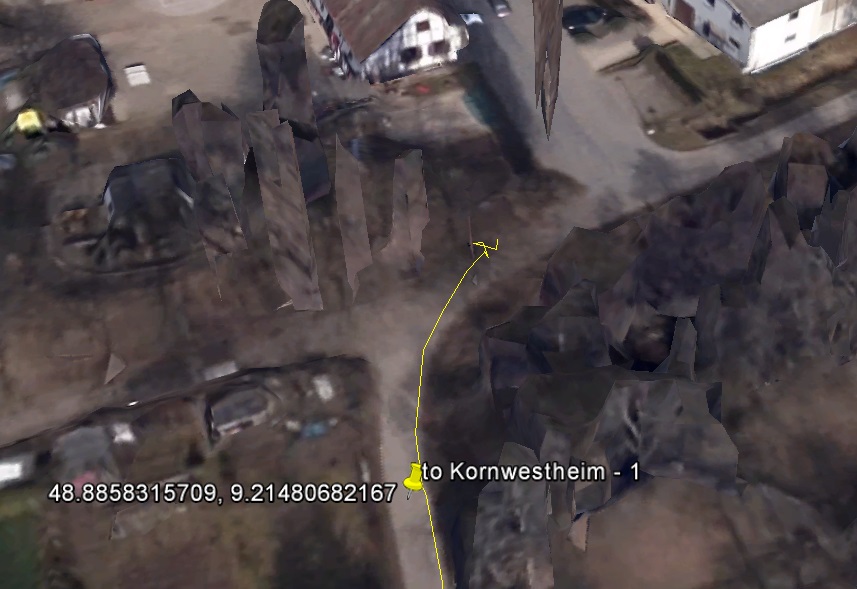
You can see the path I had to take, the gentleman was right at the corner, and the window to the right in the white building at top is where they patched me up.
I then saw that the “house” (top center) was actually a “Jugend Farm” – a youth farm, where kids get a chance to see what living on a farm is like, and get to actually work and get their hands dirty. Interestingly enough, it had a Facebook page , so on a hunch, I sent them a message, and got in touch with Markus, who is the son in law of one of the fellows who’d been involved with it from the very beginning. And it was Markus who took the time to go out and take, and then send me the pictures of what the road looks like now. He stood right about at the intersection and looked up the hill to get this photo:
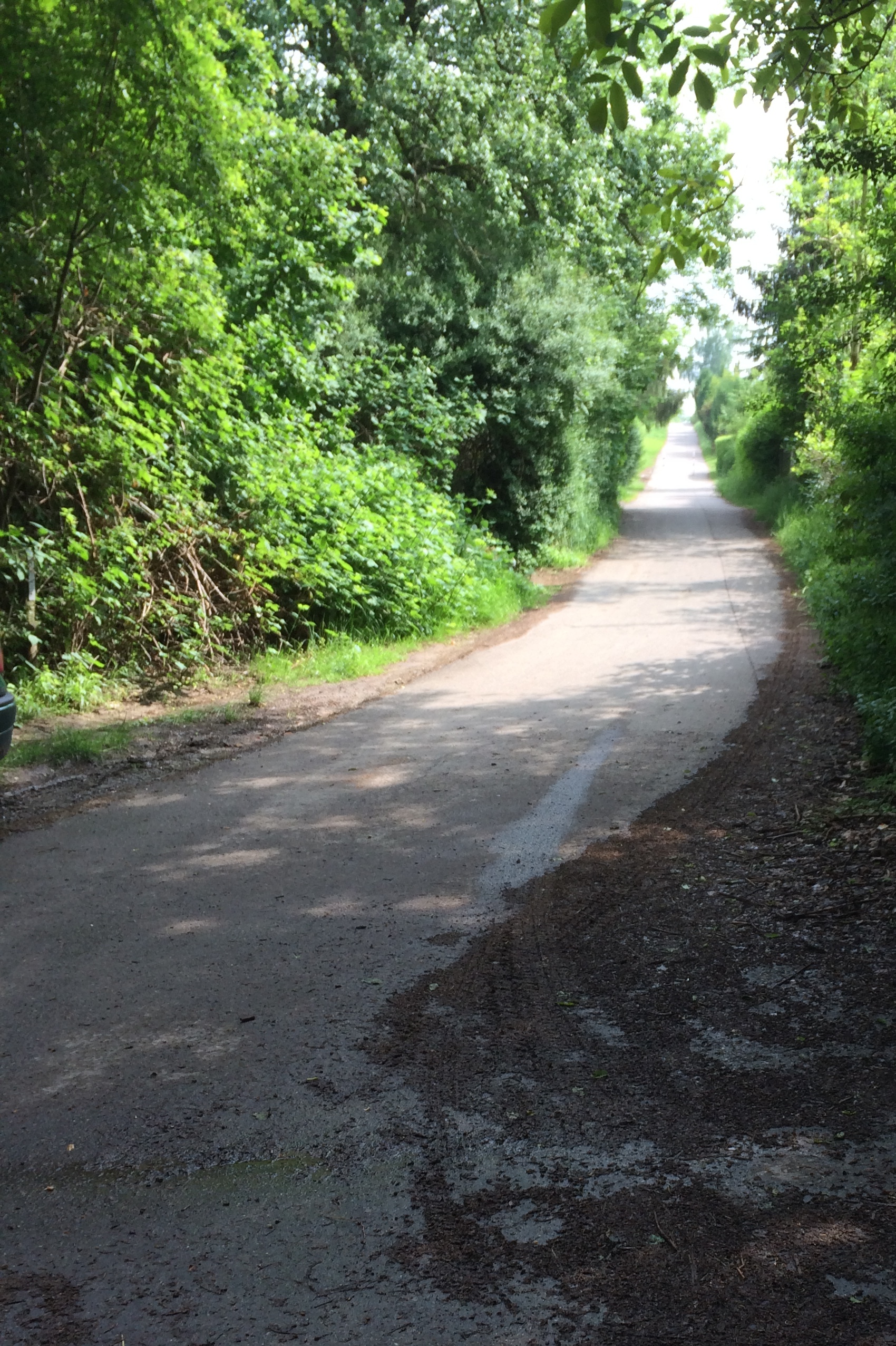
Looking up the hill I came rocketing down. The turn looks gentle from here, but swing left (for the photo below), and take it at speed, and it gets interesting. (Photo by and courtesy of Markus Weimer)
And then he mentioned that they’d replaced the fence a number of years ago, but turned from where he was in the above photo and took a picture of the new fence, in the same spot the old one had been:
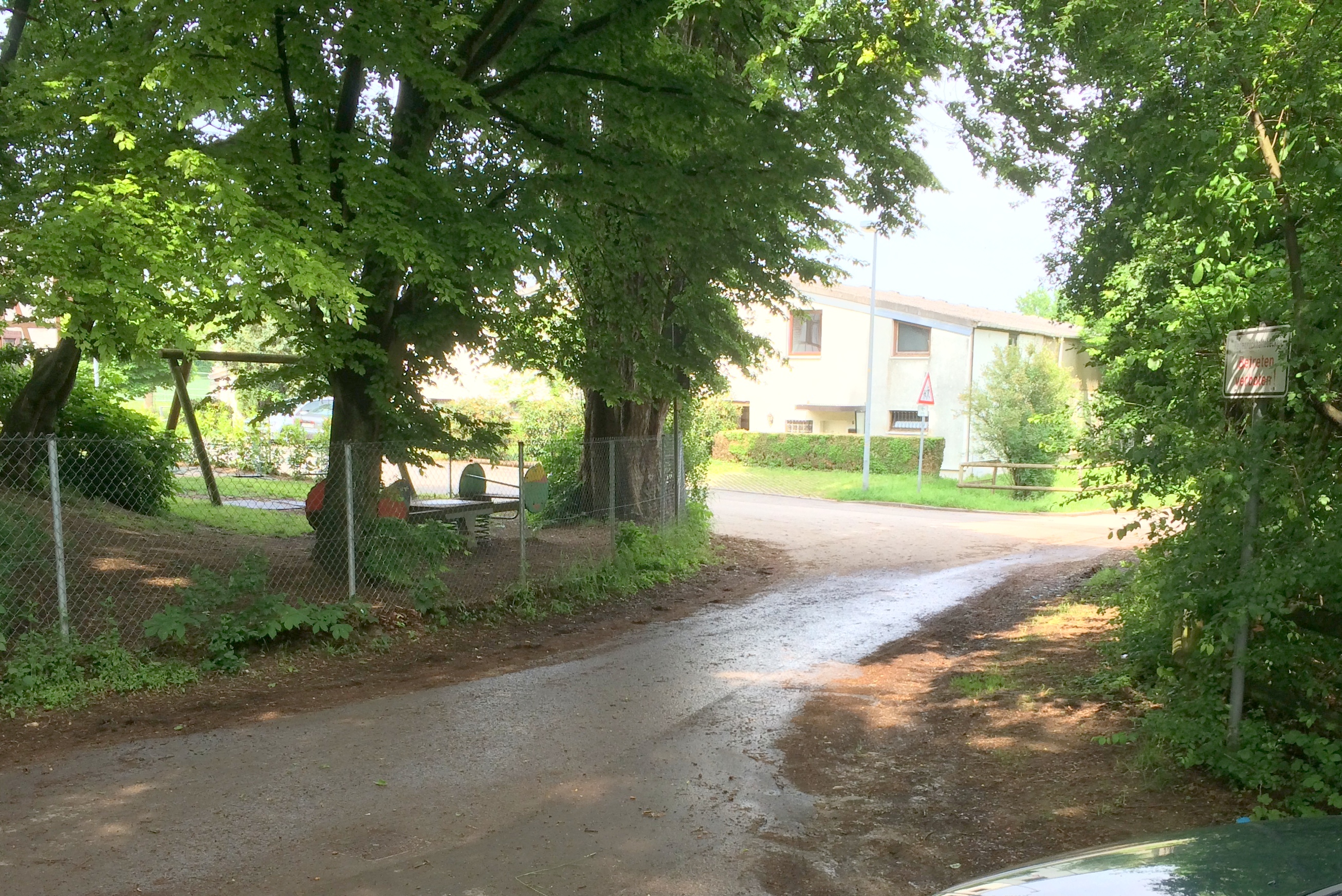
The car in the lower right is about where the old gentleman was. the trees have sure grown up in the years since I was there, but the fence post I bounced off would have been where the one just about dead center in the photo is. The ditch is just behind the fence to the right of center in the background. The building in the background was a field.
For many reasons, I haven’t been back to Germany since that summer, and it’s clearly been a few years since this happened. I wanted to make sure my memory was still accurate, so sent Markus an early draft of this story. He confirmed much about it, and sent me a note with this little bit in it, which, somehow, brought tears to my eyes.
“The building is still there, we are renovating it at the moment. The table is still at the same position right next to the windows :).”
I rolled over in bed and my hand landed on a cold pillow.
That’s not right at any time and it woke me up. I looked around to find that the living room light was on.
At 4:00 a.m.
That was definitely not right, and I stumbled out of the bedroom without my glasses to see what was going on. My wife was sitting there in the chair by the window, curtains halfway open. Eyes red. Phone hanging listlessly in her hand.
“Are you okay?”
“My dad went to heaven a little while ago.”
“Oh, I’m so sorry…”
It was a Monday, and the beginning of what one might call a rough week.
I made some coffee, took the day off work, and shortly thereafter, we were using every phone in the house. My wife checked in with family back east, getting details and helping organize things while I made airline reservations and other travel arrangements to get us all there in the next few days. We’d learn much more later, but it turned out he’d passed away in his sleep. It was how he’d said he wanted to go, so amidst the shock, we were glad he’d gotten what he wanted.
We flew back east to help with some of the arrangements, and had a gathering of family and friends who came to celebrate the life of a man loved and cherished by so many. We learned a lot about family, and about how there are times when you pitch in and help even when you don’t know what do do, or how to do it. Friends and long lost family came out of the woodwork, and amidst all the grief and sadness, there was a feeling of simply being blessed by the presence of the people who were there both in body and in spirit.
There were those who listened, those who made sure there was food for all the people who showed up, and those who shared stories that made us both laugh and cry. I don’t remember all their names, but I will remember how they made us feel, and surrounded by family in the middle of chaos, we felt loved.
Soon it was time to pack up and leave where we had all gathered. We turned to put things away only to realize, to our surprise, that much of the work had already been done. Done by willing hands who offered their help when it was needed, expecting nothing in return. We found that things and people had been taken back to the house. Unbidden, they just did it, and the stories, the laughter, and the tears, continued.
My wife would end up staying for several weeks to help out with the myriad of things that needed to be done, but a day or so later, it was time for me to head west again. To do that, we first had to head east about three hours through a massive rainstorm (<–news video of the storm and flooding) to get to the airport in Detroit.
Once again, the wipers were barely enough to keep the windshield clear, and the storm seemed to match physically what we were all going through emotionally. I had to block the emotion out, I’d have time on the plane to think about things. Right then, I just had to deal with driving and paying attention to what I could see of the road.
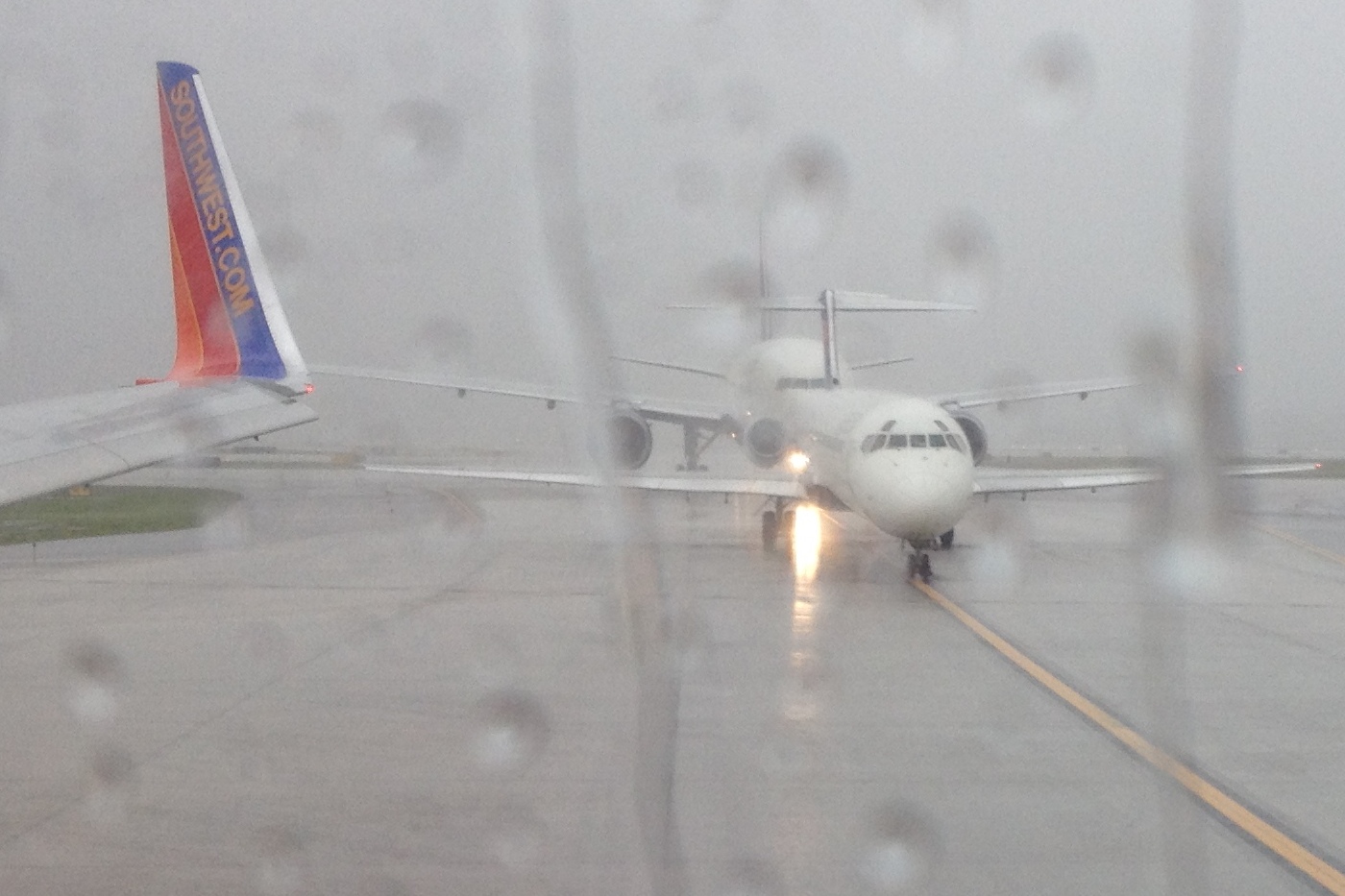
We got to the airport, I got out, managed to hug my sister-in-law, kiss Cindy goodbye and get under cover without getting too wet where I got through the beloved security lines and then to the gate, where it looked like this:
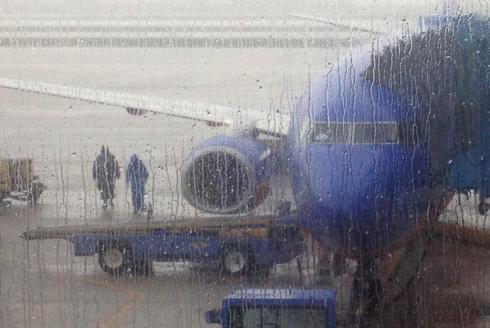
The storm looked and felt like something we’d been through not much more than a month before, so I looked it up on the radar and found this:
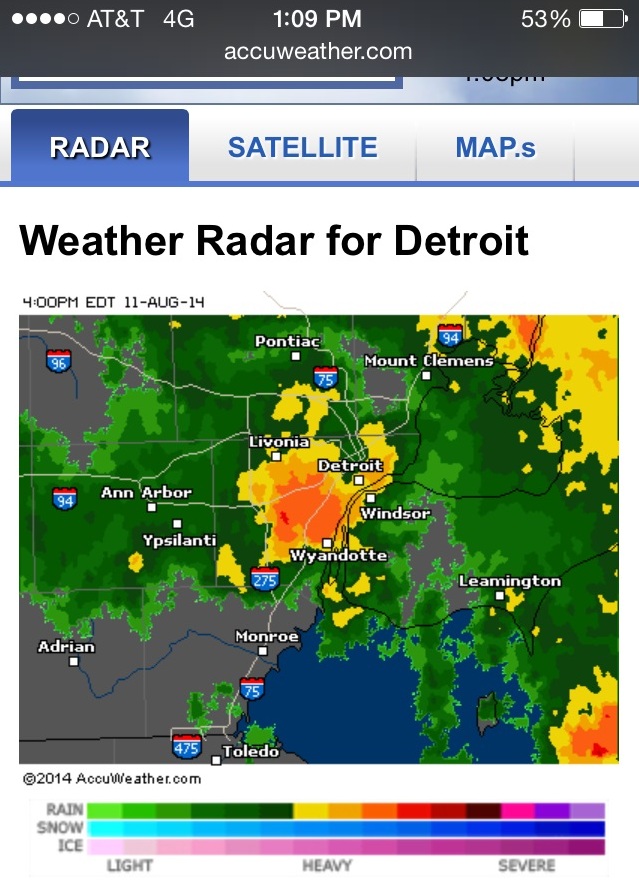
See the deep red dot at the left edge of that orange blob in the middle?
That’s where the worst of the storm was.
It’s also where the airport is.
And where I was.
It seemed fitting.
What’s strange is that right about then I realized something profound in its simplicity:
The reality of the storm we were in couldn’t be changed.
We could only change our reaction to it.
I mean, we could run to stay out of the rain, but we’d still get wet while we were in it.
That realization helped me see the bigger picture of the storm I’d seen through the windshield, out the window at the airport, and on the weather radar coalesce with the storm we were all going through emotionally.
That, also, seemed fitting.
Because of the storm, my wife’s 3 1/2 hour trip back with her sister turned into something closer to 5 1/2 hours. It was raining so hard they had to wait by the side of the road in places because they couldn’t see, much like the people waiting in the last story. I waited with all the others in the airplane at the airport until the worst was over, and finally, we were able to take our place in line and head out.
It took some time, but we finally took off, climbed out of the storm and saw the blue sky again.
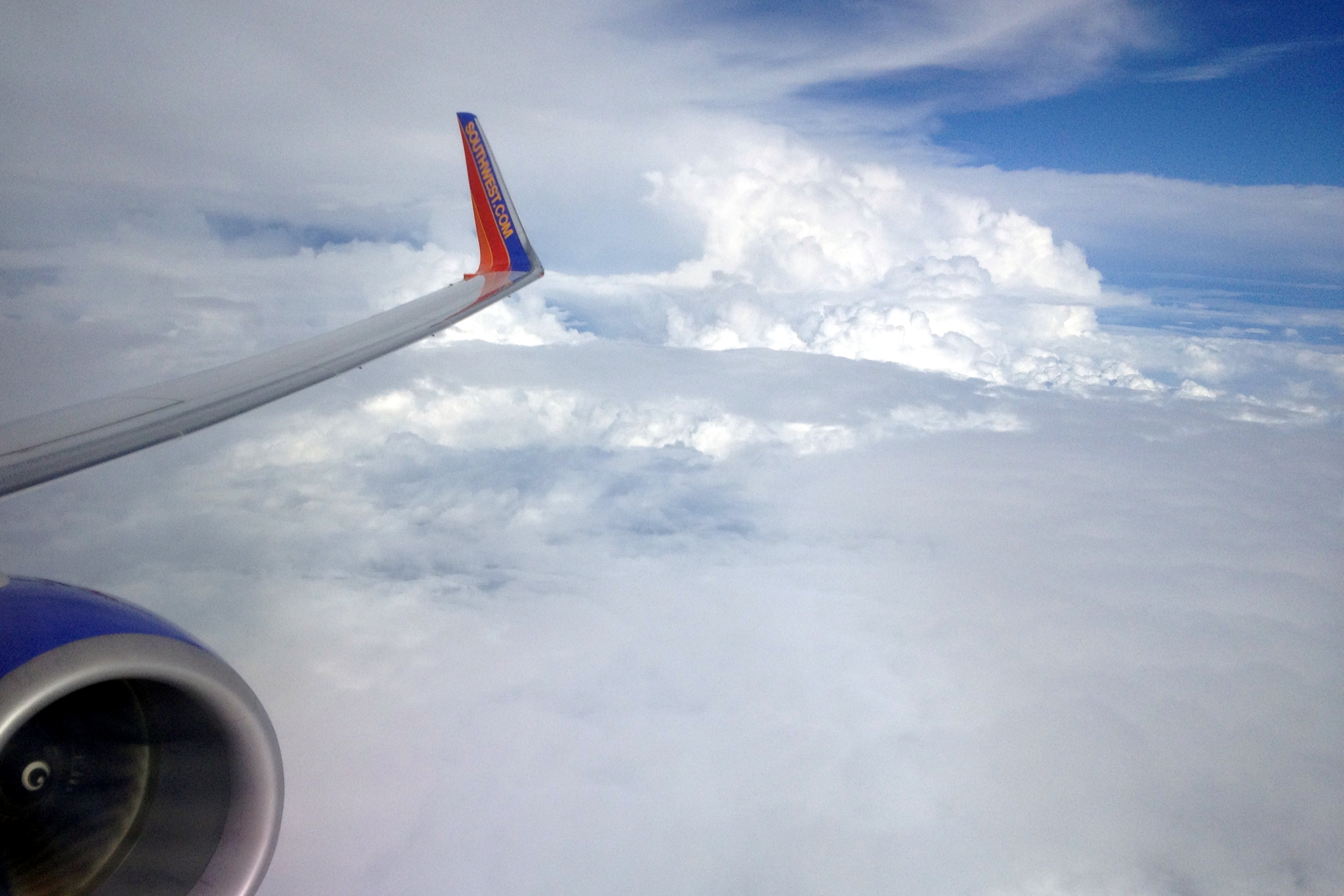
Looking back, I got a different perspective on the storm we’d been through, how we’d gone deep into it, been bounced around a good bit, and then, finally, a sense of, if not clarity, then acceptance…
After a long stop in Chicago, we chased the longest sunset I’d ever seen, all the way to Seattle.
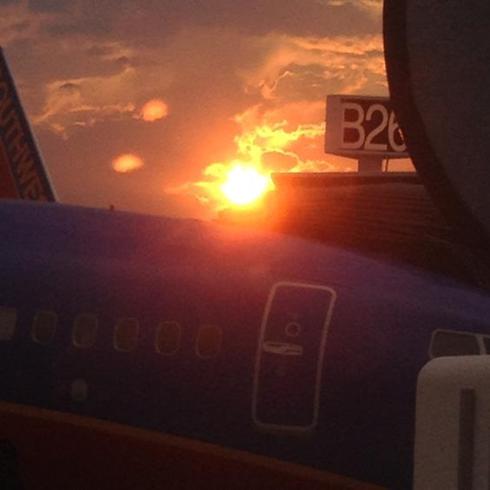
I watched it for hours, most of the flight, actually.
…and it got me thinking…
A lot.
See, what I was leaving behind, was rain, a good bit of chaos, and tears…
But I also left behind memories of a quiet, gentle man who taught not only his kids to play baseball, and who made an ice rink in the side yard for hockey because winters were cold enough to freeze it. Come to think of it, that wasn’t just for his kids, but all the kids in the neighborhood.
I left behind memories, stories of when he’d hunted rabbit to keep food on the table, and the stories of the look of satisfaction he had when he’d gotten a deer in the fall. He knew that meant the family would eat well that winter.
I had my own memories – of when I sat chatting with him on the front porch, looking out over his lawn, the bird feeder, and the maple tree he’d planted as a stick, years ago, the same porch we’d sat on side by side when I asked him if I could marry his daughter.
That had been over 25 years ago.
I looked out the window, lost in those thoughts, and then smiled at one more, remembering when he taught me how to pour coffee, and how important it was to pour it *just right*.
Back in the plane, I looked back a bit, and could see the darkness gaining on us.
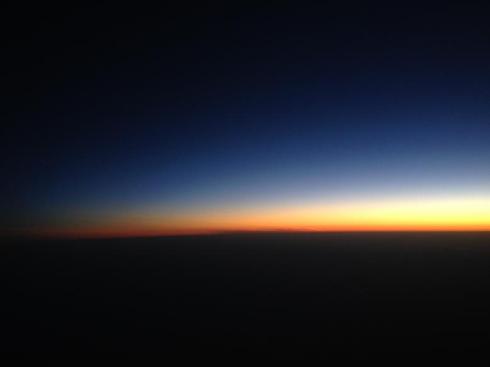
Eventually we had a glorious sunset in front of us, darkness behind us, but the darkness was faster…
And so it goes with all of us, right? Each one of us has a flight to take, one on which there will be rough weather. And beautiful weather.
And at some point – there will be a sunset that we all must face.
I pondered a bit more as the plane was slowly enveloped in the darkness, and that glorious sunset slipped away, replaced with a gray, unearthly twilight.
Looking back again, I could see the moon casting shadows on the clouds. The darkness had its own beauty. It was easy to look down, but I felt a strong urge to look up, to see what the sky looked like at night from this high up, so I slouched down in my seat as much as I could, turned my own light off above my seat, and as hard as it was in that position, I looked up.
And as our plane descended through the turbulence back to earth, the sunset faded, and I looked up into the dark, dark sky. I realized that the beauty of the fading sunset…
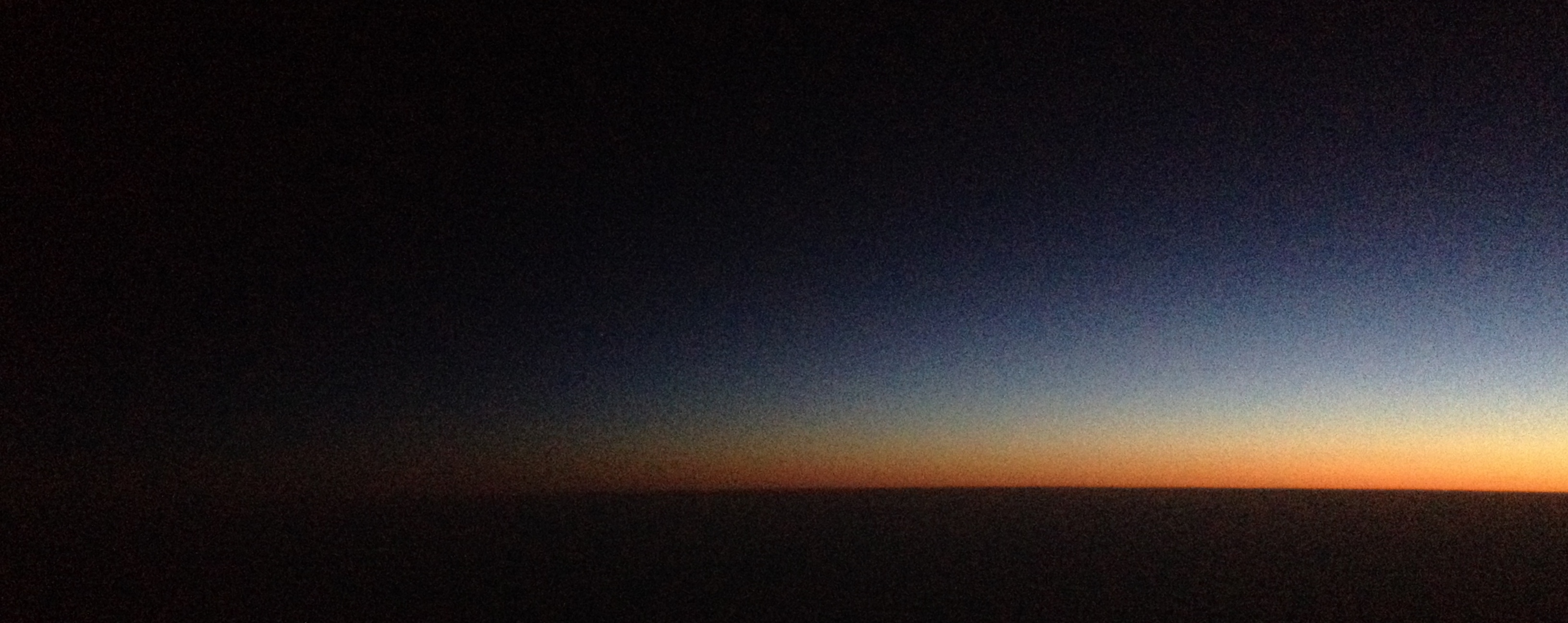
…had been replaced by stars.
It’s Memorial day as I write this, and I’m in a pensive mood…
I was at Chris’s memorial service yesterday, and I’ve been to a few of these lately – and among the food on a table was what appeared to be a rather out-of-place crumpled up McDonald’s bag.
I didn’t think much of it until I heard the story behind it. See Pat, the fellow who brought it, had been best friends with Chris, and they’d spend hours driving around, sometimes in Chris’s tow truck, sometimes not, and as often as not, they would end up stopping at a very particular McDonalds, where the two of them would order 11 cheeseburgers.
The question was asked, “Why 11? And who got to eat six of them?” and Pat said he wasn’t sure exactly where it came from, likely Chris going through the drive through with his truck to get some dinner, a hankering for cheeseburgers, and the clerk asking the simple question of “How many?”
Chris and Pat shared the unspoken question with a look, shrugged their shoulders, and next thing they knew, they had 11 cheeseburgers to share and accompany the conversations ranging from the nature of gravity to the physics of electricity and radio waves as they waited on the next call.
And over time, it became a tradition.
Every time they went to McDonald’s, they ordered 11 cheeseburgers.
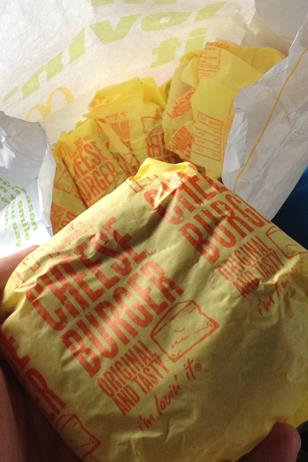
In a bag.
Every.
Single.
Time.
It became almost sacred, the way Pat told it.
And it got me thinking…
I’m in that stage of life when it’s becoming obvious that there’s a changing of the guard going on, where you realize, sometimes slowly, sometimes with a stunning realization, that you’re now the very close to being the oldest generation living in your family, where you used to be able to have conversations with grandparents, parents, uncles, aunts, who simply aren’t there anymore for you to have conversations with.
And with Chris, I realized that it’s not limited to people older than you.
It made me wonder, what kinds of little things will be precious to you when someone close to you leaves this life to live on in your memories?
I really started wondering…
There are friends who know, for example, that I will only call them a butthead if they’ve earned that privilege. (Of course, I have to explain to them that it is a privilege, a badge of honor, to be called that, only then do they get it)
I think of my dad, who I used to simultaneously love and get frustrated with, who loved me as best as he knew how, and I realize I miss hearing his greeting, “Hello sonshine.” Or yelling at us to shut the living room door as we ran out it.
I think of Glenda’s peaceful presence, and her laugh, as she took life, and death, in stride and made it work.
Betty – how we were able to take off the day to day masks we wear to protect ourselves, and just talk about the stuff that really mattered.
I think of people who are still part of my life, and realize there are things that are inexplicably special, things that have become the “11 cheeseburgers” of our lives…
The Grand Coulee Dam.
“How are things in Gloccamurra?”
“Delays, Delays…”
“Butthead…”
Yasuko’s…
A shoe shine kit.
A jar of homemade Quince jelly.
An Egg carton.
A yellow superball.
Sitting quietly with a friend at an airfield, then seeing it from above.
A phone call from a long-lost friend.
A tennis ball cannon made of a bunch of pop cans and masking tape..
An old Saab.
Two rocks, now shiny, that I’ve carried around in my pocket – one since 1997 (my son’s first day of kindergarten) one since 2010 (his first day of college)
“Hey Du…”
A pair of red Converse High Tops.
And so many others.
It’s not what they are, it’s what they symbolize.
Things that in and of themselves, mean nothing to someone who doesn’t share a history with you, I mean, it’s a bag of cheeseburgers… it’s a greeting… it’s an old car.
But for Chris and Pat, it was more than a bag of cheeseburgers – it was friendship, (and it was theoretical physics) and it signified that all was right with the world.
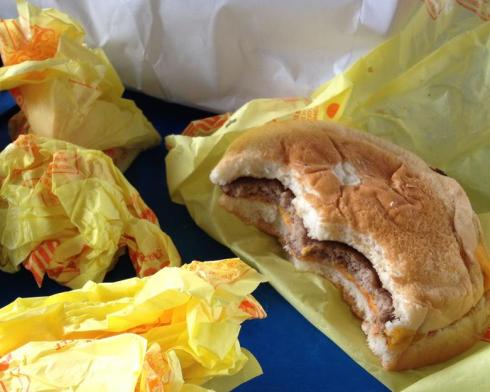
And maybe – just maybe, you’ve got your own version of a bag of 11 cheeseburgers and a bunch of memories.
What are they?
Write as much or as little as you’d like, but I know we all have them, I’d just never seen it done the way Pat did it yesterday.
And as little as I knew Chris directly, the hole he leaves in people’s lives is very real.
There was a time when I wasn’t sure I’d be able to write this story.
I mean that in the most final way that could be possible.
The original was written almost exactly 9 years ago, about something that happened a year before that, and it’s been a learning experience all the way around, so with that, step with me into the time machine, back to a day where I sat in our basement, with my keyboard in my lap, both feet on the desk, and I wrote a little note about those things we’d learned on that first anniversary.
“We’ve learned a lot through this last year dealing with cancer, treatment for it, recovery from it, and the like – and it’s phenomenal the kinds of things you do learn when you find you’ve been to the edge and back.
One of the things I learned, honestly, that life is truly not about the destination, it’s about the journey.
The destination for all our bodies, is likely a pine box or an urn on a mantel somewhere. That doesn’t have to mean that has to be our soul’s destination. Sometimes, when we just spend our time existing, drifting, our soul just shrivels up, and dries up and is blown away like dust. Believe me, I understand that, I’ve been there. But that’s not what life is about. Life is about living – and the life that comes from LIVING (all capitals on purpose) as opposed to just existing – is the difference between black and white.
We’ve found that life now (after cancer) tends to be higher contrast (speaking of black and white) – the highs higher, the lows, lower – and while those lows are definitely lower – the highs more than make up for it, and the stuff in the middle isn’t gray… it’s a… a fine mixture of that black and white. (those are all links to stories I wrote up there)
I found that life, as most people my age tend to think, is not infinite, that “someday” is not a day of the week, and that weekends, while occasionally made for Michelob, might be better spent if you realized there weren’t an infinite supply of them… So walks in the park (or wherever) have replaced being half comatose in front of the boob tube. Trips to visit friends have replaced sitting idly at home whiling away another weekend – and – that brings up something that happened just a few weekends ago.
We went down to Portland (Oregon) to do a couple of things:
1) Celebrate the end of treatment/major phase of recovery and the beginning of going back to work,
2) Visit our daughter, and
3) Visit with some of our bestest friends.
While Cindy drove the car down so we’d have a way to get back on time, our son Michael and I took the train, and I’d learned that if you pay a little extra, you sit in what they call “business class” – so instead of 4 seats across, there were only three, and the seats were wider, two seats, then an aisle, then one seat, and you got discount coupons on the food in the dining car. So we went for the business class. I was expecting we’d get the seats on the right side of the train – where you can see Puget Sound as you go by – and the rows are only one seat wide, and the seats there face each other, which made conversation and stretching your legs out easy. However, when I asked, those seats were full and we got put into “Row 6”.
On the other side of the train.
So we sat there for a bit – and with all the benefits advertised of being on a train, it wasn’t much different than sitting in an airplane – Michael reading his book, me sitting there, kind of cramped – and right about then, there was an announcement that the “Bistro car” (apparently what’s replaced the “Dining Car”) was open. I figured that since it was dinner time, and we had those coupons for the food, we should get up there before the line got too long, and so we did, standing there, swaying back and forth as the train trundled down the tracks.
After a bit of that, we got our food… Michael a hot dog, me a chili (which I spilled later, but that’s another story), and sat down at this little table, and talked, and ate, and read, and laughed, and watched the scenery, and played a game, and in general were having a good time all by ourselves.
…which was when the girls showed up.
A 12 year old and a 14 year old – they’d just met on the train themselves, were bored, and ended up sitting across the aisle from us, and started to try to make up a game. Michael and I were playing our own game by that point, and after I stomped Michael once, and he stomped me once, even worse, he felt he’d had enough, so I said, “Hey, why don’t you go over there and teach them how to play”
“Oh, I can’t do that…”
“Sure you can, what have you got to lose?”
“If you don’t go over there, it’s as good as them having said no, and you’ll have learned nothing.”
“If you do go over there and embarrass yourself, chances are you’ll never see them again, so you’re not risking much.”
“However, if you do go over there, and it works, then you’ll have the next hour and a half to spend time laughing, having fun, and making memories.”
“So really, what do you have to lose?”
After a few minutes of pondering, he went over there. Big, hulking Michael, went over and in his suave, sophisticated way asked, “Hey, wanna learn how to play a game?”
The girls loved it.
Oh, gosh, did they love it.
And, come to think of it, I think Michael did, too.
One of them got a deck of cards, and while the 14 year old was playing, learning and laughing with Michael, the 12 year old taught me a card game called “Spit” – involving faster reflexes than adults can possibly have (and that children playing games against said adults should be allowed to have). She blew me away. Then she decided to go easy on me and asked if I knew how to play “War” (each of you gets half the deck, and you each put a card down, whoever’s card is highest wins both cards. The winner is the one with all the cards). I thought I’d shuffled the deck well. Turns out I couldn’t have shuffled it much better (for her), because by the end of the first hand, she had all but two of my cards. The sound of her laughter was like the joyful ringing of a bell, and told me that even though I was losing the card game (Losing doesn’t come close – annihilated is more in the neighborhood), I was winning something much larger. I realized that if I had to ‘lose’ a game in order to bring that much laughter and joy into a child’s life, then I’d happily lose the game.
Every time.
It was at that moment that I realized that the high pitched laugh of hers had a bass line – and I looked across the aisle to find that Michael had his opponent on the ropes, so to speak, and was laughing uproariously at his position in the game.
I thought about this at the time – about how before all these realizations, before cancer, I might have just stayed there in my assigned seat because it had cost me $12.00 extra a seat to get those extra wide/comfortable ones – and by God, I was going to sit there and get my $12.00 worth of enjoyment out of them if it killed me.
But…
I didn’t.
I realized that for us to enjoy the journey the way we had, we had to get up out of our comfortable seats where they were showing a now long forgotten movie, and go up to that Bistro car, where there were no reservations for us, and no assigned seats. It was a risk, a small one, but the rewards were so well worth it. Getting up, and daring to get out of our comfort zones and living life, instead of life living us, was obviously the thing to do, for Michael, and for me.
Suddenly, before we were really ready, the call came out “Next stop, Vancouver”. One of the girls got off, and then 10 minutes later, we got to Portland – and the other little girl just disappeared into the river of people pouring out of the train. We joined the same river and spilled out onto the platform.
We stopped, the crowd thinned, we looked around, and at each other, and realized we were at our destination.
Having truly enjoyed the journey.
===
As I said, it’s been 9 years since I wrote that, and 10 years since the phone call that started it all.
We had no idea what the future would bring then. We had no idea how hard some of it would be, or how unbelievably cool other parts of it would be. Most surprising was how we would feel a peace about things through all the terror that made no sense, given what we were going through, but we also felt that that peace we were feeling was directly related to the shield of prayers our family, friends, and even some strangers (who became our friends) kept over us.
But back on that day, I remember that the doctor had said he would do his best. He’d remove what he could remove, and try to save what he could. And that little bit got me thinking the ‘what if’ thoughts that you try in vain to push out of your mind, but that wasn’t an option, so I went out that morning, while the sun was still low, and while the grass and dandelions were still wet, and I walked barefoot in the grass – trying to imprint that feeling, that memory into my mind, because I wasn’t sure I’d be able to repeat that when I came back.
To say I was a little nervous about the whole thing might be understating it a touch.
I came back in, changed, and we left the house. I drove, and after getting all prepped, we were able to convince them to let me take a CD player and some headphones in so I could have something to listen to after the surgery. My favorite composer is Johann Strauss, and so that’s what I wanted to hear, that would be my subconscious signal to myself that I’d made it through that part of it.
I remember being wheeled into the operating room. They stopped, I saw all the equipment they had, as I groggily looked over at the table I’d be laying on…
…and heard…
Strauss? YES! It was Strauss!
I’d made it.
I wiggled my toes, on both feet, and as I drifted back to sleep, I knew that as hard as the road ahead may be, it was going to be okay.
===
There are many, many people to thank here. If I thanked you all, it’d sound like an Oscar speech. But this is not the kind of thing you go through alone. It changes you. It changes those around you. So for those of you prayer warriors who helped hold up that shield up over my family and me, and to God who provided it, I thank you. We thank you. For those of you who brought meals when we needed them, or fixed plumbing, or mowed the lawn, or sat on the front porch in the shade, in the breeze, with a cold bottle of Sprite and just chatted and listened and distracted me for a moment… Thank you. For the medical staff (doctors, nurses, and vampires and staff – you know who you are) who’ve been with me through thick and thin, we thank you profusely.
The reminder that life is short, and the journey has no guarantees, is ever present. Hug your loved ones when you can.
And speaking of loved ones, there’s my family, who’s been along for the ride, hard as it’s been at times…
There are no words strong enough. Thank you barely scratches the surface. <Hugs>
PS…
I went out in the front yard this morning as the sun came up…
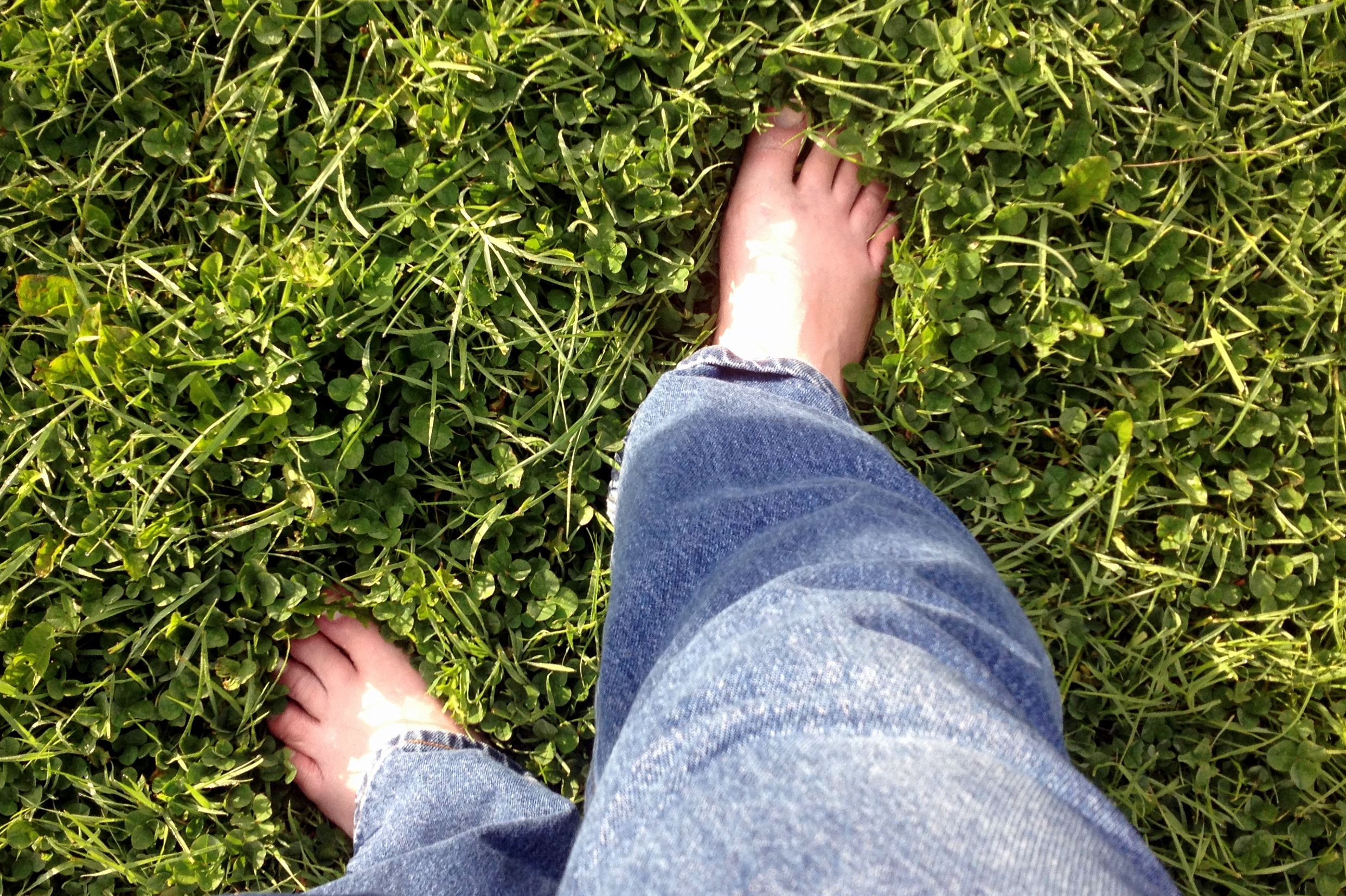
…and felt the dewy grass on my feet…
And smiled.
Hey all,
It’s been a bit since I wrote, a lot of life has happened, a lot of changes, a lot of storms, if you will, and it reminded me of a story that happened a number of years ago that involved a USAF C-130 and yours truly.
If you’ve ever seen a military airplane, chances are you’ve seen a C-130 Hercules. It is the short/medium haul workhorse of militaries all over the world that’s been in service for over 50 years. The Navy’s Blue Angels have one from the Marines they call “Fat Albert” that carries the maintenance and support crew to keep all the F-18’s flying.
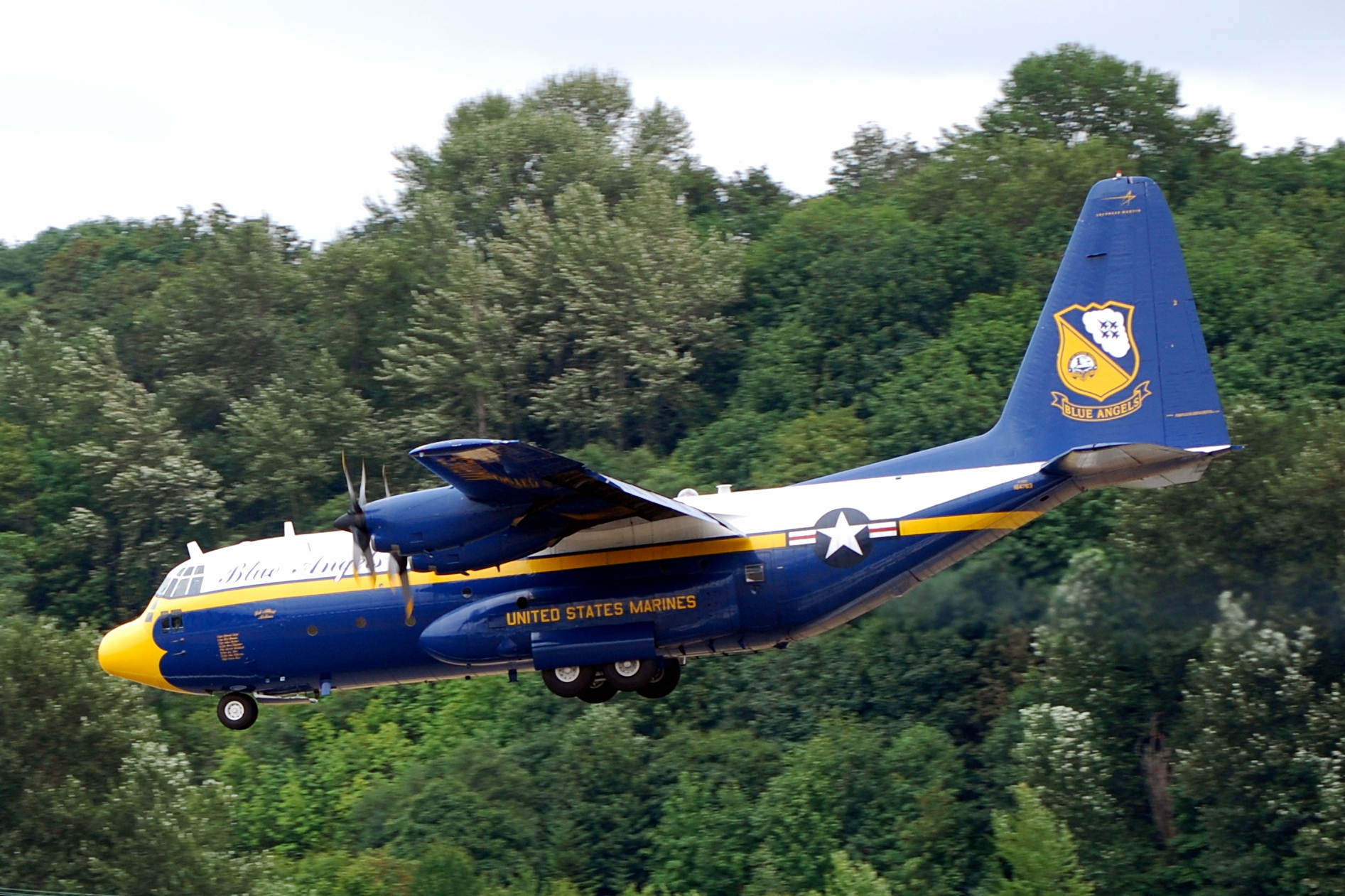
A C-130 landing just a little better than I did.
I’ve been in a couple of them, flown over some amazing countryside (Mount Rainier – I’d have pictures of that but I dropped the camera while I was in the cockpit a few thousand feet over Elbe and broke it – the camera I mean) and been in one that was dogfighting with another one (story to come later), but the one that I remember most is the one that never left the ground.
See, back when I was in Civil Air Patrol, one of the senior members of the squadron, Steve, was also in the Air Force, and he worked just across the parking lot from where we met every week.
What was cool about that place across the parking lot was that it housed two multimillion dollar full motion simulators, one of which was the one for the venerable C-130.
What was cool about Steve is that he did the same thing in the Air Force that my dad did years earlier – he worked flight simulator maintenance. Understand, folks who work in maintenance aren’t the people who get the glory. They’re not the ones with high ranks or fancy titles. The people who work maintenance, however, are like the janitor of the school you went to. They have to be able to fix anything.
And to do that, they need to be able to get anywhere.
And to do that, they have to have keys to EVERYTHING.
And Steve, so to speak, had the keys to the C-130 simulator.
Now since he worked maintenance, he had to be there all the time, just in case.
There were quiet times during his day when the simulator wasn’t scheduled – and of course, over time, I learned what those times were, and just ‘happened’ to show up pretty consistently about then.
Over the course of one summer, Steve let me fly the thing – I did the math some time back, and I think I had something like 40 hours in it over those three months.
I learned how to start the engines, how to taxi out to an imaginary runway (Steve would play the part of the air traffic controller and give me directions over the headsets from outside), and then Steve taught me how to take off. Now understand – all this is in a full size, full motion simulator that’s an exact replica of the cockpit. You hear the engines. You feel the vibration of the engines. You literally feel the bumps in the pavement you’re taxiing across. It would even have the nose dip as you hit the brakes to stop at the end of the runway before starting your takeoff roll, where you’d feel the bumps in the pavement going by faster and faster, until when you pulled the nose up, you could actually *feel* the nose gear lift off – it smoothed out because it wasn’t rolling over pavement anymore. Then there were the checklists to make sure everything was done right. Landing gear had to come up as soon as the plane was actually climbing. Flaps came up in stages as the plane accelerated, and so on.
The one thing it didn’t have was any type of visual display, so because of that, when I learned how to fly, I learned how to fly on instruments only.
I learned that the controls felt mushy at low speeds, and very stiff at high speeds, and at those high speeds, you wanted to keep the little g-meter in the bottom left of the instrument panel very happy. Overstressing that little thing could cause problems
I learned all that before I ever looked out of the cockpit of a real airplane, and the funny thing is – I learned how to fly the plane not because I had to, but because it was fun.
After some time, Steve let me just play a little bit, and I actually got pretty good at running through the checklists to start the engines, the pre-taxi checklist, the pre-takeoff checklist, after takeoff checklist – really, there were a lot of them.
One day Steve had most of an afternoon with no one scheduled in the simulator, and I happened to be there, so he decided to have some fun. He taught me GCA’s – or Ground Controlled Approaches – which you do when you can’t see the runway, and the airport has equipment you don’t have. Basically you’ve got two radio beams that intersect like a cross, coming from a couple of transmitters at the end of the runway. One shows you on the right glide slope (both approaching and descending at just the right speed), while the other shows you on the right glide path (coming down on the centerline of the runway). Your job is to keep the plane at the center of those two radio beams– you’ve got someone on the ground tracking you, and their instructions to keep you in the center are short and to the point: “Flight 279, GCA, 3 miles out, on glide slope, on glide path” (what you want to hear) versus something like “Flight 279, GCA, 2 miles out, 500 feet left of glide path, 200 feet below glide slope”. You’ve got a lot of correcting to do in the two miles you’ve got left, flying at about 130 mph, you’ll cover that in less than 30 seconds, while trying to find the end of the runway, which is at the other end of those radar beams. Remember, if you’re doing a GCA, you’re only doing it because you can’t see the runway. This is rather important because usually the runway is the only flat space big enough to land on.
It was clear that Steve had a little bit of fun being the GCA Controller, so one day he decided to take it up a notch… He stepped into the back of the simulator where the instructors usually sat – where they had all sorts of evil controls to mess with the crew being trained, and played GCA from right there instead of from his usual console outside the simulator.
I had the headphones on as usual, and he decided he’d give me what started out to be a normal approach. I’d had the flaps down to 50% as I needed to have them for that speed, and then he started dialing in some turbulence to make it a little more challenging.
Ever flown through turbulence in an airliner?
This was just like that – all the sounds, the full motion in the simulator, it was just like you’d expect to feel it in a real plane, just as bumpy, just as uncomfortable, and it suddenly dawned on me that the barf bags in the cockpit weren’t there for decoration.
He gave me gentle instructions: first just fly the plane with the turbulence randomly and dramatically trying to flip it right, left, up, or down. My goal was to keep the wings level, and keep it aimed to 340 degrees North-northwest, the same heading as the runway.
Then, when he felt I had that mastered, he decided to transition in a GCA controlled approach, meaning I had to not only keep the wings level and keep flying the plane in the storm, but manage all the procedures that were part of landing the plane.
He added wind gusts that varied from headwinds (which suddenly gave me much greater lift) to tailwinds (which suddenly meant the plane wasn’t flying through the air fast enough to generate enough lift to keep it from falling out of the sky).
Somewhere in there I realized that not only did I have that voice in my headphones to guide me, I noticed that there was an instrument on the panel in front of me that, every time I heard the message, “On glide slope, on glide path” – made a little plus sign, a little cross. It turns out it was what’s known as an ILS, or Instrument Landing System – which is a miniaturized version of the GCA. Instead of a radio and someone in the tower, it’s an instrument in the airplane.
See, the GCA is something external to the plane. . It’s sending a – kind of a cross of radio beams out, and they can tell where you are in relation to that. They will tell you what you need to do to be able to land safely.
You don’t have to have anything but a radio, tuned to the tower frequency and you just have to do what the voice in the headsets tells you to do.
The ILS is a miniaturized version of the GCA. It depends on that same kind of radio beam, but is internal to the plane. Just like a compass always points North, which is a good reference point, this always keeps you pointed toward your goal, which is finishing your flight safely, on the runway. All you have to do is pay attention to it, and keep the little cross centered in front of you, and you’ll reach that goal.
But – meanwhile, back in the cockpit, knowing what the right thing to do and actually doing it were two different things. Steve was having fun and incrementally dialing up everything, making the plane climb, bank, and turn, and fall out of the sky all at the same time. It got to the point where just trying to keep wings level, much less doing something complicated like “keep the wings level and the pointy end facing front” was an astonishing challenge. The descent rate wasn’t even averaging the 500 feet per minute descent I was supposed to be trying to do on at that part of the approach.
I thought things had gotten as bad as they were going to get, and was really working up a sweat in there… It was no longer a simulation, for me it was real.
And that’s when Steve dialed up the turbulence to the point where I was in a full-fledged storm.
I wasn’t panicking, but I was working pretty hard to keep things under control, and was concentrating so hard on keeping wings level, keeping the descent rate right, keeping it on glide slope and glide path, that I was caught off guard when Steve suggested I might look at the oil pressure of the number 3 engine.
It was falling.
Imagine your check engine light coming on in your car. You just pull over and – well, check your engine.
Interestingly, that’s exactly what I was trying to do, but had to wait till I had a successful landing behind me.
So I had to slow that engine down, but I couldn’t just pull back number 3. By now the flaps were down, if I recall, at 50%, and the air each of the four propellers pushes over the top of wing, especially with the flaps down, creates a tremendous amount of lift. So if you’ve got two huge propellers blasting air over the left wing, and only one on the right, that left wing will produce way more lift – which complicates things and needs to be considered in everything you do from there on out. So I throttled back not just number 3 (inboard engine on the right wing) but also number 2 (inboard engine on the left wing) to keep the power and lift balanced, with the hope it would last long enough to get us to the ground safely. Complicating that was the fact that the inboard engines blew air over more wing and flaps, and helped create more lift than the outboard ones. There was a good bit to think about in all of that.
Steve was impressed, so he held on to the handles mounted for the instructors in the back of the simulator, and dialed the turbulence and the mechanical problems up even more. He added what I now realize were wind shear and microbursts, meaning my airspeed would vary, causing my descent rate to range from “climbing like a homesick angel” to “falling out of the sky like an anvil with wings”.
I brought the flaps all the way to 100%, which increased lift, but also increased drag, slowing the plane down, requiring extra power (which I didn’t have much of) to stay in the air. While I was working on the approach checklist, and right as I’d gotten getting the gear down, increasing the drag yet again, and requiring more power to overcome, Steve was slowly dialing the oil pressure down in number 3, and eventually I had the engine in flight idle (lowest speed I could set it to).
At this point, my options were getting even more limited, because not only did the oil pressure keep going down, but the temperature started going up.
That’s when Steve added the smoke – real smoke in the cockpit. I have to tell you, if nothing else had my attention, the smell of hot oil on top of everything else did.
Number 3 didn’t show that it was on fire, but it was showing it was overheating, and it was clear that running out of oil to keep it lubricated and cool was going to guarantee a fire, the only question was if it’d happen before I got to the ground or after. I realized there was only one thing I could do to keep that from happening, so I reached up above the windshield, between the empty copilot’s seat and mine, and flipped the switch to arm the fire extinguishing system. I feathered the prop and pulled the fire extinguisher handle, shutting that engine down, and if nothing else, preventing a fire.
That solved one problem, but created several more.
I was still trying to land in a storm, but now I was down 25% of my power, and I was right close to stall speed.
That was when Steve decided to up the wind shear a bit, and I felt the plane lurch, then saw the instruments show I’d gone from a headwind to a downdraft and I was sinking fast.
Sinking fast when you’re flying is not a good thing.
Sinking fast when you’re almost not flying is a very bad thing.
Sinking fast when you’re almost not flying, close to the ground, is a sentence that often has a fireball for a period.
I simultaneously slammed the remaining three throttles to the firewall, and turned the yoke all the way to the left and stomped on the left rudder pedal to try to balance out the asymmetrical lift and thrust I knew I’d be getting because of number 3 being out, and stopped sinking.
In spite of that, it moved me to the right of the glide path, so I banked left (which is actually hard to do since I had more power and lift from the left wing) and had to get back on the glide path, just as I heard Steve’s calm voice inform me that I was below I was 200 feet right of glide path, and definitely below glide slope.
All the while, Steve watched from the back, saw that I was close to making it, but I still wasn’t out of the weather, and just as I was about to touch down, I got another hard gust from the left. I firewalled the throttles again to try to keep from hitting too hard, but we were too close to the ground for it to help enough in time. I did hit hard, felt and heard one of the tires in the right main landing gear go, pulled all three engines to ground idle, then the standard thing to do would be to lift all the throttles straight up, allowing me to pull them back further, changing the angle of the propeller blades so they’re blowing air forward to slow the plane down once it’s on the ground, not backward to keep it flying.
Had I done that with all three remaining engines, I would have put two engines on the left wing and one on the right into full thrust reverse, adding “pirouetting down the runway” to my list of accomplishments on that flight. I decided, instinctively to let my middle finger loose and leave the number 2 engine in ground idle and reverse numbers 1 and 4, which slowed the plane down without the pirouette until I was able to use the brakes and get off the runway.
Once everything was shut down, Steve looked at me with a huge grin and said, “Well done! I’ve had trained pilots in here that didn’t handle that as well as you did!”
It made me smile, sitting there, back all sweaty against the pilot’s seat – slowly starting to shiver from the abundance of adrenaline and the air conditioning I was just now starting to feel.
He’d said, “Well done!”
It’s said that any landing you can walk away from is a good landing – and this one was one of them.
We talked for a long time after that flight, and as I’ve been writing this, years later – I’ve found that as with many of these stories, it got me thinking…
The whole thing about this adventure we call life is like that adventure in flight in that simulator.
There are times when our lives are CAVU (Ceiling And Visibility Unlimited). Times when you are as free as a bird, where not only the valleys we struggle through, but the mountains and clouds that seemed so high, are now beneath us.
Those are times to cherish, because in those times, you gain perspective, understanding, and wisdom. You’re able to see the other side of the clouds, the side where the sun always shines.
Other times, life throws us into storms, and the things we hold dear, the things we depend on for support, for power, for strength are shaken to the core. I got to thinking about those engines, and the one that was causing trouble and catching fire trying to land in that storm – and I had to just let it go and shut it off, then figure out how to go on without it.
Those aren’t times where you gain perspective.
Those are times where you gain experience.
And we need both.
It’s the transitions that are often challenging.
We have to compensate for things that have been damaged, and flying through the storm becomes quite a bit harder when we lose things we depend on.
I realized that while I’d learned how to instinctively fix something while still compensating for my weakness in the simulator, (slamming those three throttles forward when I really needed four, and stomping on that left rudder while turning hard left to keep the strength I did have from pulling me off course), that that’s a constant lesson in real life.
I got to thinking some more about it all, and how hard flying through that storm was… You couldn’t see anything out the windows of the simulator – it was nothing but instruments – but if you were flying in a storm, you wouldn’t see anything anyway.
…and that, sometimes, is what life is like…
It feels like we’re flying blind, but only if we’re straining to find something in the murk outside…
If we look inside, at our instruments, if you will – there’s more clarity, and while doing that GCA, I had that voice in my headsets guiding me along that cross in the radio beams, and that dotted cross on the instrument panel, and the third one over the top of that, guiding me on the inside. When I was where I was supposed to be, the three crosses became one. I learned that if I focused on that cross, and listened to that voice, it would guide me through any storm.
It was a lesson in trust.
I couldn’t trust in my own instincts. Even when the storm headwinds caused me to go higher than I wanted to go, or the tailwinds caused me to sink lower than I wanted to be, even with that engine threatening to burn a wing off. Being so close to the ground and so slow that any mistake could be the last one, hard as it was, I had to trust.
Getting too far to one side or the other for too long, and pretty soon it’d be impossible to correct for in time even if I made a massive correction to try to get to the runway, so I needed to trust.
As easy as it is to let the storms of life blow me off course, and as hard I know it can be to struggle during those times when I don’t have perspective but I’m gaining that experience, I know that if I keep that cross centered in front of me, and keep listening to the voice in my headphones guides me when I can’t see it, I’ll be okay…
And just like I didn’t finish my time in the simulator unscathed, I haven’t made it through this journey we call Life without a few scars, none of us have. I remember Steve’s words after I landed, after I finished, “Well done!” and the smile and peace it gave me. I pray that at the end of this longer journey, I’ll be able to hear those same words again, from another Voice, “Well done…”
Take care folks – and for those of you who celebrate it, have a wonderful, blessed Easter.
I can’t believe it’s been five years already, but it has.
A few years ago I had occasion to meet someone on a regular basis, daily, for several weeks.
We were both going through some hard times, each fighting off some pretty harsh demons, as it were, and as we sat there, over time, each going through our own battles, we became friends. Her name was Cecily, and as the days turned into weeks, our conversations deepened, and we talked about our families, and challenges, and the struggles we were facing and overcoming.
It turns out that our opportunities to meet each other daily ended about the same time, and we kept in touch for a long time afterwards. On rare occasions, we’d meet at a Jamba Juice on checkup days for all their healthy things and just catch up on life. It was neat doing that, meeting near a place that had both caused and absorbed so much of our pain, and not having to actually go there. We talked, and we laughed. I remember for awhile she talked about her sisters and how they were helping her get a bunch of firewood for the winter.
It was a good time, just chatting.
Sometimes, when we couldn’t actually get together, we’d call or email, and just chat and check up on each other, again, asking about the families and getting back to work, and just life…
And that was fun, too.
But one day I realized an email I’d sent hadn’t been answered in awhile…
And phone calls were going to voice mail.
I left message after message, and got no answer on her office phone.
And then that stopped, too.
Over the course of several months, I tried and tried, and finally decided to simply call her main office number and get the main switchboard there, to see if I could find out why she wasn’t answering her phone. I talked to a very nice receptionist who clearly had very little history with the company, and I asked for Cecily.
She checked, and I heard my heart beating louder in my ears as she said, “I’m sorry, there’s no one here by that name…”
But I wasn’t going to give up, so I tried her cell phone…
And kept trying.
And trying…
And trying…
Then they stopped going to voice mail even on the cell phone, and went to the dreaded recording of “The number you have called has been disconnected or is no longer in service…”
I did the thing I didn’t want to do, facing what was becoming a reality, and found out why she wasn’t answering her phone or email anymore in the last section of the paper I wanted to find her in.
Cecily, my friend, my pal, my radiation buddy, as she called me, was gone.
I found her mom’s number – it took a bit – and I talked to her for a long time. We talked about her daughter, and we talked about my friend, and it turns out that Cecily’s mom knew all about me. Cecily had talked to her mom about her friends, and I was, and am, very honored to have been one of them.
So Cecily – It’s been five years, but I still think of you, that smile, that laugh, that indomitable spirit. I’m glad to have gotten a chance to know you, and I raised a glass at Jamba Juice in your memory.
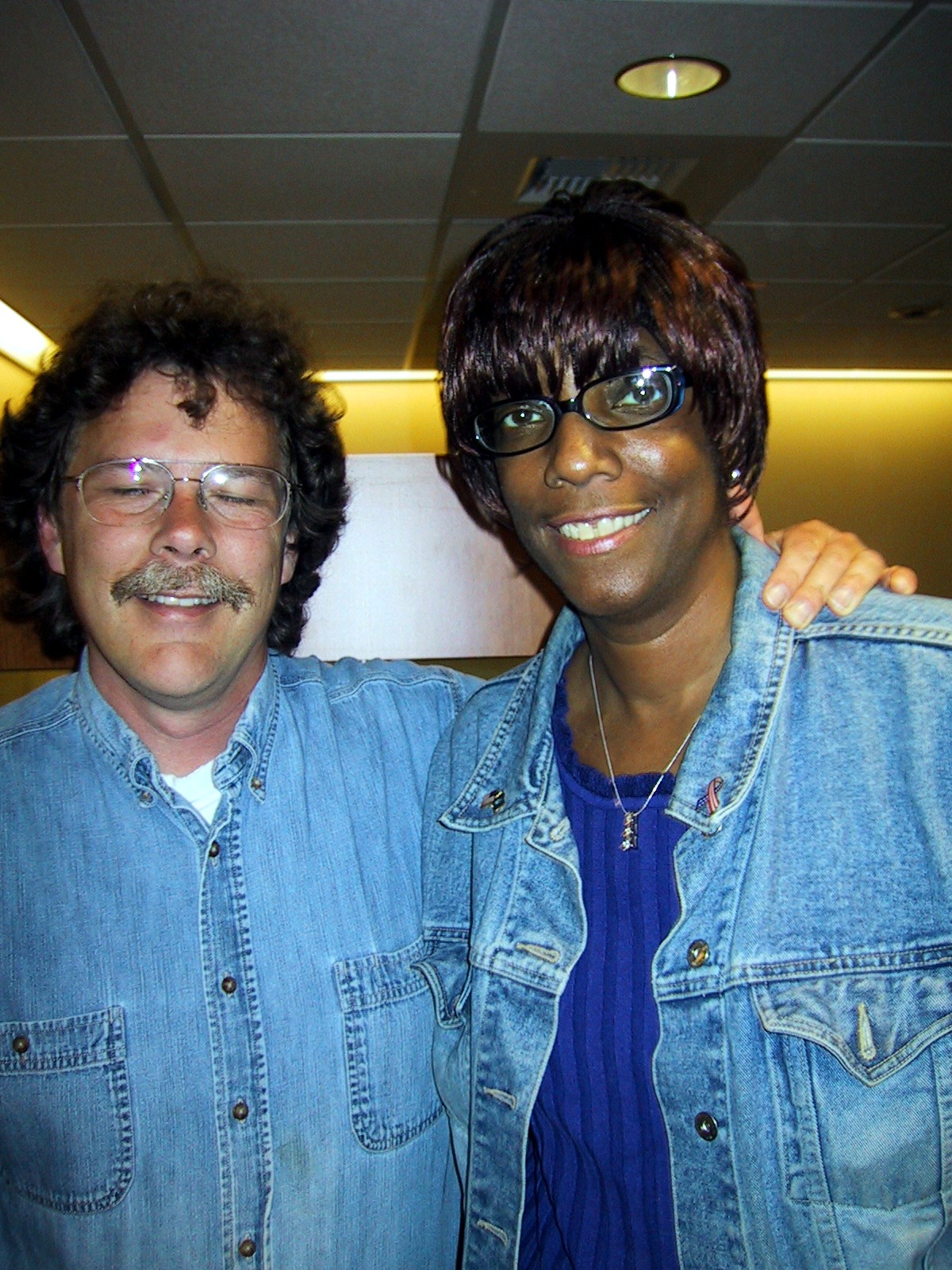
My friend Cecily and me, with one of my trademarked blinks…
God bless…
I went for a walk with a friend the other day, and on a whim, wandered down toward Pongo’s house.
And, to explain the significance of that – I have to go back a few years for most of you…
If any of you remember high school, you know how it could be a tangled up knot of stress, from the academics, which were hard enough, to the social aspect, where everyone was trying to figure out where they fit in the overall pecking order, to the after school stuff, where you often found out where you stood by being on the receiving end of some of that pecking.
I remember when I was in high school, the first thing I wanted to do when I got home was to pet my dog, and play with him, and scritch him behind his ears, and I could just feel that knotted ball of stress from school slowly unwind. It was amazing how beneficial having a dog could be right after school like that, and although we didn’t have a dog when our son was growing up years later, he found one anyway, right when and where he needed one.
And the dog he found had started out life as the runt of the litter in a cardboard box of puppies, being given away in front of a Safeway store in Bremerton, Washington. Pongo was suspected of being a mix of something Australian, a bit of shepherd, a bit of Husky, and the rest was of indeterminate origins. However, to really narrow it down, anything short of DNA testing implied something much simpler. In spite of being the runt, in his youth, Pongo was half husky, half stegosaurus. He was, as all good dogs are, the best friend of his boy, a young lad who had grown up, just like Pongo did, and unlike Pongo, eventually moved away from home.
Pongo ended up living with the boy’s dad, Jack, and the two of them grew old together over the years. It was in Jack’s front yard that you could find Pongo every day, holding down his patch of sod. And it was there that the most reliable form of therapy for any human was lovingly waiting, every day, when our son walked by coming home from school. And every day, Pongo did something no human could possibly do, which by now, thanks to Bill Watterson, had a name:
Pongo offered up Fuzz Therapy.

Once Pongo was let off his leash, he laid down in full expectation of some good-ole behind the ears scritching
And he did it with love.
He didn’t chase sticks anymore, nor did he chase Frisbees ® but he could definitely give some Fuzz Therapy.
A number of years after he graduated from High School, our son and I went back to the street where Pongo lived, and sure enough, he was still there, still holding down that one patch of sod he’d been holding down for so many years, and when he saw our son, Pongo’s tired eyes lit up at the sight of a long lost friend, and he struggled to his feet, a little bit at a time, and slowly ambled over to where he knew he’d get some petting and loving. And from what I saw in the next few minutes, it was obvious that Fuzz Therapy was a two way street.
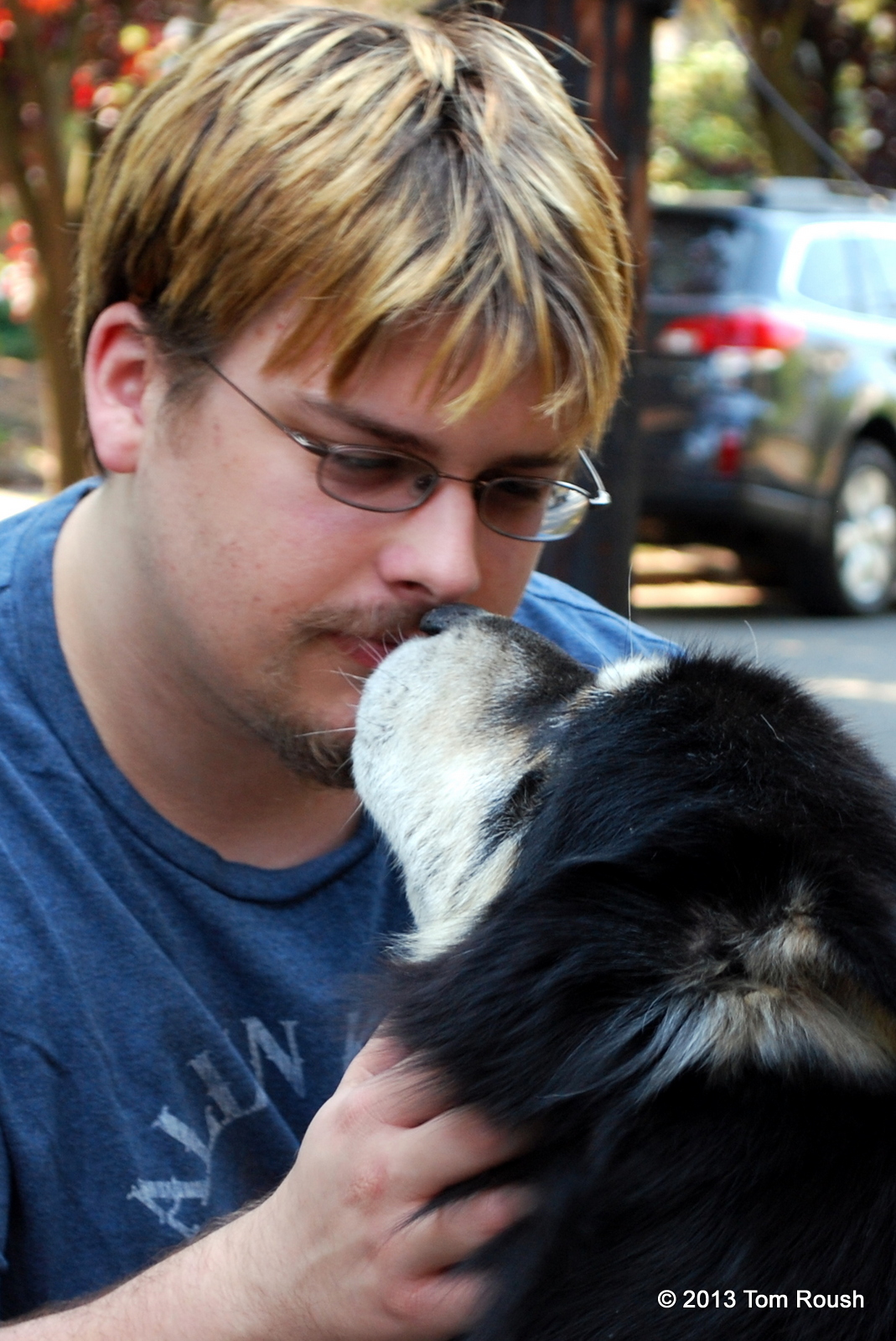
Pongo both getting – and giving – Fuzz Therapy
Jack said that Pongo’d been getting on in years, which was obvious, as well as being sick, which was not, so we were glad that we stopped by when we did. And our son, going through the stresses of being a young adult, trying to balance the risks and benefits of running his own business, figuring out backup plans for both the job market and the financial risks and benefits of college, was able to get some Fuzz Therapy one more time.
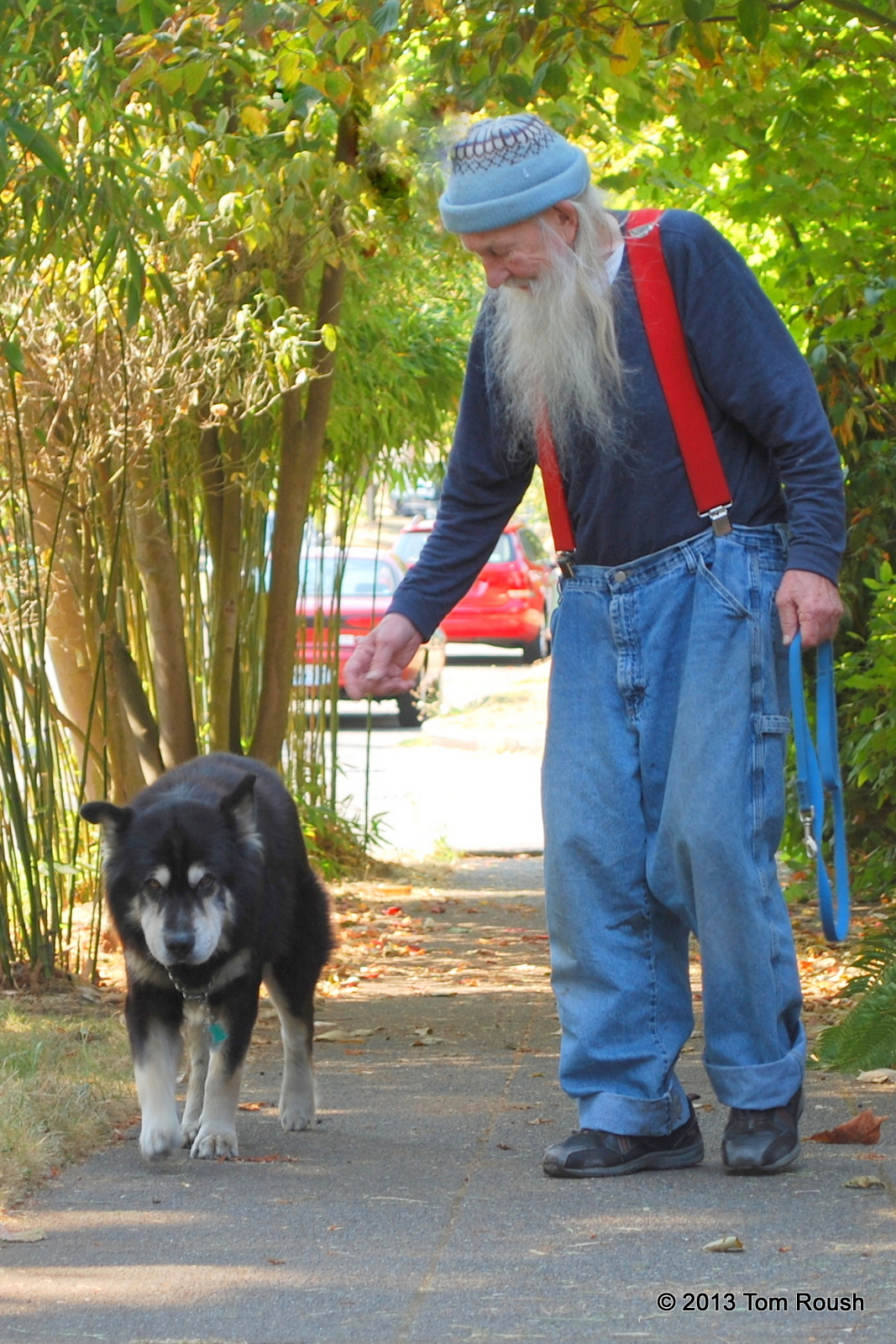
Jack taking Pongo for a short walk
Some months have gone by, and we’ve gone past Jack’s place several times since the visit in these pictures, but it has become clear that the last time we saw Pongo was the last time we would ever see Pongo…
So Pongo, my dear friend, the one who brought our son such happiness, such love, and such peace, wherever you are, I wish you an eternity blessed with a whole, healthy body, the ability to run and chase to your heart’s content, and may you get as much from the Fuzz Therapy as you gave.
===
(Pongo – as seen by the Google Street View camera in September of 2010)

 Tom Roush's Blog

