
You are currently browsing the tag archive for the ‘Friends’ tag.
Tom’s sister Petra here, sharing a post written by glider pilot Greg Bahnsen, who gave Tom a taste of what heaven must be like. In the post below, Greg shares flying experiences that he had with Tom, who wrote about their adventures on this blog. You’ll find links to Tom’s posts embedded in Greg’s story. Tom’s best bud Gregh took these photos of Tom and Greg Bahnsen.
If you have a Tom story you want to share, please send it to me via this page.
Blue sky with some stratocirrus was above that delightful fall day. Earlier I had had the fun and privilege of taking our then seventeen-year-old nephew on his first glider flight. We had released the tow plane at 4100’ above sea level, a bit above the peak of the back ridge to the east of Bergseth Field. The lift was disappointingly skimpy so we headed out over the plateau and I let him fly for a bit before having him head us back toward the ridge, seeking lift. Alas, none was to be found so I took over the controls and we soon landed. After we got out of the glider, a Schweizer SGS 2-33A, we chatted for a bit about his half-hour flight then he and his family departed.
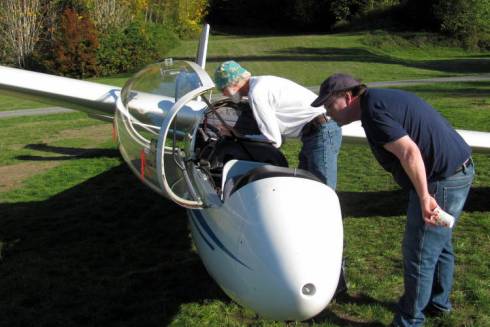
Another Schweizer, a maroon and white SGS 1-26E, beckoned me from across the field. Soon I was going through the preflight checklist and preparing to take it up for a flight. Between tasks, I looked across the field to the entrance and saw a robin-egg blue, mid-sixties Saab enter and take a spot in the parking area.
The morning had slipped into afternoon far enough that my stomach began indicating that I should eat before flying again. Peanut butter and honey sandwich in hand I looked around to find our new guest(s). Once found, introductions were made and I began to know Tom Roush and his son, Michael. The Saab was the first order of business and I told him about a similar red one that belonged to a friend of mine. (I got to take her up in a glider when she was nearly 93, but that is another tale.) I was delighted to find out that Tom was arranging to take an introductory flight, but that he needed to get to an ATM to get some oval pictures of dead presidents to finalize the deal. If memory serves, I finished my lunch and relaxed. Soon they had returned and Tom, obvious excitement building, got into the 2-33A with instructor John Miller and took off.
While the tow plane took them into the blue, a friend helped me to get the little maroon and white ship staged and I boarded so as to be ready to fly when it returned. The wait was pleasantly short.
Soon I was aloft and heading toward the south ridge. I released the tow plane at an optimistic altitude and, as it was only my second flight in this glider, decided to check out its stall performance. I did a clearing turn away from the ridge and slowly pulled the stick back. Airspeed dropped and dropped until, at about 28 miles per hour, the buffeting began and was followed by a gentle break. Back to the ridge I went in search of lift. No such thing of any significance was to be found and soon I entered the pattern, landed and secured the glider.
The robin-egg blue Saab was not to be seen.
A few days later I opened an email that had a link to What Heaven Must Be Like, or a copy of the file, I don’t recall which. Tom’s enchantingly entertaining tale of his first glider flight verified my suspicion that we both craved being airborne. He was kind enough to share it with the members of Puget Sound Soaring Association as a “Thank you” for his experience.
Soon thereafter we met up on Facebook for frequent late-night chats—often postponing getting to bed when we should. Topics ranged from the current status of the Cortez (his name for his cancer) battle and the current phase of treatment or recovery to parental challenges to studying to become a glider pilot. One memorable evening we spent quite some time playing a word game. Alas, I don’t remember the name of it or the rules, but it involved taking a word and employing a different usage somewhat like punning. Family frequently entered the equation in various ways. We discovered we had many things in common and the conversation frequently returned to hoping that we could go flying together soon.
Naturally, health topics arose often and my wife and I added Tom and his family to our prayer lists and asked many of our friends to do likewise. The summer of 2011 brought a turn of events in my health status. I’ll spare the gritty details, but the short of it was that I had contracted colon cancer. As soon as I told Tom, he asked if it would be OK if he added my name to a number of prayer lists, too. I thanked him heartily. My surgeon ended up removing parts of me and all of the cancer was localized. I was so blessed to not have to have further treatment.

Nearly every year the Museum of Flight at Boeing field holds a Soaring Expo one weekend in March. I let Tom know that I would be helping to staff the PSSA booth for the first shift that Sunday morning. He was in an up phase between treatments and so he came down to the museum and we met for the second time, chatting as we strolled amongst the displays of gliders and other aircraft. As nearly always, a recurring theme was getting him up in the club’s newly acquired PW-6U.
Some years later Tom said that he would be able to come out after church on 5 October 2014. Another basically blue sky greeted me when I arrived at the field fairly early as there were aircraft to prepare for flight and people to share the tasks and visit. Afternoon was getting on when I grabbed my brown paper lunch bag from my car and headed for a seat in the shade. My peanut butter sandwich unwrapped, I glanced toward the gate and noticed a former police car enter the parking area with Tom at the wheel. I strolled over to greet him and invite him to join me on the sidelines as I finished my lunch and spliced new loops on the ends of some tow ropes.
Earlier that morning I had put my name on the list for a flight in the club’s PW-6U. Typically we follow the first-signed up, first to fly rule, so I checked the list and found that we should have our turn fairly soon.
Not long after I had finished dealing with all of the tow ropes that needed my attention, I could sense that Tom was dithering. On one hand, he was enjoying the chats and meeting some new people, the warm autumn sunshine, the peaceful surroundings interrupted occasionally by the tow plane pulling another glider into the air. But others were going up and we were waiting and we wanted to get in the air, too, and the sun was westering. A dragonfly made for some pleasant distractions now and again, but. . . . The sun got lower.
One thing I knew that Tom didn’t yet. Regulations for aircraft that do not have navigation lights state that such aircraft must be on the ground by sunset. I, too, was getting more anxious. We had been wishing, hoping and planning for this for quite some time and I was beginning to fear that we might not get to fly after all. That was not something that thrilled me.

I was about to intercede with the field manager, the person coordinating the operation for the day, when he said ours would be the next flight. Relieved, we went to the glider staging area and I gave Tom a concise briefing and helped him get situated in the front cockpit. Once I had completed our pre-takeoff checklist I had our wingman check the sky for traffic. Time was getting very short. He got sidetracked by someone asking him to help with some other task. The tow plane was running and ready and so were we. “Could you do that after you launch us, please?” I asked. Thankfully he returned to run our wingtip and we were soon heading toward the rapidly setting sun and into the evening sky.
The tow plane pilot turned toward the south, then continued his gentle bank toward Mt. Rainier. I could almost hear Tom’s breathing ease with being in the air at last. Fall beauty surrounded us. To the west, the sun was getting ever closer to the horizon with band of stratocirrus clouds decorating the sky above it. To the east, a full moon was making its way up the sky. Below us the landscape was dimming, but, scattered amongst the evergreens were pockets of colorful foliage.
When we got to release altitude, I briefed Tom on the procedure we would follow, then asked him to identify the yellow release handle and pull it. With a loud noise the tow rope was released and we did a gently climbing turn to the right. As the airspeed bled off, our passage through the air became almost silent as we began our descent through the totally calm sky.
We headed north, skirting the ridge, and Tom pointed his Nikon toward the sunset. To give him a better shot I lowered the left wing and added some right rudder to maintain our heading. That slightly dimming orb was getting closer to the horizon. I checked the altimeter and then the sun again. Better tuck the nose down a bit to increase our descent rate.
Check the sun position again. Oh, dear. Time to head toward the landing pattern. But we have a bunch of altitude that we need to get rid of in a big hurry. . . .
Gliders are built with devices to solve this problem. They are called spoilers or air brakes. Technically there is a difference in the way that they are made, but the result of using them is the same: increased drag and sink rate. I could use them, but I prefer a technique that I find more enjoyable.
“Tom, how do you feel about steep turns?”
“I don’t know. Try me!”
Instantly I roll the glider into a 60-degree right bank.
“Whee” comes from the front cockpit. I complete 810 degrees of descending spiral, level out at pattern altitude and heading and soon the rising moon is in front of us as we glide down the final approach to touch down as the sun eases below the horizon behind us.
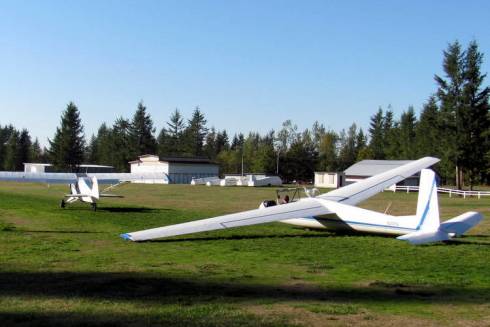
We stopped opposite the glider trailer and I helped Tom extricate himself from the cockpit. I handed him his Nikon and he took several photos while I assisted with stowing the glider in its trailer.
With the dew wiped off of the wings, the glider was tucked into its trailer to await the next weekend. Tom said good-bye, the rest of the airfield and aircraft were secured and I drove home with the memories of a beautiful, satisfying—albeit quite short—flight.
Our Facebook chats continued and it wasn’t long before he shared a link to his view of our time together that day: The images he took richly embellish the record.
Time continued to go down the minute drain. Our evening chats interspersed our weeks with topics from cats to Saabs, CNC machines to SQL, food to music. And often aviation and looking forward to gliding again. Especially since neither of his flights involved any significant soaring. Both were essentially what we call “sled rides.” Once you release, it’s just a glide back to earth. More battles with Cortez ensued. None of them particularly pleasant. Some of them more successful than others. Tom rejoiced that my checkups continued to be clean.
One day shy of a year later the skies were once again blue. This is not always the case when one goes soaring, but it really was this day. Tom wasn’t sure if he could make it out to the field, but I went out anyway. Art and Jerry, two of my high school classmates, were in the area for our 45th reunion and I had offered to take them up for their first glider flights. With my name on the list, I puttered around, helping with the operation until my friends and their wives arrived. As we waited our turns, Tom called to see how things were as he was considering coming out. I told him that I thought there was a really good chance that I would be able to get him in the air, too. He said he should be out in a bit over an hour.
The flight activities were fairly relaxed that day. No one seemed in a big hurry—more interested in savoring the warm sunshine of the autumn day. While we visited, my turns moved up the list. Tom and his friend, another Greg, arrived shortly before it was my turn for the glider. The glider I would be flying was a Blanik L-13 AC. It isn’t as sleek as the PW-6U, nor is its performance as good, but it is fun to fly and has a certain charm all of its own.
We decided that Art would be the first, so I helped him get comfortable in the front seat of the glider, gave him a briefing of his surroundings, how to exit the cockpit, made sure his harness was secure, then I climbed into the back cockpit, completed the pre-takeoff checklist and we launched.

As we were towed aloft we went through a few hints of lift (minor bumps), so I had hopes of a flight somewhat more interesting than a sled ride. Once we were free of the tow plane, Art’s body language relaxed a bit and he started enjoying himself a little more. I told him that if we had had more lift, I would have offered to let him do some of the flying, but I was going to have to work to keep us up long enough to get a reasonable feel for what this gliding thing is all about.
Alas, the hints of lift were tormenters and soon we were forced to head back and rejoin the rest of the group on the ground. After Jerry took his place in the front seat, I performed the pre-takeoff checklist for his first glider flight and we were soon airborne.
Jerry’s time slot turned out to be the best for duration. We were able to milk the lift enough to remain airborne about 42 minutes. We had fun chatting as we descended, hugging the upwind side of the ridge to eke out all of the lift that we could. Soon we were entering the downwind leg of the pattern with pre-landing checklist finished. As we rolled to the end of the runway, Tom, with his friend, was patiently awaiting his turn.
Since this was Tom’s first time in this model of glider, I gave him a briefing, too, and helped him get situated in the cockpit. I could tell that he was in some discomfort, but that the prospects of getting in the air were going to take the edge off of that momentarily. Back into the rear cockpit, I went again. This time I had Tom do the checklist under my supervision and to my satisfaction. When all was ready, we had our wingman check for traffic in the area and, once given the all clear, we launched.
The tow phase of a flight can provide a good idea of how good the lift is going to be. In this case, I surmised that what I was feeling might get us a flight that was more than a strictly down-hill glide. As the sun was higher in the sky than on his previous flight, we didn’t have to race the sundown. Also, the terrain was brighter, the colors more engaging, the cockpit warmer.
Once we freed the tow plane, I immediately began searching for lift. Tom had brought his iPhone along this time instead of his Nikon and began shooting pictures while we enjoyed the autumn beauty and interspersed the wind noise with some conversation. (See this post for pictures and his side of the story.)
The lift was slightly better than nothing, but not all we desired. Soon we were rolling to the end of the runway, then stopped. In the quiet, we opened the canopy and got out.
Gliding is like lunch. There is no such thing as a free one and all of my friends were ready to do their parts. The FAA has regulations about this—and nearly everything else related to flying you can think of—and lots of things that would likely never cross your mind. With the rating that I hold, I am allowed to only charge up to a prorated amount of the flight costs. So, we got out the rate charts and did the math. Art and Jerry had brought amounts of cash that were easy to manage. Tom drew out a fifty-dollar bill from his wallet that had a story behind it (see the link above). He said he’d been saving it quite a while for such a flight. That was all fine and good—and made the day more special—but, with the other funds at hand, there was no way to make change for the $13 that I owed him. I said he could pay me later. That he didn’t want to do. I could send him a check. Hmm. A better idea came to mind. I offered to keep it as credit towards our next flight and he heartily agreed.
Greg and Tom soon left, winding their ways through the woods, down to the Enumclaw plateau and to their separate homes.
Art, Jerry, and their wives offered to take me to dinner, so we could do some more catching up and review the guys’ first glider flights. We chose a Thai restaurant for dinner, then went across the street to a delightful shop for ice cream. The next time they come around during flying weather at least one of the wives may decide to check out the relatively silent skies, too.
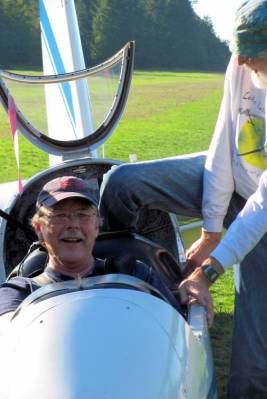
Cortez got cranky and raised his ugly head again. Sometimes our Facebook topics got rather technical and medical. I described a machine that hit Tom with needles of radiation as something that came out of the cantina on Mos Eisley. Gold buckshot. Biological/digestive reactions to being inundated with strange chemicals. The fatigue, the struggle to breathe, the fatigue, weight gain due to extreme water retention. The litany lengthened nearly every time we caught up with each other on Facebook. Frequently we would work in our hopeful dream to fly together again soon. “After all,” I’d remind him, “I still owe you money toward that next flight.”
Tom’s interest in my wellbeing—and that of my wife—was humbling. Even during his greatest suffering, he found the strength to ask about us and pray for us.
The treatment protocols changed and usually between bouts he would get a break to recoup and for evaluation of the relative effectiveness of the last trial. So, on another peaceful and beautiful (he managed to pick great days) afternoon, Tom brought his mother, Irmgard, out to see the field. I could see where Tom got some of his sense of humor and kindness from her. They shared some fresh Bartlett pears and conversation. The wistful look in Tom’s eyes was quite pronounced as the gliders would go by on the way to the staging areas, taking off, or in the air over our heads. I offered to take him up—after all, I owed him some money toward that end—if he felt up to it. But I also insisted that there was no pressure either way. It was all his choice. We conversed more as he ate a sandwich. Occasionally I would excuse myself to go launch a glider or do some other task. After enjoying the calm and fellowship with the folks around them and the warm lazy afternoon a while longer, Tom’s energy level was dropping. Since he needed to take his mom back to Roy, then drive to Seattle, he opted to share a good-bye hug and keep looking forward to another flight.
My wife maintains that my guardian angel is preparing a list of all of the great places to soar in the universe. I am so looking forward to sharing that list with Tom.
Many years ago, I went to SPU, a liberal arts college in Seattle that’s affiliated with the Free Methodist church, which was socially conservative enough to forbid dancing.
Dances (large groups of people gyrating in a dark room with lots of loud music playing) were not allowed.
Strangely, “functions” (large groups of people gyrating in a dark room with lots of loud music playing) were.
Sort of.
As long as they were off campus.
And the school didn’t “officially” know about them.
But the school let people form bands (as long as no one danced to the music) and, at one point, it held a contest. At the time, the mission of the school was to turn us into “Christian Scholar Servants.” So, a few of us, who happened to like a particular style of music that involved sand, sea, and surfboards, came up with a musical group called the “Christian Scholar Surfers.”
There were several people in the group: Larry and Dave were at the core, and there were others who came and went as they were available. Dave was the lead and used his dorm room curtain rod as a microphone, Larry played keyboards, which were two electric typewriters on ironing boards, and I played bass – which was either a hockey or a lacrosse stick.
Oh – wait – I said it was a musical group.
The music, you see, came from huge speakers that were way, way louder than we could ever be, and they were fed by a cassette player playing, in this case, a song called “Motor Mania” by a group called Roman Holiday. Larry, all six feet eight of him, did that deep, deep bass at the beginning, then Dave and I came in. We practiced and practiced, and frankly, we got so good at it that it was hard to believe that Larry’s voice and keyboards weren’t making the music, or that my hockey stick, Dave’s curtain rod, and our voices weren’t making the actual notes. Timing was pretty critical at some points, and – well, here, have a listen while you’re reading the rest of the story.
One day, when we were out of school, Dave called Larry and told him there was a lip sync contest at a place called Chevy’s in Beaverton, Oregon. Did we want to come down for it?
We’d never heard of Chevy’s, but Dave explained that it was a ‘50s style diner where the food was free a couple of hours a night, but you had to pay for drinks.
Wait.
Free food?
We were so there.
Larry and I didn’t need much convincing. We packed up our stuff, drove down to Dave’s place, rehearsed a bit, piled into Larry’s car, and then went to Chevy’s.
We got everything ready, and they told us we’d be on the schedule around 8:00 or so.
It turned out that they made their money on alcohol, which none of us drank (even though Larry’s folks owned a bar), so we had water or soda, listened to ‘50s music, and just hung out.
It was a fun place to go, and for us, my gosh, it was cheap. We went to the free buffet, got some pretty decent food, ordered cokes, and listened to fun music.
I’d been in a car accident some weeks earlier, injured my back pretty bad, and had to wear a TENS unit to numb the pain to a bearable level, so even though there was a dance floor there, and people were on it, we all knew I wouldn’t be dancing.
One of the more entertaining aspects of the evening was a group of what appeared to be aerobics instructors from a local gym. They were celebrating something with what later amounted to at least 11 bottles of champagne – to the point where, even as far away from them as we were sitting, we could actually smell it. They were laughing, joking, drinking, and in general, really having a good time.
I had never seen more than one bottle of champagne consumed, but they had the table loaded like they were ordering them by the case.
Now, remember the bit about how these folks made money?
Right.
Alcohol.
And as long as they were serving it, and people were buying, they had no reason to hurry the schedule along – so 8:00 (or so) came and went.
In fact, so did 9:00 (or so).
By about 9:45, they were well into cleaning up the free buffet, and things changed a bit, because while the quantity of food was diminishing, the quantity of alcohol being served to the table over by the wall just kept increasing. It was by far the noisiest table, and by this time, you could actually feel the heat they were putting off warming up the whole place. In fact, my glasses were slipping off my nose, and as I was reaching up to straighten them and clean a smudge off a bit, someone grabbed my arm.
My glasses cartoonishly hung in the air for a split second before clattering to the table.
I was spun out of the chair only to find my hand attached, rather firmly, to the hand of one of the aerobics instructors.
About the time I caught my balance, we were on the dance floor, and they had some very danceable ‘50s music playing just about as loud as it really needed to be played.
I looked around for help, saw blurry outlines of Larry and Dave holding up my glasses and frantically looking for me everywhere but the dance floor. Because, with my back still hurting as bad as it was, the last place I’d be would have been…
…where I was.
With limited options, I did the only thing that made sense. I cranked the TENS unit up as high as it would go until my back literally quivered, and I danced.
Three dances.
With an attractive, yet totally drunken aerobics instructor.
It was fun.
After three songs, the music stopped, and we headed back to our tables.
I collapsed into my chair, picked up my glasses, and put them on to see Larry and Dave’s faces swim into focus, their eyes as big as the little plates the buffet food was on, their jaws struggling to get off the table and at least meet their faces halfway.
All Dave could get out was, “She… you…how?” While Larry sounded like an idling outboard, “But… but… but.”
And so, I had to explain what had happened, all the while wishing I could do a “Spinal Tap” on the TENS unit and turn it up to 11. Eventually, they believed me (by this time, my shoulder was starting to hurt because she’d yanked my arm so hard), and then they both wondered if we’d actually be able to do our set. My part involved very little more than making that hockey stick look like a bass guitar, so I was good. Sure enough, at 11:00, after a lot of buildup, they called us to the stage, where Larry, Dave and I, three college students from Seattle and the Portland area, managed to knock the socks off a crowd of people enjoying music, including a few drunk aerobics instructors who wouldn’t remember a bit of it the next day.
We, on the other hand, can remember every minor detail of this epic adventure, since the strongest thing in our drinks were the bubbles in our Cokes.
Oh, the money in our hands? $75. $25 for each of us: We came in second.
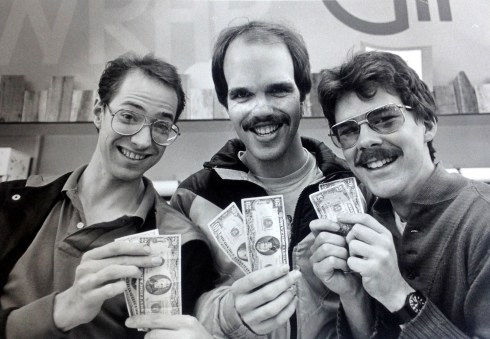
Dave, Larry & Tom, of the Christian Scholar Surfers with our winnings
I was taking my friend Beth out for a camera lesson a few years ago and we ended up at Sunset Hill Park in Seattle, and this image just happened in front of us. The light was pretty nice, the boat looked like it was trying to head to the bright spot there, so I set the exposure so it’d show what I wanted to show, and then took the picture.
And it got me thinking…
You know the old story about the fellow wandering down the street at night and sees another fellow on his hands and knees looking for something under a streetlight? The conversation goes something like this…
“What are you looking for?”
“My wallet.”
So they both start looking for awhile and neither finds anything.
Eventually the second fellow says, “So where’d you actually lose the thing? did you lose it here?”
“Oh no, I lost it over there…” (pointing to a dark section of the street)
“You… Lost… it… over there??? – then why are you searching over here?”
“Well… the light’s better here…”
And so… when I saw this image… I found myself thinking about light – and about where we should be looking for things…
And it got me thinking, as it often does, of the flip side of that story… What if there *were* light over there?
See, sometimes we might be in a spot where everything seems to be okay…
And then, sometimes, just sometimes, the Heavens will open up, and God will say, “Hey, Look over there… I have something for you… I’ll light the way – you take the first step…”
And that’s what I thought when I took this photo…
(they say a picture’s worth 1000 words, in this case, it’s around 300)
Here’s the picture – enjoy…

Sometimes you have to go to the bright spots…
Spoiler Alert: There’s a potentially gross photo at the bottom of this story, but everyone ends up living happily ever after.
K, ready?
Here goes…
Many years ago – where I grew up, Garter Snakes were pretty common, and one time, as I was cleaning up the tools one day behind the garage my dad and I were building, I heard a rather strange noise rustling in the grass.
I looked around and saw a familiar, though large, garter snake, but there was something a bit different about this one, and I stepped down off the scaffolding and took a closer look.
What I saw made me look quickly at the fading light, run inside, grab the camera, and get a photo before I did what needed to be done next.
See, the snake was stuck… and in a bit of a bind.
And the newt (or salamander, or whatever it is there) was also stuck… and in a bit of a bind…
And neither of them was giving up.
The newt was, in its last act of defiance, not going to die, plain and simple.
So I put the camera down, and pulled the dazed newt out of the snake’s mouth, being careful to not injure either of them more than they were already were – well – worse for wear…
The newt for its part, spent awhile catching its breath.
The snake spent that time eyeing its former dinner and working the kinks out of its jaw.
After some time, they both took a look at each other and each slithered their own way back to their burrow, or nest, or whatever it called home.
And it got me thinking…
There are times when we’re the snake – and we’re just doing what we do, and we get stuck, and can’t figure out how to get out of the situation we’ve gotten ourselves into.
And there are times when we’re the newt – and we’re just minding our own business and find ourselves being eaten alive and have no idea how to get out of the situation, but giving up without a heck of a fight isn’t even an option.
And then there are times – when you’ve got the rare privilege of being able to be in a position to help someone – or more than some “one” – get out of the situation they’re in – and by your position, your experience, your perspective, whatever it is – you’re able to help one – or all of the characters in our little story – the newt and the snake – go on and live happy lives – and without you – without that friend with perspective, with wisdom, with understanding, and with patience – they might just not be here today.
Think about that a bit.
So – for those of you who’ve been the newt, or the snake, or the big guy with the camera he tried to keep from getting newt slime on, allow me to thank you on behalf of newt and snake.
Oh, understand – this is not fiction – this is a true story – the photo below is my proof – but it’s also an allegory – in which many of you reading this may have played one of those parts at some point in someone’s life.
Keep doing that – because somehow – somewhere, you might find yourself smiling when you hear that newt be able to say, because of you, “I got better…”
Take care out there, folks – and don’t forget to take care of each other.
Oh – and here’s the picture…

Snake and Newt
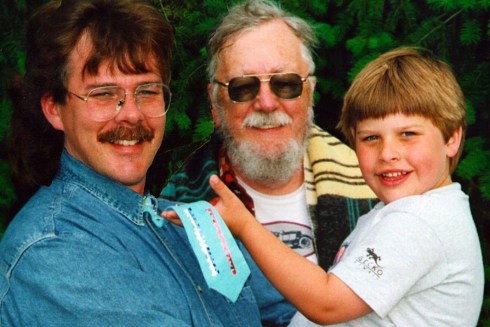
Two fathers and two sons… A photo from Father’s Day, 1997
I’ve been pondering here for a little bit, and so I’ll just start this story out with the results of the pondering…
See, it (the pondering) got me thinking…
Father’s day’s tomorrow.
I find myself thinking back on and missing my own dad – how for many years he thought he was a failure – and yet, good came out of those things he thought he’d failed at.
See, some years back, I learned how hard it is to be a parent… How much dedication, love, understanding, and determination it takes to love your kids when you’re trying to understand them, and support them when your memories of the world you grew up in “When you were their age” simply do not mesh with the world they’re growing up in.
In being a parent, I’ve been told you can do it like your parents did, do it the opposite of the way they did, or do something new.
I’ve found that there are things we all want to change from our childhoods, but there are also things we want to keep, traditions we want to pass on, and so on, and I’m still learning which ones are which.
I found myself often wanting to give advice to my kids, but then, since this is Father’s day realized how much I’d wanted my dad to listen to me – just to listen, and realized that that was so much more important…
And so, I try to spend my time listening to my kids when they want to talk.
Sometimes it’s easy, sometimes it’s hard, but all the time, it’s important.
So without writing much more (hah, it’s me… 😉 I’m gonna take you through a little guided tour of fatherhood, and my experiences with it… I just went through this blog – and found myself smiling, laughing, and tearing up just a bit at the stories I’d written over the last few years. See, my Dad left us about 16 years ago. He no longer lives with us on this earth, but lives with us in our memories… That transition, for those of you who’ve not gone through it, is astonishingly hard. Cindy’s dad did the same thing a couple of years ago, and the transition for her, her family, and us, is ongoing. I think that’s the little bit where you find yourself laughing at things they might have said, memories you might have shared, and then crying at the same time because you miss them and can’t share the story the memory brings forth with them.
So the stories are in the links below – each one with a little intro to what it’s about… They’re not in any particular order other than the order I pulled them out of the blog – so they’re kind of in reverse chronological order as they were published, but not much else, so you can skip around and read whichever story without missing anything.
That said, the stories, about being, or having, or losing, a dad:
…I realized early on that keeping a straight face when you’re being a dad is something that comes with time… In this case, I had an adventure in plumbing, and can still hear the laughter of both kids as the problem I was dealing with became painfully obvious (like, it hit me in the face obvious). It still makes me smile, and they got to laugh at their dad (with his permission).
I remember how much I wanted my own dad to listen to me when I was a kid and a young adult. Those moments were few and far between, and as a result, so absolutely precious in my mind. I had a chance to listen to my son once where I so very consciously put my mind on “record” because I knew the story he was about to tell was going to be fun. It actually is the very first story on the blog.
I’ve been asked, more than once, which story is my favorite – and it’s like asking parents which kid is their favorite… They’re all my favorites – for different reasons, but this one, “Hunting for Buried Treasure” keeps bubbling up to the top – because – well, you’ll have to read it… it’s not long, and any more would require a spoiler alert.
I remember how sometimes the dad I saw, (in his role as my dad) and the dad that was (an adult step-son), were two totally different people – I love this story for the sole reason that it showed a side of dad I didn’t know existed at the time, and it was a lot of fun to write.
This next one – just fair warning – it’s got a hankie warning on it for a reason… I think it was the story that started them. It’s called ‘Letting go of the Saddle’ – and if you can imagine teaching your kid (or being taught by your dad) to ride a bike – there’s a moment, a very special moment, that happens. It’s repeated throughout your life in different ways – and you’ll play different characters inside this story throughout your life, sometimes simultaneously. A huge part of this story really felt like it wrote itself and I was just hanging on for the ride. I remember the story changing about 2/3 of the way through, where my role in it changed – and I realized I was letting go of another saddle, but not one I was ready to let go of. It was a very hard story to write… I’ll leave it at that.
There’s the story, I’m sure you’ve heard, of The Prodigal Son. I realized that for there to be a Prodigal Son, there had to be a Prodigal Father, this is the story of the Prodigal Father and me sharing the experience of waiting for our sons to come home.
Many years before I became a dad, I was a newspaper photographer, and had the privilege of watching someone else being a dad, and was able to capture the moment, and the very strong lesson, in a 500th of a second from across a parking lot.
I’ve realized that some stories take seconds to happen, but require months or years of pondering before they’re ready to be written. This one was a little different. It took years to happen, and a couple of hours to write. It involved an F-4 Phantom, a cop, and – well, it made me smile then, and still makes me smile now.
One moment that I shared with my father in law was a simple one… a common occurrence in households around the world, but this one had something special in it. And I miss the gentle soul who was my wife’s dad.
There was a moment, not quite 16 years ago as I write this, that a number of things collided into a storm I was not ready for. A storm of fatherhood, childhood, memories, time machines, time moving forward, time standing still. I remember feeling very much like a little boy in an adult body, and I wasn’t ready to be that much of an adult right then. I remember this story for the cold, both physical and emotional, for the blowing oak leaves, the sound of Taps and a view I’d seen years before and never wanted to see again… If it’s not obvious yet, it has a hankie warning, just so you know.
And for a change of pace, you know the old saying, “Insanity is hereditary, you get it from your kids”? – Yeah, that’s true… There are other things you get from your kids. In this case, we’ve actually got three generations involved in this story… My mom’s reaction to something I did, and my reaction as a dad to something my daughter did – and it was the same reaction…
And then – you realize your kids get older – and you realize that some of the lessons change, and some stay the same, and you realize that God gives you chances to both listen to your kids and to help them out. In this case, again, a situation with my daughter – a couple decades after the above story, a gentle lesson from God, for me, as a dad, on how to be a dad… Occasionally God will present lessons with all the grace of a celestial sledge hammer… This time He used the celestial feather duster (which I appreciated very much)
Some years earlier – the family would go to Michigan for the summer to visit my wife’s side of the family, and in this case, I got to stay home and rat-sit. It was an adventure.
Then there’s the story of bathtime… and a little boy… and his dad. Oh, and giggles… Can’t forget the giggles…
Some years after the above story, Michael and I had a mad, crushing need to leave town and go on a father-son adventure. So we did. We had a fun road trip that involved Mermaids, toast scramblers (the pre-war kind) and the Gates of Mordor…
I learned how important having a hand to hold is – and more importantly, being able to reach up to hold the hand of someone bigger than you..
And how sometimes, not only can you learn a lot from a two year old, but the wisdom that can come from a two year old can be – on multiple levels, completely unadulterated and pure. Oh, and it’s also fun.
And in this story from my dad – I learned a little about man’s inhumanity to man, and how dad learned about it – but also what he did, in his power, to try to combat it, with the realization that some things matter, but an awful lot of things that we think are important actually aren’t.
Another story from dad – this is a long one, but one of my favorites. Started out as a single dusty sentence I remembered from dad, and after two years of research, I got a story out of it. Still makes me smile.
Then comes Opa’s story – from WWI. He’s mom’s dad – and if it weren’t for a piece of Russian shrapnel and some soldiers scavenging for potatoes, you might not be reading this story… Really.
Being a dad means doing a lot of things, and sometimes it means telling a sick munchkin a story. In this case, I made up a story quite literally on the fly. Here’s the story – and the ‘behind the scenes’ of telling it.
It’s about a boy…
And a dragon…
Named Fred.
On evenings when Cindy was off with our daughter, I’d often take Michael for drives, bicycle rides, walks, or combinations of all of them. On one of these we saw something most peculiar in the sky, and I turned my brain on to ‘Record’, and didn’t blink.
Oh… My favorite… Springtime. ‘Nuff Said… Go read it and smile.
And, a story about a boy and… and a borrowed dog named Pongo. Pongo was a good dog, and even though he wasn’t ours, Michael got to ‘borrow’ him on his walk home from school. We haven’t walked down that street in a very long time, in large part because as long as we don’t, in our minds Pongo will still be there.
A lesson I learned from my son, that he didn’t realize he was teaching me… out at Shi Shi beach.
I learned a number of lessons – about shoes, from my daughter – even though she didn’t realize she was teaching me. We were walking to the bus stop, as fast as we could, because as always, we were running late. Michael was tucked into my coat (really) and Lys was walking behind me, looking at my red shoes, and proudly watching her two feet, also clad in much smaller Red Converse High Tops, enter and leave her view with every step. “Look, Papa, I’m two feet behind you! Get it? Two.. Feet.. Behind you?” I smiled, and sure enough, she was… Oh, and we caught the bus that day, and the next, and she – well, there’s more to the story – you can read the rest of it here.
Every now and then – you have a story that’s a lot like “Letting go of the Saddle” – only it’s even clearer… In this case, it was my Opa – and this story has a hankie warning.
And last, but not least, I’ve learned, just like being a mom, once a dad, always a dad… the seasons of life come and go, but you’re always dad, or pop, or papa, or daddy. You hover around being a confidant and an authority figure, between teaching and learning yourself, between laughing with them and crying with them.
Sometimes you spend time on a swingset with your kids, sometimes you spend time in the car with them… Sometimes you agree with them, sometimes not…
But that’s part of life, right?
Oh, and one thing that’s constant…
You always love them.
Always.
Our scout troop has sold Christmas trees at a church parking lot every year for about the last 75 years.
I last wrote about it here. One of the things that we prided ourselves on was getting the best looking trees available, and a few years ago I drove a big truck down to several of the tree farms to get a fresh load of them. As I recall, at the end of that day, we ended up bringing home 435 trees. Over the course of the trip home, the trees settled a bit on the rough roads, and I remember checking the side mirrors once and was surprised to see that the sides of the truck were literally bulging. I wish I’d taken a picture of it that day, but the day was long, by that time it was dark, and many, many pictures weren’t taken.
One of the pictures that I not only didn’t take, but didn’t see, was taken by the scout dad in the troop named Dan who’s a forest geneticist, which is the best kind of guy to have as a resource when you’re trying to sell small forests of Christmas trees.
Dan would go out to the tree farm in August and hand pick the 1500 or so trees we’d be selling that year, and in doing so, he saw some things that most of us don’t see. He took the picture below, that looks pretty much like a picture of a wooded foresty place (that’s the Olympic mountain range in the background), but there’s a couple of white spots in the picture that don’t really make sense until you look move closer.
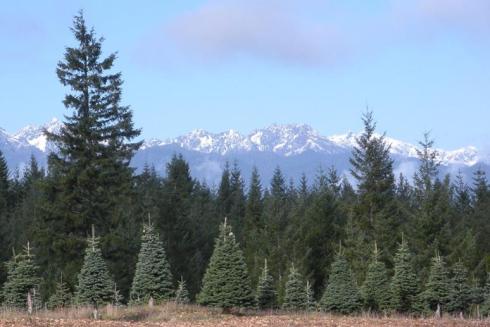
If you look at the third and fourth tree in from the left, you’ll see a small white dot on each of them. As Dan got closer, he took a picture of what those white dots really were, and you can see that in the picture below:
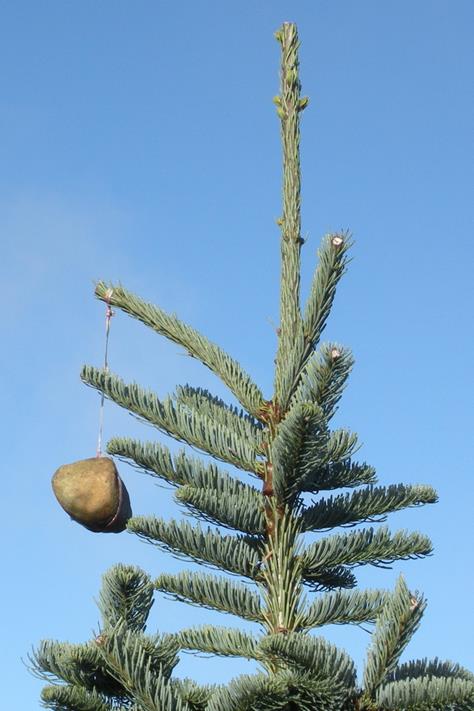
You see, the tree was perfect in every way, it’s just that the top, the part that can make or break the sale of a tree, was crooked, and so the grower, realizing that he had some time on his hands, tied a rock to a branch to help straighten the tree out.
So for years, the tree carried this burden. Day and night, through good weather and bad, through heavy rain and parching drought, the tree carried this weight.
The thing is, not all trees got this treatment. Some trees were pruned, all were fertilized, and some were found to be almost perfect but for this one flaw, so they were given this rock, this burden, to carry.
And over the years, the rock changed the tree. The tree got strong enough to carry the rock, but when the rock was put in the right place, the tree was both stronger and straighter. It had shown that it could indeed carry this burden, and carry it well.
And in the end, when the tree was done growing and it was time to harvest, the burden was lifted, the weight was removed, and the tree was straight and beautiful as ever.
And I saw something interesting in that. It made me wonder about the burdens we carry, and why. It made me wonder about burdens, being there just long enough for us to learn lessons, to grow straight, being lifted. And then I wondered about burdens that are there longer, that people carry, day in, day out, sometimes for years.
In fact, in the last year, I’ve learned of friends losing their jobs, and the financial hardship that comes from that.
I’ve learned of friends who were suddenly transferred to another part of the country, and the uproar that can cause in a family.
I’ve learned of friends who are losing or have lost loved ones.
And you can almost hear the branches of their trees creaking as they strain under the burden.
And I don’t understand why it seems that some folks are given burdens when others aren’t.
There are times when I don’t know if the burden they carry is one they can carry alone. In fact, there were times when the burden we as a family had to carry was more than we could handle, and I know personally that in situations like this, those struggling under those heavy burdens need support until they can stand on their own.
I thought back to that tree there in the picture. It could handle good sized rocks, and over time get strong enough to carry them and stand straight. Trying to hold up a 100 pound rock with that little branch would be another story. It’s not strong enough to handle that, and it would break.
I’ve seen this in other trees over in Eastern Washington, where instead of rocks, they were carrying such an amazing amount of fruit that their branches weren’t strong enough for that burden. The farmers growing that fruit helped brace the branches with large poles, sticks, or, for lack of a better term, crutches, until harvest time, at which point the weight is removed, and the tree is relieved of the weight, or what might be perceived as a hardship.
Without the constant care of the farmers, those trees would have had branches broken by burdens they were not strong enough to carry. Un-braced branches were damaged, or had broken off and fallen down, breaking other branches on the way and peeling the bark with them as they went.
It’s not pretty, and parts of the tree die when that happens.
I’ve also seen people break under burdens they weren’t strong enough to carry. Lives are damaged, people can break down and fall, causing damage to themselves or others as they go.
It’s not pretty, and parts of who that person is die when that happens too.
Understand, this doesn’t mean these people were weak. It means that as strong as they were, they weren’t strong enough for that burden, or those burdens.
There is a difference.
And it got me thinking, about trees, and support, and strength.
See, some of the trees, the evergreens, have burdens over time, for a reason.
And those trees, over the years, like the ones in the photos, develop inside support. They develop a stronger core with each passing year they are forced to carry their burden.
By the time these trees are ready for harvest, they stand straight and tall, even though what made them that way was a heavy burden.
And some of the trees, the fruit trees have burdens that come in waves, for a season (or many seasons).
Their roots will hold them up, but to keep from breaking, they need outside support to help shoulder their burden, like the fruit trees I mentioned earlier.
Those trees, over the years, develop scars and are gnarled from the burdens they’ve carried and from the crutches supporting them, but they are strong, and have produced good fruit.
And then there’s a third type of tree, and support, and it’s not just for a reason, or a season, but a lifetime.
I’ve heard that the Redwood trees in Northern California have very shallow root systems, so any strong wind could knock a single one of them over, but because they’re in groves of trees, their roots intertwine, and they support each other. They do this without crutches to hold branches up, and they do it without rocks to hold branches down.
They curl their toes together. No, really… It’s interesting, thinking about that. Those trees, they become a community. They support each other, and when one is threatened, all the interwoven roots (the toes) are all tangled, and they hold each other up, together.
There’s a chance you, or someone like you, will spend part of your life as any one of these trees, and who knows, you might have experience with more than one type in different parts of your life.
Whether you’re an evergreen, carrying small burdens over your entire life, or fruit trees, carrying huge burdens seasonally, or whether you’re a redwood tree, reaching for the skies, but curling your toes along with those near you, help each other.
Support each other.
Be there for each other.
Forgive each other.
Take care out there, take your strength from wherever you can get it, and enjoy the blessings of the Christmas season.
The other day my wife got several packages in the mail, and as we opened them, at first, we couldn’t see what was inside other than Styrofoam packing peanuts…
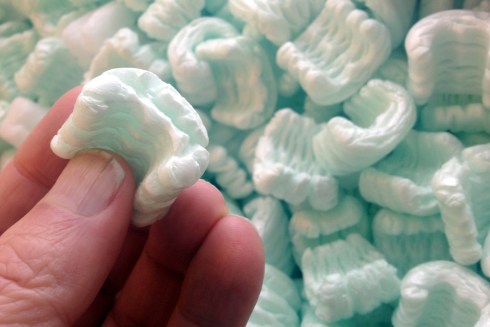
…so we kept digging, trying really hard to keep them from getting everywhere, and eventually found some very pretty glassware she’d gotten sent to her from an auction. But I almost missed it because as we were opening the box, I found myself being sucked ricocheting into the time machine like never before.
So some of you know I went to grad school and have a Master’s degree in photojournalism.
Some of the stories from those days have made it into the blog (the conversation about the photo at the end of this story, about talking my way onto a pretty cool airplane, happened where the bulk of the following story happens), but every now and then, an old memory comes back that surprises me.
See, the thing about grad school was that it was like boot camp. You are given assignments, and you are expected to perform. There are no excuses, there are no do-overs. You end up growing up very fast, and learning how to succeed, or you fail.
Those are your options.
So part of the deal was that we worked very, very hard to get all the things done we needed to get done, and that meant very late nights. At the time, I was on the student meal plan, eating three meals a day, plus a Burrito Buggy run at midnight) – and I’d eat as much as I could get into me, and I still lost 30 pounds in the first quarter I was there. I slept, usually, from 4:00 AM to 8:00 AM.
I have no idea how I did that, looking back on it, but there were some things that happened late at night, in or near the darkrooms, when things just got… a little weird…
See, this was “back in the day” when photos were printed on light sensitive photographic paper… Having been shot on real live film, both of which had to be developed in chemicals so you could see the image.
The chemicals stunk, frankly. And it’s good they did – there was sulfuric acid and all sorts of good stuff in there. There was one company that recognized this and put an odor neutralizer in one chemical and made another smell like vanilla. But the reason I mention the smell is because the chemicals had to be kept at a certain temperature, which often meant they were giving off fumes, which were bad for you.
That meant that for safety, there was a huge fan installed on the roof of the building. Huge as in it had myriads of ducts that ventilated two darkrooms with about 50 enlargers each, on two floors, sucking out chemical fumes through these large, triangular shaped vents. Each vent was about 3 feet wide at the bottom with an air slot wide enough suck fumes out, keep the smell down, and keep the fresh air coming in through the entrance fast enough to create a good strong headwind as you tried to leave.
One of the things we learned was that if the fan was running and we had very large images to print, it meant that the enlarger head was raised very, very high, and it made for very long exposures. It also meant that the photos we were printing at the time were often blurry. We found out that some years earlier, that huge fan on the roof had had a blade break, and it was welded back on, but it wasn’t completely balanced well, so unbeknownst to us, when the fan was running, the entire building shook, ever so slightly, and we only found this out when we were printing very large photos, where the enlarger was raised several feet up above the image we were trying to print. At that point, the combination of the height, exposure length, and off-balance fan meant that the image we were projecting onto the paper was shaking ever so slightly, and no matter how hard we tried, it meant the picture would be blurred.
We found we could fix this by turning the fan off.
No fan = sharp pictures.
But, there were side effects…
See, you take a bunch of grad students working in a very high pressure environment, pulling all-nighters, some forgetting to eat, and occasionally there are judgement lapses…
Like when we turned the fan off too long one time because we were all under deadline and Stephanie started hallucinating. She came tearing out of the darkroom, terrified of the black dog hiding under the counter.
We checked for her.
There was no dog.
But we did turn the fan back on, and the smell of developer, fixer, and very, very tired grad students was soon replaced with cool, dark, night air.
Then there was the time when I was trying to use this massive paper cutter to cut matte board for a presentation due the next day. It had a lever on it that helped evenly clamp down what you were cutting so your cut would be straight. There was a hole drilled into that lever, and a wooden handle attached, with a metal plate between the two to keep your fingers out of the way, because the lever was right next to the paper cutter’s blade.
On one of the two paper cutters.
That one was being used, so around 4:00 in the morning on one of the rare all-nighters, I was using the other one. The one with just the lever, and not the handle or protective plate attached to it.
And I brought the paper cutter down onto the matte board, and – did you know that paper cutters cut fingernails, too? I didn’t know that till right then. In fact, I didn’t know you could cut fingernails that short. (It’s not something I recommend, by the way). Johnny’s wife, bless her, was there – and went home to get their first aid kit. Sid kept me sane while I waited, and when she got back, we bandaged my finger up as best we could, and kept me from bleeding on the matte board (that would have been expensive). I was able to carefully cut it and then went back to the darkroom, where I learned that there’s this wicking effect if you happen to have a bandage covering up an open wound on your finger, and you pick up a photograph that’s been soaking in fixer…
And – well, did you know that getting sulfuric acid into a wound stings just a touch?
Um… Yeah…
The assignments had to be turned in at 8:00 the next morning – which meant no sleep that night.
We groggily marched over to Scripps Hall to turn in our assignments for evaluation. I didn’t mention the reason for the bandage to the professor. The assignment was turned in, that’s what mattered.
The time machine took a breather, kicked me out for a bit, then sucked me back in – this time back to the Styrofoam packing peanuts that had sucked me in there in the first place.
I’m sure this next bit happened the same night Stephanie was hallucinating, because we all had to get out of the darkroom for a while to let the fan air it out.
Understand, if you haven’t figured it out by now, things got loopy late at night, and one time, someone had ordered something rather large that had been delivered there to the darkroom area, and it had been packed in Styrofoam packing peanuts.
Lots and lots and lots of them.
And the custodians hadn’t gotten there yet.
So we tried to throw them at each other (that didn’t work). Definitely didn’t want them in the little film developing rooms – the static electricity could create sparks that could fog (expose) the film, and the garbage cans were already full.
Paul was playing with them near the ventilation intakes just above one of the counters, and the peanut just disappeared. One second it was in his hand, the next it was just… gone.
COOL!
We grabbed some more out of the box they’d come in, and like little kids, Paul, Stephanie, and Elaine were giggling the giggles of the sleep deprived as we gleefully put them in front of the air intake, where they magically reported for duty and disappeared.
It… was… amazing…
(Remember, this is very early in the morning, and very late in the quarter, it didn’t take much to amaze us)
So we kept getting more and more of them… Someone went out hunting and found an entire garbage bag of packing peanuts that were waiting for the custodians and brought them over.
It was like shoveling snow into the open maw of a snow blower – they just simply disappeared.
It was great, but eventually we ran out, and had to finish our projects for the night and, that night, get some sleep.
We put our tools, chemicals, and supplies in our lockers, and Paul and I went down the stairs to head out, and locked the door behind us – and…
…and saw snow in the parking lot.
Lots… and LOTS of snow in the parking lot…
We hadn’t heard of any snow in the forecast.
And then we saw that some of it was kind of a lime green…
Not unlike the… Oh Lordy…
The Styrofoam packing peanuts…
As our eyes got used to the dark a bit more, we realized that they were EVERY where… on cars… drifting up against the curbs, eddying in the breeze.
There was nothing we could do about it really – we hadn’t thought that far ahead, and they were, as I said, *everywhere*.
The next morning as we walked across the parking lot to class, we saw the wind had distributed them a bit further… and it makes me wonder if somewhere, hiding in a bit of forgotten shrubbery at the edge of the parking lot behind Seigfred Hall, in Athens, Ohio, whether there are still anonymous little pieces of Styrofoam with a story to tell.
I saw an old movie awhile back, and saw this fellow walking down the sidewalk, carefree, flipping a coin into the air and catching it, over and over, and laughing as he did it.
It looked like a lot of fun, that whole carefree attitude and all.
He made the coin look light and easy, and it got me thinking.
The ‘coin’ I was flipping at the time didn’t seem light and easy at all.
In fact, it seemed like the coin I was trying to flip had grown to the size and weight of a manhole cover. It was hard enough to flip, much less lift.
And then one day, I got a glimpse of what someone else was going through. Someone whose life seemed so together. They looked like they had everything they wanted in the world. A good job, to provide for a wonderful family…
But it wasn’t like that at all.
Their life was falling apart.
They were going through a breakup and their marriage, their home, their family as they knew it, was finished.
In fact, the coin I saw them flipping was clearly heavier than it looked.
I had a friend who lost a good paying IT job. For years no one would hire him. Not because he didn’t have skills, he did, and he does. He ran the entire IT department at his company, and they decided that since everything was going so well, they didn’t need him anymore. So they let him go.
He’s looked for a long time, and now has a job, but it’s changing oil for people at 1/4 the salary he was making before, has gone through his retirement account and all his savings, and is wondering where next month’s mortgage is coming from.
His coin is heavy.
Another friend, similar situation. Lost his job, tried to make it on his own. Economic downturn, real estate bubble, and they lost their house and had to move out of the home they’d had for decades.
Their coins are heavy.
A work colleague just lost his mom.
Another lost his mother-in-law.
A good friend lost his dad and had to fly out of the country while dealing with other family issues, then came back to unexpected health issues of his own.
A friend is worried about his children, their faith, their ability to find work. One has a good college degree, another has no degree and has health issues.
Neither has work.
One friend sees the path his kids are on – let’s just say there were some bad choices made that the parents warned about, and now the consequences are rearing their ugly heads.
Another friend is dealing with a chronic health issue that simply won’t go away.
Those coins are heavy.
It makes the coins I’m flipping feel so small.
So what to do?
I thought about it a little more, and realized there was a depth to the situation that wasn’t obvious on the surface.
The coin flipping ones were also making decisions, and each flip was a choice…
Do I fight this battle? (whatever the battle is, health, faith, family, job)
Do I give up?
Heads… I keep fighting.
Tails… I give up.
Do I go out swinging?
Heads… I swing.
Tails… I get knocked out.
Do I try to smile through it all?
Heads… I try to see the bright side.
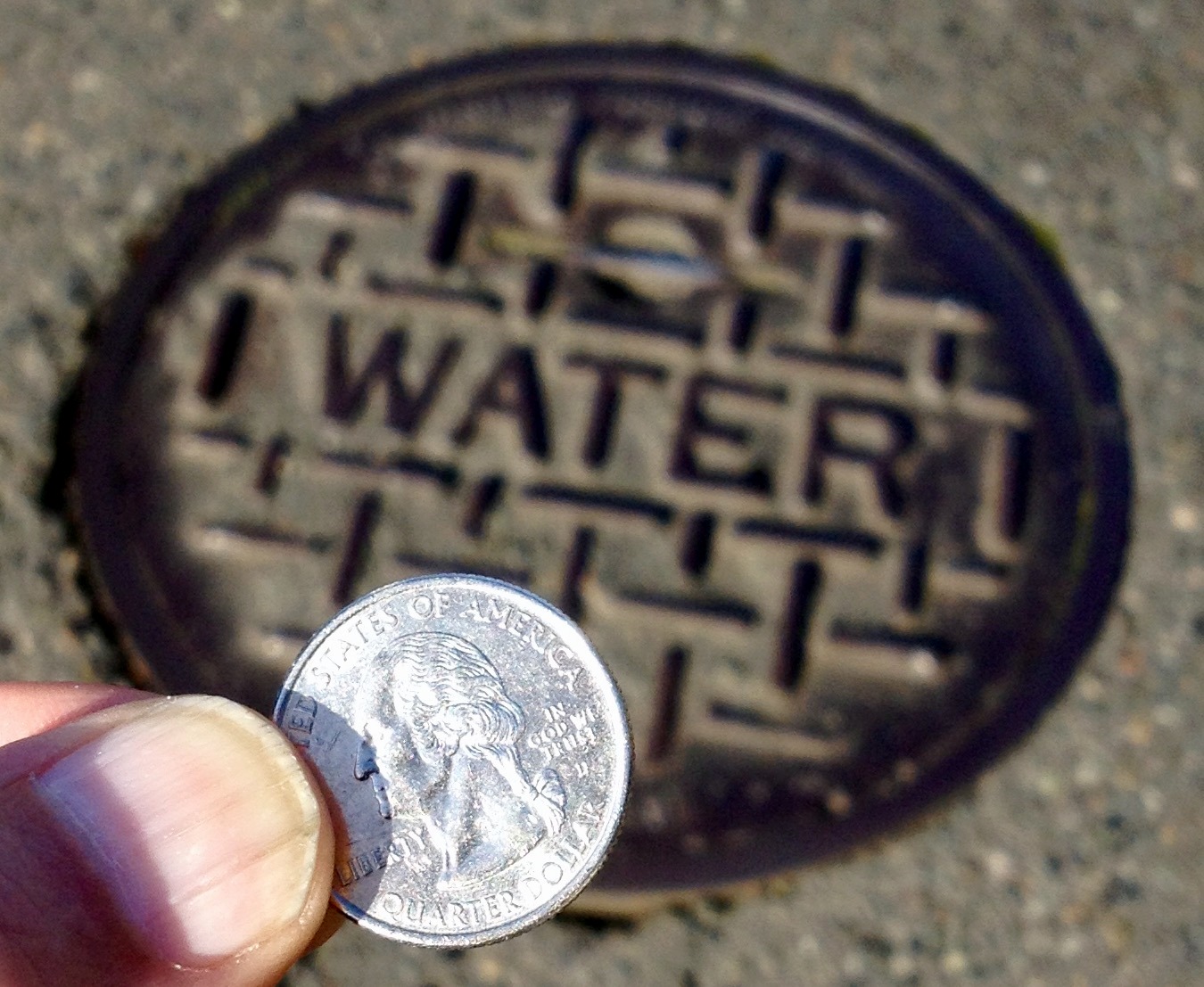
and tails…
…if there is no bright side, then as my son once said, I have lots of practice polishing up the dull side.
I was privileged to have friends share some of their hard and dark moments with me, and the above things I mentioned are all true – and have happened within the last few months, and it really kept me thinking. I finally came not to a conclusion, but to a realization.
Everyone has decisions to make every day that you will never see.
Sometimes their coin comes up heads, sometimes tails.
Sometimes folks have the energy to claw up the manhole cover that fell down tails and use the last bit of their strength to make it heads, and the expression on their face as they do it is no longer a smile, but a grimace.
The decisions and tasks some folks have to consciously go through are things so many are blessed to take for granted, and it takes me to these simple sentences:
Respect that others around you have their own journey even if you don’t see it.
Respect that those around you have their own struggles along that journey of theirs, and you cannot tell from the surface how difficult their journey is.
There will be some around you who have been carrying their burden so long that they’re no longer even capable of putting it down, or would know what to do if they could put it down.
Be kind to them. Be gentle with them.
And if you can, if they can, maybe you could put your manhole cover down next to theirs, and you can lean them together and roll them along your journey, each of you helping the other, and recovering a little as you go.
Take care out there, folks.

 Tom Roush's Blog
