
You are currently browsing the tag archive for the ‘Family’ tag.
I’m always amazed at how intertwined things can be so as to become a braid of events that become larger than the sum of their parts. One of them came together just recently that left me pondering many, many things, but I have to leave some details to my special guest author. You’ll understand why in a moment. But first, the strands themselves:
- A couple of weekends ago, we said goodbye to our beloved grandma for the last time. It caused me to look back a bit, at the 94 years of her life, and the lives of those around her.
- This last weekend, I went through a stack of 4 x 5 transparencies, some 50 years old, some older. Some had color as bright as the day they were taken, some were black and white. And while I was searching, a picture came up that hadn’t seen the light of day more than a couple of times in the last few decades. And it caused me to look back, both figuratively and literally, a bit more.
- Then last Sunday there was an article in the paper about the 50th anniversary of the 1962 World’s Fair, in Seattle, Washington, but most importantly, there was a story about Belgian Waffles.
- And that reminded me of a story my mom told, and wrote, about those very Belgian Waffles, which were an absolute hit at the fair, and which made a lasting impression on her.
And over time, hearing those stories, and seeing the pictures, made me realize that history, and we can call it that, wasn’t dull and dreary, faded black and white images. It made me realize that life way back then was just as full and vibrant as it is today, with real people, living life as best they could, sharing responsibilities and joys just like we would…
…and then I saw a connection between all of those disparate thoughts, those strands of the bigger braid being woven together up there that I hadn’t seen before.
See, in 1962, the grandma we said goodbye to a few weekends ago was younger than I am now. She babysat my sister and me so a young couple could have some time off and spend a whole day away from the responsibilities of raising two young children. That young couple was my mom and my dad, and while my grandma watched us, mom and dad headed north, to the Big City of Seattle, to see the World’s Fair – and – well, actually, let me introduce my guest writer for today, telling the story of the beginning of that braid, the very story of the Belgian Waffles mentioned in that newspaper article, not as a historical event looking back 50 years, but through the eyes of a young woman, only in America for a few years, still learning about the country, the climate, and the culture.
Oh… And the waffles.
Ladies and gentlemen, please welcome my mom.
A memory of the 1962 World Fair
By I. Roush
It had been only two years since I had come to the States when the Space Needle was built in Seattle for the 1962 World Fair.
The pictures I saw in the papers reminded me so much of the equally famous Fernseh Turm (TV tower) in Stuttgart, in the area of my home town in Germany. The two looked like twins, and that alone made me want to go to see it at the Fair.
The big stretch of cement, I-5, did not exist then, so we had about 2 hours of anticipation and conversation as we drove up what was then known as ‘Old 99’.
I didn’t have the foggiest idea of what to expect at the Fair.
Was I ever surprised!
My dear mother-in-law volunteered to take care of our two little ones, our 3 month old baby and a toddler, which gave my husband and me a chance to make a full day of it, a very welcome treat from full-time parenting.
Because it was billed as a “World Fair”, I decided to wear my Dirndl, a traditional dress from my part of the World, Southern Germany, which included Bavaria and the Black Forest.
At the Fair we walked from exhibit to exhibit and marveled over new inventions from all over the world. It was not only inventions but also people from all over the world. This could be clearly seen in their faces and many times also in their clothes.
It was fascinating, and a tremendous amount to take in. New gadgets for the household were demonstrated in one building, in another was an enormous rotating oven that was almost hypnotic to watch as it churned out hundreds of the well-known scones at a time. But even so it seemed they could not be produced fast enough to satisfy hungry Fair-visitors.
In another building was the art gallery. I remember one painting of a seascape which was so realistic that I felt the need to stay back for fear I might otherwise get wet. (I decided right there and then, that’s the way I wanted to learn how to paint water.)
Then we saw something special.
It was the Belgian Waffles. I never had heard of those.
By this time my tired feet reminded me that it was time to take a break and my stomach was in total agreement with them.
There was quite a large crowd standing in line already in front of the raised platform from which those waffles were handed down. They looked so inviting with that generous helping of luscious ripe strawberries and an even larger portion of whipping cream on top.
My husband and I looked at each other, and then realized this wasn’t such a hard decision to make, so we joined the waiting throng to be served. We hadn’t been there very long when the lady, who was handing down those yummy looking waffles, stopped and looked right at me. I’d never seen her before, and couldn’t imagine she had anything to say to me, so I looked left and then right, but there was nobody else who seemed to feel singled out by her. But then she pointed her finger right at me and with a loud voice announced:
”You probably have to go back to your booth, so I better serve you first”.
My Dirndl had given me away.
I realized that she had seen the Dirndl and thought I was one of the people who was actually part of the fair, but of course I wasn’t. There was no booth or exhibit I had to hurry back to.
Then again, I couldn’t argue with a person who was in the process of doing her ‘good deed’ for the day.
As I stood there trying to figure out what to do, the crowd helped make the decision, parted, and graciously made a path for me to receive the waffle the lady was offering me.
My dear husband didn’t wear any ‘Lederhosen’, so he could not pass as my Bavarian escort but she was gracious enough and served him also.
Happily carrying our plates, we looked for the nearest bench where we could sit down, I could rest my tired feet and enjoy those wonderful Belgian Waffles to the fullest.
That memory of the 1962 World Fair still brings a happy smile to my face and a warm feeling to my heart.
Thank you Belgian waffle Lady!
===
So – the strands of the braid come together with a thank you to the Belgian Waffle lady, a belated thank you to my grandma for babysitting my sister and me those many years ago, making this trip, and this story, possible – and a very special thanks to my mom, who wrote the story you just read. (You can see her below wearing the Dirndl in a photo taken around that time, also in a photo taken a number of years later, when she discovered that making dolls wearing Dirndls was fun, too, and one of her and dad, taken a few years before the story happened)
We were in Eastern Washington a few weeks ago, and brought home a couple of boxes of the world famous Washington State Apples. It got me thinking about all the wonderful things you can do with apples. You know, apple sauce, apple pie, my favorite apple crisp, or just simply baked apples.
You don’t need anything special to bake apples, You can bake them in a dutch oven over a fire, or in a regular oven, or like my sister did a while back, in a microwave. She cored them, put raisins and brown sugar in the hole, then nuked them in the microwave for a few minutes. The smell was absolutely divine, the kind of smell you want to come home to – and the smell would make even the rattiest shack feel like home, no matter where it was. I found myself pondering, and realized my mind had drifted off to a story my dad told about another box of apples and a baked apple recipe that had some rather special requirements.
You see – well, let me take you back to the late 1950’s or so…
Dad was in the Air Force, and worked in Crypto, that is, codes for the first few years there. The Air Force had trained him, and then sent him to where codes would be used, a lot. Now given that this was during the Cold War, the hot place to be code-wise was actually a very cold place to be geographically, and that was as near as possible to the transmitters where the codes were being transmitted from. That place was from what was then the Soviet Union.
The closest thing the US had to those transmitters were some of what were the most inhospitable hunks of real estate on the planet, that being a part of Alaska known as the Aleutian Island chain. The hunk of real estate dad was stationed on was an island almost at the west end of the Aleutians.
The messages that dad intercepted were often encoded and then sent by machine. Dad would sit there, with a headset plugged into a receiver, and transcribe these messages that were sent out in Morse Code on an old manual typewriter. Understand, he might be able to decode what the coded messages said, but not what they meant, and it was often someone else’s job to decode that level of it, so dad would sit there with his eyes closed, and type out into letters the short and long beeps he heard in his headsets. It got to the point where he’d learned the code so deeply that that part of his brain was essentially on autopilot (this would come into play over 40 years later – in a story yet to be written). His fingers were typing out the letters, while his brain was thinking about something else, anything else, for that matter, anywhere else, as the Aleutian Islands were about as far as you could get from the “Lower 48” of the United States and still be in the country. For those of you who don’t know anything about them, a short history lesson:
The Aleutian Islands came as a package deal with Alaska when the US Secretary of State William H. Seward bought it from the Russian Government in 1867 for a little more than $7.2 million, or about 2 cents an acre. There were some who thought that was a touch expensive for the land once they saw it. In fact, there were some who thought the land was so remote that it would be too expensive even if it were a straight-out gift.
However, Alaska proved its value in the gold rush of 1896, and the Aleutians were also considered valuable strategically – even as far from anything as they were. I mean seriously, the Aleutian chain goes out west so far that you can see tomorrow from the end. In all reality, today should be tomorrow in the middle of them, but the International Date Line zigzags around them so they can all at least be on the same calendar day as the rest of the United States. Not only that, some of the islands of Alaska are so far west, and thus so close to Russia that you can see it from there.
No, really.
They were fought over by the US and the Japanese during WWII, and there have been persistent rumors that some of the islands had a few visitors from Russia during the Cold War.
It’s hard to grasp how far away Shemya is from – oh – anywhere, but one fellow stationed there put it into perspective. See, using the common denominator of a McDonalds as a sign of how close or far you are from what we consider “civilization”, in the lower 48 states (that is, the continental United States) it is physically impossible to be farther than 115 miles from a McDonalds restaurant. But there’s a sign on the east end of Shemya that makes it very clear that a Big Mac is not in your immediate future. At that point, you’re 1500 miles from the nearest McDonalds.
If that doesn’t put it into perspective, let’s try this: If you were in Seattle, would you drive to Des Moines, Iowa, for a Big Mac? That’s the distance…
That’s how far out there Shemya is.
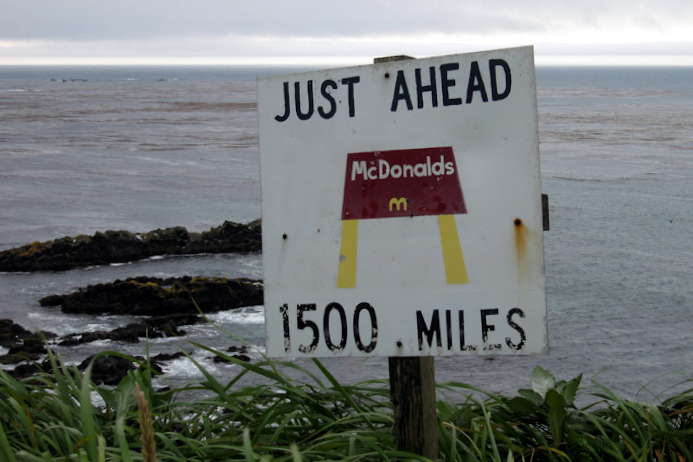
On the East end of Shemya is a reminder of how far from Civilization you really are.
(Photo courtesy of and © Lucas Payne Photography, used with permission)
So because of this remoteness, and because supplies had to be shipped thousands of miles across the North Pacific, they had to be ordered months in advance of their planned use, and given the quantities needed and the difficulties in delivering them (due to both distance and the often inhospitable weather), they were brought in infrequently by barges in loads that included up to a six month supply of everything from food and fuel to paint and paperclips.
One barge bringing in fuel was grounded in bad weather and was simply left there. The fuel was pumped out, and over the years, what remained of the barge was cut up; the usable pieces were cut away to be used for repairs that required hunks of steel. The old adage of “Use it up, wear it out, make it do or do without” was very much a part of life on the Aleutians at that time, and soldiers, sailors, and airmen learned to make do with what they had, even if it showed up as steel in the form of a grounded barge.
What they had back then were either the bare basics, and sometimes even those were hard to come by, or an astonishing amount of stuff worn out from use or weather left over from World War II that was cheaper to leave there than it was to take back to the lower 48.
Early on, heat was a challenge (namely because there wasn’t any). And solving the heat problem created new, different problems. The preservation of food, which had been easy in the lower temperatures, became difficult when the heat (in the form of oil burning stoves) was on. The food couldn’t just be left outside. While that would have kept it cool, the wildlife would have considered it a buffet, and given the barge schedule, feeding the animals wasn’t something anyone could afford. Another solution was needed, so, with nothing but time on their hands when they weren’t working, the guys who wanted cold sodas or beers went back to the way some of their parents had solved problems like this without electricity–they nailed the crates some of their supplies had come in to the sides of buildings with the open ends facing into the windows, built supports under them so they’d stay, and went inside. They opened the windows inside the heated building, and–voila!–their own little crate refrigerators. (Modern versions of these persisted even into the ‘70’s)
The heat that was welcomed by humans created another problem. It was also welcomed by some of the local wildlife:
Rats.
They got into everything, chewing through walls and getting into supplies. Some, searching for warmth, even got in bed with some of the soldiers stationed there.
They had to be dealt with.
And when you get a bunch of bored young men out in the middle of nowhere together with a problem to solve, they can often get pretty creative in solving those problems. Remember how infrequently supplies were delivered? That went for any kind of entertainment at the time as well, which explains how early on, before things got too civilized, one intrepid group of soldiers developed their own way of dealing with the rats. They decided that, instead of killing them outright, they’d have some fun with them, so when the rats chewed holes into the buildings and popped their heads up, looking for either heat or food, they got sprayed with varying colors of spray paint that had come up with the supplies. Each guy got a different color, and then the group took bets on whose rat would show up next. The image of a group of bored soldiers on one side of an oil stove, facing off with a rainbow of rats on the other, is hard to get out of my mind…
Over time, as more and more equipment was brought out, the various outposts in the Aleutians became more ‘civilized’ – but there was no letup on the fact that you were far from home.
By the time my Dad got up there, buildings were made of brick and cement and were definitely built to handle the weather and climate. He spent a little bit of time on an island called Adak (where the rainbow of rats were), but spent most of his time further west, on an island called Shemya. And out there, the weather was routinely so bad that the standard issue wind sock had worn out and had been replaced with a far more durable one.
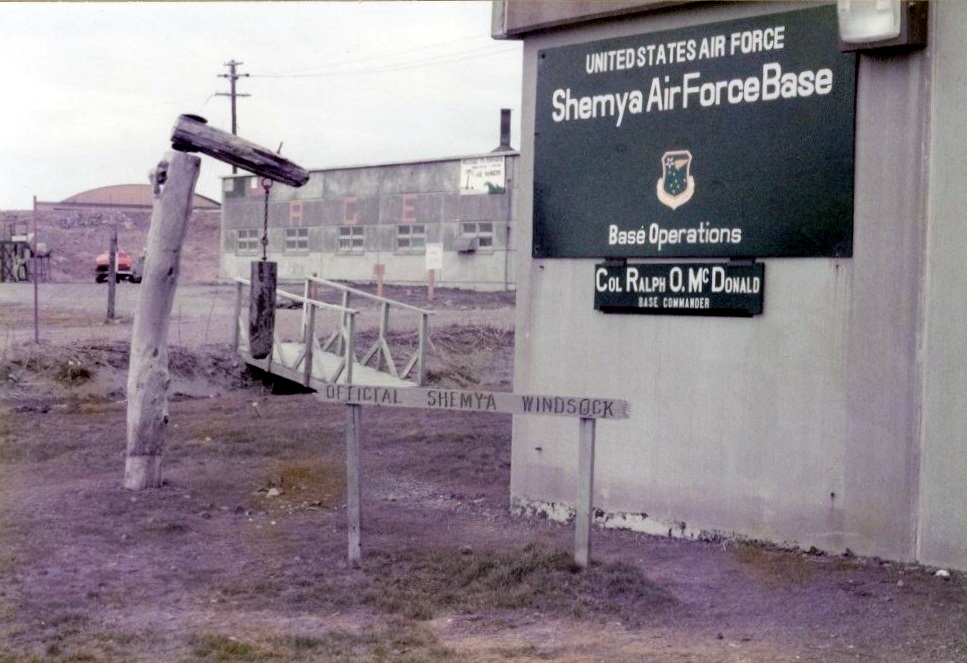
USAF Wind Sock, Shemya, Heavy Duty, One Each
(click to enlarge) Photo courtesy of and © Buck Woody , used with permission
The reason dad was out there was because out there was some of the most advanced and powerful electronic equipment of its time. Not only were there electronic listening posts (receivers), but there were electronic transmitters, and on Shemya, there was a radar unit.
This radar unit was huge.
There were several there over the years, but one in particular held some fascination for my dad and his compatriots. It was the radar known as the AN/FPS-17 – at the time it was among the most powerful radars in the world.
Now because of all the tremendously expensive electronics that were out there, the buildings and control rooms they were in had to be dry. In fact, the various buildings were heated by a combination of all the electronics that were in them, the huge oil burning heaters that were running constantly, or both. So as cool and damp as the air was on the outside of the buildings, it was warm and dry, although a bit stuffy, on the inside, since they recirculated the air they’d warmed up.
So if it’s not clear yet, because of the remoteness of the location, the complexity of resupply, and the incredibly unpredictable weather, they were very conservative with their supplies, trying hard not to waste anything, and given that weather, the radar unit took several years to build, so remember that they only had what had been brought up on the latest barge.
If, for example, one of them got a hankering for a hamburger, and there wasn’t any beef on the island, there wouldn’t be any burgers in the buns.
If, on a cold day, one of them wanted a mug of hot chocolate, and it was stuck on the barge that was waiting for the weather to clear, well, he went without the hot chocolate.
And if there were times when the desire for something as simple as hot chocolate was almost palpable, and you just wanted something warm…
…like when the fog was so thick you’d need a chainsaw to get through it.
…or when the mist was so heavy you needed to lift it with jacks just to walk under it.
…or when the cold was so bone chilling that the fact that you were out in the middle of nowhere was overpowering, and as much as you might have just wanted something simple from home back then, if it wasn’t on the island, you weren’t getting it unless months before, someone had thought to put whatever that was onto a barge to be shipped up to Shemya for the once or twice yearly resupply missions.
So… whether you liked it or not, the options were pretty limited, and you made do.
But the longing for something familiar, the homesickness – even though they’d never call it that, would just get to be so overpowering as to be debilitating. Everyone from the commander all the way down to dad and his fellow airmen realized that keeping morale up was important, that bad morale could be dangerous that far from anywhere, so jumping on any bout of homesickness right away was pretty important all the way around.
The routine there was as simple as it was monotonous: Day after day, dad would do his shift, typing the codes that came into his headphones while his mind was elsewhere. The headphones dad wore shielded some of the constant hum of the electronics, and the only break from the routine was to go outside, where he’d brave the weather or the fog monster, and he’d go just for a change of scenery. Later, there was more entertainment and recreation, but while he was up there, he, like all the others before him, had to make do with what he had…
And going outside helped sometimes.
The air was so much fresher than the dry, overheated, electric air inside the control building around the radar and communication processing equipment. For the most part, you could walk anyplace that wasn’t fenced in. You could go down to the beaches, or on the north side, to the cliffs. There were caves to find, of all things, gemstones in. One of the fellows stationed there found some Jade in one that he made into earrings for his wife. Another found a walrus tusk on the beach that he gave to his wife. Both still have them to this day. So you had a lot of freedom to ‘get away from it all’, as much as you can have on an island, but even outside, if you got close to the radar antenna, you could actually feel the electricity. In fact, along that note, the instructions had been pretty clear: you stayed out of the radar beam, and as they were testing it, after the thing had been on for a while, it became clear to even the least technical of them that there was one place on the island you didn’t want to be, and that was in front of that radar antenna.
Why?
Well, it was simple things, like the grass on the hillside in front of the radar dying after it was turned on.
And when there was snow everywhere else, there wasn’t snow in front of the radar antenna.
Someone also noticed that seagulls tended to drop dead if they hung around too long in front of the radar antenna.
And with the weather occasionally socking the place in with, sometimes you were stuck inside and couldn’t go out at all, even if all you wanted to do was watch the seagulls. About that time, the combination of the boredom and the isolation got to one of the fellows.
The almost constant fog, the cold, (it rarely got above 50 degrees, even in August), the wind, even though it brought some of the cleanest air on the planet (that is, when no one was testing Atom bombs in the vicinity) started getting to him. It was just so isolated, and after a number of months of mind numbing work, boredom, and loneliness, the fellow was simply homesick, and mentioned that he had a craving for the one thing that reminded him of home, and that was the smell of baked apples.
The other fellows, my dad included, realizing the beginnings of that homesickness, thought, “Baked apples our friend wants, baked apples we can provide.” So one fellow took the four wheel drive pickup they had down to the mess hall and got a crate of apples. The others pondered which of the hot pieces of electronic equipment they could use to warm the apples up on.
And then, as they talked, they looked around and realized what they were standing next to, started putting two and two together, and realized that thousands of miles away, Dr. Percy Spencer, the inventor of the magnetron tube that was used in the huge radars on the island, had melted a candy bar in his pocket just a few years earlier just by standing next to one of the very first ones made. Curious about the candy bar, he tried it again with popcorn. This time with it not in his pocket, he blew popcorn all over the lab he was working in, and later literally got egg on the face of one of his coworkers as he exploded the very first egg with microwaves.
And then…
Well, no one’s sure anymore who came up with the idea, but given the rudimentary supplies they had available to them (remember, what was up there came on a barge, and not very often, at that…) they started thinking of Dr. Spencer’s invention and realized that he was dealing with an itty bitty magnetron tube that was melting candy bars, popping corn, and blowing up eggs from several inches away. Dad and his buddies were seeing dead grass, cooked seagulls, and melted snow a half mile away, and without even taking the apple crate out of the truck, they devised a cunning plan to perform some ‘emergency maintenance’ on the radar unit with the dead grass and seagulls in front of it, and it was shut off.
The constant humming that had become background noise completely disappeared. The crackle in the air was gone, and that feeling you get of just being around so much electricity was simply not there. The huge Fairbanks-Morse diesel generators that had been straining to create the electricity to run this radar were suddenly just loafing. You could hear the wind whispering through the antennas. You could hear the seagulls calling. Over the hill, if the breeze was right, you could just barely hear the ocean, and the walruses and sea lions arguing about whose turn it was to be on that particular hunk of rock.
It was… Peaceful.
For a moment.
And then all that gentle background noise was shattered by the sounds of a rusted out muffler on a four wheel drive Dodge Powerwagon firing up and three guys blasting out along the edge of a cliff in it, out to where the dead grass and seagulls were, where they dropped off the crate of apples, and then hightailed it back to the building that had all the controls and the radiation shielding in it.
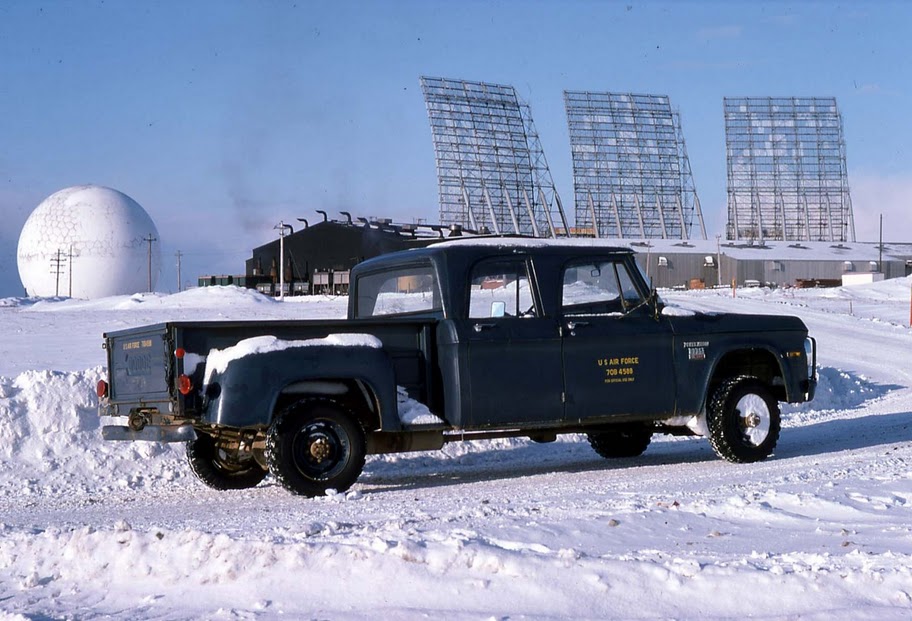
A Dodge Powerwagon, similar to the one mentioned in the story, with the Radar Antenna and the generator building in the background.
(Photo courtesy of and © Don Erdeljac, used with permission)
Once they were all safely away from the radar beam, the switches were thrown, and the generators lugged as they once again struggled to generate the 1.2 megawatts of electricity needed to power up the radar again, and the electrons surged through massive copper wires, tubes, capacitors, and finally the antennas as that crackling hum came back.
About twenty minutes later, they decided that the apples ought to be done, so there was another reason for ‘maintenance’, and once again the four wheel drive truck raced out to pick up the crate of apples.
They were surprised to find the metal parts of the crate were hot.
They were surprised, and delighted that some of the apples had popped and oozed syrupy apple juice all over the ones below.
And they were overjoyed when the apples that done were smelled exactly like baked apples should smell. They got some gloves off the dashboard where they’d been warming up and loaded the crate into the truck and took it back to the control building, where the homesick friend was trying, with marginal success, to keep his head in his work. Dad grabbed one end of the crate, another fellow grabbed the other end, and a third one held the door open as they all came piling in. That smell, that wonderful, sweet, syrupy smell of baked apples came wafting in with them, and at first, their homesick friend thought he was imagining things, but then he looked up, and saw the crate, and smelled the apples, and he smiled, and then he laughed.
They did indeed smell like baked apples should smell.
Not only that, but they tasted just like baked apples should taste.
And dad said he never had any as good as those baked on a windswept hillside on a remote island in the North Pacific, by a radar half a mile away.
===
In researching this story, and it took a couple of years of it, off and on, it became clear to me that not only did my dad use a radar that required enough power to run about 300 homes to bake apples a half mile away, but while most of the radar we think about is designed to find airplanes several miles away, the one that my dad and his buddies were using to cook apples was designed to find missiles…
In space.
===
(And now, seriously, unlike most of my stories, where I do all the research, all the writing, all the editing, so many people helped with the research on this one that I simply have to roll the credits. While my dad told me the original story many years ago, it was missing enough context, likely by design, to keep me from knowing exactly when and where it all was, since the location he’d been in was a pretty secure military installation, and most of what he was doing there was stuff he simply couldn’t talk about. I could not have written it down and made it make sense without the help of all the people below who willingly shared their memories with me, gave me their time, their own stories, and graciously allowed me to use their photographs to help tell this story from over 50 years ago. I have tried hard to bring this story to life as much as I could while I still had the access to these people and I trust those who were up on Shemya and the Aleutians who shared with me first hand thoughts about what it was like to be there. If there are any inaccuracies in the story, they are mine.)
Don B., whose widow Brenda took time out of her day to listen to questions coming out of the blue about her husband, and then told me the story about the rainbow colored rats on Adak.
Michael: You were the first to point me in the direction of Shemya. I’d heard stories of Adak, and had been focusing all my attention there – thank you so much for taking a fading memory and pointing me down a path that actually let me see the hillside my dad had talked about. Until that point, I didn’t even know what island out in the Aleutians to look for.
Tom – Your pictures, your detail, your encouragement all helped get me pointed in the right direction. Your stories (including your Saab stories) helped bring life to the story I was trying to write, especially when the stories he was telling included references to cooking seagulls that had strayed too long into the beam of the radar. 🙂
Don E. – Many, many thanks for digging through your memories, sharing your stories, your patient explanation of everything, and the use of the photo in this story.
Lucas – This picture of McDonalds Point did such a good job of putting into context how remote Shemya is. I’m hoping the combination of it for those who were right brained, and the data I was able to get from Von (for the left brained types) helped to make the picture complete. For those of you curious to see some amazing images from up north, take a look at Lucas’s site – there are some wonderful images up there.
Von – Thank you for the willingness to help out with the information showing how far Shemya is from something so ubiquitous that we take it for granted. I’m hoping our information along with Lucas’s picture above help drive the point home just a bit…
Buck – Thank you for your feedback, your friendship, the photos, and relating your experiences, they made it come alive, and made a very big world feel like a very, very small place.
Barbara – thank you for your input, your thoughts, and all the items and stories on your website. They helped me see a place I could only see in my imagination.
Of course, my dad, who remembered the story well enough to tell me so I could share it with you.
And last but certainly not least, my family, whose patience as I researched and wrote it over the years can’t be overstated.
Thank you. I couldn’t have done this one without you.
I’m always amazed at the forms my time machine takes, often when I least expect it.
This time some film negatives I’d found and scanned into the computer several years ago just to see what they were, combined with a note I found on an archived CD made for a trip down memory lane to take me back to a simpler time. So, with very little editing, here’s a story from 1996…
I spent the weekend with the kids down at my folks’ place, and made apple cider with the apples from our trees in the back yard…
- The truck full of apples we took down to make Cider with.

…on a cider press that’s probably 100 years old. It used to have a hand crank, but my Grandpa at one point put an old electric washing machine motor on it and ever since I knew of it, it ground the apples into pulp at the flick of a switch. You still had to squeeze the juice out by hand though.

- Lys and Oma making Apple Cider on a cider press that was about 100 years old

After making the cider and cleaning up, and while Alyssa and Oma (German for Grandma – my mom) did only the kinds of things that granddaughters can do with their Omas, Michael and I went to what had always been my grandparent’s farm and went for a walk among the trees (douglas fir, cedar, oak), basically where I grew up. I went for many walks out there with our dogs and BB gun when I was a kid, and often went just to think and clear my mind.
My Grandpa had passed away some years earlier, and at the time, it seemed like my grandma was planning on selling the farm, so I felt I needed to take Michael out there and show him what I used to see and where I used to go exploring before that all changed. It was very strange, and I found myself quite disoriented sometimes. There were trees in places in the back of the farm that had been completely free of trees before. Areas that had been ponds no longer existed at all. What was reality simply didn’t match up with what I had in my memory.
We came to the front of the farm and saw that my grandma was boarding some horses on the land and they came up to us and just wanted some attention (and some Apples).
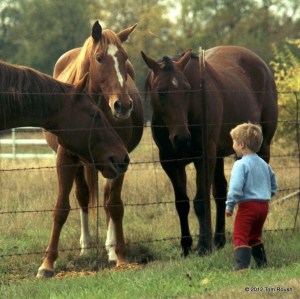
- Michael and the horses
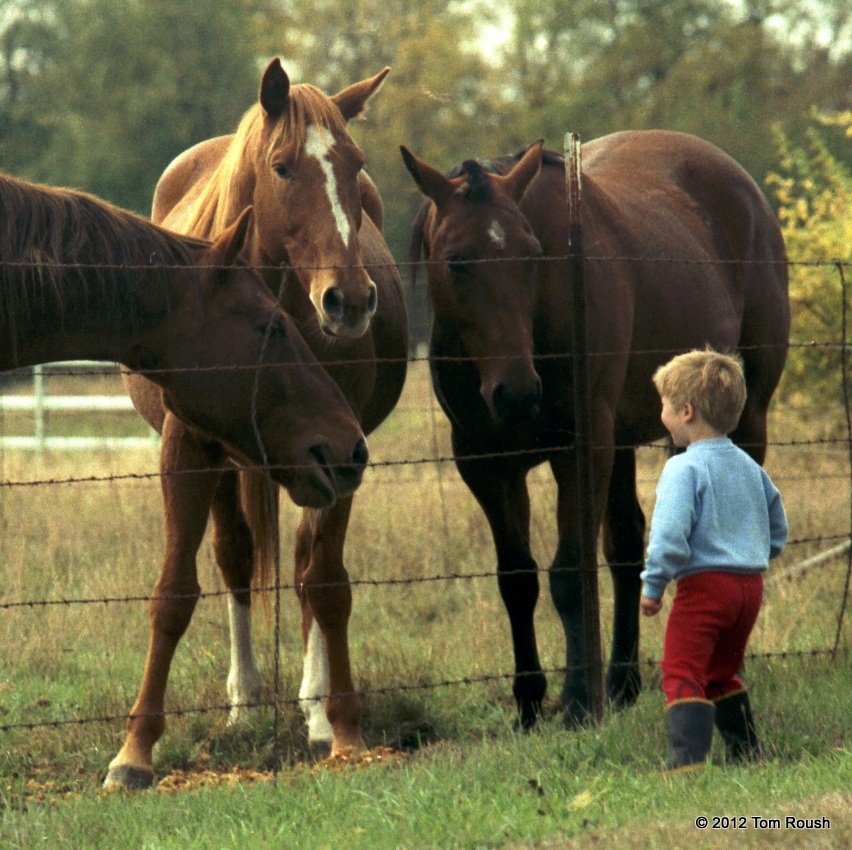
So we petted them, and Michael later stood up on a stump and scratched one of them while the other one nuzzled him… It was really neat. It’s one of those experiences I hope will stay with him for a long time…
Michael and I explored the swamp in the back, and watched several frogs try to jump away from him, one rather large one managed to escape just as his boot stepped down. He was as surprised as the frog was (but probably not as terrified). We kept wandering and exploring, and saw an area where the water was too deep to be a swamp, and became a large pond. We heard rushing water and went through a fence to find a beaver dam. Michael had on his black and yellow “fighter fighter” boots because he “might” want to go into some water, so when he did, naturally he went in just a little too deep, and the water flooded over the top into the boots…
At that moment I decided that I had a chance to either have some fun and make a memory with my little boy and get my feet wet, or gripe about the fact that his boots and pants were wet and — it was a no brainer…
I waded into the creek in my shoes — the water was COLD (it came from, as I recall, Sprofsky Springs), and went through the swamp and then hit the beaver dam. We later waded down the creek from right below the dam, just to explore, and got completely soaked. He loved it. Lost his balance, I caught him just as his bottom hit the water…
We came back, me squishing in my wet shoes, him sloshing in his wet boots, and saw this HUGE anthill and were both watching it intently when this fairly sizable spider walked into the picture.
Mistake.
Even though the ants were much, much smaller than the spider, they took it down. It was like watching “Nature” on PBS. Michael, who’d decided he was scared of spiders, suddenly found himself seriously rooting for this one, and was first interested, then incensed that the ants could do that to a spider. It was truly amazing. Michael first wanted to throw things at the ants, then thought better of it, and decided he wanted to know what ants REALLY liked to eat, and maybe he could get their attention away from the spider with that. I thought that was nice. He wanted to save the spider, but didn’t want to kill the ants.
Afterwards, he had a rock in his hand, and was wondering how the ants would react to it. I thought back about 20 years, and how I’d thrown rocks at the ancestors of those same anthills, and how typical that was of a young boy. He asked what would happen if he threw the rock, and then asked if they would attack him. (Given what he’d just seen, that was a pretty valid question). I didn’t say yes, but kind of let him make up his mind on his own. He ended up dropping the rock on the ground next to the anthill, feeling some vindication because he may have killed some of the ants that had killed his new found spider friend, but also feeling good that he hadn’t killed all of them…
We sloshed and squished back to Oma’s, and ended up having some of the cider we’d made that afternoon with dinner that evening.
Eventually I packed up some of that cider, a lot of memories, and headed back home as the kids drifted off to sleep in the back of the car.
It was truly a wonderful weekend, and I went back to work on Monday morning to a job I enjoyed, a job that allowed me to support my family, but away from the trees and forests where I grew up…
Sigh…
God has been good.
Take care, folks.
Six years ago last weekend, my son Michael and I had a new word enter our vocabulary.
Just one word…
“Norwegian.”
It’s a word that brings back memories that are still filled with wonder, laughter, awe, and not an insubstantial amount of reverence. It was the first hike for me after a long time of recovery, and was kind of a celebration of sorts, to prove that we could go out and do something more than just ‘recover’. By way of introduction, Michael was a Boy Scout at the time, and, it turned out, this was a traditional camping trip that our Scoutmaster, Paul, did on President’s day weekend.
Every year.
You might be thinking, “But President’s Day weekend is in February!”
Yup.
It is.
Every year.
The Norwegian Memorial was a 5 hour drive to get to from Seattle.
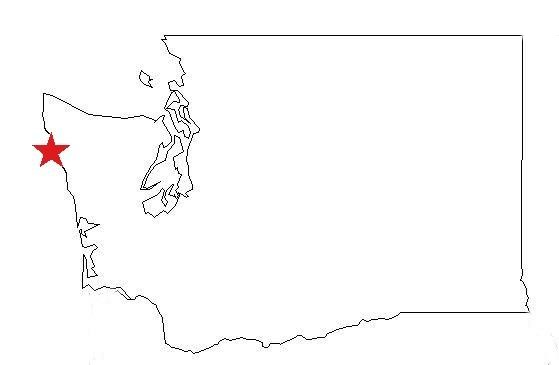
it’s way out there…
It was out west of Forks, Washington, long before any TV show brought attention to it, and after you got there, there was a hike in. I had to work Friday and couldn’t get away, and it was a hike not recommended to do in the dark.
Note: What happens in this story (note: all of it is true) is what caused us to go out the next year – the adventures of which you can read in the Shi Shi beach story. It’s in that story we learned about hiking in the dark – and if you read that, you might get a better picture of why this doesn’t happen often.
So Michael and I headed west, in the Saab (1968 Saab 96 Deluxe, with the V-4 Engine). He navigated, I drove. At one point we were bombing down a gravel logging road, and having watched bits and pieces of the Paris-Dakar Rally on TV some time earlier, he’d commented that that would be fun to do, and it didn’t take me long to realize that we were doing just that.
We were doing about – oh, 30 or so, which on a road that had simply been bulldozed through the forest actually felt pretty quick. I yelled at him over the roar of the engine, the tires sliding sideways every now and then just enough to throw gravel up against the bottom of the car, “Hey Michael! you know what we’re doing?”
“What?!”
“We’re Rallying!”
And the thing was, we kind of were…
The road was a little rough in places
I took a picture (hey, it’s me, what would you expect?)
We had a rough set of instructions that would get us into the right neck of the woods, so to speak, but we didn’t have any more detail than that… There were areas we had to travel slowly and carefully on, but there were some parts, the straight and gently curved stretches of the gravel road that we traveled down just fast enough to make it fun and exciting, without being so fast that we’d damage the car or ourselves if we got ourselves stuck. And there was the fact that this was the kind of road I’d learned to drive on (and it was a Saab I’d learned in.) So I knew the limitations of the car from a few decades of driving experience.
It was, to put it mildly, fun. (in fact, I’m still smiling about it as I write this)
Not on the map was our primary goal, which was, “Find Paul’s truck”, because if we found that, we’d find the trailhead, so that’s what we did. By the time we got there, it was 3:00, so we didn’t have too much daylight left. We’d been told it was a mile to get in, but Paul had developed this reputation that meant we had to convert “Paul Miles” into “Standard Miles” so we figured it might be a bit longer than a standard mile, and so we scarfed some snacks and started hiking in. The trail was barely distinguishable from the surrounding forest, but we figured if we kept heading west, eventually we’d hit this big patch of water called the Pacific, and we’d be able to find things from there. After some time, we took a break and sat down on a log to rest for a little bit. By this time, we’d learned two things about the trail:
- If it was muddy and you got stuck in it, chances are you were on the trail.
- If it was impassable, chances are, you were off the trail, and had to get back to the mud.
It was nice to have things clear and simple like that.
We got up and hiked for another half hour or so with Michael leading the way, and somewhere in there I realized the brand new tent I’d been focusing on, the one that was tied to his backpack, wasn’t there anymore.
Um…
Let’s see…
Sun going down in the west, nothing but trees and the beginning traces of darkness, and maybe a tent to the east.
Thing is, we still had light, we just didn’t know how far (and thus how long) we had to walk, so we didn’t know how much time we had to go look for a lost tent.
We decided he’d go back for no more than 10 minute to look for it, and it’s good we had radios with us to communicate, otherwise the trees absorbed ALL sound. It was truly eerie how loud he could yell from just a few feet away and it just didn’t penetrate the trees.
At all.
Later I took a picture at that place, because it was suddenly so easy to understand how someone might get totally lost and never come out…
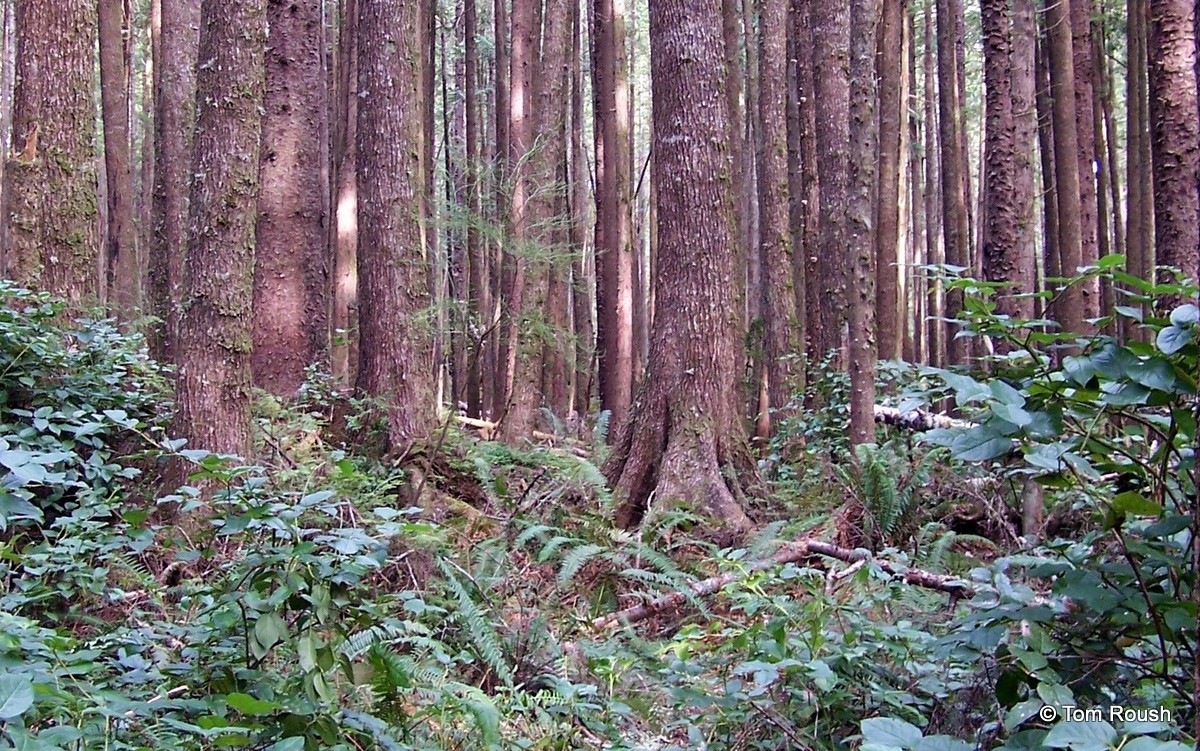
Find the trail if you can. If you got lost, you couldn’t hear someone yelling from 100 feet away.
We were glad we’d each brought a tent of our own. It gave us a spare.
We kept walking, and eventually the trail started going sideways downhill toward the beach and we could hear the surf in the distance. We found where a tree had fallen and blocked the trail. It was too big to climb over, too low to the ground to crawl under as we were, and since we were on a hillside, we couldn’t really go around. So we took our packs off and crawled under, then kind of lobbed the packs over the top of the trunk laying there and put them on when we’d gotten to the other side. It was nice that we succeeded in that, it meant not having to climb into the tree to get our backpacks back down. After that, the trail was pretty clear. In fact, when we got to the bottom of the trail, it was next to impossible to miss…
This part of the trail could actually be hiked in pitch black darkness. Here – take a look…

Now THIS was an easy trail to follow.
I also took this one looking back on the way out but this is roughly what we saw on the way in.
Some of the scouts saw us and were both surprised and delighted that we’d made it. One took my pack off my shoulders for the last few feet, and of course when that happens, you just feel like you’re floating, so I floated over to the campsite (just left of center in the picture above, and it was right…
on…
the beach…
It was amazing.
When we finally got there, there was a small fire on the beach (okay, small, relative to the size of the beach) –
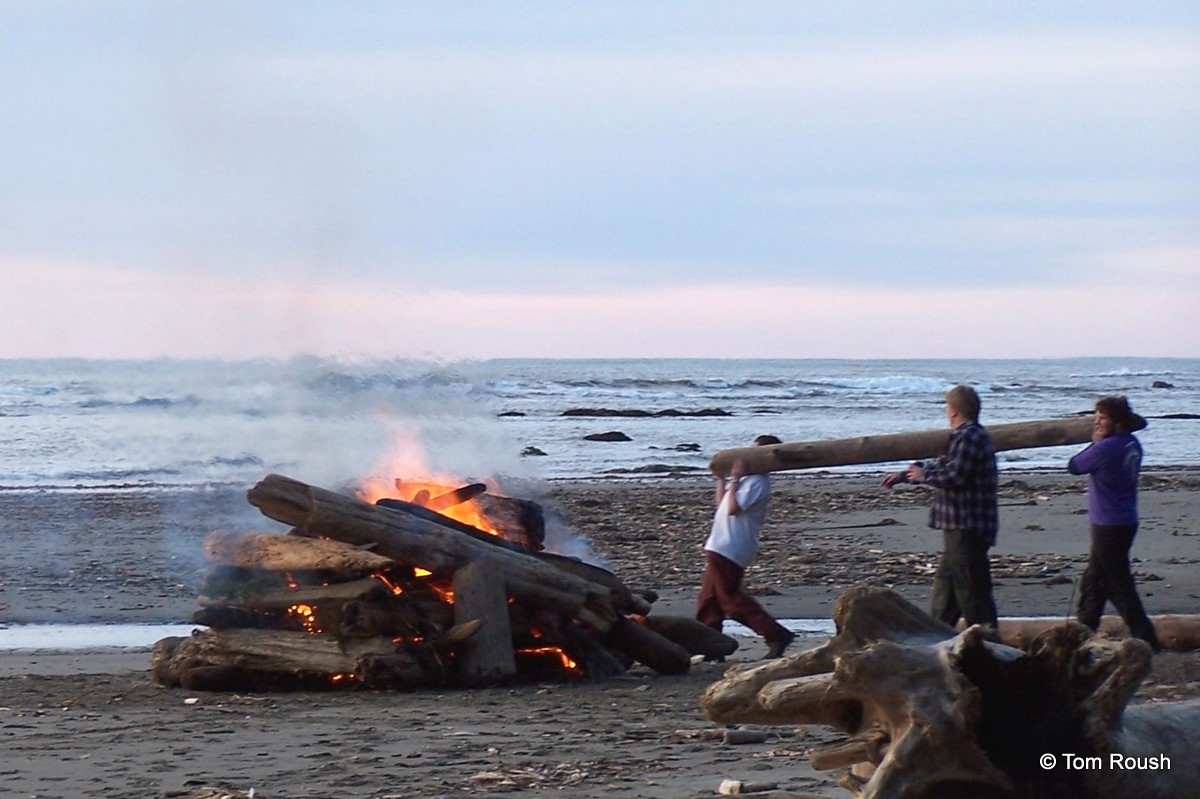
…the fire needed a little more wood…
There was only rule about the fire, and that was that if it could burn, and you could lug it to the fire, it got burned. As you can see, they were stoking the fire with a couple of small sticks as we walked up.
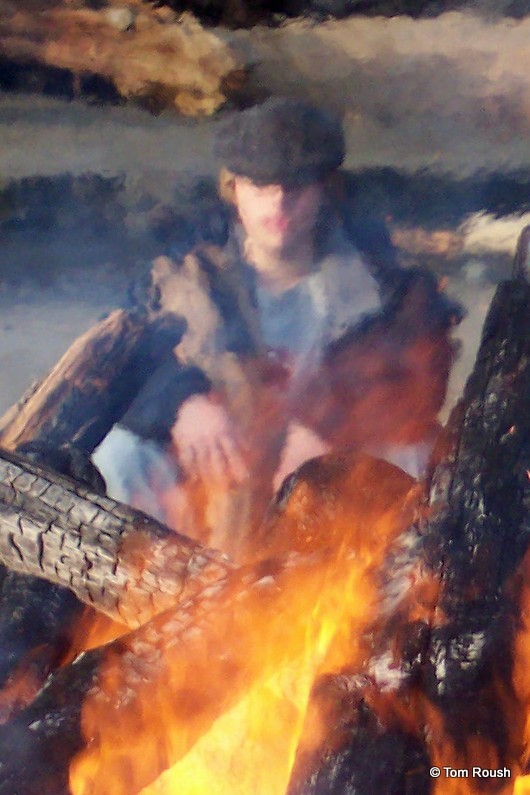
Many hours were spent like this.
The fire was worth its weight in gold for all the time spent just staring into it, focusing on everything, and nothing…

Michael had time to just wander and be by himself
There was time to walk on the beach, and just be alone with your thoughts, whatever they were,

We were glad to have brought my little tent
and even though the weather was so cold, there was a chance to sleep in a warm sleeping bag, in the same old tent that we’d slept in at Fort Ebey years ago when Michael was a Webelos Scout. We did see evidence of some strange wildlife out there, causing us to wonder where genetic engineering had gone drastically wrong.
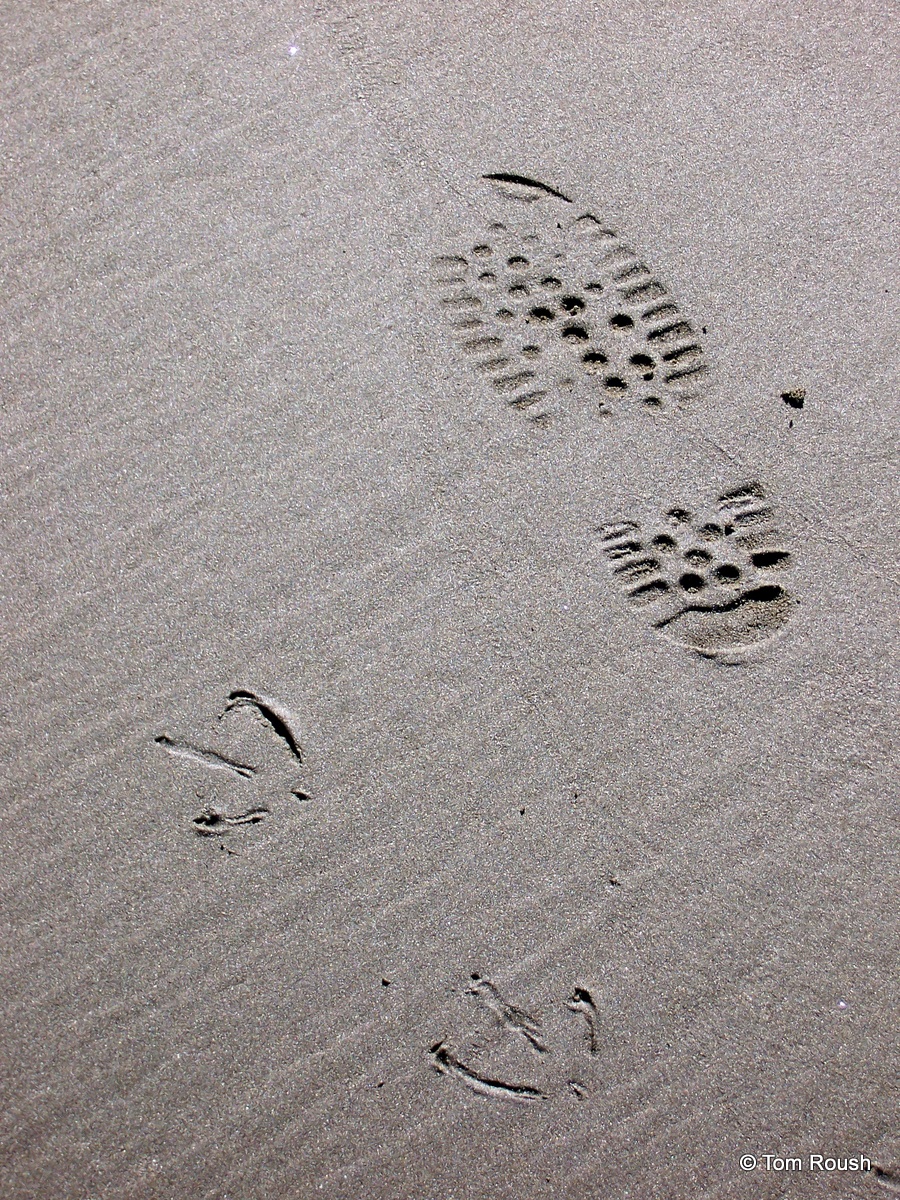
Obviously a native Washingtonian
It was a wonderful place…
There was time for pondering, and reflection…
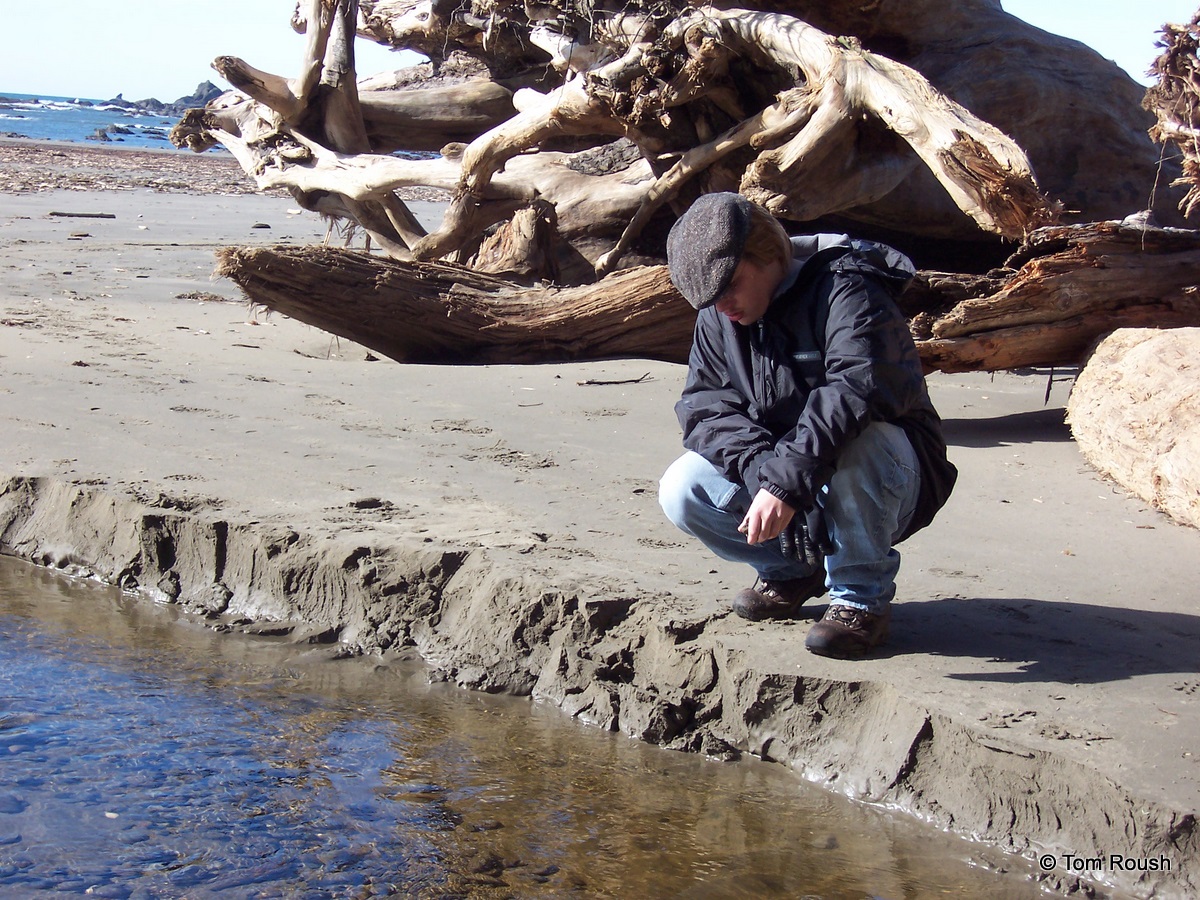
…reflecting, on many levels…
There was time to etch your autograph anyplace you could find to put it.

Writing on one rock, with another…
There was always a pot of water on…
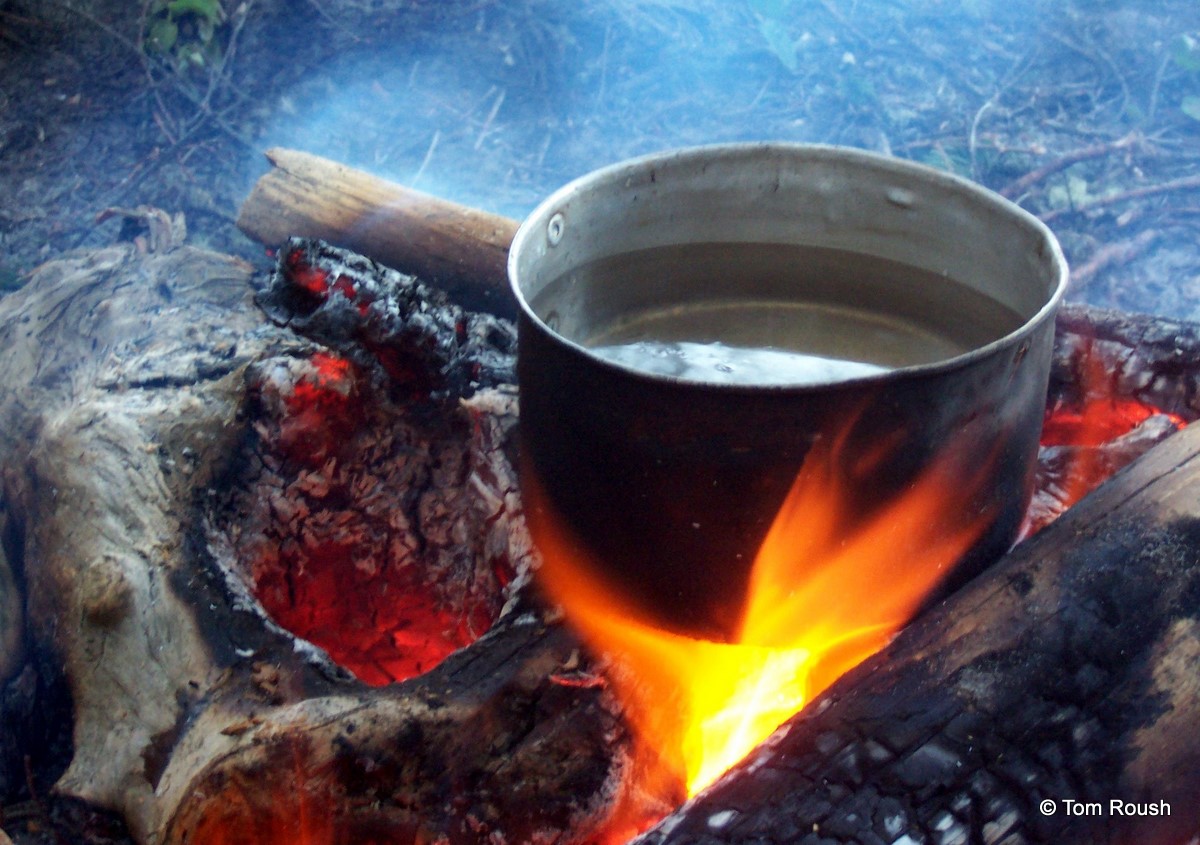
Nothing tastes like fresh coffee made with water heated by campfire
… for hot chocolate or coffee…

Some of the coffee was a little chewy…
We had some guests for dinner, and found all sorts of things on the beach…
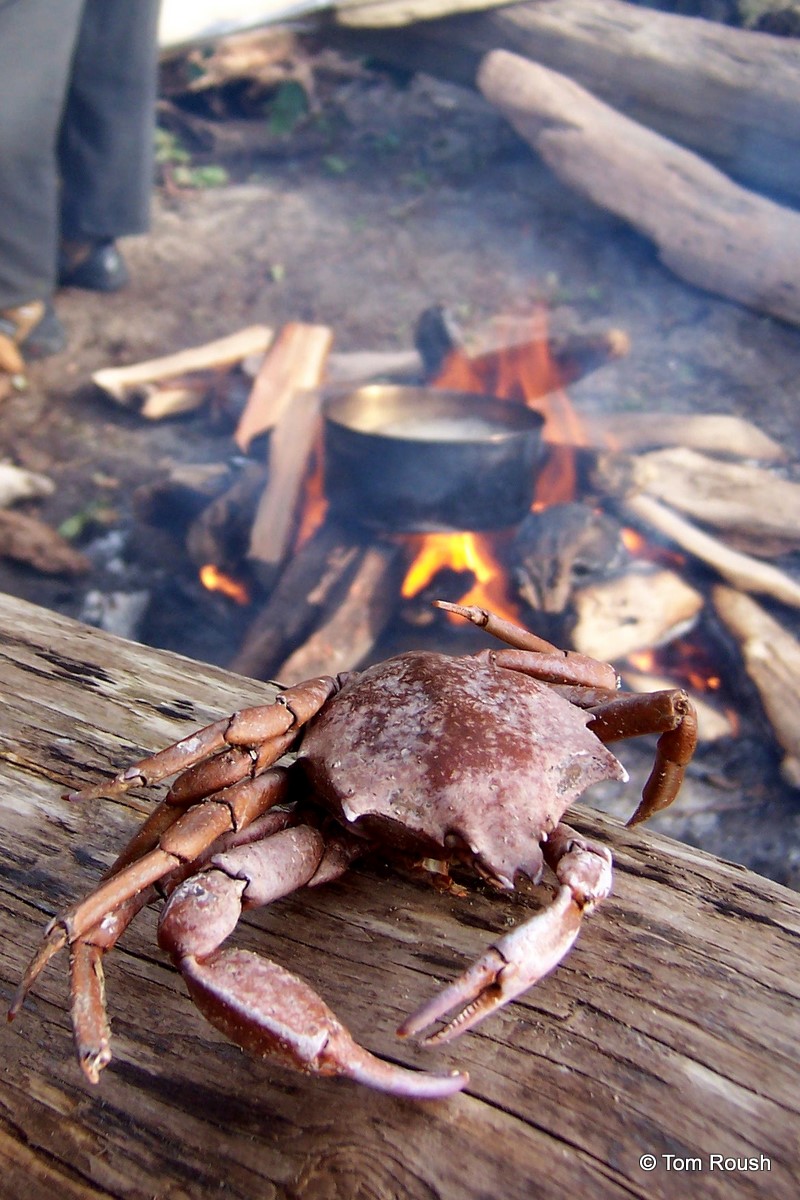
Guess who’s coming to dinner?
We never had any problem with food spoiling that weekend. Of course, the fact that it didn’t get much above 27 degrees in the daytime might have helped that particular issue out just a bit. It wasn’t windy, wasn’t rainy, just clear and bracingly cold.

It was amazing how the metal just fell apart
There was an abandoned silver mine south of Norwegian by a couple of miles. We hiked down there with the rest of the scouts who’d gone and stopped to see some of the decaying machinery, where what had once been a boiler of steel able to harness the power of steam had been scoured by the salt air for so long that the steel could be peeled away with your fingernails.
Since we’d gotten there late, Michael and I took a hike up north, to the actual Norwegian Memorial, hidden away off the beach, a memorial to the sailors who died in a shipwreck many years ago.
On our way to see the memorial, we saw many downed trees, and this one…

The concept of ‘size’ is different out there.
…was truly a Goliath among them, making all of the others look positively tiny in comparison.
We kept walking, not really knowing where exactly what we were looking for, but eventually we found it, nestled deep in the trees, away from the beach, in a place you could easily miss.
Our Scoutmaster, Paul, had been keeping it tidy once a year…
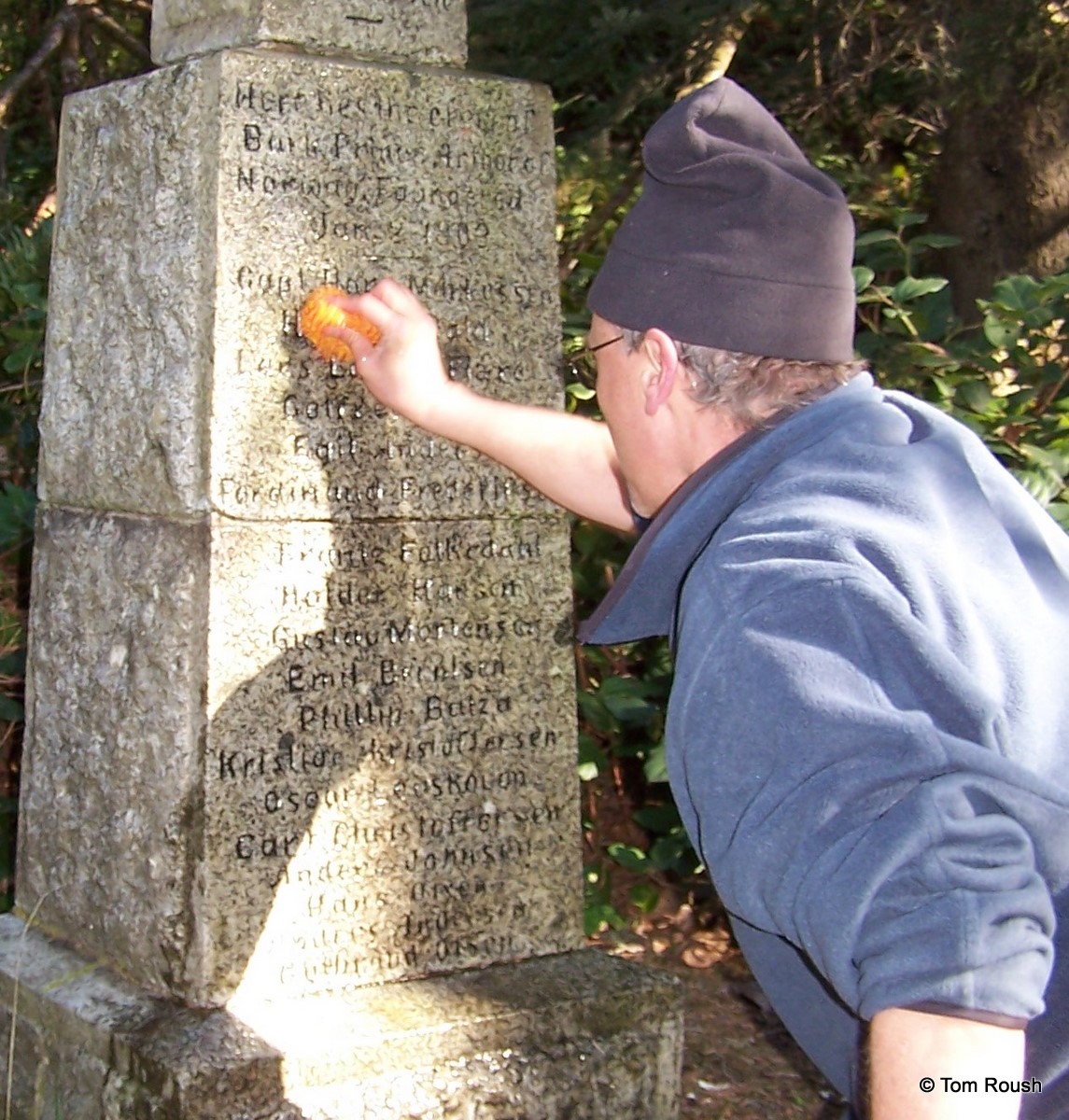
Scoutmaster Paul kept the place neat at least once a year
…for the last thirty years or so as part of being with the Norwegian Fishermen’s Association in Ballard, where we live.
The mussels we had for dinner one night simply covered a huge rock. It was impossible to walk anywhere without stepping on them. And it didn’t take long at all to gather enough for dinner.
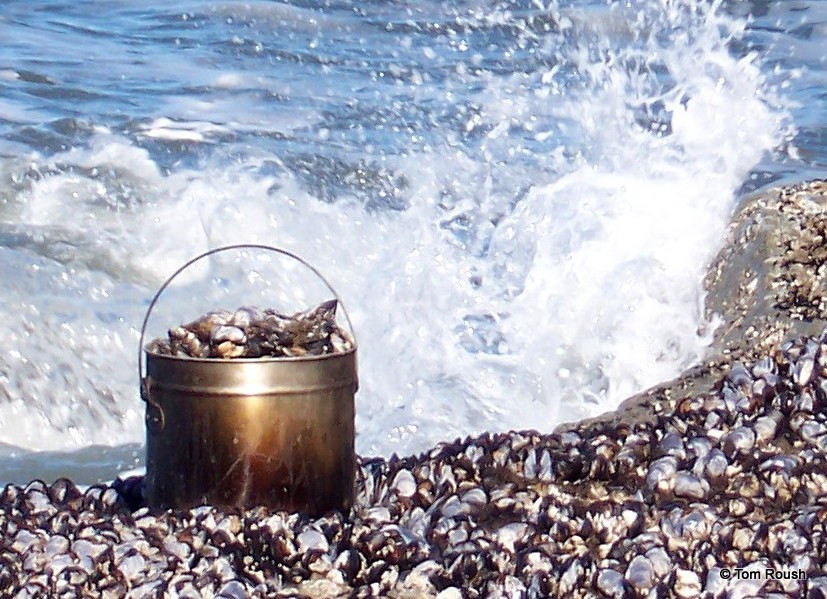
There were zillions of mussels out there
Once we got back to the campfire, we had what was again, amazing food. We learned that you can make something called Cioppino in a dutch oven, and since I’d spent a few years playing with cameras, we decided we’d take a picture of it. Of course, trying to take a picture of a dutch oven over a fire likely wouldn’t win any awards, and since we didn’t have any studio lighting, we just used the campfire for light and I think a couple of flashlights. We waved them around until we thought we might have something, and who knew that you could come up with a picture like this with just a couple of flashlights and a campfire?
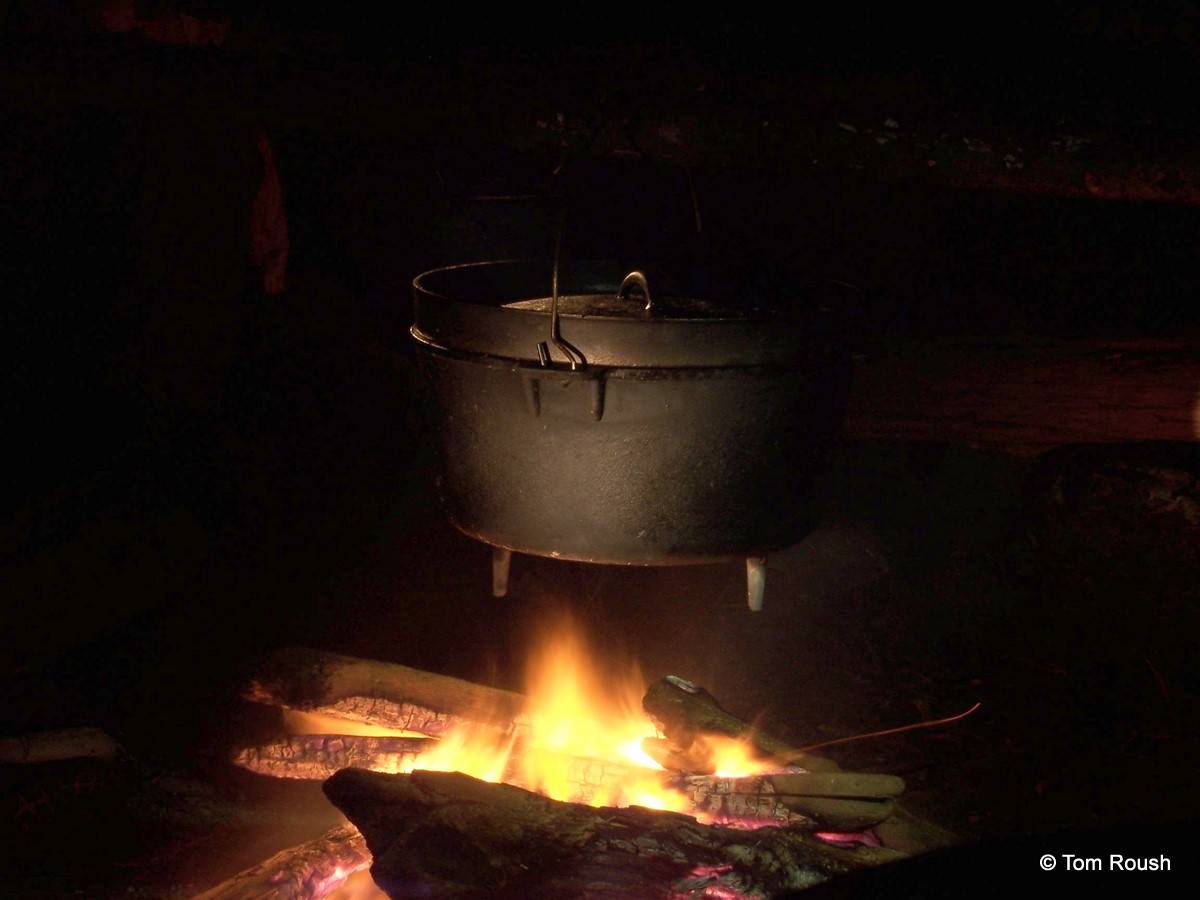
A campfire, a couple of flashlights, and a 3 second exposure… Oh, and steady hands.
Come to think of it, who knew mussels made pearls?
And, Pop Quiz:
When you’re eating them, how do you know the difference between the sand in them and those pearls?
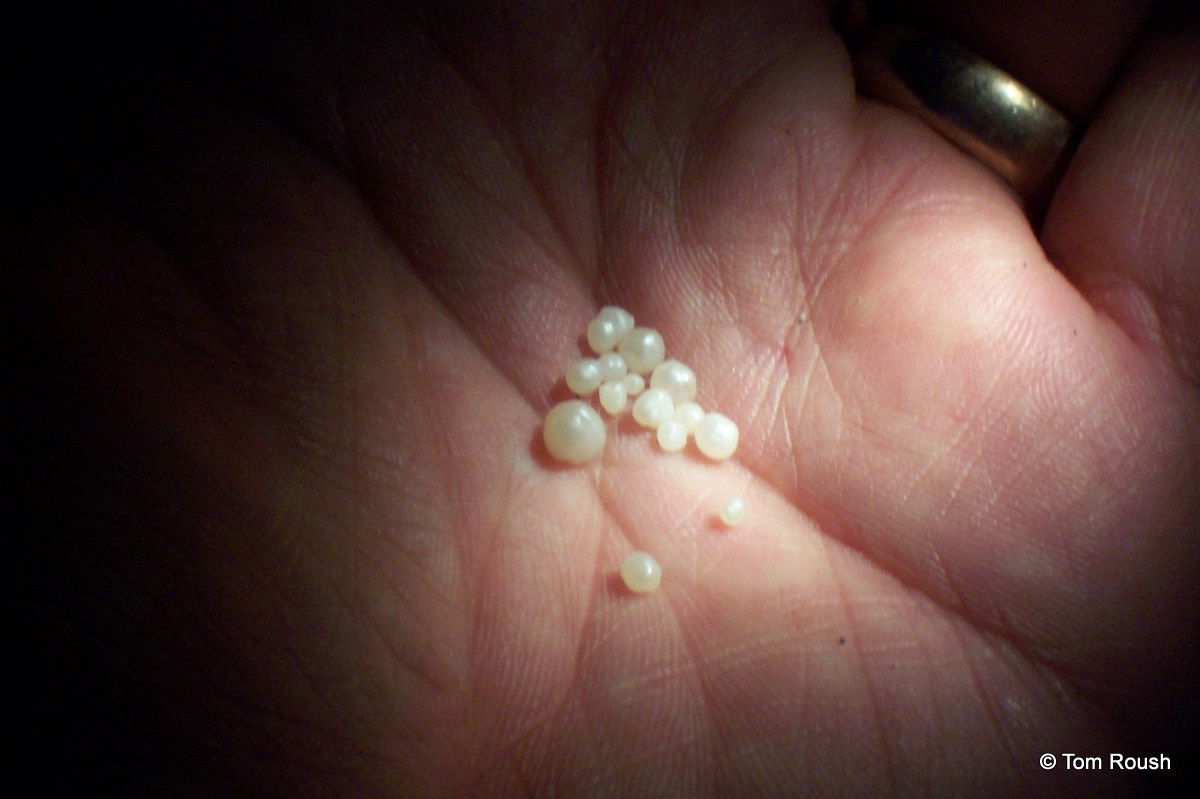
Years later I put these in a pendant for my wife
Answer:
If it’s sand, your teeth crunch it…
If it’s pearls, it’s the other way around…
(That particular lesson only takes one time to actually sink in…)
The temperature was cold, but no wind and so that evening a huge cargo net served as a wonderful hammock for two to relax and watch the sun set,
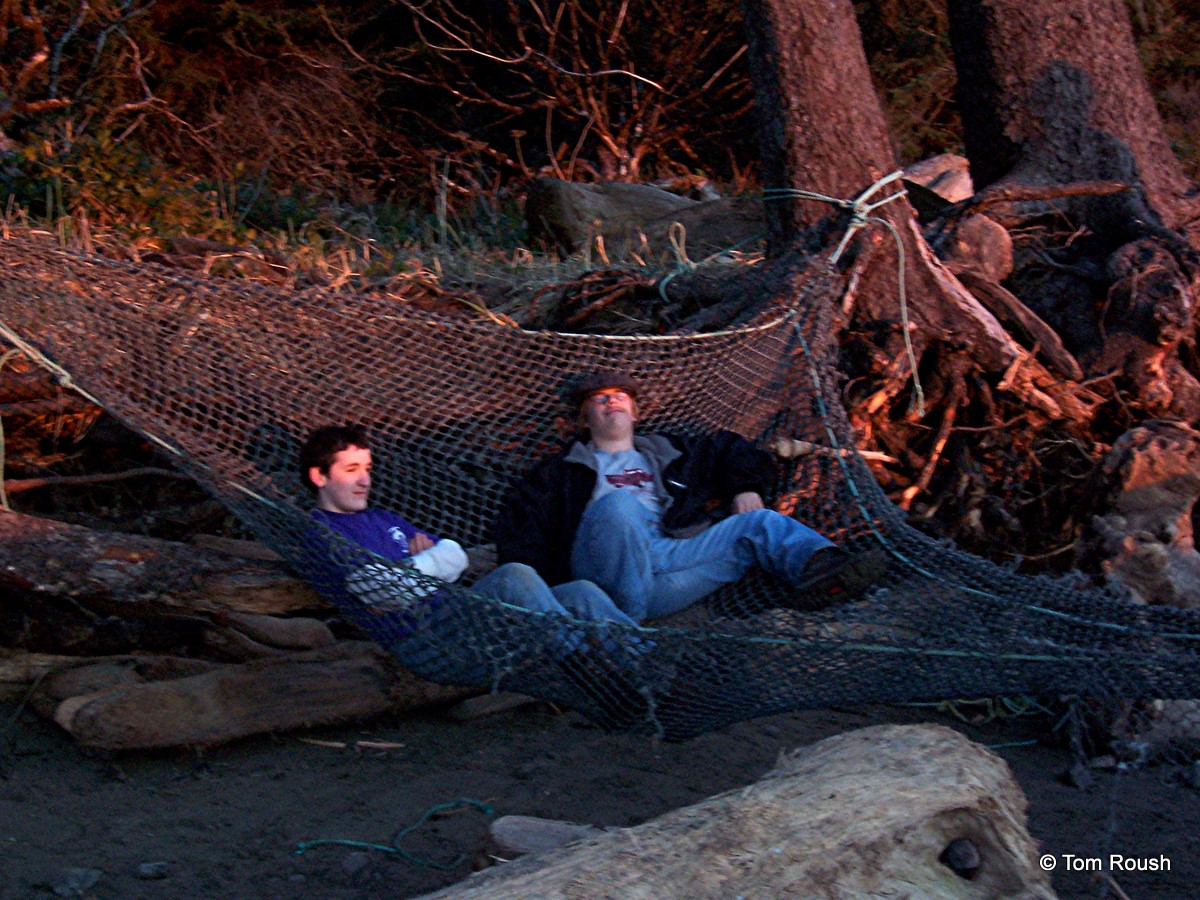
It just didn’t get any better than this… (or did it?)
and watch the fire burn to embers.
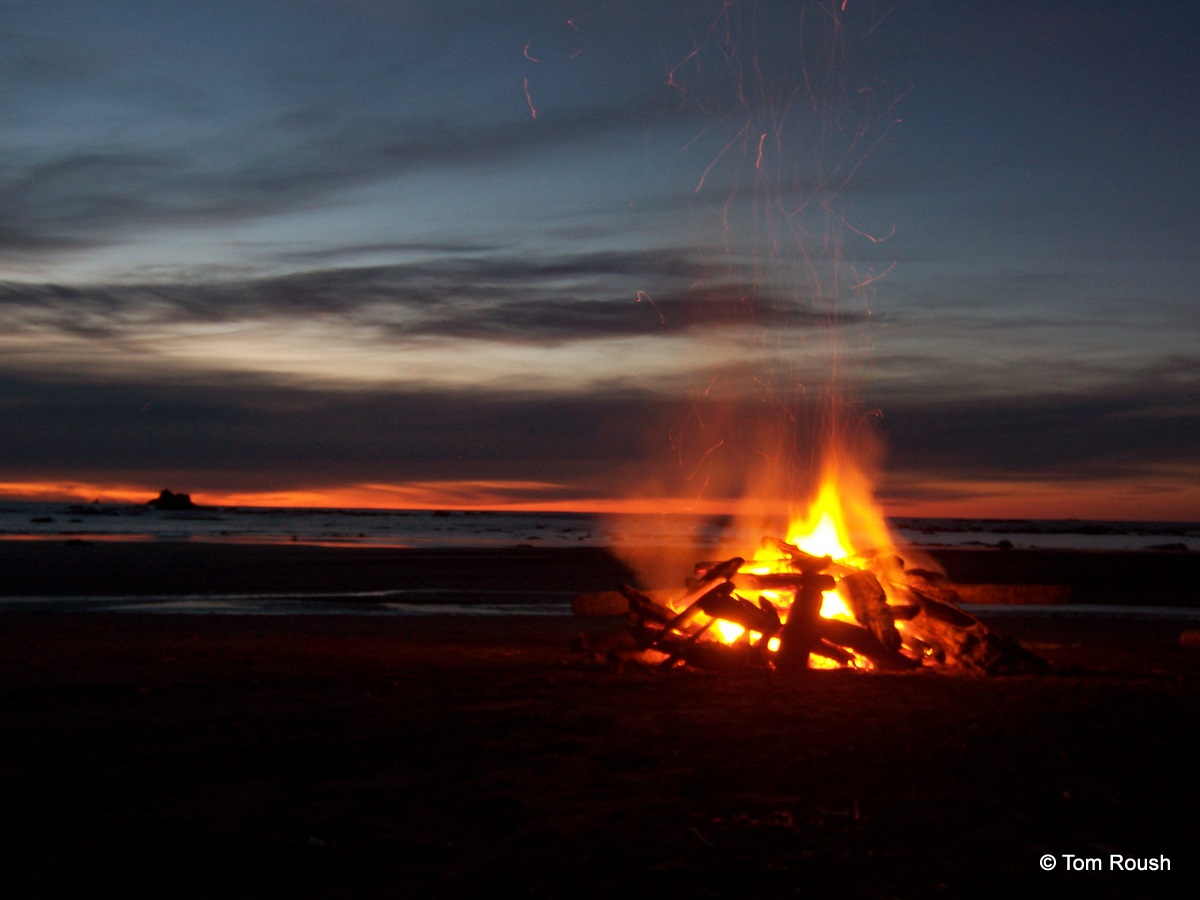
The campfire, at sunset, was amazing.
But the most incredible part of it all was something not in any photographs.
As I said, it was 27 degrees in the daytime. After dark, it got colder still. One night, we went out onto the wide, wide beach for a walk. The beach was mostly flat, so we walked and walked, and as we got further away from the light of the campfire, and our eyes got adjusted to the dark (there was no moon that night) we found that we could see, literally, in the dark. It’s because the stars were brighter than we’d ever seen, and even Orion, huge in Seattle, was small in comparison to all the other stars now visible.
We kept walking, our eyes in the heavens, as wide as children seeing those stars for the very first time.
It was only when the sand we were walking on became a little slippery, and a little soft, like crème brulée, crunchy on the top, soft underneath, that we slowed and stopped. It took about three steps or so, and we all looked down…
…and found ourselves in a world that words cannot adequately describe.
The salt water had frozen as the tide went out, and the beach we’d been on had been transformed into ice that extended as far as we could see in front of us, and far enough left and right to feel like it went to the horizon.
As I looked back up, I noticed that I could see Orion again, not once, but twice. Once upside down below the horizon, once right side up above.
Wait a minute…
I looked left and right, up and down, and still saw stars.
I kind of skootched my feet around a little to be sure I wouldn’t fall and realized we were not standing under the stars, we were standing among the stars. We were standing on a mirror, stars visible above us, below us, and all around us.
As our eyes registered it all, and our brains struggled to comprehend the magnitude of what we were seeing, the sound of the waves to our right faded away with the tide. We were quite literally in awe.
We stood there for a few minutes, in silent reverence for the creation before us and around us.
We weren’t standing on ice, on a beach, we’d been transported into the heavens.
We were standing in the stars.
It was Amazing.
It was Magical.
It was…
Norwegian.
Before I started the blog, (under duress, I might add), I was writing stories just the same. There’s been so much that happened in the last few weeks that has just knocked my socks off, and some stories will come out of all that, but they need to simmer for a bit. As part of that, I’ve been trying to do some cleaning, and, as it turns out, in my cleaning out some digital lint, I found a story I’d written almost 9 years ago. That said, I’ve taken another look at it and decided it might be fun to get it out here for you all to see. With that, let’s go on a road trip, shall we?
Work had been getting busier and busier, and I was really wiped.
I’d had to get about a week’s worth of work done in the first 3 days of the week, and needed a break.
Turns out my friend Dave had an Improv Comedy thing in Portland Friday night.
Michael had Friday off.
Hmmm.
It didn’t take me a whole lot of time to figure out that getting our collective butts out of Dodge would be a good thing.
I got Friday off.
We had originally planned on Cindy coming along for this, but she had to work, so Michael and I went by ourselves.
We’d taken the Saab up to “Andy’s Cabin” last week, (it’s a wide spot in one of the forest service roads just off Highway 97 near Liberty, Washington. Used to have a cabin on it, belonged to a guy from the Scout Troop named Andy. Andy’s long passed on, and the cabin burned down decades ago, but it’s still called “Andy’s Cabin” – yeah, go figure. But tradition is tradition.) …and honestly, I needed something a little different than the Saab for this trip. I needed something for me. Not that I didn’t trust the Saab. It ran beautifully, got 32 mpg on the trip. I just didn’t have the time to risk if something went wrong, so I decided to rent a car and got a pretty decent rate on a little red ford sedan. We caught a bus up to Hertz and Michael was kind of amazed that we were simply walking out of the house to go out of state overnight with nothing but a duffel bag.
Oh, I’d given him my old leather jacket, and he found the hat he had in the play “Barnum” last year – that, some Jeans, and some sunglasses just made the outfit.
He was working on his “Cool” persona.

The “Cool” Persona
Once we got the car, as you can see, it was awfully hard to get Michael to actually ride in the thing.

Yeah, it was hard to get him to ride in the car.
Last time we did a road trip, we went to California, and Michael ended up listening to “Walk Like an Egyptian” about a zillion times on not only the way down, but back. It became, we realized later, the ‘theme song’ if you will, of that trip.
We’d made some progress down toward Roy (the plan was to stop in Roy, Hook Mom’s new computer monitor up and visit with her and our friends Lee and Lyndy a little bit and then head down toward Portland.
As we drove down Michael, with the hat and glasses, felt he looked like a movie talent scout. We were listening to one of the CD’s – and came upon the theme song from the Davy Crockett show… Remember that one?
“Born on a mountain top in Tennessee
Greenest state in the land of the free
Raised in the woods so’s he knew every tree,
Kilt him a bar, when he was only three!
(all together now)
Daveyyyyy, Daaaaaaaavey Crockett, King of the Wild Frontier!”
I’m singing this thing at the top of my lungs, and Michael’s not buying it. I’m
getting way too weird for him. He’s used to me in my “responsible father” mode
as opposed to getting a little weird mode…
So… I invited him to sing along.
He didn’t want to.
I invited him again…
He emphatically didn’t want to.
I told him I’d keep playing it until he sang along and had fun doing it.
He made it quite clear that singing that song was not anywhere near the top
of his list of priorities.

Yup, just like peas and lima beans
I felt like I was watching a kid being told to eat peas for dinner.
Eventually, he did sing along. It was fun.
So we did that, got down to mom’s, and she’d made chicken and dumplings, they were SO good. Michael, as usual, needed to put some pepper on his stuff. The lid of the pepper shaker was a little loose, and he ended up with a little more than he was planning on.

Really, he likes pepper. Just not this much.
I hooked mom’s new monitor up and put her old desktop on it – it was nice to see that again (it’s the picture of Paddington Station that Corbis has, from the Windows 98 plus pack, with the travel theme.) –
It was the first thing we kind of ‘got back’ since her car was stolen. (so was the computer in it, but that’s another story)…
After lunch, Mom and Michael and Lyndy went out to feed the horses, and tried to get Michael to feed them, too. He kept pulling his hand away as soon as he felt their lips trying to nibble at the apple. You can see Lyndy holding his hand here in the first picture,

Lyndy, Michael, Mom, and apples
…trying to keep it there for the horse. Problem was, he kept seeing those big teeth and thought he was going to get bitten.

The horses, after nibbling on apples
He actually had good reason to think that.
Some time back we were walking through a field on the way back from Grandma Danny’s and there was this horse that first looked like it was being friendly, then it tried to take a bite out of Michael’s hat (actually the one in the picture), and then it nudged him pretty good. It became obvious the horse wasn’t nibbling in a friendly way, so I told Michael to go get through the fence while I took care of the horse.
The horse tried to nibble on me, so I smacked the crap out of it every time it did, and got to the gate as fast as I could, just barely making it over before I got the butt of my jeans ripped out by the dang thing. At first I thought I was imagining things, but then later realized, while I was looking at one of the 4 x 4 fenceposts that was barely holding up the gate I’d climbed over and that the horse was on the other side of, that I wasn’t imagining anything.
The fencepost looked like an apple core – the horse had eaten it all off.
It was very, very strange.
Then I looked a little closer still and realized the fencepost the horse had been nibbling on was pressure treated lumber. I don’t know what all chemicals they put in pressure treated lumber, but I do remember them being rather poisonous, so I can’t imagine it did good things for the horse, and I think the horse was a little crazy from it. So that’s why Michael wasn’t all that interested in horses nibbling anywhere near him.
He ended up feeding one of the horses one apple, and that was enough. But by that time, it was time to go, so I had Michael get in the car.

Michael decided he wanted the left seat.
As you can see, it was again, awfully difficult getting him to get ready to leave.
We waved goodbye to Mom and Lyndy, who waved back, thanked them both for a delicious meal…

One last wave to Mom & Lyndy, then we were off
…and we hit the gas, cranked up the tunes, and off we went.
Oh, the tunes…
We thought about all the times we’d seen, rather, heard people with stereos thumping wondering what the heck they were listening to. We waited till we were well away from civilization before cranking it up too loud, and when we did, we realized that we might be hurting our ears a bit. So, um, we put earplugs in.
And turned it up more.
So imagine two guys in a red Mustang, blasting down the freeway, with earplugs in, windows down, and the music blasting so loud you could feel it.
Now imagine them doing it to this song.
Yup… Michael and me.
We could not only hear the music, but feel it! It was great.
I have no idea how many times we listened to it, and how many times we just played it again and again and again – with no breaks, but we never got tired of it.
And the music we were listening to? “Under the Sea” (if you didn’t click on the link above, we had a Disney CD with us)
Here Michael’s shucking and jiving to…
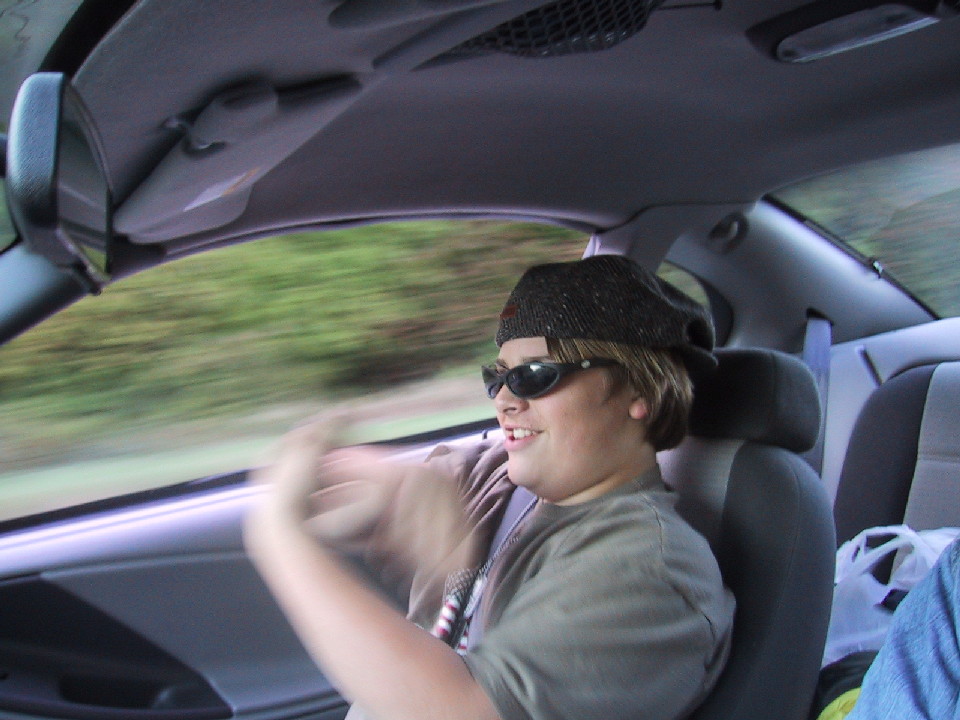
Each Little Clam here…
“Each little clam here
Know how to jam here
Each little slug here
Cutting a rug here
Each little snail here
Know how to wail here
That’s why it’s hotter
Under the water
… and so on…
After several hours of driving, (and listening to the song, over and over and over) we got there, with just enough time to get a place to stay almost within spitting distance (across the parking lot) from the church it was at. The improv was part of a conference in Drama in the Ministry. It was very eye opening, how sometimes telling a 5 minute story, a parable, if you will, can hit home a lot harder than a one hour sermon.
It was a wonderful experience.
After that was the improv, which the pictures I took simply don’t do justice to.
There was a party game, in which people had to be some sort of church member, and also have a strange personality trait.
Some of them:
- The sound man, who’s deaf.
- A youth pastor who loved to dance,
- A kleptomaniac pastor’s wife, and so on.
Then there was the Alphabet game, where you were given two characters (mother/daughter, etc…) in a situation – and they had to start the first sentence with a letter picked out by members of the audience, then each subsequent sentence with the next letter. That ended up being a lot of fun. One of the most challenging ones was with one character being a mortician and the other being his prospective client.
Then there was the game that every sentence had to be a question – or maybe they combined the two. It was just a lot of laughter that made for a lot, a lot of fun.
The one that was literally the killer was when they played “chain murder” – kind
of like clue where you try to solve a murder, but with a couple of twists:
- There are 4 people.
- Three of them leave, the last one is told, by the audience, the who/where/what of the murder.
- The other players enter the room, one at a time, and the first person tries to get them to figure it out.
- With pantomime, and gibberish. No words.
As an example, the first one ended up being
A Fireman,
In a Broom closet,
With the little things you stick into the end of an ear of corn to hold it because it’s too hot.
One person brought the house down on that one as the person was pantomiming the fireman and the broom closet. He’d guessed, “A fireman… at the Gates of Mordor?”
The second one was:
The Good Humor man,
In the belly of a whale,
With a waffle iron.
They got worse from there.
When it was over, Michael and I kidnapped Dave, but he had to be the navigator and tell us where we were kidnapping him to since we only had directions to the church and the hotel right next door. It ended up being a Shari’s Restaurant, where we tried really hard to order something.
However, we soon realized that at 11:00 at night, we were actually more in the mood for breakfast than anything else, so we tried to order, and somehow “scrambled toast” came out. We first confused the waiter so much that he ended up bringing Dave an extra hot cocoa –
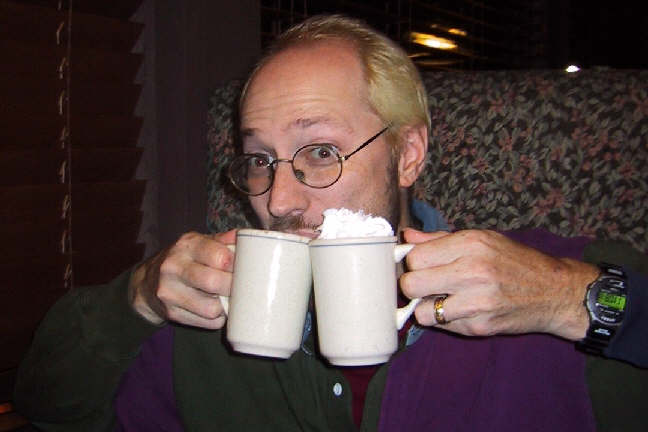
Our goofing off got David an extra hot chocolate
which ended up being part of many jokes. Then the waiter got into the “scrambled toast” bit and we just went off, kind of like the “Four Yorkshiremen” sketch, complete with British accents and everything…
“Oh, I remember having scrambled toast when I was a boy…
“Too bad they don’t make the toast scramblers anymore”
“Yeah, that’s a shame… They stopped making them in the ’40’s, you know, had to take the factories and change them over to making machine guns for the war effort.”
— and it went on…
Ration cards,
Grampa remembering when they had to scramble toast by hand.
Which led to “When I was a boy…” stories, like…
Walking to school in the winter…
…in 10 feet of snow…
Up Hill…
Both ways…
I had to staple barbed wire to my feet to get traction…
to which David countered, “You were lucky, I had to use railroad spikes!”
Michael could hardly keep his food down he was laughing so hard. Come to think of it, we were, too.
We finally realized we needed to call it a night, and as we’re heading out, I realized I wanted to take one picture of David and Michael, so I asked them to pose in front of the Shari’s sign.
They posed.
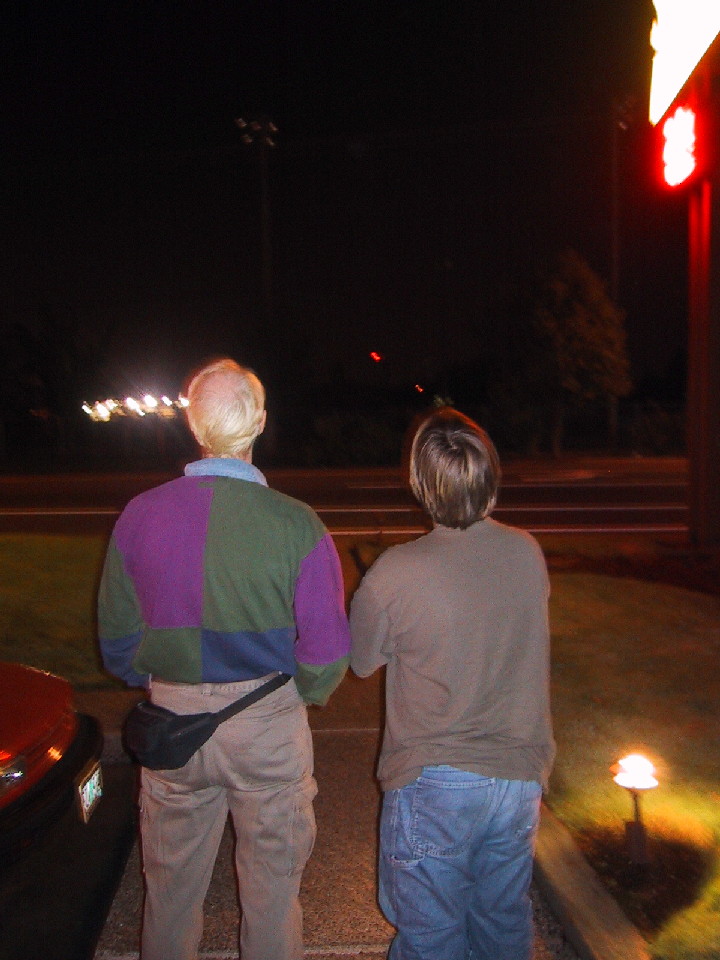
David and Michael posing for the picture
I suggested that maybe, just MAYBE, it might be better if we were to get their faces into the picture… Right about that time we were trying to figure out what we’d had, since it wasn’t Breakfast, nor was it Lunch, and it most certainly wasn’t dinner. We decided it was “Brupper” – and here we have Michael and David, Brupping in front of the Shari’s restaurant.

Michael and David, Brupping
We went back, and got David to his car and headed home. Michael and I totally crashed and slept the sleep of the dead — and the next morning managed to drag our butts out of bed, and got out of our room around 11:00 and had to tear out of there (Portland) in time to get to Michael’s soccer game (in Seattle) at 1:00. (I thought the game was at 1:30). Needless to say, the trip was a fast one for me, and a semi-conscious one for Michael.

Michael, holding down the passenger’s seat.
A little different than the trip down, but it worked.
We made it to the soccer game, lost, Michael messed around with some of the other kids after the game for a bit,
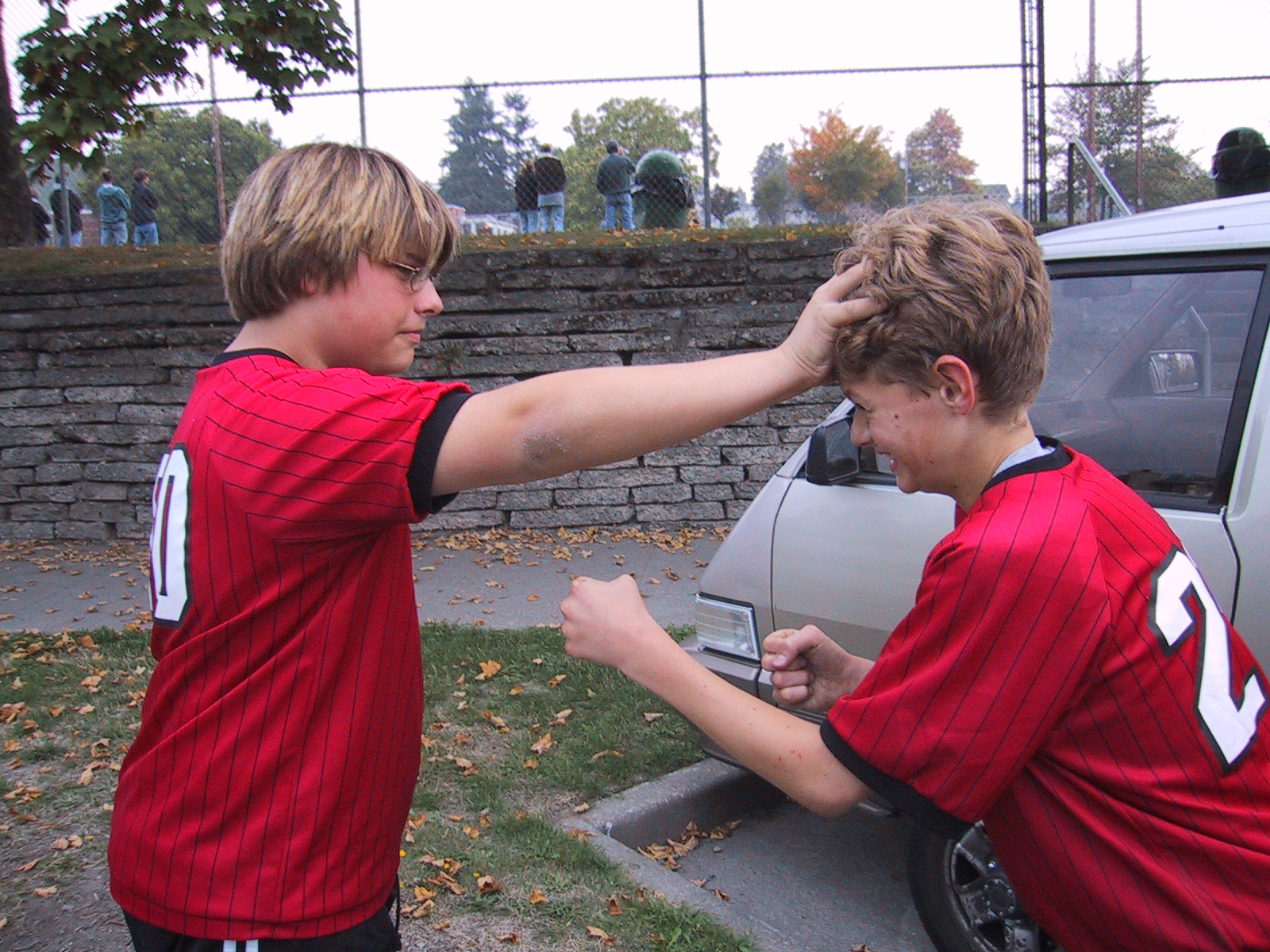
Michael showing Brian that He Who Has The Longest Arms wins.
…then we took the car up to the rental place, where we cleaned it out, dropped it off, and ran to the bus stop, just in time to have the bus meet us as it pulled out.
We rode the bus home, and since we’d been listening to “Under the Sea” so much, Michael wondered if we had the video. He found it, we did, and he wanted to watch it, and sing with it as the movie played. We both started, and got a few bars into it and then both of us just let it go. Neither one of us remembered anything from those few bars until Ariel has legs (about 40 minutes later, I think.)
All in all, it was a fast, short, weekend (actually, now that I think about it, it was less than 24 hours total), but well, well worth it.
October 3-4, 2003
I don’t know if there’s a moral to the story, other than “Spend time, enjoy the time you have with your kids while you have them, it goes by so quickly.”
Seriously – take the risk and do something weird with them.
Make memories with them.
Hug them.
Sing silly songs with them.
Laugh with them.
Above all else, love them.
I’ve been struggling to write a story for Christmas this year, and it hasn’t worked at all…
The story I’ve been working on just hasn’t come together, and I’m getting the feeling, that just like some stories have to be published at a certain time (hard to explain, but it’s true – some stories have this urgency as I’m writing them that just can’t be ignored, and later, in either comments, feedback, or just people talking to me, I often find out how important it was to get a story out at a certain time.
The story I was working on, however, is giving me the other impression. It isn’t ready, and needs to wait until it is ready, and I don’t know when that will be. On the other hand, another story showed up just this last weekend, and I think that one might have peeked out of the shadows just in time. As I write this now, I don’t know how it will end, so join me in that discovery.
I’m thinking, over the years, as I see what has happened around not just “the holidays” – but Christmas, that people (myself included) often have such high hopes and expectations of Christmas that it can’t possibly live up to those expectations, and that we end up being sad, or depressed because of that…
I was thinking about it, and realized that we often try to replicate the good parts of the Christmases we had in our childhoods, and sometimes, in those memories, forget the bad stuff that happened that made the good stuff stand out. Often we find ourselves wanting “something” – but not being sure what exactly it is.
We often do what Madison Avenue wants us to do – which is to “Stimulate the Economy” – but that just causes problems in other ways.
Where am I going with this? – Well, stay with me for a bit, we’ll find out together.
I found myself thinking of Christmas trees… I’ll tell you about three of them that I remember having. Two as a kid, one as an adult.
When I was a kid, we were poor. There’s no other way to say it. My dad was off at college trying to get a degree so he could help make life better for us. He could only come home on the weekends if he came home at all. There were several years when the money was so tight that we couldn’t even afford a tree at Christmas, much less presents to put under it. In fact, one year, we got the tree the church had used and set it up on Christmas Eve. I don’t know if many people have had a used Christmas tree, but we did.
Ironically, we didn’t think it was weird at the time, we thought it was kind of neat that at the last second, everything fell into place, and we got a tree, for free.
It was during those years that I had a paper route, earning me about $40.00 a month.
One year, we were praying for both Christmas presents and a tree, and while mom made Christmas presents, God answered the prayer. One Saturday morning as I was on my bicycle finishing my paper route, I saw a Christmas tree laying in the ditch beside the road.
I couldn’t believe my eyes, but there it was. I delivered the last few papers, and came pedaling back as fast as I could, where I picked the tree up and put it on my left shoulder with the butt facing forward so I could steer and shift the bike with my right hand. I could see through the branches, but if someone were driving by (and several people did) they’d see a rather large Christmas tree riding a bicycle, rather unsteadily, I might add, down the street.
No one crashed, including me, which was good – and we were again blessed with a Christmas tree that year.
One that we couldn’t have afforded otherwise.
The thing I realize now is that we didn’t even have a Christmas tree stand. Over the years, Dad, being home from University over Christmas, would make a tree stand with me out of 4 boards that we’d nail or screw together, then to the tree, with notches at the bottom so there’d be enough room for a pie tin of water underneath.
If we’d had a tree stand like everyone else, I wouldn’t have this memory.
The next year, finances were still pretty rough, and we were still just scraping by. At the time, we had a large garden, and were very familiar with what passed for food banks back then. We didn’t drink soda, couldn’t afford it, but we did drink apple cider we made from all the apple trees we had on the property.
Hmmm… if we’d been able to drink soda like everyone else, I wouldn’t have that memory.
I’ll write about that someday, but that December, even with all the things we’d done to save money, a tree was still not in the budget.
I think that might have been my last year with the paper route, and I was looking for a tree beside the road like we’d had that one year, but there were none.
In fact, it’s safe to say, that in that year, God did not have Christmas trees falling out of the sky for us.
Well, actually… I take that back.
He did.
A tree did fall out of the sky, but it was in kit form.
And actually, it wasn’t a ‘tree” per se…
It was a branch.
No, really.
It was a huge branch from a tree on Fort Lewis – on one of those side roads that’s made by an 18 year old kid driving a 60 ton tank at 35 miles per hour and leaving a trail of wanton destruction in his wake. (Yes, there were kids that age out there doing that. They were, however, in the Army when they did it.)
I don’t remember exactly how I got it home, but I did. The huge branch was far too long to get into a tree stand without gouging holes in the ceiling or chopping holes into the floor, so I got out one of my dad’s old saws and whacked off a good chunk of it so that it would fit. (That cut-off part unwittingly became our Yule Log) I then started cutting branches off and drilling holes into the trunk where I wanted to put them. I whittled them so they’d fit into the holes I’d drilled and ended up moving almost every branch that way.
Then I made the stand for it like I did every year.
And we did have a Christmas tree that year. It was beautiful, really. Complete with decorations, and even some presents.
If I’d been able to buy a tree like everyone else, I wouldn’t have this memory. I’d have forgotten about an anonymous little tree in one of many Christmases a long time ago.
That got me thinking.
Those weren’t easy times that I’m writing about. Seriously. But it feels like it was those parts that made me grow in ways I couldn’t have grown if life had been as easy as I wanted it to be.
Many years later, I’d grown up, become an adult, and was now in the position of trying to support my family, and for a number of years, life was pretty rough, and I got to thinking about where every penny was going, and spending any more money than I had to on a Christmas tree was just impossible to comprehend, and for years we bought our trees at a now defunct store called “Chubby and Tubby’s”.
If you’ve lived in Seattle for any length of time, you’ll remember that Chubby and Tubby trees could be had for $4.61 ($5.00 with tax). Oh you could get nicer trees, for more money, but we bought the trees we could afford, (here’s one of them, picked out by our then two year old Michael, his mittens dangling from his sleeves).
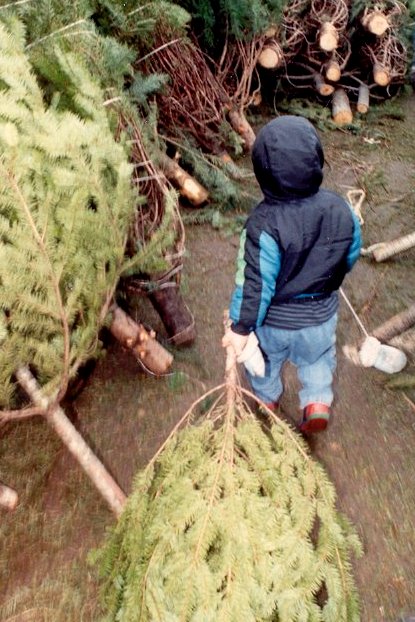
One of our Very special trees.
And for a number of years, I made a Christmas tree stand like I did when I was a kid, and I drilled holes in the trunk and moved branches around so they’d look nice, just like I did when I was a kid.
Only this time I was doing it with my son, not with my dad.
I did some more thinking – because we’ve been able to have some pretty neat Christmases over the years in spite of things. There was the year we were able to make it to church Christmas Eve. That might seem “normal”, but I’d just gone through my 4th and last round of chemo, and we had to leave right afterwards – but we made it.
That was cool.
And over the years we’ve found that Christmas comes every year, whether you’re ready for it or not.
And it’s a mixed bag, isn’t it?
Sometimes life happens to be good and you can have a “good” Christmas. That’s a blessing to cherish.
But sometimes – and you can probably figure that I could tell you stories about this: Life is just life, and it isn’t as kind and gentle as we’d hope, or as we might remember. Without going into great detail, a number of people I know are at this moment going through some of the worst challenges a human can go through, the loss of a parent, a sibling, a child, the loss of a marriage, or relationship, and they’re still trying to celebrate Christmas, and trying to figure out how and why they even can, through all the struggles. They’re looking in vain for that blessing.
And after awhile, being pulled in all sorts of directions, it’s easy to lose sight of what Christmas is all about.
I don’t have answers to why this kind of stuff seems to happen more at Christmas, but amidst the turmoil we’re all experiencing, whether it’s spiritual, or health, or relationships, or economy, I’ve come to the conclusion that we crave the opposite of that turmoil, especially at this time of year. It’s one thing: Peace.
A friend who’s experienced his share of turmoil (he’s a medic) noted, “Perhaps that’s why people wish others “Peace” during this season. That doesn’t just mean “absence of war” but inner peace. I wish you both senses of the word.”
His comment about both kinds of Peace got me to thinking of the original words about Peace in this Season, and while you can read the words here, we heard one of the great philosophers of our time do a pretty good job explaining it to his depressed friend, who was also pretty confused about what Christmas was really all about.
In a crystal clear voice he said to him, and to all who would listen,
“And there were in the same country shepherds, abiding in the field, keeping watch over their flock by night. And, lo, the angel of the Lord came upon them, and the glory of the Lord shone round about them! And they were sore afraid … And the angel said unto them, “Fear not! For, behold, I bring you tidings of great joy, which shall be to all my people. For unto you is born this day in the city of David a Saviour, which is Christ, the Lord.”
“And this shall be a sign unto you: Ye shall find the babe wrapped in swaddling clothes, lying in a manger.” And suddenly, there was with the angel a multitude of the Heavenly Host praising God, and saying, “Glory to God in the Highest, and on Earth peace, and good will toward men.”
“That’s what Christmas is all about, Charlie Brown.” – Linus Van Pelt
And so it is.
So whether you have a beautiful tree and all that goes with it, or whether you are struggling to make a tree out of a branch that fell out of the sky, above all else, I wish you God’s blessings, and Peace this Christmas season.

 Tom Roush's Blog
