
You are currently browsing the tag archive for the ‘Faith’ tag.
I’m posting this on Maundy Thursday – the Thursday between Palm Sunday, when Jesus was welcomed into Jerusalem, and Good Friday, when He was killed there. This is the day when that Last Supper you’ve seen in pictures happened, and later that evening, when Peter, one of Jesus’ strongest supporters and disciples, denied even knowing him – . Tomorrow, those who celebrate Easter will remember Good Friday, and the crucifixion. Thursday and Friday are the lowest points of the Christian calendar – but it is Sunday – Easter – when we are shown that Grace can abound, that there is hope. It is through the remembrance of that Last Supper Jesus had with His disciples, what we now call Holy Communion, that through confession and repentance, we find forgiveness, even for those who feel there is no hope, or forgiveness.
The following story, for anyone watching as it happened, took about as long as it takes to sing the verses below – but inside me – I was transported through thousands of miles, and hundreds of years – to places where time, and distance, were absolutely irrelevant.
With that, please, as you may ponder the significance of Easter, I submit:
“Amazing Grace.”
It was Sunday, in a large, old church, in a big city. The pastor had called for Holy Communion, and as he got out the bread and the – in this case – wine, the notes gently flowed while the organist cleared the pipes to play. But these weren’t just notes that had come from the organ to our ears, nor were they words that were just now coming from our lips. They had come a great distance, through many years, having been written by a man named John Newton, who was exactly what he said he was in the second line of the song, a wretch.
But the story in the song is one of redemption, of John Newton coming to an understanding that this concept of Grace – in which we are given something we do not deserve. And the words, written by him in 1779 in England, composed with notes by William Walker in South Carolina in 1835, came together in this church, on this morning.
The organ sang the first notes out, and old bones and pews creaked equally as people stood, each heading to the aisle to walk to the front to receive Holy Communion, their chance to remember in the symbol of the Bread and the Cup the forgiveness that was theirs because of what Christ had done for them. Worn shoes shuffled forward on an equally worn carpet as they sang, not with gusto, but with the tired reverence that comes with age.
Amazing grace! How sweet the sound
That saved a wretch like me!
I once was lost, but now am found,
Was blind, but now I see.
I was one of those shuffling, and heard the voices singing – some gray with years, some with the color of youth, many of them older, first generation Americans, for whom English had clearly been a a second language.
And suddenly, even though I was still shuffling – I felt I wasn’t in this church in this big city anymore.
I was transported to a land of tile roofs and cobblestone streets
A cool mist touches my face as I find myself stepping carefully on a foggy sidewalk.
As I walk, I’m overcome by the wonderful smell of simmering corned beef wafting out of a kitchen window. I follow the sound of singing around a corner to a church, where the voices and harmonies show a faith and fellowship that has lasted through the ages.
An odd tinkling sound reveals itself to be from a young man, sitting on the sidewalk with a tin cup, begging. All questions are answered by the scar across his face. The tinkling comes from the people walking by toward the church, as they put some of their Sunday offering directly where it’s needed.
He smiles and blesses them as they go on.
We shuffled forward a bit:
T’was grace that taught my heart to fear,
And grace my fears relieved;
How precious did that grace appear,
The hour I first believed!
I’m confused, for a moment – as I find myself suddenly transported to what is clearly a prison, to a cold, damp cell, with only one small, high window. A church bell rings in the distance, and the prisoner in the cell has experienced something not all prisoners do. He’s finally not only understood the significance of the mistake that brought him here, but has experienced a remorse that can only be answered by forgiveness. This does not mean that there are no consequences to his mistake, but there is forgiveness. His quiet prayer is as sincere as that from any pulpit, and the light and warmth coming into that dark cell at that moment isn’t just from the sun.
We shuffled on, and started to sing the next verse…
Thro’ many dangers, toils and snares,
I have already come;
’Tis grace has brought me safe thus far,
And grace will lead me home.
A steam whistle blows. A locomotive hisses by, slowing for the station, and a young soldier nervously holds onto the open window as his now gray eyes search for the home he left two years ago. In those eyes are the exhaustion of a thousand battles he’d wanted nothing to do with, and both the longing, and creeping doubt of seeing his family again.
He looks at his battered watch, the strap long gone, and knows that at this time, the Sunday pork roasts will be cooking, wafting their delicious smells out into the street. It’s always been the first smell he smelled after getting out of the train station. It’s a symbol of home, and this time, the war over, he should be home for good.
The train clatters and bumps to a stop. He gets up, and like all travelers, reaches for his bags and automatically walks toward the nearest exit, his uniform helping to part the respectful crowd of people so he can get through easier. As he steps to the platform, he stops in the middle of the river of people pouring out behind and around him, and stands on his toes, looking around to get his bearings – so much had been destroyed in the war – and to see if anyone is there to meet him. He is tackled from one side by his younger brother and sister, with the excitement only younger siblings can have for an older one. The little brother, as little brothers do, wants to hear all about the battles. The little sister stands quietly until he kneels to her level. She hands him a small, soft object in a cloth napkin. It’s a slice of pork roast. THE pork roast. “Mama sagt, dass Du Heim kommen sollst, dass wir alle zusammen mit dir Mittags essen können.” He shares the slice with both of them, and as his little brother picks up the bags, he picks up his little sister, and they all run across the street to the still standing house, to the kitchen, to his family.
There is no shortage of hugs, no shortage of tears.
He is home.
The melody continued, and we shuffled another step…
The Lord has promised good to me,
His word my hope secures;
He will my shield and portion be,
As long as life endures.
Again, I am transported – to a sidewalk near a church. As I stand there, looking left and right, a stooped old woman walks closer, uncomfortably using a new cane to support her. She passes me by, sobbing softly. The gold ring on her gnarled left hand tells the story. It is her first Sunday coming to church alone in nearly half a century, her husband who had sat beside her every Sunday for that many years, who stood at that altar in the radiance of youth and repeated the vows with her – ending with “…until death do us part…” had loved her – for richer, for poorer, in sickness, and in health – and he had fulfilled those vows to the very last one. He would never accompany her to church again, but church is where she needed to be on Sunday mornings, and church was where she would go. Someone who is obviously her daughter runs up to her and supports her, saying gently, “Oh maman, je suis sincèrement désolée. Je suis venue dès que j’ai su.”
The rest of the words are lost, as I hear the sound of voices singing, and feel myself being pulled away again.
We shuffled forward again…
Yea, when this flesh and heart shall fail,
And mortal life shall cease,
I shall possess within the veil,
A life of joy and peace.
Again, I find myself near a church, with the bell ringing quietly, but closely. Only this time I’m in what’s known in some countries as the ‘churchyard’ – and the group of people, all dressed in heavy coats of dark colors to ward off the cold, have come to pay their last respects to one of their own. It is clear – even without understanding the language, that she was held in high regard by everyone there. It seemed, given the expressions of some, that they were now both relieved at the end of the suffering she had endured, and confused as to who would take her place, but one thing was certain, she had enriched their lives by her simple existence. She had enriched their lives by supporting them when they thought they were supporting her. And those looks on their faces told me her transition from this life to the next had been one of peace, of joy, and eventually of rest.
We shuffled forward one last step.
I was getting close to the front of the line now – and as we sang….
When we’ve been here ten thousand years
Bright shining as the sun.
We’ve no less days to sing God’s praise
Than when we’ve first begun.
I found myself in a large, old church, in a big city.
It was my turn for communion, and as I took the bread, and drank from the cup, that first verse came back to me…
Amazing grace! How sweet the sound
That saved a wretch like me!
I once was lost, but now am found,
Was blind, but now I see.
What heaven must be like.
I’m an airplane nut who’s seen airplanes from the ground once too often.
I’m a cancer survivor who realizes that “someday” is not a day of the week, that life is not a dress rehearsal, and that I have been given a second, and actually a third chance.
I’m a guy who’s spent far too much time working and not enough time playing.
It’s been my dream to fly since I was a little boy, when my dad was in the Air Force, and when times were simpler, and the magic of the skies was still new and still fresh…
And I’d seen sailplanes, here in the states, and in Germany where I spent part of my growing up years, and there was a magic to them, an allure that no other airplane had. They would fly circles for what seemed like such a long time – and just magically stay in the sky.
I mean, to fly is simple…
Jump.
There, you flew for a second.
Wanna fly longer?
Get a trampoline.
Wanna fly MUCH longer?
Well, now you’re talking wings of some kind – and that’s where things get interesting.
If you want to fly even longer than that – well, now you’re talking engines and propellers. And when you talk engines, then you need fuel, oil, electricity, a cooling system, and gauges to tell you what they’re all doing – and things get simultaneously a little simpler (to go up, push the throttle(s) forward, to go down, pull back on them), and a lot more complex (in addition to flying, you also have to manage all the systems that have anything to do with the power you have available with that throttle).
Another side effect of having an engine is that it also makes things noisy to the point of often having to wear earmuffs to filter out the noise…
They say that the main reason for the propeller is – well, it’s a fan to keep the pilot cool, because if it stops running when he’s in the air, he starts to sweat, but really – it’s to make the flying thing simple… Push forward on the throttle, go up.
Pull back on the throttle, go down.
So if that engine, whether that’s a piston engine, a jet, or rocket engine quits, you are now officially flying a glider. A Cessna 152, for example, will go forward about 9 feet for every one foot it goes down. It might do that at 60 mph. That’s called the glide ratio, in this case, it’s 9:1. The space shuttle – which is also a glider when it’s coming in, goes forward about 3 feet for every one foot it goes down, so a 3:1 glide ratio, it’s just that it does it a WHOLE lot faster, from a WHOLE lot higher up.
Now aside from those types of planes, there are planes that are designed from the get-go to fly without engines. They’re called Sailplanes, and the best of them can have a glide ratio where they’ll go forward 60 feet for every one foot they go down. They are truly, truly amazing works of engineering, craftsmanship, and art.
This means that the space shuttle, for all its engineering brilliance, has a glide ratio a lot closer to that of a crowbar or a brick than that of an actual airplane.
So I made myself a promise awhile back – I guess you could call it one of the things on my “bucket list” – that I would fly. There were so many things that kept me from doing it – but the other Sunday, I realized once again, that life is not a dress rehearsal, that “someday” is not a day of the week, and that there is no contract anywhere that says anyone is obligated to give me tomorrow.
Realizations like that tend to be fairly deep.
The events that cause realizations like that are often quite a bit deeper.
But on the day I had this realization, the weather was perfect, and the next two weekends were the last of the season. I knew I’d be gone on one of them, and had no guarantee of the weather on the second one.
This made the decision relatively easy to make.
I asked my son if he wanted to get out of the house for the afternoon, and with such a perfect fall day, he agreed. I told my wife and daughter we were heading out for a bit – and I have to say that even though I wasn’t sure that I’d go flying – it seems I was subconsciously setting things up so that my options were never limited.
We drove for about an hour to get to this little airfield (Bergseth Field) out in the middle of nowhere – and on this gorgeous Fall day, they were as happy to see us as we were to be there…
We watched – and the difference between this airport and any other airport I’d been at in a long time was like the difference between a calm pool and a roiling river.
If you wanted to take off, they’d look up in the sky to see if there were any other planes coming in – and then you’d hear them yell ‘Pattern Clear” – and off they went, quite literally taking off from the edge of a cliff.
It seemed that for the exchange of a few little oval pictures of dead presidents, one could buy a ride in one of those sailplanes. Michael was more interested in me going than in going himself, so the exchange was made, and along with the pilot, I got into the two-seater sailplane, a Schweitzer 2-33. After I was buckled in, and Michael had handed me the camera, I looked right…

Michael’s smile made this feel like the absolute right thing to do.
…and saw him smile, which told me I was doing the right thing, and that he was simply happy because I was living a dream.
We took off heading west for a bit, swung north, then did a 270 degree turn to the left, climbing the whole way…
Notice I said, “We took off…”
Something to realize is that flying a sailplane is the only type of aviation I’m aware of that has the aerial equivalent of calling a triple-A tow truck as a standard, expected part of the deal. You don’t take off like a normal airplane, because you have no engine. So you essentially ‘borrow’ one from somewhere. Some places have huge winches that launch you into the sky, some will use a car or other vehicle, some even use huge, huge rubber bands, and some will use another airplane – and that’s the one that’s the aerial equivalent of a tow truck. Very strong, very stable, very reliable.
And that’s the one we used.
As we climbed, near Enumclaw, Washington, the pilot of the tow plane turned toward nearby Mt. Rainier.
I was awestruck.

I felt a breeze…
After we got up to altitude and the tow pilot had let us go, the pilot sitting behind me asked a simple and profound question…
“Would you like to fly?”
The little boy in me, the one who had wanted to fly for over 40 years, was jumping up and down so hard that the seat belts were strained and the canopy was in danger of cracking. The 40+ year old man that the little boy was in, sitting in the front seat of an old, but still graceful sailplane, tried to hold down his excitement and said, “Sure, I’d like to give it a shot”.
And for a moment, both the little boy and the man, held the stick for the first time.
We flew.
I flew.
And a breeze blew, and Heaven’s curtain parted for a moment to allow me to peek inside.
I flew!
Wow.
The pilot brought me back into the cockpit by asking if I could keep the wings level, and the nose just below the horizon. I’d done it often enough in my dreams that it was easy.
He had me turn the plane south, and I learned that when you bank a sailplane to the right, for example, the plane wants to go straight for two reasons, one, it just likes the whole equilibrium thing, and two, the drag and the leverage from the aileron on the “upwing” side pulls that wing back a bit, turning the nose left, not right. I gently pressed the right rudder pedal with my right toe, got the nose going the right way – and I learned what was meant by ‘seat of the pants flying’ – you really do feel it in the seat of your pants.
We turned again, and the pilot complimented me on the turns and asked if I’d flown before.
In Reality?
No.
In dreams and in my mind?
Yes.
The adult in me was soaring – I was above the cares of the world, and nothing else mattered.
But the altimeter unwound just like a timer, when there was no more altitude, our time would be up. He landed it, and I saw my son smiling as he walked toward us.

That magical moment made for happiness both in the air and on the ground.
His smile matched my own, but for different reasons. He was simply happy for me to have finally lived that dream.
So was I… So was I…
We talked a bit as we drove home, about life, and the usual things, but my mind kept drifting back up to that blue, blue sky, and I found it hard to keep both feet on the ground when I’d held the sky in my hands.

(C) 2011 Tom Roush
Most of my stuff I don’t write until it’s baked for awhile, until I’ve got some time and perspective on it.
This time it’s a little different.
This time it’s recent.
So the title: Humpty Dumpty in Winter…
We all know he had a great Fall, but that doesn’t say squat about what kind of Winter he had.
I feel a little like Humpty Dumpty in Winter right now.
So it seems that my body decided to reduce some of its parts into kit form a little while ago, ending up with me having a femur that came from the manufacturer in one piece and is currently in two.
For those of you not completely clear on the whole scientific/technical part of all this, this is not, actually – oh, what’s the word… “Desirable”
I’m not quite ready to write a whole lot more about it other than I need to thank my family – my wife, my kids up front. Without their willingness to drop everything and help when I needed it, I’d be in some seriously deep doo doo right now. I also need to thank my mom, my sisters, for their support and encouragement, and I also want to thank my friends at work, church, and elsewhere for their thoughts and prayers when I needed (correction: need) them, or being there and flipping me crap when I need that (you know who you are).
Sometimes that’s just the thing you need. Knowing when to do which – I’ll leave that up to you.
All the people at the ‘Hotel Swedish’ who helped in so many ways, from docs, to nurses, physical therapists and the chaplain, thank you…
And before this gets into sounding like an academy awards speech, I’ll stop. Thoughts, prayers, and the occasional flipping of crap are very much appreciated.
…
The weird thing is that I keep coming back to that line and lesson that came out of the Shi Shi Beach story –
“I’ve learned that whether you know it or not – people are watching you. The way you deal with the struggles you’re facing may be the only inspiration people have.”
And I find myself almost hearing God’s saying, “Are you SURE you want to say that?” I’m wondering what story/inspiration, if you will, will come out of this. I’m a little close to the forest to see the trees right now, and am wondering, honestly, how much God has for me…
He says he’ll never give us more than we can handle, but just that line combined with my history makes me wonder what kind of Faith God has in me… Clearly it’s more than I have in myself, but I’m learning.
I’ll try to update things somehow and let folks know how I’m doing. Right now the pain is tolerable – though more than a touch distracting.
Take care…
Tom
—
UMnxXGUEVraXAHySvHMe
A little background on this story first…
\\
What you see below started out as a note to my friend Greg who asked how our weekend was. People have learned, over time that asking me questions like this often ends up with – um well – stories. This was no exception. The weekend in question this time was President’s Day weekend, 2007, and the story had so much in it that it became one of my longer stories.
The previous year we’d gone out to a place called “Norwegian Memorial” over President’s day weekend. The weather on *that* weekend was stunning, cold (27 degrees in the daytime), but clear, very little wind (a wonderful story, but for another time), so when we found out the troop was heading out to the Olympic Peninsula again, we were all over it.
We wanted to relive that incredible adventure.
However – the adventure we lived, while incredible, was very different, as you’ll see.
Also – over time, I realized there was another, related story, or maybe series of stories – or lessons, tucked inside this one – those lessons will follow – but for now – this is a trip to Shi-Shi beach with the scout troop (Ballard’s BSA Troop 100) Michael and I had been a part of for years. Shi-Shi beach is out on the Pacific Ocean, near – well, it’s not near anything. But if you remember those Native Americans (the Makah tribe) who wanted to go whaling to keep their culture alive a few years back – this is just south of them.
//
Normally I take tons of pictures on trips like this. This trip was different. There are SO many pictures that weren’t taken on this trip. You’ll see why as we go.
The original plan was to leave for Neah Bay around 5:30 Saturday morning to try to catch up to the troop who’d left the night before. However, I had unplanned work that didn’t get finished until 1:30 that morning – which messed up my 5:30 plans for leaving just a touch. In fact, I didn’t wake up till 8:30.
After some last minute packing and the like, we headed out the door to drive up to the ferry terminal for the first leg of the trip. I thought we were making pretty good time – but as we were sitting in the ferry line, it became clear that the reason we were making such good time was that my watch had slowed down before actually stopping. So we’d not only missed the one we’d hoped to catch, but we’d missed the one after that… and the one after that, and… well heck, we were at plan C or D by this point.
The weather was clear blue sky, just like we’d found the previous year at Norwegian Memorial, but by the time we got out to Neah Bay around 4:00, it was absolutely raining sideways. We’d been told to stop at this thing like a lean-to to pull our gear out of the car and transfer it to the truck of our contact there to get out to the trail head, but it was raining so hard, and coming from anywhere but up, that the little roof we were under did nothing to keep us dry. As we left in his truck to go to the trail head, he pointed out the “lean-to” we were supposed to be at. That one was roughly 100 feet long. Yeah, would have been nice to see that one in time…
We got to, then left the trail head at 4:35, and before we left, we have this little prayer we say whenever we go out. It’s something I learned in Germany when I was growing up, and it’s become not only a habit, but a good one:
Alle Schritt, und alle Tritt,
Geh’ du Lieber Heiland mit.
Gehe mit mir ein und aus,
Fuehre Du mich selbst nach Haus.
Wo ich bin, und was ich tu’
Sie’ mir Gott, mein Vater zu.
— which roughly translated, equals
Every pace, and every step
Lord come along beside me
Go with me in and out
Lead me safely back home.
Where I am, and what I do,
Watch over me, Lord.
This had far more importance than we knew at the time.
Given what time it was, we started walking fast. After about 2 miles over a little gravel, some boardwalks and occasional mud, we found a turn, and it was like walking down a stream-bed with an inch of water coming down it. No problem, it was hard pan, we didn’t sink into it and it was easy to walk on. When we got to the bottom, all the water that we had been walking downhill with kind of stopped. It had been bringing all sorts of organic matter down with it, which gathered into one honking big mud hole.
With no other options, we pressed on, and the mud started out only ankle deep in most places, but was calf deep in others. Stepping carefully, we were able to avoid the places where it was obviously knee deep. Some of the foot prints we saw made it clear others had learned that the hard way.
There were about 30 spots like that, ranging from the size of a typical kitchen to twice the size of a city bus. It was hard to walk around them most times because the surrounding area was worse in many ways.
The sections of mud were so deep in places that one of our scouts literally got stuck in one of them on the way back out. We’ll come back to him, well, on the way out.
We felt, at the time, like we had no options but to go on. Camping where we were was far too wet. We were on the only trail out there, so we didn’t feel like we were in danger of getting lost, but still, with our ride back gone, the fact that we were the only ones on the trail at that time of gave us very little room for error.
Honestly, I don’t think I could embellish the story right now to make it any worse than it was, and it’s not that it was so horrible, it’s just that we’d gone from bright sunshine that morning to raining sideways that afternoon to hiking out toward a beach in mud up to our calves, and we were only about an hour into the hike.
After a while, we’d learned that walking in mud is fairly challenging, especially with my right leg running short on hamstrings, and carrying the loads we were carrying.
We also learned that if you are walking in mud that deep, anything shorter than hip waders is going to mean that your feet will very definitely get wet.
And we learned the benefits of wool socks (you aren’t really sure when your feet are wet – because the wool insulates so well).
Eventually, we got through all that, the path curved to the left (south) and we saw we were on a fairly dry path along the top of a ridge, the ocean to our right. At that point, we saw a sign, not a celestial one, but a bunch of boards nailed to a couple of hunks of wood shoved into the ground. The sign indicated that the trail stopped there, and if we wanted to continue, we had to hang a right, down the hill.
It was still light when we got to that point, but because of the trees, just barely. Michael and I headed down what looked like it might be a trail, but it was REALLY hard to make out – especially since it was under more trees, and it was that time of day when it’s too dark to see, and not dark enough for flashlights to make much difference. In addition to our backpacks, we were carrying a 5 gallon bucket with our portion of food for the troop in it because we needed to have stuff in hard sided containers to keep the raccoons away.
(Little did we know that the raccoons wouldn’t be caught dead in this weather).
The trail was steep enough in places that we were using tree roots as steps. I’d go about 10 feet, then light the way for Michael, then he’d come follow me. I slipped once and lost my water bottle. I could see it down the hill and off the trail, but seeing it and getting it were two different things. It stayed there. I’m sure some raccoon appreciated it later.
Michael did an amazing, amazing job, I am so proud of him – and told him so, but I don’t think he really, truly understands how much he did.
We made it a little further, about halfway down the hillside, which bore a bit more of a resemblance to a cliff than a gentle hillside, it turns out, and then saw a couple of flashlights on the beach as we were looking down through the trees.
Oh, wow, salvation!
We yelled, “HELLLOOOOOOOO!!!!! IT’S TOM AND MICHAEL!!!!”
No response…
We waved and yelled again, and again, and again, waving our hands, our flashlights, anything, but got zero response.
Finally, the lights came toward us, and we called out again, and added,
“WHO ARE YOU?”
“We’re Scouts“
Uh… Right.
We’d made the assumption that it was only OUR troop that would be crazy enough to go camping in a rainstorm.
“Right, but who are YOU?”
“We’re scouts from Troop 4435 on Whidbey.”
Oh, crap.
Our troop WASN’T the only one crazy enough to go camping in a rainstorm.
They graciously gave us a little guidance down the rest of the hillside, which made it much easier for us to keep going. Then we asked them if they’d seen anyone else recently, and they said they’d seen two other people with purple pack covers (like what we had on our packs) walk by at some point – they were camping just south of Petroleum Creek – which was “two or three creeks down” the beach.
They led us through their campsite, and out onto the beach, where, in the absence of any other directions, we hung a left and started walking.
We set up a pretty good pace because, honestly, we didn’t know exactly how far we had to go. Also, if it’s not clear yet by the writing, it was dark by this time. There were no stars at this beach, nothing but clouds, occasional rain, lots of wind, no light, and the roar of the Pacific Ocean 50 feet from our right ears.
The one thing we didn’t know – or have a true sense of because it was dark, was the tide – and the fact that it was out. The beach sand we were walking on was hard and level. We found out later that that was the only reason we were able to walk anywhere.
So that’s what we did…
We walked – and walked, and walked.
It must have been at least twenty minutes before we saw them – but there they were, three lights in the distance. Of course, they could have been 20 miles away, we absolutely couldn’t tell from where we were, but we kept walking – and found a creek – and crossed it.
And found another creek, and crossed it.
And a third one…
We figured we were home free.
Those lights in the distance hadn’t changed. Michael and I were walking fairly closely together – to the point where we’d occasionally bump into each other, and were using one flashlight to light our way since we were on the beach and there was no reason to use both of them.
In fact, we felt like we were in a bubble of light in the darkness – there was no real way to tell we were making any progress of any kind, no landmarks passing by, nothing.
At one point, Michael, without slowing down, smacked his flashlight and said, with a surprising amount of conviction, “Never again…”
“What?”
“NEVER again…”
His light had been giving him trouble, and was flickering a little bit, and the whole ‘adventure’ bit of this was wearing just a little thin.
“Never will we do a hike like this again,” he said, gesturing to the cold, the dark, the wet.
“…but boy, will I have stories to tell my grandkids…”
His ability to look at things with a perspective most kids his age don’t – and the ability to see the good in a bad situation, while going through the bad situation, is one he’s become very good at.
We kept walking.
Speaking of flashlights, that trip was indeed the last time we used them. They’d looked effective when we got them, but it was very, very clear that if you wanted a good light, you definitely needed to spend the money and buy a good light. A little later we were to find out what that term meant.
We kept walking, and eventually, were able to tell a difference in color on some of those lights we’d been seeing, and it was clear that one of them was a campfire, because it was yellow and flickering, the others were lights like Coleman lanterns, a little blue tinge to them, and less flickering.
We walked on.
At one point, it looked like someone had poured gas onto the fire, as it flared up pretty brightly. We figured that just had to be our scouts, so we were encouraged by that.
We’d been told by those first scouts that it was 3 creeks down the beach. By this time we’d gone past at least six, and not passed any of our own scouts, so we weren’t really sure what to think.
We came to a campsite short of the one we’d just seen with the lights, and could see lights and fire there, and we yelled, “HELLOOOOOO!!!” Someone came out with the mother of all flashlights with a beam you could walk on (clearly this was a good light) to see who was out on the beach at this time of night, and we found they weren’t scouts, either… The fellow with the light offered us some water (we were pretty tired by then, and my water bottle was gone) – and we must have looked like crap. The fellow told us the scouts were the second campsite down from theirs. He also mentioned that the next creek, Petroleum creek, was a little deeper than the other ones, about six inches, and that we should be careful.
As for the campsites, remembering our little experience with counting creeks, we figured we’d check every campsite, not just the second one, and so, at the next one, we called into the darkness, “HELLOOOOO!” – and no one even got up – it was just “WRONG GROUP!”
We looked at each other for a moment, shook our heads, and walked on.
By this time, those lights weren’t any bigger, but it was clear we were getting closer, and this cheered us greatly.
We walked on.
…and slowly, gently, almost imperceptibly, another sound came to our ears, which was a different, much harder to describe sound than the roar of the ocean that had been in our right ears the whole way. This was more the sound of a high frequency hissing/splashing combined with a much lower frequency rumble.
That sound didn’t make any sense until the source of it came into the front of that bubble of light we were walking in.
It was Petroleum creek.
And with all the rain, it was fast.
The rumble was rocks the size of grapefruits and cantaloupes rolling down the streambed, being pushed along by the water.
Where we were it was about 25 feet wide at least.
Michael and I stood there for a moment and just stared: “What should we do? What could we do?”
The troop’s campsite was clearly on the other side of that mass of moving water. Behind us we had all the distance we’d traveled and not found the group. To our left, we had logs that had been piled by the tide at the base of a cliff. And to the right, in the roaring darkness, we had approximately 5,000 miles of ocean and tide before there was any thought of land.
And that tide was starting to come in.
Suddenly the 25 feet of rumbling, splashing water in front of us didn’t seem like such a big concern, our options were clearly narrowed down to forge ahead, and forge ahead we did, right through the water.
If our feet hadn’t been wet by that time, by golly, they were wet now.
There is something about walking in very fast moving water that’s pretty amazing, and at the same time, terrifying.
If you’ve not experienced this, the water is alive. It is trying to push you over, and it doesn’t care. It doesn’t care whether you’re tired, or whether you’re sore, or whether you’ve got people waiting for you. It doesn’t care what you have planned.
It just is.
The rocks that weren’t moving when we stepped on them rolled under our feet. Those we didn’t step on rolled into our ankles. We had to be on our toes, so to speak, the whole time.
But we made it through…
…and we walked on.
And eventually we got to the campsite, where we saw we had to cross at least forty feet of wet, slippery logs just to get off the beach. One of the scouts came down (I couldn’t tell who at the time) and took the 5 gallon bucket from us. Michael got up there first, and it took me a while to get across the logs, I was quite concerned about getting across, with my right leg the way it is, being so tired, and the fact that the logs were wet and slippery and all. It would have been very, very easy to slip and break something important. Paul (the scoutmaster) came over and took my pack, told us we were just in time for dinner, and aimed us toward the “kitchen” – where there was a lot of food (spaghetti, salad, etc). It was 7:35. We’d been walking as fast as we could for three hours straight.
They’d almost given up on us – but then they saw Michael’s light coming down the beach, and they watched as we got closer, and they helped us get off the beach when it was clear it was us.
We stood and ate. There wasn’t much room, really, to sit down. People were talking and glad to see us – I couldn’t see them because of all the salt and water on my glasses, the sweat in my eyes, and the smoke from the campfire and oh, and they were all wearing headlamps – which meant that when they looked at me, all I saw was this smoky star pattern of lights, and I couldn’t see who was looking at me at all. I could mainly tell by altitude.
The voice coming from above me had to be Kim.
The one from a little lower had to be Dan.
The one that sounded like a Georgia peach cobbler had to be Ken.
The lower (both in altitude and timbre) voice sounding like a mixture of camp coffee and gravel sounded like Paul.
Past that, I couldn’t tell.
The wind hadn’t died down, but we were in a bit of shelter, so that was good. It was clear that right after eating, the only smart thing to do was to put the tent up, hunker down in the sleeping bags, and go to sleep.
Dan asked about our tent situation, and I told him that both Michael and I each had a tent, and that we could each set up our own, but it seemed more logical to just set one up quickly and go with that. Dan asked if I had my little orange pup tent (I did) and he suggested that I would be dryer if I were in a newer tent (my pup tent was 20 years old, and well used). Paul had suggested the only flat spot was right there on the trail – but that wasn’t wide enough for any tent, but when we went to get the tent, our packs were on a flat spot under a tarp, so we just set the tent up there – first time ever, in the dark, in the wind, in the rain… Got it up in about 10 minutes, though now that we know, we can do it faster. It took us a while to get everything settled, but once we lied down, we were – well, laying down never felt so good.
As I lay there, slowly letting go of the tension of the last day, just beginning to allow myself to rest, and realizing that we’d accomplished what we’d set out to accomplish, I started to see these strange animals – kind of holographic, iridescent dragons – it was very, very strange… I told Michael I was starting to dream before I was asleep, and Michael said, “Pop, you’re really out of it, you’re hallucinating.”
Oh good…
We said our prayers, grateful that we’d made it in safely, and were instantly, profoundly asleep.
The trip out is another story.
The trip out…
I’d been up in the middle of the night. I’d been dreaming that the tide was coming in, and as is the case in many such dreams, reality and mother nature strongly urged me to get outside and take care of another tide wanting to go out. I did – and saw, at the edge of the flashlight’s beam that the tide, all 5,000 miles of it, was very definitely in, and it was right on the other side of all those logs – there was no beach visible at all – it was more than a little unsettling, making me realize how close we’d come to not making it on the way in.
In fact, the waves got pretty loud there for a while – with the splashing of the waves being in the higher frequencies of sound, and again, an occasional low frequency rumbling accompanied the splashing. This time it was a little softer, and far, far lower than the rumbling of the rocks in Petroleum Creek. This rumbling I could easily feel through the ground I was standing on. At the time, however, I was awake enough only to notice it, but not awake enough to try to figure out what it was. I went back to the tent, crawled into the sleeping bag, and closed my eyes, only to be awakened seemingly seconds later by the yells of one of the adults, “Get up, get packing, we’re moving out in three hours!”
Um…
We’d just gotten here…
In fact, at that time, it had been less than 12 hours of “gotten here”…
The wind hadn’t died down, and we had rain squalls coming in off the ocean one after another.
Paul, the scoutmaster, had looked southwest when it was light enough and saw a rather large, ominous looking dark cloud, and given the state of some of the scouts (some having done poor, inexperienced packing, etc.) it was clear that if we were to stay another night, we’d be dealing with things far worse than just being wet, like hypothermia; and those things would only get worse if we were to try to hike out with the scouts in that condition to start with. The decision was made to leave, immediately.
In fact, the clock was very definitely ticking from that moment. The tide charts said that high tide was at 12:53 and that it would be a plus 9.3 (or 9.1, don’t remember which) high tide, which for those of you who understand these things, means it was way freaking high. The highest of the month.
Understand, we had about 10 scouts and 11 adults to get packed (think herding cats), out of the campsite, over the logs, across a stream, and up about a mile or two of what was now very steep beach, and rocks, and logs, and whatever the ocean decided to spew out before that tide came in.
I found out later that it was exactly at this time, when we were walking out, that my mom, 150 miles away, felt the very strong urge to pray for us. She didn’t know why, figuring that, “The boys are just on a campout.”
She prayed anyway.
It’s one of the reasons I appreciate my mom. She’s got enough experience to pay attention and to listen when God pokes them and tells her to pray.
Back at Shi Shi, on the way out…
There was this little matter of a rock that jutted out into the water at high tide that we hadn’t seen in the dark on the way in. This meant, if we weren’t past it by the time the tide came in, we were going to be there on the wrong side of the rock until that tide went back out. That might be a rather uncomfortable place to be for a few hours, I mean, imagine having your back to a cliff, wind and spray in your face, and the surf grinding huge logs into mush right in front of you (this was what I’d felt through my feet the previous night). Clearly getting caught between any of those logs was well past unacceptable. Had we gotten stuck on the wrong side of that rock, even getting back to the campsite might not have been an option, we didn’t know – and didn’t bother to think about anything remotely close to that.
The important thing was to get off the beach,and get off it fast.
Michael and I left a few minutes before the rest of the troop because we figured that because of my leg, we’d be slower than the others. We got packed up very quickly (heck, we’d barely had time to unpack), and got moving.
First thing we did?
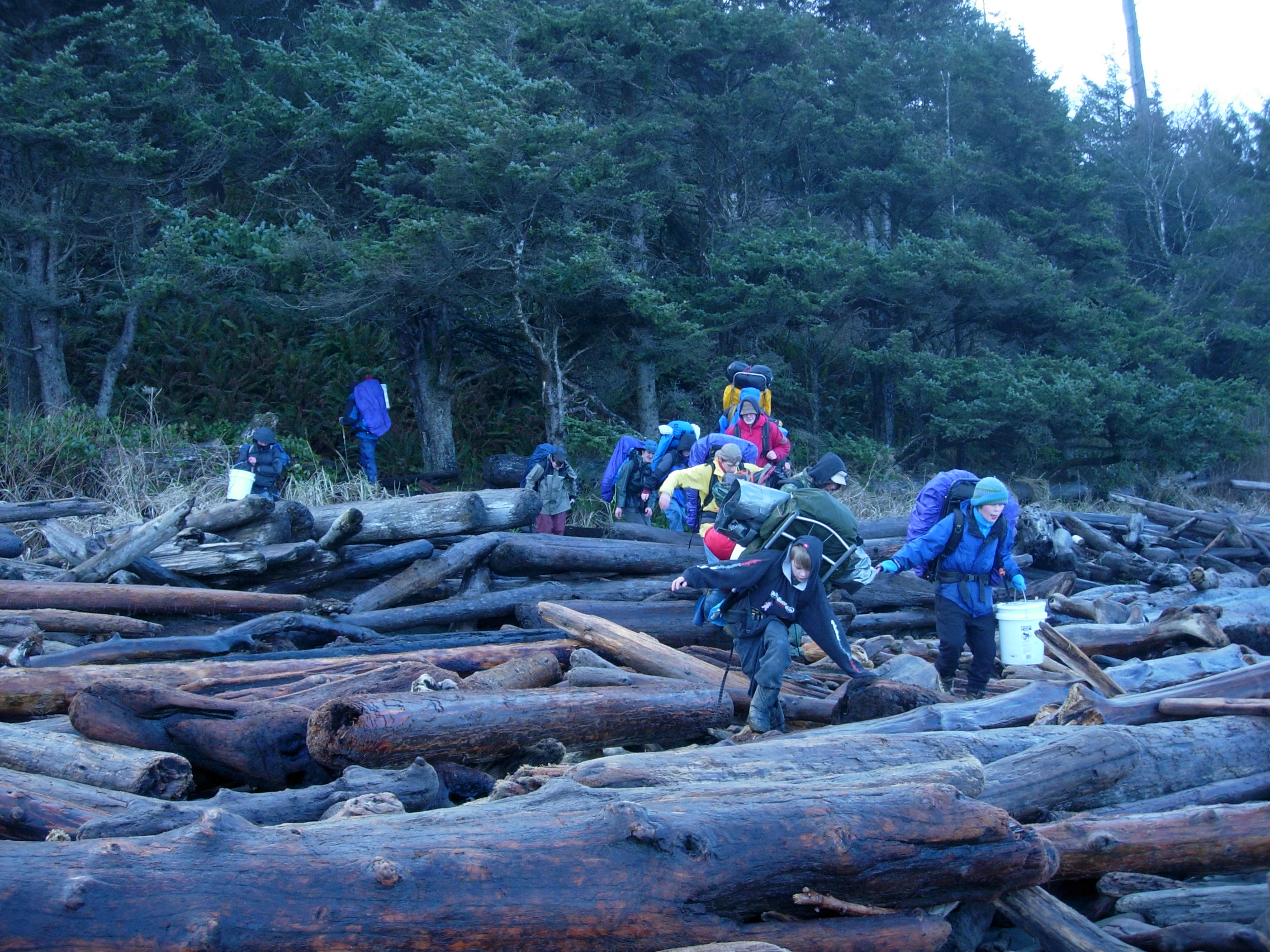
Crossing the logs to get back onto the beach.
Cross those logs – and it turned out that the low rumbling I’d heard during the night was the waves thrashing those logs we’d crossed around like toothpicks.
It made me think quite a bit – given that we’d walked in on a low tide and had made it just in time. The waves didn’t move the logs around gently. It was a seismic event, and I realized that it was that that I’d been feeling through my feet the night before. Being caught out on that beach would have been – well, in a word, fatal. We would have been backed up against a cliff, with logs grinding themselves and anything in between them into mush right in front of us, with that ocean on the other side. It would not have been a good night.
Next thing we had to do was cross Petroleum “creek”.
Since our shoes and feet were already completely soaked, we didn’t even slow down, we had that race with the tide to get the almost two miles up the beach before there was no beach left. A couple of wet feet in wool socks was nothing.
I’d look back every now and then to see who was coming – and recognized Kim’s bright yellow/green coat and figured that because of my leg, they’d gain on us and pass us (the whole point of leaving early was based on that assumption).
Much to my surprise, they didn’t.
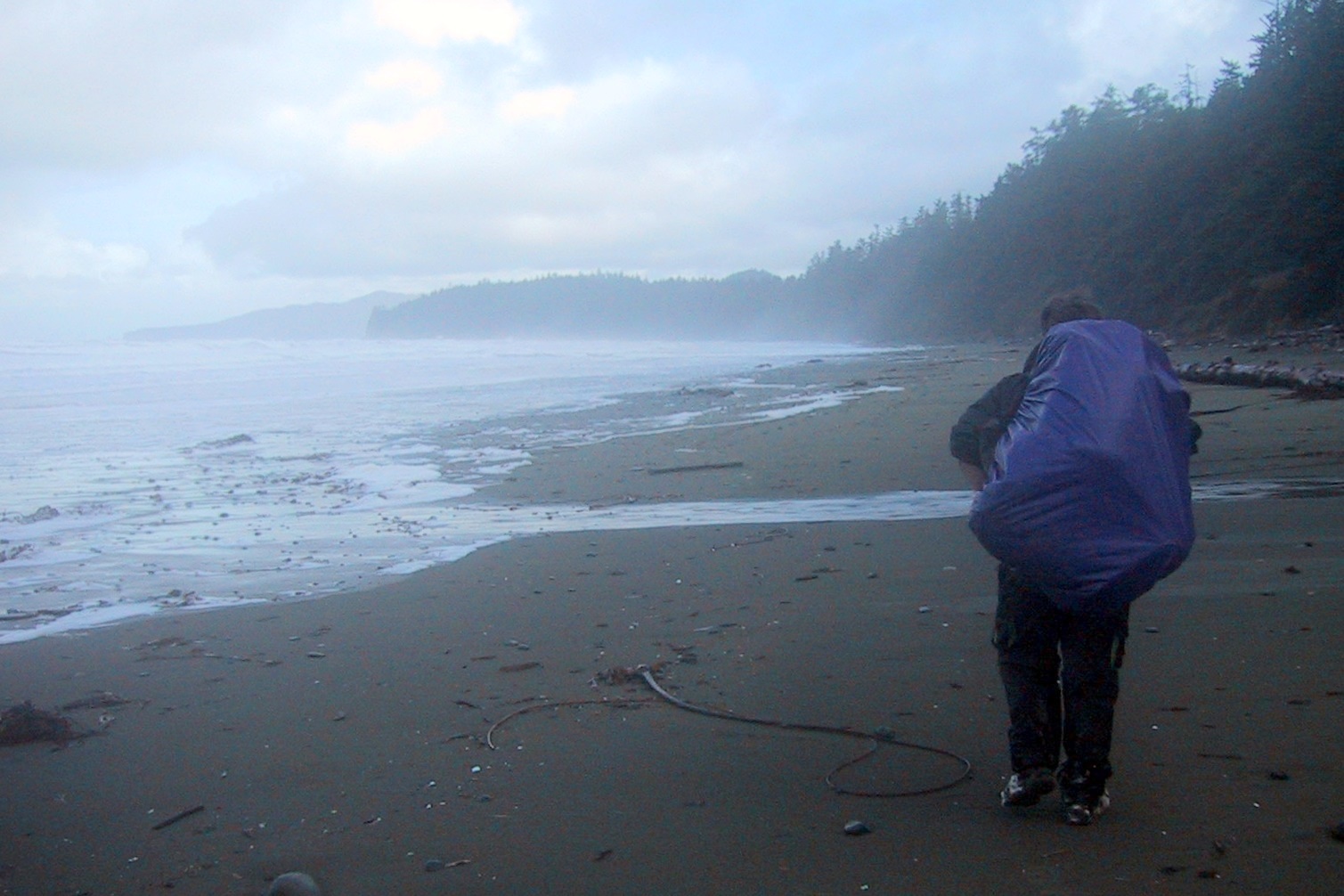
My view of Michael as we left Shi Shi. We all walked as fast as we could to get off the beach before the tide came in
On the way in, Michael had occasionally asked, “Want me to drop it down a little?” (referring to the pace we were walking) – and I would usually say “No” because I was using him to pace myself.
If he was going to go fast, I was going to go fast, and keep up with him.
Period.
On the way out, Michael’s only comment was, “Keep up, old man! I am NOT dropping the pace.” I was behind, but I did manage to stay with him.
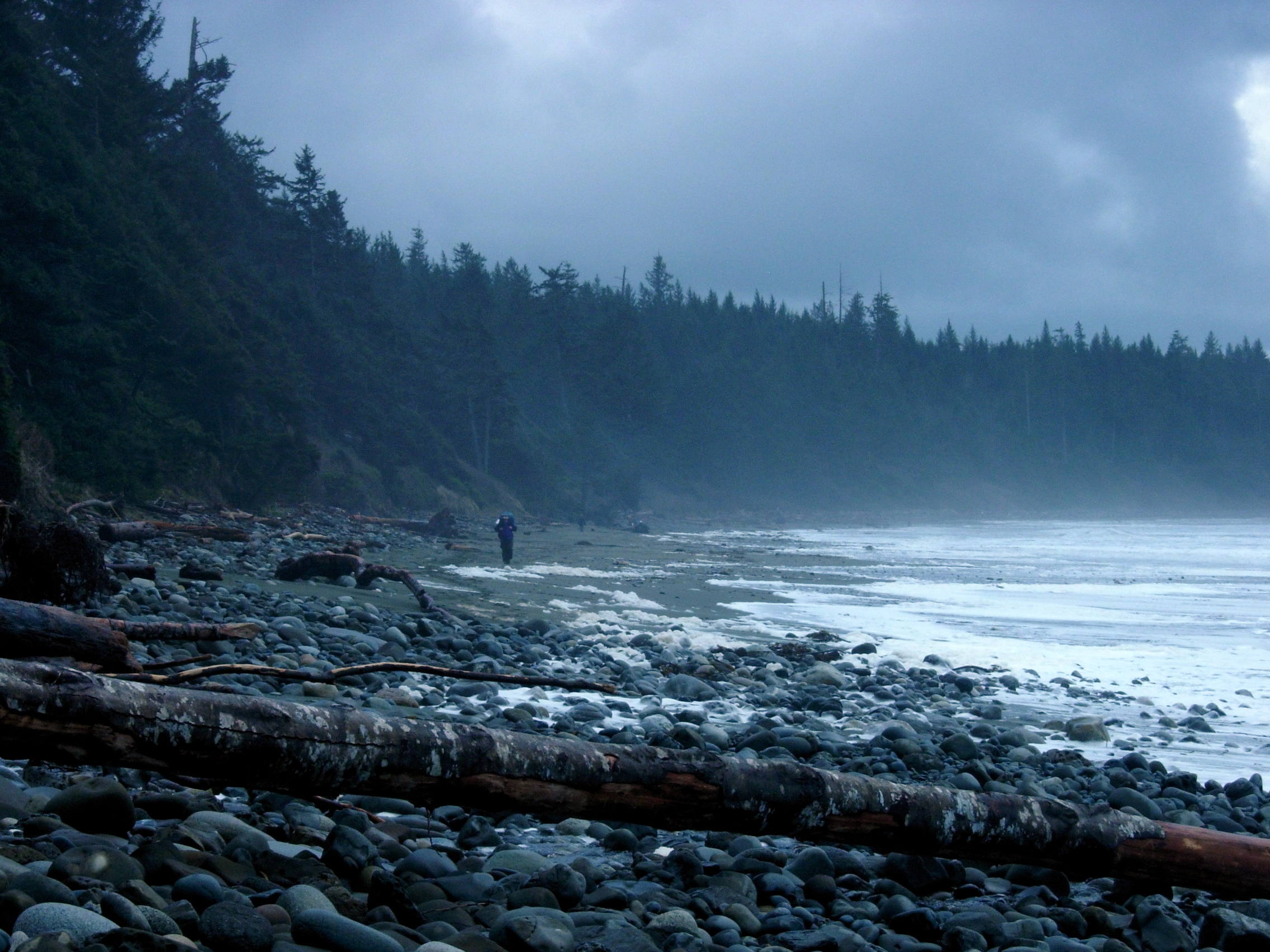
With the tide in, what remained of the beach to walk on was anything but smooth.
With that tide already on its way in, all that flat, hard sand was under water, so we had to walk on the steeper part of the beach. That part was filled with rocks, logs, and occasionally somewhat dry sand – so that meant all our walking was either on that dry stuff that just sucks the energy right out of you, or on the slippery rocks, or threading our way in between.
It was about this time that Michael, having seen one of the “Top 10 most Beautiful Beaches” in the world, mentioned, through the wind, the waves, the sand and gritted teeth, that he thought the reason the beach was called “Shi Shi” was because there was no ‘t’ in the Makah language.
I was not, at the time, in a position to disagree with him.
Now the last time we’d walked down this beach, we didn’t know how far we had to go, because
a) it was dark, and
b) we’d never been there, and
c) we had no idea how far we needed to go, and
d) all we knew was that we had to hit the beach and head “left”.
One thing we actually saw this time that we didn’t see the night we hiked in was that big rock you had to get around before the tide came in.
And the tide was definitely coming in.
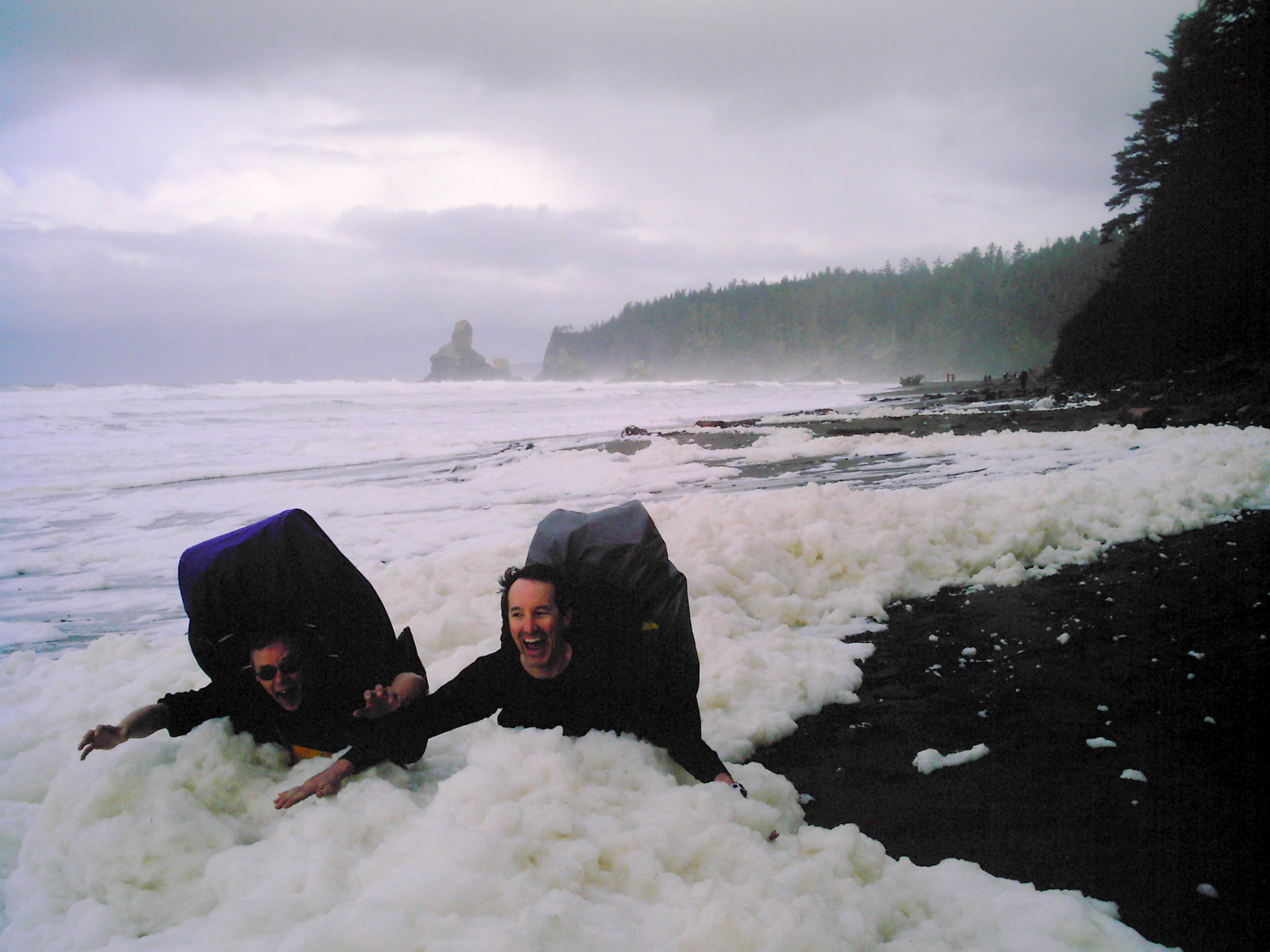
Paul and Dan, learning what “Sea Foam Green” really is.
When we got to the rock, we finally understood what “Sea Foam Green” was. The waves had deposited this line of foam about 2 – 3 feet high right at the base of that rock, and we stumbled through it before the waves came any higher.
We later heard that those coming behind us actually had to time their walks around this rock as the water had already come that far.
We got past it, and found this fellow we’d run into at the trail head the day before. He wasn’t American, didn’t speak English very well, and while we were trudging up the beach with all our big packs, he was tootling along with a little day pack. We were doing everything we could to get north, OFF the beach, and he was just getting onto it. And heading south. Toward the dead end that was that rock. No idea what his plans were, but it was strange. Michael asked him how far to the trail head, “Oh (gesturing back over his shoulder, with a thick eastern European accent), one thousand miles?” (We’re thinking, “Alaska?”) We figured he might mean 1000 meters, and kept walking. Somewhere along the way I found a stick, which I found I was depending on quite a bit.
We kept going. Problem is, we didn’t have much in the way of landmarks when we came in (since it was dark when we’d done it), so knowing where to get off the beach was getting to be more and more important.
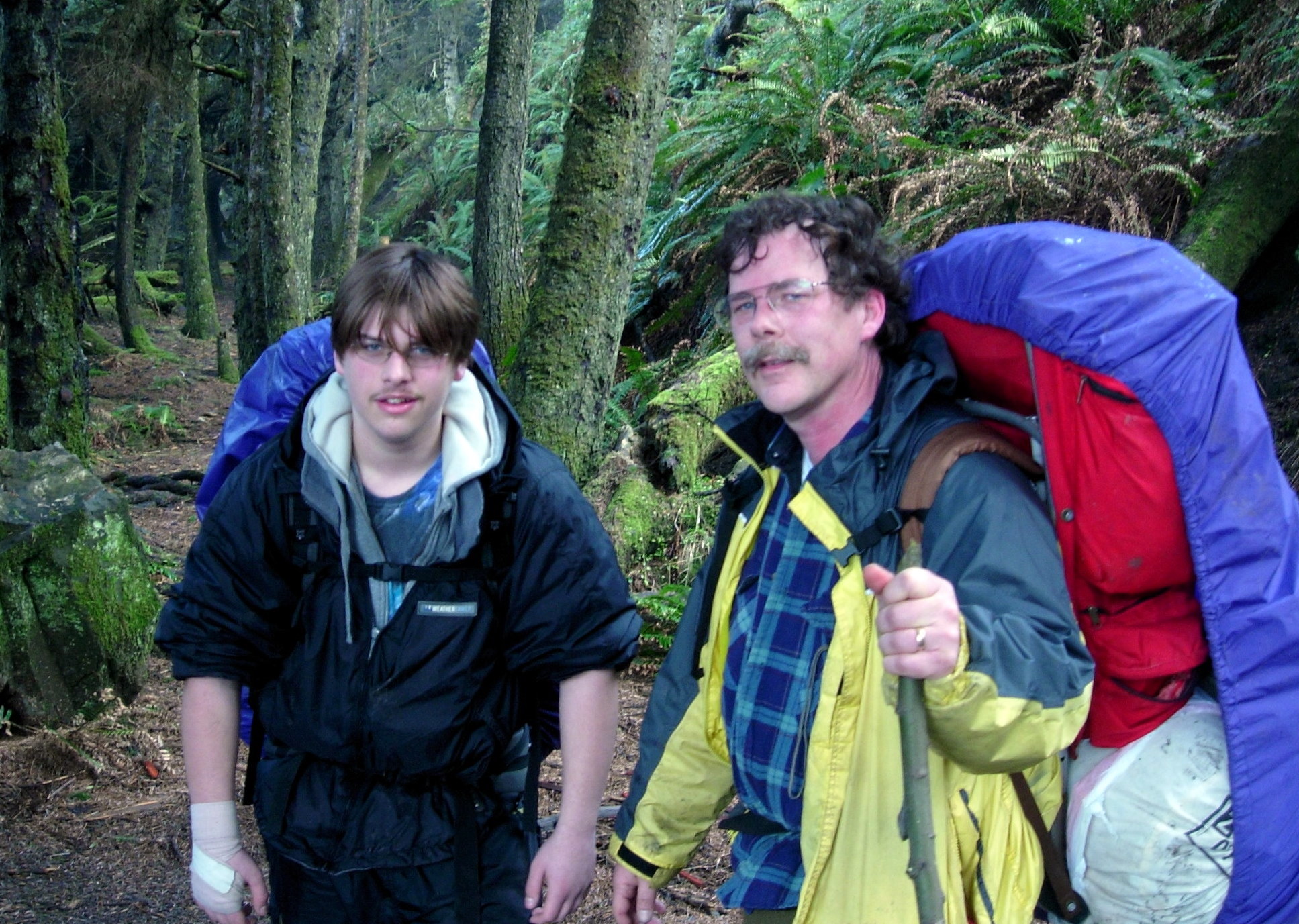
Michael and me, just after getting off the beach
Eventually, Michael was very sure he’d found where we got onto the beach, and he was right. We climbed up there, waded through a pretty deep puddle, and just stood there for a bit, catching our breath and waiting to wave to the next group that came by so they could quickly get off the beach. Turns out that Kim had been following us, and said, “Man, you guys were really moving!” – That was a nice compliment from someone who’s 6’5″ and has two tremendously long legs.
We all rested for a bit, then the folks who could, dropped their packs and go out and help the remaining little scouts who were having trouble, and there were a few.
Michael dropped his pack, and since he was hot from hiking so fast, dropped his jacket and headed out there and brought the packs of several of the little ‘scoutlets’ back in. He was on his way out again when I looked and saw how big the waves were getting.
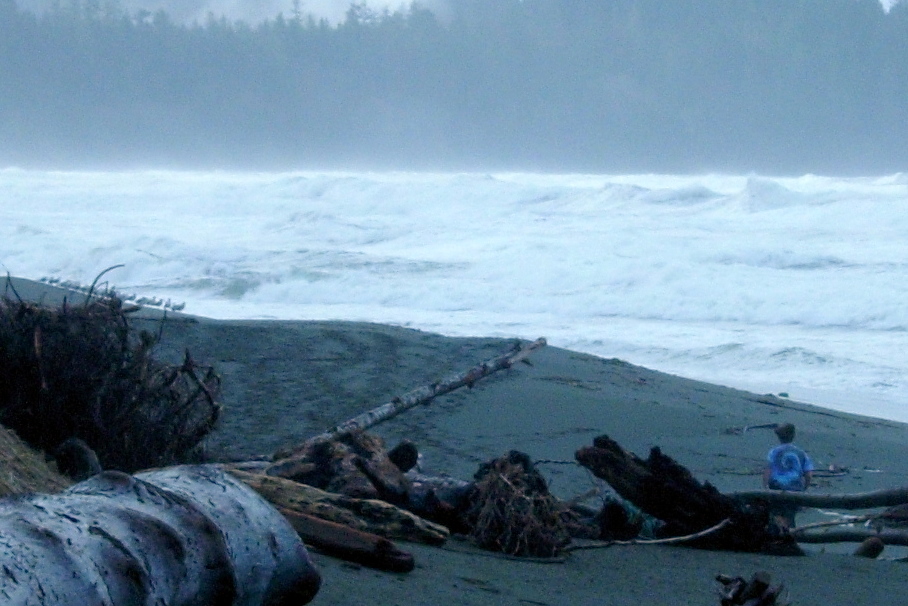
Michael, lower right, heads out a second time to help some of the little scouts get their packs in. It’s good we were hiking fast and not looking at those waves while we were out there.
That’s when the hail started.
This wasn’t just piddly hail, but hail that came crashing through the trees, ripping leaves off as it came down hail.
Being under the trees, I have no idea what it was like out on the beach where Michael was helping the other scouts.
They came back with some packs and things, and went out again to help the little ones.
Eventually everyone got back, and we ate anything we could find. We had packed for another day, so there was no shortage of food.
We rested for a bit longer, this crisis over, since we were off the beach, and braced ourselves for the rest of the hike, which was that slog through the mud I wrote about earlier.
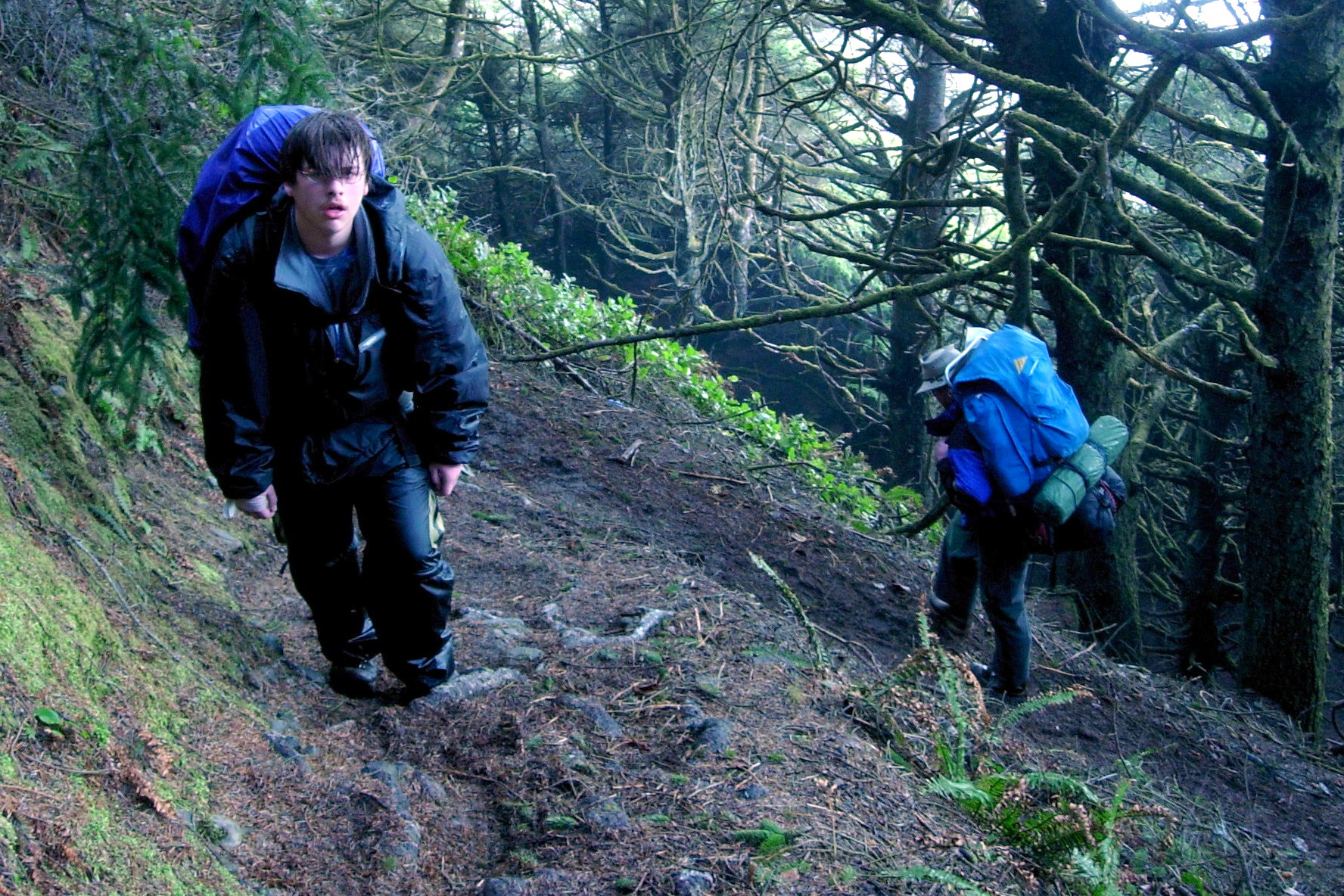
Michael coming up the “hill” – behind him somewhere over the edge is my water bottle.
Also, remember that hill we climbed down? We had to climb up it this time. But it was (relatively speaking) dry, and there was light – so we could actually see what we were doing. While we were resting, some of the older scouts came and ferried packs up that hill – that was very nice, and made the hike up a whole lot easier. Seeing it in the daytime made me think twice about the trip we’d taken down the thing at in the dark, loaded with packs, in the rain.
I didn’t bother to try to find my water bottle.
We took a little break at the top, and marched on – always trying to stay at the edges of the mud holes – I tried to count them again, but lost count at 30-ish of them… again.
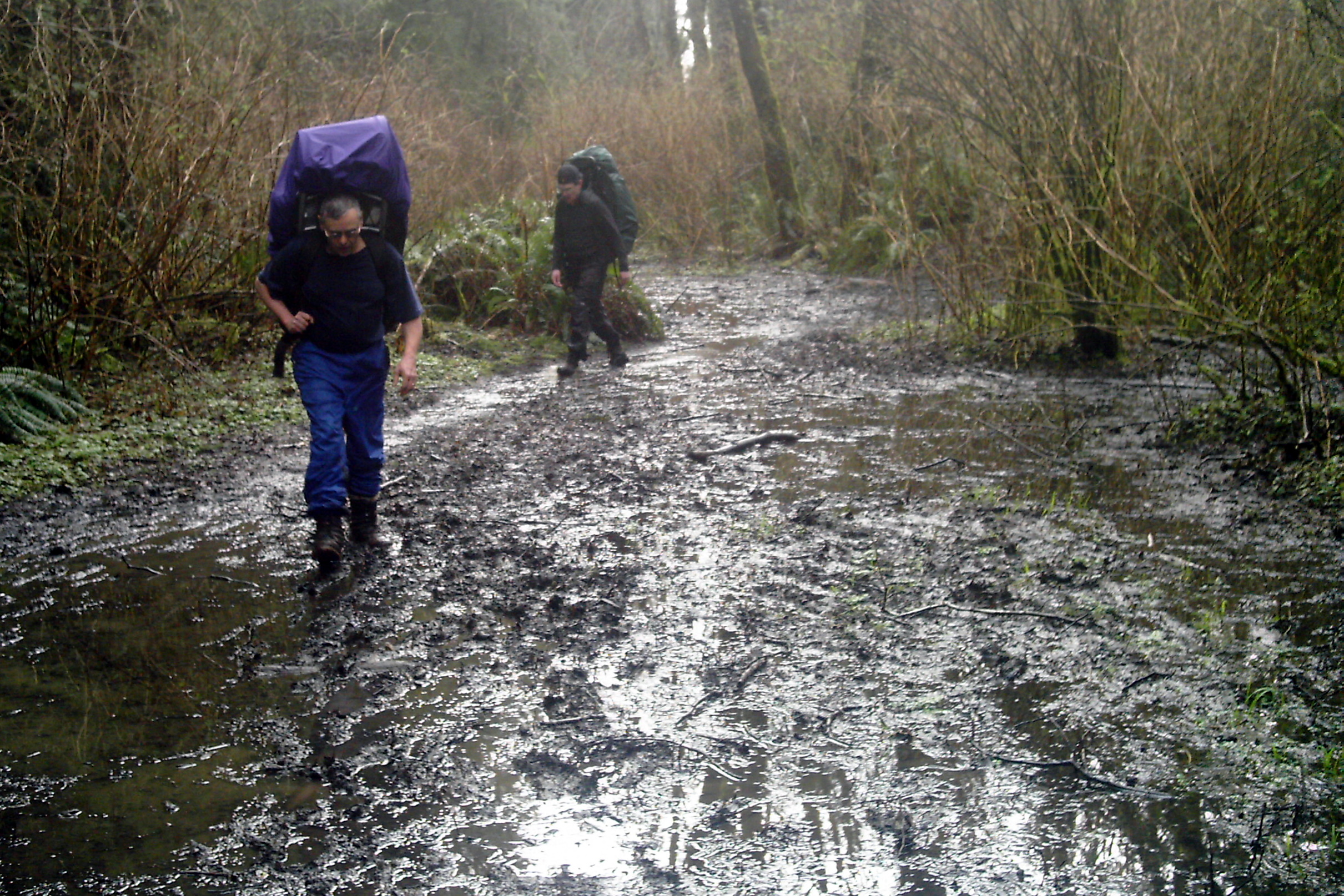
Paul and Eric going through one of the 30+ mud holes along the trail out.
Of course, our feet were soaked from the moment we’d hit that creek a couple of miles back, so worrying about mud just wasn’t worth it, but there was this stability thing we were concerned about – namely making sure we didn’t fall down while we were walking through all that mud. I had to make it clear to one scout that his shoes (and the plastic bags he had his feet in) needed to be tied securely because if they weren’t, he could easily end up face planted in 6 inches of mud, with his backpack on top of him. I didn’t have to explain to him that breathing, in that position, would be a touch on the difficult side.
He got it.
And he tied his shoes.
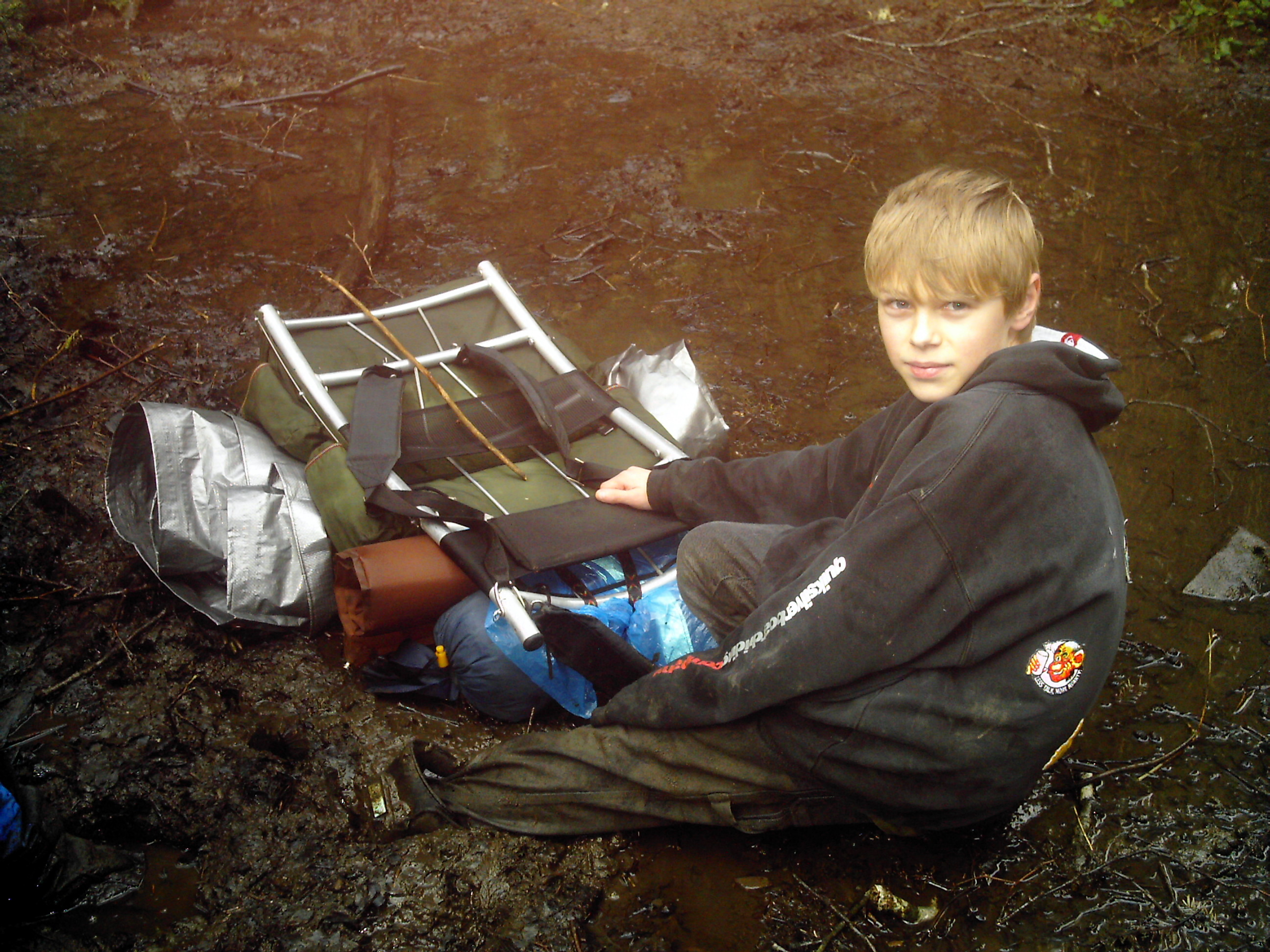
Eric just as we found him, and before Ed pulled him out of the mud.
At least one scout did end up getting stuck, and was sitting/laying there when we came up to him. Ed (his uncle) picked him up and got him out, but we had to make sure the number of boots coming out of the mud matched the number of feet coming out. (one boot got stuck, and we had to fish around in there to get it out).
One scout was just exhausted – he kept sitting down on the side of the trail, but we got him going, it takes more energy to put the pack on and get up again than it does to keep walking – but (we later found out) that this was his very first hike ever, so he had no idea what to expect, and that much walking, with that much stress, was a little beyond him. I helped him get up once and get his pack on. In doing so, I also reached down to pick his pack up so he could get up, and just about threw it into the next county. It weighed less than 20 pounds. Mine was 70 with all the wet clothes and food in it and all. (I’ll have to work on that).
The hike out, once we got going again, was really uneventful. Mud. Trail. Mud. More trail. Mud, more mud. Gravel. Then boardwalk (split hunks of wood spiked onto 6 x 6’s) – eventually, we got to the trailhead, where Mark had thoughtfully already brought the bus. Again, food was brought out, disbursed, and eaten. We found ourselves wondering at the number of calories expended on this trip, as that first part wasn’t just “hiking” – it was moving as fast as we could go to make sure we weren’t stuck. That would have been exquisitely bad.
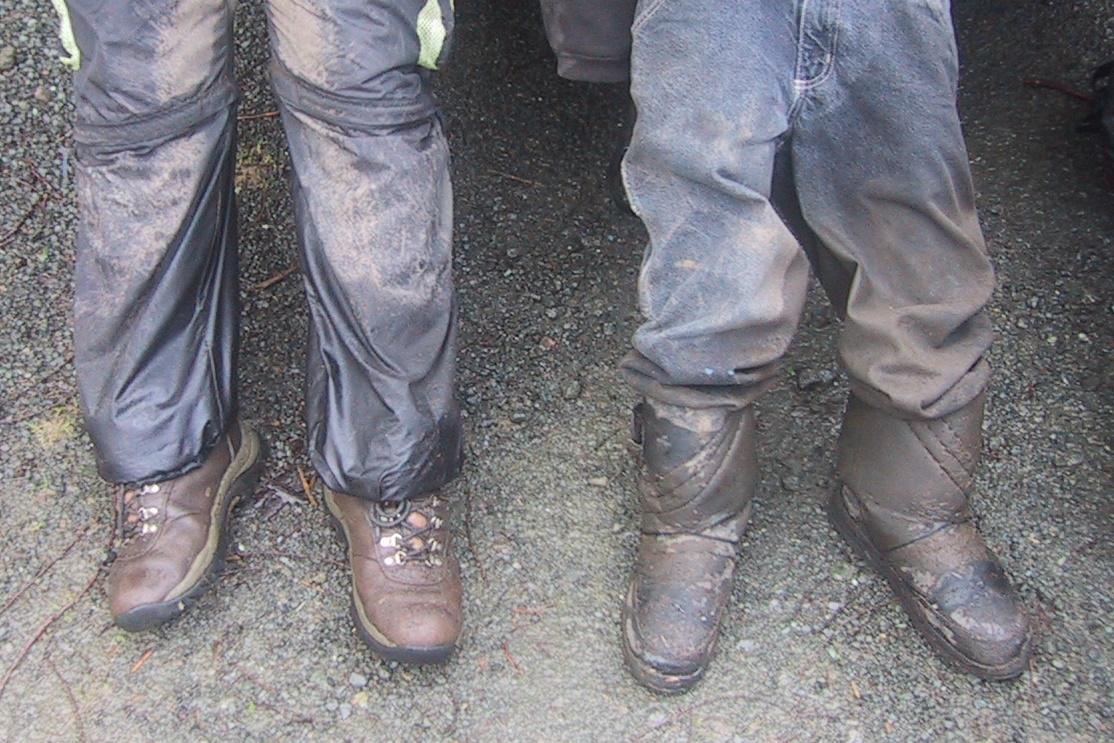
The mud was everywhere
Eventually, things were packed, the bus was loaded, and we were off to go get the Saab, and start the 5 hour trip back to Seattle, and civilization.
It was scary at times, but I do have to tell you, it beat the heck out of a weekend of wasted time in front of the TV any day.
—
Now like I said, there’s another story in all of this, and it came to me as a series of lessons, or things I learned over the months that followed this one.
I don’t have all the words together yet, but I’m going to do something a little different this time – I’m going to give you a ‘rough draft’. And I’m going to ask you to do something a little different. When you’re done seeing what I learned – if something stuck with you about this story – let me know in the comments, maybe we can all learn something together
That story is about the lessons of Shi Shi beach.
- Each of us – as we travel this road of life, will have times when the road is easy, and the burden is light.
- However, there will also be times when we will face challenges, where the outcome is unclear, where the challenges themselves seem to be insurmountable, and where there is real danger, and yet, for whatever reason, we must press on.
- I’ve learned that when you are in those situations, when you are in over your head, and you need help, people you’ve never seen before, will appear out of nowhere, and give you help and direction when you need it, and you will never see them again.
- I’ve learned that sometimes, the road can be oppressing, that you can feel completely surrounded by danger, and it can be very, very frightening.
- I’ve learned that a little light goes a long way, and as long as you have a light to guide you, you can go far.
- I’ve learned that having someone alongside you to encourage you, by either matching your speed, or encouraging you to match theirs, can make you go farther than you thought you could by yourself.
- I’ve learned that there is no better friend than one who will do just that.
- I’ve learned that there will be times when you want to just stop, and rest, and quit, that you simply can’t, you must go on.
- I’ve learned that there will be times when you want to keep going, but the smartest thing to do is to stop and rest.
- I’ve learned that knowing the difference between these two is not always as clear cut as one might think.
- I’ve learned that while moving forward is dangerous, not moving at all is even more so, and you must go on.
- I’ve learned that going on can mean doing things you’re not used to doing, and going on can be more difficult in the short run than just staying put.
- But I’ve also learned that time doesn’t stand still. Life goes on, and in some ways, life, just like Petroleum Creek in the story – doesn’t really care how you feel, or whether you’re tired, or scared, or lonely, or unsure of yourself. Time, and life, marches on.
- Just like with Petroleum Creek, when we had a cliff to our left, 5,000 miles of open ocean to our right, and nothing we needed at our backs, there are times when you have no option but to plunge ahead and push relentlessly forward into the unknown, no matter how tired or scared you are, to achieve your goal.
- I’ve learned that whether you know it or not – people are watching you. The way you deal with the struggles you’re facing may be the only inspiration people have.
- I’ve learned that some of those people watching you will be ready to drop what they’re doing and help you out at the drop of a hat.
- I’ve also learned that some of those people watching you will not help at all, and the best thing you can do when you encounter people like that is to simply keep walking.
- I’ve learned that when you are absolutely exhausted, and have done all you can, and can do no more, to not be too proud to let someone else take the load off your back.
- I’ve learned that no matter how hard you think things are, they can, and sometimes do, get harder.
- I’ve learned that when you can see clearly, and when you have the opportunity to see things in the light – that they can be far, far scarier than they ever were in the dark, because now you can see just how close you were to the edge, or to simply not making it at all.
- I’ve learned that prayer is important, critical, and we never know how much the prayer of someone many miles away affected us. Conversely – I’ve learned that if I’ve got this weird feeling that I should pray for someone, given what I’ve seen, I pray for them, and pray right then.
- I’ve learned that communication is so vital, and it has to work on both ends. Messages sent but not received are the same as messages not sent. It was only after we got back that we found two messages on my cell phone from one of the leaders, both telling us of the weather and the dangers, and that we shouldn’t come. The messages had been successfully sent, but I was not in a position to receive them. That one has some implications that are a little deeper than I can wrap my mind around right now.
- I’m sure there are more. But as I thought of how Paul had gently taken the heavy pack off my shoulders when we finally got to the campsite, and how I had to restrain myself from throwing that 20 pound pack into the next county when I picked it up – I learned one more thing: Things that are easy to one person may be almost impossible for others, either because of their condition or because of the load they’re carrying. A burden that is heavy for one, may be easily lifted by another. And when we’re in the position of being able to lift the load for another person who simply can’t go on, it is our responsibility to do so.
In this blog, I’ve been trying to write stories that have been “baked” – where I’ve spent the time over the years getting to that “aha” moment, where the laughter has finally come, the lessons finally learned, the tears finally dried, and I can share them with you.
This post is a little different.
I’ve been asked by a number of people to give “hankie warnings” on some of these stories, and in honor of that request, please consider yourself warned.
This post is a little more personal than the others, and it’s a number of stories, kind of intertwined.
As I write this – November 8th, it will have been 10 years since I spoke the words below, in front of a well-dressed, somber group of people who listened, who laughed and who cried.
I had been in that last category for ten months, and on November 8th, 2000, these people joined me there.
It was the day we buried my dad.
He’d been in the Air Force. He’d done his time in many countries. It was his time in the Air Force that had him meet my mom, that gave him stories of far-away places to tell, and that shaped my childhood. Some of those stories I’ve recalled in past posts, some are still, as it were, baking, and will be written when they’re ready.
I was at work on January 10th, 2000, when I got “the call”. Those of you who’ve been through this will understand what that means. It’s actually hard to describe the feeling to someone who hasn’t been there, but when I got “the call” – my heart froze, and given where I was, I did the only thing I could do…
I prayed…
…and then I wrote.
I didn’t know whether I’d ever get a chance to tell dad all the things I’d wanted to say over the years – and it seemed that if I was ever going to take the chance, that right then would be that chance, instead of saying all the things I wanted to say to him in a eulogy where he couldn’t hear me, and the words would be empty.
So I wrote a note to him that January afternoon. It’s included in what’s below – which, ironically, is the eulogy I gave for my dad, 10 years ago today.
= = =
Eulogy…
That’s what it says there in your program that this is going to be.
But how do you put into a few words the life of a man who was a brother, a husband, a father, an uncle, a father in law, a grandfather, a teacher — and all those countless other things that a man is in his life?
I’m not going to go into the history of dad too much, you all can read that on the backs of your bulletins. We tried to get as much in there as we could. We’ll also have some pictures going in the fellowship hall so you can see a little more about who dad was.
But right now, I’d like to tell you a little bit about who dad is.
By now most of you know a bit about how this all came about, and for a number of you, the last time you saw him was in this very church on January 8th of this year at Tom McLennan’s Memorial Service.
Dad went into the hospital that night, stayed in ICU at Madigan until May, during which time he had a stroke and some other complications, and later was taken to Bel Air Nursing home in Tacoma, where he died last Friday.
I wrote him a note on January 10th, when things looked pretty bad, his heart had stopped the night before, and we didn’t know what was going on, since he’d walked into the hospital the night before that, and I tried to tell him what he meant to me. I’d like to read part of that note to you, because in a lot of ways, it tells a bit about the thoughts, the feelings, the emotions, and the legacy that he left behind.
<note>
1:45 PM 1/10/00
Hi Pop,
It’s Monday, you’re in the hospital right now, and I’m praying for you.
I have to tell you a few things, just so you know them.
I love you.
— this is so hard to write…
I don’t want this to be the time to say goodbye, but I need to say a few things so that when the time comes, I can say goodbye knowing I’ve told you what I need to tell you.
You know as well as I do that there were a lot of things in our lives that haven’t panned out the way we’d planned.
Because of the time you spent away from the family in the Air Force and at school, I didn’t get a chance to have you around when I really needed a dad.
This doesn’t mean it was easy for you, in fact it was hard. I know now it was very hard for you as well.
But I want you to know that good has come out of that.
I try to spend time with my little boy now as a result, and I’m glad I was able to get my schooling out of the way before I became a papa.
Because you went away to school to improve yourself, I learned that sacrifice is sometimes necessary for future growth.
And good has come out of that.
I learned how much a son needs his father, and I try to be here for my son. So even though you felt very much like you were a failure, you weren’t. You taught me a valuable lesson, one that I will treasure always.
Because of the time you spent fixing things (and the time I spent holding the flashlight for you*)
*He’d ask me to hold the flashlight for him while he was working on something, and being a kid, my attention span was about as long as a gnat’s eyebrow, and so I’d be looking all over, shining the flashlight to what I wanted to see.
I learned how to fix things I never thought I could.
I also expanded my vocabulary during these times.
Because of the way you showed us responsibility, I was able to get a paper route and learn responsibility early, on my own.
Because you helped us deliver those papers on weekends sometimes, I learned that sometimes helping your kids to do the things they’re responsible for doing is a good thing.
Because of the way you told me to take things one step at a time, I was able to build pretty big things at Microsoft when I was there,, one step at a time.
And because you made things for me (like a train table)
and read to me (from Tom Sawyer)
and told me stories (like Paul Bunyan)
and sang to me (The Lord’s Prayer)
and took me to work (where I spun the F-4 Simulator)*
* — in the Air Force Dad was a flight simulator technician — he fixed flight simulators, and one time he took me to work, I think I must have been 5 or 6, and there was this whole line of these simulators — all just cockpits of airplanes, and he, as fathers are known to do, picked me up and popped me in the driver’s seat. I sat there, my eyes huge, as I saw all these dials and gauges in front of me, and it was just so cool and so complicated. — And there was this big stick thing in the way, so I pushed it off to one side so I could get a better look at the dials. I didn’t know that the simulator thought it was flying, and by pushing that stick over I made it think it was corkscrewing into the ground, and all the dials and gauges started spinning alarms went off. I got so scared, I thought I’d broken it, and I looked out at him — he was standing right there, talking to someone else, and with fear and trepidation said,
“Daddy?” —
He turned around, took one look at what was happening, reached in and fixed it. Just like that. He fixed it. I hadn’t broken it. But he just reached in, and with one touch, he fixed it.
and showed me things, (like Wolf Spiders)*
When we lived in Illinois, we discovered that the spiders there are significantly bigger than spiders here in Washington.
So one time Dad was in the basement, doing something, and he called me down. He wanted me to see what he’d found under this can. So, being a kid and being curious, I squatted right beside it, and then picked up the can — to find the biggest, hairiest god-awful ugliest wolf spider I’d seen in my entire life. I jumped up and screamed, and dad was over there laughing so hard. I didn’t think it was funny then, but for years all we’d have to say was “wolf spider” it would bring the whole thing back, and we’d have a good laugh over it.
and surprised me with presents (like at Christmas in 1971 when you told me to clean up a pile of newspapers, and you’d put a bunch of toy trains underneath them)*
*He kept asking me to clean up the papers, but there was always another present to unwrap, another toy to play with, another cookie to eat — and finally, when the Christmas eve was finally winding down and we were cleaning up, I remembered the newspapers and started to clean them up — and underneath was a train set he’d gotten from somewhere, on a set of tracks, just waiting for a little boy to play with them.
and provided for me (helping me get my first Saab)*
*Many of you in this church may remember praying for that very car…
and went out of your way to help me (when that first Saab broke down)
— and the second Saab, — the third one (the fourth one’s out there, it runs fine)
and drove all the way up to Seattle to SPU when I was a student one Christmas to bring me a present — a radio controlled Porsche 928) when you knew it was the only thing I would get.
and visited me at work when I was able to show you where I worked and what I’d become professionally
And supported me in your thoughts and prayers as I became a father in my own right.
You showed me love.
And because you told me, I know you love me.
I love you too.
</note>
I read this note to him several times, never being quite sure whether it got across to him. In August, at the nursing home, I read it to him again, and he looked at me very intently while I read it, and as I finished, there was this look on his face, of peace, of contentment, of, “My job is done.” and for a split second, the stroke seemed to be gone.
He then took the note from my hand and read it himself.
And I know that he knew when he left that he was loved, he was cared for, he was appreciated, and that he would be missed.
We rejoice for him, we’re happy, for him, that this ordeal is over, but we’re sad for us, for the big, dad/Gary/grampa shaped hole he leaves in each of our lives.
— I was thinking the other day about the things I’d miss about him, and I’m sure there will be many to come, but the things that come to mind right now are the little things — and it’s always the little things, isn’t it?
The fact that he’d say “I love you” and “I’m proud of you” so often that we didn’t realize how important it was for him to be able to say that, and now, how important it was for us — the whole family to have him as a cheerleader in the background. There were times he couldn’t do as much as he wanted to do for us, and in his mind, he always wanted to do more — and the fact that he’s no longer in the background, just being there cheering us on — I’ll miss that. We’ll miss that.
I miss his meow — for those of you who don’t know, he had this way of meowing like a cat so you couldn’t tell where it was coming from. It drove us nuts — and we miss it.
I miss him greeting Michael and me with, “Hello Sonshine”
I miss seeing him snuggle my little girl Alyssa, in his lap, reading any of a number of books to her, and the look on her face that told me of the security she felt in those arms.
I miss him standing with mom, waving good bye to us as we left after a visit. — and no matter where we were, when we got together, he’d always thank us for taking the time to do that, to get together as a family, and to include him and he would always remind us, “You are loved.”
We miss him telling us “Remember, a fat old man loves you.”
I miss him yelling at us to shut the living room door. That’s the sound we grew up with. We’d run out, be halfway up the stairs, and hear, “SHUT THE DOOR” — of course, he hadn’t done that for years since he put a spring on it so it’d shut itself. But I miss knowing I won’t hear it again.
I miss him calling me up at night to tell me there was something interesting on Channel 9 (PBS) that he wanted to share with me, even though we couldn’t be together, we could see it at the same time.
When I was growing up, and I’d be upstairs brushing my teeth late at night, I’d hear dad snoring downstairs, — a gentle snore (at least from upstairs) and I knew that that meant all was right with the world.
I’ll miss that, too.
And even though there are many things we’ll miss about him, I know he’s better off now than he was for the last 10 months.
Some time ago I had a dream — a dream of him essentially dying, and it didn’t look as bad as we all generally think of dying.
In my dream, he was laying there, his body all there, but kind of gray, and damaged. It looked like dad, but suddenly he broke free of that body, and he just kind of came up, there was this whole, healthy copy of him, in living color that kind of came out of him like a butterfly comes out of a cocoon, and he was free, he was whole, and he flew away, leaving the gray, damaged body behind him.
After Dad died, Petra was doing some thinking about what his death was like for him, and the image she came away with was this, that dad was in bed, in the nursing home, having just been sung to and prayed for by the love of his life. She laid down on the bed next to him to rest, and dad, who had had his eyes closed, suddenly could see her.
The machine wasn’t breathing for him anymore.
His mind was clear, not muddled by a stroke.
His heart didn’t struggle.
His feet weren’t cold.
We imagine he looked around, saw the things we’d brought in to make him feel at home, saw his beloved wife laying there, who’d been with him for 41 years, for better or worse, for richer or for poorer, in sickness and in health, and with his new, whole body, then left the presence of his wife to be with his Lord.
During dad’s life, we all knew that no matter where we went or what we did, dad loved us, and I am convinced that up there in heaven, he loves us still.
When the service was done, we headed to what would be dad’s final resting place, and on that cold, clear day, the wind blowing the oak leaves around the cemetery, our family gathered around dad one last time as he was given a military funeral, with an Air Force Honor Guard from McChord Air Force Base, a flag, and a rifle salute.
We shivered as we took our places in the chairs under the portable gazebo they’d set up for us, with mom sitting in the front row. I walked away for a bit to clear my head as the ceremony started.
I’d seen the airman with his trumpet, trying to keep his mouthpiece warm on that cold day, and I knew he was going to play Taps – which I’d learned to play when I played the trumpet in junior high school, but I’d never had to play when it counted.
Taps, originally used to signal “lights out” in the military, eventually became the bugle call played at funerals, where it signaled – or symbolized – a final “lights out” for an individual.
I’d heard it played when my friend Bruce Geller died in 1978.
I’d heard it played when I, as a photojournalist, was covering the funeral of Lee Stephens, a sailor from the USS Stark that was hit by a missile on May 17th, 1987, and each time I’ve heard it, it has been like a knife in the heart for me.
It is a symbol of the end of a life, and of a loved one, where they make that transition from living in your life to living in your memories.
I remember, as I shot the funeral of Lee Stephens, how I wanted to honor the grief and sorrow his family was experiencing, but at the same time, I wanted to tell the story that this young sailor, from a small town in Ohio, who’d graduated just a few years before, had people left behind who still loved him.
I remember seeing, through the viewfinder of my Nikon, through a long, long telephoto lens, the look on this sailor’s mom’s face as the sergeant of the honor guard handed her the flag. It was a photo that, while it was “the” photo from a photojournalism point of view, I did not take. The moment was too intimate, the grief was too raw.
I remember her eyes, simultaneously exhausted, numb, disbelieving, and utterly spent as she accepted a flag from an honor guard member, “…on behalf of a grateful nation…”
In walking away a bit, I had unconsciously recreated the view I’d seen through that camera, the photo I didn’t take in 1987 at that cold cemetery 13 years later, and I was not prepared to see that look on my mom’s face and in her eyes.
But I’d seen that look before, and knew what it meant.
We’d had 10 months to prepare for this moment, but the fact is, we all know we’re going to die. Being faced with it as “sometime” in the vague future is one thing. Seeing it in front of you in unblinking reality is something else entirely.
I saw the honor guard fold the flag as precisely as they could fold it
But this time, I wasn’t hiding behind my camera, trying to insulate myself from the pain of a mother who had lost her son.
This time, while I wasn’t a mother who’d lost her son, I was the son of a mother who’d lost her husband.
This time, I was the son who’d lost his father.
I understood things a little more clearly now.
I understood a little more about how much it means to sit in that chair, and have someone hand you a flag, in exchange for someone you love.
As if that wasn’t enough, it was then that they did the rifle salute. For those of you who have not experienced it, it is very much like a 21 gun salute. Retired military members who have served honorably receive a 9 gun salute, a volley where 3 soldiers fire off three rounds apiece. It is done as a sign of respect, of honor. For those not prepared for it, it can be shocking.
The call was made,
“Ready! Aim! Fire!”
Three fingers squeezed three triggers.
“Fire!”
Three firing pins hit three cartridges.
“Fire!”
Three cartridges fired and were ejected.
The honor guard was called to attention, and the command “Present Arms” was given so precisely – they all moved as one. Those without rifles saluted – those with rifles held them in the “present arms” position.
As the three shots echoed away, the only sound left was of those leaves, the movement of cloth, and the click of rifles being presented.
There was a moment where this was all we heard. Leaves rustling, coats flapping, and the stunned silence of those still not ready to let go.
It was then that the bugler, who’d clearly kept his mouthpiece warm, played Taps. He played clearly, with dignity, and with the respect and honor due.
– and through the wind, I heard the sergeant’s words I’d heard years before, “on behalf…of a grateful nation…” drift across on the wind as he solemnly handed the folded flag to my mom.
And at the end of the day, as I watched them drive off, I found myself, in spite of the fact that I had my own family, a job, a mortgage, all the trappings of being an adult, I found myself crying, because underneath it all, I was a little boy who’d just lost his daddy.
I cried for the fact that much as I’d wanted to, there were things left unfinished.
I cried for the relationship that had at times been rough, but had started to mend.
I cried for the relationship that, like it or not, mended or not, was ended.
…
It is Veteran’s Day as this is published…
For those of you out there who are wearing the uniform, or for those of you who have worn it, with honor, you have my greatest respect.
For those of you who’ve lost your sons – like Mr. and Mrs. Stephens, who lost their son Lee, and so many others, and for those of you out there who’ve lost your daddies, my heart goes out to you.
For those of you who are still daddies, remember your kids only have one of you, and they only have one childhood.
It’s not a dress rehearsal, it’s the real thing.
Take the time to be there for them while you can.
Love them. Hug them.
Veteran’s Day, 2010
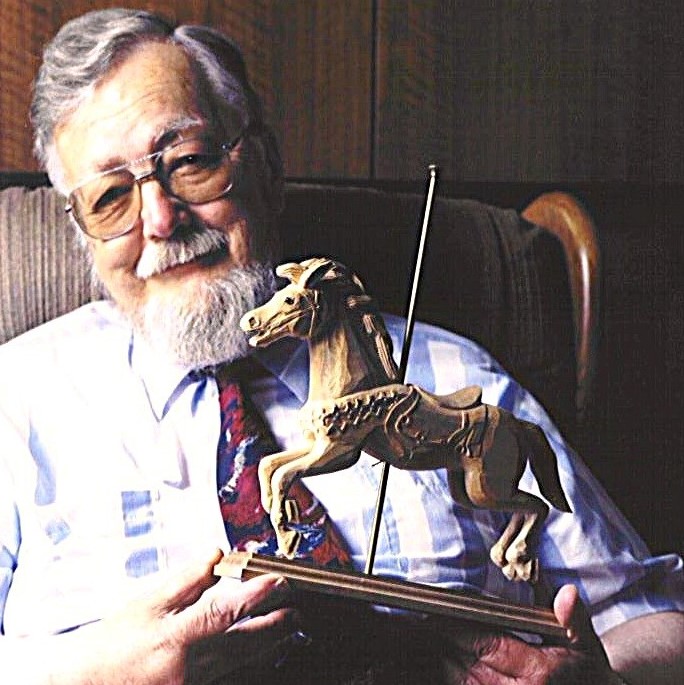
Dad and one of the merry go round horses he carved.

 Tom Roush's Blog
