
You are currently browsing the tag archive for the ‘Stories’ tag.
Hey all,
It’s been a bit since I wrote, a lot of life has happened, a lot of changes, a lot of storms, if you will, and it reminded me of a story that happened a number of years ago that involved a USAF C-130 and yours truly.
If you’ve ever seen a military airplane, chances are you’ve seen a C-130 Hercules. It is the short/medium haul workhorse of militaries all over the world that’s been in service for over 50 years. The Navy’s Blue Angels have one from the Marines they call “Fat Albert” that carries the maintenance and support crew to keep all the F-18’s flying.
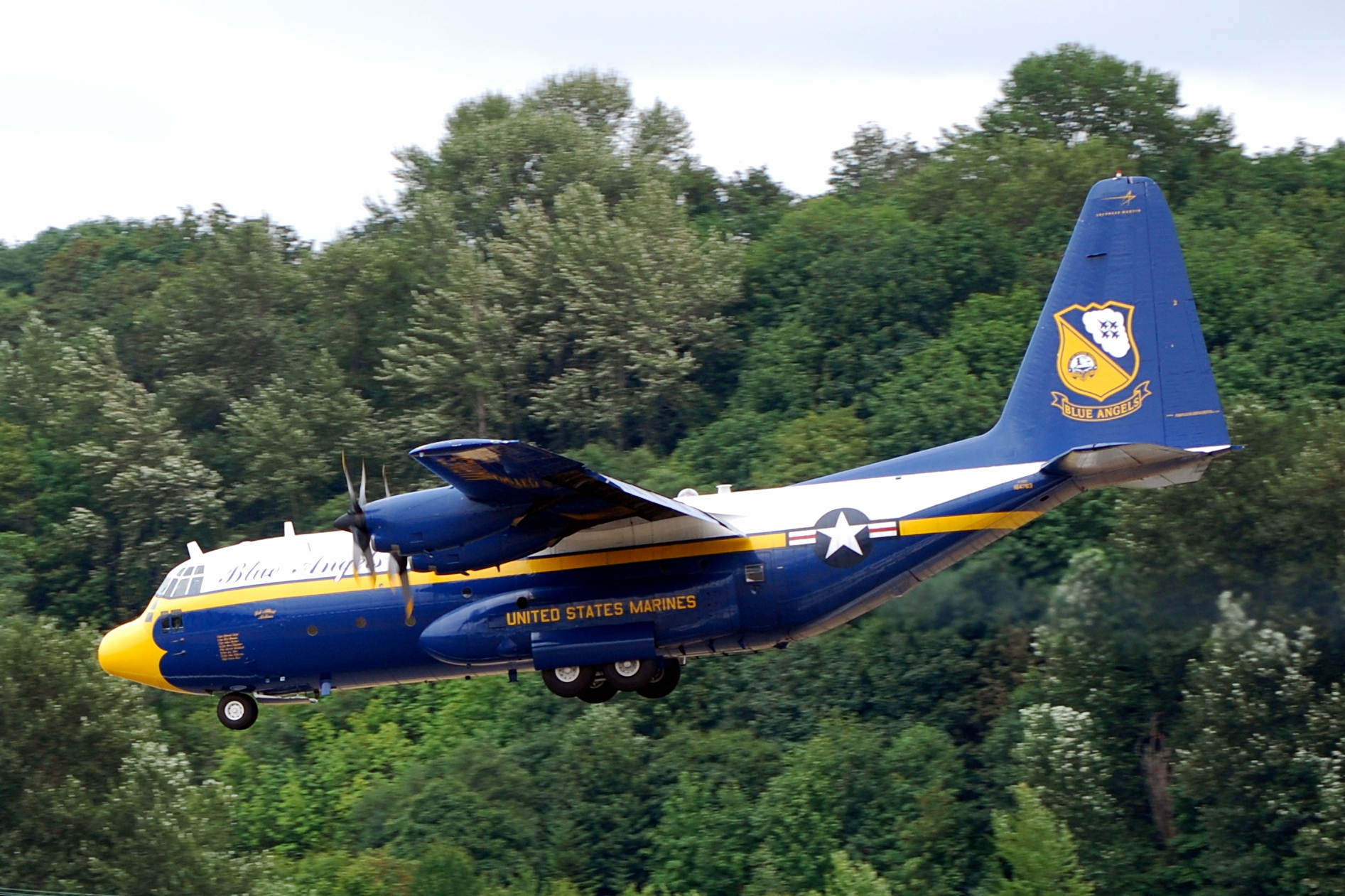
A C-130 landing just a little better than I did.
I’ve been in a couple of them, flown over some amazing countryside (Mount Rainier – I’d have pictures of that but I dropped the camera while I was in the cockpit a few thousand feet over Elbe and broke it – the camera I mean) and been in one that was dogfighting with another one (story to come later), but the one that I remember most is the one that never left the ground.
See, back when I was in Civil Air Patrol, one of the senior members of the squadron, Steve, was also in the Air Force, and he worked just across the parking lot from where we met every week.
What was cool about that place across the parking lot was that it housed two multimillion dollar full motion simulators, one of which was the one for the venerable C-130.
What was cool about Steve is that he did the same thing in the Air Force that my dad did years earlier – he worked flight simulator maintenance. Understand, folks who work in maintenance aren’t the people who get the glory. They’re not the ones with high ranks or fancy titles. The people who work maintenance, however, are like the janitor of the school you went to. They have to be able to fix anything.
And to do that, they need to be able to get anywhere.
And to do that, they have to have keys to EVERYTHING.
And Steve, so to speak, had the keys to the C-130 simulator.
Now since he worked maintenance, he had to be there all the time, just in case.
There were quiet times during his day when the simulator wasn’t scheduled – and of course, over time, I learned what those times were, and just ‘happened’ to show up pretty consistently about then.
Over the course of one summer, Steve let me fly the thing – I did the math some time back, and I think I had something like 40 hours in it over those three months.
I learned how to start the engines, how to taxi out to an imaginary runway (Steve would play the part of the air traffic controller and give me directions over the headsets from outside), and then Steve taught me how to take off. Now understand – all this is in a full size, full motion simulator that’s an exact replica of the cockpit. You hear the engines. You feel the vibration of the engines. You literally feel the bumps in the pavement you’re taxiing across. It would even have the nose dip as you hit the brakes to stop at the end of the runway before starting your takeoff roll, where you’d feel the bumps in the pavement going by faster and faster, until when you pulled the nose up, you could actually *feel* the nose gear lift off – it smoothed out because it wasn’t rolling over pavement anymore. Then there were the checklists to make sure everything was done right. Landing gear had to come up as soon as the plane was actually climbing. Flaps came up in stages as the plane accelerated, and so on.
The one thing it didn’t have was any type of visual display, so because of that, when I learned how to fly, I learned how to fly on instruments only.
I learned that the controls felt mushy at low speeds, and very stiff at high speeds, and at those high speeds, you wanted to keep the little g-meter in the bottom left of the instrument panel very happy. Overstressing that little thing could cause problems
I learned all that before I ever looked out of the cockpit of a real airplane, and the funny thing is – I learned how to fly the plane not because I had to, but because it was fun.
After some time, Steve let me just play a little bit, and I actually got pretty good at running through the checklists to start the engines, the pre-taxi checklist, the pre-takeoff checklist, after takeoff checklist – really, there were a lot of them.
One day Steve had most of an afternoon with no one scheduled in the simulator, and I happened to be there, so he decided to have some fun. He taught me GCA’s – or Ground Controlled Approaches – which you do when you can’t see the runway, and the airport has equipment you don’t have. Basically you’ve got two radio beams that intersect like a cross, coming from a couple of transmitters at the end of the runway. One shows you on the right glide slope (both approaching and descending at just the right speed), while the other shows you on the right glide path (coming down on the centerline of the runway). Your job is to keep the plane at the center of those two radio beams– you’ve got someone on the ground tracking you, and their instructions to keep you in the center are short and to the point: “Flight 279, GCA, 3 miles out, on glide slope, on glide path” (what you want to hear) versus something like “Flight 279, GCA, 2 miles out, 500 feet left of glide path, 200 feet below glide slope”. You’ve got a lot of correcting to do in the two miles you’ve got left, flying at about 130 mph, you’ll cover that in less than 30 seconds, while trying to find the end of the runway, which is at the other end of those radar beams. Remember, if you’re doing a GCA, you’re only doing it because you can’t see the runway. This is rather important because usually the runway is the only flat space big enough to land on.
It was clear that Steve had a little bit of fun being the GCA Controller, so one day he decided to take it up a notch… He stepped into the back of the simulator where the instructors usually sat – where they had all sorts of evil controls to mess with the crew being trained, and played GCA from right there instead of from his usual console outside the simulator.
I had the headphones on as usual, and he decided he’d give me what started out to be a normal approach. I’d had the flaps down to 50% as I needed to have them for that speed, and then he started dialing in some turbulence to make it a little more challenging.
Ever flown through turbulence in an airliner?
This was just like that – all the sounds, the full motion in the simulator, it was just like you’d expect to feel it in a real plane, just as bumpy, just as uncomfortable, and it suddenly dawned on me that the barf bags in the cockpit weren’t there for decoration.
He gave me gentle instructions: first just fly the plane with the turbulence randomly and dramatically trying to flip it right, left, up, or down. My goal was to keep the wings level, and keep it aimed to 340 degrees North-northwest, the same heading as the runway.
Then, when he felt I had that mastered, he decided to transition in a GCA controlled approach, meaning I had to not only keep the wings level and keep flying the plane in the storm, but manage all the procedures that were part of landing the plane.
He added wind gusts that varied from headwinds (which suddenly gave me much greater lift) to tailwinds (which suddenly meant the plane wasn’t flying through the air fast enough to generate enough lift to keep it from falling out of the sky).
Somewhere in there I realized that not only did I have that voice in my headphones to guide me, I noticed that there was an instrument on the panel in front of me that, every time I heard the message, “On glide slope, on glide path” – made a little plus sign, a little cross. It turns out it was what’s known as an ILS, or Instrument Landing System – which is a miniaturized version of the GCA. Instead of a radio and someone in the tower, it’s an instrument in the airplane.
See, the GCA is something external to the plane. . It’s sending a – kind of a cross of radio beams out, and they can tell where you are in relation to that. They will tell you what you need to do to be able to land safely.
You don’t have to have anything but a radio, tuned to the tower frequency and you just have to do what the voice in the headsets tells you to do.
The ILS is a miniaturized version of the GCA. It depends on that same kind of radio beam, but is internal to the plane. Just like a compass always points North, which is a good reference point, this always keeps you pointed toward your goal, which is finishing your flight safely, on the runway. All you have to do is pay attention to it, and keep the little cross centered in front of you, and you’ll reach that goal.
But – meanwhile, back in the cockpit, knowing what the right thing to do and actually doing it were two different things. Steve was having fun and incrementally dialing up everything, making the plane climb, bank, and turn, and fall out of the sky all at the same time. It got to the point where just trying to keep wings level, much less doing something complicated like “keep the wings level and the pointy end facing front” was an astonishing challenge. The descent rate wasn’t even averaging the 500 feet per minute descent I was supposed to be trying to do on at that part of the approach.
I thought things had gotten as bad as they were going to get, and was really working up a sweat in there… It was no longer a simulation, for me it was real.
And that’s when Steve dialed up the turbulence to the point where I was in a full-fledged storm.
I wasn’t panicking, but I was working pretty hard to keep things under control, and was concentrating so hard on keeping wings level, keeping the descent rate right, keeping it on glide slope and glide path, that I was caught off guard when Steve suggested I might look at the oil pressure of the number 3 engine.
It was falling.
Imagine your check engine light coming on in your car. You just pull over and – well, check your engine.
Interestingly, that’s exactly what I was trying to do, but had to wait till I had a successful landing behind me.
So I had to slow that engine down, but I couldn’t just pull back number 3. By now the flaps were down, if I recall, at 50%, and the air each of the four propellers pushes over the top of wing, especially with the flaps down, creates a tremendous amount of lift. So if you’ve got two huge propellers blasting air over the left wing, and only one on the right, that left wing will produce way more lift – which complicates things and needs to be considered in everything you do from there on out. So I throttled back not just number 3 (inboard engine on the right wing) but also number 2 (inboard engine on the left wing) to keep the power and lift balanced, with the hope it would last long enough to get us to the ground safely. Complicating that was the fact that the inboard engines blew air over more wing and flaps, and helped create more lift than the outboard ones. There was a good bit to think about in all of that.
Steve was impressed, so he held on to the handles mounted for the instructors in the back of the simulator, and dialed the turbulence and the mechanical problems up even more. He added what I now realize were wind shear and microbursts, meaning my airspeed would vary, causing my descent rate to range from “climbing like a homesick angel” to “falling out of the sky like an anvil with wings”.
I brought the flaps all the way to 100%, which increased lift, but also increased drag, slowing the plane down, requiring extra power (which I didn’t have much of) to stay in the air. While I was working on the approach checklist, and right as I’d gotten getting the gear down, increasing the drag yet again, and requiring more power to overcome, Steve was slowly dialing the oil pressure down in number 3, and eventually I had the engine in flight idle (lowest speed I could set it to).
At this point, my options were getting even more limited, because not only did the oil pressure keep going down, but the temperature started going up.
That’s when Steve added the smoke – real smoke in the cockpit. I have to tell you, if nothing else had my attention, the smell of hot oil on top of everything else did.
Number 3 didn’t show that it was on fire, but it was showing it was overheating, and it was clear that running out of oil to keep it lubricated and cool was going to guarantee a fire, the only question was if it’d happen before I got to the ground or after. I realized there was only one thing I could do to keep that from happening, so I reached up above the windshield, between the empty copilot’s seat and mine, and flipped the switch to arm the fire extinguishing system. I feathered the prop and pulled the fire extinguisher handle, shutting that engine down, and if nothing else, preventing a fire.
That solved one problem, but created several more.
I was still trying to land in a storm, but now I was down 25% of my power, and I was right close to stall speed.
That was when Steve decided to up the wind shear a bit, and I felt the plane lurch, then saw the instruments show I’d gone from a headwind to a downdraft and I was sinking fast.
Sinking fast when you’re flying is not a good thing.
Sinking fast when you’re almost not flying is a very bad thing.
Sinking fast when you’re almost not flying, close to the ground, is a sentence that often has a fireball for a period.
I simultaneously slammed the remaining three throttles to the firewall, and turned the yoke all the way to the left and stomped on the left rudder pedal to try to balance out the asymmetrical lift and thrust I knew I’d be getting because of number 3 being out, and stopped sinking.
In spite of that, it moved me to the right of the glide path, so I banked left (which is actually hard to do since I had more power and lift from the left wing) and had to get back on the glide path, just as I heard Steve’s calm voice inform me that I was below I was 200 feet right of glide path, and definitely below glide slope.
All the while, Steve watched from the back, saw that I was close to making it, but I still wasn’t out of the weather, and just as I was about to touch down, I got another hard gust from the left. I firewalled the throttles again to try to keep from hitting too hard, but we were too close to the ground for it to help enough in time. I did hit hard, felt and heard one of the tires in the right main landing gear go, pulled all three engines to ground idle, then the standard thing to do would be to lift all the throttles straight up, allowing me to pull them back further, changing the angle of the propeller blades so they’re blowing air forward to slow the plane down once it’s on the ground, not backward to keep it flying.
Had I done that with all three remaining engines, I would have put two engines on the left wing and one on the right into full thrust reverse, adding “pirouetting down the runway” to my list of accomplishments on that flight. I decided, instinctively to let my middle finger loose and leave the number 2 engine in ground idle and reverse numbers 1 and 4, which slowed the plane down without the pirouette until I was able to use the brakes and get off the runway.
Once everything was shut down, Steve looked at me with a huge grin and said, “Well done! I’ve had trained pilots in here that didn’t handle that as well as you did!”
It made me smile, sitting there, back all sweaty against the pilot’s seat – slowly starting to shiver from the abundance of adrenaline and the air conditioning I was just now starting to feel.
He’d said, “Well done!”
It’s said that any landing you can walk away from is a good landing – and this one was one of them.
We talked for a long time after that flight, and as I’ve been writing this, years later – I’ve found that as with many of these stories, it got me thinking…
The whole thing about this adventure we call life is like that adventure in flight in that simulator.
There are times when our lives are CAVU (Ceiling And Visibility Unlimited). Times when you are as free as a bird, where not only the valleys we struggle through, but the mountains and clouds that seemed so high, are now beneath us.
Those are times to cherish, because in those times, you gain perspective, understanding, and wisdom. You’re able to see the other side of the clouds, the side where the sun always shines.
Other times, life throws us into storms, and the things we hold dear, the things we depend on for support, for power, for strength are shaken to the core. I got to thinking about those engines, and the one that was causing trouble and catching fire trying to land in that storm – and I had to just let it go and shut it off, then figure out how to go on without it.
Those aren’t times where you gain perspective.
Those are times where you gain experience.
And we need both.
It’s the transitions that are often challenging.
We have to compensate for things that have been damaged, and flying through the storm becomes quite a bit harder when we lose things we depend on.
I realized that while I’d learned how to instinctively fix something while still compensating for my weakness in the simulator, (slamming those three throttles forward when I really needed four, and stomping on that left rudder while turning hard left to keep the strength I did have from pulling me off course), that that’s a constant lesson in real life.
I got to thinking some more about it all, and how hard flying through that storm was… You couldn’t see anything out the windows of the simulator – it was nothing but instruments – but if you were flying in a storm, you wouldn’t see anything anyway.
…and that, sometimes, is what life is like…
It feels like we’re flying blind, but only if we’re straining to find something in the murk outside…
If we look inside, at our instruments, if you will – there’s more clarity, and while doing that GCA, I had that voice in my headsets guiding me along that cross in the radio beams, and that dotted cross on the instrument panel, and the third one over the top of that, guiding me on the inside. When I was where I was supposed to be, the three crosses became one. I learned that if I focused on that cross, and listened to that voice, it would guide me through any storm.
It was a lesson in trust.
I couldn’t trust in my own instincts. Even when the storm headwinds caused me to go higher than I wanted to go, or the tailwinds caused me to sink lower than I wanted to be, even with that engine threatening to burn a wing off. Being so close to the ground and so slow that any mistake could be the last one, hard as it was, I had to trust.
Getting too far to one side or the other for too long, and pretty soon it’d be impossible to correct for in time even if I made a massive correction to try to get to the runway, so I needed to trust.
As easy as it is to let the storms of life blow me off course, and as hard I know it can be to struggle during those times when I don’t have perspective but I’m gaining that experience, I know that if I keep that cross centered in front of me, and keep listening to the voice in my headphones guides me when I can’t see it, I’ll be okay…
And just like I didn’t finish my time in the simulator unscathed, I haven’t made it through this journey we call Life without a few scars, none of us have. I remember Steve’s words after I landed, after I finished, “Well done!” and the smile and peace it gave me. I pray that at the end of this longer journey, I’ll be able to hear those same words again, from another Voice, “Well done…”
Take care folks – and for those of you who celebrate it, have a wonderful, blessed Easter.
With all the spying stuff that’s been in the news the last few months, the comparison to Big Brother from George Orwell’s 1984 has been on my mind a bit, and it got me to thinking about my own little experience with Mr. Orwell.
See, back in high school, we did the play adaptation of the book,

…and I managed to talk my way not only into playing Mr. Charrington on stage when that actor quit, but because of my voice and ability to do accents, I had also been chosen to play the voice of Big Brother, (deep, ominous, with slight Russian accent), the voice of his arch nemesis Goldstein, (high, kind of a German accent with a little Yiddish thrown in) and on a closed circuit screen, the “Telescreen” News Announcer.
The good part of this?
I got to play 4 parts in the play.
The bad part?
I had to play 4 parts in the play.
The biggest challenge to doing them all was getting from the tiny little studio we had set up to the right of the light booth, in the back of the auditorium, where all the equipment for all the closed circuit “Telescreen” shots was, and getting into costume, makeup, into character and up onto the stage. Once there I had to get into a Cockney accent and look and act much older than the Telescreen announcer I’d been a couple of minutes before.
The reason this was “the bad part” wasn’t that I couldn’t do the parts.
I could, and did.
The problem was logistics.
I spent the first part of the play in the windowless camera booth at the back of the auditorium, then had to get up, cross the light booth, out to the hallway, run down that hallway till I could get backstage and get into makeup, all without making so much noise as to distract the audience.
This didn’t really come up until the last few rehearsals, which were full dress, right after school. That was when we discovered that there just wasn’t enough time to get the costumes changed in the time I had.
So on the second dress rehearsal, I planned on getting changed up there in the windowless camera booth, before meeting everybody on stage for the pre-rehearsal meeting where they were all gathered around the telescreen that was in the middle of the stage.
Except I got there late.
And I had to hurriedly change in the only space available in the little studio beside the light booth, that being between the News Announcer’s desk and the camera.
The one with the little red light on it when it was running.
I’d almost finished changing when I heard everyone on stage laughing. I looked around, wondering what was going on, only to hear several people yell, “Tom’s changing in front of the camera and he doesn’t know it’s running!”
It was then that I noticed the red light was on.
Big Brother was indeed watching me.
So I did the only thing that made sense at the time, given my condition (half dressed) and position (in front of the camera).
I grinned…
And then I mooned Big Brother.
And then I turned and took a long, exaggerated bow.
But it got me thinking… It reminded me that even in the smallest things, people are watching; your kids, your colleagues, your friends, and how you handle yourself when you don’t think people are watching is just as important, if not more important as when they are.
Take care folks – be good examples out there, but don’t be afraid to moon Big Brother…
Sometimes he needs it.
I stepped into the time machine again the other day.
It’s taken many shapes over the years… Sometimes a cardboard box of photos, sometimes a garage full of old stuff that’s in that strange stage between being treasure and being junk, sometimes an old car full of memories.
In this case, it was a train… and a plane… and a mountain…
…all in the shape of an old swing set.
It was old when we got it almost 20 years ago from a family that was moving out of state and couldn’t take it with them. I remember seeing it and thinking it was just the kind of swing set I’d drooled over years ago in the old Sears catalog when I was a kid. My dad was in the Air Force at the time, and we moved around too much to be able to have our own swing set, and this time, even though it was used, the little boy inside me was just thrilled for my own kids, that they’d be able to have the kind I’d always wanted – down to the paint and everything.
And you know what? The kids loved it.

I learned to pull the kids by their feet on the swing from the front, not push them from the back – that way I could see their faces, tickle their feet, and laugh with them as they swung toward me. I never understood the idea of pushing them from the back, pulling them from the front was just so much more fun.
We moved, and took the swing set with us to what we called “the brick house” – where the back yard was barely big enough to take it, and you ended up with your butt in the hedge when swinging all the way back, the only thing visible being your arms and maybe your feet.
And we moved again, this time to a house with a back yard big enough to hold the entire swing set and have plenty of room to swing, and slide, and play.
I spent some time on that ‘glider’ swing with my son – where one adult and one kid (or four kids) could sit and pretend they’re on a train, in a hot air balloon, or on an adventure of some kind. For us it was mostly the train, and we swung back and forth as we traveled through magical kingdoms and faraway lands, with bridges crossing beautiful valleys, and tunnels darkly going through tall mountains.
There were times that the train also ended up traveling through tall jungles…
(that had to do with where I was working, and the length of the commute),
…because I had to hack and slash a path back to the swing set in late spring when I had the time to spend an entire weekend taming the jungle that had been a lawn at one time.

We’d tied a rope from the swing set to the tree house we’d made in the apple tree, and put a pulley with a handle onto it. That pulley became the quickest way to escape from the apple tree (just in case there were monsters attacking that needed escaping from).
And as time went on, the swing set was played on by many children, mowed around every couple of weeks in the summer, and it was a place where the imagination, and children, could soar.
One morning awhile back, I went out there again, and things looked different. The grass was still worn underneath, but it was something else that caught my eye.
It was obvious that the swing set had current visitors, but the laughter of small children on it was still. The chains had rusted, and instead of children going on magical journeys, there were spiders.
And there was a web.
And it got me thinking…
We have our children for a very short time.
I’ve learned the hours and minutes can feel like they’re dragging on (remember the last time you were in an emergency room with your kid?) – but the months and years fly by like the smoke from a blown out birthday candle.
I remembered when I was a kid, desperately wanting to grow up because adults always had all the answers, and adults knew everything, especially mom and dad. As I grew older, I realized that I didn’t have all the answers and in all honesty, neither did they.
In fact, I found myself repeating that one especially as I learned (from my own kids) that there were questions I’d never thought of, and it’s impossible to have all the answers for your kids, especially when you’re still looking for them for yourself.
I stood there, in the morning sunshine, watching the spider weaving her web, and came to the realization that I was in the middle of a transition. My mind stumbled across it all. Among the myriad of things that had happened this year, our daughter had gotten married, and both she and her new husband were doing amazing work at their respective companies. Our son, heading off to college this fall, had started a small shop selling chainmail jewelry, which he would often make while singing along with John Rawnsley’s wonderful version of The Barber of Seville (he’d graduated from the Bugs Bunny version that I found myself humming…)
And then, while the last of the strains of Figaro (the barber) were still echoing in my mind, I thought of the lessons I’d taught them, both consciously and unconsciously. For good or for bad, I’ve learned some of the most powerful lessons that stick are the ones we don’t realize we’re teaching them, and we often only realize years later. I thought of the conversations I’d had with both of them over their lives, and I pondered a moment at how much both the kids and the conversations had changed. Both of them were in various stages of putting away their childish things (we know, because most of them are still in the basement 🙂 ) and are well on their way to thinking and acting like the adults they are becoming instead of the children they had been.
They’re growing up…
…
I gave the swing just enough of a push to make the spider a little woozy and watched as it swung back and forth a few times.
It brought a smile, a tear, more than just a little gratitude at the blessings I had experienced with them, because of them.
I stood there a little longer…
Thinking…
Pondering…
Remembering…
A lifetime of memories floated by as the swing swung a little slower each time, creaking a little less with every one…
The years, unlike the swing, seem to go by more quickly each time, creaking a little more with every one.
I pondered a little more… reflecting, and then suddenly became conscious not only of the years, but of the minutes, and realized that time never stood still. It was still passing. I stole a look at my watch and realized it was time to leave for work, so I turned, took a deep breath, wiped my eyes, and like the kids, left the swing set and the memories behind to start a new day.
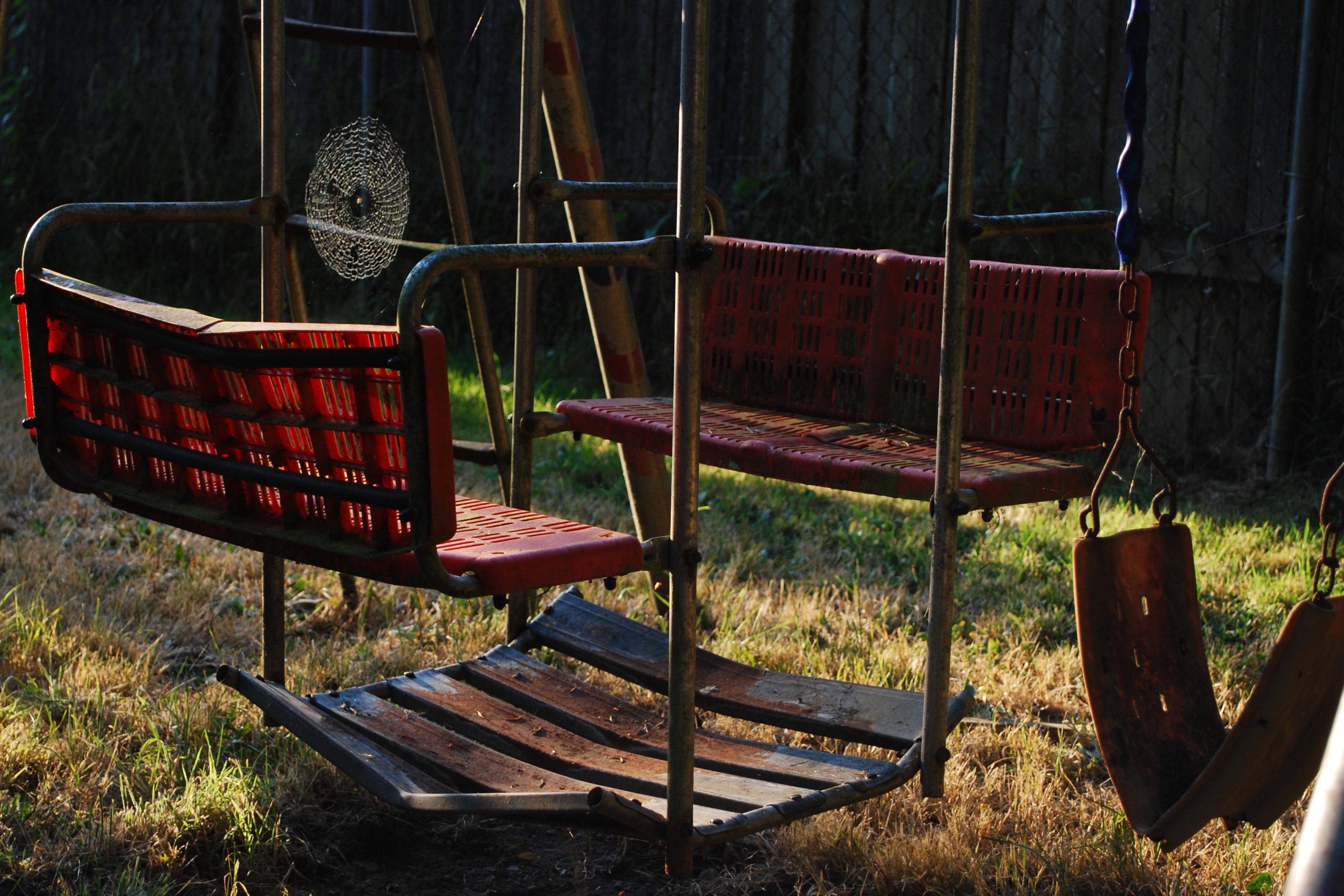
I can’t believe it’s been five years already, but it has.
A few years ago I had occasion to meet someone on a regular basis, daily, for several weeks.
We were both going through some hard times, each fighting off some pretty harsh demons, as it were, and as we sat there, over time, each going through our own battles, we became friends. Her name was Cecily, and as the days turned into weeks, our conversations deepened, and we talked about our families, and challenges, and the struggles we were facing and overcoming.
It turns out that our opportunities to meet each other daily ended about the same time, and we kept in touch for a long time afterwards. On rare occasions, we’d meet at a Jamba Juice on checkup days for all their healthy things and just catch up on life. It was neat doing that, meeting near a place that had both caused and absorbed so much of our pain, and not having to actually go there. We talked, and we laughed. I remember for awhile she talked about her sisters and how they were helping her get a bunch of firewood for the winter.
It was a good time, just chatting.
Sometimes, when we couldn’t actually get together, we’d call or email, and just chat and check up on each other, again, asking about the families and getting back to work, and just life…
And that was fun, too.
But one day I realized an email I’d sent hadn’t been answered in awhile…
And phone calls were going to voice mail.
I left message after message, and got no answer on her office phone.
And then that stopped, too.
Over the course of several months, I tried and tried, and finally decided to simply call her main office number and get the main switchboard there, to see if I could find out why she wasn’t answering her phone. I talked to a very nice receptionist who clearly had very little history with the company, and I asked for Cecily.
She checked, and I heard my heart beating louder in my ears as she said, “I’m sorry, there’s no one here by that name…”
But I wasn’t going to give up, so I tried her cell phone…
And kept trying.
And trying…
And trying…
Then they stopped going to voice mail even on the cell phone, and went to the dreaded recording of “The number you have called has been disconnected or is no longer in service…”
I did the thing I didn’t want to do, facing what was becoming a reality, and found out why she wasn’t answering her phone or email anymore in the last section of the paper I wanted to find her in.
Cecily, my friend, my pal, my radiation buddy, as she called me, was gone.
I found her mom’s number – it took a bit – and I talked to her for a long time. We talked about her daughter, and we talked about my friend, and it turns out that Cecily’s mom knew all about me. Cecily had talked to her mom about her friends, and I was, and am, very honored to have been one of them.
So Cecily – It’s been five years, but I still think of you, that smile, that laugh, that indomitable spirit. I’m glad to have gotten a chance to know you, and I raised a glass at Jamba Juice in your memory.
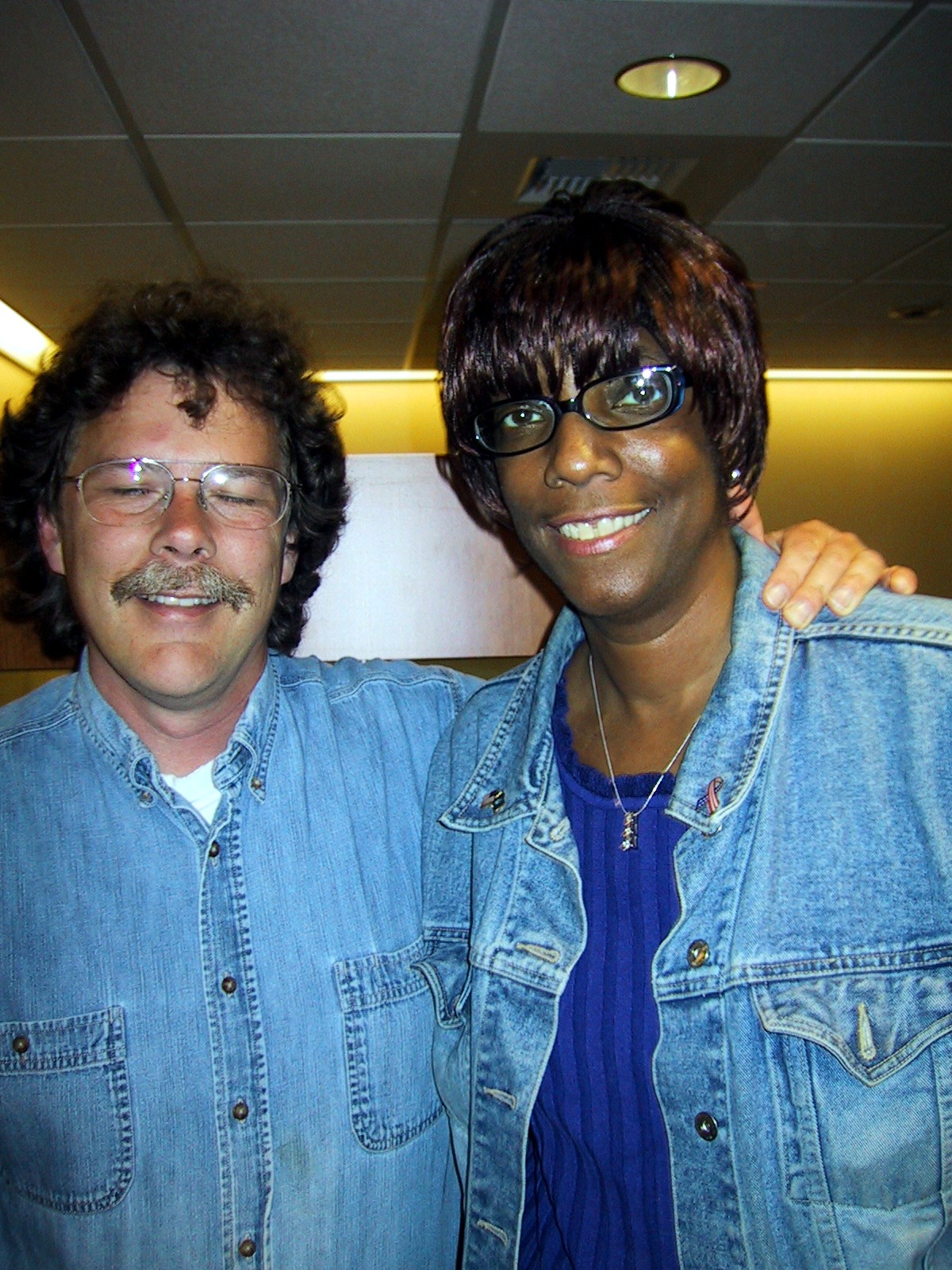
My friend Cecily and me, with one of my trademarked blinks…
God bless…
I went for a walk with a friend the other day, and on a whim, wandered down toward Pongo’s house.
And, to explain the significance of that – I have to go back a few years for most of you…
If any of you remember high school, you know how it could be a tangled up knot of stress, from the academics, which were hard enough, to the social aspect, where everyone was trying to figure out where they fit in the overall pecking order, to the after school stuff, where you often found out where you stood by being on the receiving end of some of that pecking.
I remember when I was in high school, the first thing I wanted to do when I got home was to pet my dog, and play with him, and scritch him behind his ears, and I could just feel that knotted ball of stress from school slowly unwind. It was amazing how beneficial having a dog could be right after school like that, and although we didn’t have a dog when our son was growing up years later, he found one anyway, right when and where he needed one.
And the dog he found had started out life as the runt of the litter in a cardboard box of puppies, being given away in front of a Safeway store in Bremerton, Washington. Pongo was suspected of being a mix of something Australian, a bit of shepherd, a bit of Husky, and the rest was of indeterminate origins. However, to really narrow it down, anything short of DNA testing implied something much simpler. In spite of being the runt, in his youth, Pongo was half husky, half stegosaurus. He was, as all good dogs are, the best friend of his boy, a young lad who had grown up, just like Pongo did, and unlike Pongo, eventually moved away from home.
Pongo ended up living with the boy’s dad, Jack, and the two of them grew old together over the years. It was in Jack’s front yard that you could find Pongo every day, holding down his patch of sod. And it was there that the most reliable form of therapy for any human was lovingly waiting, every day, when our son walked by coming home from school. And every day, Pongo did something no human could possibly do, which by now, thanks to Bill Watterson, had a name:
Pongo offered up Fuzz Therapy.

Once Pongo was let off his leash, he laid down in full expectation of some good-ole behind the ears scritching
And he did it with love.
He didn’t chase sticks anymore, nor did he chase Frisbees ® but he could definitely give some Fuzz Therapy.
A number of years after he graduated from High School, our son and I went back to the street where Pongo lived, and sure enough, he was still there, still holding down that one patch of sod he’d been holding down for so many years, and when he saw our son, Pongo’s tired eyes lit up at the sight of a long lost friend, and he struggled to his feet, a little bit at a time, and slowly ambled over to where he knew he’d get some petting and loving. And from what I saw in the next few minutes, it was obvious that Fuzz Therapy was a two way street.
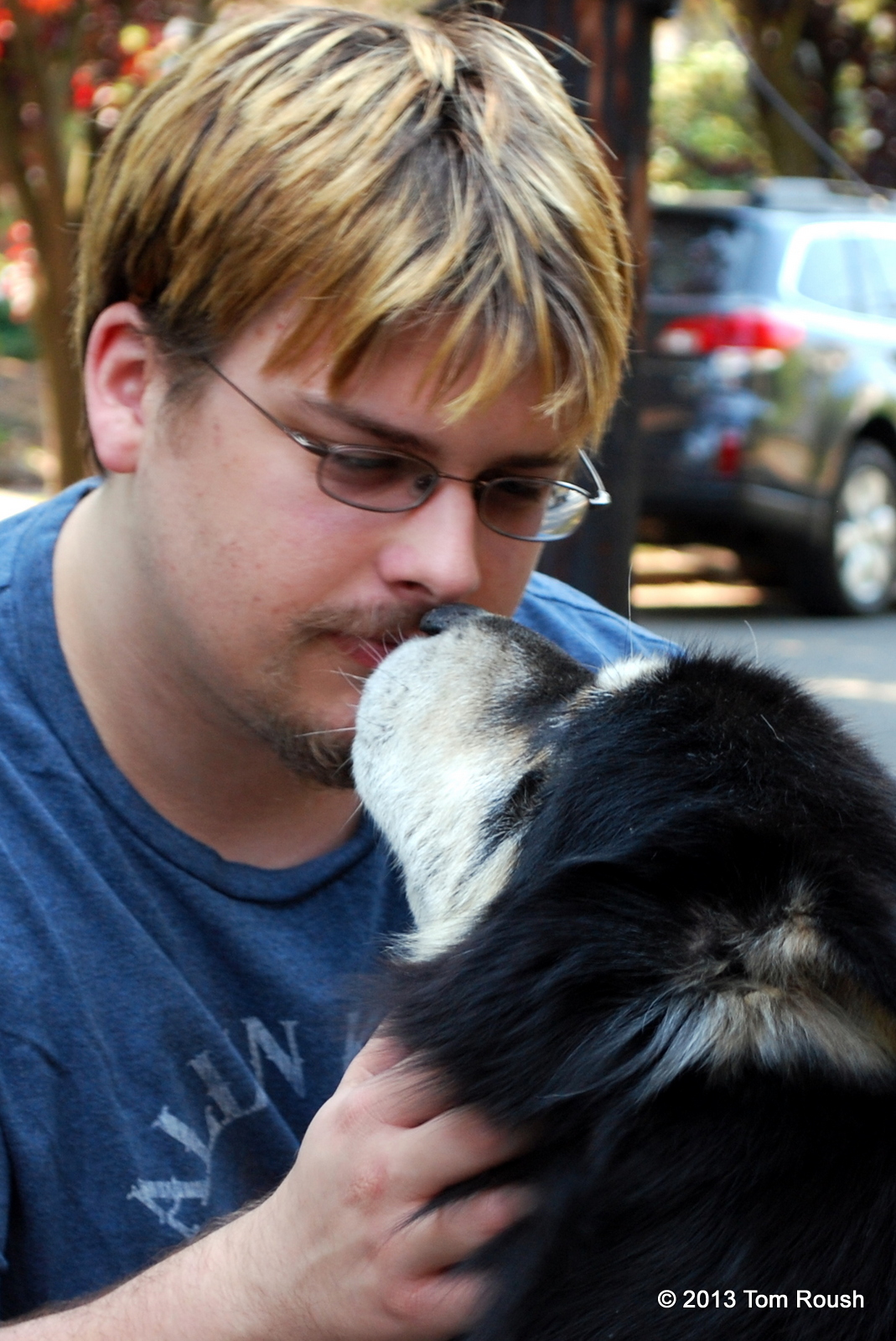
Pongo both getting – and giving – Fuzz Therapy
Jack said that Pongo’d been getting on in years, which was obvious, as well as being sick, which was not, so we were glad that we stopped by when we did. And our son, going through the stresses of being a young adult, trying to balance the risks and benefits of running his own business, figuring out backup plans for both the job market and the financial risks and benefits of college, was able to get some Fuzz Therapy one more time.
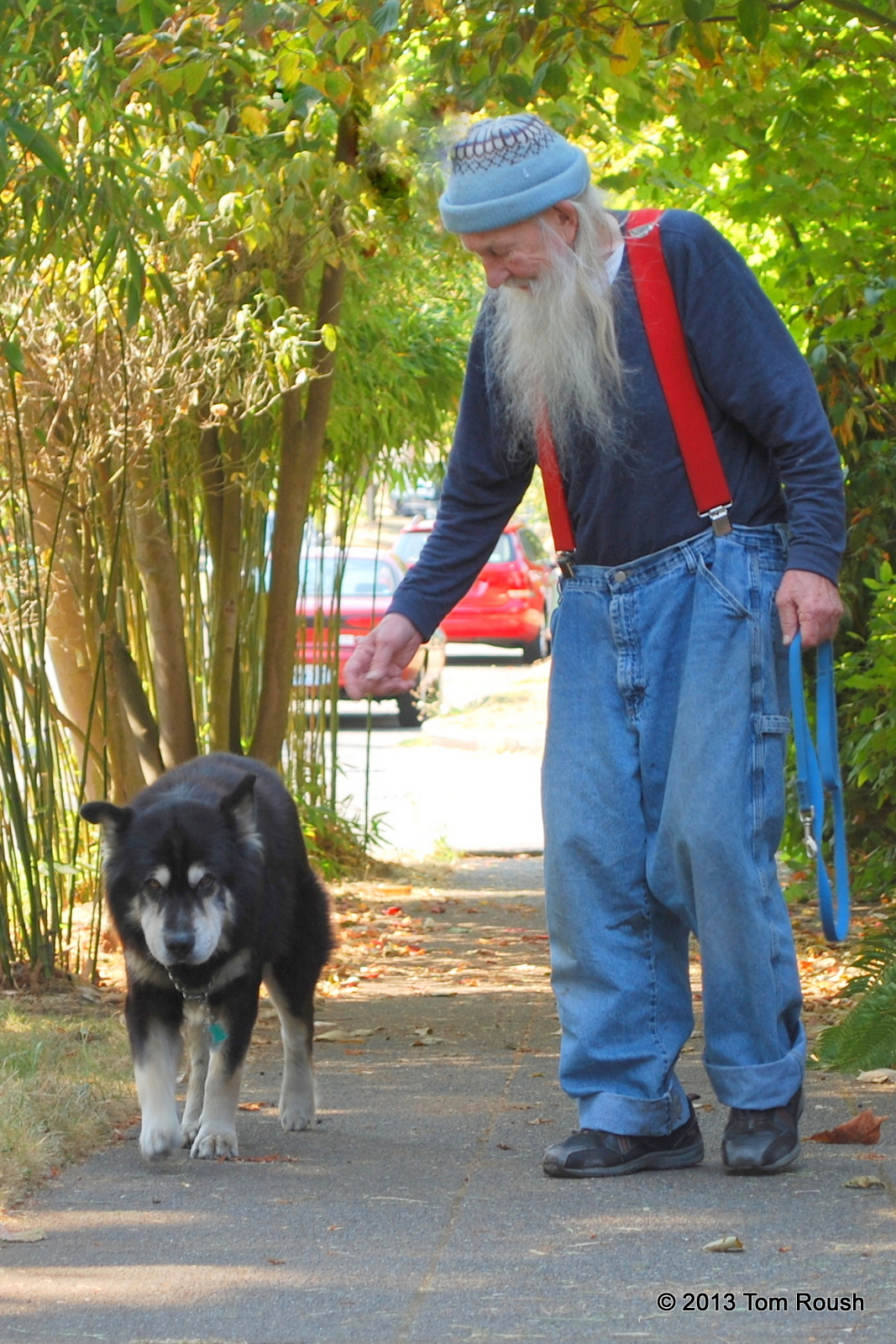
Jack taking Pongo for a short walk
Some months have gone by, and we’ve gone past Jack’s place several times since the visit in these pictures, but it has become clear that the last time we saw Pongo was the last time we would ever see Pongo…
So Pongo, my dear friend, the one who brought our son such happiness, such love, and such peace, wherever you are, I wish you an eternity blessed with a whole, healthy body, the ability to run and chase to your heart’s content, and may you get as much from the Fuzz Therapy as you gave.
===
(Pongo – as seen by the Google Street View camera in September of 2010)
At first Heidi didn’t know what she was part of that evening.
She refilled our glasses, she kept the food and drink coming, and then she did what all good waitresses do.
She left us alone.
We were sitting in a nondescript restaurant, the three of us, sharing stories, memories, and laughing ourselves silly.
The last time the three of us had been together was about 32 years earlier, and I got to pondering about the journeys we’d all not only taken, but survived to get to this table in this restaurant. What had brought us together was a funeral, the death of J.C. Masura…
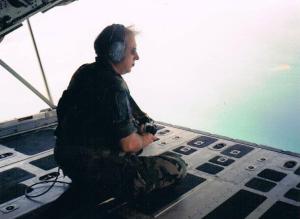
J.C. as we knew him, looking out the back of a C-130 high over somewhere. Photo copyright by and used with permission of the Masura Family.
…who’d been our commander many years earlier when we were all in the same Civil Air Patrol Squadron on what was then McChord Air Force Base. J.C. had been a loadmaster on C-130’s and C-141’s, back in the day, and up until recently had run an aviation maintenance facility at an airfield near his home.
Of the three of us there in that restaurant after the funeral and reception, there was Aaron.
He told a story of being up on Mount Rainier during his Civil Air Patrol days, trying to put his tent together and it being a tangle of poles and cloth. He told of J.C. coming over, and being relieved that he’d have help to solve this problem. J.C. did help. He said, “Son, if you don’t get this tent up, you’re gonna die. So you’d better figure it out.”
And Aaron did.
The most vivid memory I have of Aaron was when we were trying to ram him through the bushes (<–story) on one of our searches. This evening, however, he was sitting across the table from me, in a uniform that spoke of honor, valor and courage. A uniform that spoke of someone who no longer needed to be pushed through bushes, but led people through walls.
As we sat there, reminiscing, and as Heidi kept our water glasses and plates full, Aaron told stories that had us laughing, and shaking our heads in amazement.
He told of coming back from one of many missions to a country in the Middle East, ‘the sandbox’, exhausted to the core, and climbing onto a ubiquitous, anonymous Air Force cargo plane that was to take him home, only to find himself being welcomed onto the plane by a loadmaster with the familiar name of Masura stitched to his uniform. It seems J.C’s oldest son (we knew him as Jimmy) had followed in his father’s footsteps, and was now a loadmaster himself, with enough stripes on his arm to put the fear of God into even the highest ranking officer.
Aaron, the highly decorated soldier, slept most of the flight home, watched over not by a stranger, but by a friend.
Heidi came by about then to refill our glasses, and it was obvious to her that she was seeing, and was part of, something very special. It was obvious we hadn’t seen each other in a long time. Typical of such reunions, she said, was folks from college getting back together. She was amazed to hear that we hadn’t seen each other since high school, and even more amazed that we’d gotten together at all.
Then there was Bill, who I’d been able to keep in touch with a little more. I have many memories of Bill, some of which have actually been written down. One of those involved our Civil Air Patrol Squadron, a regional Drill competition (<–story) in Oregon, and the memories of the looks on people’s faces when they saw us beating them at their own game.
Bill was dressed in a suit jacket and tie for the funeral, had become a world traveler, working as a biologist and traveling to every continent on the planet, and some places that don’t come remotely close to being continents. Bill told a story about going back to Antarctica, where before they could study the penguins, and the wildlife, one of the first orders of business was getting things habitable, and during that time it was discovered that the ‘facilities’ had been buried in 7 feet of snow since they were last there. By the time they got everything dug out and opened up for use, they discovered several inches of frost on the toilet seat.
No. Really.

It was chilly. (photo copyright and courtesy of William Meyer)
We laughed about the “when I was your age” stories that would grow into: “When I was your age, we didn’t have these fancy things called toilets, we had to dig through 7 feet of snow just to get to a seat with a hole in it. And it had FROST on it. And we had to melt that off ourselves…”
“With our Butts.”
Yeah, I can see that…
We’d get post cards from Bill every now and then, telling of his adventures in warmer climates, too. He told one story – and it wasn’t even a story, but just a vignette, of writing one of his post cards, in this case to his sister, sitting under a tree somewhere in Africa, and writing it by candle light, because it was all he had. When a scorpion crawled across the postcard as he was writing it, looking for bugs that might have been attracted by the candle, he decided it was time to call it a night.
Heidi came back and checked on us, and the stories continued.
I’d had some of my own adventures – some of which I’ve written about, some not, and we marveled, literally, not just about the various journeys we’d gone on to get to this table, in this restaurant, but the fact that we’d survived them all. Even though we were there for hours, each one of us had stories that there wasn’t time to share that evening, and each one of us had stories of adventure and danger, as well as growth and promise that we realized would have to wait for another day.
We pondered that, and found ourselves all taking a collective breath. As we did, we realized the restaurant had grown quiet. There was no conversation, no bustling of waiters. In fact, the only sounds we heard were those of clinking dishes as the staff cleaned up the restaurant, which had closed around us.
We were the last customers in the place, and the doors were locked.
Heidi, bless her, came by one last time, and let us out…
…and stood in the parking lot for another half hour, talking and shivering in the dark, but vowing that we would get together again without someone having to die in order for it to happen.
There were friends who were not able to make it this time, and friends who would not make it, ever.
And it got me thinking…
Why do we wait so long?
One person asked me, “Why is it we wait till we have nothing but weddings and funerals to get together?”
Why do we often just get stuck in our little ruts and miss out on some of the cool stuff of life, like sharing stories and laughing, and – why does it take something *more* special than just getting together to get us to get together? (yeah, I read that a couple of times myself too before I let it go, but it works…)
I mean – the three of us hadn’t been together in over 3 decades.

Me surrounded by two world travelers, Bill on the left, and Aaron on the right.
Not a week later I had occasion to go to a friend’s birthday party. I was fighting off a bug and wasn’t feeling too well yet, but for heaven’s sake, it had been years since I’d seen him, so I went. He’d hit the big 5 decade mark, and wondered the same thing… why do we get stuck in our little ruts?
I know the answer to this – and there’s a story in it, which I’ll tell later, but in a nutshell, it’s because it takes more energy to get out of a rut than it does to fall into one.
Sometimes that energy comes because you see patterns and realize if you don’t change something, the pattern is pretty predictable. Sometimes the energy comes in the adrenaline fueled by the sudden, tragic realization that nothing lasts forever, and everything, everything comes to an end, whether we want to believe it or not.
So – and I’m realizing I’ve been ending a lot of stories with this theme: Make sure you let the ones you love know that while you can.
Hug your husband/wife.
Hug your kids.
Hug your parents. Even if it’s a verbal hug, with a phone call, card, or email.
Just do it.
A friend wrote recently that he’d found out another friend had passed away, and somehow 10 years had slipped by since they’d talked. You never know when your last words with someone will indeed be your last words with someone.
Sometimes a telephone call will reopen doors to old friendships. Sometimes you’ll find those doors have closed and it’s time to move on. That might hurt, but regardless the door’s position, at least you’ll know, and you’ll be able to open or close it yourself. And you’ll actually have a chance to know what those last words with someone will be. Make sure they’re good ones.
In the end, what changed is that I did just that.
I picked up the phone and checked up on some old friends and kept in touch with them more. I found some doors opened wide again, and found some doors closed – I write all this from experience, both joyful and painful.
And I tried, as best I could, when I saw that one of those doors had closed, to make my last words good ones.
So take care of yourselves. This is the one time we have through this life.
Take care of each other, too. You never know when you’ll need each other.
Oh, and if you happen to meet a waitress named Heidi, working at the Outback Steakhouse in Puyallup, Washington, who keeps your glasses full and allows you to enjoy your reunion time with your friends, give her a good tip.
She deserves it.
===
Footnotes:
It’s been a year since the events in this story unfolded, and it took this long to think them through, get some perspective, apply some of the lessons I learned, and be ready to share them with you. That might make a little more sense now that you’ve read it.
Aaron is still in the Army – he invited us to help celebrate his promotion recently, and we shared more stories, more laughs. We kept the promise to get together more often, and made more promises to do it again.
Bill and I got together the day after my birthday last year along with another friend, Mark, and have kept in touch more. He’s doing a little less exploring, but still doesn’t have a “desk” job. He couldn’t make it to the promotion party because he was strapped into a small airplane, flying around the hinterlands of the country in an airplane, counting Elk.
Jimmy’s still in the Air Force, I saw him at Aaron’s celebration, and they got along like the old friends they are, not with the stuffy formality you might expect of an officer and an enlisted man. It was fun to see that.
J.C.’s wife – well – widow – hard to write that, but it’s true – is doing all the things you do when you’ve lost a loved one. That first year, I can tell you from experience, is a hard one. I’ve kept in touch with them as I could over the last 12 months, not as much as I’d like, but far more than the previous 30 years or so.
And as time, and the years, go on, I’m realizing more and more that the things that are valuable to me are less and less the things that gather dust, or rust, or whatever. They’re the relationships I treasure with friends old and new.
Now go out there, and find some treasure. (and then come back and share what you found, you might help other people get out of their ruts with your stories.)
Take care,
Tom

 Tom Roush's Blog