
You are currently browsing the tag archive for the ‘Lessons’ tag.
Before I started the blog, (under duress, I might add), I was writing stories just the same. There’s been so much that happened in the last few weeks that has just knocked my socks off, and some stories will come out of all that, but they need to simmer for a bit. As part of that, I’ve been trying to do some cleaning, and, as it turns out, in my cleaning out some digital lint, I found a story I’d written almost 9 years ago. That said, I’ve taken another look at it and decided it might be fun to get it out here for you all to see. With that, let’s go on a road trip, shall we?
Work had been getting busier and busier, and I was really wiped.
I’d had to get about a week’s worth of work done in the first 3 days of the week, and needed a break.
Turns out my friend Dave had an Improv Comedy thing in Portland Friday night.
Michael had Friday off.
Hmmm.
It didn’t take me a whole lot of time to figure out that getting our collective butts out of Dodge would be a good thing.
I got Friday off.
We had originally planned on Cindy coming along for this, but she had to work, so Michael and I went by ourselves.
We’d taken the Saab up to “Andy’s Cabin” last week, (it’s a wide spot in one of the forest service roads just off Highway 97 near Liberty, Washington. Used to have a cabin on it, belonged to a guy from the Scout Troop named Andy. Andy’s long passed on, and the cabin burned down decades ago, but it’s still called “Andy’s Cabin” – yeah, go figure. But tradition is tradition.) …and honestly, I needed something a little different than the Saab for this trip. I needed something for me. Not that I didn’t trust the Saab. It ran beautifully, got 32 mpg on the trip. I just didn’t have the time to risk if something went wrong, so I decided to rent a car and got a pretty decent rate on a little red ford sedan. We caught a bus up to Hertz and Michael was kind of amazed that we were simply walking out of the house to go out of state overnight with nothing but a duffel bag.
Oh, I’d given him my old leather jacket, and he found the hat he had in the play “Barnum” last year – that, some Jeans, and some sunglasses just made the outfit.
He was working on his “Cool” persona.

The “Cool” Persona
Once we got the car, as you can see, it was awfully hard to get Michael to actually ride in the thing.

Yeah, it was hard to get him to ride in the car.
Last time we did a road trip, we went to California, and Michael ended up listening to “Walk Like an Egyptian” about a zillion times on not only the way down, but back. It became, we realized later, the ‘theme song’ if you will, of that trip.
We’d made some progress down toward Roy (the plan was to stop in Roy, Hook Mom’s new computer monitor up and visit with her and our friends Lee and Lyndy a little bit and then head down toward Portland.
As we drove down Michael, with the hat and glasses, felt he looked like a movie talent scout. We were listening to one of the CD’s – and came upon the theme song from the Davy Crockett show… Remember that one?
“Born on a mountain top in Tennessee
Greenest state in the land of the free
Raised in the woods so’s he knew every tree,
Kilt him a bar, when he was only three!
(all together now)
Daveyyyyy, Daaaaaaaavey Crockett, King of the Wild Frontier!”
I’m singing this thing at the top of my lungs, and Michael’s not buying it. I’m
getting way too weird for him. He’s used to me in my “responsible father” mode
as opposed to getting a little weird mode…
So… I invited him to sing along.
He didn’t want to.
I invited him again…
He emphatically didn’t want to.
I told him I’d keep playing it until he sang along and had fun doing it.
He made it quite clear that singing that song was not anywhere near the top
of his list of priorities.

Yup, just like peas and lima beans
I felt like I was watching a kid being told to eat peas for dinner.
Eventually, he did sing along. It was fun.
So we did that, got down to mom’s, and she’d made chicken and dumplings, they were SO good. Michael, as usual, needed to put some pepper on his stuff. The lid of the pepper shaker was a little loose, and he ended up with a little more than he was planning on.

Really, he likes pepper. Just not this much.
I hooked mom’s new monitor up and put her old desktop on it – it was nice to see that again (it’s the picture of Paddington Station that Corbis has, from the Windows 98 plus pack, with the travel theme.) –
It was the first thing we kind of ‘got back’ since her car was stolen. (so was the computer in it, but that’s another story)…
After lunch, Mom and Michael and Lyndy went out to feed the horses, and tried to get Michael to feed them, too. He kept pulling his hand away as soon as he felt their lips trying to nibble at the apple. You can see Lyndy holding his hand here in the first picture,

Lyndy, Michael, Mom, and apples
…trying to keep it there for the horse. Problem was, he kept seeing those big teeth and thought he was going to get bitten.

The horses, after nibbling on apples
He actually had good reason to think that.
Some time back we were walking through a field on the way back from Grandma Danny’s and there was this horse that first looked like it was being friendly, then it tried to take a bite out of Michael’s hat (actually the one in the picture), and then it nudged him pretty good. It became obvious the horse wasn’t nibbling in a friendly way, so I told Michael to go get through the fence while I took care of the horse.
The horse tried to nibble on me, so I smacked the crap out of it every time it did, and got to the gate as fast as I could, just barely making it over before I got the butt of my jeans ripped out by the dang thing. At first I thought I was imagining things, but then later realized, while I was looking at one of the 4 x 4 fenceposts that was barely holding up the gate I’d climbed over and that the horse was on the other side of, that I wasn’t imagining anything.
The fencepost looked like an apple core – the horse had eaten it all off.
It was very, very strange.
Then I looked a little closer still and realized the fencepost the horse had been nibbling on was pressure treated lumber. I don’t know what all chemicals they put in pressure treated lumber, but I do remember them being rather poisonous, so I can’t imagine it did good things for the horse, and I think the horse was a little crazy from it. So that’s why Michael wasn’t all that interested in horses nibbling anywhere near him.
He ended up feeding one of the horses one apple, and that was enough. But by that time, it was time to go, so I had Michael get in the car.

Michael decided he wanted the left seat.
As you can see, it was again, awfully difficult getting him to get ready to leave.
We waved goodbye to Mom and Lyndy, who waved back, thanked them both for a delicious meal…

One last wave to Mom & Lyndy, then we were off
…and we hit the gas, cranked up the tunes, and off we went.
Oh, the tunes…
We thought about all the times we’d seen, rather, heard people with stereos thumping wondering what the heck they were listening to. We waited till we were well away from civilization before cranking it up too loud, and when we did, we realized that we might be hurting our ears a bit. So, um, we put earplugs in.
And turned it up more.
So imagine two guys in a red Mustang, blasting down the freeway, with earplugs in, windows down, and the music blasting so loud you could feel it.
Now imagine them doing it to this song.
Yup… Michael and me.
We could not only hear the music, but feel it! It was great.
I have no idea how many times we listened to it, and how many times we just played it again and again and again – with no breaks, but we never got tired of it.
And the music we were listening to? “Under the Sea” (if you didn’t click on the link above, we had a Disney CD with us)
Here Michael’s shucking and jiving to…
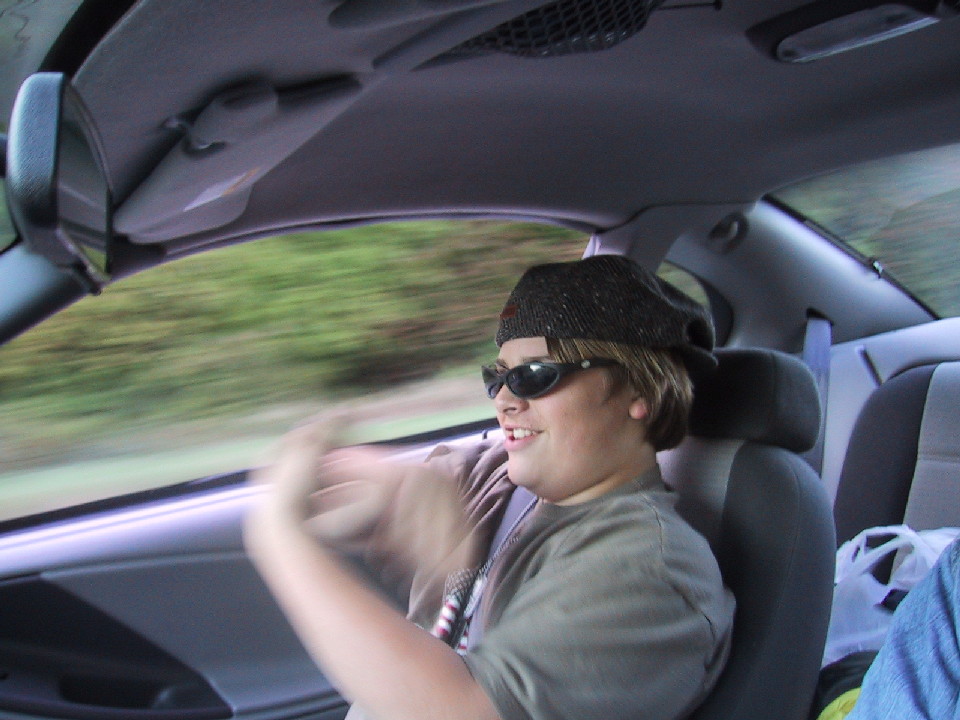
Each Little Clam here…
“Each little clam here
Know how to jam here
Each little slug here
Cutting a rug here
Each little snail here
Know how to wail here
That’s why it’s hotter
Under the water
… and so on…
After several hours of driving, (and listening to the song, over and over and over) we got there, with just enough time to get a place to stay almost within spitting distance (across the parking lot) from the church it was at. The improv was part of a conference in Drama in the Ministry. It was very eye opening, how sometimes telling a 5 minute story, a parable, if you will, can hit home a lot harder than a one hour sermon.
It was a wonderful experience.
After that was the improv, which the pictures I took simply don’t do justice to.
There was a party game, in which people had to be some sort of church member, and also have a strange personality trait.
Some of them:
- The sound man, who’s deaf.
- A youth pastor who loved to dance,
- A kleptomaniac pastor’s wife, and so on.
Then there was the Alphabet game, where you were given two characters (mother/daughter, etc…) in a situation – and they had to start the first sentence with a letter picked out by members of the audience, then each subsequent sentence with the next letter. That ended up being a lot of fun. One of the most challenging ones was with one character being a mortician and the other being his prospective client.
Then there was the game that every sentence had to be a question – or maybe they combined the two. It was just a lot of laughter that made for a lot, a lot of fun.
The one that was literally the killer was when they played “chain murder” – kind
of like clue where you try to solve a murder, but with a couple of twists:
- There are 4 people.
- Three of them leave, the last one is told, by the audience, the who/where/what of the murder.
- The other players enter the room, one at a time, and the first person tries to get them to figure it out.
- With pantomime, and gibberish. No words.
As an example, the first one ended up being
A Fireman,
In a Broom closet,
With the little things you stick into the end of an ear of corn to hold it because it’s too hot.
One person brought the house down on that one as the person was pantomiming the fireman and the broom closet. He’d guessed, “A fireman… at the Gates of Mordor?”
The second one was:
The Good Humor man,
In the belly of a whale,
With a waffle iron.
They got worse from there.
When it was over, Michael and I kidnapped Dave, but he had to be the navigator and tell us where we were kidnapping him to since we only had directions to the church and the hotel right next door. It ended up being a Shari’s Restaurant, where we tried really hard to order something.
However, we soon realized that at 11:00 at night, we were actually more in the mood for breakfast than anything else, so we tried to order, and somehow “scrambled toast” came out. We first confused the waiter so much that he ended up bringing Dave an extra hot cocoa –
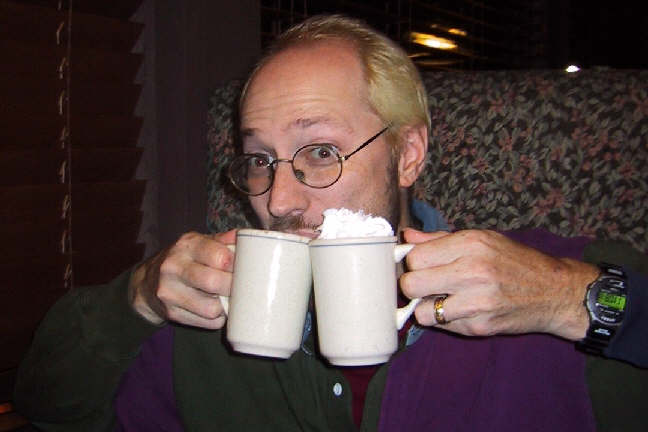
Our goofing off got David an extra hot chocolate
which ended up being part of many jokes. Then the waiter got into the “scrambled toast” bit and we just went off, kind of like the “Four Yorkshiremen” sketch, complete with British accents and everything…
“Oh, I remember having scrambled toast when I was a boy…
“Too bad they don’t make the toast scramblers anymore”
“Yeah, that’s a shame… They stopped making them in the ’40’s, you know, had to take the factories and change them over to making machine guns for the war effort.”
— and it went on…
Ration cards,
Grampa remembering when they had to scramble toast by hand.
Which led to “When I was a boy…” stories, like…
Walking to school in the winter…
…in 10 feet of snow…
Up Hill…
Both ways…
I had to staple barbed wire to my feet to get traction…
to which David countered, “You were lucky, I had to use railroad spikes!”
Michael could hardly keep his food down he was laughing so hard. Come to think of it, we were, too.
We finally realized we needed to call it a night, and as we’re heading out, I realized I wanted to take one picture of David and Michael, so I asked them to pose in front of the Shari’s sign.
They posed.
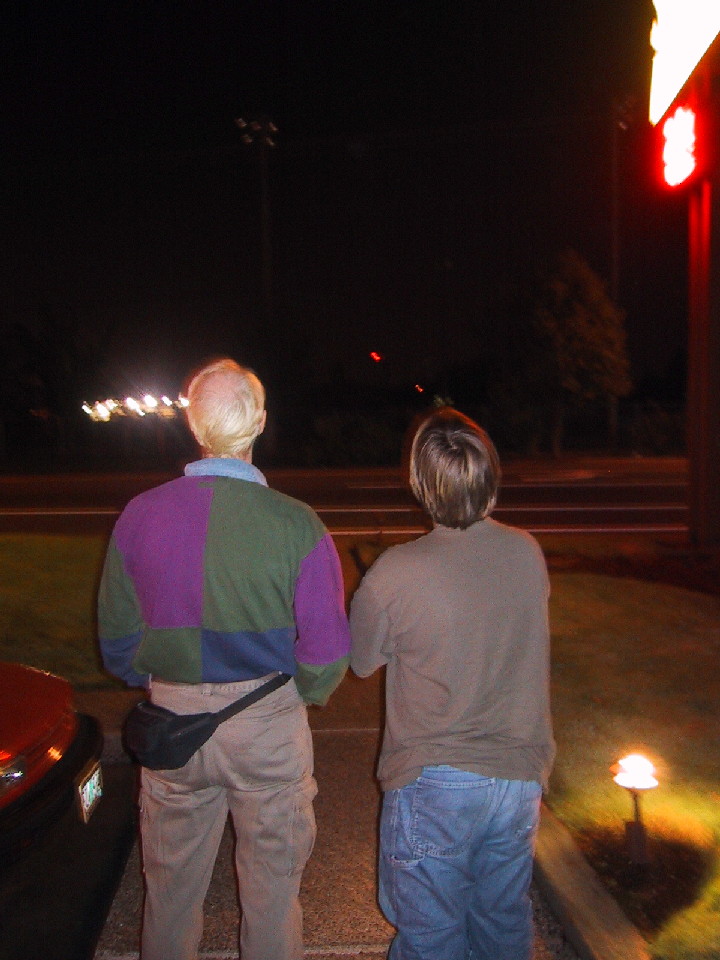
David and Michael posing for the picture
I suggested that maybe, just MAYBE, it might be better if we were to get their faces into the picture… Right about that time we were trying to figure out what we’d had, since it wasn’t Breakfast, nor was it Lunch, and it most certainly wasn’t dinner. We decided it was “Brupper” – and here we have Michael and David, Brupping in front of the Shari’s restaurant.

Michael and David, Brupping
We went back, and got David to his car and headed home. Michael and I totally crashed and slept the sleep of the dead — and the next morning managed to drag our butts out of bed, and got out of our room around 11:00 and had to tear out of there (Portland) in time to get to Michael’s soccer game (in Seattle) at 1:00. (I thought the game was at 1:30). Needless to say, the trip was a fast one for me, and a semi-conscious one for Michael.

Michael, holding down the passenger’s seat.
A little different than the trip down, but it worked.
We made it to the soccer game, lost, Michael messed around with some of the other kids after the game for a bit,
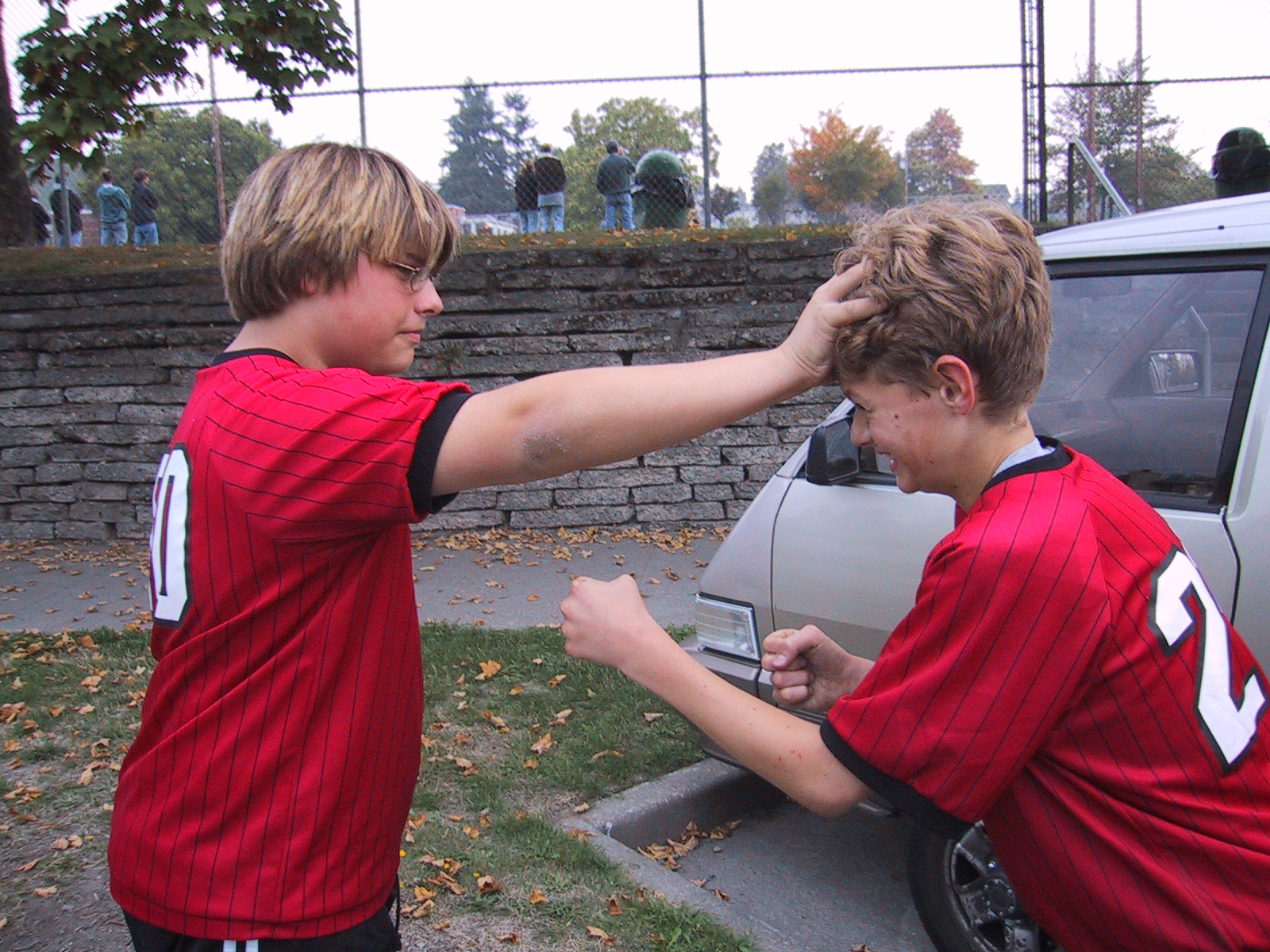
Michael showing Brian that He Who Has The Longest Arms wins.
…then we took the car up to the rental place, where we cleaned it out, dropped it off, and ran to the bus stop, just in time to have the bus meet us as it pulled out.
We rode the bus home, and since we’d been listening to “Under the Sea” so much, Michael wondered if we had the video. He found it, we did, and he wanted to watch it, and sing with it as the movie played. We both started, and got a few bars into it and then both of us just let it go. Neither one of us remembered anything from those few bars until Ariel has legs (about 40 minutes later, I think.)
All in all, it was a fast, short, weekend (actually, now that I think about it, it was less than 24 hours total), but well, well worth it.
October 3-4, 2003
I don’t know if there’s a moral to the story, other than “Spend time, enjoy the time you have with your kids while you have them, it goes by so quickly.”
Seriously – take the risk and do something weird with them.
Make memories with them.
Hug them.
Sing silly songs with them.
Laugh with them.
Above all else, love them.
I’ve been struggling to write a story for Christmas this year, and it hasn’t worked at all…
The story I’ve been working on just hasn’t come together, and I’m getting the feeling, that just like some stories have to be published at a certain time (hard to explain, but it’s true – some stories have this urgency as I’m writing them that just can’t be ignored, and later, in either comments, feedback, or just people talking to me, I often find out how important it was to get a story out at a certain time.
The story I was working on, however, is giving me the other impression. It isn’t ready, and needs to wait until it is ready, and I don’t know when that will be. On the other hand, another story showed up just this last weekend, and I think that one might have peeked out of the shadows just in time. As I write this now, I don’t know how it will end, so join me in that discovery.
I’m thinking, over the years, as I see what has happened around not just “the holidays” – but Christmas, that people (myself included) often have such high hopes and expectations of Christmas that it can’t possibly live up to those expectations, and that we end up being sad, or depressed because of that…
I was thinking about it, and realized that we often try to replicate the good parts of the Christmases we had in our childhoods, and sometimes, in those memories, forget the bad stuff that happened that made the good stuff stand out. Often we find ourselves wanting “something” – but not being sure what exactly it is.
We often do what Madison Avenue wants us to do – which is to “Stimulate the Economy” – but that just causes problems in other ways.
Where am I going with this? – Well, stay with me for a bit, we’ll find out together.
I found myself thinking of Christmas trees… I’ll tell you about three of them that I remember having. Two as a kid, one as an adult.
When I was a kid, we were poor. There’s no other way to say it. My dad was off at college trying to get a degree so he could help make life better for us. He could only come home on the weekends if he came home at all. There were several years when the money was so tight that we couldn’t even afford a tree at Christmas, much less presents to put under it. In fact, one year, we got the tree the church had used and set it up on Christmas Eve. I don’t know if many people have had a used Christmas tree, but we did.
Ironically, we didn’t think it was weird at the time, we thought it was kind of neat that at the last second, everything fell into place, and we got a tree, for free.
It was during those years that I had a paper route, earning me about $40.00 a month.
One year, we were praying for both Christmas presents and a tree, and while mom made Christmas presents, God answered the prayer. One Saturday morning as I was on my bicycle finishing my paper route, I saw a Christmas tree laying in the ditch beside the road.
I couldn’t believe my eyes, but there it was. I delivered the last few papers, and came pedaling back as fast as I could, where I picked the tree up and put it on my left shoulder with the butt facing forward so I could steer and shift the bike with my right hand. I could see through the branches, but if someone were driving by (and several people did) they’d see a rather large Christmas tree riding a bicycle, rather unsteadily, I might add, down the street.
No one crashed, including me, which was good – and we were again blessed with a Christmas tree that year.
One that we couldn’t have afforded otherwise.
The thing I realize now is that we didn’t even have a Christmas tree stand. Over the years, Dad, being home from University over Christmas, would make a tree stand with me out of 4 boards that we’d nail or screw together, then to the tree, with notches at the bottom so there’d be enough room for a pie tin of water underneath.
If we’d had a tree stand like everyone else, I wouldn’t have this memory.
The next year, finances were still pretty rough, and we were still just scraping by. At the time, we had a large garden, and were very familiar with what passed for food banks back then. We didn’t drink soda, couldn’t afford it, but we did drink apple cider we made from all the apple trees we had on the property.
Hmmm… if we’d been able to drink soda like everyone else, I wouldn’t have that memory.
I’ll write about that someday, but that December, even with all the things we’d done to save money, a tree was still not in the budget.
I think that might have been my last year with the paper route, and I was looking for a tree beside the road like we’d had that one year, but there were none.
In fact, it’s safe to say, that in that year, God did not have Christmas trees falling out of the sky for us.
Well, actually… I take that back.
He did.
A tree did fall out of the sky, but it was in kit form.
And actually, it wasn’t a ‘tree” per se…
It was a branch.
No, really.
It was a huge branch from a tree on Fort Lewis – on one of those side roads that’s made by an 18 year old kid driving a 60 ton tank at 35 miles per hour and leaving a trail of wanton destruction in his wake. (Yes, there were kids that age out there doing that. They were, however, in the Army when they did it.)
I don’t remember exactly how I got it home, but I did. The huge branch was far too long to get into a tree stand without gouging holes in the ceiling or chopping holes into the floor, so I got out one of my dad’s old saws and whacked off a good chunk of it so that it would fit. (That cut-off part unwittingly became our Yule Log) I then started cutting branches off and drilling holes into the trunk where I wanted to put them. I whittled them so they’d fit into the holes I’d drilled and ended up moving almost every branch that way.
Then I made the stand for it like I did every year.
And we did have a Christmas tree that year. It was beautiful, really. Complete with decorations, and even some presents.
If I’d been able to buy a tree like everyone else, I wouldn’t have this memory. I’d have forgotten about an anonymous little tree in one of many Christmases a long time ago.
That got me thinking.
Those weren’t easy times that I’m writing about. Seriously. But it feels like it was those parts that made me grow in ways I couldn’t have grown if life had been as easy as I wanted it to be.
Many years later, I’d grown up, become an adult, and was now in the position of trying to support my family, and for a number of years, life was pretty rough, and I got to thinking about where every penny was going, and spending any more money than I had to on a Christmas tree was just impossible to comprehend, and for years we bought our trees at a now defunct store called “Chubby and Tubby’s”.
If you’ve lived in Seattle for any length of time, you’ll remember that Chubby and Tubby trees could be had for $4.61 ($5.00 with tax). Oh you could get nicer trees, for more money, but we bought the trees we could afford, (here’s one of them, picked out by our then two year old Michael, his mittens dangling from his sleeves).
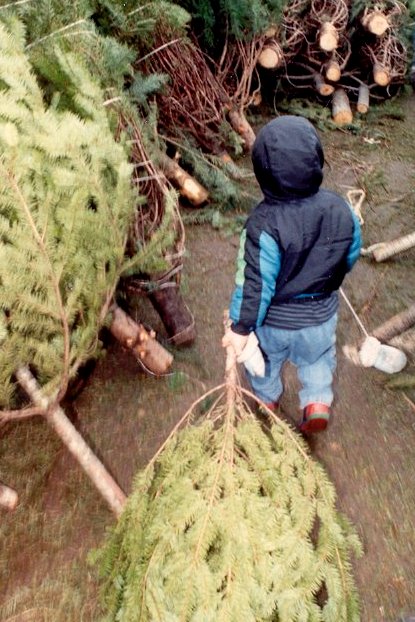
One of our Very special trees.
And for a number of years, I made a Christmas tree stand like I did when I was a kid, and I drilled holes in the trunk and moved branches around so they’d look nice, just like I did when I was a kid.
Only this time I was doing it with my son, not with my dad.
I did some more thinking – because we’ve been able to have some pretty neat Christmases over the years in spite of things. There was the year we were able to make it to church Christmas Eve. That might seem “normal”, but I’d just gone through my 4th and last round of chemo, and we had to leave right afterwards – but we made it.
That was cool.
And over the years we’ve found that Christmas comes every year, whether you’re ready for it or not.
And it’s a mixed bag, isn’t it?
Sometimes life happens to be good and you can have a “good” Christmas. That’s a blessing to cherish.
But sometimes – and you can probably figure that I could tell you stories about this: Life is just life, and it isn’t as kind and gentle as we’d hope, or as we might remember. Without going into great detail, a number of people I know are at this moment going through some of the worst challenges a human can go through, the loss of a parent, a sibling, a child, the loss of a marriage, or relationship, and they’re still trying to celebrate Christmas, and trying to figure out how and why they even can, through all the struggles. They’re looking in vain for that blessing.
And after awhile, being pulled in all sorts of directions, it’s easy to lose sight of what Christmas is all about.
I don’t have answers to why this kind of stuff seems to happen more at Christmas, but amidst the turmoil we’re all experiencing, whether it’s spiritual, or health, or relationships, or economy, I’ve come to the conclusion that we crave the opposite of that turmoil, especially at this time of year. It’s one thing: Peace.
A friend who’s experienced his share of turmoil (he’s a medic) noted, “Perhaps that’s why people wish others “Peace” during this season. That doesn’t just mean “absence of war” but inner peace. I wish you both senses of the word.”
His comment about both kinds of Peace got me to thinking of the original words about Peace in this Season, and while you can read the words here, we heard one of the great philosophers of our time do a pretty good job explaining it to his depressed friend, who was also pretty confused about what Christmas was really all about.
In a crystal clear voice he said to him, and to all who would listen,
“And there were in the same country shepherds, abiding in the field, keeping watch over their flock by night. And, lo, the angel of the Lord came upon them, and the glory of the Lord shone round about them! And they were sore afraid … And the angel said unto them, “Fear not! For, behold, I bring you tidings of great joy, which shall be to all my people. For unto you is born this day in the city of David a Saviour, which is Christ, the Lord.”
“And this shall be a sign unto you: Ye shall find the babe wrapped in swaddling clothes, lying in a manger.” And suddenly, there was with the angel a multitude of the Heavenly Host praising God, and saying, “Glory to God in the Highest, and on Earth peace, and good will toward men.”
“That’s what Christmas is all about, Charlie Brown.” – Linus Van Pelt
And so it is.
So whether you have a beautiful tree and all that goes with it, or whether you are struggling to make a tree out of a branch that fell out of the sky, above all else, I wish you God’s blessings, and Peace this Christmas season.
I initially wrote this story in my blog on SQL databases (you can find that here) and realized the story could easily fit here, too, that lessons can sometimes come from the most unexpected places. There’s a line in this story below that has become kind of a running joke between my son and me, in large part because of the wisdom in it, and how old he was when he came upon that wisdom. That little line became the title of the story, and as I finished writing it, I realized that the story was both about that line, and about success, and how the two fit together. So with that as an introduction, please allow me to share a story that happened many years ago, but still has wisdom and relevance even today.
When my son was little – about 2, we went out to the Pacific coast of Washington State and stayed in a vacation house for a few days.
He got to run on the beach…
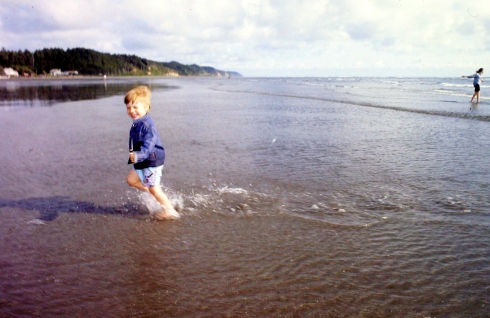
Michael & Alyssa at Pacific Beach
Play with things he’d never played with…
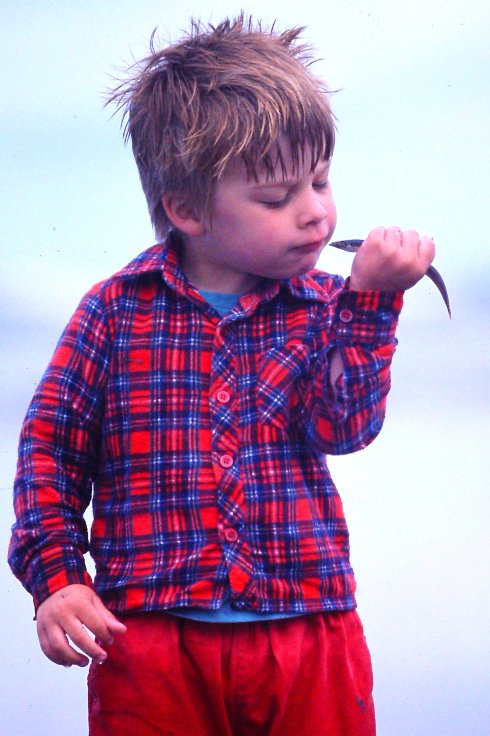
Michael and his Friend
play with airplanes…
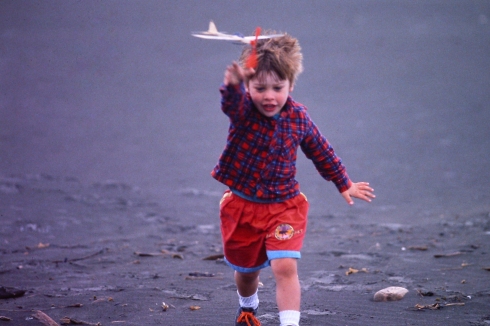
Michael and his Airplane
…and just really, really had a good time.
It was wonderful to watch. For those of you who have children, you’ll recognize this.
He was also at this stage in life where he just wanted to do everything by himself – and, for those of you who have children, you’ll recognize some of this, too.
He was a “big boy” now, and he wanted to take care of things in a “big boy” way, so when he had to go take care of some, shall we say, personal business, he wanted to do it, as he said, “all by myself”.
And so, like many parents, I waited for him to call me and tell me he was done, so I could help him finish up the paperwork, so to speak. And he didn’t call, and didn’t call, and didn’t call.
Finally I called in and asked if he was okay. I heard a strained, “I’m fine!” – and then silence. Then I heard a thump, followed by another thump.
Hmmm…
Silence followed by thumps is never good. It seemed like it was time to go check on him, so I rushed in to see what was the matter – and in half a second I could see what had happened.
He’d been sitting on the toilet – the “grownup” toilet that everyone else used, not the little one he would normally use, and he’d been struggling to hold himself up with his hands to keep from falling in.
When he was done, and being a little tired from holding himself up, he wanted to be a “grownup”, he skootched himself forward until he could get off, but in doing so, left quite a bit of “evidence” on the toilet seat, the front of the toilet, and all the way up his back that he’d done so. It was clear he’d lost his balance a bit as he was trying to stand and had bumped into the wall, leaning there to hold himself up.
The, um, “evidence” was there, too.
He was standing there in the middle of the bathroom, ‘pullups’ down around his feet, surveying the scene with an almost analytical detachment when I rushed in and saw the whole thing. I could clearly see what had happened based on what I just described, but instinctively wanting to confirm it, I blurted out, “Michael! What happened?!”
His answer was priceless…
“Well, Papa. Sometimes… things go wrong.”
There it was, plain and simple. “Sometimes, things go wrong.”
Despite the best of intentions, despite the best will in the world, as he said, “Sometimes, things go wrong.”
People make mistakes, or don’t live up to our expectations.
Things go wrong.
Things break, or don’t work like we expect.
Things go wrong.
No matter what we do in life…
Sometimes…
Things go wrong.
So how do you handle it when they do?
And, when you have a simple acknowledgement of the fact up front, how on earth can you be angry?
How do you – at work or at home – handle it when things go wrong?
What, if you were faced with that situation I mentioned, would be the most important thing?
Seems like they’d be like this, in order:
- Clean up Michael (as in: clean up the source of the – we’ll call it “evidence”)
- Clean up the toilet seat (as in: make sure things are functional again)
- Clean up the wall (as in: take care of any – we’ll call it ‘collateral damage’ here)
- This one’s incredibly important: Remember: Sometimes, THINGS GO WRONG – equipment breaks or wears out, code for our computers has bugs in it, and humans, both personally and professionally, are not perfect.
Yelling at my son about making a mess he already told me he didn’t mean to make wasn’t going to solve anything.
Managers yelling at employees when things go wrong generally don’t have much of a good result either, nor, often, does yelling in personal situations.
The important thing there was to help clean up the mess, then reassure him and let him know that everything was okay. Just like you need to reassure and encourage the people involved so they’re not afraid to, shall we say, ‘get back in the saddle’.
And this takes us to…
5. If you want to keep this kind of thing from happening again:
Personally: I can’t stress the importance of communication – not just speaking, but being willing to listen. I can’t tell you how crucial that is, but I’ll be the first to admit I’m not perfect in this and have definitely made my share of mistakes, so please don’t take this as some perfect being sitting on the top of a mountain dispensing wisdom. Nope, I’m down in the trenches, muffing things up along with everyone else, trying to learn the lessons God has for me, and trying to share the experiences along the way.
Also, (this one is challenging) realize yours might not be the only right view there. (Yes, hard as it is to understand this in the moment, it’s possible for two people to be right about something – and still disagree with each other). Often, one will be thinking short term, one long term. Or, one may be thinking, we’ll call it ‘rationally’ while the other is thinking ’emotionally’.
Note: One is just as valid as the next.
Professionally: Communication here is just as critical. You might have one person thinking long term, but unable to articulate it, while another is focused on the immediate problem, and is more vocal.
Both are valid.
Be sure to listen to the quiet people in your organization. Make sure your people are equipped with the proper tools to do the job they’re expected to do. Going back to my son’s analogy, it’s good to make sure the saddle’s the right size in the first place. Instead of your people using all their strength to keep from falling into a place they’d rather not be because the hole – or the responsibility – is too big, make sure they have the skills (read: training) to be big enough to keep from falling in in the first place.
Does that make sense?
There are many ways to handle situations like this, but for those of you doing management of some kind, understand that the minds of your employees are the most vital things you have. Most often, it’s in there that the solutions to the problems lie. Making them quake in fear of you isn’t a productive use of your time, isn’t a productive use of their skills, and doesn’t make them feel comfortable getting, as I said, ‘back in the saddle’.
So, whether it’s in your work life, or your personal life, when dealing with folks:
Respect them for their skills, whatever they may be.
Forgive them for their mistakes, whatever they were.
Put the past where it belongs, behind you, and in doing so, you’ll help them learn, and you’ll teach them something far, far more valuable than you realize.
You’ll teach them they can trust you to have their back when they need you.
You’ll teach them they can take risks and fail, and not worry about their jobs.
But in setting them up like that – they’ll also feel comfortable right at the edge of their skill envelope, and, as one leader (the former CIO of the company I work for – yes, this means you, Dale) once said, “it’s when you’re at the edge of your envelope that you make mistakes, but that’s also where you learn the most. Yes, sometimes you fail, but sometimes you succeed beyond your wildest dreams.”
He was right, and I appreciated that sentiment more than I ever really found words for.
It also boggled my mind that someone, with all the education he had, with all the experience he had, at the peak of his career in a company could come to the same conclusion that my then two year old son came up with on his own.
It shouldn’t be that hard for those of us somewhere between the two to come to similar conclusions, should it?
In fact, it seems like a huge part of success comes from understanding, and accepting, that…
Sometimes…
Things go wrong.
(C) 2011 Tom Roush – all rights reserved
So I’d been thinking about a Thanksgiving story this year, had seen a number of them, and realized I hadn’t written anything ahead of time. I had so much to be thankful for that it would take far more than you’d want to read to explain it all, so for the sake of this story, I’ll make that part short. I am thankful beyond words for my family – who when the chips are down, band together like no one’s business. (I’m sure I’ll write about that someday). I’m thankful for my friends, who do such an amazing job of flipping me crap when I need it (and sometimes when I don’t). And I’m thankful for the blessings of health. The talk around the Thanksgiving table was full of surprises, and I’m truly grateful that God’s seen fit to let me be around another year. It was on the way down to my mom’s for this Thanksgiving that today’s story, much to my surprise, unfolded.
I headed there on Wednesday afternoon to get an early start helping out with getting things ready. I was driving down a road that I used to drive a couple of times daily, but hadn’t driven down in some time, when my mind suddenly shifted gears faster than a dual clutch automatic transmission in a time machine.
Suddenly I was a 20 again.
Not driving my wife’s Honda wagon with a 17 pound turkey in the back.
Not coming back home to visit as an adult.
Not planning on being part of creating a Thanksgiving feast for 8.
The time machine had deposited me inside memories that washed over me like a dump truck full of water balloons, each one bringing another thought, story, or reminder that flashed into my consciousness as it popped, until I was completely soaked in the spring of 1982.
I was almost finished with my second year going to a local community college, and I had a friend named Jill. She was my absolute best friend at the time, and we hung out as friends do. She was still in high school, I was a couple of years older, and we all went to the same church, same youth group, and so on. One day I had some car troubles (the car in question was a 1965 Saab 95, 3 cylinder, 2 stroke, 46 cubic inches of raw, unbridled power – of COURSE I had car trouble), and without me even asking, she offered to loan me her car one day if I could pick her up from tennis practice after school.
This was a no brainer, and I immediately took her up on her offer.
Now something to know about her car, it was about a ‘74 Ford Torino, originally came from the factory with a 302 cubic inch V-8 engine that had been customized over time to be a V-5. The rest of the car was great, but this thing was the personification of the phrase, “Not firing on all cylinders.” Three of the cylinders were just along for the ride, and what a ride it was. (It was actually hard to comprehend the concept of having three cylinders not firing. If the Saab had had three cylinders not firing, that car would be parked.)
I drove it to school, and I realized that since I’d been spending a huge amount of time under the hood of cars in general, it wouldn’t take much to just do a tuneup on her car as a thank you for letting me borrow it, so I bought 8 plugs, points, condenser, and a rotor and cap, typical tuneup stuff for a car of that vintage, and it cost less than 20.00 for the parts.
I drove it into the middle stall of the three car garage that my dad and I had built. Even though it was the only car in there, the garage felt a little crowded. It had never seen a car that big, and I popped the hood to start working on it. What was really a challenge at the time was just figuring out where everything was. I mean, it wasn’t hard to work, on, it’s just that that 302 V-5 (soon to be V-8 again) was so huge compared to the 3 cylinder engine I could pull out of the Saab and carry by myself to where it needed to be.
So I yanked all the plugs out – sure enough, three were pretty bad, and gapped the 8 new ones so they were set right, then popped them in, put new points in, gapped them, replaced the cap and rotor, making sure that all 8 plug wires were connected in the right order, then replaced the condenser and then, finally, got my timing light out and made sure all the plugs were firing when they were supposed to. It wasn’t hard, but it did take just a touch more than the hour I’d budgeted for it, and I was getting worried that I might not make it in time to pick her up from tennis practice like I’d promised.
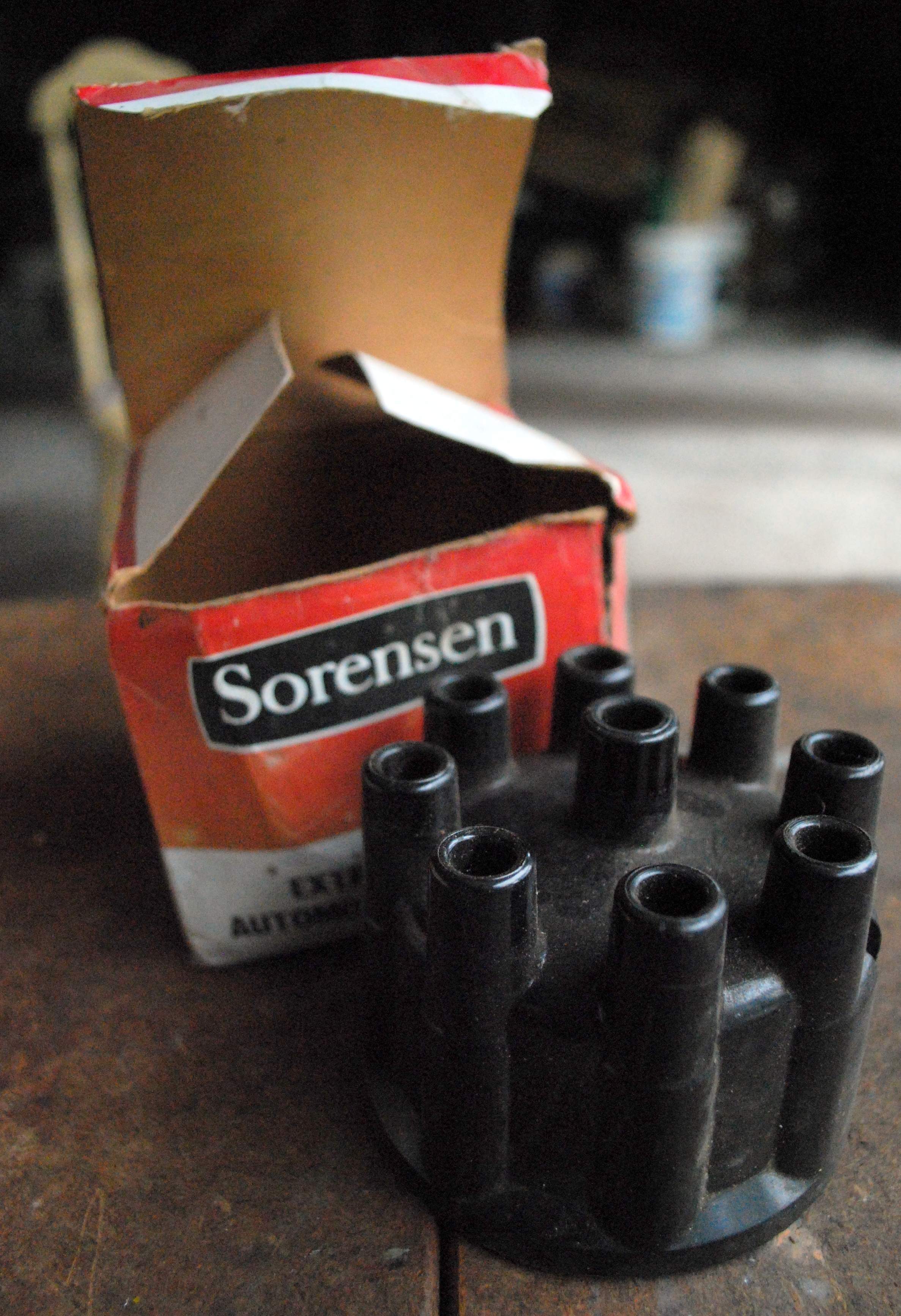
Jill’s old Distributor Cap
I fired it up, and it started beautifully. It ran on all 8 cylinders, and was so smooth you could hardly tell it was running.
I allowed myself a smile, then suddenly realized as I looked at my watch that I was cutting it a little close. I ran into the house to clean up, then tried like you wouldn’t believe to keep from driving like a madman to pick her up in time.
A couple of green traffic lights helped me get there with a few seconds to spare. She saw me as she came bouncing off the tennis court as I eased her car gently onto the unpaved parking lot. You couldn’t even hear the engine anymore. All you could hear was the tires, slowly crunching on the gravel.
She got to the car, and was just starting to get in on the passenger’s side when she realized it was her car she was about to be a passenger in, so she playfully informed me that she was driving. She ran around to the driver’s door. I played along and skootched over to the passenger’s side, and she got in the driver’s seat.
The engine was still running, just purring, no longer doing the “thoof thoof thoof” that the custom V-5 had been doing under the hood for so long. She automatically put her seatbelt on while I was still fumbling with mine. I looked over at her and saw she was giving me “the look” that made it crystal clear that the car wasn’t moving till I had my seatbelt on and my tray table in the full upright and locked position… (okay, ignore the tray table thing) So I hurried up and got mine on as well.
Understand, she had no clue about what I’d done.
So she put it in drive, like she always did.
And then she gave it 5 cylinders worth of gas, like she always did.
And she expected to have 5 cylinders pull the car out of the parking lot, like they always did.
But Jill did not know, at that moment, that she had 8 cylinders reporting for duty under the hood.
With the gas pedal close to floored, those 8 cylinders did exactly what they were designed to do, and the engine roared. The tires spun, and Jill sprayed gravel all OVER that parking lot before she stomped on the brakes, looked at me in total shock (and just a little delight) and said,
“WHAT have you DONE to my CAR?”
“I, um… I fixed a few things…”
“You WHAT?”
She couldn’t believe it – and insisted on paying me.
I didn’t want any money for it – it really didn’t cost much to do it, and it was so much fun to see that amazed look. I think, in the end, she managed to give me $10.00 – which was close enough to the price, but what was worth more than all the money she could have ever given me was the look on her face when she hit the gas that first time.
She drove the car for the rest of that summer and into the next winter, and as there are people who are in your life for a reason, a season, or a lifetime, Jill was in my life for a season. That summer, she and I still saw each other, but she had a special friend named Mike, and Mike and Jill were inseparable. On the one hand, I was, as anyone would be, heartbroken that she’d chosen someone else, but she and Mike were such a couple, and it seemed that there was something so much bigger going on than just Mike and Jill, that anything other than bowing out gracefully simply wasn’t an option, and so I did the best I could.
That summer was hard, but like I said, Jill was in my life – in our lives – for a season.
I got the Saab working again…
School started again…
Life was, for the most part, going okay. We made it through Thanksgiving and Christmas of that year, were barely a couple of weeks into the New Year when one Thursday morning the phone rang.
I still remember being home that cold morning – when the phone rang.
I still remember the pastor’s wife’s voice on the phone, crying.
I still remember sitting down, collapsing, really, as I heard her say there’d been an accident.
I heard everything, almost as if I were an uninvolved third party, but this was happening, and happening right then.
I heard disjointed words.
I heard something about a patch of ice, and about a pickup truck in the oncoming lane.
And I heard that both Mike and Jill, who’d been on their way to school that cold, clear morning, took an unexpected detour and left this life.
The next week was a blur.
The funeral for them was huge. I think there were 1500 people there. I’m not sure. There were many, many tears, but I remember walking past the casket, and looking inside, and while Jill’s body was there – Jill’s spirit was gone, flying as freely as the angel she was.
As you can tell, I still think about my friend Jill, and I miss her.
But I’m thankful for the time I had, and for the friendship that we had those many years ago.
I’ve learned that time machines can be wonderful ways to reach back into the past, bringing back memories that you’d forgotten were there. But I also learned you have to be a little careful, as along with the memories come emotions that you might have forgotten were there, too.
I wiped my eyes with the back of my hand as I stepped out of the time machine, and came back to Thanksgiving, 2011, where the smell of the turkey was just starting to waft through the house. I asked mom if she knew where “the picture” of Jill was.
There was only one that I knew of. She never wanted to be in any pictures, and was pretty adamant about that, but one day, that spring that I fixed the car for her, we were doing homework in the camping trailer my parents had. I was fiddling with my mom’s Yashica rangefinder 35mm camera. It took a bit to learn how to focus a rangefinder camera, which was achieved by getting two images to line up one over the other, and once you figured it out, it took some practice to get any image in focus. So I told Jill all I was doing was checking the focus, but inside, I really wanted at least one picture of my friend – and I was able to capture the only picture I have of her, doing her algebra homework after school one day.

And I got to thinking.
The Jill-shaped hole she left in our hearts will never be filled, but the more I thought about it, the more I realized Jill hadn’t left.
She’d just gone home.
My son and I were talking the other day, and the subject of the conversation was about asking for things.
I’ve learned, over the years, that often you don’t get what you want because you don’t ask for it. This concept has been around for thousands of years. I learned it pretty clearly on a number of occasions, We talked about how, if you don’t ask for something, the answer, if you will, is a guaranteed ‘no’, whereas if you do ask, the answer is at least a ‘maybe’.
So I got to thinking about this whole thing – realized that a number of the stories I’ve written are because I simply didn’t understand that someone could possibly say ‘no’ to a well reasoned, logical request. The story about Fifi is a prime example. So’s the story about Misty 42. There’s a bunch of unwritten stories still in my head that are the same way – and this whole thing could apply to any life situation. I mean seriously, what right did I have to badger a newspaper photo editor that I didn’t know into holding space for me on the front page of his paper so I could talk my way onto the only flying B-29 in the world… Then again – who was I to just casually talk my way onto a KC-135 tanker (twice, actually) and get a picture of an F-4 Phantom seconds before it refueled? (Those are the above stories) Who was I to get strapped into a C-130 for the greenest ride of my life?
What did I do to deserve something as cool as some of the things I was privileged to do?
Well – the answer’s pretty simple. I asked.
See – that whole thing about a guaranteed “no” is something I learned early on, whether it involved asking a young lady out on a date when I was younger, or asking for a seemingly nonexistent transmission for my car, or if I somehow could get go onto a plane, train, or automobile (yes, I have stories of all three) – it was still the same. If I didn’t ask, the answer was no. So… I asked. So with that as a little bit of a background, let me take you to a small town in west central Ohio for one of these stories – just because it was an example of what a difference asking a question like that can make.
I’d just started my internship as a photojournalist at the Sidney Daily News, and was between assignments, looking for some of what they called “Feature” shots. That means anything that makes you think thoughts like “oh, cool!” or “gosh, I wonder how they got that shot”, or just something that’s a fun picture to take, something to share with the folks who live in the area, and, hopefully, is of general interest. Part of this was just having a fresh set of eyes that hadn’t seen anything like this town before, part of it was just curiosity. So being between assignments, I found myself in the center of town, driving circles counter clockwise around the courthouse. There was construction going on, and I thought I could make an interesting image out of it. I saw a fellow up on the scaffolding, and figured I’d found something to work with – so I parked the car, grabbed my gear, and moved so there weren’t trees in the way. I realized I’d need my 300 mm Nikkor 4.5 because of how far I was – then realized that wasn’t enough. Hmm. I put the doubler on it, making it act like a 600 mm lens. Then I got down on one knee, steadied myself with one elbow on the trunk lid of the car, and then realized that I was taking a shot anyone on the street could take with what was then the camera that produced some of the crappiest pictures on the market, a Disc Camera. Oh, sure, my shot would look like it was shot through a telescope compared to the Disc Camera, but that wasn’t the point… The point was that I’d been hired to take photographs that other people couldn’t see, that other people couldn’t get to, or that other people would never in their wildest dreams think of taking. I mean, it was possible to take a photograph of the courthouse from the ground and have it look great. I found a shot online and asked the fellow if I could use it (Thank you David Grant)– and here it is:
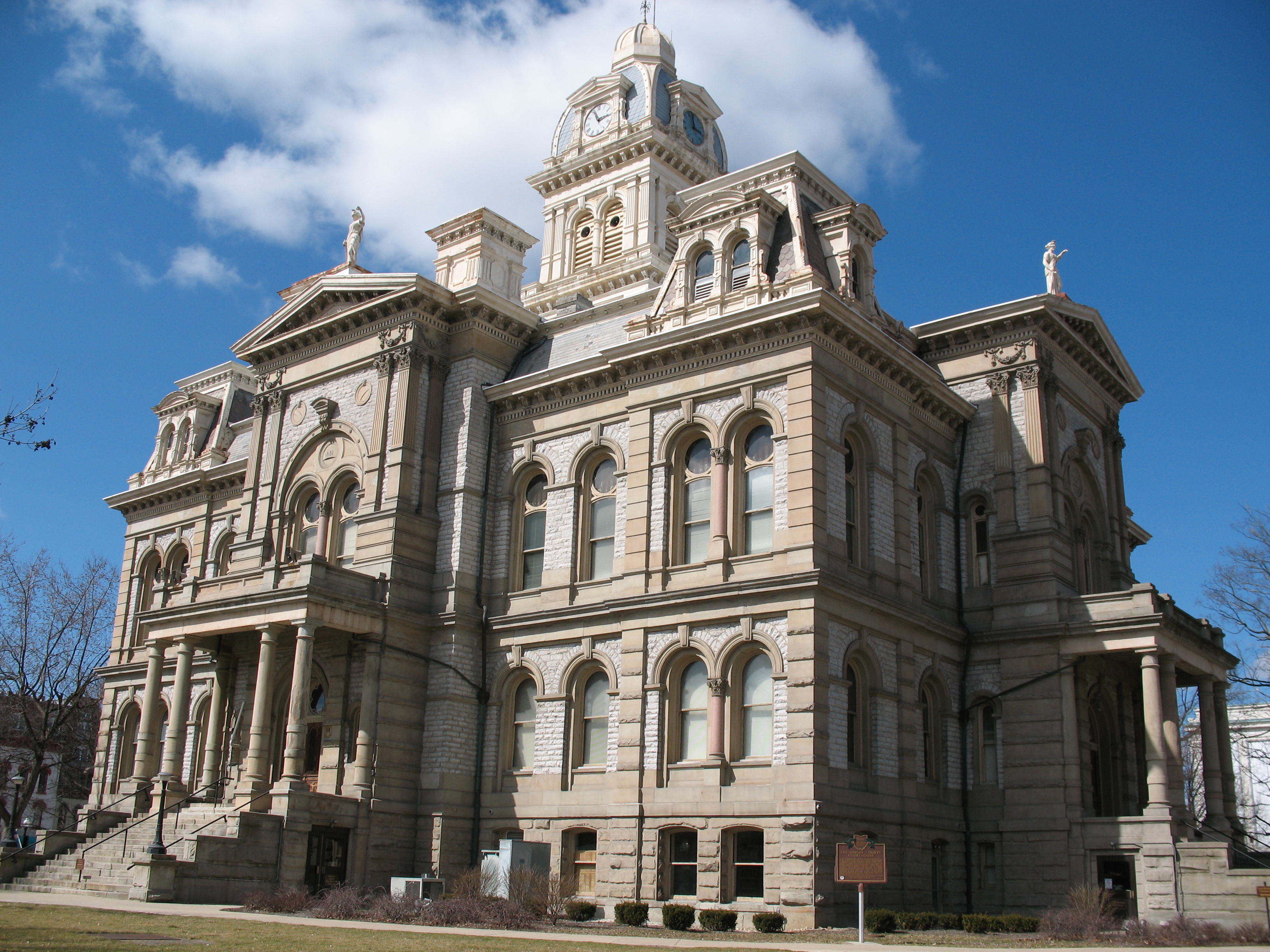
Shelby County Courthouse, Sidney, Ohio. Photo Copyright David Grant, used with permission
Problem though, was the light for what I wanted to shoot, while gorgeous like the shot above, wasn’t that gorgeous on the side of the court house where my picture was waiting for me. I knew that – I’d driven around the thing, and sure enough, all the action was on the shady side. Sigh. I put the camera down before I took a poorly lit shot anyone else could take from across the street, and stood up.
And then I did something dangerous.
I started wondering…
I wondered what the view from up there was like…
And then I wondered how I could get up there…
And then I did some thinking about how I could get up there.
See, if you want to get into a building, and if you want to go straight to the top, it’s best to start right at the bottom – and often, as in this case, the fellow at the bottom is the janitor.
Janitors are amazing people. They have keys for EVERYTHING. So I made sure the car was locked, threw everything over my shoulder and headed into the courthouse, to have a chat with whoever was playing receptionist and see if together we could find the janitor. One receptionist’s phone call later, I was introduced to the older gentleman with the iconic huge ring of keys, and I heard myself give what would be my standard greeting for the next few months, “Hi, my name’s Tom Roush and I’m a photographer for the Sidney Daily News…” followed by the question of the day. In this case, it was: “I see you’ve got some work being done on the roof, and was wondering if I could get some shots of it for the paper. Is there any way I could get up there?”
I don’t think five minutes had gone by from the time I didn’t take that picture over the trunk of the car until I was walking out of the elevator, through a dusty attic filled with huge beams, and through a small open window onto the roof. The janitor looked out, called up to the fellow I’d seen, then stepped aside and let me crawl out. I introduced myself to the fellow many feet over my head up on the scaffolding and asked if I could come up. He stopped his caulking for a moment and looked down, seeing I was carrying a camera bag, a couple of cameras, including that one with the 300 mm lens and the doubler on it.
Somehow bringing the bag up there onto the scaffolding was deemed, without any words needing to be spoken, a bad idea. So I set it down, put the 24mm wide angle lens on the F-3, slung it over my shoulder, and carefully climbed up the scaffolding. I climbed on top of the topmost section so I could look down and see him, my goal being to see – and thus tell a story – that no one else could see. I sat on the very top of the scaffolding, wrapped my right leg around the vertical part of the support, leaned back, (yes, the scaffolding leaned with me, but not by much) composed the frame so the horizon was at the top, then told the fellow to just keep working as he could (as I write this I still can’t believe I did that – there was nothing but air between me and the roof about 30 feet below, and had I slipped, I would have rolled down, then off the roof and fallen another 40 feet or so before becoming one with the pavement.
And the thing is – I could have taken that first shot from across the street, it would have been safe – but it would have been a totally forgettable image, lost in the back of the paper somewhere.
But I didn’t take that first shot.
I wondered, “What if?”
I wondered, “What can I do that will make this better?”
And then I realized the only thing keeping me from making it better was me.
I had to go in, ask a question that they could have easily said,”No.” to, and that would have been that.
But I didn’t.
I asked.
And when you’re faced with weird situations in life when you’re just thinking there’s no way you can succeed – trust me, there are ways you can succeed.
And stand out – literally above the crowd.
There have been times in my life – and there will be times in yours, when you find you can barely think of the question to ask, much less step out of your comfort zone and ask it, but that little thought, that maybe, just maybe, asking will make a difference, that *is* the difference. In fact, often, the hardest/simplest/most important thing of all is for you to step out of your comfort zone and just ask.
Now, understand, whoever you’re asking might say no, and you’ll be right where you were before you asked the question, but so what?
You can try something else then.
On the other hand, if you don’t ask, the “no” is guaranteed.
So…
Take care – really – be careful out (and up) there.
And don’t forget, it’s okay to ask.
Think about it: what’s the worst that can happen? (they say “No”, and life hasn’t changed. But if you do – the results can be magic. I’m working on a few more stories that will show you what happens if you dare to ask – they’ll come out over the next year or so, and often, they will be the story behind a photograph (which is proof in and of itself) All that said, here (below) is the shot I’ve been describing. (in another frame you’d see the camera bag teetering at the bottom of the frame, but that one didn’t make the final cut)…
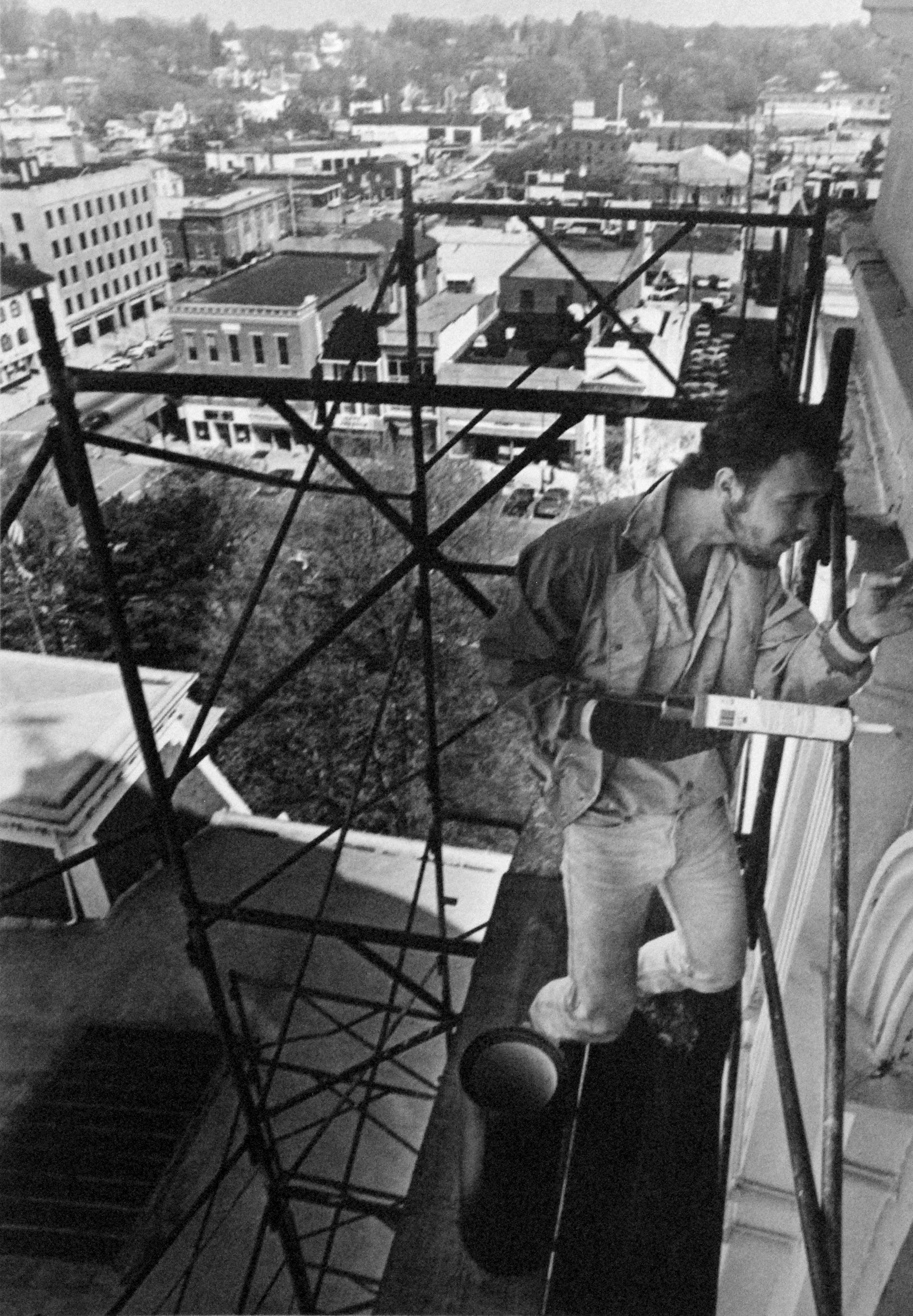
Shelby County Courthouse, Sidney, Ohio. (click for larger image)
…and how it appeared in the paper the next day.
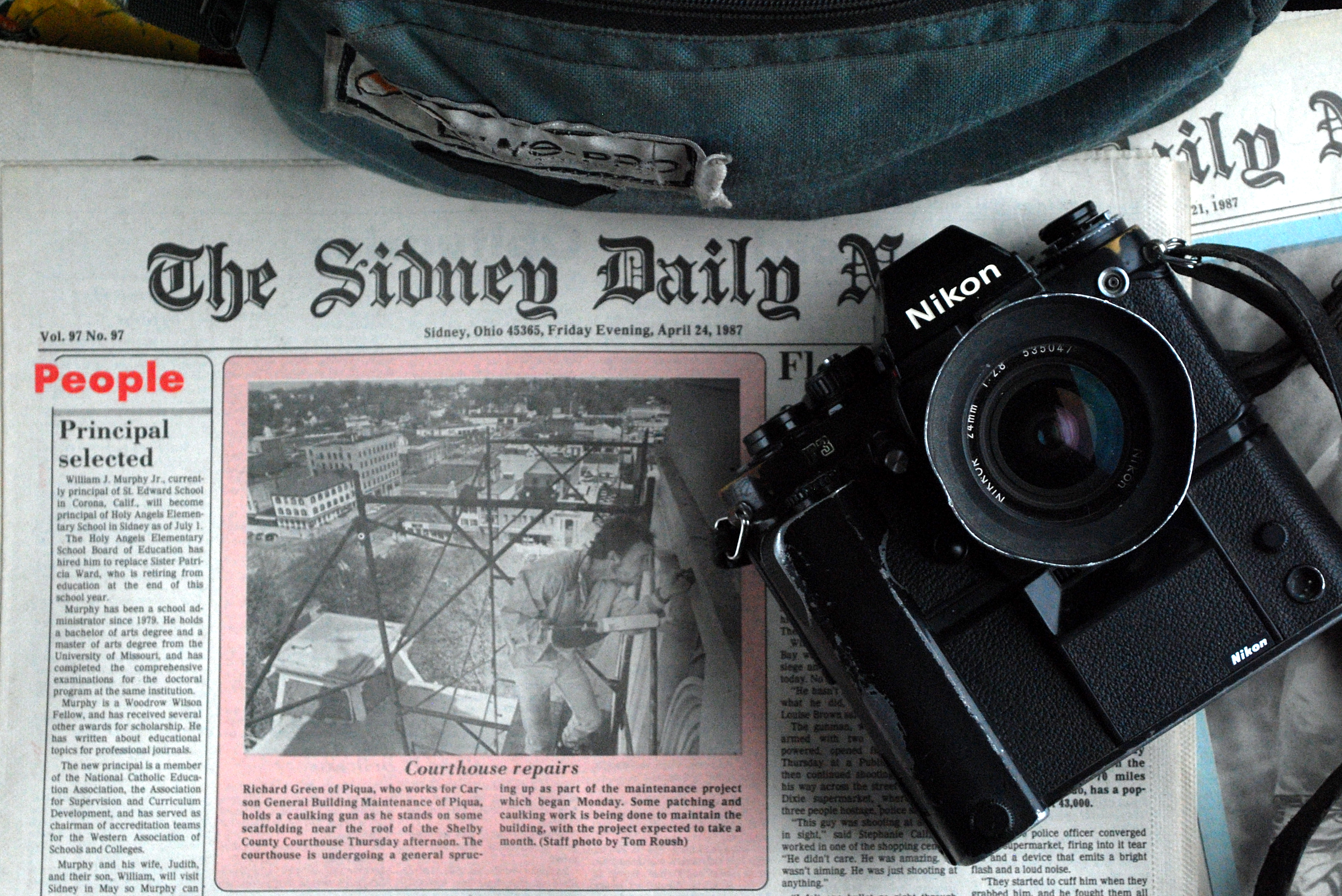
The front page, with the camera & lens I shot it with. At top is the camera bag mentioned in the story. (click for larger image)

 Tom Roush's Blog
