You are currently browsing the tag archive for the ‘Lessons’ tag.


I can’t believe it’s been five years already, but it has.

A few years ago I had occasion to meet someone on a regular basis, daily, for several weeks.

We were both going through some hard times, each fighting off some pretty harsh demons, as it were, and as we sat there, over time, each going through our own battles, we became friends.  Her name was Cecily, and as the days turned into weeks, our conversations deepened, and we talked about our families, and challenges, and the struggles we were facing and overcoming.

It turns out that our opportunities to meet each other daily ended about the same time, and we kept in touch for a long time afterwards.  On rare occasions, we’d meet at a Jamba Juice on checkup days for all their healthy things and just catch up on life.  It was neat doing that, meeting near a place that had both caused and absorbed so much of our pain, and not having to actually go there.  We talked, and we laughed.  I remember for awhile she talked about her sisters and how they were helping her get a bunch of firewood for the winter.

It was a good time, just chatting.

Sometimes, when we couldn’t actually get together, we’d call or email, and just chat and check up on each other, again, asking about the families and getting back to work, and just life…

And that was fun, too.

But one day I realized an email I’d sent hadn’t been answered in awhile…

And phone calls were going to voice mail.

I left message after message, and got no answer on her office phone.

And then that stopped, too.

Over the course of several months, I tried and tried, and finally decided to simply call her main office number and get the main switchboard there, to see if I could find out why she wasn’t answering her phone.  I talked to a very nice receptionist who clearly had very little history with the company, and I asked for Cecily.

She checked, and I heard my heart beating louder in my ears as she said, “I’m sorry, there’s no one here by that name…”

But I wasn’t going to give up, so I tried her cell phone…

And kept trying.

And trying…

And trying…

Then they stopped going to voice mail even on the cell phone, and went to the dreaded recording of “The number you have called has been disconnected or is no longer in service…”

I did the thing I didn’t want to do, facing what was becoming a reality, and found out why she wasn’t answering her phone or email anymore in the last section of the paper I wanted to find her in.

Cecily, my friend, my pal, my radiation buddy, as she called me, was gone.

I found her mom’s number – it took a bit – and I talked to her for a long time.  We talked about her daughter, and we talked about my friend, and it turns out that Cecily’s mom knew all about me.  Cecily had talked to her mom about her friends, and I was, and am, very honored to have been one of them.

So Cecily – It’s been five years, but I still think of you, that smile, that laugh, that indomitable spirit.  I’m glad to have gotten a chance to know you, and I raised a glass at Jamba Juice in your memory.
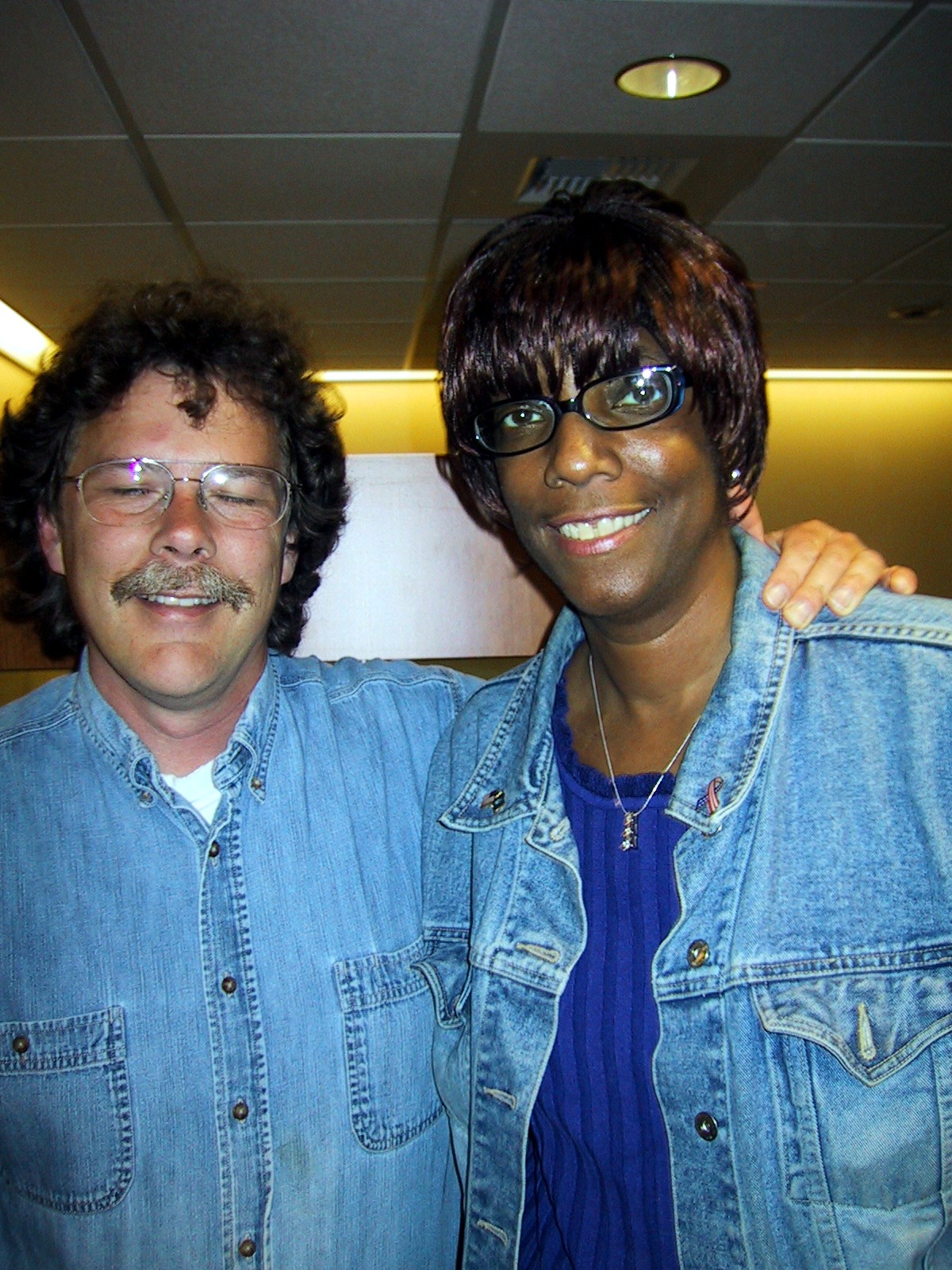
My friend Cecily and me

My friend Cecily and me, with one of my trademarked blinks…

God bless…


Hey folks – after a long, cold, wet winter, we’ve finally gotten a late spring here in the Pacific Northwet, (yes, I spelled it that way on purpose) and the sun, has finally come out, and it made me think of something that happened about 15 years ago.

It reminded me of what it was like to be both little boy, and a dad, and I just had to write it down, and the following story was born.  Of all of the stories I’ve written, I think this is my favorite.  I’ve changed the name of the little girl (who by now is a young woman), but otherwise, the story is as it was written back in 1998.

Springtime has hit my son (who’s 7) like a ton of the proverbial bricks.

The object of his affections is a very nice little girl in his class named Sarah.

Recently we got a student directory for his school, and he’d started reading it, looking for where kids in his class lived. He was spellbound every time he had his mom read it to him, as if it were the best children’s book you could ever hope to hear.

It took us a little while to figure out what he was up to, but we did notice there was method to his madness when we read off Sarah’s address.

“That’s only two blocks from here!”

“Yup.”

So he would sit there curled up on the couch and look at the directory, a big, dopey grin on his face, and thoughts of Sarah dancing through his head.

Last Saturday, he felt this irrepressible urge to “go for a walk”

I agreed, but things got in the way, the afternoon started to slip by as they so often do, and he got more and more insistent on taking this walk. Finally I asked him if there was any place in particular he wanted to go, and he gave me that look that all parents know. You know, your child wanting to tell you something so much that they’re ready to pop, but not really wanting to let go of the secret they’re holding onto so tightly. It’s a lot like a balloon, which can only handle so much pressure until it bursts. In this case it did burst and the secret of where he wanted to go came blurting out:

“Sarah’s.”

“Sarah’s?”

“Sarah’s! Can we go right now?”

“Um, sure, but what if she’s not home?”

“Oh.”

“Should I call her mom to see if she’s there?”

“Yeah, yeah, do that.  Call her mom.”

I had no idea what I would ask her mom, but figured if I did ask something I might want to ask it without little ears hanging on my every word.

“Do you want to be here when I talk to her?”

“Uh, (gulp) — I see what you mean…”

— and so he went off as if to go to his room, but hid just around the corner and waited, – and if you can imagine a 7 year old turning into a giant ear, that’s what happened … He was listening with every pore of his being.

I dialed and heard a male voice, “Hello?”

“Hello, is this the Johnson residence?”

“Yes, it is.”

“Are you Sarah’s dad?”

“Yes.”

“Okay, Hi, I’m Tom Roush, I’m Michael’s dad, and Sarah is in my son’s class, and it seems that spring has hit him pretty hard…”

[long pause]

“…ooooOOOhhh….”

“…and he found out where Sarah lived, and it’s just two blocks away, and he’s been pestering me to go for a walk all afternoon, with the idea of…”

“…walking past Sarah’s house?”

“Yup.”

“Well, she’s not here right now, but should be back in about half an hour…”

There was a pause as we both were taken back a bit to our childhoods and we remembered the butterflies caused by little girls when we were that young…

“Does Michael like dogs?”

“He does, why?”

“Well we’ve got this (whatever breed) who really likes people, I could go outside and play with the dog for awhile and just kind of be out there when you come by on your walk…”

“That sounds great, we’ll see you in a little bit…”

Normally it takes Michael a good long while to find his shoes and socks, no matter where he’s put them.

This time was different.

Normally when we go out for walks, I walk, and he runs up and shows me stuff, then comes back, then runs up again, and back, and so on.

This time was different.

He held my hand and stayed pretty close, and we looked at house numbers, the tension building as they got closer and closer to 1006, her house number.

We saw the dog first, and we saw her dad, Phillip. And as we started chatting, some friends brought over some hamsters for them to hamster-sit, Michael played with the dog and watched some ants that were mining for dirt under the sidewalk. We meandered into the back yard, just chatting away with Michael being ever so patient, just being a very good little boy, wanting to play on the playset they had back there, but being too polite to interrupt and ask.

Until…

…the Heavens opened…

…Trumpets sounded…

…Angels sang…

…And Gabriel Himself announced the arrival of…

…Sarah, who popped out the back door.

“Hi!”

And popped right back into the house.

The door to the Heavens got stuck half open …

Trumpeters picked up sheet music …

Angels straightened out their robes …

And Gabriel Himself stood there, checking his list to see if he was at the right house.

Michael looked up at me, and all I could do was shrug my shoulders.

Next thing we knew, she’d popped back out again.

Angels in overalls got the door to the Heavens unstuck.

The trumpets picked up where they’d left off.

The Angels counted time waiting for their part.

And Gabriel found that He was indeed, at the right house.

“Sarah, you know Michael, right? – would you like to show him some of the animals in the house?”

Turns out that a menagerie would be an understatement.

So Michael and Sarah went up to the living room where she showed him her hamsters, and her gerbils, and there’s a bird in there somewhere, while Phil and I went downstairs to the basement to talk about “guy stuff”, you know, the “I’m thinking of knocking this wall out here and putting in a bathroom here, and…” – stuff that little boys who came to visit little girls aren’t interested in in the least.

…and soon it was time to go.

Michael thanked them for letting us come over and calmly walked down the stairs, as did I.

It was only after we got out of sight of the house that he started floating.

— actually, floating is too gentle a word for it.

It was a full bore run with an exclamation point of a jump at the end, “YES!” – both arms up in the air, both feet completely off the ground, and head definitely in the clouds.


The moon is absolutely gorgeous as I write this.  All I have to do is look out the living room window to see it – and it got me thinking, and remembering, to a Sunday evening back in 1998.

I’d spent the afternoon with my son, just being together and doing stuff, and as it got dark, drove down to Golden Gardens in the old Saab, and as we were going around the big S turns on the way down, he looked up and saw the crescent moon in the evening sky.

“Look Papa!  The moon’s a white banana in the sky!”

And so it was.

It was wonderful to see, and wonderful to see it through his eyes.

We got down to the beach, just as most parents were packing up and leaving, and built a sand castle in the wet sand, it clumping together – bits of shell and the like as we worked… The sand castle appeared over time to the sound of an invisible boat chugging up the Sound.

At this moment, I decided to put all my sensors on full alert, as I wanted to remember this moment, and saw and heard other parents with their children, trying not to blink as they grew up.

That’s one of the hardest things about being a parent, trying not to blink…

As the sand castle took shape, the sounds of the evening changed from children running along the beach and into the water to children bargaining for more time, begging for “just one more minute”, and parents reluctantly giving in, for that one minute, knowing that they’ll be vacuuming the sand out of the car tomorrow, but knowing also that a memory was made, and it’s one small grain of sand in the beach of a happy childhood…


At first Heidi didn’t know what she was part of that evening.

She refilled our glasses, she kept the food and drink coming, and then she did what all good waitresses do.

She left us alone.

We were sitting in a nondescript restaurant, the three of us, sharing stories, memories, and laughing ourselves silly.

The last time the three of us had been together was about 32 years earlier, and I got to pondering about the journeys we’d all not only taken, but survived to get to this table in this restaurant.  What had brought us together was a funeral, the death of J.C. Masura…
J.C. as we knew him, looking out the back of a C-130 high over somewhere.

J.C. as we knew him, looking out the back of a C-130 high over somewhere.   Photo copyright by and used with permission of the Masura Family.

…who’d been our commander many years earlier when we were all in the same Civil Air Patrol Squadron on what was then McChord Air Force Base.  J.C. had been a loadmaster on C-130’s and C-141’s, back in the day, and up until recently had run an aviation maintenance facility at an airfield near his home.

Of the three of us there in that restaurant after the funeral and reception, there was Aaron.

He told a story of being up on Mount Rainier during his Civil Air Patrol days, trying to put his tent together and it being a tangle of poles and cloth.  He told of J.C. coming over, and being relieved that he’d have help to solve this problem.  J.C. did help.  He said, “Son, if you don’t get this tent up, you’re gonna die. So you’d better figure it out.”

And Aaron did.

The most vivid memory I have of Aaron was when we were trying to ram him through the bushes (<–story) on one of our searches.  This evening, however, he was sitting across the table from me, in a uniform that spoke of honor, valor and courage.  A uniform that spoke of someone who no longer needed to be pushed through bushes, but led people through walls.

As we sat there, reminiscing, and as Heidi kept our water glasses and plates full, Aaron told stories that had us laughing, and shaking our heads in amazement.

He told of coming back from one of many missions to a country in the Middle East, ‘the sandbox’, exhausted to the core, and climbing onto a ubiquitous, anonymous Air Force cargo plane that was to take him home, only to find himself being welcomed onto the plane by a loadmaster with the familiar name of Masura stitched to his uniform.  It seems J.C’s oldest son (we knew him as Jimmy) had followed in his father’s footsteps, and was now a loadmaster himself, with enough stripes on his arm to put the fear of God into even the highest ranking officer.

Aaron, the highly decorated soldier, slept most of the flight home, watched over not by a stranger, but by a friend.

Heidi came by about then to refill our glasses, and it was obvious to her that she was seeing, and was part of, something very special.  It was obvious we hadn’t seen each other in a long time.  Typical of such reunions, she said, was folks from college getting back together.  She was amazed to hear that we hadn’t seen each other since high school, and even more amazed that we’d gotten together at all.

Then there was Bill, who I’d been able to keep in touch with a little more.  I have many memories of Bill, some of which have actually been written down.  One of those involved our Civil Air Patrol Squadron, a regional Drill competition (<–story) in Oregon, and the memories of the looks on people’s faces when they saw us beating them at their own game.

Bill was dressed in a suit jacket and tie for the funeral, had become a world traveler, working as a biologist and traveling to every continent on the planet, and some places that don’t come remotely close to being continents.  Bill told a story about going back to Antarctica, where before they could study the penguins, and the wildlife, one of the first orders of business was getting things habitable, and during that time it was discovered that the ‘facilities’ had been buried in 7 feet of snow since they were last there. By the time they got everything dug out and opened up for use, they discovered several inches of frost on the toilet seat.

No. Really.

All you have to do if your kids complain about a cold toilet seat is show them this one.  "When I was your age..."

It was chilly. (photo copyright and courtesy of William Meyer)

We laughed about the “when I was your age” stories that would grow into: “When I was your age, we didn’t have these fancy things called toilets, we had to dig through 7 feet of snow just to get to a seat with a hole in it.  And it had FROST on it.  And we had to melt that off ourselves…”

“With our Butts.”

Yeah, I can see that…

We’d get post cards from Bill every now and then, telling of his adventures in warmer climates, too.  He told one story – and it wasn’t even a story, but just a vignette, of writing one of his post cards, in this case to his sister, sitting under a tree somewhere in Africa, and writing it by candle light, because it was all he had.  When a scorpion crawled across the postcard as he was writing it, looking for bugs that might have been attracted by the candle, he decided it was time to call it a night.

Heidi came back and checked on us, and the stories continued.

I’d had some of my own adventures – some of which I’ve written about, some not, and we marveled, literally, not just about the various journeys we’d gone on to get to this table, in this restaurant, but the fact that we’d survived them all.  Even though we were there for hours, each one of us had stories that there wasn’t time to share that evening, and each one of us had stories of adventure and danger, as well as growth and promise that we realized would have to wait for another day.

We pondered that, and found ourselves all taking a collective breath. As we did, we realized the restaurant had grown quiet. There was no conversation, no bustling of waiters.  In fact, the only sounds we heard were those of clinking dishes as the staff cleaned up the restaurant, which had closed around us.

We were the last customers in the place, and the doors were locked.

Heidi, bless her, came by one last time, and let us out…

…and stood in the parking lot for another half hour, talking and shivering in the dark, but vowing that we would get together again without someone having to die in order for it to happen.

There were friends who were not able to make it this time, and friends who would not make it, ever.

And it got me thinking…

Why do we wait so long?

One person asked me, “Why is it we wait till we have nothing but weddings and funerals to get together?”

Why do we often just get stuck in our little ruts and miss out on some of the cool stuff of life, like sharing stories and laughing, and – why does it take something *more* special than just getting together to get us to get together? (yeah, I read that a couple of times myself too before I let it go, but it works…)

I mean – the three of us hadn’t been together in over 3 decades.

Me surrounded by two world travelers, Bill on the left, and Aaron on the right.

Not a week later I had occasion to go to a friend’s birthday party.  I was fighting off a bug and wasn’t feeling too well yet, but for heaven’s sake, it had been years since I’d seen him, so I went.  He’d hit the big 5 decade mark, and wondered the same thing… why do we get stuck in our little ruts?

I know the answer to this – and there’s a story in it, which I’ll tell later, but in a nutshell, it’s because it takes more energy to get out of a rut than it does to fall into one.

Sometimes that energy comes because you see patterns and realize if you don’t change something, the pattern is pretty predictable.  Sometimes the energy comes in the adrenaline fueled by the sudden, tragic realization that nothing lasts forever, and everything, everything comes to an end, whether we want to believe it or not.

So – and I’m realizing I’ve been ending a lot of stories with this theme: Make sure you let the ones you love know that while you can.

Hug your husband/wife.

Hug your kids.

Hug your parents.  Even if it’s a verbal hug, with a phone call, card, or email.

Just do it.

A friend wrote recently that he’d found out another friend had passed away, and somehow 10 years had slipped by since they’d talked.  You never know when your last words with someone will indeed be your last words with someone.

Sometimes a telephone call will reopen doors to old friendships.  Sometimes you’ll find those doors have closed and it’s time to move on.  That might hurt, but regardless the door’s position, at least you’ll know, and you’ll be able to open or close it yourself.  And you’ll actually have a chance to know what those last words with someone will be. Make sure they’re good ones.

In the end, what changed is that I did just that.

I picked up the phone and checked up on some old friends and kept in touch with them more.  I found some doors opened wide again, and found some doors closed – I write all this from experience, both joyful and painful.

And I tried, as best I could, when I saw that one of those doors had closed, to make my last words good ones.

So take care of yourselves.  This is the one time we have through this life.

Take care of each other, too.  You never know when you’ll need each other.

Oh, and if you happen to meet a waitress named Heidi, working at the Outback Steakhouse in Puyallup, Washington, who keeps your glasses full and allows you to enjoy your reunion time with your friends, give her a good tip.

She deserves it.

===

Footnotes:

It’s been a year since the events in this story unfolded, and it took this long to think them through, get some perspective, apply some of the lessons I learned,  and be ready to share them with you.  That might make a little more sense now that you’ve read it.

Aaron is still in the Army – he invited us to help celebrate his promotion recently, and we shared more stories, more laughs.  We kept the promise to get together more often, and made more promises to do it again.

Bill and I got together the day after my birthday last year along with another friend, Mark, and have kept in touch more.  He’s doing a little less exploring, but still doesn’t have a “desk” job.  He couldn’t make it to the promotion party because he was strapped into a small airplane, flying around the hinterlands of the country in an airplane, counting Elk.

Jimmy’s still in the Air Force, I saw him at Aaron’s celebration, and they got along like the old friends they are, not with the stuffy formality you might expect of an officer and an enlisted man.  It was fun to see that.

J.C.’s wife – well – widow – hard to write that, but it’s true –  is doing all the things you do when you’ve lost a loved one.  That first year, I can tell you from experience, is a hard one.  I’ve kept in touch with them as I could over the last 12 months, not as much as I’d like, but far more than the previous 30 years or so.

And as time, and the years, go on, I’m realizing more and more that the things that are valuable to me are less and less the things that gather dust, or rust, or whatever.  They’re the relationships I treasure with friends old and new.

Now go out there, and find some treasure. (and then come back and share what you found, you might help other people get out of their ruts with your stories.)

Take care,

Tom


We sang that in church a few weeks ago – (you can hear a version of it here) and I thought about that – what does it mean to “follow hard”?

It came to me in a camping trip my son Michael and I took to Shi Shi Beach (you can read about that trip in more detail here), on the Olympic Peninsula in northwest Washington State.

We should have made it to the trailhead by 1:00 that afternoon.  For various reasons we left much later than expected and got there at 4:30.  When we did, it was quite literally raining sideways.

We’d been told that it was a 3 hour hike, with a mile on the beach and, we’d heard, parts of the trail that were so muddy that boots got sucked off.

It was also February, and 3 hours after 4:30 would be well after dark – so we really felt like we needed to push it.

And Michael did.  Between the two of us, we managed to get down to the beach, and then we walked.  Hard, and fast, we walked.

The tide was out, the beach was flat, the sand was hard, and we walked in this little bubble of light from the flashlights.  Occasionally, Michael would ask if I needed him to slow down the pace a bit, and I said no, because while we’d been told it’d be “just a mile or so” down the beach, we didn’t really know how far we had to go, so going full tilt as far as possible seemed to make sense.

We did get there, and the very next morning, the weather turned so bad that the scoutmaster made the wise decision to leave – and that’s what we did.  There’s so much more to this – but this sets up the important part.

We left.

The tide had come in just after we got there, went out again overnight and was coming in again.  We had to be out of there before high tide.  There were parts of the beach that were up against a cliff, with logs that had been brought in over the years at the base, so it made decisions easy: you either walked out when the tide was out, or you waited till the tide was out.  Dilly dallying around meant you got to have waves and logs in your face while you had a cliff at your back.

Not a good option.

Michael and I started walking out early because of problems with my leg; we didn’t want to hold anyone up.  And so we walked.

Hard and fast, we walked.

But this time it was different.  The only hard sand had waves lapping on it already, so we couldn’t walk there.  The only sand we could walk on was now steep, soft, and at this moment, still dry, the kind you walk through more than you walk on, especially with heavy packs.  In all this, we had to race that tide that was coming in so we wouldn’t get stuck on the beach.

And Michael, this time, did not ask if I wanted to slow down.

He didn’t ask if I needed to slow down, in fact, what he said was, “Keep it up, old man. I am not dropping the pace.”

And I followed.

Hard.

I tried to stay within 10 feet of him, sometimes it stretched out to 30 or so – but I followed – because right behind us was that tide.

I had to follow.

Hard.

I walked as fast as I could, with a stick for support, wind at my back, incoming waves to my left, rain and hail soon to follow.

Rest had to wait.

Pain had to wait.

Hunger had to wait.

Even thirst had to wait.

The deep sand had to be pushed through.

The creeks we’d come through on the way in had to be forded again on the way out.

The waves, dashed around.

Until we were off that beach, the only thing on my mind was following.

Hard.

And then it hit me.

To follow hard is to focus on one thing and follow that.

Whatever it costs, however much it hurts, no matter how tired you are, you follow.

And when in Church we sing, “…and I will follow hard after you…” – it is Jesus who we are following.

And the tide? – I guess I see that as all the distractions of the world.

While we were aware of the waves, (you don’t turn your back on the ocean, ever, especially out there), not once did we stop to look at the waves until we were well off the beach, it would have taken time we didn’t have, and energy we didn’t have, from achieving our goal.

And we did that.  We achieved our goal, and we did make it.  The tide drowned the beach underneath it just as we made it off the sand.

It was not easy.

It is not easy, and it can and does cost to do this.  There is no guarantee that we won’t be hit by some “rogue wave” in our lives, and honestly, a lot of us are, but as I think about it – the more we “follow hard” after Jesus, the faster we’ll get off this beach, to safety.

Michael went back onto the beach and helped some of the younger scouts make it to the sheltered area we were in, and eventually we got everyone to safety.

Some months after I wrote the above, I realized I was pondering it a lot, and as often is the case, it got me thinking.  I realize that while I wrote the story because I had the image of that walk going through my head as we were singing in church, specifically, following Christ, accepting Him and His forgiveness, because hey, we’ve all screwed up, we’ve all sinned. It’s part of life.  Recognizing that, and recognizing that the forgiveness is there if we ask for it, is all part of what it’s like to “follow hard”.

I thought back to Michael going back out onto the beach, with the tide coming in, a hailstorm starting (this was in February, yes, camping in February) – knowing that we’d achieved our goal of getting off it – and how he went to help others do the same thing.

I realized that in anything we do – we will have the opportunity, many times over, to do that – to help people who come after us achieve their goal of “getting off the beach” whatever that beach is in their lives – and in doing so, sometimes we have to go out onto the beach again.  When we do that – with the waves crashing, and the hail coming, we then have to focus on that goal, to the point of being aware of, but not letting the storm and waves distract us from achieving it.

I thought some more, and learned that the song had more to teach me.

My mom, who reads these stories, has mentioned that this blog is my pulpit, so if you felt like you’ve just read a sermon, that’s cool.  But I realize that not everyone reading this is a Christian, I know some of you out there personally – most, I don’t.  And for you, this may not be a sermon, but just a story.  I’m okay with that.  I do hope and pray that the wisdom that He gives me in these stories is shared well, and that it blesses you in ways you can’t imagine right now.  I also realize that this concept of “Following Hard” could be applied to any goal worth pursuing.  And that thought alone has made me smile, realizing that in every challenge that I faced from that moment on, any challenging goal that I had to follow hard after, I would have both that trip to Shi Shi beach in my memory, and that song in my heart.


It’s funny what happens when the phone rings in our house.  There are the usual calls from family and friends, the usual telemarketers that get ignored, and the usual wrong numbers. But every now and then we get a call that just has to be remembered.

The other day I got a call from a friend of my dad’s, who had worked with him in the Air Force over half a century ago. He told me a story from his youth that had stuck with him all these years, and – well…

…fade back with me

… to a long time ago, in a country far, far away, where a shepherd had members of his village both enthralled and in disbelief at how he had fought off two fire breathing beasts who had been attacking his flock of sheep.  The beasts were bigger that he was, stronger than he was, and much, much faster than he was.

The beasts were metal, he said, and attacked over and over, terrifying the sheep, scattering them all across the meadow on the mountainside they were on.

And yet he fought them off.

And won.

And they never, ever bothered his sheep again.

Some people doubted him, but he stuck with his story, resolute in his claim that he was telling the truth.

But there is more to this tale.

See the job of being a shepherd is one of those jobs that is necessary, requires wisdom, bravery, and an understanding of a particularly unpredictable type of animal.  But given those parameters, it hasn’t changed much in millennia.  In fact, there are stories in the Bible about sheep, and shepherds, dating back thousands of years.  The Christmas Story very clearly involves shepherds, get this, “Keeping watch over their flocks, by night”.  It means the only thing predictable about the sheep was that they would get into trouble.  The only thing unpredictable was what kind of trouble that might be.  Given that, even at night the sheep couldn’t even be left alone without being protected or watched.  The Bible doesn’t say whether the shepherds were protecting the sheep from poachers (likely) or predators (also likely) or their own stupidity (no, really).  It should be simple, right? You keep the sheep happy, you keep the sheep where they can have food and water, you keep them out of danger, and keep the predators away from them.

And that should be it, right?

Well, to quote the author Gary Paulsen (in his book Haymeadow)

Things just happen to sheep. I don’t know why it is, but if you have 15 horses, 20 cows and one sheep standing on a hill and a thunderstorm comes, lightning will hit the sheep. Every time.”

And in this case, the lightning came in the form of…

…well, again, let’s step back a bit, no, not just a bit, let’s travel, you and I, to a place completely foreign to the world of the mountain meadow.

There is no grass in this world.

There are no trees in this world.

There aren’t even parts of any sheep in this world, other than the wool that had been used to make the uniforms being worn in what was known as the ready room of a military airbase.

Those uniforms, when cared for, made young men look sharp, and two of the best of the bunch were very, very proud to wear them.

I’m sure you’ve heard the phrase, “Clothes make the man” – and at some level, they do. The right clothes can make a young man look far more mature than one might expect, and in this case, when the two young men in question were barely out of their teens at 24, if you took the uniforms away, you’d have two young men who looked very much like they could be seen playing volleyball on a beach, or out for an evening with a lovely lady on each arm, without a care in the world.

This time, in a young man’s life, is a strange combination of development, with the body in almost peak condition, but not all of the brain has caught up with that peak condition of the body… See, the frontal lobe of the brain, the one dealing with responsibility and mature thinking, acknowledging the consequences of one’s actions and the like, especially for boys growing into young men, that’s just not all there yet.

And yes, it is safe to make the assumption that this plays into the story.

See, this is the time when a young man often somehow manages to put a lot of money either making or buying a car or motorcycle far more powerful than he has any right to be driving, but these young men weren’t recklessly riding motorcycles with 50 horsepower or driving cars with 200.  No, these young men had been trained by the military to fly the F-100 Super Sabre, which had two fully afterburning turbojet engines powerful enough to push the plane past the speed of sound.

That meant if the plane were flying at you,  you’d have no warning that it was coming, because it was flying faster than the sound it was making.  When it flew past, all the noise it had been making would show up in an instant in a sonic boom, and then you might hear it roar off, and that would be that.

So, the military could teach them how to fly, but only time (and experience) would teach them how to fly wisely.

Let’s go back to the ready room, where we join those on active duty, and those working maintenance, but who couldn’t do anything till the planes came back, all chatting, playing board games or cards, or studying maintenance manuals to help them understand the complex machines they would be repairing.  In one corner, an old refrigerator grumbled as it kept drinks cool.  The sound of the games and laughter going on inside was accompanied by a bass line of activity outside.  Turboprops rumbled and turbojets whined as planes taxied to the end of the runway, and roared as they accelerated planes to takeoff speed and onto their missions.  And, as was the custom, one man in the ready room had a hand held radio tuned to the tower frequency, just in case a pilot radioed something like this:

“EMERGENCY! We need to get in, losing hydraulic fluid!”

Emergency?

EMERGENCY?!

Chairs, cards, and manuals scattered across the floor as everyone rushed outside to see what they could do.  Of course, there were procedures for this… They’d been practicing them for months, but this time it was clearly for real.  The tide of humanity rushed back in through the one door.  Manuals were pulled off shelves, checklists were consulted, and all aircraft not declaring the emergency were cleared from the area.  All  had to land at other airports, some barely had enough fuel to get there, but an emergency was an emergency, and at the risk of creating another possible emergency, the pattern had to be clear for the one they were sure about.

Eventually, those in the tower with binoculars looked downwind and saw two planes, one rock steady, and another one clearly struggling to keep the pointy end forward and wings level.

By this time, all other airborne aircraft had been redirected and the runways and approach patterns were clear.  The fire engines were already growling their way out to their appointed positions near the runway in case they were needed.  There were still 75 fighters parked in rows outside that there wasn’t time to move out of the way, but both planes managed to make a safe landing, and they taxied to the flight line, shutting down without incident.

The pilots climbed out, and both of them gathered around the crippled plane. One kneeled down and saw a huge dent, then a gaping hole in the bottom of the fuselage, leading to the main hydraulic pump where the lines and pump itself were mangled.  They knew what had happened, the question now was explaining it.  As they were trying to figure that out, standing there looking at the growing puddle of the last of the hydraulic fluid, the squadron commander, a, dignified man, his maturity showing in his bearing, his spotless uniform, and the graying of closely cropped hair at his temples,  came out to find out what the nature of the emergency was.

Understand, that to get to his position in that country, and in the military in general, he had to have some experience in letting people know what kind of behavior was acceptable and what was not.  He also had to have some experience getting his thoughts across succinctly, with very little room for interpretation.  He took one look at the plane, which, despite the fact that they were not at war with anyone, looked like it had been hit by anti-aircraft fire.  As commander of the squadron, this plane was his responsibility.  Any damage to it would be expensive, both financially and in the terms of someone’s career.  The consequences of those thoughts came out succinctly, and with little room for interpretation.

“What? Am I going mad? What happened to the plane?”

The two young pilots looked at each other, and clearly had to explain something.  The only question was how.  The looks on their faces were the looks of young boys with their hands caught in the world’s biggest cookie jar.  One of them cautiously tried to explain:

“We… we were intercepted.”

The look the commander gave them could have easily blistered paint.

“You were what? Intercepted? By whom? The Enemy? Where were you? Who intercepted you?”

The other pilot, before he could think of something that sounded more sane, blurted out, “The shepherd.”

“The what? You were intercepted by a shepherd?”

There followed a long diatribe about the logic of a supersonic jet fighter being intercepted by an old shepherd who was supposed to be watching a flock of clearly subsonic sheep.

Slowly but surely the story came out.

It seems that inside the uniforms of those two first lieutenants were indeed two 24 year old kids, who might otherwise be driving fast cars and chasing pretty girls.

Instead, they were flying fast planes and chasing thousands of sheep.

They’d seen them on the way back from a mission, and decided to have a little fun, so they dove down on the sheep, pulling up at the last second, low enough to singe the wool on the sheep that hadn’t scattered, and then they lit their afterburners to accelerate and climb, leaving their own thunder to fade as the sound and smell of scattered, panicked, and smoldering sheep spread all over the hillside. Time after time they climbed to altitude, then dove on the sheep, laughing behind their oxygen masks,

Eventually, the shepherd, neither he nor his sheepdogs able to defend against this kind of attack, in an act of desperation and pure defiance, waited until the plane came again, and heaved the biggest rock he could find up at it.

The Super Sabre, flying over 400 mph as it buzzed the sheep, flew directly into the rock just as it was pulling up, and the rock took out enough of the hydraulic system to immediately cause a Christmas tree of warning lights to flash brightly on the instrument panel.  There were clearly some serious, immediate problems, and being that close to the ground was not the place to be with problems, so they climbed up for as much altitude as they could get and headed back to base, declaring their emergency to anyone who would listen.

The pilots were reprimanded, and were given quite a bit of time in the brig on base to allow the frontal lobes of their brains to be realigned with reality so they would understand the consequences of their actions. The cost of all those planes that had been diverted, the crew and staff who ended up at bases not their own, all the fuel that had been burned getting them there, passengers who had missed connections, meetings, and flights, cargo that hadn’t been delivered, plus the cost of the repair, refit, and testing of the airplane, which was a figure far more than the two pilots made in a decade, much less a year, slowly sunk in over the weeks and months.

But the plane was repaired and flew again.

The pilots eventually learned their lessons and flew again.

The shepherd and the sheep, on the other hand, were all but forgotten.

And that bit – that little bit about the shepherd – got me thinking.

See, one of the things I’ve learned over the years takes me back to one of those first things I mentioned about shepherds.    For the most part, the sheep are unaware of them, unless or until they’re needed, like when there’s danger, or when there’s trouble.

Then the sheep are very aware.

Kind of like us.

I found myself thinking back to the Christmas Story – where the shepherds were watching their flocks – who should have been sleeping – but the sheep were so valuable that the owner felt they were worth protecting, so he made sure there was someone watching them, protecting them, guarding them, 24/7.  And understand, just because the shepherds were out there with what looked like a peaceful postcard image doesn’t mean they were weak.

Oh no, not at all…

The shepherds were there to protect the sheep, because sometimes, the sheep needed to be protected from predators.

Kind of like us.

The shepherds were there to protect the sheep, because sometimes, the sheep got themselves into trouble and had to be searched for and found.

Kind of like us.

And sometimes, like us, they had to be protected from themselves.

Hmmm…

Kind of like us…

Day or night.

I thought some more…

If we’re not careful and either wander out of sight of the Shepherd, or get so involved in our own lives and our own pursuits that we lose sight of the Shepherd who protects us from fire breathing beasts, we do run the risk of being burned by those flames.

It makes me thankful for that Shepherd we have, the One who protects us when we don’t even know it…

For that matter, especially when we don’t know it.

It gave me a far greater understanding, and respect, for shepherds, and for our Shepherd.

===

And I found my thoughts drifting back to a small village in a country, far, far away, where now live the grandchildren of a shepherd who was revered by the villagers for a story he told, how he fought off two enemies much bigger, much stronger, and much, much faster than he was.

With nothing more than a rock.

And I realize that on many levels, it’s a true story.

© 2013 Tom Roush, all rights reserved


The other day the guy getting on the bus ahead of me was a quarter short because the fare had gone up.

A quarter for him made all the difference for that day.

A quarter for me was what I’d found on the sidewalk the day before.

So I put a quarter in.

And made his day.

Made mine, too.

===

And it got me thinking, later…

I didn’t have to do anything grand – I just had to do *something* – and often, we have the grandest intentions, the grandest hopes, the grandest dreams.  We’ll go for the best vacation, the best night out, the best…

… whatever.

Folks, today’s all you’ve got.

I can tell you from some pretty deep personal experience that we’re not guaranteed tomorrow.

Heck, we’re not guaranteed our next breath, so do what you can for and with your family, whether they be family by blood or by choice… Doesn’t matter.

And gosh, if it means you don’t do the grandest vacation but spend an evening playing board games with your kids, do that.

If it means having macaroni and cheese and hot dogs, but having it with your family around the dinner table, then do that.

And do it today.

Not “someday” –

Because “Someday” isn’t a day you’ll find on the calendar…

Because “Someday” isn’t a day of the week…

And because “Someday” never comes.

==

and… a side note.

I’m writing this for some rather personal reasons.  I’ve been to a few more funerals recently than I really want to go to.  I’m going to one in two days where the promise of “Getting together someday” was said back in January of this year, and that’s a Someday I’ll never get back.

When you go to things like this, you realize that there was a last hug that you didn’t notice.  There was a last glance you didn’t catch, and maybe, just maybe, there was a final goodbye that slipped past you.

And when you notice that that happened, it hurts, and you can’t go back to fix it.

So…

I’m not writing this stuff because I know how to do it better.  I’m often writing this stuff simply because I’ve made the mistake, whatever it is, and hope that in seeing my mistake, written the way that I’ve written it, encourages you to go out and not make that same mistake.

So go out there and don’t let the moment slip by.

Go do something for someone and make their day, even if it’s by doing something as simple slipping a quarter you found into the bus fare box for them.

Take care out there.


I’m always amazed at the forms my time machine takes, often when I least expect it.

This time some film negatives I’d found and scanned into the computer several years ago just to see what they were, combined with a note I found on an archived CD made for a trip down memory lane to take me back to a simpler time.  So, with very little editing, here’s a story from 1996…

I spent the weekend with the kids down at my folks’ place, and made apple cider with the apples from our trees in the back yard…
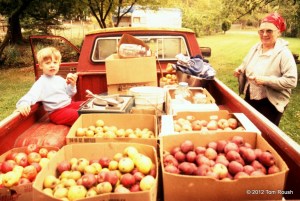
The truck full of apples we took down to make Cider with.

…on a cider press that’s probably 100 years old. It used to have a hand crank, but my Grandpa at one point put an old electric washing machine motor on it and ever since I knew of it, it ground the apples into pulp at the flick of a switch.  You still had to squeeze the juice out by hand though.

Lys and Oma making Apple Cider on a cider press that was about 100 years old

After making the cider and cleaning up, and while Alyssa and Oma (German for Grandma – my mom) did only the kinds of things that granddaughters can do with their Omas, Michael and I went to what had always been my grandparent’s farm and went for a walk among the trees (douglas fir, cedar, oak), basically where I grew up.  I went for many walks out there with our dogs and BB gun when I was a kid, and often went just to think and clear my mind.

My Grandpa had passed away some years earlier, and at the time, it seemed like my grandma was planning on selling the farm, so I felt I needed to take Michael out there and show him what I used to see and where I used to go exploring before that all changed.  It was very strange, and I found myself quite disoriented sometimes.  There were trees in places in the back of the farm that had been completely free of trees before.  Areas that had been ponds no longer existed at all.  What was reality simply didn’t match up with what I had in my memory.

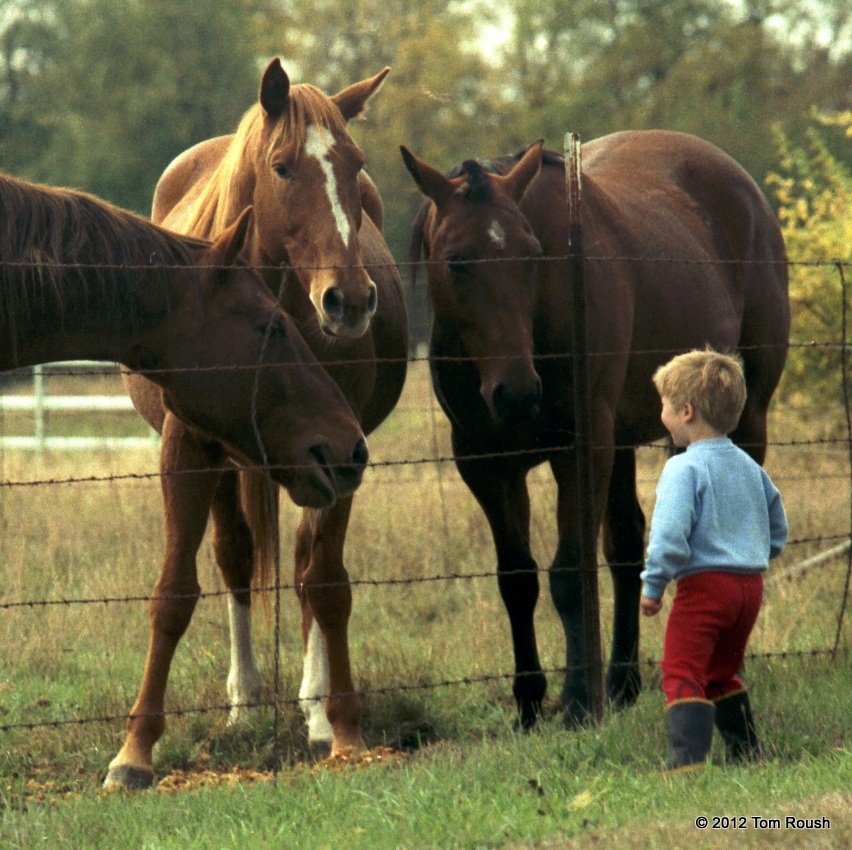
We came to the front of the farm and saw that my grandma was boarding some horses on the land and they came up to us and just wanted some attention (and some Apples).
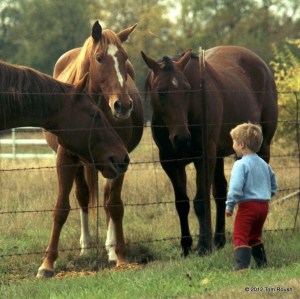
Michael and the horses

So we petted them, and Michael later stood up on a stump and scratched one of them while the other one nuzzled him…  It was really neat.  It’s one of those experiences I hope will stay with him for a long time…

Michael and I explored the swamp in the back, and watched several frogs try to jump away from him, one rather large one managed to escape just as his boot stepped down.  He was as surprised as the frog was (but probably not as terrified).  We kept wandering and exploring, and saw an area where the water was too deep to be a swamp, and became a large pond.  We heard rushing water and went through a fence to find a beaver dam.  Michael had on his black and yellow “fighter fighter” boots because he “might” want to go into some water, so when he did, naturally he went in just a little too deep, and the water flooded over the top into the boots…

At that moment I decided that I had a chance to either have some fun and make a memory with my little boy and get my feet wet, or gripe about the fact that his boots and pants were wet and — it was a no brainer…

I waded into the creek in my shoes — the water was COLD (it came from, as I recall, Sprofsky Springs), and went through the swamp and then hit the beaver dam.  We later waded down the creek from right below the dam, just to explore, and got completely soaked.  He loved it.  Lost his balance, I caught him just as his bottom hit the water…

We came back, me squishing in my wet shoes, him sloshing in his wet boots, and saw this HUGE anthill and were both watching it intently when this fairly sizable spider walked into the picture.

Mistake.

Even though the ants were much, much smaller than the spider, they took it down.  It was like watching “Nature” on PBS.  Michael, who’d decided he was scared of spiders, suddenly found himself seriously rooting for this one, and was first interested, then incensed that the ants could do that to a spider.  It was truly amazing.  Michael first wanted to throw things at the ants, then thought better of it, and decided he wanted to know what ants REALLY liked to eat, and maybe he could get their attention away from the spider with that.  I thought that was nice.  He wanted to save the spider, but didn’t want to kill the ants.

Afterwards, he had a rock in his hand, and was wondering how the ants would react to it.  I thought back about 20 years, and how I’d thrown rocks at the ancestors of those same anthills, and how typical that was of a young boy.  He asked what would happen if he threw the rock, and then asked if they would attack him.  (Given what he’d just seen, that was a pretty valid question).  I didn’t say yes, but kind of let him make up his mind on his own.  He ended up dropping the rock on the ground next to the anthill, feeling some vindication because he may have killed some of the ants that had killed his new found spider friend, but also feeling good that he hadn’t killed all of them…

We sloshed and squished back to Oma’s, and ended up having some of the cider we’d made that afternoon with dinner that evening.

Eventually I packed up some of that cider, a lot of memories, and headed back home as the kids drifted off to sleep in the back of the car.

It was truly a wonderful weekend, and I went back to work on Monday morning to a job I enjoyed, a job that allowed me to support my family, but away from the trees and forests where I grew up…

Sigh…

God has been good.

Take care, folks.


Every now and then I get this urge – no, not just an urge, almost a command, to write a story – a post, if you will, about something specific… What’s strange sometimes is that this one you’re reading now kind of popped up last night – and while I’m not sure why it’s important to post it now – it feels like I should.  So come with me as I take another trip into my time machine – the one that looks like an old yellow Kodak photo paper box, and learn a lesson or two in a photo I took once, a long time ago.

First the photo:

I was in college, and was trying to photograph one of the parts of the Homecoming celebration for Seattle Pacific University, which included the men’s heavyweight eight man alumni crew racing each other down the Lake Washington Ship Canal right near the campus.  I’d developed a friendship with the coach for the crew team, and because of that, I was the only photographer allowed to get on the boat he was coaching from.  This gave me the chance to get into a position to get a much better shot than any other photographer out there as they were finishing the race.  We talked (well, shouted to each other over the motor on the coach’s boat), and I was able to get him to position his boat to show how close the race was by crossing the finish line at the same time the lead boat was crossing it, the goal being to show the difference between first place, the winner, and second, the, well, the loser.  However, it wasn’t the closest race in the world – the other boat is cropped just out of the frame at the bottom right, but something magical happened as I was setting up for that shot, something I wasn’t expecting at all.

As I was looking right to gauge where the second place boat was to try to figure out what to do next, I saw this duck, barreling down the canal as fast as it could.  I checked the settings on the the camera – (a Nikon FM2 with a 100 mm Nikkor lens on it that I’d borrowed from a friend) I saw I was on frame 36 (yes, film, and yes, the last frame) that I was shooting at f/8 and 1/250th of a second – the film was Tri-X black and white film, pushed two stops to be shot at ASA 1600 because everything I was shooting that day was going to be either moving fast or in low light, or both.  I realized I had precisely one chance to make this right, and focused on the far boat, wanting to get the expressions of the guys in the crew shell in focus more than the duck, I’d just let the depth of field cover that.  As I was looking, I realized that with as much planning as had gone into getting the shot I wanted (the two boats finishing the race) – that wasn’t the shot I needed.  In fact, the shot I needed was far better than the one I wanted, and I had to make a decision, instantly:  Either take the shot of the boats and tell the story of the race, or take the shot of the duck, and tell the story of another race, that no one had planned for, that had been a surprise, a chance that would be there and gone in the blink of an eye.  I chose the duck, and decided that as soon as I saw it appear in the right side of the viewfinder, I’d push the button, with the knowledge from experience that it would take about 1/10th of a second for all the mechanical things in the camera to actually do their thing to expose the film. In the meantime, the duck would be moving across the frame at about 30 mph.  If I waited until the duck was where I wanted it to be before I took the picture, it would be gone by the time the camera had actually exposed the film, so I had to think on my feet, on a moving boat, and make decisions fast.

All the other sports I’d shot, there would often be a second chance, another basket, another goal, another… whatever.

This time, I had one duck, one boat, one shot.

I’d brought the camera to my eye, focused on the sharp point of the boat, and as I saw the duck enter the frame from the right, hit the shutter release, felt and heard the camera take the shot, then heard the motor drive whine and jam, telling me it was at the end of the roll.  I wasn’t sure if I’d gotten the shot or not, but I’d done everything I could to get it.  I automatically rewound the film, popping it out and putting it in a separate pocket from all the other exposed film, and loaded another roll, but the duck was gone.

I could hardly wait to get back to the darkroom to see what had happened and sure enough, when I got the film developed, I found the image, and it was indeed, the 36th and last shot of the roll.

And so what’s the big deal about the image?

Well – it’s a duck.

And a boat.

And the guys?

They look like they’re racing the duck which makes it fun, but they’re really looking for the finish line, which painted on both sides of the canal, is just out of the frame on the left on their side, and just to my left behind me.

But I only had the one chance, and I’m glad I took it.

And it got me thinking, this photo, and I learned that as much as we want to believe in second chances, there are times in life where you get one chance to do something, and that’s it.  Life will go on, but it will be different, and you will never know “what if” something else had happened.

Think about it: Often, life is a lot like the GPS system you might have in your car or your phone, where if you make a wrong turn, you get this message that says ‘recalculating’ as it tries to get you to go back on course, and because it’s doing that, you’re being given a second chance to do something that somehow you muffed up.  The muff up could have been simple human error, it could have been not being prepared for what you were facing, it could have been something completely out of your control, but the fact is, what you planned to happen, didn’t, and now you have to sit there while something literally tries to get you back on the track you’re supposed to be on.

Then there are the other times.  Some of you know I spent a number of years as a photojournalist, and saw many, many things through my viewfinder as I was shooting.  The thing about shooting with an SLR is that you never actually see the picture you take.  You can see what happens immediately before the image, and what happened after, but it’s only your training, your eye, or your instinct that tell you when to take the shot.  You have to trust that everything worked in that blink of an eye when everything, the event in front of your camera, the experience behind it, came together.

I kept thinking, and like many of you, found myself wondering what it all means.  And I guess it’s this:

There will be times in your life when you have one chance, and one chance only, to make a difference in some way.  It may be a life changing experience for you, or for someone else.  It may be something that comes completely out of the blue, and goes against everything you ever planned for that moment, but (and I’m speaking to myself just as much as I’m speaking to you) I encourage you to take the chance.  It’s possible, just slightly, that something magical will happen.  It might be in your job, it might be in your family, it might be taking a chance on repairing a strained relationship, or giving someone a second (or third) chance because you know what it’s like to not have that option.  It might be simply holding someone you know at the funeral of someone you barely know. It might be taking a chance at applying for a job you don’t think you’re completely qualified for, but that will fit you like a glove, or that you can grow into.  It may be finishing that last, painful cancer treatment that takes so much courage to go to when you know what it will take out of you.

I don’t know.  All of the things mentioned above have happened to friends of mine or me in the last few weeks.

So…

Take the chance.

You might make a difference in someone’s life.

And it might be your own.

Or – you might get a cool picture of a duck that reminds you of every one of these things many years later.

So take care out there, folks.

Be safe…

Love each other while you can.

Be prepared for what you can be prepared for – and at the same time, be ready for when plans change, because they can, and will, with barely a moment’s notice.

Oh.  One last thing.  Here’s the photo I’ve been talking about.
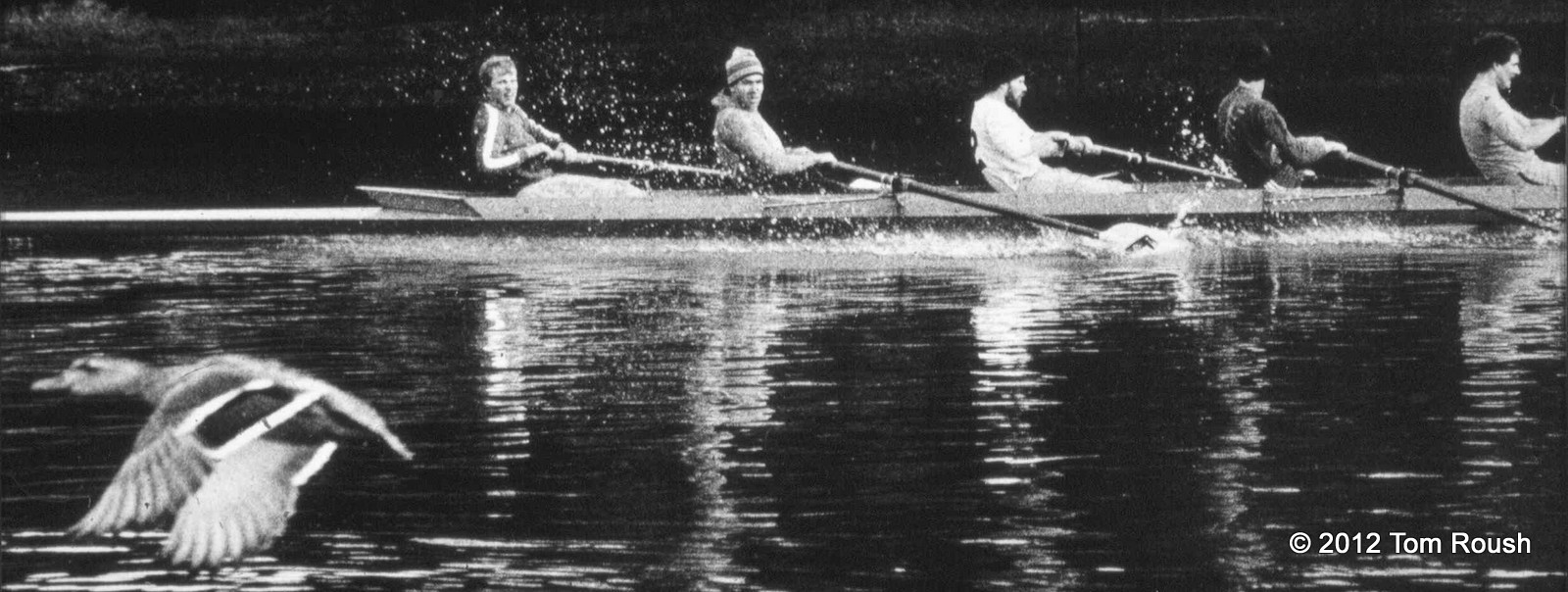
The Duck… (click on it to make it bigger)


My Opa (grampa in German) was in the Army in World War 1.

Yes, the First World War.

The war that happened before just about everything we take for granted in today’s world existed.

Before cell phones.

Heck, before most people had seen or heard wired phones.

Better yet, before most homes had electricity.

In fact, before most homes had indoor plumbing.

World War 1. 1914-1918. Back when most armies still depended on horses, and when the Red Baron’s plane not shooting its own propeller off was the epitome of technological advancement.

That war.

At the time, military inventions came at such a furious rate that they allowed soldiers to kill one another with enough ruthless efficiency that it became known as “The War to end all Wars”.  Of course, this “War to end all Wars” ended almost 100 years ago, and since that time, there have been countless other ones, and literally millions of people have died as a result.

But this story, while about war, isn’t about the death that always accompanies it.  It’s a story about life, day to day life, and it involves simple things.

It involves shovels, potatoes, and cannons.

…and very, very close calls.

Let me set the stage for you.

Russia.

World War 1.

Europe, if you don’t remember your history, was a powder keg. There were a whole bunch of countries in Europe at the time, from itty bitty, to absolutely massive, and they’d decided to make alliances between themselves.  This was the governmental equivalent of you telling your buddies, “Hey, if they mess with you, they mess with me…”

This would have been okay if it were just one or two people.

But it wasn’t.

It would have been okay if it had been one or two countries.

But it wasn’t.

In fact, it was two rather large groups of countries, with alliances so tangled up that they looked like a plate of spaghetti.  On the one side were what were known as the Allies, with a whopping 18 countries with over 42 million soldiers, from comparatively tiny (and distant) countries like Nepal and Montenegro, to behemoths like Russia, the United Kingdom, and France.

And then we have what were known as the Central Powers on the other side.  This included the German Empire, the Austro-Hungarian Empire, the Ottoman Empire, and the Kingdom of Bulgaria. They weighed in with just under 23 million soldiers.

Two of the countries in these groups, on opposite sides, were kind of like a David and Goliath, where the part of David was played by the German Empire – long before it became what we now know as Germany, and the part of Goliath was played by the country of Russia. (except this time, in the end, Goliath would win)

They squared off, and the Armies of the German Empire headed east and invaded Russia.

Now if you know your history, you know that a little guy named Napoleon had tried pretty much the same thing about 100 years earlier and failed miserably, and another German army would try it again in less than 30 years.  Eventually, armies would learn that trying to conduct a war while the famed Russian winter waited on the sidelines was a bad idea, but for now, they attacked.

Of course, an invading Army goes through fuel, food, and equipment faster than any civilian could imagine, which is why there was rationing of everything in all of Germany for civilians during the war. And in case the shipments of supplies were interrupted or they ran out, those in the invading force were given Plan B.

Plan B was simply this: “The supplies aren’t coming. Fend for yourselves.”

If they had no supplies, they were to “live off the land” – meaning they would take what they could from the civilians, the farmers, the peasants, the Russians who lived there, and being soldiers, could easily do it at gunpoint.

Of course, doing so meant that the Russian civilians would starve, so those who understood what was going on, headed east in a hurry.  Those who didn’t, were evacuated east away from the invading army as fast as they could be, with the Russian army following close behind, burning everything behind them to keep their enemy from being able to use it. This meant not just single homes were destroyed, but entire farms and villages went up in smoke, and anything that could possibly be of use to an invading army was reduced to ashes.

It was a very effective “Scorched Earth” kind of retreat when they succeeded.  There were no vehicles to “borrow”, no houses to sleep in, but at a more basic level, there were no crops to harvest and eat.

This worked very well for the crops that grew above ground, and it worked for crops that hadn’t been harvested, but if there was one thing the Russians were good at growing, it was potatoes, and when they needed to be stored, the place that worked best was actually below ground.  A large hole was dug, and as I recall, lined with straw, the potatoes were put in there, more straw if it was available, and then dirt was mounded on top.

It was the stereotype of lots of Russian ways of doing things, from farming potatoes to putting a man or woman (or dog) into space.

It was simple.

It was reliable.

And it worked.

The potatoes were preserved against drought, against frost, but most importantly, in this case, they were preserved against fleeing armies.

And right behind the fleeing army came the pursuing Armies.

The pursuing Armies were advancing fast and far enough at the time to outrun their own supply lines, which meant that they had to go to that Plan B for a lot of their supplies.

Plan B, mentioned earlier was simple, a bit more reliable than supplies that weren’t coming, and, as brutal as it often was, it worked.

When you have all sorts of weapons, it becomes pretty easy to fend for yourself.  So if there were weapons left behind by the fleeing army, they were taken, to be used by the invading Army.  If there was any useful mode of transportation available, it was taken, to be used by the invading Army.  If there was food left that hadn’t been destroyed, it was taken, to be eaten by the invading Army.

And in this Army, the pursuing one, was my 24 year old Opa, and because he was in the infantry, he was assigned to help the Army do Plan B: Fend for itself by getting food from wherever they could get it.  He’d been told about these lumps they might find in the fields that would be covering a hoard of potatoes, and one sunny day he and a buddy went out looking for them, and sure enough, in one field, on one fall afternoon, there was this little shed not much bigger than an outhouse.  It’s where all the tools were kept for the peasants to work the fields, so they broke into it, got some shovels and started digging.

They’d made it through the first layer of dirt and were working through the straw and had just seen their first potato when they heard a cannon fire.

It was a war zone, cannons became part of the background noise, and they were always far away, so they didn’t pay too much attention to it because of how far away it was, and kept digging.

They’d gotten a little deeper when the same cannon fired a second time.

Opa had just stood up and was wiping his forehead when he saw that shell hit.

It was a little closer.

They started paying attention, and while he was standing, the third shell was fired.

It landed closer still.

By this time the two of them realized what was happening.

Even 65 years later, the disbelief was still clear in his voice as he told me, “They were ranging on us!”, and he was amazed that the Russians weren’t so much aiming at them as just elevating the cannon a little higher with each shot, hoping for a hit.  They’d used up three shells already, trying to hit two guys out in a field, and were clearly not concerned with conserving ammunition.  Opa and his buddy saw the spacing on where the shells had landed and realized the next one would likely hit them.

Then they heard the cannon fire again, and heard the shell come in, with that unforgettable “oncoming freight train” sound a cannon shell makes when it’s coming toward you.

They tried to hide, but they were in a field with nothing in it but a lump that the potatoes were buried under and a shed the size of an outhouse.  There wasn’t much they could do, and there was even less time to do it in.   On top of it all, this shell was different.  It was an air-burst shell, and by the time they dove for cover behind the little shed, the shell was there – and it exploded several meters above them.

The explosion shattered the shed, missed Opa’s friend, but one piece of shrapnel shot into Opa’s leg in the back just a little north of where the thigh no longer has a decent name as he was diving for cover.

He never told me how he got back to his unit, but somehow, he did get there, where his injury was determined to be enough to send him back to a hospital to have the shrapnel removed. It had just barely missed, but was still very close to his femoral artery.  It needed to come out.

He was put on a train to the “Lazaret” (hospital) in Berlin, and as he told me the story years ago, he tried unsuccessfully to imitate the accent of the doctor who’d treated him.  At the time, almost 100 years ago, most people lived their whole lives within 10 miles of where they were born, so regional, even local accents were very, very distinct, to the point where if you were paying attention, you could tell what village someone came from, or what part of a bigger city they came from, just by listening to them speak a few words.  So, being from a town in southern Germany, he spoke the Swabian dialect (Schwäbisch) and couldn’t resist poking a little fun at the Berlin dialect of the doctor who’d treated him.  Imagine someone with a gentle Georgia drawl, and gentle Georgia personality, poking a little fun at and talking to someone from, say, New York, with the mentality and accent to match.

The medics on the front lines hadn’t treated the thing other than to stop the bleeding, and Opa likely laid on his stomach the whole train trip from wherever he was in Russia all the way to Berlin, so by the time he got to the Lazaret, things had gotten a little infected.  The doctor listened as Opa told him what happened.  Curious, both personally and medically, he took a look at it, saw the infection, and said, “Ach, das schiesst noch einmal!” (Oh, this is going to shoot again!) – and sure enough – a little work with a scalpel, a little pressure with a couple of fingers, and in the Lazaret in Berlin, the piece of Russian shrapnel shot again, this time coming out of Opa’s leg.  He was cleaned up, stitched up, and as Penicillin wouldn’t be discovered for another 10 years or so, he spent the rest of that winter in Berlin while the infection cleared up and he recovered from the injury.

In the spring, he was sent to be reunited with his unit, and when he got there, he found that of the 600 soldiers that had gone to the Russian Front the previous fall,  only 60 were left when he came back.

It was then that he realized that how much in war, and in life, depends either on luck, or on the fact that there’s Someone Up There watching out for you, and that simple order to get potatoes, the same one that had put him in the sights of a Russian artillery piece, the same order that had put him in the “wrong place at the wrong time” and had gotten him shot, had likely saved his life.

He thought about that a long time, trying to find out about his friends who he’d lost, and never really knowing, as there had been so many of them.

He didn’t spend much time talking about the War.  There are some things best left unsaid to those who were not there to experience it with you.  But while he didn’t talk much about it, he did spend a long time thinking about it.

Life, as it’s known to do, moved on.  He got married to a farm girl and they started their own family.  There would be the great Depression of 1929, there would be unemployment and poverty, there would be another War that would make the first one look like child’s play, but there would also be happiness, and children, and baptisms, and first days of kindergarten, and confirmations.  And there was more hardship, but as I said, time went on, and soon there were joyous weddings as they watched their children get married, followed by grandchildren who brought them great joy.

As for that piece of shrapnel, to my knowledge it was not kept, but I thought about it just like Opa had, and the longer I thought about it, the more I realized that were it not for that piece of Russian shrapnel, it’s very likely that none of that above would have happened, my mom wouldn’t have been born, I wouldn’t be here to write this story.

And you wouldn’t be reading it.

Note: About 60 years after this piece of shrapnel changed the history of Opa and every one of his descendants, one of his grandsons would experience something similar, being in the range of a cannon being fired, and he would understand the sound of a cannon shell coming in, would remember a story he had heard years earlier, and as he thought about it, would understand far better what his Opa had been trying to tell him.

Tom Roush

Archives