You are currently browsing the tag archive for the ‘Friends’ tag.


The other night some friends had an “Oktoberfest” – where they blocked off the street in front of their house.  There was bratwurst, sauerkraut, potato Salad, and of course, beer.  On top of it all, was this overwhelming oompah music.

It’s funny, as I was writing this story – I realized there was a theme in it that I hadn’t even noticed –

It took me back many years – the last time I was in Munich, when our friend Martin, his brother Wolfgang, my sister and I drove down there from the Ludwigsburg area where we lived, and took in the sights.  We went to the park they’d made for the 1972 Olympics, went up the tower.  You could see the BMW Museum from there, so we went to visit that, where I discovered that they absolutely don’t like you touching the artifacts (since I’m an official airplane nut, I was looking at, and in this case touching, a WWII airplane engine – I’d just reached out to touch it when I heard a very loud, very German voice on the loudspeaker shatter the otherwise almost reverent silence of the museum.  I looked up and froze.  The camera that had been aimed at the engine was now aimed straight at me, with a red, almost laser like light on it that made it clear I’d been both spotted and caught.

Yup… Deer in the headlights, that’s me.

It was very clear that I was to keep my hands off the merchandise…

The tone in the fellow’s voice made it very easy to imagine that in a control room somewhere, a security guard must have been marking a little notch in what would translate as his gunbelt… “Yep, got another one…”

I was embarrassed, and not just a little terrified, but what could I do?  So we left.  By this time it was afternoon, and went to the German Museum where they had all sorts of exhibits and displays, and for whatever reason we started at the bottom, and were in the middle of this exhibit on some kind of ancient Babylonian or Mesopotamian stuff when the lights started flashing and we thought either there was a power outage or – then the siren went off.

I figured I’d touched something wrong.

Again…

Turns out it was neither.

It was the fact that the place was closing down, and of all things, at 4:00 on a freaking Tuesday.  With me being the aforementioned airplane nut, instead of going straight for the airplanes, we’d wanted to see everything, and were planning on saving the best (airplanes) for last.  When I heard on the loudspeaker the rough German equivalent of “Attention K-mart shoppers, the store will be closing in 5 minutes, please take your purchases to the checkout stand.” – okay, so it wasn’t K-mart shoppers, it was all of us who’d come thousands of miles to see the exhibits, only to find out at the last second that the place was closing before we could see everything.  On that realization I just about went nuts and tore out of the Babylonian exhibit into the lobby area.  I looked around, found the signs to the second floor and tore up this huge curved staircase to the second floor where the airplanes were.  I was running so fast that it’s possible to truthfully say that I ran rings around a V-2 Rocket (okay, so the rocket was in the center of the curved staircase I was taking two and three steps at a time), and I arrived panting at the door of the hall the planes were displayed in just as a rather burly, and fairly stubborn guard locked the door from the inside.  (Note: you don’t get much more stubborn than German stubborn, unless you’re talking Hungarian stubborn – don’t ask me how I know this 🙂

I tried to plead my case, but my Schwäbisch accent was no match for his Bavarian accent and attitude – and he was the one with the key in the lock.  I could only look through the now smudged windows at the planes I’d come to see, neither realizing, nor being able to convince the guard, that this might be my only chance to ever see them.  He didn’t seem to care.  I remember seeing a two seater Me-262 and the only Do-335 in the world – oddly, without the swastika on the rudder, like most planes of the time had had – but then I realized, even then, that the echoes of WWII were still there, and the law was clear: absolutely no swastikas – even if they made something historically accurate.  You couldn’t even buy a model WWII airplane with the right decals…

Once the doors were closed, there wasn’t anything else to do there – I was so frustrated at the time I don’t even remember taking a picture of anything.  Wolfgang, Martin, and my sister showed up about then, and, knowing that this was something we – especially I – had wanted to see, they tried to get me out of my funk… I mean, getting kicked out of – well, “encouraged” to not come back to the BMW museum until I could behave was one thing… Having the dang exhibits in the German Museum close in my face was another.

We were hoping to not make it a “three strikes and you’re out” kind of thing, but I was seriously frustrated.

It was hard to acknowledge it at the time, but aside from that, we’d had a pretty good day.  We’d driven well over 100 mph on the famed Autobahn, to the point where slowing down to 60 when we got into Munich made us want to get out and push, we’d seen priceless works of art, items that were literally one of a kind on the planet – and – it was almost as if Ferris Bueller had taken a day off and gone to Munich, instead of going to Chicago.  Somewhere in there we got onto a subway and got out at the Marienplatz in the square in Munich and watched the famed clock tower (or Glockenspiel) strike, I think it was 5:00 in the evening by the time we got there – and our friends, realizing it was dinnertime and still trying to help overcome the last Museum bust, wanted to take us to this place they called the “Hofbräuhaus

We were tired, had done a LOT of walking, and were to the point of not even caring anymore, but they insisted, so we went in – and were suddenly surrounded – no – immersed – in Bavaria at its finest.

To say that the Hofbräuhaus had atmosphere would be like saying water is wet, and this atmosphere was thicker than the proverbial pea soup.

First: The music.  I know there are people who think that the definition of “perfect pitch” is when the accordion you just tossed out lands on the banjo. I’m not sure how many banjos there were, and I didn’t take any pictures, but Lordy, you have never, ever heard “Ooompah” music till you’ve heard it played by a bunch of well lubricated Bavarians. (there was an accordion, a tuba, a baritone, I think a trumpet and a trombone)

Tourists like us were there, but it was the locals who were just a delight to watch.  I’d heard the song most Americans know as the “Beer Barrel Polka” – but the words were a lot different, and came across sounding more like the music here: “Rosamunde”.  (the video’s not from the Hofbrauhaus, but watch the crowd in the video to get a sense of what it was like).

It looked like the people in the band wouldn’t remember it the next morning.  In fact, it seemed the band was on complete autopilot.  Waitresses kept their steins full, and they played – well, like a well lubricated machine… it was a wonderful background to everything else.  Occasionally the crowd would join in and we’d see people standing up, arm in arm, singing their lungs out.

There was smoke from any kind of tobacco, but above it all was the astounding smell of beer.  Not stale beer from a place that’s been serving beer for the last few years and hasn’t been cleaned up, but fresh beer that’s been poured in the place since 1589.

Like for more than 400 years.

There was a sign up at the front where the bartenders were filling the 1 liter steins as fast as they could, something to the effect of “Wet Floor” – and they weren’t kidding… there was beer all over the place, and you did want to be careful to not slip on it.

Why was there beer all over the place?

Well, part of the answer lay in the regulars.  It seems that the place has special tables for them. A lot of them are pensioners who live in apartments nearby and come for the camaraderie, the social aspect, the food, and of course, the beer.  What’s surprising about them is the vast quantities of beer some of them can put away.  I was talking to a fellow who’d been there a few times, and had seen this little old man, couldn’t have weighed more than 100 pounds, put away several liters, every evening, every time he showed up.  These are guys who by any other definition would be considered alcoholics – but there, they show up (and have been showing up) daily for years, and they have their usual table, the waitresses know them, know their orders, and keep them happy by keeping their beer mugs full.

Now those waitresses, to keep from having to make too many trips to serve a table, take as much as they can carry with every trip.  This means that invariably, some glasses spilled, some fell, some broke, (hence the  warning signs about the wet floor) but for the most part, the beer gets to where it needs to be.

So it was this expectation that helped set up our next encounter.  We were led to our table, and as the waitress came over, we realized we’d spent most of our money on museums, trips up the tower, and souvenirs.  We pooled all our money together and realized that if we subtracted the money for the souvenirs we wanted to buy there, subway money to get back to the car, gas money to get the car back to Ludwigsburg, that left us with enough for – um – one beer.

Split four ways.

Oh oh.

So one of the things that’s important to know is that a good percentage of the tourist photos show gorgeous young Bavarian women serving beer in places like this.

They’re models.

The real ones aren’t hired for their looks.  They’re hired because they can carry, over the course of a shift, hundreds of liters of beer to their customers.  They keep the customers from getting too thirsty, they keep them from getting too hungry, and they keep bringing whatever it takes to keep the customers satisfied and happy, as they’ve been doing for several centuries.

Our waitress looked like she’d been there since the place opened.

She looked tired.

And it looked, from everything we could see about her, that she’d had a day we, as tourists, couldn’t possibly imagine. She looked like we were her last table and she was looking forward to going home, soaking, then putting the feet she’d been on all day up and getting a chance to rest a bit before starting it all over again.

She just had this one last table to deal with, and at that table were four teenagers and a pile of change.

She straightened her apron out a bit as she got to our table and was all business:

“Also, was möchten sie?”

(Her words said, “So, what would you like?” but her tone said the Bavarian equivalent, “So, what’ll it be?”)

We looked at each other, swallowed, and then together, said, “Ein Bier.” (one beer)

“Also gut… Vier Bier.“

(“Right… Four beers”)

„Nein… EIN Bier.“

(“No, actually, ONE beer.“)

„EIN BIER? Da sind ja doch vier von Euch!“

(“ONE BEER? But there’s FOUR of you!?“)

She looked at us with a combination of disgust and disdain that can only be done by German and French waiters.  Add to that a look of confusion, like a mathematician who’d just discovered that dividing by zero didn’t work.  In her world, one customer = many beers, not the other way around.

We kind of stared at each other, and it was then that we realized the first rule of the Hofbrauhaus:

It is not, repeat, NOT a good idea to – um – ‘irritate’ a Bavarian waitress… I don’t care how many weights you’ve lifted, they’ve lifted more, they’re stronger than you are, and they do it for eight hours at a stretch.

As we were coming to that conclusion, the day finally got to her and she absolutely went off on us.  I don’t remember her exact words, but they translated roughly to:

“How can you possibly expect me to make any money if my customers only order one beer?  I mean, you’re sitting there taking up four spots, and only ordering ONE beer? There’s no way you’re ordering one beer, that’s not just unheard of, that’s an insult.”

Uh… right… insults were off the table.

Then again, now that she had set her expectations: “Also, was möchten sie?”

(Again, her words said, “So, what would you like?” but the tone said, “Alright, really, let’s get this show on the road… what else are you going to order that is going to make it worth my time to even see your faces again?”)

We dug deeper into pockets, wallets, whatever might have a little extra money, and ordered some kind of pork roast, some sauerkraut, and I think there might have been some mashed potatoes.

And one beer.

And oh, my, it was good.

The beer was strong enough to pack a bit of a punch, but between the four of us, none of us had enough to worry about. The pork was amazing, and the sauerkraut was something you’d just have to go there to experience.  It was amazing.  We pooled enough money for a tip, left what we could there, then headed out into what was now night..

We got to the subway, then to the car, but didn’t drive 100 on the autobahn this time.  This time we slowed down to about 80 mph.

Because it was dark.

And because it was raining off and on.

Martin wanted to be safe and drive even slower, but there’s something about German drivers and the autobahn, and by golly, they’ll drive as fast as they can.  We were constantly having to move over so that other cars could pass us.  The law’s pretty clear over there.  If someone wants to pass you, you let them.  Martin had been moving back and forth and was getting tired of it, so decided to stay in the fast lane.  One driver made his thoughts very clearly known to us by getting so close that I, in the back seat, couldn’t see his headlights past the trunk lid. Martin finally moved over, and the last thing I remember of that day was that the silhouette of a Porsche 911 with a glowing exhaust pipe as it passed us.

Oh – and we did get home.  I’d managed to save enough for one souvenir that actually survived the trip back, and that I still have after all these years.
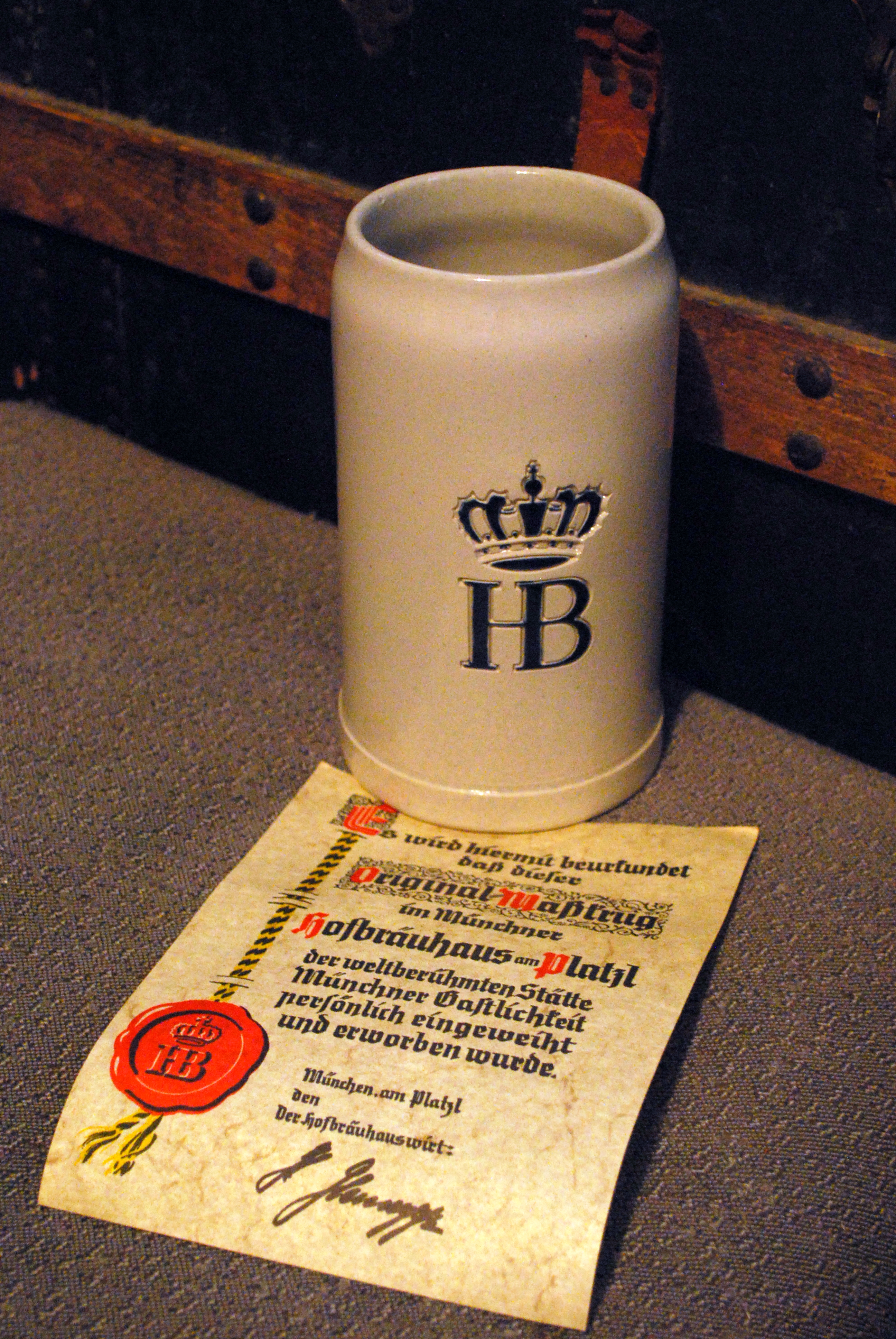
One, genuine beer stein from the Hofbrauhaus


Many years ago, I was in Civil Air Patrol, the Official Auxiliary of the United States Air Force.  Among the missions of the Civil Air Patrol is Search, and Rescue.

I’ve mentioned it before, there were other things we did, but one of the very important things we learned was all about Search and Rescue, or SAR.

One the hallmarks of a good search was when the person was found.

One of the things that made that possible was the organization that was part of every search.  There was communication (we had an old M-715 military surplus communications truck (mentioned in this story) with radios of all varying frequencies, so we could be a relay to the myriad of agencies that could be part of a large search), there were all the volunteers who showed up, and then there were the people who did the searching.  Sometimes the searching was done from the air, but that was to get a general sense of where things might be.  The end of a search was often done from the ground.  In both circumstances, we would work what was called a grid pattern, so we would always know what had been searched, and what had yet to be searched.

What was drilled into us at the time was that you searched a part of the grid, and if you didn’t find what you were looking for, you crossed that square off, and then moved to your next assigned section.  It was almost sacred, how important that was. The commanders had to know with 100% certainty which grids had been searched and which ones still needed to be.  Therefore, you did not, under any circumstances, deviate from the grid pattern.

Ever.

So to practice these searches, and these techniques, we had training.  Each squad (two to four cadets) had a map of the area being searched.  We each had a compass, and we had our assigned grid sections.  And we did everything we could do to be prepared for any emergency, at any time.

And then one day, every member of the squadron got a phone call.

The phone call.

Someone was actually lost.

Someone needed to be both searched for and rescued.

This time it was for real.

This time someone’s life was really on the line.

This time someone needed help, and so with adrenaline flowing like never before, we all did what we’d been training to do for what seemed like ‘ever’.  We gathered our pre-packed gear, put on our uniforms, and assembled the squadron to go to find this person who’d completely disappeared.  The family was in shock, and for everyone’s benefit, the person in question needed to be found.

We created a command post near where the person was last seen.

We assembled our vehicles.

We spread our maps on the most convenient flat thing around (that would be the warm hoods of cars), got our compasses out, and planned our search.  To be honest, it looked very much like an old war movie.  The only thing missing was an old Jeep and mugs of bad Army coffee.  Actually, come to think of it, the maps were held down on the hoods of those cars with what was probably cups of, by then, lukewarm 7-11 coffee.

After the planning, we were each assigned a section, and the leaders would gather their squads together and give instructions.  We’d go out initially in groups of two or four cadets, each squad having one copy of the map of the area divided up into the now familiar and very sacred grid pattern, and we started searching.

In my group, there was Aaron, Bruce, Dave, and me.  Aaron had this back problem, so he had this huge brace that he’d wear from his hips to his neck, and we’d always want to be careful that he didn’t hurt himself. The thing we weren’t used to was that Aaron’s view of the brace wasn’t that it was a hindrance, but that it was just part of life, and being careful about it really wasn’t something he was concerned with.  So we went and searched the grid area to the northeast of the house, and since this was a real live search, we were going to leave no stone unturned.  If this person was out there, we were going to find them.  It was a matter of safety for them, and a matter of pride for us, so we put all our training to use, and we searched.

Now one of the things they didn’t tell us about this grid pattern was that if there was something truly in your way, you could walk around it.

In fact, they’d never said we could walk around anything.

I suppose because when they drilled it into us that we were to maintain those straight grid lines, that we hadn’t thought to ask, but when we got to our designated section of the grid, there was this huge, house sized thicket of bushes in front of us.  A lesser (or a smarter) group of people would think thoughts like, “If you can’t even part the shrubbery, how could you possibly get there to actually be lost?” – Seriously –the bushes were so thick we couldn’t even get into them, much less get through them.

At all.

But remember, this was during a time of youth. This was when we were full of energy, testosterone, and Infinite Teenage Wisdom®.

And Aaron, bless him, said, “Grab my brace and push me through!”

We thought he was nuts.   This was like taking someone’s cast off their broken leg and beating off an attacker with it – it just didn’t seem right.  But Aaron insisted, and so he got in front, I remember grabbing his brace through his shirt, Bruce had his hands in the middle of my back, and – well, I couldn’t see what happened past Bruce, but on the count of three, we all shoved Aaron into the thicket.

We had to do it over and over, and each time, pushing Aaron a little further into the thicket.

Luckily, this wasn’t a briar patch, or images of Brer Rabbit would have been quite appropriate.  No, this was just a thicket of bushes, along the side of this country road that was on our grid.

Eventually we made it through the other side of that thicket (which was really deeper into the woods), and this may not come as a surprise, but we didn’t find that our lost person was in there.  We radioed that our grid was clear.  We were ordered to split up and I was given another grid with another cadet.  This time we were to be walking on public roads, so we were issued bright orange vests to go over our fatigues.  That way it would be safer, and our presence would be obvious from some distance.

We walked some distance on that road, making some turns and such, following the instructions on the map we’d been given, but again, didn’t find what we were looking for, so we were able to successfully mark that grid clear.  We were invited to come back to the command post for a break, and so we headed in that direction, but while the map seemed to show us that we were heading back, the countryside looked quite unfamiliar.  In fact, we had walked quite some distance, and because we were to cover all the ground in our grid, had taken some turns we weren’t expecting, turns we didn’t see until we got there to take them, and eventually, unintentionally, had walked off the edge of the map, so to speak.  We had to backtrack a good bit, and were coming back in from a direction we hadn’t planned on coming back from.

Eventually we started seeing familiar territory, and I decided to call the command post on the radio and let them know we were on the way in, and I heard a voice on the radio say something that I still remember to this day.

“Understood. I’ve got you in sight”

Have us in sight?

How could they have us in sight?  For that matter, how long had they had us in sight?

We couldn’t see them, how could they see us?

It turns out they had binoculars – and because we’d gone off the grid, we were late coming back, and they were looking for us.  In fact, they’d had some hot food and something to drink ready and waiting for us, and had been keeping track of all of us for some time as we were walking back…  Those orange vests we’d thought were so funny earlier were actually turning out to be pretty useful, and even then, it got me thinking. How many times do we wander off on our own merry way in our lives, going places we really don’t have any business going, that don’t make any sense at all?

It made me wonder how many times we actually work hard at doing the stupid things we do in our lives, either allowing ourselves to be pushed, or even enlisting the help of our friends to push us into places we really shouldn’t be.

And sometimes we end up completely off the grid, in places we didn’t expect to be at all.

How many times, when we should be paying attention to being where God really wants us to be, do we end up getting ourselves lost, even when we have a map we could use to guide us, or better yet, have a radio we could use to simply push the button and check in?

And how many times, when the light finally comes on, so to speak, and we do check in, do we hear, “Come on in, I’ve got you in sight?”

I’ve pondered that over the years, wondering how often God simply watches us through His binoculars, to see how long it actually takes us to come to our senses, and start heading home, back to the command post, where He’s got hot dogs and cokes waiting for us.

We learned later, after we told the story about the bushes, that we actually didn’t have to walk through things on the grid that were in our way.  We had permission to walk around things that we couldn’t walk through as long as we got back onto the grid again.  Sometimes that kind of stuff happens.  Things get in the way.  You step around them, get back on the grid, and move on.  It turns out that takes a lot less energy than trying to fight your way through something that’s bigger and stronger than you are.

Ironically, had I used the radio I had clipped to my belt to ask about that at the time, I would have gotten a very quick answer right then that would have saved us (and Aaron) a lot of trouble, but we were so busy ramming Aaron through the bushes that we didn’t think of calling in and asking for advice.

Of course, given that we were operating with that ever popular “Infinite Teenage Wisdom®,” that would have made far too much sense.

Over the years, I’ve found myself wondering if there’s an adult version of “Infinite Teenage Wisdom®”. (I’m sure there is)

I wonder how often we do things like that when we grow up, how often we stray from the map, and get off the grid in ways we really don’t mean to, only to get pushed around by things that are bigger and stronger than we are.

I wonder how often we do that and don’t realize that we could just walk around them instead of spending all our energy trying to fight them.

I still wonder how long they had been watching us, and I wonder about that radio I had on my belt, the one that when I used it to let someone know we were on our way back, broadcast the words, “I’ve got you in sight…”

And I wonder how often, in life, even if we stray off the map, we might actually hear God saying words like that if we were really paying attention.

It turns out – both on that search, and in life, we weren’t completely lost.

He’d known where we were all along.


Well, school started for a lot of kids this week – and it got me thinking about my first day of school many years ago.

Mind you, it was grad school, but “The First Day of School” seems to have the same connotations no matter where you go or how old you are.  I got in touch again with a friend the other day, and she was telling me how nervous and antsy she was about the first day of school.

Then I found out she was a teacher.

I guess those “First Day of School” jitters never really go away, huh?

So the first day of school I was thinking about was when I went to Grad school in Athens, Ohio, and I got there in September, a number of years ago.

You know that song, “Try to remember, the kind of September… when life was sweet, and oh so mellow…”

Honestly, I don’t remember this particular September as being quite the gentle one mentioned in the song.  This one involved moving across the country, to a place I’d never been, and doing something that everyone but me thought I was really good at, and learning to be better at it.

I was graciously given a ride down from the Cleveland Airport from my friend Renee’s parents, who were a nice transition from leaving a place where I knew everything to arriving at a place where it seemed I knew absolutely nothing.  We got there in the evening, with enough light to take my suitcase and pack up to the third floor walk-up apartment (a semi-finished attic that was being rented out).  I turned the radio on I’d had shipped ahead on to hear something familiar, only to hear stations from Chicago to West Virginia.

Wow – They were a far cry from what I was used to.  Everything was so new, and I suddenly felt so very far from home.  In fact, not only was everything new, but there was just so much of it to absorb.  On top of that, aside from Renee’s parents, the closest person I knew was a minimum of 2,000 miles away.  The adventure of it all seemed to pale in comparison to the enormity of the distance from all things familiar.

The closest phone was a phone booth at the grocery store a couple of blocks away, so I walked over there and called home to let my folks know I’d arrived and was getting settled, (and, honestly, to hear a familiar voice).

The next day I decided to explore my surroundings, since I was expecting to be there for at least a year, possibly two, so I went for a walk.  I’d been writing a letter, so I took the clipboard I had the paper on, slung one of my cameras over my shoulder and headed out.  I was more than a little astonished at people’s reactions to that.  I’d be walking along, taking pictures of the campus, writing in the letter that I had on the clipboard about what I’d seen, and people would see me and give me a really wide berth, like they didn’t want anything to do with me.  Later I realized that I must have looked very official, and people just wigged out a little, not realizing that at the time, that all I was doing was taking pictures for a letter I was writing to my folks.

Oh well.

One thing I learned on that walk was that the humidity in southeast Ohio was a little different than it was in Seattle.  I won’t say it was humid, but I will say that if you had a potato chip that was too large, you could fold it in half before you gnawed it to death.  It was so humid you really didn’t get much wetter if you jumped into a pool, a shower, or a bathtub.   The apartment I was in had an air conditioner, but all that did was change the climate in that attic apartment from hot and sticky to cold and clammy.  In a nutshell, it went from plain uncomfortable to just plain gross.

I also began to understand the concept of big porches, which we don’t really have much of in the northwest.  You might spend time inside, and you might spend time outside, but that halfway point between the two, the front porch, really doesn’t exist where I come from, so it’s a whole different culture, just by that very little architectural thing, and one of the things you do on a porch is just sit there and watch the world go by.

Now, given that my place had no porch, and because there were very few places in it where you could actually stand up all the way, I found myself staying there mainly to sleep, and the first quarter there I did surprisingly little of that.  The girls on the second floor downstairs smoked, so there was this constant stale smoke smell that permeated everything.  Well, not everything.  If you got close enough to the air conditioner to be cold and clammy, the stale smoke smell lost out to the slimy, mildewy, air conditioner smell.

Ummmyeah… an olfactory experience not to be missed, I tell you…

Not.

On the walls was this old (actually kind of pretty) pine paneling.  But the one thing I really liked about the apartment was the location.  It was literally across the parking lot from the school of art, where I had most of my classes.  I could be in class in 2 minutes flat, assuming I was in the apartment.  Usually I was in one of the studios, the darkroom, or the computer lab.  Like I said, I used the place for sleeping and that was about it.

And so, like many other people in the area did in the evening, I went for a walk, just to get out of the house.  And that early evening, while walking up the street, no cars moving anywhere, I saw a guy, sitting on his porch, at his house, across the street.

Alone.

He was rocked back on a chair, gently fanning himself with a ratty old hat, watching the world go by, which at that moment, consisted of just me.

“Hah!”

(Hah?)

I looked around.

He clearly couldn’t be talking to me.

I mean, he was all the way across the street from me.

In Seattle, where I’d been, there was always traffic.  You wouldn’t dare talk to someone across the street without looking both ways to see if you’d be interrupted or hit by a car or truck or bus coming by.

I looked left and right.

Still no cars.

In fact, no trucks.

Or buses.

Not even a stray cat to make life interesting.

“Haaaayadoin?”

(Haaaayadoin?)

(oh… “How are you doing?”)

I looked back at him – he was looking right at me and obviously talking only to me.

“Uh, fine?”

“Naaas weather, ain’it?”

Nice?

Nice?

I started thinking of that potato chip I mentioned earlier.  It wasn’t – oh, he’s making conversation – I get it.  I’d lived alone for the last year.  I was completely out of practice of simply making conversation, but I gave it a try.

“Um… a little humid.”

He smiled and waved the ratty hat at me.

“Have a naaas dayie”

I waved back, pondered the whole exchange for a bit and kept going…  There was something about the way he waved that would repeat itself a couple of years later in a totally different setting, but that wave, and the willingness to just say hi to a stranger, was something worth more than I realized at the time.

I’d rented the apartment sight unseen from a lady I only knew through several other people.  In fact, I rented it from a payphone at the Safeway on top of Queen Anne hill in Seattle. I’d never done anything like that before, but it worked out well.  She’d mailed me a key to the place, so I was able to get into the apartment, and when I was all settled in there in Athens, I called her, and she came by to show me around.  I didn’t realize that “around” would include a guided tour of the whole town, but it did.

She took me for a ride in her old metal flake green convertible that, honestly, reminded me of a cross between split pea soup, and the worst cold I ever had.  For some reason known only to her and God himself, she had eye shadow to match the car.

She was an absolute sweetheart, but being driven around in a huge convertible snot green 1972 Cadillac with white leather seats by a little old lady, (and I mean little, my gosh, if she was 5 feet tall I’d have been surprised.  She had the seat all the way forward, an old pillow tucked behind her, and was driving this behemoth with her toes) just wasn’t what I was expecting as a young college student ready to take on the world.

I clearly had a lot to learn.

She took me for that tour of town, showing me where everything was.  Most places have a “downtown”. Athens has an “uptown”.

We stopped at a traffic light, in the left lane, the big V-8 engine in front of us almost silent, and were talking a bit about town when another convertible pulled up beside us.  Actually, “pulled up” is far too gentle a word.  This was a bright, fire engine red, convertible VW Rabbit, and I, who had been living alone for over a year, was suddenly faced with four – um “college women” who just, for lack of a better phrase, simply materialized beside us with a little ‘scritch’ of their tires.  The girls were, let’s just say they weren’t the “California Girls” in the Beach Boys song, but Lordy, they would sure have found a place in it… I think somewhere between the “Southern Girls” and the “Midwest farmer’s daughters” – they would have fit just fine… They were dressed for the weather, full of life and fun, laughing and giggling.  I was just getting my mind, and, admittedly, eyes around what I was seeing, the girls laughed, said, “Hi!”  The light turned green, and they were gone.

Um.

Wait?

I looked left, and a thought crossed my mind.  The little old lady peering under the steering wheel hadn’t always been old.  It made me wonder if, at some point, this little old lady with the green eye shadow, driving the green Cadillac with her toes had been a young college student once, and what stories she might have to tell about times when she was young.

I didn’t know, at the time, that my life would forever be changed by the things that happened there in Athens.

I didn’t know that I’d work so hard that even eating 4 meals a day I’d still lose 30 pounds in 10 weeks.

I didn’t know then that I’d do things, make friends, and have adventures in the next few years that I still smile about today.

I didn’t know then whether the dreams I had of being a globe-trotting photojournalist would pan out, but I was sure going to try.

There was so much, that fall, that I didn’t know, and as I think now about sitting there in that green Cadillac, I realize that the little old lady must have been able to look back at the kind of September that I – well, not that I was about to experience, but the kind of September I’d remember, too.  She, by driving me around, was sharing her own memories, her hangouts, her little secrets, and in a way, allowing me to be a part of her reliving her own youth.  It was, I realized years later, an honor, and a privilege, to be allowed to be part of that moment in her life.

All during the writing of this, I’ve been drawn back to the song … (listen – or read the music and lyrics)

(music © by Harvey Schmidt, words © by Tom Jones)

Try to remember the kind of September
When life was slow and oh, so mellow.
Try to remember the kind of September
When grass was green and grain was yellow.
Try to remember the kind of September
When you were a tender and callow fellow.
Try to remember, and if you remember,
Then follow.

Follow, follow, follow, follow, follow,
Follow, follow, follow, follow.

Try to remember when life was so tender
That no one wept except the willow.
Try to remember when life was so tender
That dreams were kept beside your pillow.
Try to remember when life was so tender
That love was an ember about to billow.
Try to remember, and if you remember,
Then follow.

Deep in December, it’s nice to remember,
Although you know the snow will follow.
Deep in December, it’s nice to remember,
Without a hurt the heart is hollow.
Deep in December, it’s nice to remember,
The fire of September that made us mellow.
Deep in December, our hearts should remember.

And so, as I hum the words above, I think back with fondness on the memory of a very little old lady in a very big car, who allowed a young student’s September to be a part of the December in her life.


Have you ever come up with a snappy answer to a question that you just couldn’t get out of your mouth in time? I generally get my “snappy answers” about a week or two later, having spent the entire time wondering what I should have said, could have said, didn’t say, whatever. I rarely, if ever come up with the *right* answer at the right time.

Except for once, when I was in grad school in, as it was known by the director of the program, “Athens-by-God-Ohio.”

One of the things that we tried to do, as grad students in photojournalism, was to get internships at newspapers. It built up our portfolios, got us to understand the daily pressures of working in a real paper, and so on. It was also a cheap way for the newspapers to get some help, and my first internship was in a small town in West Central Ohio. I’d applied for the internship by sending out the portfolio, the cover letter, the self-addressed, stamped manila envelope, and the whole nine yards, and was completely blown away when I actually got a call telling me that I’d gotten it. I was ecstatic, and I had to call someone to tell them the good news. The first person on the list was my sister (who, as an aside, was instrumental in getting me to start writing these stories down in the first place). I’d been telling her about the challenges in getting an internship (they involved moving to where the internship was, for example) so I called her.

She worked at Seattle Pacific University, and a college student who was her assistant at the time answered the phone.  When I asked for my sister, the student innocently said, “…she’s not here right now, can I take a message?”

And at that moment, God saw the setup for a perfect punch line, chuckled a bit, and actually gave me the snappy answer without making me have to wait two weeks for it.

See, I realized that the name of the town I was in, the name of the town I was going to be in, and what I was doing could make for a wonderfully misleading combination.  So I took a deep breath, and said in my most authoritative and confident voice,

     “This is her brother Tom, I’m in Athens, and I got the internship in Sidney.”

There was an almost reverent silence on the other end of the line for a moment, and then, “Uh, wow. Congratulations – I’ll, uh, I’ll make sure to tell her.”

And so, on Easter Sunday, I got into the car and drove from Athens to Sidney, Ohio, (which was about 150 miles, vs. flying from Athens (the original) to Sydney (the one with the Opera House), which is just under 10,000 miles) and I spent some time as a photographer for the Sidney Daily News, in the little town of Sidney, in West Central Ohio.

Now one of the first things I learned in West Central Ohio is that people were just plain friendly. I don’t know if it was just an Ohio thing or more, but folks in the parts of Ohio I’d visited would just wave at you to say hi, just because you were there – not like where I’d lived in Seattle just before then, where they’d just look at you, maybe.  I learned later on a lot of this just had to do with the proximity of so many people. If there were only a few of you (in the country), you tend to notice each other. If there are massive herds of people (say, in the city), you kind of ignore each other just out of self-preservation – one of the many differences in Country vs. City living.

Now I mentioned that I’d driven to Sidney. 

I’d purchased a 1979 Ford Fairmont from a guy I could barely understand (if you think America has no regional accents, go to Southeast Ohio sometime and try to talk to some of the folks who live back in the “Hollers” and haven’t come out for generations   (Oh, “Holler” – that’s spelled “Hollow” by the way – it’s a valley that kind of stops at one end). Oh my gosh, it was – um ‘different’ – but I digress… 

The car was all straight and everything – in fact, it’s mentioned in another story — it’s the car I drove across the country in.  Come to think about it, it’s also the one I was driving in Michigan when I met the strong arm of the law

Anyway, back in Athens, as I recall, the very first thing I did after getting the car was to lock my keys in the trunk. Seems the fellow hadn’t told me about the spring to hold the trunk open being broken, and I hadn’t felt the need to check for dead bodies or anything in it, so I bought the car, not having opened the trunk. After he drove off, I unlocked it, opened it, accidentally dropped the keys in the trunk, then dropped the trunk lid on my head as I discovered the broken spring while reaching for the keys I’d dropped.

Yeah… good times…

So one lump on the noggin and $50.00 to a mobile locksmith later I was good, had the keys back, and was literally on the road.

For as old as it was, it got great gas mileage, and I used it to explore Shelby County, where Sidney was, and it was there that I learned there was an etiquette to driving in that part of the country.

See, if you’re on a country road out there, you wave at people as you go by. If you see oncoming traffic, the very least you do is raise a finger (no, not that finger) in simple acknowledgement of the other person’s presence.  It’s a neighborly thing to do, so you do it.

If there’s a farmer (and there are a lot of hard working farmers out there) working in his field, you could be a quarter mile away, driving at 60 mph with your right hand on the steering wheel, the left elbow out the window, holding on to the roof of the car, and literally raise a finger, one finger (the index finger, on your left hand, the one on the roof, just in case you’re curious) and the guy would wave back.

I was just amazed at this, how easy it was to just chat with people you’d never met, how simply nice people were.

So one day I was driving out to get some of what we called “Feature” photos out at a place called Lake Loramie, I’d just driven past one of those farmers, had just waved at him with the index finger of my left hand, just like I mentioned earlier, when the car died.

Stone cold dead.

I checked the gas gauge as I coasted to a stop.  ¼ tank.

Hmmm…

I put my four-way flashers on and carefully pulled over just a little with the last of my momentum (they have some pretty deep ditches in some of those places so I wanted to be careful) and then did the very male thing of propping the hood open and just stood there, with a perplexed look on my face as I tried to figure this out.  I mean, I wasn’t out in the middle of nowhere, but I thought I could see it from where I was, and the car I’d had for about a month was dead.  No symptoms, no rattles, no wheezing, no coughing, no last gasp of any kind.

It was just dead.

Hmmm…

I’d been driving and maintaining cars for a while by that time, and was pretty sure I knew what an engine needed to run…

It needed gas (I had ¼ tank) and

It needed air (I was still breathing, so that part was taken care of)

It needed spark.  (I’d had that). 

I was still standing there trying to figure out what could possibly be wrong when I heard the chugging of a tractor coming out of the field. 

From the dust trail behind him, I could tell it was the farmer I’d just waved to.

He asked what was wrong, and since I’d never had a car quit on me quite like this before, I said, “I think it’s out of gas.”

“Well, let’s take you up to Harry Frilling’s, Harry’s got some gas…”

He untangled a cable off the back of his tractor, wrapped it around the front bumper of the Ford and headed off.

I sat in the car, hypnotically watching the tread on those big tractor tires just a few feet in front of me as we chugged along at a whopping 8 mph, until we pulled into Harry’s farm yard, where the anonymous farmer unhooked the cable and headed off. Harry came out and asked what was wrong, and I told him what I thought the problem was, (that it might be out of gas) but that knew I still had ¼ tank, which made it all a little confusing. We both stood there for a bit, leaning on the fenders, and looked under the hood, in that thoughtful way men look at engines when they don’t have a clue as to what’s wrong…

“Wha’dja say your name was?”

     “My name’s Tom Roush, I’m a photographer for the Sidney Daily News.”

     “Ooooh…. and, uh, where’d ya say you were goin’?”

      “I was just going up to Lake Loramie to get some pictures for the paper.”

He pondered that for a moment, as if trying to decide on something…

     “How long d’you think you’ll be gone?”

I thought – figuring time to travel up and back, find an image, when I had to get back to the paper, plus deadlines and the like… and that left me with…

     “About an hour or so…”

More pondering by Harry.

     “Why don’t you take my car?  Key’s in it.”

Why don’t I take his car…

Why don’t I what???

I looked him in the eye  to be sure – but he clearly wasn’t kidding.

So, I accepted his offer, and took his car, which was much nicer than mine, carefully putting my camera bag on the passenger’s seat beside me instead of just tossing it in like I did with the Ford.

I drove it to the lake, not much was happening, so I stalked some ducks and got a picture of a duck and ducklings, brought the car back, and got some gas from Harry’s tank that he had for his farm vehicles to put in the Ford.  I paid Mrs. Frilling, who was inside, and went off, still kind of amazed at the difference in people from one part of the country to another.

I made the picture, it got into the paper, and life went on.

Weeks went by.

One day I had on my shooting schedule for that evening some kind of award at an event at a hotel in town.  I went, and found it was, ironically, a “Ducks Unlimited” dinner – an organization which I knew nothing about, but figured it was about some kind of conservation of ducks.  Okay, whatever. I figured I’d just show up and shoot the event and get back in time to process the film, mark the shot I thought was best, and then leave it for Mike (the chief photographer) to print the next morning.

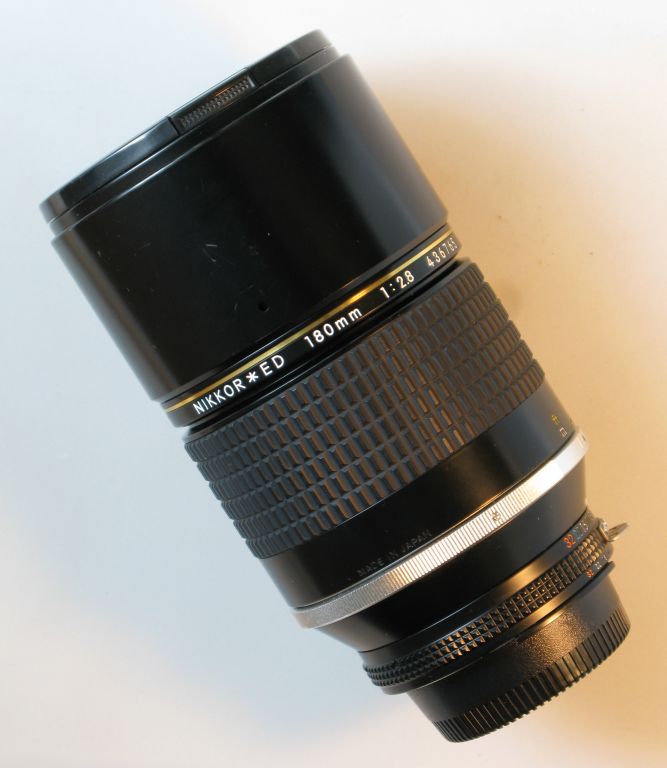
So I was standing there at the back of the room, and realized that this award was happening sooner rather than later, and I’d missed the name of the recipient. I wouldn’t have time to get up to the front of the room and would have to quickly shoot from where I was, so I put a telephoto lens (my 180 f/2.8 for those of you who are curious) on the camera (my Nikon F3), along with my powerful SB-16 flash (the same one used in this story) and was just focusing on things when the award and a prize were handed to whoever the recipient was.

And the prize was…

A shotgun…

Wait a minute…

This is Ducks Unlimited… They’re not trying to conserve ducks to keep them alive, they’re trying to conserve them so they can make them dead!

Oh geez…

The things I learned when doing my own shooting…

I was just floored, but I’d gotten my shot, and I had to finish the job, so I noted the suit jacket the fellow with the new shotgun was wearing, and made my way to the front of the room where he was talking with someone.

I waited for a bit, standing behind him, and with my cameras and camera bag hanging off my right shoulder, and my reporter’s notebook in my left hand, I tapped him on the shoulder with my pen.

“Excuse me, sir, my name’s Tom Roush. I’m shooting for the Sidney Daily News and need to get your name for the paper.”

The fellow in the suit jacket turned around, and I saw nothing but a huge smile on his face as a big, meaty hand came down in a controlled crash on my left shoulder, “Why Tom, you know me! I’m Harry Frilling! I loaned you my car!

And so he had.

I hadn’t recognized him in that suit, but sure enough, it was Harry.

The next morning, I told Mike the story and he, having lived in the town far longer than I had, made an astute observation. “You know, Tom, as big a deal as it was to you to get the picture, it was probably a bigger deal to Harry to have been able to loan you his car.  I’ll bet he told his friends about that for some time.”

I wasn’t sure about that, but like I said, Mike had been in the town far longer than I, and had a good sense of what was important to folks.

Eventually I left Sidney, but I kept that Ford for many years after that. It turned out the problem had been a faulty electronic ignition module and replacing it fixed the problem (I’d never had a car with an electronic anything in it before, which is why it was so baffling to me), and after a trip west across the country, I kept it long enough to bring my son home from the hospital in it.

A number of years later, I looked Harry up, and on a whim, picked up the phone and called him, and introduced myself as the photographer he’d loaned his car to, and asked if he remembered me.

And he did.

We talked and laughed for a while, about how a young photographer and an old farmer met because of a broken down car and a shotgun, about how life had changed for us both over the years, and how good, and important, it was to just get in touch again, and how much that small act of kindness on his part had meant to me.

A few weeks ago, I got back in touch with Mike – and we got to talking, and laughing, telling stories, and just catching up.  We talked about how it’s been over 20 years since I was a photographer at the Sidney Daily News, singlehandedly blowing through their annual film budget in the short time I was there, and then I remembered something, and asked Mike, “Do you remember the story about Harry Frilling?” – and without any other clues, Mike remembered, too, and we both just laughed and laughed… 

There’s a Footnote, or Post Script to this story:

Last week, because this was a story about a real, live person, I did what I always do and tried to find Harry again to ask his permission to write and publish the story.  I didn’t find him, but found and ended up talking to his son.  As it turns out, Harry had passed away a few years ago, and I found out that Mike was right.  It seems that that little story, the one that meant so much to me, that told me about how some folks are inherently just plain good folks, was indeed one that meant something to Harry as well, in fact, it was one of his favorite stories, that he told often, and I was astonished to hear from his son that my – that our – little story was told as part of his Eulogy as people told stories about who Harry was and what he meant to them.

It’s people like Harry who teach us that lifting a finger – figuratively, or literally one finger of one hand – whether that’s lifting it from your steering wheel as you drive by to wave at a farmer and acknowledge each other as fellow humans on the planet, or lifting it to dial the phone to call an old friend to get back in touch with them and see how they’re doing, or dropping what you’re doing and helping a friend do some things he or she couldn’t do otherwise, that ‘lifting a finger’ can make all the difference in the world in someone’s life. 

He also taught me that that one finger, when crashing down onto my left shoulder with the rest of his hand and that smile of his, made me feel like I was the most important person in the world right then.

It’s been, as I said, years, but this formerly young photographer still treasures that smile, that laugh, and is humbled to have known an old farmer like Harry Frilling.

As I thought about this story, and about what became this post script, I realized that after anyone passes away, the material things they’ve accumulated in their lives have to be taken care of or taken over by others.  But when people like Harry pass away, the love and the memories left behind, those are treasures, and they live on.

Special thanks to his son and daughter, who graciously gave me permission to publish this story.

© 2011 Tom Roush


One of the things I’ve been doing in these stories is writing down history.  I’ve written down a number of stories about my dad and his time in the military.  There are others in the works, but I happened to run across a couple that I’d convinced him to write before he passed away.  They’re rare because he printed them, and then later the computer they were stored on was stolen, so these are the only stories I have that he actually wrote.  I think that’s one of the reasons I’m doing my own writing – so my kids can see and read some of the stories that are part of their history and that they’ve heard over the years.

I’ve been baking artisan bread for the last little while (bakers go back in the family for generations, and my son got me this book which has been absolutely wonderful).  So given that, the other day I was thinking about baking bread, and it got me to thinking of this next, actually, the second of the four stories that dad wrote about his times in the Air Force.

We have to travel back in time to about 1953, when my dad was in his early 20’s, in the Air Force, and just past basic training at Keesler AFB, in Mississippi, and into the technical training (radio operator and some things he wasn’t allowed to talk about) that formed the beginning of his career.  If we were to set the stage, we’d have to do so with the understanding that World War II was still very much in people’s minds, the Cold War between the former allies of the United States and the USSR was just ramping up, and the Korean War was in full swing. The Air Force was training thousands of new recruits every month, on an assembly line basis at a quantity that was as mind numbing for the recruits as it was for those trying to keep track of them, keep them busy, and keep them healthy.

These recruits were resources, and the Air Force had to take care of them by feeding them, giving them shelter, and keeping them occupied when they weren’t busy learning whatever the Air Force had decided they would learn.  On top of all the classes and mental training for the actual skills, there was the physical discipline that was taught by having the recruits do daily calisthenics, and the mental discipline that was accomplished by assigning daily tasks that were simply not optional.

So while they were taking classes in some of the most technical, and classified, jobs and skills available at the time, they were also to take care of themselves and each other in the most basic ways you can imagine.  There were assignments to clean the barracks, mow the lawns, maintain vehicles, buildings and property, and to scrub things till they shined. The person in charge of tasks like this was, in civilian terms, a manager.  In the military, he (at that time and in that place they were mostly “he’s”) was a Sergeant.  Very few recruits ever saw Generals.  All recruits saw Sergeants, and the Sergeant wore the hat of your mother, your father, your elementary through high school principals, your cop, and pastor, and occasionally, your bartender, all in one very crowded body, and your Sergeant could change hats faster than you could blink an eye, so staying on his good side was your greatest mission in life.

Make your Sergeant proud, he’d take care of you.  Embarrass him, and your life would be a living hell.  You would be cleaning bathroom floors with a toothbrush for a month – and it would likely be your own toothbrush you’d be doing it with.

From the Sergeant’s point of view, you’re a hands-on leader, and in the military, as anywhere, good leadership is the key to getting things done.  You depend on your soldiers (or sailors, or airmen, or Marines) to get the job done.

When things don’t get done, there are consequences.

Your job, as a Sergeant, is to make sure, beyond a shadow of a doubt, that those consequences are so unforgettable so that whatever caused them never, ever happens again.  At the same time, your job is to be in your soldier’s corner, letting them know you support them and will get them what they need to get the job they’ve been assigned done.

In doing that, you want to make sure that if they screwed something up, the screwup is fixed at your level and goes no higher.  You know that if a soldier ends up being called on the carpet in front of their commander, whether that’s a Sergeant or a general, there are only three acceptable answers to questions that might be asked, and those answers were simply, “Yes, Sir”, “No, Sir”, and “No Excuse, Sir.”

Three very important things here.

  1. You never wanted to have to be in a position ask those questions.  It meant something had gone wrong.
  2. You never, ever wanted to be in a position to have to answer those questions.  It meant that you hadn’t been able to fix whatever went wrong.
  3. You never, ever, ever wanted to have to give that last answer.   It meant you were the one who was responsible for whatever went wrong.  It was the equivalent of falling on your sword

And Sergeants, without whom there would simply be no military, were well known for coming up with creative ways of not falling on their swords, so to speak.  Some of the ways problems were “solved” were due to ingenuity borne out of the rare moments when you are faced with the only fate worse than death itself, having to say the dreaded words, “No Excuse, Sir.”

Occasionally, if the situation demanded, things were literally covered up.  This was only done as a last resort when everything else had failed.  It meant you were out of resources, out of supplies, or out of time.

This is important to remember.  The stress of running a huge kitchen like they had at training bases like Keesler was enormous, the time available to feed thousands of recruits was limited, so the kitchens had staff working around the clock preparing food for those three mealtimes when everything had to be ready to go, all at once.  Some in that staff were there full time, others were there as assigned.  This meant there were often people working there who didn’t really understand the significance of what they were doing.  (or not doing, as the case may be)

There were officers in charge of the entire operation, but it was the Mess Sergeant in charge who took care of day to day things in the Mess Hall. It was the Mess Sergeant in charge who made sure the kitchen ran with – well, military precision.  And it was the Mess Sergeant who did everything possible to eliminate all the variables he could, and make sure everything worked, so he could feed everyone coming through the door quickly, efficiently so they could go out and get trained to fight the enemy, whoever that was.

Under no circumstances did he want to stand in front of his commander uttering the words, “No Excuse, Sir”, so he instilled in his underlings a fear far worse than the fear of God; it was the fear of the Mess Sergeant.

So, there’s a lot of background to this story.  Take a deep breath, smell the smell of a big, industrial sized kitchen.  Here you can smell the vegetables being chopped up for the next lunch. Walk a little further, you can smell the aroma of freshly peeled potatoes for tomorrow morning’s hash browns, and hear the stories two young recruits are telling each other about anything but potatoes.  A little further, the steamy vapor coming out of an industrial sized dishwasher tickles your nose, and finally, a bit further on, you can smell the yeasty smell of bread dough rising, mixed with the smell of coffee and cigarettes, and above the constant roar of the fans, you hear a number of 20-somethings laughing and goofing off.

Around you are huge stoves, walk-in refrigerators and freezers, hand trucks to make moving the huge sacks of raw ingredients easier, enormous chromed ovens, and mixers that you could mix enough dough in to feed an – well – an Air Force.  Come with me as we stand off to the side and lean up against the wall and listen for a bit, as a much younger version of my dad tells the story behind a rather strange article that appeared in the paper that week.  It’s below, just as he wrote it.

We had a certain number of KP’s to do as we went through the technical training.  “Kitchen Police” is the full title of the job.  With so many trainees, we had a mess hall row.  Only one of the mess halls had a bakery, and even then I enjoyed the smell of fresh baked goods.   We were assigned to the midnight shift, and were supposed to make rolls.  Lots of them.  One of the KP’s got some flour that wasn’t the right kind of flour we needed and dumped it in the big mixer, then I was left to watch the dough rise while the rest of them had coffee break.  They had a super long break that night, and our KP pusher caught us goofing off. 

I told him it hadn’t risen enough yet.

He started sweating, a lot, for the mess sergeant was due in any time.

There was a growth of bushes separating the places where the men were marched in, so he had all of us KP’s dig holes for the large quantity of dough to be poured and hidden.  We went to work with a will and even covered the pile of dough with the sweepings.  There was a picture in the paper later of the finding of a giant puffball mushroom by the mess hall.

…and, in the inimitable words of Paul Harvey, now you know “The Rest of the Story


July 4th

Here in America, it means there are lots of events involving fireworks.  Some of these things are legal, some are not.  Some can be made with good old Yankee ingenuity, and some can be made with a little bit of knowledge of chemistry.  There can be an astounding variation of things, but the bottom line is that they all explode, fly, or make lots of sparks.

And of course, if you do it right, they’ll do all three.

And the thing about my friend Jimi was that if there was any possible way that something could blow up, or fly, or make lots of sparks… he’d figure it out.  It seemed like “The Fourth” for Jimi was a day to celebrate everything – and he went all out on it.

One time – he and I had decided that the big Styrofoam gliders you could get would fly better if they were powered by something stronger than an arm, like, say, a rocket engine. So we found that there was one kind of thing, called a ‘ground bloom flower’ – that, if aimed correctly and taped securely to each Styrofoam wing on this glider, two of them might produce enough thrust to get it airborne.

It turns out that timing the ignition of these things was a pretty major challenge – and that the concept of asymmetrical thrust – that is – one of these things lighting before the other – was not theoretical at all, and the plane, when we did manage to get it in the air, didn’t fly so much as spend its time trying to do a very colorful pirouette to one side, followed by a lurch forward for the split second both “engines” were firing at the same time, followed by a feeble attempt at another very colorful pirouette to the other side as the first engine died and second one lit off.

Was it entertaining?

Heck yes.

Did it fly well?

Uh…. No.

It’s safe to say that it really didn’t fly very well.

It’s also well to say that it wasn’t very safe, at all…

I mean, a highly flammable object, that’s already got a totally unpredictable flight path, combined with devices that are already spewing sparks and flames…

What could possibly go wrong?

<ahem>

In our misguided attempt to actually get the thing to fly, we kept fiddling, and finally got things set so we could try again – and found that where the fuse came out of the ‘ground bloom flower’ wasn’t exactly where the fire and thrust came out.

We were able to deduce this by the large hole the flame had burned in the right wing.  We taped over that and decided a single producer of thrust would work better if we could center it.

So we – after long and hard thinking of all the things that would be illegal to purchase and let fly in Shoreline (where Jimi lived), we realized that model rocket engines would be perfect (and legal) – and bought a few of those, made a self-ejecting holder out of some ductape, stuck a fuse into the engine, lit it, and threw the plane, figuring it’d fly, gracefully, as it should.

Turns out that adding that much thrust to one of those things doesn’t necessarily improve anything in a predictable way – and after even more fiddling, the first one that actually flew did a very tight loop, hit some wires, and came down hard, mostly in one piece.

The next one was a little better, but it was the last one, that I didn’t see, that was clearly the best.

I’d just run into the house to get something, when I heard the rocket engine fire, and I heard Jimi yell.  I heard a thump, the rocket continued to burn, and Jimi laughing like an absolute lunatic.

By the time I got out there, tears were running down his face, he was holding his stomach, and having trouble deciding whether to laugh or breathe.

I looked around and followed the smoke to the hood of his car.  It seems the engine had burned itself out by then – the smoke more of a haze at that point – but before it had done that, the little rocket engine had pushed the plane up high enough so that one wing had hit a telephone wire again.  That spun the plane around 180 degrees, pointed right at the ground. It came down at full power, almost pulled up, but hit and bounced on the hood of Jimi’s little Chevy Nova, getting the nose stuck under one of the windshield wipers.  The little engine that could wasn’t done yet, and continued to burn with the plane trapped by those windshield wipers – finally ending up burning the paint off part of the hood of the car.

Jimi was just beside himself.

I was mortified, and thought that he’d have to figure out how to explain that to the insurance company, but he just wanted to leave it the way it was.  The scorched metal, the blistered paint, was worth far more as a story to him than getting a new hood put on the car ever was.

I’ll always remember that laugh of his – and how much it meant to just hear that childlike joy.

It’s funny – Jimi and I were so much like kids in all of that that neither he, an award winning photographer who never went anywhere without his Olympus cameras, nor I, a budding photojournalist who never went anywhere without my Nikons, took any pictures of the event.

We just laughed and laughed and laughed.

And some memories are best left there, in your mind, as a memory that remains strong, and bright.

I miss him.

For now, just imagine the intense hiss of a model rocket engine, the hollow metallic thunk of some hard Styrofoam on a metal hood, and the sound of two grown men laughing like the little boys that were still very much alive inside us.

Those little boys who had read all the small print on the fireworks and rocket engines… “Use under adult supervision…”

Yeah, we supervised alright.

It was a good day.

Years later, in Jimi’s memory, I decided it was time to share that joy of Styrofoam airplanes, rocket engines, and some adults who still remembered what it was like to be a kid with my son, but that’ll be a story (complete with pictures) for another time.

Have a safe Fourth of July, folks.


Hey all – I’m back.  I’ve been off, away from my writing – and away from a lot of other stuff – for a bit – learning some pretty important lessons about dodging bullets (or maybe, as my son says, angry meteors) – and have been learning about family, how important it is, and how important it is to take care of each other.

I’ve been on the receiving end of a lot of that recently – and got to thinking about how much I’m looking forward to “graduating” from needing that. I’ll write more about some of those lessons – but it’ll take some time for them to simmer a bit, or bake a bit, or do whatever lessons do when they start roaming around in my noggin.

But back to that graduation thing…

Several friends, or children of friends, have just recently graduated from various parts of their lives – some from high school, some from college, a couple from Boy Scouts (they made Eagle) – and it got me thinking about when I graduated from college…

<play along with me here – fade to black – and then come back to a much younger and thinner me…>

When I went to college, I found, to my surprise, the little bit of photography I’d been dabbling in was something other people thought I was good at.

Also to my surprise, I did not know at the time that you could schedule classes in college to NOT start at the hour when God Himself hadn’t yet thought of making coffee, but sure enough, my very first class started at 7:30 in the morning.  It was called “Media Production” – where we were to learn about making slide presentations…

(using real film – none of this fancy digital crap you have now– that we had to expose, and to develop the film, by hand, we had to walk two miles, uphill, in snow 10 feet deep, and – no, wait… wrong story… sorry – my “old codger” dial was set a little too high there… that’s been fixed, and we now return you to the regularly scheduled story, already in progress…)

…and the final project would be a presentation of both slides (images) and music that we’d made on our own.  About half way through the course, the instructor interrupted our work on our presentations with a message from the editor of the yearbook.  I was standing up front between two young ladies who also didn’t get that memo that you didn’t have to take classes before God finished grinding His coffee beans.

The message from the editor of the yearbook was simple: They were backed up with assignments, and desperately needed help in photography, and our instructor wanted to know if any of us wanted to volunteer to help them out.

At that moment, I felt one firm hand on each shoulder push me a step forward.

The two young ladies, bless their fuzzy little hearts, had “volunteered” me.

I asked about the requirements.

“You need to have a camera.”

“I don’t have one.”

I didn’t. I was borrowing the school’s old Nikon FE for this class.

“You need to have darkroom experience.”

“What’s a darkroom?”

My experience in dark rooms was limited to turning the lights off.

And thus started my ‘career’ in photography.

I spent an astonishing amount of time in the darkroom the first few weeks, learning how to mix chemicals, how to develop film properly (in large part because I developed it improperly first), how to print pictures well, (in large part because I printed some absolutely awful images). Lordy… talk about making mistakes – but I was learning, and learning things like to how to tell when the water was exactly 68 degrees (which is the temperature most developer had to be for film to be developed) – all the stuff you don’t even see anymore because it’s all digital, but it was magic, and I loved it.

So much of the learning how to do it right was learned by screwing it up first, and doing it wrong, first, and eventually developing (pardon the pun) the experience to build on over time so I wouldn’t make those mistakes again…

I shot for, and later became the photo editor for the yearbook “Cascade”, and did the same for the student newspaper, “The Falcon.”

By the time I graduated, I’d been shooting at SPU for two years, to the point where I’d gotten to know everyone from the president of the school to the head custodian.  I learned what time the light was good on which buildings – and which season was best to shoot them in. I’d shot from the roofs of building you weren’t supposed to be able to get to (Knowing the president of the school does not get you onto roofs of buildings… Knowing the head custodian does – funny how that works) – and I went everywhere – and I mean *everywhere* with my camera bag and my two Nikons and assorted lenses.

I took my camera bag with me everywhere, except for one night, when I went up from the darkroom (in one building) to get something I’d forgotten in my dorm room (most of the way across campus and up a steep hill).  I just left the bag in the darkroom, behind two locked doors, and walked up to the dorm quickly – but feeling very strange and off balance since my camera and bag had become such a part of me.  In fact, it became clear to me that I wasn’t the only one used to seeing me with it.  One person I passed that evening seemed totally startled by the fact that I was there and blurted out, “Tom? – is it really you? I didn’t recognize you without your camera bag!”

And that little comment followed me all the way to the day I graduated from Seattle Pacific University.

In fact, one day, while on the roof of one of the dorms, taking pictures from an angle no one else had thought to take pictures from, I saw a friend walk by below who’d complained about me being “everywhere” – popping out from behind bushes and the like, and the situation was just too ripe… I mean, if there was ever an example of low hanging fruit  – this was fruit just ripe for the picking – even if I was doing it from the top of Marston Hall at SPU.  I leaned over the edge, focused on him, took the picture, and then ducked back onto the roof, “leaving” the camera hanging over the edge just long enough for him to look up on hearing the sound of my motor drive and to see it being pulled back.  I waited about 10 seconds, then peeked over the edge and waved.  He was standing there, mouth open, staring at me, his suspicions confirmed, that I was indeed, “everywhere.”

The funny thing about that was that, like I said, everyone was used to seeing me with my camera bag, and conversely, people quite literally didn’t recognize me without it.  But this meant that I became, for lack of a better way to say it, a fixture, with my cameras, all over the place.  Most, if not all of the faculty had gotten to know me in one form or another, and so when it was clear that my time at SPU was coming to a close (in large part because I was graduating) a thought, nay, an idea started germinating in the dark, developer soaked recesses of my mind.

See, if everyone knew me with the camera bag, and I walked across the stage to get my diploma with it, there’d be a couple of laughs, or worse, no one would notice at all, it was just “oh, that’s Tom, with the camera bag” – and I’d be done.

Hmm…. Unacceptable.

If I just walked across the stage with nothing, that would have the same effect…

Nothing.

I’d just be an anonymous graduate who had 4 people in the audience cheering him on, and that would be that.

Also unacceptable.

After all I’d done, after all the pictures I’d taken, the memories I’d captured, the treasures I’d seen and shared through my cameras, I wanted something *just* a touch bigger.

So I started thinking, and that idea started festering into thoughts like:

“What would the faculty *not* expect?”

“What would the students *not* expect?”

“What would the audience *not* expect?”

…and what could I do that would make them remember that it was me who walked across the stage, and not some other student?

And then, as if by magic, the day before graduation, I got a surprisingly big paycheck, and I bought a motor drive for my Nikon F-3, the best camera out there at the time.  This motor drive would let me burn through a roll of film (36 frames) in about 8 seconds But I also bought myself what was then known as an SB-16 – or a “Speedlight” – think of it as a flash for the camera, on Tour de France levels of steroids.  It would keep up with the motor drive for about 6 frames if you set it right, and I found myself pondering what I could do with that combination.

I didn’t have to ponder long.

If carrying the camera bag across the stage was out…

And carrying nothing across the stage was out…

What about…

…and so, I managed to conceal, under my gown, my Nikon F3, the MD-4 Motor Drive, and the SB-16 Speedlight.  I put a set of fresh batteries in both the flash and the motor drive, threw my standard 50 mm lens on the camera, slung it over my shoulder, put the gown on over it, and set the whole thing “just so” so that it would hang without putting too many bulges in the wrong places.

One of the things I’d learned over the years was to hang the camera over my right shoulder, and hang it there with the lens facing my body.  That way, the lens was protected, and if there was a shot I needed to take quickly, I could reach down with my right hand, grab the side of the camera that held the shutter release, whip it up, and have my left hand ready to hold the lens while the right held the camera body.

Having the SB-16 on there kind of nixed that idea, since the flash would have been rather uncomfortably in my armpit, even with the long camera strap I had. So I had to hang it with the lens facing out, then when I was ready to go, twist it around so I had my right hand on the camera where it needed to be.  Given what I was doing, this had an unintended effect, namely that all the little blinky lights on the back of this new strobe were now facing outward.

None of the students could see this, but as I was standing there on stage, waiting to cross the stage, having handed the little card with my name on it to the Vice President of Academic Affairs (the guy who read my name for everyone to hear), the camera, the motor drive, and the strobe unit together made for a large, blackish object just under a foot and a half tall, bulging at my shoulder, with little blinking lights.

And several of the faculty, sitting on the stage, saw me reach for it and turn it around.

I saw their movement, and looked right to see tittering wave of comments and concern rippling as more and more of the faculty’s eyes focused on the blinky lights and the bulge under this one student’s gown.

Before I could react, and before anyone else could say anything, I heard my name called, and things simultaneously went into slow motion, tunnel vision, and I felt like I was hearing everything underwater.

When I looked back, I saw the school president, Dr. Dave LeShana smiling, saw the look of expectation in his eyes, the diploma in his hand. I saw the orchestra, and my friends in it, playing quietly, or watching, as their parts dictated.  Past them a bit, I saw the photographer, waiting to take a picture as I shook the president’s hand, and I did what I’d just rehearsed in my mind a few seconds before: six steps out, pivot on the right foot, the seventh step, face the audience, bring the camera and flash out, (it did have film in it, for later) flip the top of the flash down (it was aimed straight up) – and then I fired the camera out at the audience until the flash stopped flashing.

Stunned Silence.

A pin, dropped on a carpeted floor would have echoed in there.

I waved at the crowd, then looked over at president LeShana, who started laughing, and I shook his hand.  I held on for a bit, waiting to see the flash of the photographer who was supposed to be shooting *my* picture, and saw nothing.  I let go of the handshake, and looked down at the photographer, who was just staring, rather dumbfounded.  I realized that I had significantly more – um – firepower – photographically speaking, than he did, and he was just shocked into silence and inaction.

Not wanting to hold up the ceremony any longer, I walked past him, got to the stairs that got me off the stage, and as I took my first step down, my ears seemed to start working again and I heard the crowd, the students, on their feet, cheering and screaming.

Heh…

I high-fived a bunch of them as I walked past.

Yeah, that was better than just taking the camera bag across the stage.

==

Years later I heard from my sister, who’d been there.  She’d talked to the fellow who was the student body president, who’d been sitting in the 4th balcony.

“Was that your brother who shot graduation?”

“He didn’t shoot it, he graduated.”

“No, I mean, he graduated – but he took pictures, from the stage, didn’t he?”

(Given that everyone else was taking pictures aiming toward the stage, this was notably different)

“Oh, yeah, that was him, why, did you see him?”

“Oh I saw him alright… I was watching him. Through binoculars.  And every time that flash went off was like being hit in the eyes with a sledgehammer.”

Heh… yeah… it was different than the standard, run-of-the-mill trip across the stage.

…though I sure would have liked it had the photographer gotten a shot of Dr. LeShana and me.

So… gosh, do I have a message for those of you out there graduating?

I hadn’t planned on one – but hey, since we’re here, there’s actually quite a few of them…

You won’t have all the answers when you graduate.

You’ve barely learned to ask the questions.

I learned a lot more after that day, but the thing that had me thinking was this:

I took risks.

I made the best decisions I could make while working with incomplete information, and as much as you tend to look back and think thoughts like “if only I’d…” – those thoughts are useless without a time machine to go back and prove that your “if only…” would have been the right decision.

I climbed tall buildings (not in a single bound, mind you, and always with permission – though there’s a certain church roof I’ll never climb up again with or without permission, that was just scary high, and steep) –

I did things “just because” – and I had a blast doing it.

On the other hand, I was so poor afterwards as I was starting out that there were a lot of things I didn’t do.  I learned to make a big can of oatmeal (that cost me $2.86) last a month.  I remember inviting friends over for lunch – and it was boxed Mac and cheese that I’d gotten for a quarter.

And it was fun.

Would I put all that hard work into it again?

In a heartbeat.

Looking back on it all now…

Did life go the way I’d planned?

Nope.  Not even close.

Would I change anything, looking back on it now?

That would involve that time machine again, proving that whatever decisions got me to this point were the absolute right or wrong ones to be made – and remember the bit about making the best decisions you can with the info you’ve got at the time?

Some parts that have happened were better than I could have possibly imagined in my wildest dreams.

Some parts that have happened were worse than I could have possibly imagined in my worst nightmares.

That’s called life…

Remember the good.

Learn from the bad.

Do the best you can, with what you’ve got, at that time, and you build on that.

When you look back, you’ll see you made mistakes.

Some of those mistakes will have been small, but as you look back, you’ll see you made some huge ones.

But look harder, and you’ll realize you’ve learned a lot of lessons from those mistakes…

And after you learned those lessons, I’ll bet you didn’t make those mistakes again – or as much (because you now had *new* and *exciting* and *bigger* mistakes to learn from!)

And sometimes, even when you think you finally have it all together, and you’ll have some sort of picture, symbolizing all the lessons you learned, something will invariably go wrong (like, say, photographers at graduation not taking pictures of the graduating students…) and the only thing you’ll have are the memories.

So… learn what you can.

Learn from those mistakes.

Forgive yourself for making them.

And move on, teaching those who come behind you as you can.

Take care folks…


 I had to have a meeting with the head of security at work last week.

In his office…
We decided to get some fresh air while we were doing it.
And some scenery…

He let me lead the meeting for a bit while he was researching some stuff – (full frame shot there)

And I didn’t have to use the barf bag at all – (though I was sure thinking about it – seems the resonant frequency of my tummy means 120 mph isn’t a good thing… 90 mph works fine.

Finally it was time to call the meeting to a close…

And I sat in the airport lobby for awhile – just letting my tummy settle down – it was good to let that happen.

It was fun – too much other stuff going on – I simply had to take the day off to try to decompress.

Take care folks –

Tom


If you’ve been reading for awhile, you know that a whole LOT of my stories have something to do with my cars in some way, and this one does – albeit peripherally.  It has to do with friendships, Saabs, and cookie jars – and it’s a very honest story.  When I started writing it, I didn’t know where it would go – and then I realized it had a second part – so I wrote that – and the two parts together gave it almost a synergy… So having given you that as an intro – allow me to introduce “Dirty Fingernails, Paint Covered Overalls, and True Friends”

My first car was a 1965 Saab 95.  3 cylinders, two stroke, just like an outboard.  At the time, I was learning so much – and there was so much to learn about it (translation: I knew so little about cars at the time) that for every hour I drove it, it’d take about that much maintenance, or more.  Eventually I got it to be relatively stable – but even so, it was a challenge to own this beastie.

One Saturday, as part of the routine at the time, I’d yanked the engine out of it (yes, “yanked” – you could do that with this car – take all the bolts loose, then grab the exhaust manifold in the right hand, the fuel pump in the left, do the hokey pokey, and yank the sucker out – really). I’d then fixed something on it it, and put it back in, and then driven the car to school on the following Monday.

At the school I went to at the time, a community college – we had a huge cafeteria with round tables for about 10 people, and a pretty regular group of us sat at this one table between classes to study, hang out, have lunch, chat – whatever.

I remember that Monday. I reached across the table for a pencil or something and someone saw that I still had grease under my fingernails that I just hadn’t been able to get completely out from the Saturday before – and this gal just absolutely freaked, then almost threw a pair of nail clippers at me and then went off on telling me that I needed to get new clothes and look better.  This went on for a bit, and it was clear that trying to get a word in edgewise wasn’t going to work at all, so I let her rant for a while.

A really good friend took me aside and tried to help.  He’d known me longer than they had, and tried to kind of help or smooth things out a bit by offering to take me to a fairly upscale clothing store – and I remember thinking,

“…and just WHO is going to pay for all this stuff to make me look acceptable in their eyes?”

I remember thinking they were incapable of seeing through the grease far enough to see why it was there.  Not that I wanted to go to school dirty, but if you’ve ever worked on a car, getting grease under the fingernails is part of the process, and getting it out takes a little longer.  I know now that there are things that can help with that, but I didn’t then.  I also knew at that time that none of them would be able to do what I did – I’d gotten to the point where I could have the engine out in half an hour (well, 32 minutes) – from the time I shut it off to the time it was in the bed of my dad’s pickup truck – and I thought to myself that if I had a skill that would cause a little dirt under my fingernails to remain, I’d take that skill over “looking good for someone for whom that was the defining characteristic of whether I could be their friend” every time.

I left that table that day and never went back.

I studied in the library, not in the cafeteria…

But based on that experience, I decided to try something.

I dressed like crap for a quarter.

On purpose.

I wore old clothes.

I wore overalls I’d painted my Grampa’s barn in (trust me, the barn wasn’t the only thing that got paint on it)

I wore the boots I’d been wearing when I painted the barn (they’d started out black, they now looked like a negative of a leopard… that was an oops…)

I mean, I worked at looking crappy.

If it was nice, unstained, and untorn, I didn’t wear it.

Did I have nice clothes?

Yup.

But that wasn’t the point, at all.  I was going for the seriously crappy look, and I did absolutely everything on purpose.  I wanted to prove something.

And honestly, it was pretty lonely for a bit.  I remember that it was hard to do what I was doing, but I was stubborn enough to do it – and I kept at it.

A few weeks went by, and I found some new friends at the library who were pretty cool people, and who didn’t really seem to give a rip about what I wore, they were just cool folks, so I hung out with them.  I remember one gal, Bonnie, was just gorgeous, and I was just stunned that she’d even be seen with me, but she didn’t seem to care, and it was really, really cool to see that these people didn’t care what I wore, or whether I had grease under my fingernails or not, they just liked me for who I was.

At the end of that quarter, I felt my point had been made, so at the beginning of the next quarter – I dressed a bit nicer – just because by that time, it was getting old, even for me.

And they noticed.

I remember Bonnie asking me what was up, and I told her – and the rest of my new friends. They were kind of surprised that they’d been unwitting participants in an impromptu social experiment, but I was honest with them.  And they now had a friend who they knew, and who they liked, and who also now dressed a little more respectably, and I had friends I knew didn’t care about my fingernails – and – here’s what got me about that…

In that first group, nobody seemed to care what it took to get my fingernails like that – not that I wanted them filthy – but there is zero chance that anyone sitting at that table could have done what I did with a car – any car, much less a 1965 3 cylinder, two stroke Saab…

And that’s what made me mad.

It’s like they were looking at me like a cracked cookie jar.  And they only saw the cracks, not the cookies inside.

Years later, I tried another experiment at another college, and it was almost the same experiment – from the other side.

Some of you guys reading this out there might get this.  Just like in any college, you end up with a lot of friends – male, female, whatever.  The university I went to had – well, far more than its share of nice looking young ladies.  I remember being very shy about talking to them – and at the same time remember feeling quite bad about the – oh – how do we put this politely? – I was feeling rather bad about the feelings this “red blooded American boy” was having about these “red blooded American girls.” – Those feelings tended toward the whole objectifying the young ladies end of the spectrum, and I just didn’t like that in myself.  So I thought about it for a bit, and realized that there was actually an inverse relationship between how well I knew the gals and how “red blooded” I felt about them.  It was almost linear:  The better I knew them, the more I thought of them as a human being and friend, and the less I thought of them as – well, objects.

So I tried to figure out how to solve this problem.  I mean, each of these gals was someone’s daughter, someone’s sister, etc…  And while I was just as full of hormones as the next guy, but I just didn’t like objectifying them that way.  At all.

And I wondered…

How could I stop thinking about all these nice looking young ladies in these inappropriate ways?

…and then I remembered…

I didn’t think of the girls that were my buddies that way…

What if…

And so – I remember picking one gal rather specifically (the gal I was most terrified of because she was the most gorgeous of the bunch, and therefore, I figured, totally unapproachable) – I’d chat with her in the foyer of the building before class (and was late to class more than once – heh – in fact, I remember one time, I’d just told her I had to get up to get to class and saw the whole class trooping down the stairs – I’d missed the class entirely…Well, I was majoring in communication at the time, and by golly, I was communicating… : )

…not that the prof saw it that way, mind you, but still…

One thing led to another, and Yolande and I became friends, nothing more than that, that had never been my goal, we simply became friends.  And while the fact that we were now friends didn’t change the fact that she was drop dead gorgeous one whit – it did change something in me.  I saw her as Yolande, my friend, instead of seeing her – and thinking of her – in ways that would make her feel uncomfortable, and me feel ashamed.  I haven’t seen her in years – but I still remember how well that little experiment worked, and how much fun that friendship was, a friendship that wouldn’t have started had I not wanted to be, as we used to say back then, “just friends.”

And what’s interesting is these two stories go together…

In the first – people were distracted by what they saw – because they didn’t like it, and didn’t bother to look past it to see what was inside.

In the second – I was distracted (oh, Lordy was I distracted – but… I digress) by what I saw – not because I liked it, but because I liked it in ways that I really shouldn’t have in that context – and just like the first one, I didn’t bother to look past the outside to see the person inside.

It’s kind of funny – this story also answers the question one of my college buddies once asked about “Why does Tom constantly have all these gorgeous women around him?”

Well…

Some were buddies to start with just because I just liked them…

And some ended up being buddies because I wanted to just like them.

It ended up being a serious win-win… : )

But it taught me a huge amount about people.

What they looked like, whether it was good or bad, gorgeous or plain, didn’t necessarily translate into what kind of a friend they’d make.

And it taught me to take gentle chances – because often, I found, the people I was scared of talking to wanted a friend just as much as I did.


I was on the phone with my mom the other day, and she said a couple of words that I’d never, ever heard from her.

We were all going through a rough time, so she wished us well, she said, “individually and collectively”.

The last time I’d heard those words said like that was in 1978, at Kingsley Field in Klamath Falls, Oregon, and I realized I had another story to write.

Back then I was in Civil Air Patrol, and our squadron, based at McChord Air Force Base, had one of the best military style drill teams around.  We had a group of young men and a few young ladies who could march beside each other, between each other, we could literally march rings around each other. You name it, we could do it, and we looked sharp.  Each state was organized as a “Wing” – and several of these “Wings” made up a Region (several states)

We had Wing drill competitions, (Youtube link as an example) and our reputation was such that the folks at Wing wanted us (McChord Composite Squadron, CAP) to compete simply because they wanted to see what we’d do at the Regional competition.

In fact, now that I think of it, for these Wing competitions, we had to get our uniforms looking absolutely perfect, including the shoes, and we learned how to spit shine them so you could see your teeth in them. At one Wing competition, I’d gotten a brand new pair of shoes that didn’t have any creases in them yet.  I shined them to within an inch of their lives, and then walked carefully out to where we’d go through a very thorough inspection.  The fellow doing the inspecting noticed those shoes with the mirror finish and no creases, and looked me square in the eye,

“Wha’d you use on those shoes, Cadet?”

He said the word “Cadet” with all the affection a cat might have for a hairball it’s trying to cough up. Clearly he’d noticed, but also clearly he thought I’d used a spray shine, which was way faster, way easier, and was definitely considered cheating. Not knowing what else to say, I answered truthfully:

Kiwi and spit, Sir!”

He wasn’t sure about that response

“Are you mocking me, Cadet?”

I was just being honest…

He’d asked a question.

I answered it…

Truthfully.

He just wasn’t used to seeing shoes without creases – so not only could he see his teeth in them, but he could see his eyes, his nose, heck, if he wanted to, he could even see his nose hairs – really, they were good (the shoes, not the nose hairs).  They’d be that good only once, but once was all I needed, and so to answer his question of whether I was mocking him, I said,

“Sir, No Sir!”

I mean, he couldn’t get me on anything, I wasn’t being disrespectful, I was answering his questions truthfully, so he harrumphed a bit, then turned off to inspect and harangue the next cadet.

Well, we won that competition, and were officially the best drill team in the state.  We were going to Regionals – which was a tremendous honor, and it was held at an airbase in Klamath Falls, Oregon, a place none of us had ever been.

The Regional competitions at the time seemed to be a little more involved than the Wing ones.  They involved the drill competitions as expected, competitions in individual physical fitness, meaning a mile run, and team physical fitness, which was a volleyball game, I believe there was some level of written test or tests, and of course, you were expected to be on your best behavior at all times, because anything, and I mean ANYTHING you did could sway the Judges’ thoughts or ideas about your ability – or eligibility – to compete.

What this meant is that You Did Not Want To Screw Up.

The ride from McChord to Klamath Falls could take well over 7 hours, but with an old Air Force van, and the requisite stops complete with fluid exchanges (for both the vehicles and the passengers) it took a bit longer.

By the time we got there, we had just enough time to get out of our traveling clothes and into our uniforms for a meeting in a classroom, where the schedule would be given, the expectations would be set, and the law, we learned, would be laid down…

We’d just gotten in and were thinking we were pretty cool for making it when we heard the sound of marching.

In the hallway.

Marching?

INSIDE?

That just didn’t make sense.  But as we turned toward the door see where the sound was coming from, the squadron that had won the Nevada Wing competition marched in.

This was clearly not their first competition.

They all had matching flight jackets.

We didn’t.

They all marched to their seats, and stood there…

We hadn’t.

…in those glorious flight jackets…

Which we didn’t have.

…and they were at attention.

Which we weren’t.

We were stunned into silence..

Their commander called out, “Ready, Coats!” and every one of them took off their flight jacket, held it over their left arm, and at the command “Seats!” they all sat down…

As a unit.

Our eyes must have been big as saucers – this was clearly psychological intimidation, and to be honest, right then, it was working just a bit on us, in spite of the fact that we thought they were really pushing this thing over the edge just a bit.  Later, we were all wondering if they did everything in unison, and imagined that same march, only not through a classroom door, but through the men’s room door, followed by the command, “Ready, Zip!”

Nahhhh… not possible…

We knew good, but what we were seeing was more than good, it was just plain arrogant, and we weren’t having any of that.

We’d learned that at some of these competitions, a squadron might send out spies to watch another team practice, and actually steal their moves.  If the team with the spy went first in the competition, the team who’d invented the moves would look like they were the ones stealing them.

With all the talk of honor and stuff that we’d had drilled into our heads, this was just not right – but, as has been said many times over the years, all’s fair in love and war.

And in the inimitable words of Bugs Bunny, “Of course you realize, this means WAR!”

So that evening, we did a quick run through of our routine as far away as we could get from the barracks. It was very, very clear that we were ready, we were functioning as a machine, and we were simply ON.  So on the way back we figured if they wanted to see something, we’d give them something to see.

Now the way it works when you’re marching in a situation like that, is you’ve got one person, the commander, giving the commands, and the rest follow.

And the way the commands work is this: there’s the Preparatory command, which tells you what to do, and then there’s the command of execution, which tells you to do it.  So you’ve all heard “Forward, March!” in movies and the like, well…

“Forward” – that’s the preparatory command…

“March”    – that’s the command of execution…

And instead of “March”, we’d learned to say “Harch” – because when you’re trying to say it really loud without yelling, you can just get more volume into it.  Also, if you ever did something that was different than the standard “Forward, Harch” – (like Doubletime, Harch) – you could always undo that command with “Forward, Harch” again.

You always start out on the right foot, and even if the command was “To the Rear, Harch” – you take one step forward, pivot 180 degrees, and then go on your way, as a unit.

So now that you know all that, remember, we’re marching back toward the barracks we were staying in, (think dormitories, if you’ve never heard that term ‘barracks’) and we just knew that some of the Nevada team would be on the lookout, and we wanted to make sure they saw something, and that what they saw would mess with them just as much psychologically as they’d done with us – just from a different direction.

We had this fellow in the squadron named Ken Meloche.  He was Canadian, and reveled in the whole “for Queen and country” bit – and when he marched, he liked to march like the English did, with their arms and legs swung high.  So just as we came in sight of some of the windows in the barracks, and to mess with the Nevada boys a bit, our commander gave the command,

“Meloche Walk, Harch!”

– and every one of us, without skipping a beat, started walking just like Ken did.

Including Ken.

“Forward, Harch!”

– and we all marched normally again, like a drill team should march.

Heh – this was fun.

We marched for a bit, and could see more of the windows in the barracks – and out of nowhere came a command we’d never, ever heard before in our lives:

“Double to the Rear with Three Hops in the Middle, Harch!”

– and again, without skipping a beat, we did a ‘To the rear, Harch’ – which is just a reversal in direction, but we all took one step, and literally as a unit, did three hops.  I think there were twelve of us there, and I remember hearing the sound of three distinct impacts, we were that in sync.  We took one step forward, then did the next ‘To the rear, Harch’ and tried like heck to keep from grinning from ear to ear… (we tried that double to the rear with three hops in the middle again later – and could never repeat it).

This was just NOT what drill competition was supposed to be like.  It was supposed to be more serious than this.

When the final windows of our own barracks came into view, we heard the command,

“Walk like slobs, Harch!”

And I suppose the best thing that you could liken what we did to that exists in current culture is that we walked, in formation, like a bunch of zombies, knuckles dragging, feet dragging, drooling, the whole bit.

For about 10 steps.

“Forward, Harch!”

And we were back to looking sharp as tacks.

It was great…

If the Nevada boys wanted to mess with our minds, we’d mess right back.

So after we’d had dinner, and gotten into our bunks and everything – there were four of us in each room, and we were all full of spit and vinegar, the night before the competition. One fellow in the room decided that since the body can produce, – let’s just call it a ‘greenhouse gas’ – one that is flammable, he wanted to show us that it could be done.  And in a split second, I found myself taken back to a story my dad told me from when he was a kid.  Well, not so much when he was a kid, but when he was in that ‘no man’s land’ between childhood and adulthood, where bodies grow faster than brains, you know… And in it he’d told me it could indeed be done.  So as background, let me tell you that story from his “young adulthood”, as it affected things a little further down the road in my “young adulthood”.…

So I knew from my dad that “it” could be done.  He’d told me the story of when he was

a)       Young, and

b)      Male

…of how a group of his friends got together to prove that this, um, ‘greenhouse gas’ could be produced by a human, and could be lit.

On fire.

(Note: male… teenager… fire… cue the ominous music)

One of that group of his friends produced some matches, and two separate things happened that changed the outcome of that story forever.

Note: there was no one suggesting that this might, in fact, be dangerous, or that there was a possibility of injury… No, these were young men, with at that age, possibly a single functioning brain cell between them.  That they had to share.  And the fellow with the match was rather modest, so his plan was to demonstrate this flammability factor without exposing any skin – the implication being that this gas could escape through cloth and everything would still work.

That it would work was true, but the cloth also kept a bit of it between the skin and said cloth before it escaped.  This would have been well and good, and had the experiment been successful, there might have been the possibility of some hair follicles being ignited.  Other than that, no problem.

This was under the assumption that the cloth was cotton, or wool, or some natural fiber.

But it wasn’t.

This was back when the artificial fibers that we’re now used to wearing – be they Nylon or Rayon or whatever combination of things we have that make cloth last longer now – were just being experimented with.

And if you didn’t know, Nylon is flammable.

And those pants were made of Nylon.

So when this greenhouse gas came into contact with an ignition source, that which had made it past the Nylon ignited very well.

But remember about the cloth? – and that some would gather inside before making it through?

It did.

Which meant that on both sides of this flammable Nylon was flammable methane.

That was on fire.

The Nylon pants didn’t stand a chance.

They caught fire, and melted, and… let’s just say the area around the source of the methane was tender and blistered for weeks to come.  It’s likely that the ‘modest’ young man had a story to tell his grandchildren years later – and a peculiar scar in a place only his doctor would see once a year.

It was with this story in mind that I suggested to – we’ll call him ‘Bill’ – that maybe getting the layer of cloth away from the – um – source of the methane would be a good idea, and given that I’d told the above story fairly well, including using the words “second degree burns”, “blisters”, and the phrase “his pants were melted to his butt” – ‘Bill’ agreed, and lied down on his bunk on his back, his knees up by his shoulders, trying to arrange things in such a way that the gas would be lit, but other, shall we say, delicate objects in the vicinity would be safe.

It took quite a number of tries with a little Bic lighter that someone had with them, and eventually, the timing, and location of everything was right.  There was “fuel”, there was “ignition” and it really worked.  It was indeed evident that methane was flammable, though not with the full blown cataclysmic flame-throwing display that we’d all been hoping for.  Slightly disappointed, Bill put everything back where it belonged, but there was some evidence of our attempts with the Bic wafting about, and one of the rules that had been laid down early on was that there would be no smoking, no matches, no fires.

Period.

An adult who was supposed to be responsible for safety on that floor of the barracks we were in came storming into the room and absolutely wanted to know what was going on.

We thought we were dead.

This was the night before the Regional drill competition.  We were the best Washington had to offer, and we realized might have just blown it, in more ways than one – so to speak…

The tone in his voice made it clear he was taking no prisoners, and taking no excuses.  He wanted answers, and he wanted them now.

“Have you been smoking?”

Not knowing what else to say, we answered truthfully.

“No sir.”

“Have you been playing with matches?”

Matches? We didn’t have any matches, we had a lighter.

“No sir”

He kept at this for a bit, asking us as a group, then one by one, the same questions.

We told him the truth, every time.

The problem was, he kept asking us all the wrong questions.

He then called his superior into the room, explained the situation, and asked the same questions all over again.  Eventually he said, as if justifying to his superior why he’d even been called into the room:

“I’ve asked them individually and collectively whether they were smoking, or lighting matches, and they all said no…”

They decided that they needed to go talk this over, and about the time they left, we looked at Bill and suddenly realized that this could disqualify us before the competition even started.  The dawning realization of how deep the doodoo was that we might have gotten into – and what we would have to tell the people back home if we were disqualified, was agonizing, but we knew what the right thing to do was.

We told Bill he had to go down to tell the guy everything and straighten it out, and he did.  Well, we don’t know what exactly he told him, but we told him to tell the guy the truth.

And I’m sure, as Bill was trying to explain this whole thing to this stern adult, that deep in that stern adult’s mind was a young man who’d likely done exactly the same thing a few decades earlier.

We were let off with a warning – as long as we <snicker> didn’t do it again….

And somehow, we got away with it…

The problem was, not ONCE had he ever asked us if any one of us was using a Bic lighter to try to light farts with.

We were allowed to compete.

We came in second – I mean, we did really well in the drill competition, and did okay in the volleyball game, and I remember my time for the mile run being okay – a little over six minutes – but my pulse was 228 and my gums were bleeding as I crossed the finish line – so I knew I’d given it pretty much all I had.  The reason we were a little short in the physical fitness part of it was because we were used to the elevation of McChord Air Force Base –a whopping 283 feet.  The 4,000+ foot elevation of Klamath Falls just did a number on us.

I don’t remember what maneuvers we did for the drill competition, really, it was the silly stuff we did that we remembered.  The stuff we got away with.

So… when I heard my mom say “individually and collectively” the other day – the floodgates in my memory opened up, and I realized, “Oh, no… there’s another story there…” – and I told it to her pretty much as you read it above, and she laughed…

© 2011 Tom Roush

Tom Roush

Archives