
You are currently browsing the tag archive for the ‘Family’ tag.
In honor of this upcoming weekend, I thought I’d write a little story about one of the traditions we used to have for Mother’s day, and something I, as a guy, learned about both women and chocolate.
As a guy, learning about either of these two things, and the interaction between them, can be both a stunning and humbling, if not totally baffling experience.
See, it seems like chocolate affects men a whole lot differently than it does women. Me? I can take it or leave it. Now I’ve talked to friends who happen to be female about this whole thing – and the word chocolate is uttered with a reverence a guy might have for – oh, say, the remote… or beer… or both… I don’t know – all I know is that chocolate holds a place near and dear to every woman’s heart that I know, and none of the men I know really grasp the concept of how important, how heavenly, how earth shatteringly WONDERFUL chocolate can be to the women I’ve talked to.
As is often the case, it’s so much easier to illustrate than to explain, and of course, that takes us into tonight’s story, about Mother’s day, Chocolate, and a gender gap the size of the grand canyon.
We used to go down to Cannon Beach, in Oregon, and stay there for Mother’s Day weekend at a house right on the beach. It was a neat place, and there were at least 4 bedrooms upstairs, and I think 23 couches and a ping pong table downstairs in a room just a touch smaller than the footprint of the house.
One of the things do aside from walking the beach and going out to Haystack Rock was try to have some fun stuff to eat while down there – and since there was a kitchen in the place, we’d bring food or get some locally to make while we were there.
One year my sister decided that something called Raclette, kind of like fondue – but she had it in her mind that instead of cheese, we’d do it with chocolate instead. So a bunch of chocolate was melted, and plates of all kinds of things, especially fruit were brought out – and we – well, the guys of us, that’d be my dad, my son, and my brother-in-law and me – didn’t quite get the whole concept of dipping perfectly good fruit into hot, gooey chocolate, but that seemed to be the thing to do.
So we did.
And I learned something about chocolate that evening.
It turns out that it affects men and women differently.
Those of us with a Y chromosome didn’t quite understand what the fuss was all about with the chocolate, and kind of half-heartedly put our little dishes up onto the grill to melt the chocolate, and then dipped our fruit into it after it was melted.
And I’d have to say, it was okay, but it just didn’t seem like “two great tastes that go great together” – and if we ate much of it at all, we’d eat the fruit, then maybe the chocolate, and pretty much forego the melting part altogether.
But it’s what the chocolate did to us (and I’m speaking of us as in guys) that was so different. See, by the time we’d gotten to the point where we realized that waiting for the chocolate to melt for the second go around, all the sugar had overloaded our systems, and to a man (and boy) we were slowing down.
In the meantime, as if through a tunnel, we were hearing the women (that’d be, in chronological order, my mom, my wife, my sister, and daughter) laughing and chatting and just having a really good time…
Pretty soon it was clear that staying at the table was going to be a challenge – this was more sugar and/or chocolate than any of us guys had had in a long time.
We were fading, and fading fast.
Meanwhile, on the double X chromosome side of the table, the partying was going on with wild abandon. Jokes were being told, laughter was clearly the order of the day, and chocolate flowed like – well – um….. Melted chocolate.
The XY members of the group drifted to the living room area, because – well, it was quieter, and tiredness was descending on us like a down comforter.
Meanwhile, at Party Central, those left at the table were now being regaled with stories that brought howls of laughter the likes of which I’d never heard.
For “the guys” – it turned out the living room, which we’d gone to to escape the noise, was still too loud. The call of the down comforter was too strong, and trying to keep our eyes open was a battle that simply could not be won.
The guys, The “Team of XY” all faded off to bed, with a mumbled “Thanks for the nice dinner” as we each shuffled to the bedrooms, resigned to lose not just the battle, but the war.
I put my son to bed, and heard the laughter still ringing in my ears, the sound of three generations of laughter and merriment in the distant background.
And suddenly – it stopped – as they noticed we were all gone.
I couldn’t help it. I could barely keep my eyes open. In those few moments, my son was already deeply asleep. I’d just managed to crawl into bed myself before falling there, but the last words I heard before succumbing to the arms of Morpheus, and I don’t remember who said them, were, “Now isn’t it just like those men, leaving us to do the dishes!”
Yup.
Just like those men.
But I blame the chocolate.
Happy Mother’s Day to all you moms out there, no matter which chromosomes you’ve got.
I’m posting this on Maundy Thursday – the Thursday between Palm Sunday, when Jesus was welcomed into Jerusalem, and Good Friday, when He was killed there. This is the day when that Last Supper you’ve seen in pictures happened, and later that evening, when Peter, one of Jesus’ strongest supporters and disciples, denied even knowing him – . Tomorrow, those who celebrate Easter will remember Good Friday, and the crucifixion. Thursday and Friday are the lowest points of the Christian calendar – but it is Sunday – Easter – when we are shown that Grace can abound, that there is hope. It is through the remembrance of that Last Supper Jesus had with His disciples, what we now call Holy Communion, that through confession and repentance, we find forgiveness, even for those who feel there is no hope, or forgiveness.
The following story, for anyone watching as it happened, took about as long as it takes to sing the verses below – but inside me – I was transported through thousands of miles, and hundreds of years – to places where time, and distance, were absolutely irrelevant.
With that, please, as you may ponder the significance of Easter, I submit:
“Amazing Grace.”
It was Sunday, in a large, old church, in a big city. The pastor had called for Holy Communion, and as he got out the bread and the – in this case – wine, the notes gently flowed while the organist cleared the pipes to play. But these weren’t just notes that had come from the organ to our ears, nor were they words that were just now coming from our lips. They had come a great distance, through many years, having been written by a man named John Newton, who was exactly what he said he was in the second line of the song, a wretch.
But the story in the song is one of redemption, of John Newton coming to an understanding that this concept of Grace – in which we are given something we do not deserve. And the words, written by him in 1779 in England, composed with notes by William Walker in South Carolina in 1835, came together in this church, on this morning.
The organ sang the first notes out, and old bones and pews creaked equally as people stood, each heading to the aisle to walk to the front to receive Holy Communion, their chance to remember in the symbol of the Bread and the Cup the forgiveness that was theirs because of what Christ had done for them. Worn shoes shuffled forward on an equally worn carpet as they sang, not with gusto, but with the tired reverence that comes with age.
Amazing grace! How sweet the sound
That saved a wretch like me!
I once was lost, but now am found,
Was blind, but now I see.
I was one of those shuffling, and heard the voices singing – some gray with years, some with the color of youth, many of them older, first generation Americans, for whom English had clearly been a a second language.
And suddenly, even though I was still shuffling – I felt I wasn’t in this church in this big city anymore.
I was transported to a land of tile roofs and cobblestone streets
A cool mist touches my face as I find myself stepping carefully on a foggy sidewalk.
As I walk, I’m overcome by the wonderful smell of simmering corned beef wafting out of a kitchen window. I follow the sound of singing around a corner to a church, where the voices and harmonies show a faith and fellowship that has lasted through the ages.
An odd tinkling sound reveals itself to be from a young man, sitting on the sidewalk with a tin cup, begging. All questions are answered by the scar across his face. The tinkling comes from the people walking by toward the church, as they put some of their Sunday offering directly where it’s needed.
He smiles and blesses them as they go on.
We shuffled forward a bit:
T’was grace that taught my heart to fear,
And grace my fears relieved;
How precious did that grace appear,
The hour I first believed!
I’m confused, for a moment – as I find myself suddenly transported to what is clearly a prison, to a cold, damp cell, with only one small, high window. A church bell rings in the distance, and the prisoner in the cell has experienced something not all prisoners do. He’s finally not only understood the significance of the mistake that brought him here, but has experienced a remorse that can only be answered by forgiveness. This does not mean that there are no consequences to his mistake, but there is forgiveness. His quiet prayer is as sincere as that from any pulpit, and the light and warmth coming into that dark cell at that moment isn’t just from the sun.
We shuffled on, and started to sing the next verse…
Thro’ many dangers, toils and snares,
I have already come;
’Tis grace has brought me safe thus far,
And grace will lead me home.
A steam whistle blows. A locomotive hisses by, slowing for the station, and a young soldier nervously holds onto the open window as his now gray eyes search for the home he left two years ago. In those eyes are the exhaustion of a thousand battles he’d wanted nothing to do with, and both the longing, and creeping doubt of seeing his family again.
He looks at his battered watch, the strap long gone, and knows that at this time, the Sunday pork roasts will be cooking, wafting their delicious smells out into the street. It’s always been the first smell he smelled after getting out of the train station. It’s a symbol of home, and this time, the war over, he should be home for good.
The train clatters and bumps to a stop. He gets up, and like all travelers, reaches for his bags and automatically walks toward the nearest exit, his uniform helping to part the respectful crowd of people so he can get through easier. As he steps to the platform, he stops in the middle of the river of people pouring out behind and around him, and stands on his toes, looking around to get his bearings – so much had been destroyed in the war – and to see if anyone is there to meet him. He is tackled from one side by his younger brother and sister, with the excitement only younger siblings can have for an older one. The little brother, as little brothers do, wants to hear all about the battles. The little sister stands quietly until he kneels to her level. She hands him a small, soft object in a cloth napkin. It’s a slice of pork roast. THE pork roast. “Mama sagt, dass Du Heim kommen sollst, dass wir alle zusammen mit dir Mittags essen können.” He shares the slice with both of them, and as his little brother picks up the bags, he picks up his little sister, and they all run across the street to the still standing house, to the kitchen, to his family.
There is no shortage of hugs, no shortage of tears.
He is home.
The melody continued, and we shuffled another step…
The Lord has promised good to me,
His word my hope secures;
He will my shield and portion be,
As long as life endures.
Again, I am transported – to a sidewalk near a church. As I stand there, looking left and right, a stooped old woman walks closer, uncomfortably using a new cane to support her. She passes me by, sobbing softly. The gold ring on her gnarled left hand tells the story. It is her first Sunday coming to church alone in nearly half a century, her husband who had sat beside her every Sunday for that many years, who stood at that altar in the radiance of youth and repeated the vows with her – ending with “…until death do us part…” had loved her – for richer, for poorer, in sickness, and in health – and he had fulfilled those vows to the very last one. He would never accompany her to church again, but church is where she needed to be on Sunday mornings, and church was where she would go. Someone who is obviously her daughter runs up to her and supports her, saying gently, “Oh maman, je suis sincèrement désolée. Je suis venue dès que j’ai su.”
The rest of the words are lost, as I hear the sound of voices singing, and feel myself being pulled away again.
We shuffled forward again…
Yea, when this flesh and heart shall fail,
And mortal life shall cease,
I shall possess within the veil,
A life of joy and peace.
Again, I find myself near a church, with the bell ringing quietly, but closely. Only this time I’m in what’s known in some countries as the ‘churchyard’ – and the group of people, all dressed in heavy coats of dark colors to ward off the cold, have come to pay their last respects to one of their own. It is clear – even without understanding the language, that she was held in high regard by everyone there. It seemed, given the expressions of some, that they were now both relieved at the end of the suffering she had endured, and confused as to who would take her place, but one thing was certain, she had enriched their lives by her simple existence. She had enriched their lives by supporting them when they thought they were supporting her. And those looks on their faces told me her transition from this life to the next had been one of peace, of joy, and eventually of rest.
We shuffled forward one last step.
I was getting close to the front of the line now – and as we sang….
When we’ve been here ten thousand years
Bright shining as the sun.
We’ve no less days to sing God’s praise
Than when we’ve first begun.
I found myself in a large, old church, in a big city.
It was my turn for communion, and as I took the bread, and drank from the cup, that first verse came back to me…
Amazing grace! How sweet the sound
That saved a wretch like me!
I once was lost, but now am found,
Was blind, but now I see.
Bathtime…
A quiet time, when the cares of the day are soaked away by a warm, relaxing soak in the tub…
…for people without kids, that is…
* * *
When my son Michael was much younger, we used to take baths together, you know, a father-son kind of a thing…
Well, he’s gotten bigger, and unfortunately, so have I, and so getting the two of us in the tub at the same time isn’t as easy as it used to be. So I’ve taken to sitting on the edge of the tub with my feet in it, having taken my shoes and socks off and having rolled up my pants…
That said, one night, many years ago, he was taking a bath, and as is often the case, he called out, “Papa, can you come in here?” (Actually, it was “Papa, kannsch du do hehr komma, bitte?” – he still knows some of his German – Southern German to be clear.)
Sometimes he wants someone to read him a book while he’s in the tub, sometimes he just wants someone to play with.
This time, he wanted someone to play with…
Okay, I thought, what are my options? There was a TV program I was considering watching, that will probably be rerun, and I have the childhood of my little boy, which will not.
It was a no brainer…
So I went in there, and we’ve got some old shampoo bottles there (which make far better bath toys than anything else. You can make boats out of them, submarines, bombs (filling them and then dropping them into the tub – they make a pretty good splash when dropped by a creative 6 year old), and most of all, squirt guns…)
I was planning on just kneeling down beside the tub and playing with him, grabbing one of the shampoo bottles and kind of having a squirt-gun war… But when I got into the bathroom, he said, “Can you put your feet in the tub?”
Well, that would have meant taking my socks off, rolling my pants up, and in general getting ready. He would have had fun, and that would have been that.
On the other hand, I thought, “what if I just get in there with him?”
So, right after he said that, I stepped into the tub, socks, pants and all. He was looking down at the time, heard the splash of my left foot, and saw something just slightly unfamiliar at the bottom of the tub.
A foot.
With a sock on it.
At the bottom of a hole in the water.
Attached to a leg.
With pants on it.
The water splashed back, and he followed the splash and the leg up to the rest of me with this look that was a mixture of, “No, really? and “You’ve GOT to be kidding me” and “WOW!!! This is COOL!!!”
Then he started laughing that wonderful belly laugh that just makes your heart melt…
We had fun…
We found that if you have the shampoo bottles that have the little button on top to push down to get the shampoo out, you can actually take that whole unit off without taking the actual lid off and have a really good squirt gun.
So we did.
…and started squirting at the little lids that were now floating in the tub, the other stuff in the tub, and each other.
Within a minute I was significantly wetter than I’d planned on being.
We called Cindy, who had that, “Oh, you boys…” kind of look on her face…
Oh well…
So we went back to squirting each other…
Now after awhile my pants were pretty darned wet, and it was getting close to “Bedtime for Bonzo”, so I got out, and tried to take the pants off.
Now if you’ve ever tried to take wet pants off you know that it’s a bit harder than taking dry ones off, because they cling to your legs and won’t let go.
Michael watched with amusement as I made this discovery
So there I am, hopping around in the bathroom on one foot, with my very wet socks sklorching every time I hit the floor, part of one semi removed pant leg flying about, splattering water everywhere, and Michael’s laughing…
After flopping and splashing and sklorching and kicking for a very intense minute or so (it was probably less, but it sure seemed that long…) I managed to get my right foot out of the pants leg and onto the floor.
But in that last desperate kick to get my foot out and catch my balance, I very skillfully kicked the pants leg into the toilet.
This couldn’t be happening.
Michael howled.
Had he not been in the tub, he would have been rolling on the floor.
As it was, he was laughing that laugh that you just can’t get from anywhere but a small, happy child.
So, I got me dried off and changed, got him dried off and changed, and then got him bundled off into bed.
Ahh, Bathtime…
Such a relaxing time…
What heaven must be like.
I’m an airplane nut who’s seen airplanes from the ground once too often.
I’m a cancer survivor who realizes that “someday” is not a day of the week, that life is not a dress rehearsal, and that I have been given a second, and actually a third chance.
I’m a guy who’s spent far too much time working and not enough time playing.
It’s been my dream to fly since I was a little boy, when my dad was in the Air Force, and when times were simpler, and the magic of the skies was still new and still fresh…
And I’d seen sailplanes, here in the states, and in Germany where I spent part of my growing up years, and there was a magic to them, an allure that no other airplane had. They would fly circles for what seemed like such a long time – and just magically stay in the sky.
I mean, to fly is simple…
Jump.
There, you flew for a second.
Wanna fly longer?
Get a trampoline.
Wanna fly MUCH longer?
Well, now you’re talking wings of some kind – and that’s where things get interesting.
If you want to fly even longer than that – well, now you’re talking engines and propellers. And when you talk engines, then you need fuel, oil, electricity, a cooling system, and gauges to tell you what they’re all doing – and things get simultaneously a little simpler (to go up, push the throttle(s) forward, to go down, pull back on them), and a lot more complex (in addition to flying, you also have to manage all the systems that have anything to do with the power you have available with that throttle).
Another side effect of having an engine is that it also makes things noisy to the point of often having to wear earmuffs to filter out the noise…
They say that the main reason for the propeller is – well, it’s a fan to keep the pilot cool, because if it stops running when he’s in the air, he starts to sweat, but really – it’s to make the flying thing simple… Push forward on the throttle, go up.
Pull back on the throttle, go down.
So if that engine, whether that’s a piston engine, a jet, or rocket engine quits, you are now officially flying a glider. A Cessna 152, for example, will go forward about 9 feet for every one foot it goes down. It might do that at 60 mph. That’s called the glide ratio, in this case, it’s 9:1. The space shuttle – which is also a glider when it’s coming in, goes forward about 3 feet for every one foot it goes down, so a 3:1 glide ratio, it’s just that it does it a WHOLE lot faster, from a WHOLE lot higher up.
Now aside from those types of planes, there are planes that are designed from the get-go to fly without engines. They’re called Sailplanes, and the best of them can have a glide ratio where they’ll go forward 60 feet for every one foot they go down. They are truly, truly amazing works of engineering, craftsmanship, and art.
This means that the space shuttle, for all its engineering brilliance, has a glide ratio a lot closer to that of a crowbar or a brick than that of an actual airplane.
So I made myself a promise awhile back – I guess you could call it one of the things on my “bucket list” – that I would fly. There were so many things that kept me from doing it – but the other Sunday, I realized once again, that life is not a dress rehearsal, that “someday” is not a day of the week, and that there is no contract anywhere that says anyone is obligated to give me tomorrow.
Realizations like that tend to be fairly deep.
The events that cause realizations like that are often quite a bit deeper.
But on the day I had this realization, the weather was perfect, and the next two weekends were the last of the season. I knew I’d be gone on one of them, and had no guarantee of the weather on the second one.
This made the decision relatively easy to make.
I asked my son if he wanted to get out of the house for the afternoon, and with such a perfect fall day, he agreed. I told my wife and daughter we were heading out for a bit – and I have to say that even though I wasn’t sure that I’d go flying – it seems I was subconsciously setting things up so that my options were never limited.
We drove for about an hour to get to this little airfield (Bergseth Field) out in the middle of nowhere – and on this gorgeous Fall day, they were as happy to see us as we were to be there…
We watched – and the difference between this airport and any other airport I’d been at in a long time was like the difference between a calm pool and a roiling river.
If you wanted to take off, they’d look up in the sky to see if there were any other planes coming in – and then you’d hear them yell ‘Pattern Clear” – and off they went, quite literally taking off from the edge of a cliff.
It seemed that for the exchange of a few little oval pictures of dead presidents, one could buy a ride in one of those sailplanes. Michael was more interested in me going than in going himself, so the exchange was made, and along with the pilot, I got into the two-seater sailplane, a Schweitzer 2-33. After I was buckled in, and Michael had handed me the camera, I looked right…

Michael’s smile made this feel like the absolute right thing to do.
…and saw him smile, which told me I was doing the right thing, and that he was simply happy because I was living a dream.
We took off heading west for a bit, swung north, then did a 270 degree turn to the left, climbing the whole way…
Notice I said, “We took off…”
Something to realize is that flying a sailplane is the only type of aviation I’m aware of that has the aerial equivalent of calling a triple-A tow truck as a standard, expected part of the deal. You don’t take off like a normal airplane, because you have no engine. So you essentially ‘borrow’ one from somewhere. Some places have huge winches that launch you into the sky, some will use a car or other vehicle, some even use huge, huge rubber bands, and some will use another airplane – and that’s the one that’s the aerial equivalent of a tow truck. Very strong, very stable, very reliable.
And that’s the one we used.
As we climbed, near Enumclaw, Washington, the pilot of the tow plane turned toward nearby Mt. Rainier.
I was awestruck.

I felt a breeze…
After we got up to altitude and the tow pilot had let us go, the pilot sitting behind me asked a simple and profound question…
“Would you like to fly?”
The little boy in me, the one who had wanted to fly for over 40 years, was jumping up and down so hard that the seat belts were strained and the canopy was in danger of cracking. The 40+ year old man that the little boy was in, sitting in the front seat of an old, but still graceful sailplane, tried to hold down his excitement and said, “Sure, I’d like to give it a shot”.
And for a moment, both the little boy and the man, held the stick for the first time.
We flew.
I flew.
And a breeze blew, and Heaven’s curtain parted for a moment to allow me to peek inside.
I flew!
Wow.
The pilot brought me back into the cockpit by asking if I could keep the wings level, and the nose just below the horizon. I’d done it often enough in my dreams that it was easy.
He had me turn the plane south, and I learned that when you bank a sailplane to the right, for example, the plane wants to go straight for two reasons, one, it just likes the whole equilibrium thing, and two, the drag and the leverage from the aileron on the “upwing” side pulls that wing back a bit, turning the nose left, not right. I gently pressed the right rudder pedal with my right toe, got the nose going the right way – and I learned what was meant by ‘seat of the pants flying’ – you really do feel it in the seat of your pants.
We turned again, and the pilot complimented me on the turns and asked if I’d flown before.
In Reality?
No.
In dreams and in my mind?
Yes.
The adult in me was soaring – I was above the cares of the world, and nothing else mattered.
But the altimeter unwound just like a timer, when there was no more altitude, our time would be up. He landed it, and I saw my son smiling as he walked toward us.

That magical moment made for happiness both in the air and on the ground.
His smile matched my own, but for different reasons. He was simply happy for me to have finally lived that dream.
So was I… So was I…
We talked a bit as we drove home, about life, and the usual things, but my mind kept drifting back up to that blue, blue sky, and I found it hard to keep both feet on the ground when I’d held the sky in my hands.

(C) 2011 Tom Roush
A number of years ago, when I was just starting out in college, I’d often find myself driving through McChord Air Force Base (now Joint Base Lewis McChord) in large part because
a) I could, and
b) there were SO many cool airplanes there.
One weekend they had an actual air show, with the Thunderbirds, and aerial demonstrations of guys jumping out of perfectly good airplanes, explosions, the whole works. It was great. I got to walk around the flight line and look at planes up close I’d only been able to look at from a distance, and in some cases, I was able to go out and either touch them or actually, the most fun, sitting in the cockpit of a military airplane, and pretending to fly it, you know, just like you do when you’re a kid.
So later that week, after the airshow was over in reality, but I was still reliving it in my mind, I happened to go over to McChord, and look out at that very same flight line, and of all things, found an F-4 Phantom in the very last spot on the left. This is a plane that sucks down more gas in a minute than your car does all year. Speaking of cars, I parked mine in a legal zone (no, really) and was just drawn to the Phantom.
I walked over toward it, with my hands behind my back – I wanted to be sure that if anyone did see me and had this feeling like I shouldn’t be there, that my hands were in a very obvious spot of not being able to do anything…
The plane was facing away from me, and I walked around it clockwise, starting on the left side and working my way around. I looked at, but didn’t touch those elevators that were angled down so sharply.
I walked further, hands still behind my back, and ducked under the wingtip, which is angled up ever so slightly.
I looked into the engine intakes, imagining how much air they must have sucked in as those big J-79 engines spooled up.
I couldn’t see into the cockpit, but walked around the front of the plane – still careful not to touch anything, and made it back around the other side, and finally came to the gaping maw that was the back end of those engines. The F-4’s engines have what are called ‘afterburners’ – which means simply that if you have the jet engine running at full throttle, and the engine simply can’t put out more thrust, you start pumping buckets of fuel into the hot exhaust – where it – well, it doesn’t ‘explode’ – but all those pictures you see of military planes with 20-30 foot flames out the back? That’s what happens when you hit the afterburners. It can easily double the thrust of an engine.
Now the J-79 engine was weird, in a way… It was the one engine the military had that, surgeon general’s warning or not, they simply couldn’t get to stop smoking. If it was idling, it was fine. If it was in full afterburner, it was fine. If it was anywhere in between, it smoked.
It was like leaving a big arrow penciled into the sky saying, “Hi! Here I am!” All you had to do was look up and follow the pencil mark in the sky. At the end, sure as anything, there’d be an F-4.
It made camouflage and stealth kind of a moot point.
But those engines, oh gosh – I’d seen what they could do in real life. I was in a KC-135 tanker, shooting pictures of one being refueled somewhere over Missouri. The plane, call sign “Misty 42”, was in the pre-connect position 50 feet behind us. Gus, the boom operator (the boom being the big pipe that did the refueling) called out on the radio “Misty 42, forward 50” – as in “come forward 50 feet” – and this 60,000 pound plane that was parked back there behind us, just shot forward those 50 feet and then stopped like he was anchored there – right where Gus could top it off. And when Misty 42 was finished, I saw something I’d only seen in movies – the pilot banked hard right, pulled hard on the stick, peeled off, and was gone.
So when those engines were running, they would just leave this layer of soot in the sky, and, coming back down from the sky and to that flight line, where I was standing with both hands behind my back, I was mesmerized by the business end of these huge jet engines, some of that soot I was talking about had been left inside the engines, creating a blackness so total it would make charcoal look white. It gave a totally new definition to the term “black hole” and I was wondering how much of a problem it would be to swipe a little soot off the engine of a Phantom.
It was this wondering that caused curiosity to prevail over common sense.
…but not by much…
I unclasped my hands, and slowly, with my right pinkie, swiped it against the inside of that engine, to see if any of that blackness would actually come off. It didn’t seem to, I was looking at my pinkie, trying to figure it out, when
“Can I help you, sir?”
Uh oh…
One of the United States Air Force’s finest SP’s (Security Police) was standing there, in uniform, which was as complete as a military cop’s uniform could be…
“Uh, no, actually, I was just looking at the F-4 here”
“Did you know, sir, that you’re not allowed to be here?”
My gosh he was polite…
On the other hand, he could afford to be. He had Mr. Smith and Mr. Wesson snug in a leather holster at his side to help him out, should he need it.
“Sir, see, there’s this red line here on the pavement…”
He was right… there was indeed a red line on the pavement…
“Sir, you’re not supposed to cross that line.”
“Really?”
“Did you see the signs painted on the ground, sir?”
“No – I mean, I was just here the other day…”
“Sir, that was for the air show. See here?”
…and he walked me over to where one of the signs was indeed painted in a big white rectangle on the ground.
“They’re painted on the ground every 100 feet.”
And I’d parked my car beside the hangar, and walked right out there, between two of them, totally oblivious to the signs, and totally focused on the F-4…
“Sir, can you read the line in red there, near the bottom?”
I started reading the stenciled letters on the pavement.
“Sir, do you understand what that means?”
And things suddenly became very clear. That line there meant that Mr. Smith and Mr. Wesson didn’t necessarily have to stay in their little leather holster, they could have come out to back up the Security Police officer and no one would have batted an eye.
“Yes sir, I do.”
He escorted me back to my car, realizing that I was just a young kid not much younger than he was, likely just as much of an airplane nut as he was, but I was driving a little red Saab (1967 model 96, 3 cylinder, two stroke, and a 4 speed transmission, on the column, for those of you who are curious) at the time, all by myself, and he was driving a blue Air Force police cruiser, with his pals Mr. Smith and Mr. Wesson quietly squeezed into the front seat with him.
I was a little more careful from there on out, but I still considered McChord my home away from home.
…
Fast forward 21 years. I’d gotten married, had the wonderful privilege of becoming a father, and lo and behold, there was another air show at McChord AFB. I took my son to see the show, and this time I got to the McChord AFB air show in a little blue Saab (1968 model 96, Deluxe, with a V-4 engine, and a 4 speed transmission, on the column, for those of you who are curious), and this time, I wasn’t alone.
We watched, and heard the Thunderbirds tear the sky apart again – watched the aerial drops, the explosions, all the cool stuff, it was great – and then as we were walking through the displays – I realized I’d been there before. Not just on McChord AFB, but as I looked around, wondering why the hangars looked familiar, and why the tower looked so familiar, not just individually, but collectively, I felt this incredible feeling of déjà vu, suddenly I realized I was standing on the spot – THE VERY SPOT where that F-4, the SP, and Mr. Smith and Mr. Wesson had been those many years earlier.
I’d told my son the story you just read more than once, to the point where he could do the little swipe with his pinkie just exactly like I did it, and I knew, I just knew, I had to show him that spot, and take a picture of the sign on the ground, with the red letters, and the red line on it.
And I did…
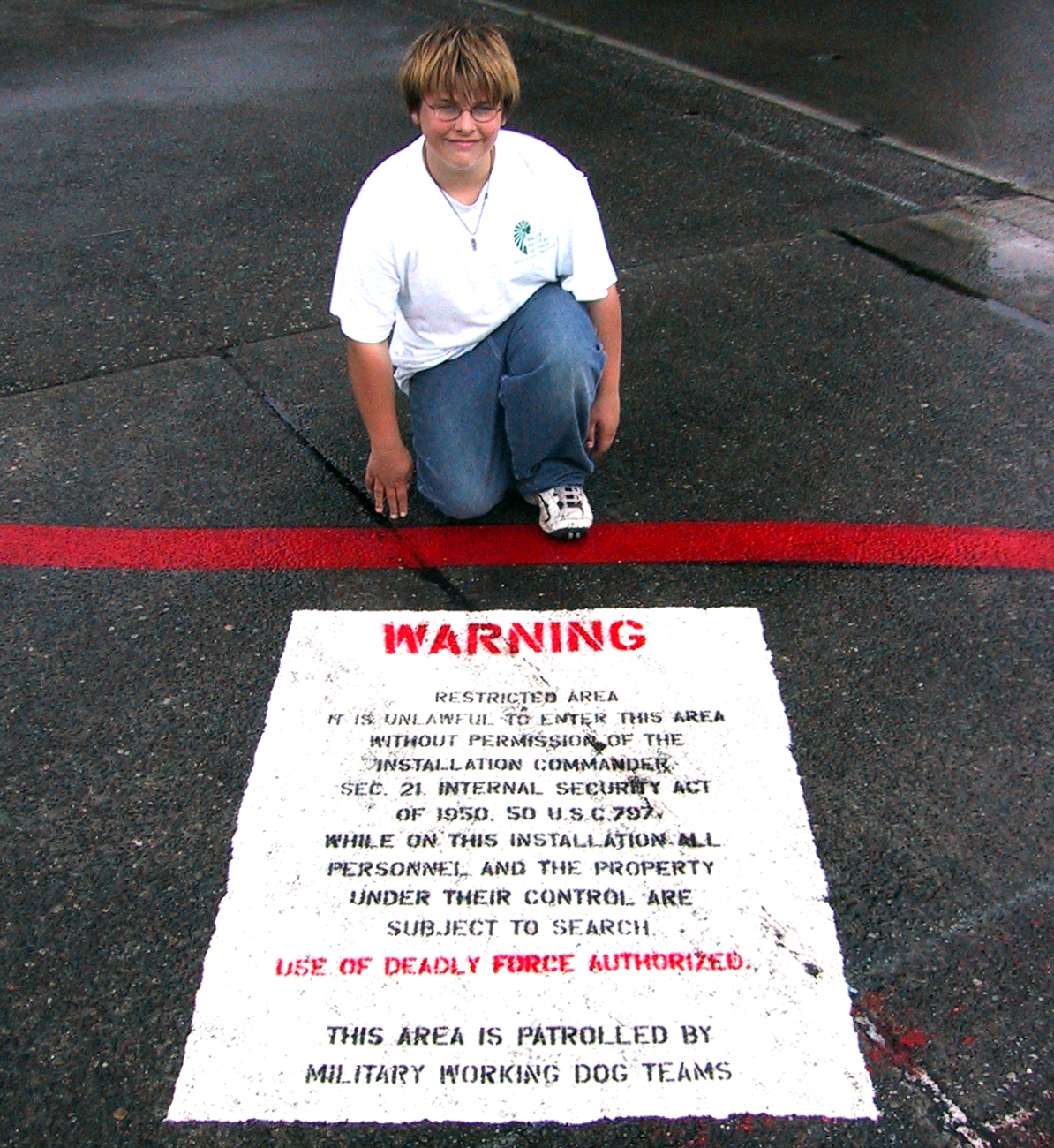
Sure enough… it was still there.
I got the shot of him with the sign in the story I’d told him so many times.
…
Fast forward again – to the year 2010, I’d done a presentation in Tucson, and found that after the presentation, we had a few hours to do some touristy things, and given the fact that I am an airplane nut, and that the last time we’d been in Tucson I’d only been able to drive past it, the Pima Air Museum was definitely on our list. It has hundreds of airplanes, and in the few hours we had, we tried to see as many as we could. We walked past some, paused for a moment at others.
And then I saw an F-4 and stopped cold.
A Phantom.
“Michael! This is it! This is the kind of plane I was talking about!” –
…and I did the little pinkie swipe with my right hand.
He knew exactly what I meant, and before I could do anything or even stop him, he’d gone to the back of the plane, and I suddenly knew what the SP had seen those many years ago.
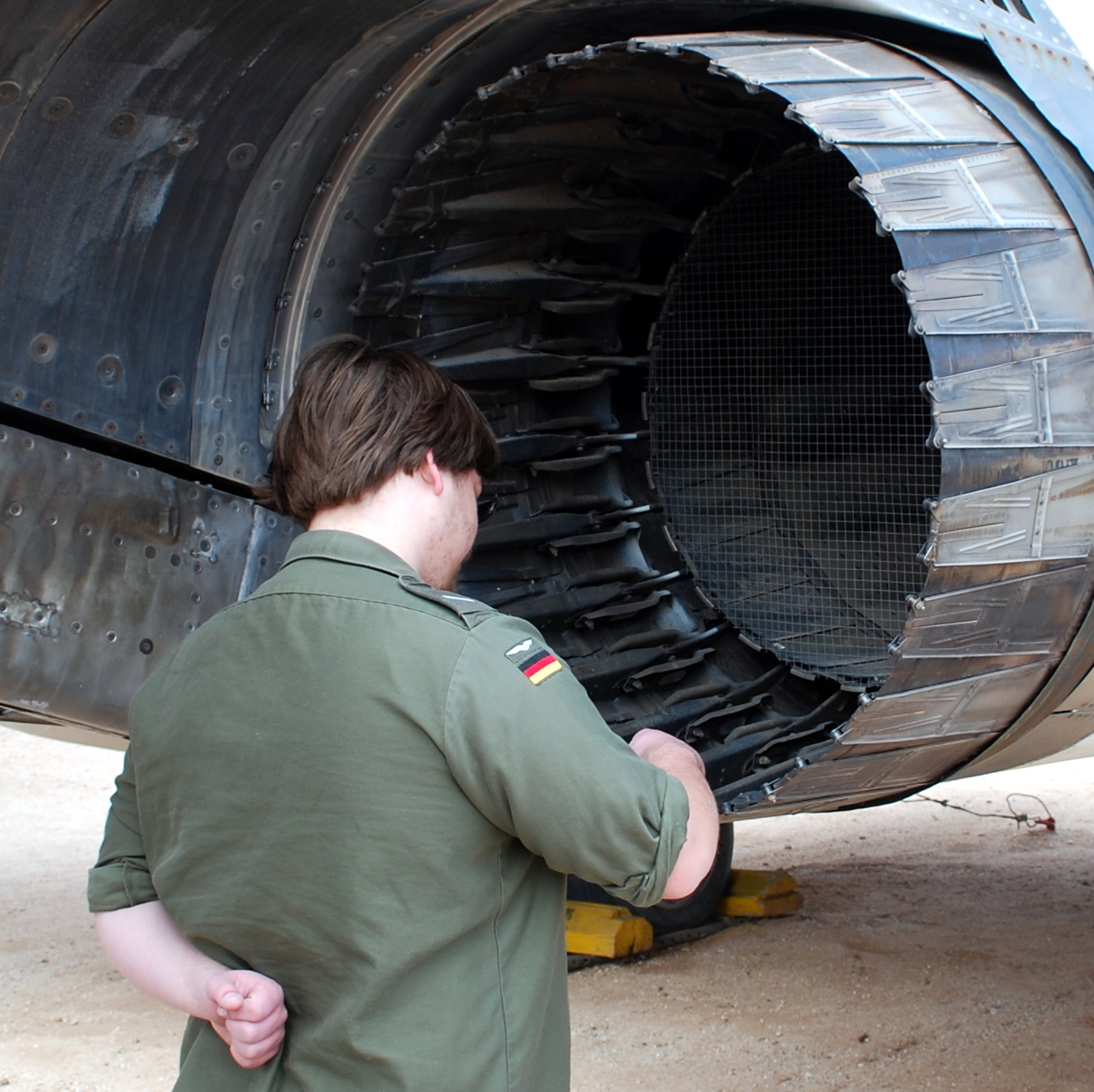
Without me saying another word, Michael had not only gone to the back of that Phantom – but gone to the right engine, and with his left hand still held firmly in the small of his back, like I’d done when I was the very same age, he took his pinkie, and swiped a little soot off the engine of a Phantom.
And no one stopped him.
© Tom Roush, 2010
Some time ago I was visiting my in-laws in Michigan, and had to learn how to make coffee all over again.
The thing is, living in Seattle, and having a daughter who’d worked at a, shall we say, ‘Moby Dick’ sized purveyor of coffee (therefore getting me the beans at a lower price than normal) I’d gotten quite used to grinding my own beans, brewing my own coffee, and knowing what I’d get in the end.
It wasn’t scientific perfection I was after, it was simple things, like knowing how much water to put in (until it looked right), and how much coffee to put in (until it looked right), and then letting it brew (until it dissolved any spoon used to stir it) and then it WAS right.
But their coffee maker was different, and at the time, I don’t think there was a Starbuck’s anywhere near there.
I tried to make coffee using their little coffee maker, and did manage to succeed at that, but the next step was so remarkably unsuccessful that I could do nothing but stand there and wonder what had gone wrong.
In trying to pour coffee into a mug (note: you shouldn’t need a degree in physics or thermodynamics to do this) – I managed to pour it all over the counter.
At first, I just thought just wasn’t quite awake enough and maybe I’d just missed, but later tried it again, and realized that the lip of the coffee pot was bent in such a way that instead of the coffee shooting out toward the cup, a good part of it would actually shoot backward under the coffee pot as I was pouring – and miss the mug entirely.
And I’d have almost a third of the coffee on the counter, not in the cup.
Day after day I tried to fix this, pouring faster, slower, different angles, aiming at different spots in the cup – didn’t matter, it just poured out onto the counter, and I’d clean it up.
One day, my father in law walked up and watched with mild amusement while I was trying once again to pour a mug of coffee. This was the guy who’d made coffee with this crazy little coffee maker for years, and I figured that over that time, he must have found some sort of secret way to do this right. So that morning, out of just a touch of frustration, I asked him, “How on earth do you pour this without getting it all over the counter?”
And the answer was simultaneously simple, basic, and brilliant.
“I just pour it over the sink.”
You… just…
What?!
And he showed me.
He poured the coffee into his cup, and it spilled just about as much as it did when I poured it –but he did it over the sink, and while it spilled, it didn’t get on the counter.
And it made me think about the question I was asking and the problem I was trying to solve.
Which was more important?
Getting coffee into the mug?
Or keeping it off the counter?
Because if I could solve one of the problems (getting a decent amount of coffee into the mug) while keeping it off the counter, I could effectively solve both problems at once.
And if spilling a little coffee was irrelevant, then the problem was solved.
You could substitute anything for the two options there, and in this case, a simple solution that didn’t even cross my mind solved all the problems I was concerned with at once.
It was a win-win…
I got the coffee I wanted.
I kept the counter clean.
…and I learned a lot about solving problems from a little off the cuff comment from my father in law Bruce.

Bruce Harris, Coffee Pourer extraordinaire (and cool father in law)
In this blog, I’ve been trying to write stories that have been “baked” – where I’ve spent the time over the years getting to that “aha” moment, where the laughter has finally come, the lessons finally learned, the tears finally dried, and I can share them with you.
This post is a little different.
I’ve been asked by a number of people to give “hankie warnings” on some of these stories, and in honor of that request, please consider yourself warned.
This post is a little more personal than the others, and it’s a number of stories, kind of intertwined.
As I write this – November 8th, it will have been 10 years since I spoke the words below, in front of a well-dressed, somber group of people who listened, who laughed and who cried.
I had been in that last category for ten months, and on November 8th, 2000, these people joined me there.
It was the day we buried my dad.
He’d been in the Air Force. He’d done his time in many countries. It was his time in the Air Force that had him meet my mom, that gave him stories of far-away places to tell, and that shaped my childhood. Some of those stories I’ve recalled in past posts, some are still, as it were, baking, and will be written when they’re ready.
I was at work on January 10th, 2000, when I got “the call”. Those of you who’ve been through this will understand what that means. It’s actually hard to describe the feeling to someone who hasn’t been there, but when I got “the call” – my heart froze, and given where I was, I did the only thing I could do…
I prayed…
…and then I wrote.
I didn’t know whether I’d ever get a chance to tell dad all the things I’d wanted to say over the years – and it seemed that if I was ever going to take the chance, that right then would be that chance, instead of saying all the things I wanted to say to him in a eulogy where he couldn’t hear me, and the words would be empty.
So I wrote a note to him that January afternoon. It’s included in what’s below – which, ironically, is the eulogy I gave for my dad, 10 years ago today.
= = =
Eulogy…
That’s what it says there in your program that this is going to be.
But how do you put into a few words the life of a man who was a brother, a husband, a father, an uncle, a father in law, a grandfather, a teacher — and all those countless other things that a man is in his life?
I’m not going to go into the history of dad too much, you all can read that on the backs of your bulletins. We tried to get as much in there as we could. We’ll also have some pictures going in the fellowship hall so you can see a little more about who dad was.
But right now, I’d like to tell you a little bit about who dad is.
By now most of you know a bit about how this all came about, and for a number of you, the last time you saw him was in this very church on January 8th of this year at Tom McLennan’s Memorial Service.
Dad went into the hospital that night, stayed in ICU at Madigan until May, during which time he had a stroke and some other complications, and later was taken to Bel Air Nursing home in Tacoma, where he died last Friday.
I wrote him a note on January 10th, when things looked pretty bad, his heart had stopped the night before, and we didn’t know what was going on, since he’d walked into the hospital the night before that, and I tried to tell him what he meant to me. I’d like to read part of that note to you, because in a lot of ways, it tells a bit about the thoughts, the feelings, the emotions, and the legacy that he left behind.
<note>
1:45 PM 1/10/00
Hi Pop,
It’s Monday, you’re in the hospital right now, and I’m praying for you.
I have to tell you a few things, just so you know them.
I love you.
— this is so hard to write…
I don’t want this to be the time to say goodbye, but I need to say a few things so that when the time comes, I can say goodbye knowing I’ve told you what I need to tell you.
You know as well as I do that there were a lot of things in our lives that haven’t panned out the way we’d planned.
Because of the time you spent away from the family in the Air Force and at school, I didn’t get a chance to have you around when I really needed a dad.
This doesn’t mean it was easy for you, in fact it was hard. I know now it was very hard for you as well.
But I want you to know that good has come out of that.
I try to spend time with my little boy now as a result, and I’m glad I was able to get my schooling out of the way before I became a papa.
Because you went away to school to improve yourself, I learned that sacrifice is sometimes necessary for future growth.
And good has come out of that.
I learned how much a son needs his father, and I try to be here for my son. So even though you felt very much like you were a failure, you weren’t. You taught me a valuable lesson, one that I will treasure always.
Because of the time you spent fixing things (and the time I spent holding the flashlight for you*)
*He’d ask me to hold the flashlight for him while he was working on something, and being a kid, my attention span was about as long as a gnat’s eyebrow, and so I’d be looking all over, shining the flashlight to what I wanted to see.
I learned how to fix things I never thought I could.
I also expanded my vocabulary during these times.
Because of the way you showed us responsibility, I was able to get a paper route and learn responsibility early, on my own.
Because you helped us deliver those papers on weekends sometimes, I learned that sometimes helping your kids to do the things they’re responsible for doing is a good thing.
Because of the way you told me to take things one step at a time, I was able to build pretty big things at Microsoft when I was there,, one step at a time.
And because you made things for me (like a train table)
and read to me (from Tom Sawyer)
and told me stories (like Paul Bunyan)
and sang to me (The Lord’s Prayer)
and took me to work (where I spun the F-4 Simulator)*
* — in the Air Force Dad was a flight simulator technician — he fixed flight simulators, and one time he took me to work, I think I must have been 5 or 6, and there was this whole line of these simulators — all just cockpits of airplanes, and he, as fathers are known to do, picked me up and popped me in the driver’s seat. I sat there, my eyes huge, as I saw all these dials and gauges in front of me, and it was just so cool and so complicated. — And there was this big stick thing in the way, so I pushed it off to one side so I could get a better look at the dials. I didn’t know that the simulator thought it was flying, and by pushing that stick over I made it think it was corkscrewing into the ground, and all the dials and gauges started spinning alarms went off. I got so scared, I thought I’d broken it, and I looked out at him — he was standing right there, talking to someone else, and with fear and trepidation said,
“Daddy?” —
He turned around, took one look at what was happening, reached in and fixed it. Just like that. He fixed it. I hadn’t broken it. But he just reached in, and with one touch, he fixed it.
and showed me things, (like Wolf Spiders)*
When we lived in Illinois, we discovered that the spiders there are significantly bigger than spiders here in Washington.
So one time Dad was in the basement, doing something, and he called me down. He wanted me to see what he’d found under this can. So, being a kid and being curious, I squatted right beside it, and then picked up the can — to find the biggest, hairiest god-awful ugliest wolf spider I’d seen in my entire life. I jumped up and screamed, and dad was over there laughing so hard. I didn’t think it was funny then, but for years all we’d have to say was “wolf spider” it would bring the whole thing back, and we’d have a good laugh over it.
and surprised me with presents (like at Christmas in 1971 when you told me to clean up a pile of newspapers, and you’d put a bunch of toy trains underneath them)*
*He kept asking me to clean up the papers, but there was always another present to unwrap, another toy to play with, another cookie to eat — and finally, when the Christmas eve was finally winding down and we were cleaning up, I remembered the newspapers and started to clean them up — and underneath was a train set he’d gotten from somewhere, on a set of tracks, just waiting for a little boy to play with them.
and provided for me (helping me get my first Saab)*
*Many of you in this church may remember praying for that very car…
and went out of your way to help me (when that first Saab broke down)
— and the second Saab, — the third one (the fourth one’s out there, it runs fine)
and drove all the way up to Seattle to SPU when I was a student one Christmas to bring me a present — a radio controlled Porsche 928) when you knew it was the only thing I would get.
and visited me at work when I was able to show you where I worked and what I’d become professionally
And supported me in your thoughts and prayers as I became a father in my own right.
You showed me love.
And because you told me, I know you love me.
I love you too.
</note>
I read this note to him several times, never being quite sure whether it got across to him. In August, at the nursing home, I read it to him again, and he looked at me very intently while I read it, and as I finished, there was this look on his face, of peace, of contentment, of, “My job is done.” and for a split second, the stroke seemed to be gone.
He then took the note from my hand and read it himself.
And I know that he knew when he left that he was loved, he was cared for, he was appreciated, and that he would be missed.
We rejoice for him, we’re happy, for him, that this ordeal is over, but we’re sad for us, for the big, dad/Gary/grampa shaped hole he leaves in each of our lives.
— I was thinking the other day about the things I’d miss about him, and I’m sure there will be many to come, but the things that come to mind right now are the little things — and it’s always the little things, isn’t it?
The fact that he’d say “I love you” and “I’m proud of you” so often that we didn’t realize how important it was for him to be able to say that, and now, how important it was for us — the whole family to have him as a cheerleader in the background. There were times he couldn’t do as much as he wanted to do for us, and in his mind, he always wanted to do more — and the fact that he’s no longer in the background, just being there cheering us on — I’ll miss that. We’ll miss that.
I miss his meow — for those of you who don’t know, he had this way of meowing like a cat so you couldn’t tell where it was coming from. It drove us nuts — and we miss it.
I miss him greeting Michael and me with, “Hello Sonshine”
I miss seeing him snuggle my little girl Alyssa, in his lap, reading any of a number of books to her, and the look on her face that told me of the security she felt in those arms.
I miss him standing with mom, waving good bye to us as we left after a visit. — and no matter where we were, when we got together, he’d always thank us for taking the time to do that, to get together as a family, and to include him and he would always remind us, “You are loved.”
We miss him telling us “Remember, a fat old man loves you.”
I miss him yelling at us to shut the living room door. That’s the sound we grew up with. We’d run out, be halfway up the stairs, and hear, “SHUT THE DOOR” — of course, he hadn’t done that for years since he put a spring on it so it’d shut itself. But I miss knowing I won’t hear it again.
I miss him calling me up at night to tell me there was something interesting on Channel 9 (PBS) that he wanted to share with me, even though we couldn’t be together, we could see it at the same time.
When I was growing up, and I’d be upstairs brushing my teeth late at night, I’d hear dad snoring downstairs, — a gentle snore (at least from upstairs) and I knew that that meant all was right with the world.
I’ll miss that, too.
And even though there are many things we’ll miss about him, I know he’s better off now than he was for the last 10 months.
Some time ago I had a dream — a dream of him essentially dying, and it didn’t look as bad as we all generally think of dying.
In my dream, he was laying there, his body all there, but kind of gray, and damaged. It looked like dad, but suddenly he broke free of that body, and he just kind of came up, there was this whole, healthy copy of him, in living color that kind of came out of him like a butterfly comes out of a cocoon, and he was free, he was whole, and he flew away, leaving the gray, damaged body behind him.
After Dad died, Petra was doing some thinking about what his death was like for him, and the image she came away with was this, that dad was in bed, in the nursing home, having just been sung to and prayed for by the love of his life. She laid down on the bed next to him to rest, and dad, who had had his eyes closed, suddenly could see her.
The machine wasn’t breathing for him anymore.
His mind was clear, not muddled by a stroke.
His heart didn’t struggle.
His feet weren’t cold.
We imagine he looked around, saw the things we’d brought in to make him feel at home, saw his beloved wife laying there, who’d been with him for 41 years, for better or worse, for richer or for poorer, in sickness and in health, and with his new, whole body, then left the presence of his wife to be with his Lord.
During dad’s life, we all knew that no matter where we went or what we did, dad loved us, and I am convinced that up there in heaven, he loves us still.
When the service was done, we headed to what would be dad’s final resting place, and on that cold, clear day, the wind blowing the oak leaves around the cemetery, our family gathered around dad one last time as he was given a military funeral, with an Air Force Honor Guard from McChord Air Force Base, a flag, and a rifle salute.
We shivered as we took our places in the chairs under the portable gazebo they’d set up for us, with mom sitting in the front row. I walked away for a bit to clear my head as the ceremony started.
I’d seen the airman with his trumpet, trying to keep his mouthpiece warm on that cold day, and I knew he was going to play Taps – which I’d learned to play when I played the trumpet in junior high school, but I’d never had to play when it counted.
Taps, originally used to signal “lights out” in the military, eventually became the bugle call played at funerals, where it signaled – or symbolized – a final “lights out” for an individual.
I’d heard it played when my friend Bruce Geller died in 1978.
I’d heard it played when I, as a photojournalist, was covering the funeral of Lee Stephens, a sailor from the USS Stark that was hit by a missile on May 17th, 1987, and each time I’ve heard it, it has been like a knife in the heart for me.
It is a symbol of the end of a life, and of a loved one, where they make that transition from living in your life to living in your memories.
I remember, as I shot the funeral of Lee Stephens, how I wanted to honor the grief and sorrow his family was experiencing, but at the same time, I wanted to tell the story that this young sailor, from a small town in Ohio, who’d graduated just a few years before, had people left behind who still loved him.
I remember seeing, through the viewfinder of my Nikon, through a long, long telephoto lens, the look on this sailor’s mom’s face as the sergeant of the honor guard handed her the flag. It was a photo that, while it was “the” photo from a photojournalism point of view, I did not take. The moment was too intimate, the grief was too raw.
I remember her eyes, simultaneously exhausted, numb, disbelieving, and utterly spent as she accepted a flag from an honor guard member, “…on behalf of a grateful nation…”
In walking away a bit, I had unconsciously recreated the view I’d seen through that camera, the photo I didn’t take in 1987 at that cold cemetery 13 years later, and I was not prepared to see that look on my mom’s face and in her eyes.
But I’d seen that look before, and knew what it meant.
We’d had 10 months to prepare for this moment, but the fact is, we all know we’re going to die. Being faced with it as “sometime” in the vague future is one thing. Seeing it in front of you in unblinking reality is something else entirely.
I saw the honor guard fold the flag as precisely as they could fold it
But this time, I wasn’t hiding behind my camera, trying to insulate myself from the pain of a mother who had lost her son.
This time, while I wasn’t a mother who’d lost her son, I was the son of a mother who’d lost her husband.
This time, I was the son who’d lost his father.
I understood things a little more clearly now.
I understood a little more about how much it means to sit in that chair, and have someone hand you a flag, in exchange for someone you love.
As if that wasn’t enough, it was then that they did the rifle salute. For those of you who have not experienced it, it is very much like a 21 gun salute. Retired military members who have served honorably receive a 9 gun salute, a volley where 3 soldiers fire off three rounds apiece. It is done as a sign of respect, of honor. For those not prepared for it, it can be shocking.
The call was made,
“Ready! Aim! Fire!”
Three fingers squeezed three triggers.
“Fire!”
Three firing pins hit three cartridges.
“Fire!”
Three cartridges fired and were ejected.
The honor guard was called to attention, and the command “Present Arms” was given so precisely – they all moved as one. Those without rifles saluted – those with rifles held them in the “present arms” position.
As the three shots echoed away, the only sound left was of those leaves, the movement of cloth, and the click of rifles being presented.
There was a moment where this was all we heard. Leaves rustling, coats flapping, and the stunned silence of those still not ready to let go.
It was then that the bugler, who’d clearly kept his mouthpiece warm, played Taps. He played clearly, with dignity, and with the respect and honor due.
– and through the wind, I heard the sergeant’s words I’d heard years before, “on behalf…of a grateful nation…” drift across on the wind as he solemnly handed the folded flag to my mom.
And at the end of the day, as I watched them drive off, I found myself, in spite of the fact that I had my own family, a job, a mortgage, all the trappings of being an adult, I found myself crying, because underneath it all, I was a little boy who’d just lost his daddy.
I cried for the fact that much as I’d wanted to, there were things left unfinished.
I cried for the relationship that had at times been rough, but had started to mend.
I cried for the relationship that, like it or not, mended or not, was ended.
…
It is Veteran’s Day as this is published…
For those of you out there who are wearing the uniform, or for those of you who have worn it, with honor, you have my greatest respect.
For those of you who’ve lost your sons – like Mr. and Mrs. Stephens, who lost their son Lee, and so many others, and for those of you out there who’ve lost your daddies, my heart goes out to you.
For those of you who are still daddies, remember your kids only have one of you, and they only have one childhood.
It’s not a dress rehearsal, it’s the real thing.
Take the time to be there for them while you can.
Love them. Hug them.
Veteran’s Day, 2010
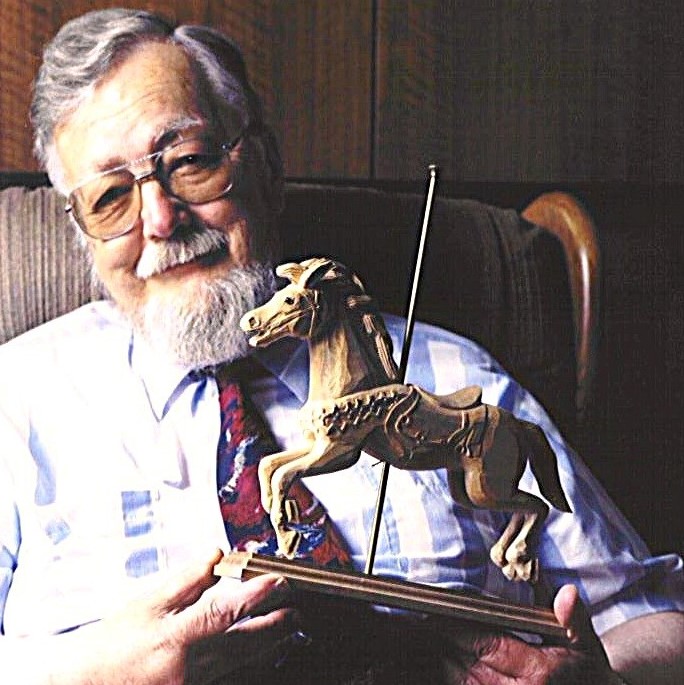
Dad and one of the merry go round horses he carved.
My son has informed me that “to be old and wise, you first have to be young and stupid” – and with that in mind, we’ll start with a story – it’s from my childhood, when I, like most of us, was young and stupid.
Speaking of my son, as he was growing up, I told him “Stupid Things that Papa did when he was Little” stories, in hopes that he wouldn’t do those things. Now it’s said that tragedy plus time equals comedy, and when hearing these stories of my stupidity in my childhood, he would usually laugh at the tragedy I’d survived, mostly of my own doing. And somewhere in the story there’d be a lesson, and he’d remember it. Now since I was telling him the stories, it must have meant I’d survived, but still, stupid is stupid.
So, in this case, I was about 16 or so, and I was building a diorama – a model of a burned out, destroyed building that a model tank would be positioned as crashing through. It involved a bit of plaster, a few small pieces of plywood, and a whole bunch of little wood scraps and such – oh, and the model. I was trying to make it look like the building had burned, and needed that black smoky look to come out of the windows.
Black… Smoky… the kind of smoke that comes from… oh, what is that yellow/orange stuff?…
Fire, yeah… that’s where smoke comes from…
(insert ominous music here)
Now, was I doing this on a desk?
No…
(that would have been smart, and I wouldn’t have this story to be telling you)
…a modeling table?
No…
(that would have been smarter, as I’d have a place to put all the bits and pieces and let glue dry)
…someplace where I could safely light a match or candle and let the smoke do its thing?
No…
(that would have been smartest, as – well – lighting matches… teenagers… in the house… need I say more?)
I was doing it on the carpet in my room.
Oh wait. It gets better.
See, I was trying to get a smokey effect…
A match would have been good.
A candle would have been great.
But for some reason, which I must attribute to my Infinite Teenage Wisdom ®, I decided that they weren’t quite good enough and decided to use a highway flare instead of a match.
Oh, just go back and read that again, you know you need to…
Yes, a highway flare...
Upstairs.
In the house.
Over the carpet.
Well – it’s not so much that I really wanted to use the highway flare, but I had it in my hand, and had the cap off, and was idly wondering how much force it would take to get a spark – oh heck – like that would go over as an excuse…
Right…
…did you know that once lit, highway flares are, um, extremely hard to put out?
…and they drip red hot stuff when they’re burning?
…that melts carpets?
Ummmyeah…
Doing the “Olympic torch” run through the house to get it outside just wasn’t going to happen. I mean, there’s that red hot stuff dripping, In this case, it was a carpet, but if I were running (and who can’t imagine running through the house with a flare like an Olympic torch, the crowds cheering, the – no wait – that was just SO not happening…) And that red hot stuff would have been dripping on my shoulder, and that would have been, oh, bad… yeah, we’ll just call it bad… (keeping in mind of course that dripping red hot burning stuff onto a carpet really isn’t on the “good” side of the spectrum).
The more I think about it, the more I realize we’re so far past the border between dumb and stupid that you can’t even see it in the rear view mirror. I’d had some plaster powder there for the diorama I was making – and out of pure instinct I shoved the flare into that – which, to my delight and surprise, put it out. But the thing that got me, I still can’t believe it to this day, was that mom smelled the smoke, came in, and wondered what was going on. And my guilty conscience went ballistic trying to defend itself. Understand, this is a teenage mind going off here – but here was my Infinite Teenage Wisdom ® reasoning:
I argued:
“Just because you smell smoke, and
just because you walk into the room that you can barely see through because of that smoke, and
just because I’m the only one in it,and
you came in through the only door, and
just because I’m sitting there on the floor, with a hot flare sitting beside me and a smoking hole in the carpet, you think I DID IT?”
We pause, reverently, hands over hearts for a moment, as the parents out there realize they’ve heard some variation of this before, both from their own mouths and from their children’s…
“Uh… Yeah… As a matter of fact, I do think you did do it.”
My mom, bless her, realized that she was not arguing with logic in the slightest, she was arguing with a guilty conscience and emotion, and no amount of logic was going to make it through that.
I have no idea why I was defending myself so much at that time – but I was. I’m sure I would have said that someone else was using my fingers and put my fingerprints on it had it gotten to that… Dumb, dumb, dumb…
Speaking of fingerprints…
…fast forward about 25 years – I was in my darkroom developing film for a client, and had some hanging up to dry. My daughter came down, eating some chicken. I put two and two together and said, “Don’t touch the film.” I then turned back to the enlarger. Something made me turn around.
One of the strips of film was moving.
The one with some greasy fingerprints that hadn’t been there a moment before.
There was also a very guilty looking 8 year old.
“Didn’t I tell you to not touch it?”
“I didn’t!”
“I can see your fingerprints right there!”
“It wasn’t me”
“We’re the only two in the darkroom!”
And then…
It dawned on me…
I started thinking about fingerprints and realized that I wasn’t the only one who had a stranglehold on denial, and that my son’s comment from earlier was right…
To be old and wise, you have to be young and stupid first…
I just didn’t know it would be hereditary…
My son has informed me that “to be old and wise, you first have to be young and stupid” – and with that in mind, we’ll start with a story –it’s from my childhood, when I, like most of us, was young and stupid.
Speaking of my son, as he was growing up, I told him “Stupid Things that Papa did when he was Little” stories, in hopes that he wouldn’t do those things. Now it’s said that tragedy plus time equals comedy, and when hearing these stories of my stupidity in my childhood, he would usually laugh at the tragedy I’d survived, mostly of my own doing. And somewhere in the story there’d be a lesson, and he’d remember it. Now since I was telling him the stories, it must have meant I’d survived, but still, stupid is stupid.
So, in this case, I was about 16 or so, and I was building a diorama – a model of a burned out, destroyed building that a model tank would be positioned as crashing through. It involved a bit of plaster, a few small pieces of plywood, and a whole bunch of little wood scraps and such – oh, and the model. I must have been trying to make it look like the building had burned, and needed that black smoky look to come out of the windows.
Black… Smoky… the kind of smoke that comes from… oh, what is that yellow/orange stuff?…
Fire, yeah… that’s where smoke comes from…
(insert ominous music here)
Now, was I doing this on a desk?
No…
(that would have been smart, and I wouldn’t have this story to be telling you)
…a modeling table?
No…
(that would have been smarter, as I’d have a place to put all the bits and pieces and let glue dry)
…someplace where I could safely light a match or candle and let the smoke do its thing?
No…
(that would have been smartest, as – well – lighting matches… teenagers… in the house… need I say more?)
I was doing it on the carpet in my room.
Oh wait. It gets better.
See, a match would have been good.
A candle would have been great.
But for some reason, which I must attribute to my Infinite Teenage Wisdom ®, I decided that they weren’t quite good enough and decided to use a highway flare.
Upstairs.
 In the house.
Over the carpet.
Well – it’s not so much that I really wanted to use the highway flare, but I had it in my hand, and had the cap off, and was idly wondering how much force it would take to get a spark – oh heck – like that would go over as an excuse… Right…
…did you know that once lit, highway flares are, um, extremely hard to put out?
…and they drip red hot stuff when they’re burning?
…that melts carpets?
Ummmyeah…
Doing the “Olympic torch” run through the house to get it outside just wasn’t going to happen. I mean, there’s that red hot stuff dripping, In this case, it was a carpet, but if I were running (and who can’t imagine running through the house with a flare like an Olympic torch? – but that red hot stuff would have been dripping on my shoulder, and that would have been, oh, bad… yeah, we’ll just call it bad… (keeping in mind of course that dripping red hot burning stuff onto a carpet really isn’t on the “good” side of the spectrum).
The more I think about it, the more I realize we’re so far past the border between dumb and stupid that you can’t even see it in the rear view mirror. I’d had some plaster powder there for the diorama I was making – and I shoved the flare into that – which, surprisingly enough put it out. But the thing that got me, I still can’t believe it to this day, was that mom came in and wondered what was going on. And my guilty conscience went ballistic trying to defend myself. Understand, this is a teenage mind going off here – but here was my Infinite Teenage Wisdom ® reasoning:
I argued:
“Just because you smell smoke, and
just because you walk into the room that you can barely see through because of that smoke, and
just because I’m the only one in it, and you came in through the only door, and
just because I’m sitting there on the floor, with a hot flare sitting beside me and a smoldering hole in the carpet, you think I DID IT?”
We pause, reverently, hands over hearts for a moment, as the parents out there realize they’ve heard some variation of this before, both from their own mouths and from their children’s…
“Uh… Yeah… As a matter of fact, I do think you did do it.”
My mom, bless her, realized that she was not arguing with logic in the slightest, she was arguing with a guilty conscience and emotion, and no amount of logic was going to make it through that.
I have no idea why I was defending myself so much at that time – but I was. I’m sure I would have said that someone else was using my fingers and put my fingerprints on it had it gotten to that… Dumb, dumb, dumb…
Speaking of fingerprints…
…fast forward about 25 years – I was in my darkroom developing film for a client, and had some hanging up to dry. My daughter came down, eating some chicken. I put two and two together and said, “Don’t touch the film.” I then turned back to the enlarger. Something made me turn around and there were some greasy fingerprints on one of the strips of film that hadn’t been there a moment before. There was also a very guilty looking 8 year old.
“Didn’t I tell you to not touch it?”
“I didn’t!”
“I can see your fingerprints right there!”
“It wasn’t me”
“We’re the only two in the darkroom!”
And then…
It dawned on me…
I started thinking about fingerprints and realized that I wasn’t the only one who had a stranglehold on denial, and that my son was right…
To be old and wise, you have to be young and stupid first…
I just didn’t know it would be hereditary…
I opened a jar of jelly this morning.
It wasn’t store bought, it was home made.
It was made of something known as quince – a fruit that looks a lot like a drunken pear, and is really not all that good to eat directly, but is wonderful in jellies, it has almost a smokey apple flavor.
Mom’s had a fruit tree – a quince tree for years, and every year she’s canned jelly.
She’d put them in little one pint Ball canning jars, put the year and the type of fruit on them, and then put them on the counter to cool. As they cooled, you could hear them seal – there’d be this audible ‘doink’ as the lid of each one actually sealed shut.
When dad was still alive, I knew she’d be in the kitchen, cutting up fruit, and dad would be sitting in his chair, reading jokes or stories out of the Reader’s Digest to her just to keep her company. He was her cheerleader. There were things she did well, and things he did well – over the years they’d complemented each other. It was a scene that would play out every year, at the end of every summer, when it was time for the harvest of all the trees they had growing.
And every year, when the canning was done, there’d be this armada of jars on the counter, each with its own destination, each with the name of the fruit and the year written in sharpie on the lid.
The thing about this was that often she’d end up making far more jelly or jam than they could consume, and so whenever we visited, we couldn’t leave without a couple of jars of jelly. Sometimes it was quince, sometimes it was black currant mixed with raspberry, sometimes it was blackberry.
And sometimes, these jars of jelly would end up in the back of the cupboard in our kitchen, like this morning.
I opened a jar – this one clearly an old one, one that had been made while dad was still alive.
I rolled it around in my hand, hearing the stories it was telling me – of the fruit that mom and dad had picked off the tree in the side yard, of the way they had carried it over under to the picnic table or into the house, of the stories dad read to mom as she peeled and prepared the fruit. I heard it tell the story of how it was kept cool, preserved for just the right time until she pulled it out of the pantry to give to us.
I looked at it – listening, feeling, remembering.
I unscrewed the canning jar ring, then wedged my fingernails under the lid and heard the hiss as the air from today mixed with the air from many years ago – and the thoughts of today mixed with the memories of years gone by.
I realized, with a start, that not only was I holding a jar of jelly, I was holding a time capsule in my hand.
A time capsule of love.
I dipped a knife into it, and spread it on my toast, and with a cup of coffee and a smile, planned my day.
© Tom Roush

 Tom Roush's Blog
