
You are currently browsing the tag archive for the ‘Family’ tag.
A chortling water buffalo pulled up beside us as we waited for the stop light at 15th and Market.
I looked left.
Hmmm… No water buffalo.
Especially in Ballard. However, there was a Harley, making all the gorgeous sounds idling Harleys make.
“The driver’s too skinny,” said Michael from the passenger’s seat after giving him a once-over.
“And a bit young…” I said as my eyes moved up from the bike to the rider.
Sure enough… a too skinny kid in his 20’s… straddling a burbling Harley.
We watched, and listened, as we waited for the light to turn green, and as it did, the Harley roared off, blasting open the doors of the time machine and leaving me ricocheting off long forgotten memories for the rest of the trip home.
Those memories spanned well over a quarter of a century, and I bounced between lessons from Grad school, a famous photograph, my first internship, and lessons learned many, many years later.
And as the sound faded away, it got me thinking about Harley Davidson.
The real one.
But to tell you that story – I’ll need to tell you a couple of other stories to fill in some gaps.
I got my Master’s degree in photojournalism from Ohio University, and one of the things Terry Eiler drilled into us there was to go out and take risks. Go out and try new things. Do the thing no one else is doing. Do the assignment you were sent to do to be safe, but then go do a little bit more.
I learned from that. I’ve been inside the boiler of a steam locomotive (it was pretty dark). I’ve talked my way onto airplanes (it was loud), and I’ve gotten images of normal things from abnormal locations just because I asked if I could. (it was amazing).
What Terry didn’t tell us at the time is what kinds of stories we’d get on the way to taking these pictures… There’s the “running over the skunk” story, and the oh-so-memorable “the car broke down” story, things that seemed to “just happen” – and yet, took on a life of their own. Lessons to be learned, stories to be lived.
But all that was in the future still. While in class, he told us about a guy named Rob Goebel, who’d worked at this small town paper, and one hot day had gone out to see if he could find some images that could tell a story, and eventually, he found himself in a bar…
With a biker.
Named Bones.
He knew the shot he wanted, and after as much chatting as you could do, set up the lights, got the shot he’d had in mind, and then left.
Fast forward 15 years. I’d gotten my first internship out of Grad School, for the same newspaper Rob had been working for at the time. Mike Grone was the chief photographer, and one day as we were going over assignments, he got this twinkle in his eye that I didn’t recognize until later, smiled, and said, “Hey, you ought to go see Bones.”
“Bones?”
“Yeah, Bones and Harley – Rob Goebel took a picture of him a few years back… Won the POY (Pictures of the Year) award for it after he left.”
“Oh really?” I said as he dug through a file cabinet for a faded tearsheet of the original.
He found it, and gave me the address, and I tossed my camera bag into the back seat of my old Ford and headed on over to the little house on Wilkinson, hoping to maybe reproduce a photo of him and Harley 15 years later, kind of an “after” shot to Rob’s ”before” photo. I found the house, parked the car, and as I shut it off, looked up to see Bones himself sitting in an overstuffed recliner on what would soon be a dilapidated old front porch, idly sharpening a knife. He’d aged since the photo, but even so, there was still a presence about him that could be sensed, was almost palpable.
As I walked up and got my bearings, I realized that the thing about Bones was he wasn’t just skin and…
It was not hard imagining him riding a large motorcycle. He filled up the generously sized chair he was in, his overalls, and that presence extended out well past the porch. I took the initiative and introduced myself, not really sure of what kind of a reaction I’d get.
He sized me up, understanding pretty clearly that I wanted to take some pictures (a camera bag and two Nikons likely gave that away). He tucked his sharpening stone between his belly and his left leg, and we talked for a bit…
I don’t remember much of the conversation until he asked if I had a knife. Of course I had a knife. I’d had a Swiss Army Knife of one kind or another for years. It was as much a part of me as a watch might have been, or today, a cellphone.
“Let me see it.” he said. It wasn’t a request, more a statement of a fact that just hadn’t happened yet.
I handed it over. He grunted a combination of acknowledgement and disgust as he pulled the bits of packing tape off the blade that were still stuck there from the last time I’d opened a cardboard box with it. He shifted in his chair and pulled the well-rounded sharpening stone I’d seen earlier out from under his paunch and talked me through the finer points of knife sharpening.
Harley came out about then, and I tried to make something of a picture of the two of them on the porch, but things, weren’t clicking, so to speak. Bones wanted to finish the knife, and I couldn’t make any of it really work photographically, so we just chatted a little more.
That’s when I heard another screen door tentatively creak open, and I looked over to see a young lady, who I learned later was Harley’s sister, come out. I watched as she came out, and remember thinking that she looked a lot like – well, like she just didn’t seem to belong in that place… Kind of a rose among thorns, if you will. I was still trying to reconcile that when I looked back to Bones and noticed something had changed, as if a wall had suddenly fallen between us. Totally unspoken, there was a sense that I had unwittingly crossed a pretty significant line, and I could feel the temperature drop as he handed me back my knife, folded closed. I opened it, and realized that in the couple of minutes he’d had it, he’d taken it from a bits-of-tape encrusted piece of metal to a finely honed instrument that would do far more than cut through the tape of cardboard boxes. He’d left his mark on that knife, and was not so subtly letting me know what he was capable of, and even though he was showing his age at the time, still not a man to be trifled with.
So, I didn’t trifle, and realized that the picture I had gone there to recreate might not be possible, but I’d tried. I remember going back a time or two more, but that wall was still there, and over time, Bones and his family faded off the back burner of my mind.
Many years later, I got back in touch with Mike as I was writing this story about a fellow named Harry Frilling who’d lived there in Sidney. We started talking about how it had been almost a lifetime since we’d talked, and he told me about how things had changed there… We talked about Harry, and me climbing on top of the courthouse, and running over the skunk. We talked, and laughed, about me blowing through the annual film budget during my few months there.
And somehow, the subject of Bones came up.
I found that the knowledge I gained about not trifling with him was not limited to just me. In fact, Mike mentioned that had actually been a concern when President Reagan had visited Sidney on his Whistlestop Tour. He found in his files a quote from the Sidney Daily News that day:
“The neighborhood has never looked better. Citizens living near the North Street Chessie crossing have been out cleaning up in preparation for President Reagan’s visit. Much work remains to be done, but most of it is in the area of security. Just where will Bones Kah sit?“
Bones, whose political views weren’t quite in the same ballpark as President Reagan’s, was nowhere to be found. It turned out he had been taken into what they called “Protective Custody”.
Mike didn’t find it necessary to mention who was being protected from whom, or why.
The thing is, Bones, being the leader of a motorcycle gang (or club), (The Vikings) – had developed, and cultivated a reputation. There are some motorcycle clubs that cultivate a reputation of working for charity, and others that work hard at cultivating another image. I understand that there is a culture of respect, and there are rules, which, now that I think of it, are not to be trifled with.
But the reputation that goes along with being the leader of a Motorcycle Club is a bit different than the reputation one develops in being a dad who might work in an office somewhere. No matter what, it’s hard to keep work and home life separate. It’s like – well, you’ve heard of dads being late to their son’s ball game because of a meeting at work. Bones’ situation was a little different, in that the qualities that made him effective when leading a motorcycle club didn’t translate very well to having kids and being a dad.
A single example: There’s a story told by Rob (the photojournalist mentioned above) that when Bones visited the newborn Harley and mom shortly before he took the picture, Bones visited the hospital with a dead rat tied to his leg.
There was no mention of how old the rat was or how long it had been there, but the story attained almost urban legend status, and Bones wasn’t about to dissuade anyone from believing it.
The stories Rob told were told of a very few moments with Bones, and the thing is, as a photojournalist, you come into a situation, you do your best to capture or create a lasting image that tells the best story you can, and then, most often, you leave and never see the people or hear from them again.
Rob did a stunning job of capturing that image. He took a situation, a dark bar with the smell of years of spilled beer and cigarette smoke, the smell of countless Saturday night closings where many people had had too many drinks and ended the evening bowed down before or curled up around the porcelain throne in the restrooms, and invited us in with him, to share Bones’ “office.”
In doing that – that simple thing, he showed Bones in all his – well, ‘glory’ isn’t the word I’d use – but the persona of Bones that I saw on his front porch the day I was there was the same one I see in Rob’s picture.
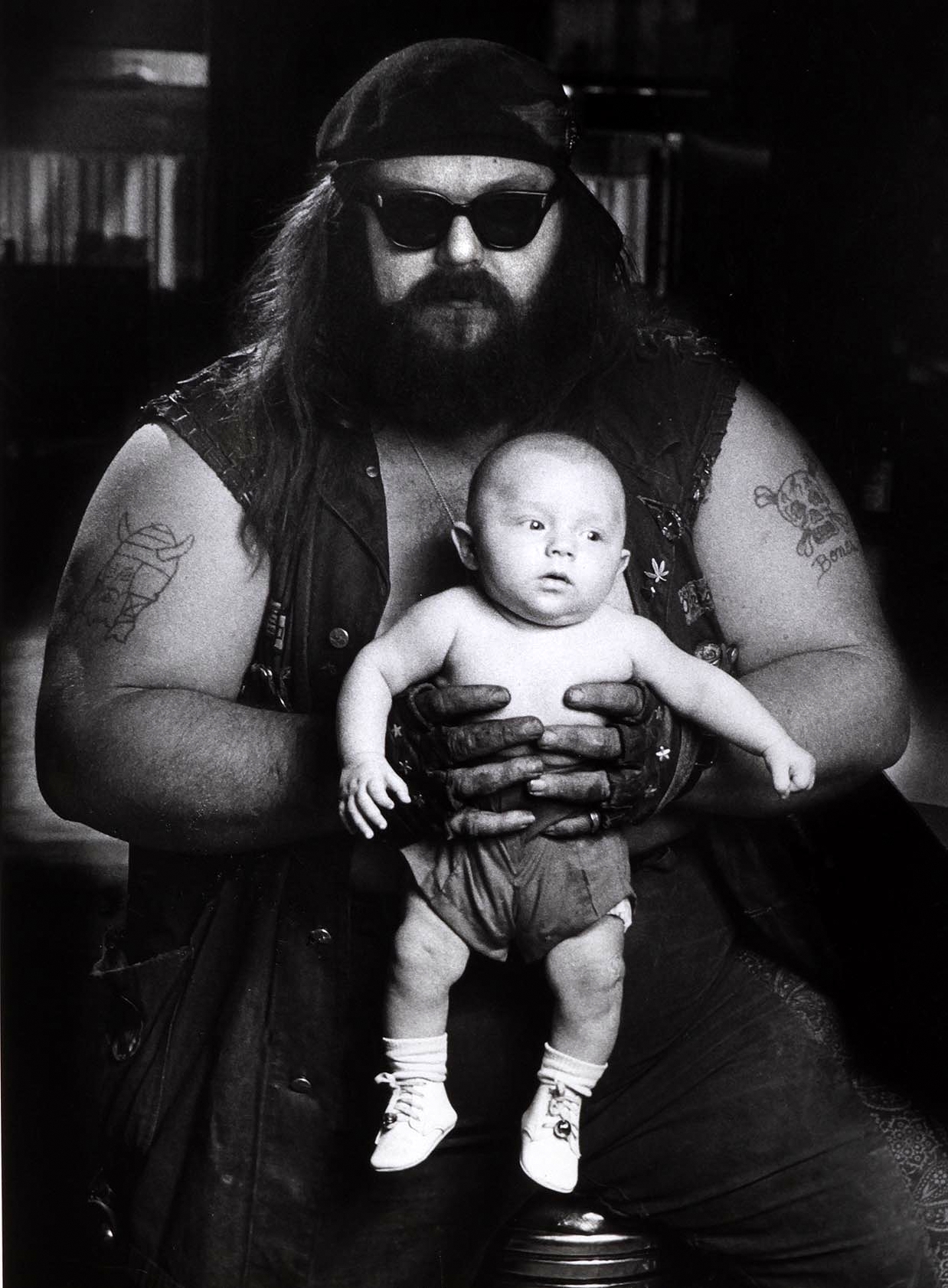
Bones and Harley – in a bar someplace in Sidney, Ohio. Photo (c) Rob Goebel. Used with Permission
That’s what Harley grew up with.
That’s who Harley grew up with.
Extrapolate on that.
Just a little.
Imagine what it’s like, growing up like that. I can’t. It turns out Harley left Sidney shortly after I did. I talked with him recently, and he said, and I quote, “After I left Ohio in 1987 we never looked back.”
While he has spared me the details, just that comment, and what I’d experienced myself and heard from Mike, gave me a hint of the life that had gone on long before, and well after that memorable image was taken.
Harley grew up.
Mike left the paper to pursue new things, and in one of his last assignments for the paper he was to get some photos of Bones and his two houses. In Mike’s words, “His spare house was condemned. Both houses, by all accounts, were of hoarder status. My assignment was photographing the exteriors of the side-by-side structures. Bones took great exception and offered to place the camera where there wasn’t enough ambient light to make an image. Since I finished the assignment before his offer, I bid him a fond adieu.”
And in 2008, Bones died.
I don’t have the few pictures I took of him when I was there, but given what I saw, I would understand why Harley had wanted to leave. He continued in that conversation we were having, “…but I was man enough to go see my father on his death bed and look him right in the eyes and forgive him for the abuse that he put us through. Things happen for a reason I believe and I am stronger for it.”
And, as you can imagine, it got me thinking.
Over time I realized that we learn how to be a parent from three separate but distinctly different things:
- Because of who you grew up with…
Seriously – how many times has someone said, “You’re just like your dad…”?
How many times have you heard your parents words coming out of your mouth, the very words you promised yourself you’d never say.
And yet you did.
And sometimes, those words came borne out of hard experience, and you realized, as hard as they were to hear when you were a kid, they were the right ones when you found yourself on the other side of the parental fence.
Then again, sometimes, as parents, we’ve find ourselves victims of our own past, and the world has changed faster than we’ve been able to adapt. Things that used to be acceptable aren’t anymore, and things that were totally unacceptable now have gone through a sea change of – well – change, and now they are. It brings challenges to parenting that take the most important job in the world, being a consistent role model for the next generation, and makes it even harder.
- In spite of who you grew up with…
You realized that your father was, for all intents and purposes, simply broken in ways you couldn’t fix. Over time, you realized it went back generations, and there was nothing you could do to fix that. Everyone grew up and did what they did because, well, that’s how it was done, right or wrong.
Eventually you also realized – consciously or unconsciously, that no matter what your dad did, you wouldn’t repeat it. You would find the courage he didn’t have, or the strength he didn’t have, the wisdom he didn’t have, and you would do the honorable and right thing for your family and children.
Eventually, you would come to that same decision point Harley hit while standing next to his father’s deathbed, and you forgive him for – in the case of Harley and many others, abuse. “For they knew not what they were doing.” Because that’s the way they were brought up and didn’t know any better – or in some cases, they did know what they were doing was wrong, but they did it anyway. And you realize, that while that kind of behavior is inexcusable, it does – no, it did – happen. And eventually, sometimes on a deathbed, you forgive them. Not because what they did was forgivable, but because you can’t change it… It happened. You can let it eat you alive, or you can forgive them, let it go, and allow yourself to leave the prison of those thoughts and learn from them, which takes us to the third item on the list:
- Growing up – and being totally different…
Think about this for a second: How many times do you remember seeing a situation happening in front of your eyes, and realizing you’d lived that before – only this time you had the chance to actually do something different, and break the cycle – so instead of doing things the same broken ways you’d seen them happen in your family over the years, you decided enough was enough.
And so you did something different.
And you did indeed break the cycle.
Ideally, you pick and choose the best in what your dad taught you – either by example of something they did right, or by the anti-example of what they did wrong. I remember when I was a kid, my dad was away at college, and one very rare time, he was at home when I had a band concert. I expected him to come, but he didn’t. The reason doesn’t matter… He wasn’t there. I vowed to never let that happen with my kids, and did my best to be there for them every time I could. I did something different.
…and I kept thinking…
I thought about how inadequate I felt when I held my kids for the first time… I’d forgotten entirely that humans came in such small, fragile, helpless packages. Remember – that’s not just fragile physically, they’re also fragile emotionally and spiritually. They need to be tended, carefully. Disciplined in time, yes… Broken, no. Broken children become broken adults, and the cycle of brokenness continues, doing its damage for generations to come.
I remember praying for and with them when they were little, folding their little hands in my bigger ones as I did, imagining that my hands were folded inside the even bigger Hands of my Father at the same time. It made the prayers feel more complete.
…the thoughts continued…
I remember growing as a father just as much as my kids grew at being kids. I got really, really good at making breakfast in about 90 seconds, a “Papa McMuffin” I called it.
And I made mistakes while my kids were growing up. All fathers I know have. There were times I was too drawn into work, too focused on outside things, too lenient with them in some areas, too strict in others. Times I wish I could go back and fix, but I can’t, so I do my best now, in the only moment I can change.
I went back in my mind to the concert dad missed, and how all the times he’d been away affected me, and while the child in me still wept for those lost times, the adult in me realized that Harley was right, and I came to the same conclusion: Forgiving my father – our fathers, for the mistakes they made was the only option that made sense. That doesn’t mean it has to happen immediately, and it doesn’t mean it was or is easy.
But given the options, learning from him, his successes, his failures, and picking and choosing the right ones, and working with those as my base gave me something greater than zero to start from, but there was one thing more.
I’d repeated a lot of those mistakes that have been made through the years, through the generations. It took some time to realize they were there, and I’m still working on correcting them. Some will take a long time, and in my observations with other dads, it seems that one of the first people we need to be able to forgive is ourselves.
And that’s hard.
But it’s the first step.
So… call your dad – if you can. Wish him Happy Father’s day, if you can, if you’re reading this on Father’s day (as I’m writing it), and then, if you can, take a deep breath and forgive him.
Learn from the mistakes of the past, but don’t repeat them.
===
The story above, as all stories on this blog are, is true.
I have several people to thank for their help in it. Chronologically, they’d be:
Terry Eiler, former director of VisCom, Ohio University – who encouraged me to go out and shoot – and take risks.
Mike Grone – former Chief photographer of the Sidney Daily News, who actually had me take those risks.
Rob Goebel, now of the Indy Star newspaper, who graciously allowed me the use of the photo, and
Harley himself, who in his simple words, taught me so much, and who allowed and encouraged me to write the story about his famous, award winning baby picture that had been taken in a bar, with a biker (Bones), by a guy (Rob) whose photos I’d admired and skills I was trying to emulate, all because my instructor (Terry) in grad school told a story and sent me out there so that my boss (Mike) could grin and send me off on a lesson I’d suddenly find myself remembering when sitting at a traffic light in Seattle, with my son, next to the Harley that sent me ricocheting back through my time machine to tell you this story…
Take care out there, folks.
Know that out there – every image you see -whether it’s an award winning photo, or a glimpse into someone’s life, has a story behind it.
This was one of them.
There was a time when I wasn’t sure I’d be able to write this story.
I mean that in the most final way that could be possible.
The original was written almost exactly 9 years ago, about something that happened a year before that, and it’s been a learning experience all the way around, so with that, step with me into the time machine, back to a day where I sat in our basement, with my keyboard in my lap, both feet on the desk, and I wrote a little note about those things we’d learned on that first anniversary.
“We’ve learned a lot through this last year dealing with cancer, treatment for it, recovery from it, and the like – and it’s phenomenal the kinds of things you do learn when you find you’ve been to the edge and back.
One of the things I learned, honestly, that life is truly not about the destination, it’s about the journey.
The destination for all our bodies, is likely a pine box or an urn on a mantel somewhere. That doesn’t have to mean that has to be our soul’s destination. Sometimes, when we just spend our time existing, drifting, our soul just shrivels up, and dries up and is blown away like dust. Believe me, I understand that, I’ve been there. But that’s not what life is about. Life is about living – and the life that comes from LIVING (all capitals on purpose) as opposed to just existing – is the difference between black and white.
We’ve found that life now (after cancer) tends to be higher contrast (speaking of black and white) – the highs higher, the lows, lower – and while those lows are definitely lower – the highs more than make up for it, and the stuff in the middle isn’t gray… it’s a… a fine mixture of that black and white. (those are all links to stories I wrote up there)
I found that life, as most people my age tend to think, is not infinite, that “someday” is not a day of the week, and that weekends, while occasionally made for Michelob, might be better spent if you realized there weren’t an infinite supply of them… So walks in the park (or wherever) have replaced being half comatose in front of the boob tube. Trips to visit friends have replaced sitting idly at home whiling away another weekend – and – that brings up something that happened just a few weekends ago.
We went down to Portland (Oregon) to do a couple of things:
1) Celebrate the end of treatment/major phase of recovery and the beginning of going back to work,
2) Visit our daughter, and
3) Visit with some of our bestest friends.
While Cindy drove the car down so we’d have a way to get back on time, our son Michael and I took the train, and I’d learned that if you pay a little extra, you sit in what they call “business class” – so instead of 4 seats across, there were only three, and the seats were wider, two seats, then an aisle, then one seat, and you got discount coupons on the food in the dining car. So we went for the business class. I was expecting we’d get the seats on the right side of the train – where you can see Puget Sound as you go by – and the rows are only one seat wide, and the seats there face each other, which made conversation and stretching your legs out easy. However, when I asked, those seats were full and we got put into “Row 6”.
On the other side of the train.
So we sat there for a bit – and with all the benefits advertised of being on a train, it wasn’t much different than sitting in an airplane – Michael reading his book, me sitting there, kind of cramped – and right about then, there was an announcement that the “Bistro car” (apparently what’s replaced the “Dining Car”) was open. I figured that since it was dinner time, and we had those coupons for the food, we should get up there before the line got too long, and so we did, standing there, swaying back and forth as the train trundled down the tracks.
After a bit of that, we got our food… Michael a hot dog, me a chili (which I spilled later, but that’s another story), and sat down at this little table, and talked, and ate, and read, and laughed, and watched the scenery, and played a game, and in general were having a good time all by ourselves.
…which was when the girls showed up.
A 12 year old and a 14 year old – they’d just met on the train themselves, were bored, and ended up sitting across the aisle from us, and started to try to make up a game. Michael and I were playing our own game by that point, and after I stomped Michael once, and he stomped me once, even worse, he felt he’d had enough, so I said, “Hey, why don’t you go over there and teach them how to play”
“Oh, I can’t do that…”
“Sure you can, what have you got to lose?”
“If you don’t go over there, it’s as good as them having said no, and you’ll have learned nothing.”
“If you do go over there and embarrass yourself, chances are you’ll never see them again, so you’re not risking much.”
“However, if you do go over there, and it works, then you’ll have the next hour and a half to spend time laughing, having fun, and making memories.”
“So really, what do you have to lose?”
After a few minutes of pondering, he went over there. Big, hulking Michael, went over and in his suave, sophisticated way asked, “Hey, wanna learn how to play a game?”
The girls loved it.
Oh, gosh, did they love it.
And, come to think of it, I think Michael did, too.
One of them got a deck of cards, and while the 14 year old was playing, learning and laughing with Michael, the 12 year old taught me a card game called “Spit” – involving faster reflexes than adults can possibly have (and that children playing games against said adults should be allowed to have). She blew me away. Then she decided to go easy on me and asked if I knew how to play “War” (each of you gets half the deck, and you each put a card down, whoever’s card is highest wins both cards. The winner is the one with all the cards). I thought I’d shuffled the deck well. Turns out I couldn’t have shuffled it much better (for her), because by the end of the first hand, she had all but two of my cards. The sound of her laughter was like the joyful ringing of a bell, and told me that even though I was losing the card game (Losing doesn’t come close – annihilated is more in the neighborhood), I was winning something much larger. I realized that if I had to ‘lose’ a game in order to bring that much laughter and joy into a child’s life, then I’d happily lose the game.
Every time.
It was at that moment that I realized that the high pitched laugh of hers had a bass line – and I looked across the aisle to find that Michael had his opponent on the ropes, so to speak, and was laughing uproariously at his position in the game.
I thought about this at the time – about how before all these realizations, before cancer, I might have just stayed there in my assigned seat because it had cost me $12.00 extra a seat to get those extra wide/comfortable ones – and by God, I was going to sit there and get my $12.00 worth of enjoyment out of them if it killed me.
But…
I didn’t.
I realized that for us to enjoy the journey the way we had, we had to get up out of our comfortable seats where they were showing a now long forgotten movie, and go up to that Bistro car, where there were no reservations for us, and no assigned seats. It was a risk, a small one, but the rewards were so well worth it. Getting up, and daring to get out of our comfort zones and living life, instead of life living us, was obviously the thing to do, for Michael, and for me.
Suddenly, before we were really ready, the call came out “Next stop, Vancouver”. One of the girls got off, and then 10 minutes later, we got to Portland – and the other little girl just disappeared into the river of people pouring out of the train. We joined the same river and spilled out onto the platform.
We stopped, the crowd thinned, we looked around, and at each other, and realized we were at our destination.
Having truly enjoyed the journey.
===
As I said, it’s been 9 years since I wrote that, and 10 years since the phone call that started it all.
We had no idea what the future would bring then. We had no idea how hard some of it would be, or how unbelievably cool other parts of it would be. Most surprising was how we would feel a peace about things through all the terror that made no sense, given what we were going through, but we also felt that that peace we were feeling was directly related to the shield of prayers our family, friends, and even some strangers (who became our friends) kept over us.
But back on that day, I remember that the doctor had said he would do his best. He’d remove what he could remove, and try to save what he could. And that little bit got me thinking the ‘what if’ thoughts that you try in vain to push out of your mind, but that wasn’t an option, so I went out that morning, while the sun was still low, and while the grass and dandelions were still wet, and I walked barefoot in the grass – trying to imprint that feeling, that memory into my mind, because I wasn’t sure I’d be able to repeat that when I came back.
To say I was a little nervous about the whole thing might be understating it a touch.
I came back in, changed, and we left the house. I drove, and after getting all prepped, we were able to convince them to let me take a CD player and some headphones in so I could have something to listen to after the surgery. My favorite composer is Johann Strauss, and so that’s what I wanted to hear, that would be my subconscious signal to myself that I’d made it through that part of it.
I remember being wheeled into the operating room. They stopped, I saw all the equipment they had, as I groggily looked over at the table I’d be laying on…
…and heard…
Strauss? YES! It was Strauss!
I’d made it.
I wiggled my toes, on both feet, and as I drifted back to sleep, I knew that as hard as the road ahead may be, it was going to be okay.
===
There are many, many people to thank here. If I thanked you all, it’d sound like an Oscar speech. But this is not the kind of thing you go through alone. It changes you. It changes those around you. So for those of you prayer warriors who helped hold up that shield up over my family and me, and to God who provided it, I thank you. We thank you. For those of you who brought meals when we needed them, or fixed plumbing, or mowed the lawn, or sat on the front porch in the shade, in the breeze, with a cold bottle of Sprite and just chatted and listened and distracted me for a moment… Thank you. For the medical staff (doctors, nurses, and vampires and staff – you know who you are) who’ve been with me through thick and thin, we thank you profusely.
The reminder that life is short, and the journey has no guarantees, is ever present. Hug your loved ones when you can.
And speaking of loved ones, there’s my family, who’s been along for the ride, hard as it’s been at times…
There are no words strong enough. Thank you barely scratches the surface. <Hugs>
PS…
I went out in the front yard this morning as the sun came up…
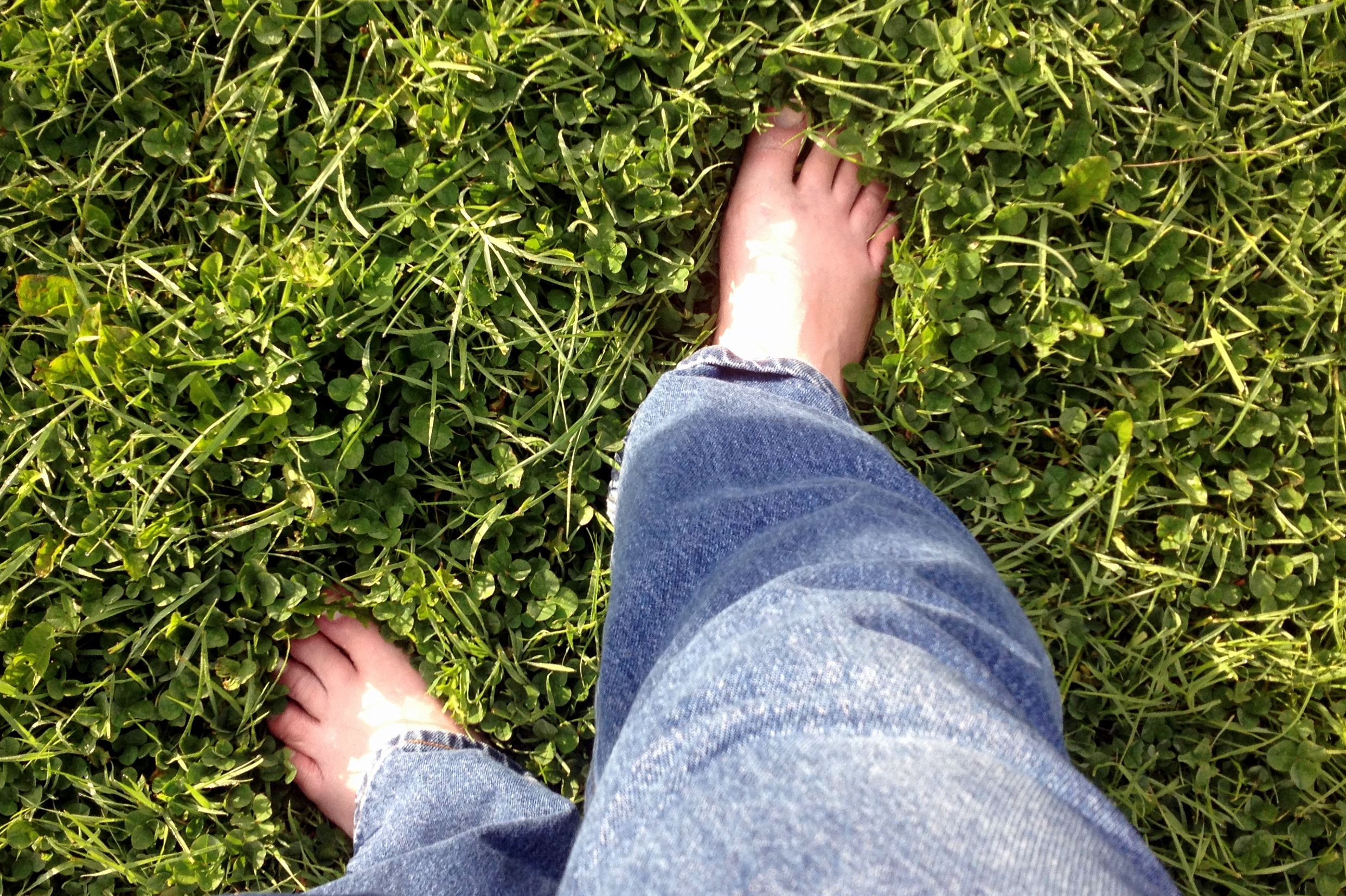
…and felt the dewy grass on my feet…
And smiled.
I stepped into the time machine again the other day.
It’s taken many shapes over the years… Sometimes a cardboard box of photos, sometimes a garage full of old stuff that’s in that strange stage between being treasure and being junk, sometimes an old car full of memories.
In this case, it was a train… and a plane… and a mountain…
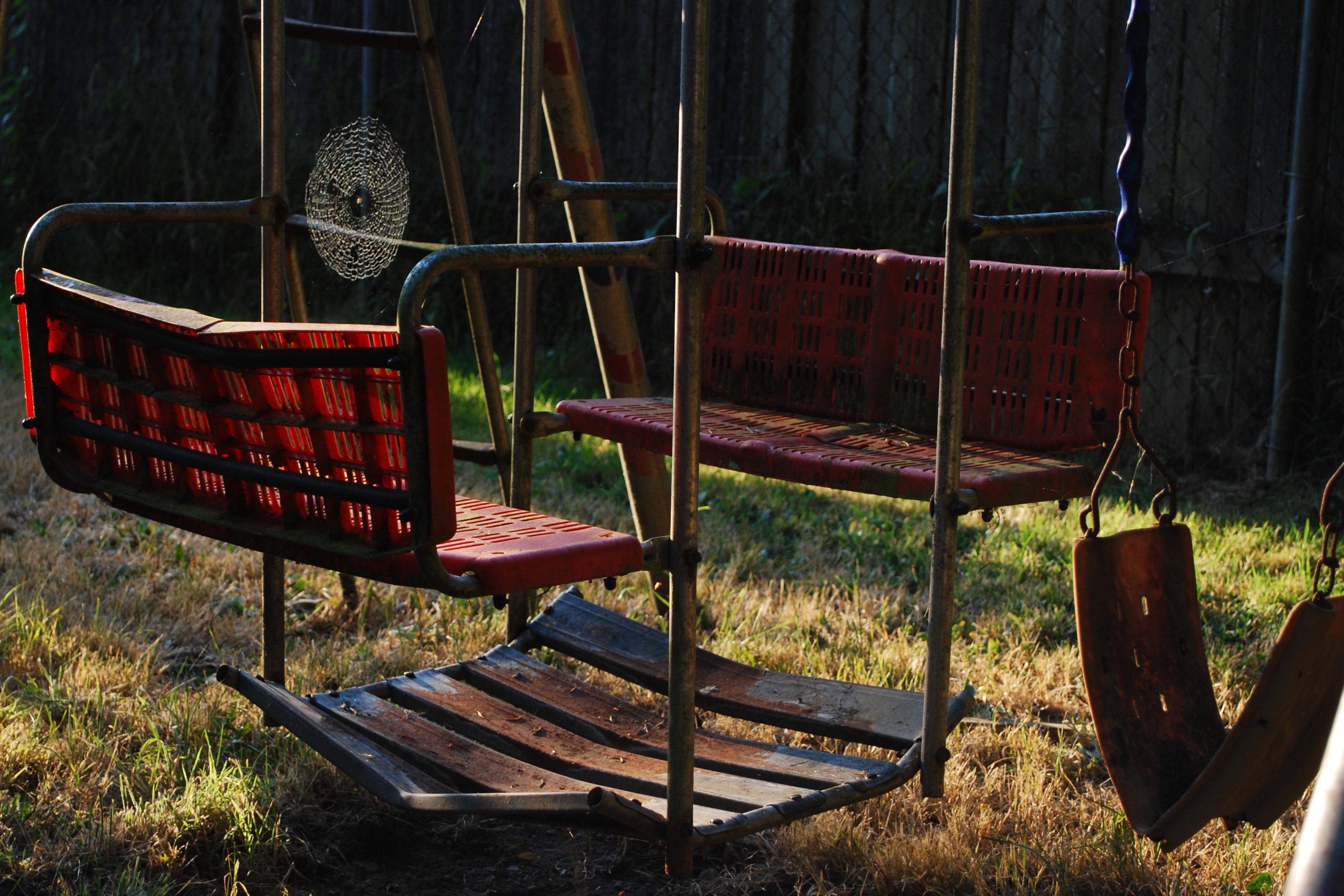
…all in the shape of an old swing set.
It was old when we got it almost 20 years ago from a family that was moving out of state and couldn’t take it with them. I remember seeing it and thinking it was just the kind of swing set I’d drooled over years ago in the old Sears catalog when I was a kid. My dad was in the Air Force at the time, and we moved around too much to be able to have our own swing set, and this time, even though it was used, the little boy inside me was just thrilled for my own kids, that they’d be able to have the kind I’d always wanted – down to the paint and everything.
And you know what? The kids loved it.

I learned to pull the kids by their feet on the swing from the front, not push them from the back – that way I could see their faces, tickle their feet, and laugh with them as they swung toward me. I never understood the idea of pushing them from the back, pulling them from the front was just so much more fun.
We moved, and took the swing set with us to what we called “the brick house” – where the back yard was barely big enough to take it, and you ended up with your butt in the hedge when swinging all the way back, the only thing visible being your arms and maybe your feet.
And we moved again, this time to a house with a back yard big enough to hold the entire swing set and have plenty of room to swing, and slide, and play.
I spent some time on that ‘glider’ swing with my son – where one adult and one kid (or four kids) could sit and pretend they’re on a train, in a hot air balloon, or on an adventure of some kind. For us it was mostly the train, and we swung back and forth as we traveled through magical kingdoms and faraway lands, with bridges crossing beautiful valleys, and tunnels darkly going through tall mountains.
There were times that the train also ended up traveling through tall jungles…
(that had to do with where I was working, and the length of the commute),
…because I had to hack and slash a path back to the swing set in late spring when I had the time to spend an entire weekend taming the jungle that had been a lawn at one time.

We’d tied a rope from the swing set to the tree house we’d made in the apple tree, and put a pulley with a handle onto it. That pulley became the quickest way to escape from the apple tree (just in case there were monsters attacking that needed escaping from).
And as time went on, the swing set was played on by many children, mowed around every couple of weeks in the summer, and it was a place where the imagination, and children, could soar.
One morning awhile back, I went out there again, and things looked different. The grass was still worn underneath, but it was something else that caught my eye.
It was obvious that the swing set had current visitors, but the laughter of small children on it was still. The chains had rusted, and instead of children going on magical journeys, there were spiders.
And there was a web.
And it got me thinking…
We have our children for a very short time.
I’ve learned the hours and minutes can feel like they’re dragging on (remember the last time you were in an emergency room with your kid?) – but the months and years fly by like the smoke from a blown out birthday candle.
I remembered when I was a kid, desperately wanting to grow up because adults always had all the answers, and adults knew everything, especially mom and dad. As I grew older, I realized that I didn’t have all the answers and in all honesty, neither did they.
In fact, I found myself repeating that one especially as I learned (from my own kids) that there were questions I’d never thought of, and it’s impossible to have all the answers for your kids, especially when you’re still looking for them for yourself.
I stood there, in the morning sunshine, watching the spider weaving her web, and came to the realization that I was in the middle of a transition. My mind stumbled across it all. Among the myriad of things that had happened this year, our daughter had gotten married, and both she and her new husband were doing amazing work at their respective companies. Our son, heading off to college this fall, had started a small shop selling chainmail jewelry, which he would often make while singing along with John Rawnsley’s wonderful version of The Barber of Seville (he’d graduated from the Bugs Bunny version that I found myself humming…)
And then, while the last of the strains of Figaro (the barber) were still echoing in my mind, I thought of the lessons I’d taught them, both consciously and unconsciously. For good or for bad, I’ve learned some of the most powerful lessons that stick are the ones we don’t realize we’re teaching them, and we often only realize years later. I thought of the conversations I’d had with both of them over their lives, and I pondered a moment at how much both the kids and the conversations had changed. Both of them were in various stages of putting away their childish things (we know, because most of them are still in the basement 🙂 ) and are well on their way to thinking and acting like the adults they are becoming instead of the children they had been.
They’re growing up…
…
I gave the swing just enough of a push to make the spider a little woozy and watched as it swung back and forth a few times.
It brought a smile, a tear, more than just a little gratitude at the blessings I had experienced with them, because of them.
I stood there a little longer…
Thinking…
Pondering…
Remembering…
A lifetime of memories floated by as the swing swung a little slower each time, creaking a little less with every one…
The years, unlike the swing, seem to go by more quickly each time, creaking a little more with every one.
I pondered a little more… reflecting, and then suddenly became conscious not only of the years, but of the minutes, and realized that time never stood still. It was still passing. I stole a look at my watch and realized it was time to leave for work, so I turned, took a deep breath, wiped my eyes, and like the kids, left the swing set and the memories behind to start a new day.
I went for a walk with a friend the other day, and on a whim, wandered down toward Pongo’s house.
And, to explain the significance of that – I have to go back a few years for most of you…
If any of you remember high school, you know how it could be a tangled up knot of stress, from the academics, which were hard enough, to the social aspect, where everyone was trying to figure out where they fit in the overall pecking order, to the after school stuff, where you often found out where you stood by being on the receiving end of some of that pecking.
I remember when I was in high school, the first thing I wanted to do when I got home was to pet my dog, and play with him, and scritch him behind his ears, and I could just feel that knotted ball of stress from school slowly unwind. It was amazing how beneficial having a dog could be right after school like that, and although we didn’t have a dog when our son was growing up years later, he found one anyway, right when and where he needed one.
And the dog he found had started out life as the runt of the litter in a cardboard box of puppies, being given away in front of a Safeway store in Bremerton, Washington. Pongo was suspected of being a mix of something Australian, a bit of shepherd, a bit of Husky, and the rest was of indeterminate origins. However, to really narrow it down, anything short of DNA testing implied something much simpler. In spite of being the runt, in his youth, Pongo was half husky, half stegosaurus. He was, as all good dogs are, the best friend of his boy, a young lad who had grown up, just like Pongo did, and unlike Pongo, eventually moved away from home.
Pongo ended up living with the boy’s dad, Jack, and the two of them grew old together over the years. It was in Jack’s front yard that you could find Pongo every day, holding down his patch of sod. And it was there that the most reliable form of therapy for any human was lovingly waiting, every day, when our son walked by coming home from school. And every day, Pongo did something no human could possibly do, which by now, thanks to Bill Watterson, had a name:
Pongo offered up Fuzz Therapy.

Once Pongo was let off his leash, he laid down in full expectation of some good-ole behind the ears scritching
And he did it with love.
He didn’t chase sticks anymore, nor did he chase Frisbees ® but he could definitely give some Fuzz Therapy.
A number of years after he graduated from High School, our son and I went back to the street where Pongo lived, and sure enough, he was still there, still holding down that one patch of sod he’d been holding down for so many years, and when he saw our son, Pongo’s tired eyes lit up at the sight of a long lost friend, and he struggled to his feet, a little bit at a time, and slowly ambled over to where he knew he’d get some petting and loving. And from what I saw in the next few minutes, it was obvious that Fuzz Therapy was a two way street.
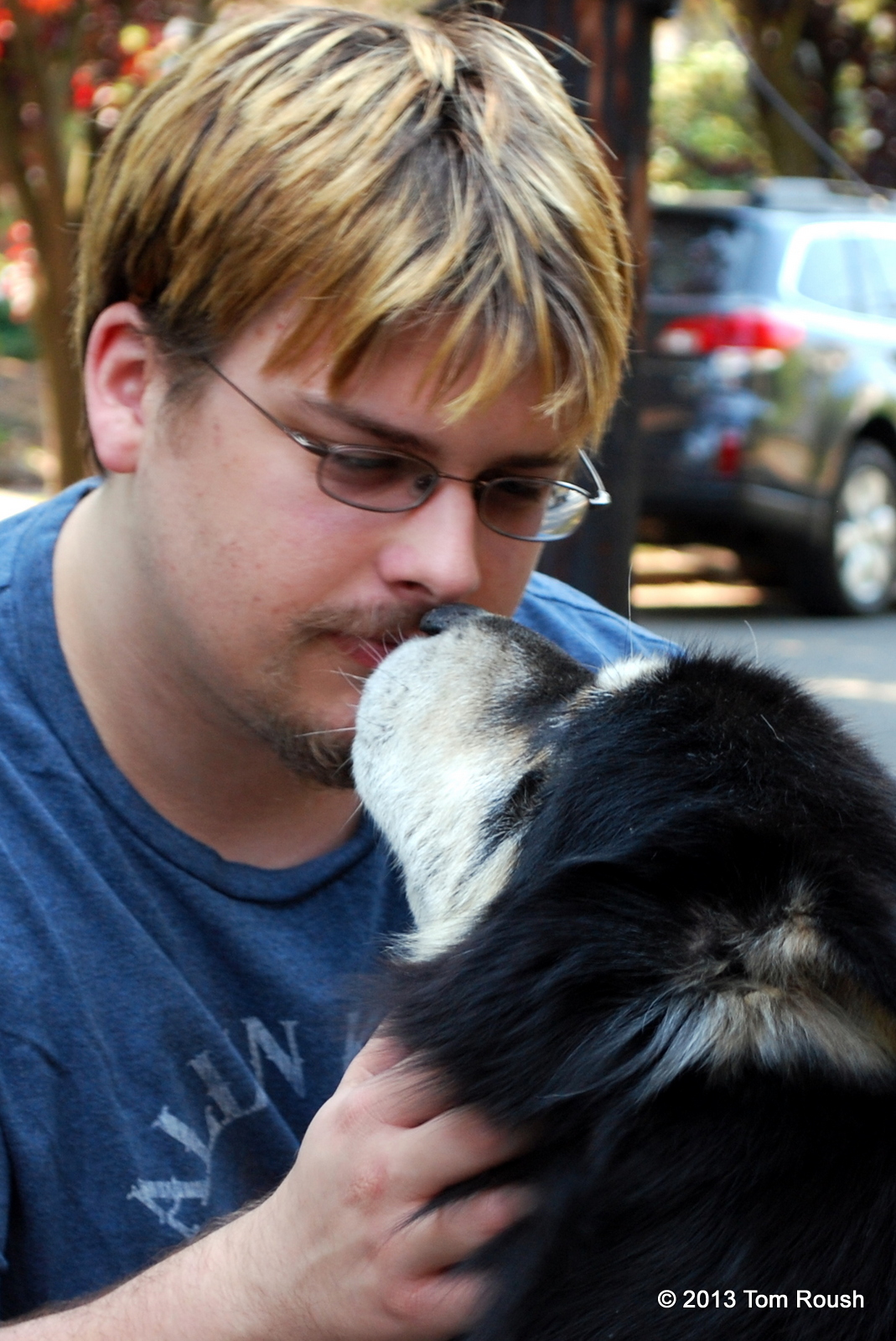
Pongo both getting – and giving – Fuzz Therapy
Jack said that Pongo’d been getting on in years, which was obvious, as well as being sick, which was not, so we were glad that we stopped by when we did. And our son, going through the stresses of being a young adult, trying to balance the risks and benefits of running his own business, figuring out backup plans for both the job market and the financial risks and benefits of college, was able to get some Fuzz Therapy one more time.
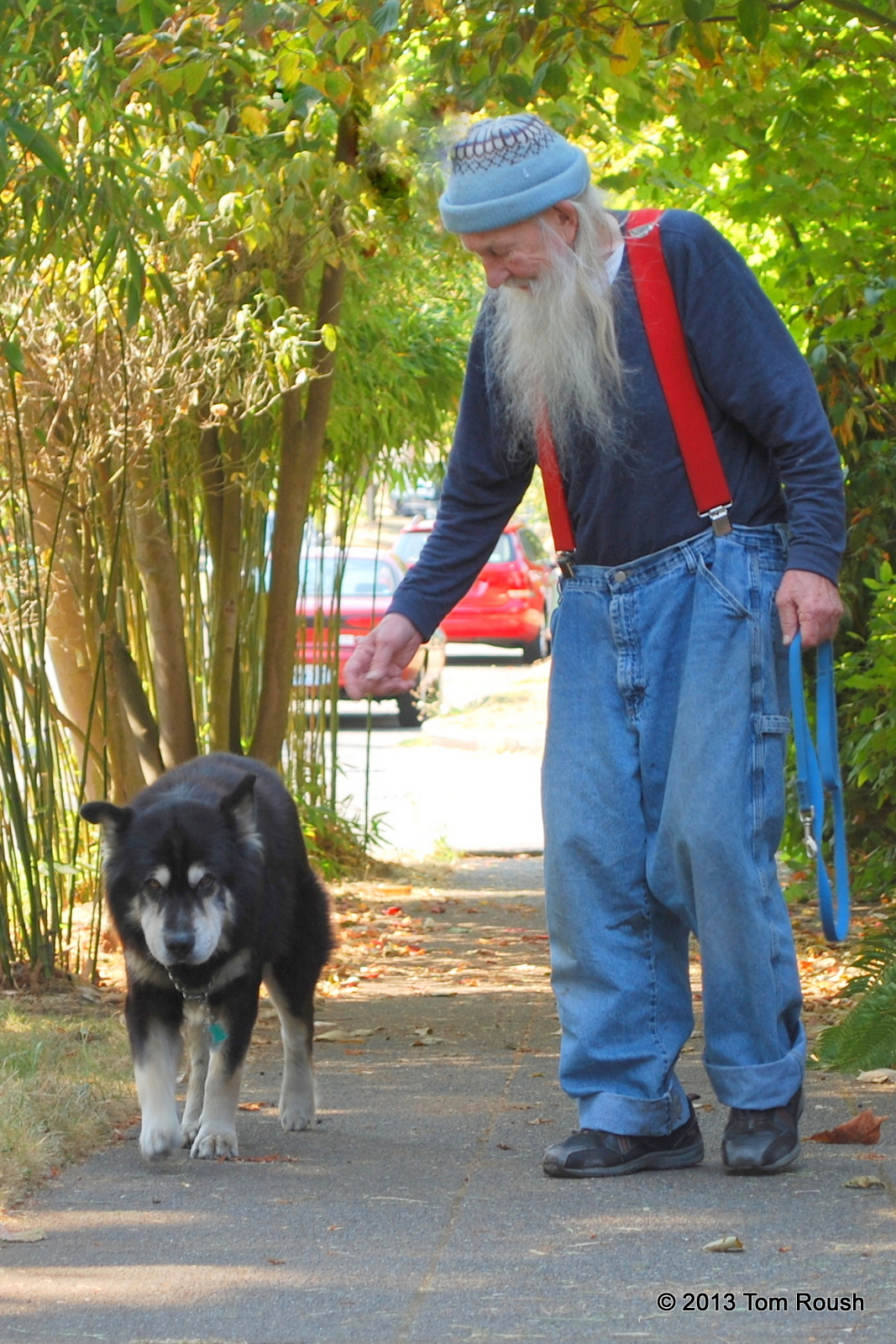
Jack taking Pongo for a short walk
Some months have gone by, and we’ve gone past Jack’s place several times since the visit in these pictures, but it has become clear that the last time we saw Pongo was the last time we would ever see Pongo…
So Pongo, my dear friend, the one who brought our son such happiness, such love, and such peace, wherever you are, I wish you an eternity blessed with a whole, healthy body, the ability to run and chase to your heart’s content, and may you get as much from the Fuzz Therapy as you gave.
===
(Pongo – as seen by the Google Street View camera in September of 2010)
At first Heidi didn’t know what she was part of that evening.
She refilled our glasses, she kept the food and drink coming, and then she did what all good waitresses do.
She left us alone.
We were sitting in a nondescript restaurant, the three of us, sharing stories, memories, and laughing ourselves silly.
The last time the three of us had been together was about 32 years earlier, and I got to pondering about the journeys we’d all not only taken, but survived to get to this table in this restaurant. What had brought us together was a funeral, the death of J.C. Masura…
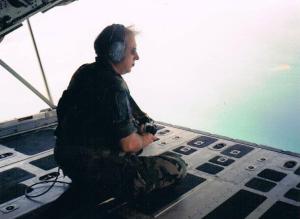
J.C. as we knew him, looking out the back of a C-130 high over somewhere. Photo copyright by and used with permission of the Masura Family.
…who’d been our commander many years earlier when we were all in the same Civil Air Patrol Squadron on what was then McChord Air Force Base. J.C. had been a loadmaster on C-130’s and C-141’s, back in the day, and up until recently had run an aviation maintenance facility at an airfield near his home.
Of the three of us there in that restaurant after the funeral and reception, there was Aaron.
He told a story of being up on Mount Rainier during his Civil Air Patrol days, trying to put his tent together and it being a tangle of poles and cloth. He told of J.C. coming over, and being relieved that he’d have help to solve this problem. J.C. did help. He said, “Son, if you don’t get this tent up, you’re gonna die. So you’d better figure it out.”
And Aaron did.
The most vivid memory I have of Aaron was when we were trying to ram him through the bushes (<–story) on one of our searches. This evening, however, he was sitting across the table from me, in a uniform that spoke of honor, valor and courage. A uniform that spoke of someone who no longer needed to be pushed through bushes, but led people through walls.
As we sat there, reminiscing, and as Heidi kept our water glasses and plates full, Aaron told stories that had us laughing, and shaking our heads in amazement.
He told of coming back from one of many missions to a country in the Middle East, ‘the sandbox’, exhausted to the core, and climbing onto a ubiquitous, anonymous Air Force cargo plane that was to take him home, only to find himself being welcomed onto the plane by a loadmaster with the familiar name of Masura stitched to his uniform. It seems J.C’s oldest son (we knew him as Jimmy) had followed in his father’s footsteps, and was now a loadmaster himself, with enough stripes on his arm to put the fear of God into even the highest ranking officer.
Aaron, the highly decorated soldier, slept most of the flight home, watched over not by a stranger, but by a friend.
Heidi came by about then to refill our glasses, and it was obvious to her that she was seeing, and was part of, something very special. It was obvious we hadn’t seen each other in a long time. Typical of such reunions, she said, was folks from college getting back together. She was amazed to hear that we hadn’t seen each other since high school, and even more amazed that we’d gotten together at all.
Then there was Bill, who I’d been able to keep in touch with a little more. I have many memories of Bill, some of which have actually been written down. One of those involved our Civil Air Patrol Squadron, a regional Drill competition (<–story) in Oregon, and the memories of the looks on people’s faces when they saw us beating them at their own game.
Bill was dressed in a suit jacket and tie for the funeral, had become a world traveler, working as a biologist and traveling to every continent on the planet, and some places that don’t come remotely close to being continents. Bill told a story about going back to Antarctica, where before they could study the penguins, and the wildlife, one of the first orders of business was getting things habitable, and during that time it was discovered that the ‘facilities’ had been buried in 7 feet of snow since they were last there. By the time they got everything dug out and opened up for use, they discovered several inches of frost on the toilet seat.
No. Really.
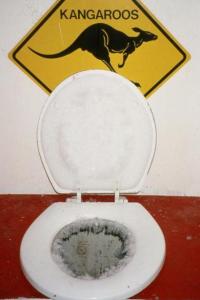
It was chilly. (photo copyright and courtesy of William Meyer)
We laughed about the “when I was your age” stories that would grow into: “When I was your age, we didn’t have these fancy things called toilets, we had to dig through 7 feet of snow just to get to a seat with a hole in it. And it had FROST on it. And we had to melt that off ourselves…”
“With our Butts.”
Yeah, I can see that…
We’d get post cards from Bill every now and then, telling of his adventures in warmer climates, too. He told one story – and it wasn’t even a story, but just a vignette, of writing one of his post cards, in this case to his sister, sitting under a tree somewhere in Africa, and writing it by candle light, because it was all he had. When a scorpion crawled across the postcard as he was writing it, looking for bugs that might have been attracted by the candle, he decided it was time to call it a night.
Heidi came back and checked on us, and the stories continued.
I’d had some of my own adventures – some of which I’ve written about, some not, and we marveled, literally, not just about the various journeys we’d gone on to get to this table, in this restaurant, but the fact that we’d survived them all. Even though we were there for hours, each one of us had stories that there wasn’t time to share that evening, and each one of us had stories of adventure and danger, as well as growth and promise that we realized would have to wait for another day.
We pondered that, and found ourselves all taking a collective breath. As we did, we realized the restaurant had grown quiet. There was no conversation, no bustling of waiters. In fact, the only sounds we heard were those of clinking dishes as the staff cleaned up the restaurant, which had closed around us.
We were the last customers in the place, and the doors were locked.
Heidi, bless her, came by one last time, and let us out…
…and stood in the parking lot for another half hour, talking and shivering in the dark, but vowing that we would get together again without someone having to die in order for it to happen.
There were friends who were not able to make it this time, and friends who would not make it, ever.
And it got me thinking…
Why do we wait so long?
One person asked me, “Why is it we wait till we have nothing but weddings and funerals to get together?”
Why do we often just get stuck in our little ruts and miss out on some of the cool stuff of life, like sharing stories and laughing, and – why does it take something *more* special than just getting together to get us to get together? (yeah, I read that a couple of times myself too before I let it go, but it works…)
I mean – the three of us hadn’t been together in over 3 decades.

Me surrounded by two world travelers, Bill on the left, and Aaron on the right.
Not a week later I had occasion to go to a friend’s birthday party. I was fighting off a bug and wasn’t feeling too well yet, but for heaven’s sake, it had been years since I’d seen him, so I went. He’d hit the big 5 decade mark, and wondered the same thing… why do we get stuck in our little ruts?
I know the answer to this – and there’s a story in it, which I’ll tell later, but in a nutshell, it’s because it takes more energy to get out of a rut than it does to fall into one.
Sometimes that energy comes because you see patterns and realize if you don’t change something, the pattern is pretty predictable. Sometimes the energy comes in the adrenaline fueled by the sudden, tragic realization that nothing lasts forever, and everything, everything comes to an end, whether we want to believe it or not.
So – and I’m realizing I’ve been ending a lot of stories with this theme: Make sure you let the ones you love know that while you can.
Hug your husband/wife.
Hug your kids.
Hug your parents. Even if it’s a verbal hug, with a phone call, card, or email.
Just do it.
A friend wrote recently that he’d found out another friend had passed away, and somehow 10 years had slipped by since they’d talked. You never know when your last words with someone will indeed be your last words with someone.
Sometimes a telephone call will reopen doors to old friendships. Sometimes you’ll find those doors have closed and it’s time to move on. That might hurt, but regardless the door’s position, at least you’ll know, and you’ll be able to open or close it yourself. And you’ll actually have a chance to know what those last words with someone will be. Make sure they’re good ones.
In the end, what changed is that I did just that.
I picked up the phone and checked up on some old friends and kept in touch with them more. I found some doors opened wide again, and found some doors closed – I write all this from experience, both joyful and painful.
And I tried, as best I could, when I saw that one of those doors had closed, to make my last words good ones.
So take care of yourselves. This is the one time we have through this life.
Take care of each other, too. You never know when you’ll need each other.
Oh, and if you happen to meet a waitress named Heidi, working at the Outback Steakhouse in Puyallup, Washington, who keeps your glasses full and allows you to enjoy your reunion time with your friends, give her a good tip.
She deserves it.
===
Footnotes:
It’s been a year since the events in this story unfolded, and it took this long to think them through, get some perspective, apply some of the lessons I learned, and be ready to share them with you. That might make a little more sense now that you’ve read it.
Aaron is still in the Army – he invited us to help celebrate his promotion recently, and we shared more stories, more laughs. We kept the promise to get together more often, and made more promises to do it again.
Bill and I got together the day after my birthday last year along with another friend, Mark, and have kept in touch more. He’s doing a little less exploring, but still doesn’t have a “desk” job. He couldn’t make it to the promotion party because he was strapped into a small airplane, flying around the hinterlands of the country in an airplane, counting Elk.
Jimmy’s still in the Air Force, I saw him at Aaron’s celebration, and they got along like the old friends they are, not with the stuffy formality you might expect of an officer and an enlisted man. It was fun to see that.
J.C.’s wife – well – widow – hard to write that, but it’s true – is doing all the things you do when you’ve lost a loved one. That first year, I can tell you from experience, is a hard one. I’ve kept in touch with them as I could over the last 12 months, not as much as I’d like, but far more than the previous 30 years or so.
And as time, and the years, go on, I’m realizing more and more that the things that are valuable to me are less and less the things that gather dust, or rust, or whatever. They’re the relationships I treasure with friends old and new.
Now go out there, and find some treasure. (and then come back and share what you found, you might help other people get out of their ruts with your stories.)
Take care,
Tom

 Tom Roush's Blog