So I’d been thinking about a Thanksgiving story this year, had seen a number of them, and realized I hadn’t written anything ahead of time. I had so much to be thankful for that it would take far more than you’d want to read to explain it all, so for the sake of this story, I’ll make that part short.  I am thankful beyond words for my family – who when the chips are down, band together like no one’s business.  (I’m sure I’ll write about that someday). I’m thankful for my friends, who do such an amazing job of flipping me crap when I need it (and sometimes when I don’t).   And I’m thankful for the blessings of health.  The talk around the Thanksgiving table was full of surprises, and I’m truly grateful that God’s seen fit to let me be around another year.  It was on the way down to my mom’s for this Thanksgiving that today’s story, much to my surprise, unfolded.

I headed there on Wednesday afternoon to get an early start helping out with getting things ready. I was driving down a road that I used to drive a couple of times daily, but hadn’t driven down in some time, when my mind suddenly shifted gears faster than a dual clutch automatic transmission in a time machine.

Suddenly I was a 20 again.

Not driving my wife’s Honda wagon with a 17 pound turkey in the back.

Not coming back home to visit as an adult.

Not planning on being part of creating a Thanksgiving feast for 8.

The time machine had deposited me inside memories that washed over me like a dump truck full of water balloons, each one bringing another thought, story, or reminder that flashed into my consciousness as it popped, until I was completely soaked in the spring of 1982.

I was almost finished with my second year going to a local community college, and I had a friend named Jill.  She was my absolute best friend at the time, and we hung out as friends do.  She was still in high school, I was a couple of years older, and we all went to the same church, same youth group, and so on.  One day I had some car troubles (the car in question was a 1965 Saab 95, 3 cylinder, 2 stroke, 46 cubic inches of raw, unbridled power – of COURSE I had car trouble), and without me even asking, she offered to loan me her car one day if I could pick her up from tennis practice after school.

This was a no brainer, and I immediately took her up on her offer.

Now something to know about her car, it was about a ‘74 Ford Torino, originally came from the factory with a 302 cubic inch V-8 engine that had been customized over time to be a V-5.  The rest of the car was great, but this thing was the personification of the phrase, “Not firing on all cylinders.”  Three of the cylinders were just along for the ride, and what a ride it was.  (It was actually hard to comprehend the concept of having three cylinders not firing.  If the Saab had had three cylinders not firing, that car would be parked.)

I drove it to school, and I realized that since I’d been spending a huge amount of time under the hood of cars in general, it wouldn’t take much to just do a tuneup on her car as a thank you for letting me borrow it, so I bought 8 plugs, points, condenser, and a rotor and cap, typical tuneup stuff for a car of that vintage, and it cost less than 20.00 for the parts.

I drove it into the middle stall of the three car garage that my dad and I had built.  Even though it was the only car in there, the garage felt a little crowded.  It had never seen a car that big, and I popped the hood to start working on it.  What was really a challenge at the time was just figuring out where everything was.  I mean, it wasn’t hard to work, on, it’s just that that 302 V-5 (soon to be V-8 again) was so huge compared to the 3 cylinder engine I could pull out of the Saab and carry by myself to where it needed to be.

So I yanked all the plugs out – sure enough, three were pretty bad, and gapped the 8 new ones so they were set right, then popped them in, put new points in, gapped them, replaced the cap and rotor, making sure that all 8 plug wires were connected in the right order, then replaced the condenser and then, finally, got my timing light out and made sure all the plugs were firing when they were supposed to.  It wasn’t hard, but it did take just a touch more than the hour I’d budgeted for it, and I was getting worried that I might not make it in time to pick her up from tennis practice like I’d promised.
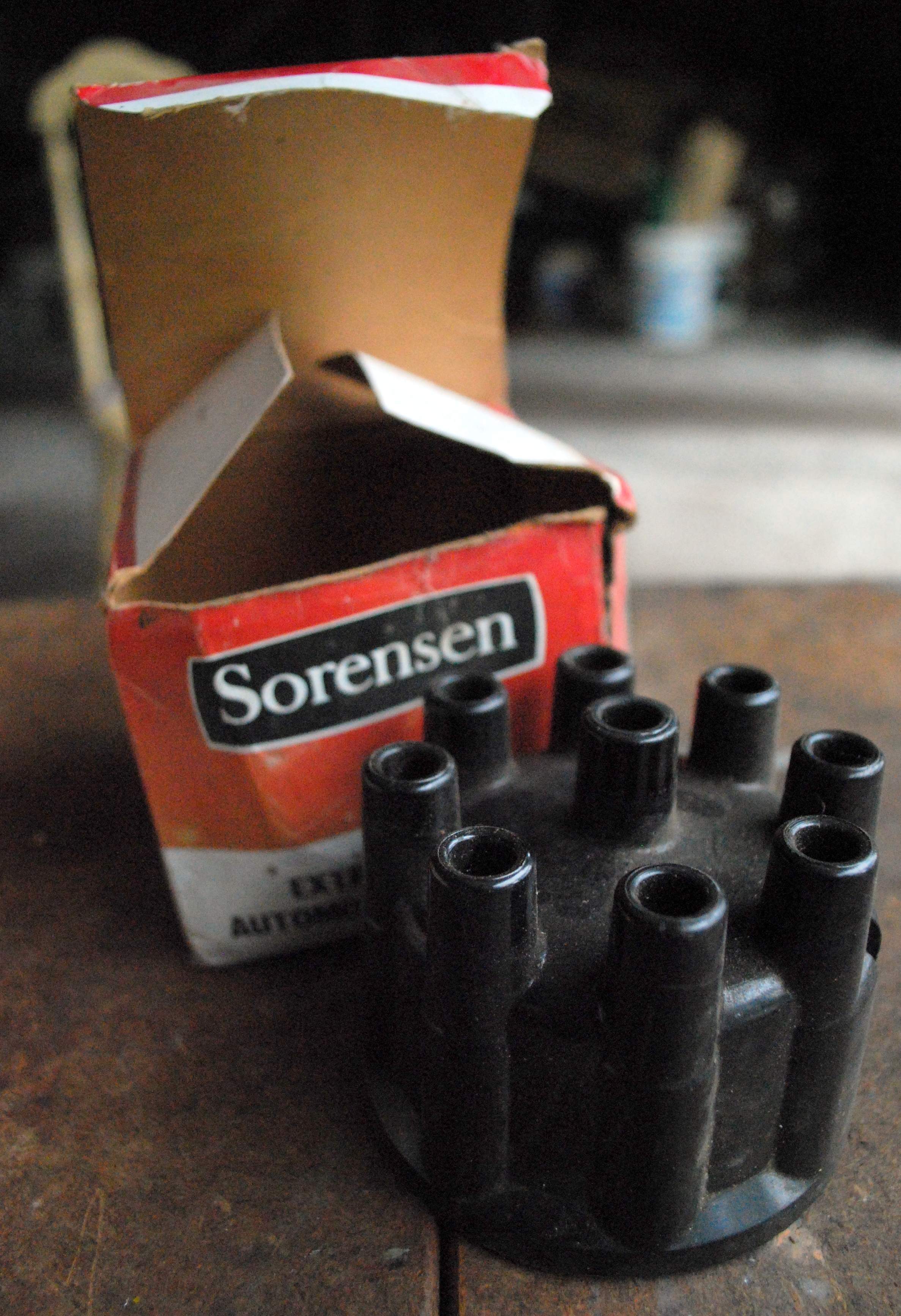
Jill’s old Distributor Cap

I fired it up, and it started beautifully.  It ran on all 8 cylinders, and was so smooth you could hardly tell it was running.

I allowed myself a smile, then suddenly realized as I looked at my watch that I was cutting it a little close.  I ran into the house to clean up, then tried like you wouldn’t believe to keep from driving like a madman to pick her up in time.

A couple of green traffic lights helped me get there with a few seconds to spare.  She saw me as she came bouncing off the tennis court as I eased her car gently onto the unpaved parking lot.  You couldn’t even hear the engine anymore.  All you could hear was the tires, slowly crunching on the gravel.

She got to the car, and was just starting to get in on the passenger’s side when she realized it was her car she was about to be a passenger in, so she playfully informed me that she was driving.  She ran around to the driver’s door. I played along and skootched over to the passenger’s side, and she got in the driver’s seat.

The engine was still running, just purring, no longer doing the “thoof thoof thoof” that the custom V-5 had been doing under the hood for so long.  She automatically put her seatbelt on while I was still fumbling with mine.  I looked over at her and saw she was giving me “the look” that made it crystal clear that the car wasn’t moving till I had my seatbelt on and my tray table in the full upright and locked position… (okay, ignore the tray table thing) So I hurried up and got mine on as well.

Understand, she had no clue about what I’d done.

So she put it in drive, like she always did.

And then she gave it 5 cylinders worth of gas, like she always did.

And she expected to have 5 cylinders pull the car out of the parking lot, like they always did.

But Jill did not know, at that moment, that she had 8 cylinders reporting for duty under the hood.

With the gas pedal close to floored, those 8 cylinders did exactly what they were designed to do, and the engine roared. The tires spun, and Jill sprayed gravel all OVER that parking lot before she stomped on the brakes, looked at me in total shock (and just a little delight) and said,

“WHAT have you DONE to my CAR?”

“I, um… I fixed a few things…”

“You WHAT?”

She couldn’t believe it – and insisted on paying me.

I didn’t want any money for it – it really didn’t cost much to do it, and it was so much fun to see that amazed look. I think, in the end, she managed to give me $10.00 – which was close enough to the price, but what was worth more than all the money she could have ever given me was the look on her face when she hit the gas that first time.

She drove the car for the rest of that summer and into the next winter, and as there are people who are in your life for a reason, a season, or a lifetime, Jill was in my life for a season. That summer, she and I still saw each other, but she had a special friend named Mike, and Mike and Jill were inseparable.  On the one hand, I was, as anyone would be, heartbroken that she’d chosen someone else, but she and Mike were such a couple, and it seemed that there was something so much bigger going on than just Mike and Jill, that anything other than bowing out gracefully simply wasn’t an option, and so I did the best I could.

That summer was hard, but like I said, Jill was in my life – in our lives – for a season.

I got the Saab working again…

School started again…

Life was, for the most part, going okay.  We made it through Thanksgiving and Christmas of that year, were barely a couple of weeks into the New Year when one Thursday morning the phone rang.

I still remember being home that cold morning – when the phone rang.

I still remember the pastor’s wife’s voice on the phone, crying.

I still remember sitting down, collapsing, really, as I heard her say there’d been an accident.

I heard everything, almost as if I were an uninvolved third party, but this was happening, and happening right then.

I heard disjointed words.

I heard something about a patch of ice, and about a pickup truck in the oncoming lane.

And I heard that both Mike and Jill, who’d been on their way to school that cold, clear morning, took an unexpected detour and left this life.

The next week was a blur.

The funeral for them was huge.  I think there were 1500 people there.  I’m not sure.  There were many, many tears, but I remember walking past the casket, and looking inside, and while Jill’s body was there – Jill’s spirit was gone, flying as freely as the angel she was.

As you can tell, I still think about my friend Jill, and I miss her.

But I’m thankful for the time I had, and for the friendship that we had those many years ago.

I’ve learned that time machines can be wonderful ways to reach back into the past, bringing back memories that you’d forgotten were there.  But I also learned you have to be a little careful, as along with the memories come emotions that you might have forgotten were there, too.

I wiped my eyes with the back of my hand as I stepped out of the time machine, and came back to Thanksgiving, 2011, where the smell of the turkey was just starting to waft through the house.  I asked mom if she knew where “the picture” of Jill was.

There was only one that I knew of.  She never wanted to be in any pictures, and was pretty adamant about that, but one day, that spring that I fixed the car for her, we were doing homework in the camping trailer my parents had. I was fiddling with my mom’s Yashica rangefinder 35mm camera.  It took a bit to learn how to focus a rangefinder camera, which was achieved by getting two images to line up one over the other, and once you figured it out, it took some practice to get any image in focus. So I told Jill all I was doing was checking the focus, but inside, I really wanted at least one picture of my friend – and I was able to capture the only picture I have of her, doing her algebra homework after school one day.

And I got to thinking.

The Jill-shaped hole she left in our hearts will never be filled, but the more I thought about it, the more I realized Jill hadn’t left.

She’d just gone home.

I went for a walk with my friend Greg a few weeks ago, and we walked past Mr. Carr’s house.  We stopped, standing in the middle of the street, and my mind went back a few years and I told Greg about a time when I’d worked for Mr. Carr, and experienced a moment that has stayed with me to this day.

Now I’m sure Mr. Carr had a first name, but I never knew what it was.  He had grown up, as I recall, in the Ozarks, and was the kind of guy who could speak intelligently about absolutely anything.  At the time I knew him, he was old.  I wouldn’t say he was older than dirt, but I’m sure he watched some of the first dirt being made.

There are people on this planet who make stuff, and there are people on this planet who do stuff.  And then there are the people on this planet who know how to make stuff to do stuff.

This was Mr. Carr.

If you’ve ever seen the movie “Shooter” – and heard the fellow say the line, “…still got the shovel…” that’s a lot what Mr. Carr looked and sounded like.  You just knew  that he knew far, far more than his simple life would tell you.

He had a sky blue 1962 Ford Falcon that he changed the oil on every 1200 miles, whether it needed it or not.  I don’t know if he ever drove it faster than 35 mph, though I suppose he might have on some of the straighter roads out there.  The car had been in mint condition until someone backed into the left front fender.  He had it replaced with one from a black 1962 Ford Falcon, and that’s the way I remember the car.  There was no reason, in his mind, to paint the car.  The fender did what it was supposed to do, so that’s how it was left.

He rented half a duplex from my grandparents, and had lived in this duplex for as long as I could remember.

It had an oil stove in it, an old black and white TV, and a rocking chair and a couch.  His kitchen could be seen from the living room, and the kitchen windows looked out over his little garden, where he had his tomatoes, his corn, and his beans.

The light coming into the kitchen lit up the old porcelain sink and an empty dish strainer on the counter. A simple cutting board was next to it, and the towel that he’d used to dry the dishes was hanging from a little hook.  The dishes were put away, nowhere to be seen.

Standing in the kitchen, looking out to the right, you could see the Falcon in the carport.  Beside the Falcon in the carport was an old hoe, with a handle that had been marinated smooth from years of well-earned sweat.

The handle on the hoe made me look back at the garden.

There were no weeds in it.

At all.

Mr. Carr wanted for nothing.  That is to say, he had what he needed, and to be honest, he didn’t need much, but one day, it seems, the duplex needed to be painted, and my grampa was willing to hire me, an eager teenager to do it.  As I recall, my job that day involved scraping the side of the duplex in preparation for the painting that was to come later, so it wasn’t hard work, just tedious.  I got there and started working on the west side while it was still in the shade.

Around noon, the sun was just starting to peek over the eaves, Mr. Carr came out, and asked if I was hungry.   I hadn’t thought about it until then, but it had been several hours since breakfast, and any time sitting with Mr. Carr was a treat – he was so full of stories of times gone by that it was like listening to a time traveler, telling of long lost adventures, so when he offered to make me a sandwich, I said I’d be delighted to have lunch with him.  He had me sit on the front steps while he went back inside to that little kitchen of his.  He’d said he had some good ham, and was going to make me a ham sandwich.

And he did.

The hinges on the screen door creaked, as he came out a couple of minutes later with exactly what he said he’d make: a ham sandwich.

With it he had a pickle, and a glass of water.

At first, I thought there was something missing.  I mean, on the plate, there were two slices of bread, not found in any store, and between them, a slab of ham almost as thick as the slices of bread he’d sawed off the loaf.

But I have to tell you – there must have been a glow in that little kitchen when he made it, and Angels must have been singing next to the cutting board as his knife cut through the bread, because this was a ham sandwich like none I have had before or since.

Any other ham sandwich I’d had was on bread that you didn’t want to squeeze too tight or it’d turn to mush.

Any other ham sandwich needed mayonnaise on it because the bread wasn’t moist enough.

Any other ham sandwich needed mustard on it, and maybe some lettuce or something, because the ham was – well, just ham…

But as I sat there in the shade on his front step, a paper plate with a pickle on it balanced on my knee, the glass of water carefully placed on the cement one step down, I looked at the sandwich, and wasn’t sure whether to be disappointed or not.  He’d talked about having some ‘good’ ham – but I’d never had a sandwich that was – well, just a slab of ham stuck in between a couple of thicker slabs of bread.

But he was right.

I took a first, tentative bite, and it was clear this was no supermarket bread.  This was bread with a crust that had enough attitude to put up a fight, but once I got past that, I found a sweet, earthy nuttiness.  It was bread that had enough flavor on its own for you to be perfectly happy eating just the bread – without anything on it, bread that had enough moisture to not need the mayo that every other ham sandwich had always needed.

But there was something on it – it was the ham – and Mr. Carr was right – this was, indeed, “some good ham”.  It had been cured just right, with spices like I’d never tasted before.  It was cool, still from his old refrigerator, and had so much flavor it didn’t need the mustard like every other ham sandwich had always needed.

…and right about then, looking down at that sandwich, I had to reach for the paper plate, and decided to try the pickle.  It was home canned.  It wasn’t bought from a store, either, and it was soft where it needed to be, crunchy where it needed to be, refreshingly sweet, salty, and spicy.

It was so simple.  Bread.  Ham… Pickle.

That was it.

I sat there, savoring it, and realized I still had the glass of water.   What could possibly top that sandwich and the pickle?

It was a glass of well water.

Not city water that had been purified to within an inch of its life, but simple, pure, clear, water.

…that had come out of a faucet, yes, but the well that fed that faucet was in the back yard, just past that weedless garden.

I took a sip.

And realized that Mr. Carr had given me a gift.

Instead of being a time traveler, telling me stories of times gone by, this time, he’d given me a gift, and without me realizing it, had taken me along on one of them.

I allowed my thoughts to come back to the present – which was my friend Greg and me standing there, looking at the porch I’d had the sandwich on, and the house Mr. Carr had lived in those many years ago, and Greg paused, and said, “You should write that one down…”

So I did, and even though I couldn’t share the sandwich, at least I can share the memory.

Fare well, Mr. Carr – and thank you…


My son and I were talking the other day, and the subject of the conversation was about asking for things.

I’ve learned, over the years, that often you don’t get what you want because you don’t ask for it.  This concept has been around for thousands of years.  I learned it pretty clearly on a number of occasions, We talked about how, if you don’t ask for something, the answer, if you will, is a guaranteed ‘no’, whereas if you do ask, the answer is at least a ‘maybe’.

So I got to thinking about this whole thing – realized that a number of the stories I’ve written are because I simply didn’t understand that someone could possibly say ‘no’ to a well reasoned, logical request.  The story about Fifi is a prime example.  So’s the story about Misty 42.  There’s a bunch of unwritten stories still in my head that are the same way – and this whole thing could apply to any life situation. I mean seriously, what right did I have to badger a newspaper photo editor that I didn’t know into holding space for me on the front page of his paper so I could talk my way onto the only flying B-29 in the world…  Then again – who was I to just casually talk my way onto a KC-135 tanker (twice, actually) and get a picture of an F-4 Phantom seconds before it refueled?  (Those are the above stories) Who was I to get strapped into a C-130 for the greenest ride of my life?

What did I do to deserve something as cool as some of the things I was privileged to do?

Well – the answer’s pretty simple. I asked.

See – that whole thing about a guaranteed “no” is something I learned early on, whether it involved asking a young lady out on a date when I was younger, or asking for a seemingly nonexistent transmission for my car, or if I somehow could get go onto a plane, train, or automobile (yes, I have stories of all three) – it was still the same. If I didn’t ask, the answer was no. So… I asked. So with that as a little bit of a background, let me take you to a small town in west central Ohio for one of these stories – just because it was an example of what a difference asking a question like that can make.

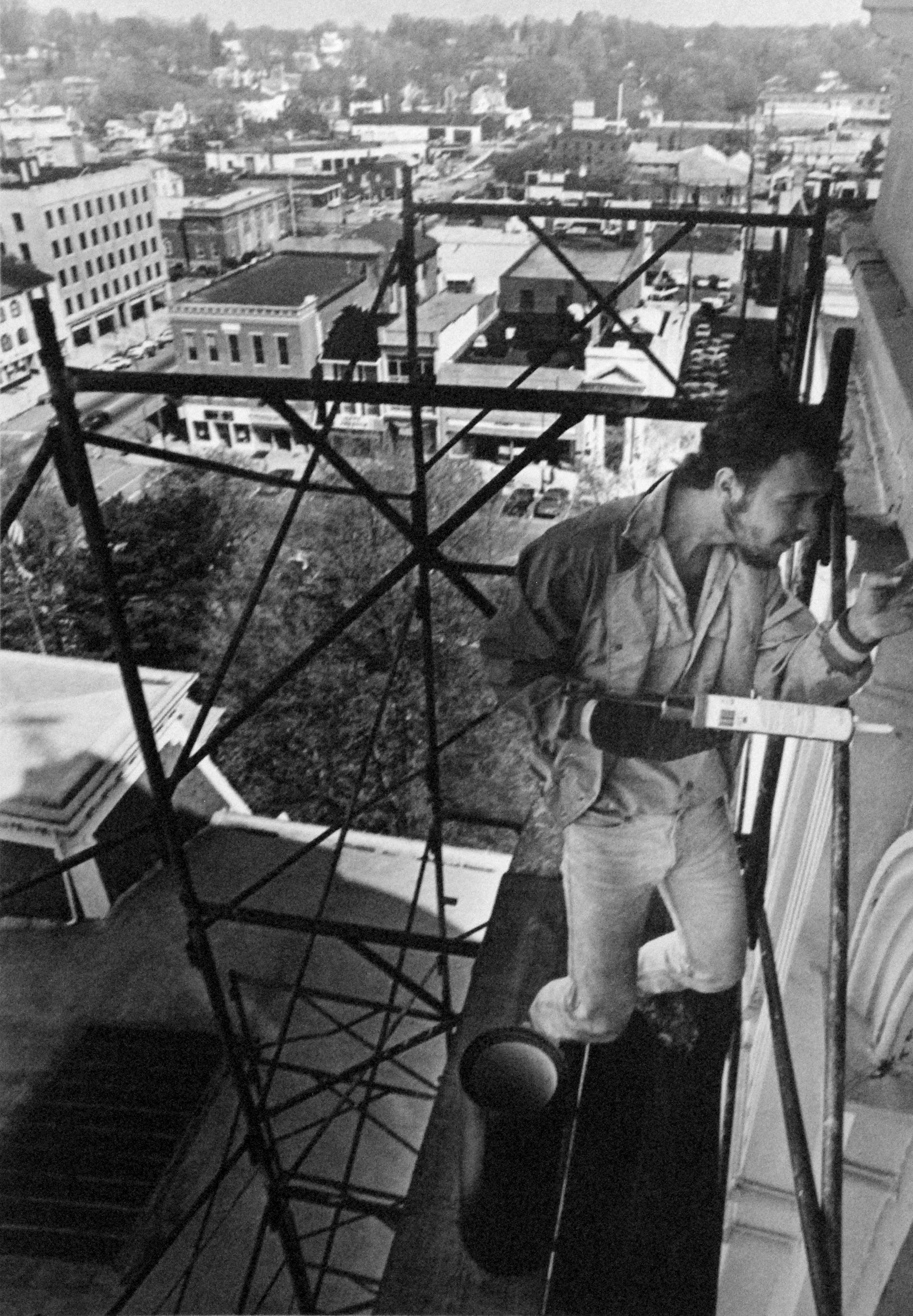
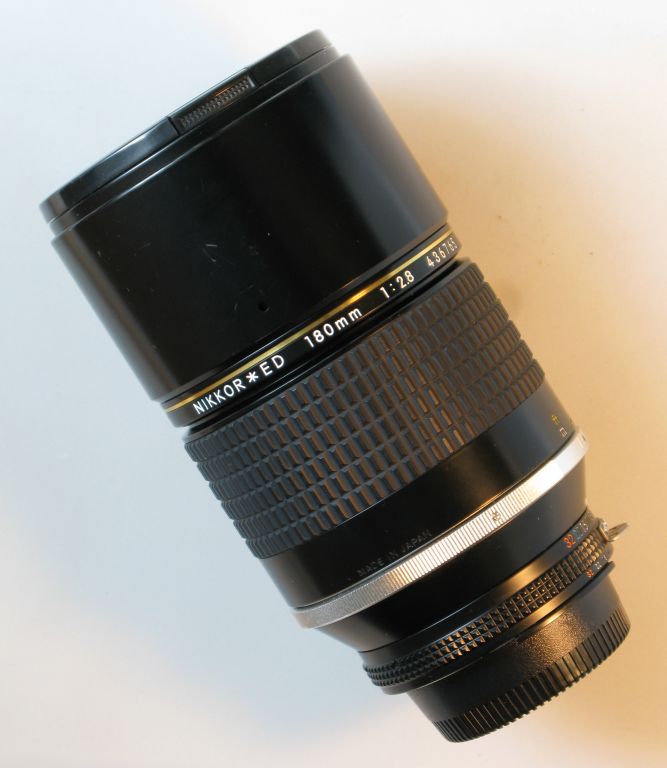
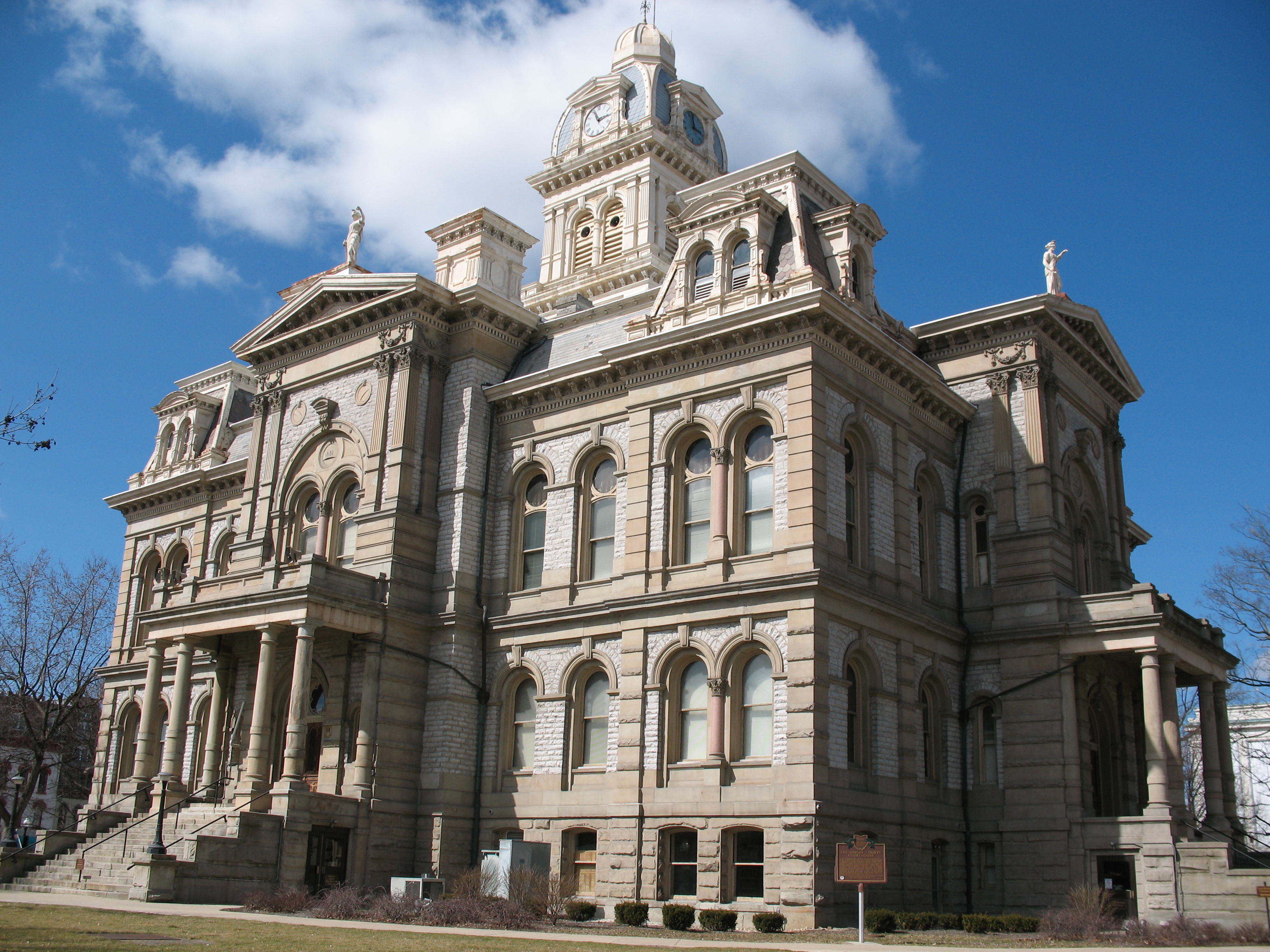
I’d just started my internship as a photojournalist at the Sidney Daily News, and was between assignments, looking for some of what they called “Feature” shots.  That means anything that makes you think thoughts like “oh, cool!” or “gosh, I wonder how they got that shot”, or just something that’s a fun picture to take, something to share with the folks who live in the area, and, hopefully, is of general interest. Part of this was just having a fresh set of eyes that hadn’t seen anything like this town before, part of it was just curiosity. So being between assignments, I found myself in the center of town, driving circles counter clockwise around the courthouse.  There was construction going on, and I thought I could make an interesting image out of it. I saw a fellow up on the scaffolding, and figured I’d found something to work with – so I parked the car, grabbed my gear, and moved so there weren’t trees in the way.  I realized I’d need my 300 mm Nikkor 4.5 because of how far I was – then realized that wasn’t enough. Hmm.  I put the doubler on it, making it act like a 600 mm lens.  Then I got down on one knee, steadied myself with one elbow on the trunk lid of the car, and then realized that I was taking a shot anyone on the street could take with what was then the camera that produced some of the crappiest pictures on the market, a Disc Camera.  Oh, sure, my shot would look like it was shot through a telescope compared to the Disc Camera, but that wasn’t the point… The point was that I’d been hired to take photographs that other people couldn’t see, that other people couldn’t get to, or that other people would never in their wildest dreams think of taking. I mean, it was possible to take a photograph of the courthouse from the ground and have it look great.  I found a shot online and asked the fellow if I could use it (Thank you David Grant)– and here it is:

Shelby County Courthouse, Sidney, Ohio. Photo Copyright David Grant, used with permission

Problem though, was the light for what I wanted to shoot, while gorgeous like the shot above, wasn’t that gorgeous on the side of the court house where my picture was waiting for me. I knew that – I’d driven around the thing, and sure enough, all the action was on the shady side. Sigh. I put the camera down before I took a poorly lit shot anyone else could take from across the street, and stood up.

And then I did something dangerous.

I started wondering…

I wondered what the view from up there was like…

And then I wondered how I could get up there…

And then I did some thinking about how I could get up there.

See, if you want to get into a building, and if you want to go straight to the top, it’s best to start right at the bottom – and often, as in this case, the fellow at the bottom is the janitor.

Janitors are amazing people. They have keys for EVERYTHING. So I made sure the car was locked, threw everything over my shoulder and headed into the courthouse, to have a chat with whoever was playing receptionist and see if together we could find the janitor. One receptionist’s phone call later, I was introduced to the older gentleman with the iconic huge ring of keys, and I heard myself give what would be my standard greeting for the next few months, “Hi, my name’s Tom Roush and I’m a photographer for the Sidney Daily News…” followed by the question of the day. In this case, it was: “I see you’ve got some work being done on the roof, and was wondering if I could get some shots of it for the paper.  Is there any way I could get up there?”

I don’t think five minutes had gone by from the time I didn’t take that picture over the trunk of the car until I was walking out of the elevator, through a dusty attic filled with huge beams, and through a small open window onto the roof. The janitor looked out, called up to the fellow I’d seen, then stepped aside and let me crawl out. I introduced myself to the fellow many feet over my head up on the scaffolding and asked if I could come up. He stopped his caulking for a moment and looked down, seeing I was carrying a camera bag, a couple of cameras, including that one with the 300 mm lens and the doubler on it.

Somehow bringing the bag up there onto the scaffolding was deemed, without any words needing to be spoken, a bad idea.  So I set it down, put the 24mm wide angle lens on the F-3, slung it over my shoulder, and carefully climbed up the scaffolding. I climbed on top of the topmost section so I could look down and see him, my goal being to see – and thus tell a story – that no one else could see.  I sat on the very top of the scaffolding, wrapped my right leg around the vertical part of the support, leaned back, (yes, the scaffolding leaned with me, but not by much) composed the frame so the horizon was at the top, then told the fellow to just keep working as he could (as I write this I still can’t believe I did that – there was nothing but air between me and the roof about 30 feet below, and had I slipped, I would have rolled down, then off the roof and fallen another 40 feet or so before becoming one with the pavement.

And the thing is – I could have taken that first shot from across the street, it would have been safe – but it would have been a totally forgettable image, lost in the back of the paper somewhere.

But I didn’t take that first shot.

I wondered, “What if?”

I wondered, “What can I do that will make this better?”

And then I realized the only thing keeping me from making it better was me.

I had to go in, ask a question that they could have easily said,”No.” to, and that would have been that.

But I didn’t.

I asked.

And when you’re faced with weird situations in life when you’re just thinking there’s no way you can succeed – trust me, there are ways you can succeed.

And stand out – literally above the crowd.

There have been times in my life – and there will be times in yours, when you find you can barely think of the question to ask, much less step out of your comfort zone and ask it, but that little thought, that maybe, just maybe, asking will make a difference, that *is* the difference.  In fact, often, the hardest/simplest/most important thing of all is for you to step out of your comfort zone and just ask.

Now, understand, whoever you’re asking might say no, and you’ll be right where you were before you asked the question, but so what?

You can try something else then.

On the other hand, if you don’t ask, the “no” is guaranteed.

So…

Take care – really – be careful out (and up) there.

And don’t forget, it’s okay to ask.

Think about  it: what’s the worst that can happen? (they say “No”, and life hasn’t changed.  But if you do – the results can be magic. I’m working on a few more stories that will show you what happens if you dare to ask – they’ll come out over the next  year or so, and often, they will be the story behind a photograph (which is proof in and of itself) All that said, here (below) is the shot I’ve been describing.  (in another frame you’d see the camera bag teetering at the bottom of the frame, but that one didn’t make the final cut)…

Shelby County Courthouse, Sidney, Ohio. (click for larger image)

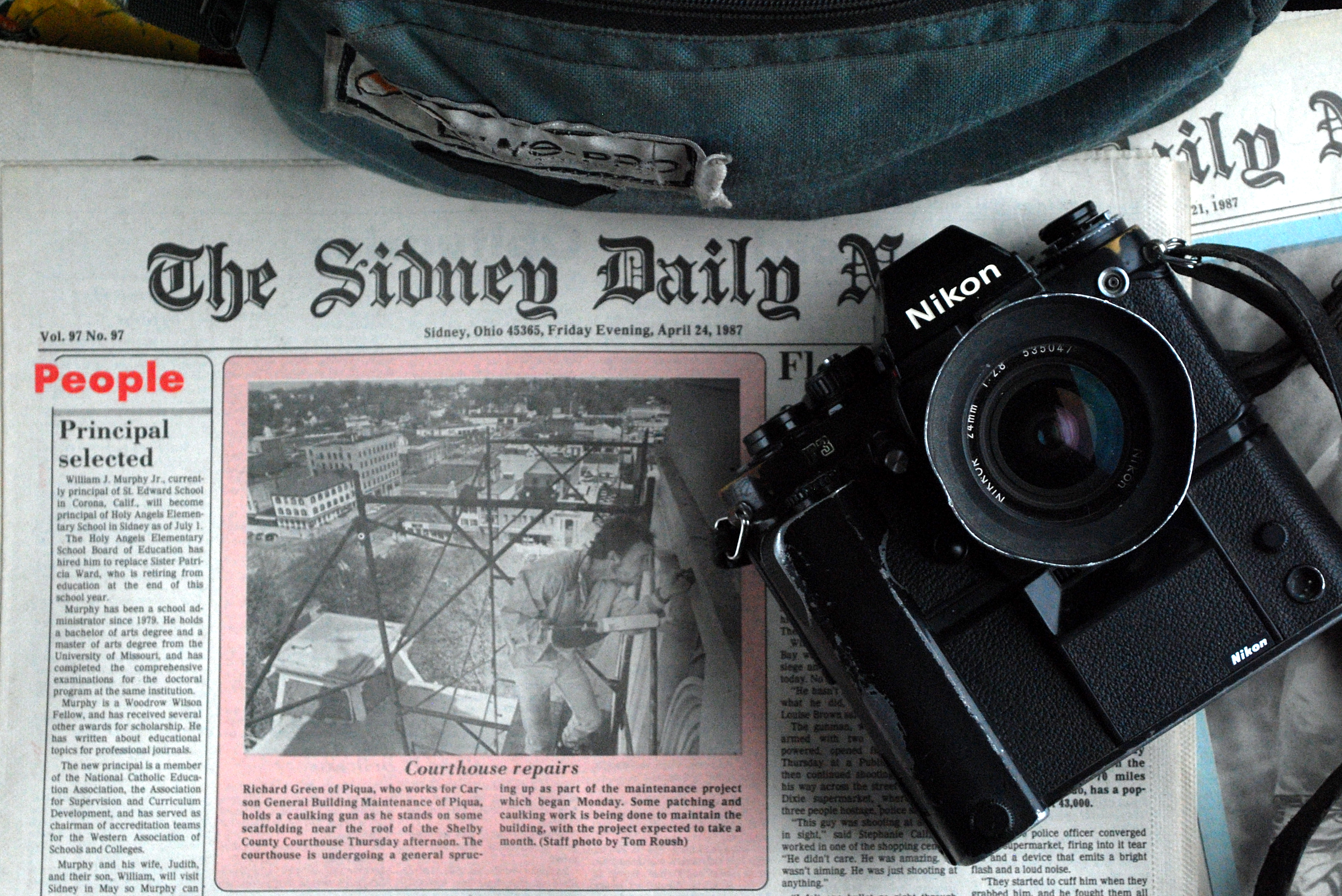
…and how it appeared in the paper the next day.

Camera, Courthouse, and Front page. All in one shot.

The front page, with the camera & lens I shot it with. At top is the camera bag mentioned in the story. (click for larger image)


The other night some friends had an “Oktoberfest” – where they blocked off the street in front of their house.  There was bratwurst, sauerkraut, potato Salad, and of course, beer.  On top of it all, was this overwhelming oompah music.

It’s funny, as I was writing this story – I realized there was a theme in it that I hadn’t even noticed –

It took me back many years – the last time I was in Munich, when our friend Martin, his brother Wolfgang, my sister and I drove down there from the Ludwigsburg area where we lived, and took in the sights.  We went to the park they’d made for the 1972 Olympics, went up the tower.  You could see the BMW Museum from there, so we went to visit that, where I discovered that they absolutely don’t like you touching the artifacts (since I’m an official airplane nut, I was looking at, and in this case touching, a WWII airplane engine – I’d just reached out to touch it when I heard a very loud, very German voice on the loudspeaker shatter the otherwise almost reverent silence of the museum.  I looked up and froze.  The camera that had been aimed at the engine was now aimed straight at me, with a red, almost laser like light on it that made it clear I’d been both spotted and caught.

Yup… Deer in the headlights, that’s me.

It was very clear that I was to keep my hands off the merchandise…

The tone in the fellow’s voice made it very easy to imagine that in a control room somewhere, a security guard must have been marking a little notch in what would translate as his gunbelt… “Yep, got another one…”

I was embarrassed, and not just a little terrified, but what could I do?  So we left.  By this time it was afternoon, and went to the German Museum where they had all sorts of exhibits and displays, and for whatever reason we started at the bottom, and were in the middle of this exhibit on some kind of ancient Babylonian or Mesopotamian stuff when the lights started flashing and we thought either there was a power outage or – then the siren went off.

I figured I’d touched something wrong.

Again…

Turns out it was neither.

It was the fact that the place was closing down, and of all things, at 4:00 on a freaking Tuesday.  With me being the aforementioned airplane nut, instead of going straight for the airplanes, we’d wanted to see everything, and were planning on saving the best (airplanes) for last.  When I heard on the loudspeaker the rough German equivalent of “Attention K-mart shoppers, the store will be closing in 5 minutes, please take your purchases to the checkout stand.” – okay, so it wasn’t K-mart shoppers, it was all of us who’d come thousands of miles to see the exhibits, only to find out at the last second that the place was closing before we could see everything.  On that realization I just about went nuts and tore out of the Babylonian exhibit into the lobby area.  I looked around, found the signs to the second floor and tore up this huge curved staircase to the second floor where the airplanes were.  I was running so fast that it’s possible to truthfully say that I ran rings around a V-2 Rocket (okay, so the rocket was in the center of the curved staircase I was taking two and three steps at a time), and I arrived panting at the door of the hall the planes were displayed in just as a rather burly, and fairly stubborn guard locked the door from the inside.  (Note: you don’t get much more stubborn than German stubborn, unless you’re talking Hungarian stubborn – don’t ask me how I know this 🙂

I tried to plead my case, but my Schwäbisch accent was no match for his Bavarian accent and attitude – and he was the one with the key in the lock.  I could only look through the now smudged windows at the planes I’d come to see, neither realizing, nor being able to convince the guard, that this might be my only chance to ever see them.  He didn’t seem to care.  I remember seeing a two seater Me-262 and the only Do-335 in the world – oddly, without the swastika on the rudder, like most planes of the time had had – but then I realized, even then, that the echoes of WWII were still there, and the law was clear: absolutely no swastikas – even if they made something historically accurate.  You couldn’t even buy a model WWII airplane with the right decals…

Once the doors were closed, there wasn’t anything else to do there – I was so frustrated at the time I don’t even remember taking a picture of anything.  Wolfgang, Martin, and my sister showed up about then, and, knowing that this was something we – especially I – had wanted to see, they tried to get me out of my funk… I mean, getting kicked out of – well, “encouraged” to not come back to the BMW museum until I could behave was one thing… Having the dang exhibits in the German Museum close in my face was another.

We were hoping to not make it a “three strikes and you’re out” kind of thing, but I was seriously frustrated.

It was hard to acknowledge it at the time, but aside from that, we’d had a pretty good day.  We’d driven well over 100 mph on the famed Autobahn, to the point where slowing down to 60 when we got into Munich made us want to get out and push, we’d seen priceless works of art, items that were literally one of a kind on the planet – and – it was almost as if Ferris Bueller had taken a day off and gone to Munich, instead of going to Chicago.  Somewhere in there we got onto a subway and got out at the Marienplatz in the square in Munich and watched the famed clock tower (or Glockenspiel) strike, I think it was 5:00 in the evening by the time we got there – and our friends, realizing it was dinnertime and still trying to help overcome the last Museum bust, wanted to take us to this place they called the “Hofbräuhaus

We were tired, had done a LOT of walking, and were to the point of not even caring anymore, but they insisted, so we went in – and were suddenly surrounded – no – immersed – in Bavaria at its finest.

To say that the Hofbräuhaus had atmosphere would be like saying water is wet, and this atmosphere was thicker than the proverbial pea soup.

First: The music.  I know there are people who think that the definition of “perfect pitch” is when the accordion you just tossed out lands on the banjo. I’m not sure how many banjos there were, and I didn’t take any pictures, but Lordy, you have never, ever heard “Ooompah” music till you’ve heard it played by a bunch of well lubricated Bavarians. (there was an accordion, a tuba, a baritone, I think a trumpet and a trombone)

Tourists like us were there, but it was the locals who were just a delight to watch.  I’d heard the song most Americans know as the “Beer Barrel Polka” – but the words were a lot different, and came across sounding more like the music here: “Rosamunde”.  (the video’s not from the Hofbrauhaus, but watch the crowd in the video to get a sense of what it was like).

It looked like the people in the band wouldn’t remember it the next morning.  In fact, it seemed the band was on complete autopilot.  Waitresses kept their steins full, and they played – well, like a well lubricated machine… it was a wonderful background to everything else.  Occasionally the crowd would join in and we’d see people standing up, arm in arm, singing their lungs out.

There was smoke from any kind of tobacco, but above it all was the astounding smell of beer.  Not stale beer from a place that’s been serving beer for the last few years and hasn’t been cleaned up, but fresh beer that’s been poured in the place since 1589.

Like for more than 400 years.

There was a sign up at the front where the bartenders were filling the 1 liter steins as fast as they could, something to the effect of “Wet Floor” – and they weren’t kidding… there was beer all over the place, and you did want to be careful to not slip on it.

Why was there beer all over the place?

Well, part of the answer lay in the regulars.  It seems that the place has special tables for them. A lot of them are pensioners who live in apartments nearby and come for the camaraderie, the social aspect, the food, and of course, the beer.  What’s surprising about them is the vast quantities of beer some of them can put away.  I was talking to a fellow who’d been there a few times, and had seen this little old man, couldn’t have weighed more than 100 pounds, put away several liters, every evening, every time he showed up.  These are guys who by any other definition would be considered alcoholics – but there, they show up (and have been showing up) daily for years, and they have their usual table, the waitresses know them, know their orders, and keep them happy by keeping their beer mugs full.

Now those waitresses, to keep from having to make too many trips to serve a table, take as much as they can carry with every trip.  This means that invariably, some glasses spilled, some fell, some broke, (hence the  warning signs about the wet floor) but for the most part, the beer gets to where it needs to be.

So it was this expectation that helped set up our next encounter.  We were led to our table, and as the waitress came over, we realized we’d spent most of our money on museums, trips up the tower, and souvenirs.  We pooled all our money together and realized that if we subtracted the money for the souvenirs we wanted to buy there, subway money to get back to the car, gas money to get the car back to Ludwigsburg, that left us with enough for – um – one beer.

Split four ways.

Oh oh.

So one of the things that’s important to know is that a good percentage of the tourist photos show gorgeous young Bavarian women serving beer in places like this.

They’re models.

The real ones aren’t hired for their looks.  They’re hired because they can carry, over the course of a shift, hundreds of liters of beer to their customers.  They keep the customers from getting too thirsty, they keep them from getting too hungry, and they keep bringing whatever it takes to keep the customers satisfied and happy, as they’ve been doing for several centuries.

Our waitress looked like she’d been there since the place opened.

She looked tired.

And it looked, from everything we could see about her, that she’d had a day we, as tourists, couldn’t possibly imagine. She looked like we were her last table and she was looking forward to going home, soaking, then putting the feet she’d been on all day up and getting a chance to rest a bit before starting it all over again.

She just had this one last table to deal with, and at that table were four teenagers and a pile of change.

She straightened her apron out a bit as she got to our table and was all business:

“Also, was möchten sie?”

(Her words said, “So, what would you like?” but her tone said the Bavarian equivalent, “So, what’ll it be?”)

We looked at each other, swallowed, and then together, said, “Ein Bier.” (one beer)

“Also gut… Vier Bier.“

(“Right… Four beers”)

„Nein… EIN Bier.“

(“No, actually, ONE beer.“)

„EIN BIER? Da sind ja doch vier von Euch!“

(“ONE BEER? But there’s FOUR of you!?“)

She looked at us with a combination of disgust and disdain that can only be done by German and French waiters.  Add to that a look of confusion, like a mathematician who’d just discovered that dividing by zero didn’t work.  In her world, one customer = many beers, not the other way around.

We kind of stared at each other, and it was then that we realized the first rule of the Hofbrauhaus:

It is not, repeat, NOT a good idea to – um – ‘irritate’ a Bavarian waitress… I don’t care how many weights you’ve lifted, they’ve lifted more, they’re stronger than you are, and they do it for eight hours at a stretch.

As we were coming to that conclusion, the day finally got to her and she absolutely went off on us.  I don’t remember her exact words, but they translated roughly to:

“How can you possibly expect me to make any money if my customers only order one beer?  I mean, you’re sitting there taking up four spots, and only ordering ONE beer? There’s no way you’re ordering one beer, that’s not just unheard of, that’s an insult.”

Uh… right… insults were off the table.

Then again, now that she had set her expectations: “Also, was möchten sie?”

(Again, her words said, “So, what would you like?” but the tone said, “Alright, really, let’s get this show on the road… what else are you going to order that is going to make it worth my time to even see your faces again?”)

We dug deeper into pockets, wallets, whatever might have a little extra money, and ordered some kind of pork roast, some sauerkraut, and I think there might have been some mashed potatoes.

And one beer.

And oh, my, it was good.

The beer was strong enough to pack a bit of a punch, but between the four of us, none of us had enough to worry about. The pork was amazing, and the sauerkraut was something you’d just have to go there to experience.  It was amazing.  We pooled enough money for a tip, left what we could there, then headed out into what was now night..

We got to the subway, then to the car, but didn’t drive 100 on the autobahn this time.  This time we slowed down to about 80 mph.

Because it was dark.

And because it was raining off and on.

Martin wanted to be safe and drive even slower, but there’s something about German drivers and the autobahn, and by golly, they’ll drive as fast as they can.  We were constantly having to move over so that other cars could pass us.  The law’s pretty clear over there.  If someone wants to pass you, you let them.  Martin had been moving back and forth and was getting tired of it, so decided to stay in the fast lane.  One driver made his thoughts very clearly known to us by getting so close that I, in the back seat, couldn’t see his headlights past the trunk lid. Martin finally moved over, and the last thing I remember of that day was that the silhouette of a Porsche 911 with a glowing exhaust pipe as it passed us.

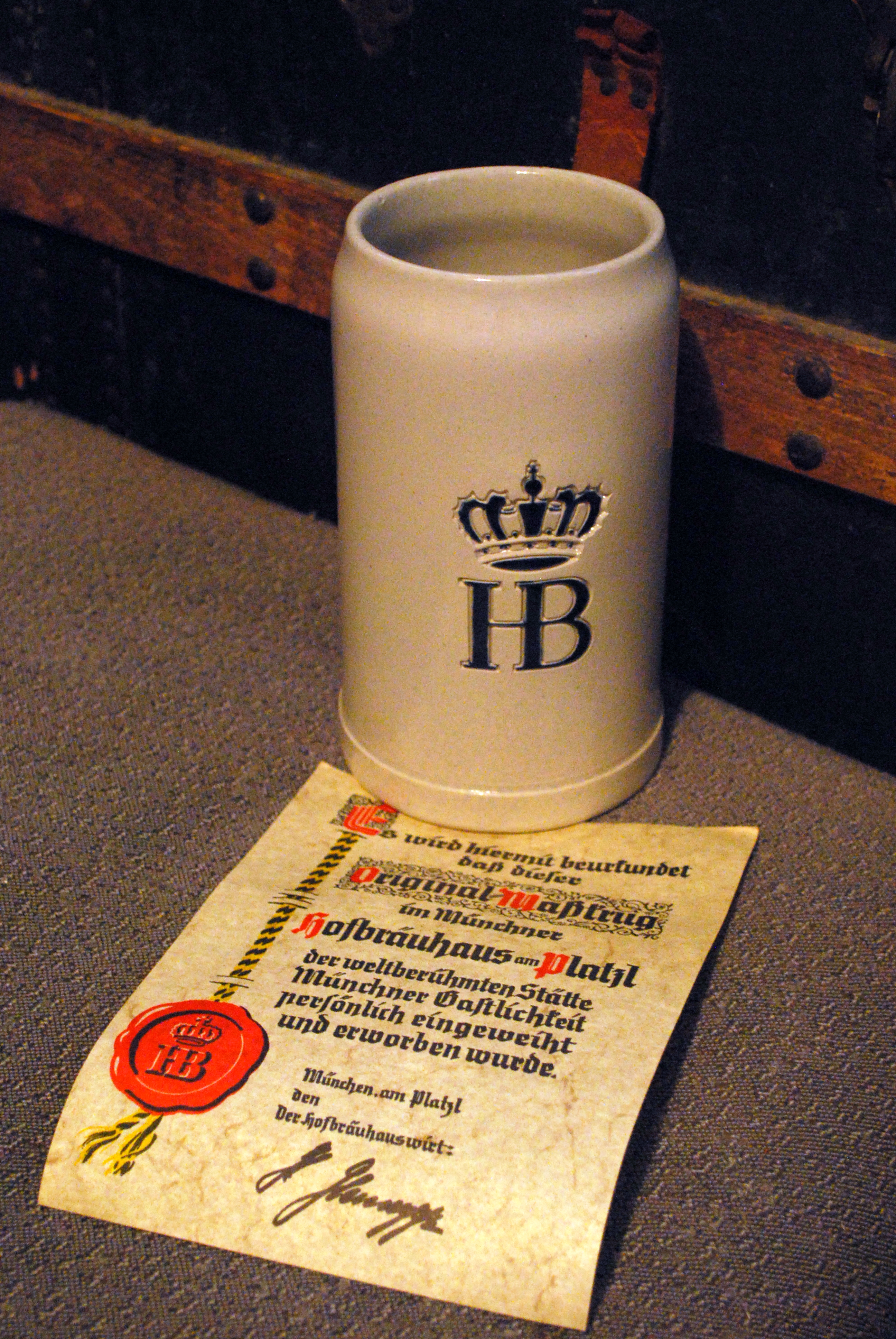
Oh – and we did get home.  I’d managed to save enough for one souvenir that actually survived the trip back, and that I still have after all these years.

One, genuine beer stein from the Hofbrauhaus


It’s been a busy couple of weeks, and my son and I are visiting my mom as I write this.  Coming down here is like walking into a time machine, with all the memories and so on.  Last night, as we were heading off to the store, we passed a certain spot in the road.  “Hey, Michael, this bridge here is where the story in the Ranchero happened.”  (Yes, I was passing a car… on a bridge… I’d forgotten to mention that in that story…)

I found I was telling him stories, not just stories from some mystical past, but stories right where they happened.  And it made the stories a little more real, to be standing exactly on the spot where they happened.

And we got to talking about one particular story that happened long before the house had any reliance on fossil fuels.  When I was a kid, back before Al Gore had even thought of inventing the internet, we didn’t have cable TV, or video games, but there was always, always something to do.  There were chores constantly, and one of mine was simple: When I came home from school, I’d have to bring wood in for the rather cranky woodstove (it was simple: no wood, no heat), or – sometimes when I came home and there was no one else home, the house was cold.

Well, if the house was cold, and I was the only one in it, and if I was the one who wanted heat, then I had to build a fire in the stove.  That got interesting sometimes, as there were times when I couldn’t get a fire going for anything.

Keep in mind here – I was a teenager.

With matches.

And I couldn’t get a fire started…

In the house…

Sigh…

The idea of having a thermostat to turn up was a dream – but it was just that.  (It was only 11 years ago that we had a gas fireplace installed there for my mom.  But back when I was a kid (oh gad that makes me sound old), one day, I was both cold and impatient, and to light the stove in the living room, I got a bunch of newspaper, was too impatient to split any kindling, so I just put some wood scraps from the lumber mill in town on the newspaper there in the stove.  Sometimes I’d be lucky and actually get it to light – but this time it just wouldn’t stay lit for anything – and I was cold, and I just wanted a fire.

RIGHT NOW. 

So, operating with the Infinite Teenage Wisdom ® that is so common at that age, I got some gas from the lawn mower, and poured a little onto the wood and paper in the stove.  I then reached up to the place where the matches were…

…and realized I’d used the last of them trying so unsuccessfully to start the fire.

Oh good.

I took the gas can back outside (first – actually, only – smart thing I did) and hunted all over until I found some matches.  When I got back to the stove, I instinctively knew what had happened – the gas had vaporized to its most lethal form, and I knew that lighting it would be a bit of a challenge now – far different than the “I can’t start this fire” challenge.

Given that, and knowing that exploding gas would be a challenge to try to contain, I decided to stand to the side of the stove, with the door open instead of trying to toss the match in and slam the door shut., That way it would relieve the pressure I knew was coming, and toss the match in while I was standing on the side, away from what I thought would be a bit of a flame coming out.

So I stood to the side, with some fresh newspaper and more wood in the firebox of the stove, and I tossed the match in.

Now I don’t think I’d ever seen a rectangular flame before, and definitely haven’t since, but a flame – exactly the size and shape of the stove opening, shot about three feet out of the stove, spewing bits of wood and burning newspaper paper all over the living room.  What must have been just seconds seemed like hours as I frantically cleaned all those pieces up before they caught the rest of the living room on fire.  That would have been, um, bad…

And I would have had to explain to my mom yet again why there was smoke in the same room I coincidentally happened to be occupying. (I did have some experience with that)

By the time my mom got home that day, the fire was burning nicely.

Inside the stove.

I have no idea how I hid my guilty expression when she came home.  Maybe I was too frustrated by the whole event to feel guilty. In fact, she only heard about this years later. (actually, Thanksgiving a couple of years ago)

And of course, she was shocked.

Come to think of it, a number of the stories that are mentioned here are stories she finds out about as I’ve been writing them.  It makes for fun conversations now – but as I look back on it – the adult in me got to asking myself, the Teen With the Infinite Wisdom ®, “What were you thinking?” Or more specifically, I narrowed it down to, “Did you not see the line between dumb and stupid as you blasted past it?”

I realized that this, like most of the actions controlled by my Infinite Teenage Wisdom® were the result of simply not thinking of the consequences to my actions early enough to have them change what I was doing.

Yes, I knew that gasoline was flammable, in fact, I even counted on it.  What I didn’t count on, or expect, was that the, um, “influence” that the gasoline had, could expand to other things as quickly as it did.  No, even that’s not true… I knew it would be dramatic, otherwise I wouldn’t have stepped to the side.  I guess I was expecting flames, but not the aftermath of all the fiery bits and pieces that flew out after the flames, and I didn’t expect to have to try to put all that back in the stove.

I did some more thinking about it, and realized that the adage my son has told me many times, “To be Old and Wise, you must first be Young and Stupid.” –

In fact, there’s an old saying, with a corollary right along with it:

“With age comes Wisdom”

“…but sometimes, Age comes alone.”

So how do I learn from this as an adult now?  Well, I’m still human, still capable of making mistakes with the best of them, but at least I’m working on learning from the old ones and using those lessons to learn how to make different new mistakes, (instead of repeating the same old ones over and over.

And I guess that’s it, huh? Learn from your mistakes, because if you don’t, you may as well just soak the mistakes in gas and throw in the match, because in the end – well, – cleaning bits and pieces of what you were trying to do will be very much like trying to put a burning fire back into a fire place, and that, my friends, is hard.


Many years ago, I was in Civil Air Patrol, the Official Auxiliary of the United States Air Force.  Among the missions of the Civil Air Patrol is Search, and Rescue.

I’ve mentioned it before, there were other things we did, but one of the very important things we learned was all about Search and Rescue, or SAR.

One the hallmarks of a good search was when the person was found.

One of the things that made that possible was the organization that was part of every search.  There was communication (we had an old M-715 military surplus communications truck (mentioned in this story) with radios of all varying frequencies, so we could be a relay to the myriad of agencies that could be part of a large search), there were all the volunteers who showed up, and then there were the people who did the searching.  Sometimes the searching was done from the air, but that was to get a general sense of where things might be.  The end of a search was often done from the ground.  In both circumstances, we would work what was called a grid pattern, so we would always know what had been searched, and what had yet to be searched.

What was drilled into us at the time was that you searched a part of the grid, and if you didn’t find what you were looking for, you crossed that square off, and then moved to your next assigned section.  It was almost sacred, how important that was. The commanders had to know with 100% certainty which grids had been searched and which ones still needed to be.  Therefore, you did not, under any circumstances, deviate from the grid pattern.

Ever.

So to practice these searches, and these techniques, we had training.  Each squad (two to four cadets) had a map of the area being searched.  We each had a compass, and we had our assigned grid sections.  And we did everything we could do to be prepared for any emergency, at any time.

And then one day, every member of the squadron got a phone call.

The phone call.

Someone was actually lost.

Someone needed to be both searched for and rescued.

This time it was for real.

This time someone’s life was really on the line.

This time someone needed help, and so with adrenaline flowing like never before, we all did what we’d been training to do for what seemed like ‘ever’.  We gathered our pre-packed gear, put on our uniforms, and assembled the squadron to go to find this person who’d completely disappeared.  The family was in shock, and for everyone’s benefit, the person in question needed to be found.

We created a command post near where the person was last seen.

We assembled our vehicles.

We spread our maps on the most convenient flat thing around (that would be the warm hoods of cars), got our compasses out, and planned our search.  To be honest, it looked very much like an old war movie.  The only thing missing was an old Jeep and mugs of bad Army coffee.  Actually, come to think of it, the maps were held down on the hoods of those cars with what was probably cups of, by then, lukewarm 7-11 coffee.

After the planning, we were each assigned a section, and the leaders would gather their squads together and give instructions.  We’d go out initially in groups of two or four cadets, each squad having one copy of the map of the area divided up into the now familiar and very sacred grid pattern, and we started searching.

In my group, there was Aaron, Bruce, Dave, and me.  Aaron had this back problem, so he had this huge brace that he’d wear from his hips to his neck, and we’d always want to be careful that he didn’t hurt himself. The thing we weren’t used to was that Aaron’s view of the brace wasn’t that it was a hindrance, but that it was just part of life, and being careful about it really wasn’t something he was concerned with.  So we went and searched the grid area to the northeast of the house, and since this was a real live search, we were going to leave no stone unturned.  If this person was out there, we were going to find them.  It was a matter of safety for them, and a matter of pride for us, so we put all our training to use, and we searched.

Now one of the things they didn’t tell us about this grid pattern was that if there was something truly in your way, you could walk around it.

In fact, they’d never said we could walk around anything.

I suppose because when they drilled it into us that we were to maintain those straight grid lines, that we hadn’t thought to ask, but when we got to our designated section of the grid, there was this huge, house sized thicket of bushes in front of us.  A lesser (or a smarter) group of people would think thoughts like, “If you can’t even part the shrubbery, how could you possibly get there to actually be lost?” – Seriously –the bushes were so thick we couldn’t even get into them, much less get through them.

At all.

But remember, this was during a time of youth. This was when we were full of energy, testosterone, and Infinite Teenage Wisdom®.

And Aaron, bless him, said, “Grab my brace and push me through!”

We thought he was nuts.   This was like taking someone’s cast off their broken leg and beating off an attacker with it – it just didn’t seem right.  But Aaron insisted, and so he got in front, I remember grabbing his brace through his shirt, Bruce had his hands in the middle of my back, and – well, I couldn’t see what happened past Bruce, but on the count of three, we all shoved Aaron into the thicket.

We had to do it over and over, and each time, pushing Aaron a little further into the thicket.

Luckily, this wasn’t a briar patch, or images of Brer Rabbit would have been quite appropriate.  No, this was just a thicket of bushes, along the side of this country road that was on our grid.

Eventually we made it through the other side of that thicket (which was really deeper into the woods), and this may not come as a surprise, but we didn’t find that our lost person was in there.  We radioed that our grid was clear.  We were ordered to split up and I was given another grid with another cadet.  This time we were to be walking on public roads, so we were issued bright orange vests to go over our fatigues.  That way it would be safer, and our presence would be obvious from some distance.

We walked some distance on that road, making some turns and such, following the instructions on the map we’d been given, but again, didn’t find what we were looking for, so we were able to successfully mark that grid clear.  We were invited to come back to the command post for a break, and so we headed in that direction, but while the map seemed to show us that we were heading back, the countryside looked quite unfamiliar.  In fact, we had walked quite some distance, and because we were to cover all the ground in our grid, had taken some turns we weren’t expecting, turns we didn’t see until we got there to take them, and eventually, unintentionally, had walked off the edge of the map, so to speak.  We had to backtrack a good bit, and were coming back in from a direction we hadn’t planned on coming back from.

Eventually we started seeing familiar territory, and I decided to call the command post on the radio and let them know we were on the way in, and I heard a voice on the radio say something that I still remember to this day.

“Understood. I’ve got you in sight”

Have us in sight?

How could they have us in sight?  For that matter, how long had they had us in sight?

We couldn’t see them, how could they see us?

It turns out they had binoculars – and because we’d gone off the grid, we were late coming back, and they were looking for us.  In fact, they’d had some hot food and something to drink ready and waiting for us, and had been keeping track of all of us for some time as we were walking back…  Those orange vests we’d thought were so funny earlier were actually turning out to be pretty useful, and even then, it got me thinking. How many times do we wander off on our own merry way in our lives, going places we really don’t have any business going, that don’t make any sense at all?

It made me wonder how many times we actually work hard at doing the stupid things we do in our lives, either allowing ourselves to be pushed, or even enlisting the help of our friends to push us into places we really shouldn’t be.

And sometimes we end up completely off the grid, in places we didn’t expect to be at all.

How many times, when we should be paying attention to being where God really wants us to be, do we end up getting ourselves lost, even when we have a map we could use to guide us, or better yet, have a radio we could use to simply push the button and check in?

And how many times, when the light finally comes on, so to speak, and we do check in, do we hear, “Come on in, I’ve got you in sight?”

I’ve pondered that over the years, wondering how often God simply watches us through His binoculars, to see how long it actually takes us to come to our senses, and start heading home, back to the command post, where He’s got hot dogs and cokes waiting for us.

We learned later, after we told the story about the bushes, that we actually didn’t have to walk through things on the grid that were in our way.  We had permission to walk around things that we couldn’t walk through as long as we got back onto the grid again.  Sometimes that kind of stuff happens.  Things get in the way.  You step around them, get back on the grid, and move on.  It turns out that takes a lot less energy than trying to fight your way through something that’s bigger and stronger than you are.

Ironically, had I used the radio I had clipped to my belt to ask about that at the time, I would have gotten a very quick answer right then that would have saved us (and Aaron) a lot of trouble, but we were so busy ramming Aaron through the bushes that we didn’t think of calling in and asking for advice.

Of course, given that we were operating with that ever popular “Infinite Teenage Wisdom®,” that would have made far too much sense.

Over the years, I’ve found myself wondering if there’s an adult version of “Infinite Teenage Wisdom®”. (I’m sure there is)

I wonder how often we do things like that when we grow up, how often we stray from the map, and get off the grid in ways we really don’t mean to, only to get pushed around by things that are bigger and stronger than we are.

I wonder how often we do that and don’t realize that we could just walk around them instead of spending all our energy trying to fight them.

I still wonder how long they had been watching us, and I wonder about that radio I had on my belt, the one that when I used it to let someone know we were on our way back, broadcast the words, “I’ve got you in sight…”

And I wonder how often, in life, even if we stray off the map, we might actually hear God saying words like that if we were really paying attention.

It turns out – both on that search, and in life, we weren’t completely lost.

He’d known where we were all along.


I was mowing the lawn the other day.

Well, the term “mowing” would be an understatement…

And… come to think of it, so would the term “lawn.”

I’d been recovering from a broken leg (long story, for another time) and for all the time my leg was healing, the grass back there was growing.

And growing…

And growing…

By the time it even got *onto* our priority list, it was so tall that small children could have gotten lost in it.  We’d been able to tame the front yard, but the back one – well, it was a jungle out there, and it was more than we could handle, so in response to our cries for help, we got a fellow from church who came over and mowed until we had all available yard waste bins full, and then it rained, so for two weeks the grass just grew again.  Our neighbor right next door who, for a six pack of his favorite “beverage”, volunteered to help, had brought his mower over and attacked the jungle with a passion.  It now looked like a new military recruit after the barber had had one – or maybe 10 too many drinks the night before.

So the other day I was out trying to mow it one step further to even it out.  By that time some of the ‘bad haircut’ grass had dried out a bit, and while my son and I were out there raking it up a little bit at a time, I caught a whiff of that drying grass that just rocketed me back to a time when I was just over half his age…

Back then, my grampa had a herd of cows – Black Anguses (Angii?) and they needed to be fed both summer and winter.  In the summer, he’d have them grazing his acreage, but he needed hay for them in the winter, when the grass wasn’t growing.  So he’d contract with people all around the area to mow their fields of grass and bale it for cattle feed.  This was back in the days when feeding cows grass was considered normal, not a ‘green’ thing.

Summer meant a lot of things, but the big thing at the end of summer for me was that it was haying season, and it was time to fill up the barn with bales of hay for the cows.  This meant that someone would make many trips to those fields in the area grampa had contracted to get the hay from, cut it, and turn it every now and then so it would dry, and eventually be put into bales.

When it was time to bale it, a veritable army of vehicles went out to bring it all back.  If everything worked right, someone had been out there a day or so earlier, with the little Ford tractor from this story and it was pulling the hay baler that was powered by a little hand cranked, air cooled V-4 Wisconsin engine – the same kind mentioned in this story.  A lot of gas was burned to get all that year’s worth of hay back to the barn – but I think it was the combination of smells that I seem to remember so vividly. The exhaust from those old engines smelled so much different from the cars nowadays.  If you were behind the baler, you’d get the smell of the freshly baled hay, mixed in with the hot, dry smell of the little Wisconsin engine that powered it.  Little pieces of hay would get sucked into the cooling fins of the engine, so you’d get a little whiff of of that, too.  You’d also get a whiff of the Ford tractor pulling it, which smelled just like – well, like something that could pull 3 cars out of a creek, single handedly – oh, wait – it actually did that… and – gosh, as I write this, I’m realizing how hard it is to describe smells that simply don’t exist anymore – I mean, the engines on the tractor, the baler, and all the trucks burned leaded gasoline, and there just isn’t any of that anymore.  A lot of those engines had air filters with oil in them, so you’d smell a little oil mixed in with the exhaust. The big dump truck just smelled and sounded like raw power.  Nothing fancy, nothing extra.  Just a deep, throaty, “I’ll win a tug of war with, oh, say, Corsica” kind of power.

All of these engines had carburetors to mix the air and gas so the gas would burn, sometimes they didn’t burn it as well as they do now, and you could smell that.  In fact, most engines nowadays have fuel injection, so they burn the gasoline far more efficiently.  Most engines now have pollution control equipment and catalytic converters to make the already clean (from the fuel injection) exhaust cleaner, and that’s all well and good, but those smells that symbolize an era of simplicity, of just success from hard, simple work, are long gone.

About those trucks: There were two main trucks we used:

There was the red 1966 ¾ ton Dodge truck with the 318 cubic inch V-8, and an automatic transmission.  It was simple in the extreme.  It just looked like a pickup truck, but really, it could handle anything you could throw at it, and it would do so without complaining at all.  It was much easier to drive than the dump truck, which was a 1955 Ford F750 flatbed dump with a 5 speed manual transmission and a two speed rear end for a total of 10 speeds forward and two in reverse.  As old as it was, even then, you could move the shifter all over the map even if it was in gear.  The shift pattern, if there had ever been one, had worn off the shifter knob decades earlier, so knowing where to look for a specific gear was something only accomplished by experience. In fact, finding a gear was like finding buried treasure.  You’d feel the looseness of the knob as it vibrated in your right hand.  Then, when it was time to shift, and you did find a gear, you smiled in satisfaction as you felt the synchros in that old transmission reluctantly acknowledge you as master of the truck.  I would not know this feeling for several years.

It only had two pedals.

The gas pedal had worn off (yes, you read that right) and had never been replaced.  There was just a steel rod that you pushed your foot on, and two identical round pedals that The Men driving the truck would just work magic with.  How they worked three pedals with two feet was beyond my young comprehension, but it was part of driving the truck during haying season, and it happened every summer, as this small convoy of vehicles would go out to the surrounding countryside to pick up bales of hay to feed the cows in the coming winter.  Every year, The Men of the family, that is, my grampa, my dad, my uncles, and eventually me, went out to do battle with the bales.

One year, when I was 12 or so, I went, sitting in my usual spot in the passenger’s side of the Dodge, and I felt so grown up, going with “The Men” to do this manly thing – and then, as we got to the field, we all got out and talked about who was going to do what.  My uncle Bill came over to me and had me climb up the mile or so into the cab of the Ford.  It suddenly became very clear that I wasn’t going to be a passenger anymore.

I was going to be one of “The Men”.

I was thrilled.

I was terrified.

This was the truck that growled.

This was the truck that could pull the curves in the Nisqually River straight.

This was the truck that could pull Mount Rainier into Idaho if you got a chain long enough.

But he wasn’t having me pull over Mount Rainier. He was just having me drive the truck while two or three guys stood on the back, standing on, throwing, and stacking 80 pound bales of hay as tightly as they could be stacked.

Once they got to loading, there was nothing for them to hold on to, so whoever drove the truck had to drive it smoothly.  No sudden starts, no sudden stops.  It could be dangerous, I was told. I’d seen how high the hay was piled, and knew that if someone were to fall off, it could be a bad thing.

I was ushered into the cab, behind a steering wheel the size of a manhole cover and my instructions, in their entirety, were as follows:

“Ever driven a stick?”

“Uh, no?”

“No sweat, piece of cake.  See that pedal on the left? “

“Uh huh…”

“Push down on it.”

I pushed.

Pushing it to the floor required holding onto the steering wheel with both hands and standing on the clutch pedal, which lifted my butt right off the seat.

My uncle reached across from where he was standing on the running board, grabbed that big shifter and shoved it with some authority into first.

“…let up on it to go, push down to stop.”

 “Um. Okay…”

(said with far more confidence than I felt)

“We’ll bang once on the top of the cab for you to stop, twice to start up again.  You think you can do that?”

“Um… yeah.”

And he swung off the running board, climbed onto the bed, and we were off.

Now you’d think that with instructions that simple, it’d be easy, but the muscles in my 12 year old legs were barely a match for the huge springs in that truck’s clutch.  Pushing down was hard enough.  Letting up on it wasn’t any easier, because I learned very quickly that if I let it up, that truck was going to move, and anything not tied down (say, the guys stacking hay bales in the bed of the thing, for instance) better hold on tight if they didn’t want to fall over or fall off.

I thought I was a big kid, but I had no idea what I was doing. I mean, I only had two feet, why were there three pedals? – well, two pedals and that metal rod thingie.

All I knew was to go, I had to let up on the big round pedal on the left.

And to stop, I pushed down on it – and held it.

Let up on it to go.

Push down to stop.

I did this for about 45 minutes, and it worked fine on the field, but I could tell my left leg was getting a little tired.  You know how it happens when you’re standing on a ladder or something – on your toes, and all of a sudden your leg starts bouncing like the foot of a sewing machine, all on its own?  I could feel that starting to happen in mine, so I figured I’d give it a rest, and used my right foot to push down on the clutch.

This worked, too, only the first couple of times I let up on it WAY too fast.  Understand, the truck didn’t care how fast I let the clutch up.

It had a monstrous truck engine.

It had a monstrous truck transmission.

And it had one of the lightest loads you could put on it – a couple of guys and a bunch of hay, so when I let up on the clutch, no matter how fast, that truck was going to move.

Immediately.

And when my right leg let that clutch up, oh, man, I heard about it from the guys up on the back.  They were scrambling to hang on to anything they could to keep from falling off, and then they used words that my young ears hadn’t heard before.

I went back to using my left leg.

One time, we must have been in the middle of a bunch of bales, because they had me stop for the longest time, and by now both legs were pretty tired from the constant pushing down on the clutch pedal.

What was worse is that both legs were starting to do the sewing machine thing after just a short stop, so I was getting a little nervous, the field was only half empty, but the truck was getting piled up there pretty high.

We had one more length of the field to go, and then we’d be through.  I was looking forward to that.  No, that’s not true.  As thrilled and terrified as I was to be one of “The Men” – by now my legs were doing that sewing machine thing so bad they could have stitched their own set of pants.  I was really looking forward to being through.

So I aimed the truck toward the end of the field, and each time I stopped, it took a little longer, because so many hay bales had already been loaded, that these last ones had to be piled up on top of the ones already there, and therefore lifted up, much higher.

By now, we were in the middle of the field, which wasn’t completely flat, but a little higher that at the edges.  That made things different.  Before, when I wanted to stop, I just hit the clutch (with either foot) and the truck stopped.  Now, heading toward the edges from this middle meant I had to deal with a bit of a downhill slope, and I realized that the truck would keep rolling, ever so slowly, even if I hit the clutch.

I learned pretty quickly that the middle pedal was the brake, and hit that.

And heard some of those same words I’d heard earlier coming from the back of the truck.

It seemed that being gentle with the truck kept the guys on the back from using some of those words, so I did what I could to be gentle, but my left leg was so tired, and was clearly doing the sewing machine thing that I decided the next time around, I’d give it a rest and use my right leg to hit the clutch. (the left pedal).

Now, remember that downhill slope?  I was on it, and there was an old fence at the end of the field about 50 feet ahead of me, and there was a swamp on the other side of that.

I heard the thump on the roof, and it really seemed like an excellent time to stop the truck, but with my right foot firmly on the clutch, the truck didn’t stop that time.  I couldn’t let off the clutch, but had to stop the truck, so I used the only leg I had left (uh, that would be the left one) to hit the brake (the right pedal).

By the time I got all this done, the 50 feet had shrunk considerably, and I was standing there hanging onto the steering wheel with both hands, holding down the clutch with all my might with my right leg, and my left leg braided over it on the brake.

And of course, that area being near the swamp, there were a lot of hay bales in that area. It felt like all the guys on the back of the truck were taking their own sweet time while my arms were getting tired from hanging onto that huge steering wheel while standing on those pedals with crossed legs, trying to keep the truck from either rolling forward because my foot was off the clutch, or coasting forward because it was off the brake.  Either way, I was close enough to the fence to where going through it and tipping the truck over or getting stuck in the swamp was a real possibility.

Of course, this is when my right leg (the one on the clutch) started doing the sewing machine thing again.

I couldn’t jerk the truck this time.

It wasn’t level.

The hay was piled too high…

…and even if I didn’t drive it through the fence and into the swamp, if I wasn’t careful and jerked the truck while turning to avoid the fence, I could lose part of the load (of either the hay or the guys on the back of the truck).

And that would be bad.

On top of that, by that time, seeing the green murky water in front of me, and thinking of nothing but how to avoid it, I had this sudden and immediate need to go to the bathroom.

But I couldn’t go.

I had to keep the truck where it was, and to do that I had to hold the steering wheel, and couldn’t hold onto anything else, nor could I find anything else in the truck to help solve that rather pressing problem.  I was within seconds of calling for help when I heard a voice from on high call out, “Go ahead!”

Ahh, the sound of relief.

But it wasn’t an angelic voice, it was my uncle, telling me to move the truck ahead.  He didn’t mean I should “Go ahead” and take care of that pressing issue that had become the center of a battle in the cab of the truck that he actually knew nothing about.

I put all my weight into pulling on the left side of the wheel, and just barely brushed the fence, but didn’t’ lose either the hay or the guys on it.  My knees were like jelly, and I could barely stand, much less hang onto the wheel, but I got us to a safe spot, and called out to my uncle, who hopped down off the bed and then jumped up onto the running board.

This time I put my left foot on the clutch, and we were on level ground, so I didn’t need the brake, and when I told him how bad I needed to go, and what had happened, he laughed so hard I thought I was going to – well, you know…

He reached across me and pulled the truck out of gear and had me pull on the parking brake.

Turns out no one had ever told me that you could take the fool thing out of gear, and me, being a whopping 12 years old at the time, didn’t know to ask.

With the truck safely stopped, he let me jump out and take care of some important business, and then someone else got in and drove the rest of the way that day, but they loved, absolutely loved to tease me about jerking the truck around, and how they were hanging on for their lives while I was stomping on the gas, slamming on the brakes, and slaloming across the field.  Understand, I couldn’t reach the gas pedal  to stomp on it – no, wait, the pedal was gone… I couldn’t reach that steel rod where the gas pedal had been.  Well, I could, but I wasn’t big enough to do that and see out the windshield at the same time, so all the stuff I did was with the engine just idling.

There was no slaloming going on…

At all.

But reputations are made, and stories are told and retold, and the stops and starts, along with the slaloming got worse and worse every time the story was told.

One year, I was driving the Dodge, the truck with the automatic transmission, and it was a dream to drive compared to the Ford.  The standard thing was still to thump once on the top of the cab to stop, and twice to go, and the ribbing about not jerking the truck around continued, but the Dodge was easy enough to drive to where I didn’t have to work at driving it smoothly, so I was ignoring the ribbing and just driving, smoothly, carefully, relishing the whole automatic transmission thing, when I heard a thump to stop.  I stopped – and I remember very distinctly how gently I was stopping.

In fact, I remember I was actually proud of how gently I was stopping when I heard this HUGE crash, the truck shook as if it had been hit by something, the roof of the cab caved in, and to my horror, I saw my uncle roll off the cab, down the windshield, bounce onto the hood, and then disappear over the edge.

Believe me, I stopped.

I saw him get up, holding his clearly sore back, but with a smile on his face. He looked up at the guys on the top of the load, and I could tell that they’d decided to take the ribbing one step further and see what I’d do if someone actually did fall off.  He ended up being okay. I didn’t run over him, but he never did that again.

Haying continued over the years as I grew up – and eventually I grew big enough and strong enough to take a turn hucking those 80 pound bales up onto the truck like my Grampa, and my Dad, and my Uncle and all the rest of The Men had done all those years before.

Every year we all looked forward to the trip back to the farm, where my grandma would be waiting with huge pitchers of iced tea or lemonade, and then we’d load the bales onto the conveyor, which took it into the barn, where we’d stack them all the way to the roof for the cows to eat that winter.

As I think of this, the one thing I remember so clearly – as if all of this seems like it’s in a bit of a haze – is that grassy, cowy, milky smell you can only smell in a real barn, with real cows, eating real grass.  And on top of it all was the fresh smell of that hay – which is where we started, isn’t it?

That brought me back to the present, in my own back yard, where I was standing with my son, who was still raking up the dry grass, and who wasn’t aware I’d just gone for a long trip through half-forgotten memories.

I looked around, realizing that the tractors were gone, literally not in the back yard, but also having been sold years ago.  I realized my son wouldn’t have stories to tell of adventures with cows and driving slow motion slaloms in ancient trucks through even more ancient fields, so it was important for me to tell the stories to him, so even if he couldn’t say he had had those adventures – he could say he knew someone who had.

And I told him the story, and idly wondered, as I looked about, if we could get my grampa’s old baler into the back yard, whether we could have made a few bales.

We were just missing a barn.

Post script: both trucks were sold to a neighbor, who still has them, and they both still run.  And the Dodge still has a dent in the roof of the cab.


Well, school started for a lot of kids this week – and it got me thinking about my first day of school many years ago.

Mind you, it was grad school, but “The First Day of School” seems to have the same connotations no matter where you go or how old you are.  I got in touch again with a friend the other day, and she was telling me how nervous and antsy she was about the first day of school.

Then I found out she was a teacher.

I guess those “First Day of School” jitters never really go away, huh?

So the first day of school I was thinking about was when I went to Grad school in Athens, Ohio, and I got there in September, a number of years ago.

You know that song, “Try to remember, the kind of September… when life was sweet, and oh so mellow…”

Honestly, I don’t remember this particular September as being quite the gentle one mentioned in the song.  This one involved moving across the country, to a place I’d never been, and doing something that everyone but me thought I was really good at, and learning to be better at it.

I was graciously given a ride down from the Cleveland Airport from my friend Renee’s parents, who were a nice transition from leaving a place where I knew everything to arriving at a place where it seemed I knew absolutely nothing.  We got there in the evening, with enough light to take my suitcase and pack up to the third floor walk-up apartment (a semi-finished attic that was being rented out).  I turned the radio on I’d had shipped ahead on to hear something familiar, only to hear stations from Chicago to West Virginia.

Wow – They were a far cry from what I was used to.  Everything was so new, and I suddenly felt so very far from home.  In fact, not only was everything new, but there was just so much of it to absorb.  On top of that, aside from Renee’s parents, the closest person I knew was a minimum of 2,000 miles away.  The adventure of it all seemed to pale in comparison to the enormity of the distance from all things familiar.

The closest phone was a phone booth at the grocery store a couple of blocks away, so I walked over there and called home to let my folks know I’d arrived and was getting settled, (and, honestly, to hear a familiar voice).

The next day I decided to explore my surroundings, since I was expecting to be there for at least a year, possibly two, so I went for a walk.  I’d been writing a letter, so I took the clipboard I had the paper on, slung one of my cameras over my shoulder and headed out.  I was more than a little astonished at people’s reactions to that.  I’d be walking along, taking pictures of the campus, writing in the letter that I had on the clipboard about what I’d seen, and people would see me and give me a really wide berth, like they didn’t want anything to do with me.  Later I realized that I must have looked very official, and people just wigged out a little, not realizing that at the time, that all I was doing was taking pictures for a letter I was writing to my folks.

Oh well.

One thing I learned on that walk was that the humidity in southeast Ohio was a little different than it was in Seattle.  I won’t say it was humid, but I will say that if you had a potato chip that was too large, you could fold it in half before you gnawed it to death.  It was so humid you really didn’t get much wetter if you jumped into a pool, a shower, or a bathtub.   The apartment I was in had an air conditioner, but all that did was change the climate in that attic apartment from hot and sticky to cold and clammy.  In a nutshell, it went from plain uncomfortable to just plain gross.

I also began to understand the concept of big porches, which we don’t really have much of in the northwest.  You might spend time inside, and you might spend time outside, but that halfway point between the two, the front porch, really doesn’t exist where I come from, so it’s a whole different culture, just by that very little architectural thing, and one of the things you do on a porch is just sit there and watch the world go by.

Now, given that my place had no porch, and because there were very few places in it where you could actually stand up all the way, I found myself staying there mainly to sleep, and the first quarter there I did surprisingly little of that.  The girls on the second floor downstairs smoked, so there was this constant stale smoke smell that permeated everything.  Well, not everything.  If you got close enough to the air conditioner to be cold and clammy, the stale smoke smell lost out to the slimy, mildewy, air conditioner smell.

Ummmyeah… an olfactory experience not to be missed, I tell you…

Not.

On the walls was this old (actually kind of pretty) pine paneling.  But the one thing I really liked about the apartment was the location.  It was literally across the parking lot from the school of art, where I had most of my classes.  I could be in class in 2 minutes flat, assuming I was in the apartment.  Usually I was in one of the studios, the darkroom, or the computer lab.  Like I said, I used the place for sleeping and that was about it.

And so, like many other people in the area did in the evening, I went for a walk, just to get out of the house.  And that early evening, while walking up the street, no cars moving anywhere, I saw a guy, sitting on his porch, at his house, across the street.

Alone.

He was rocked back on a chair, gently fanning himself with a ratty old hat, watching the world go by, which at that moment, consisted of just me.

“Hah!”

(Hah?)

I looked around.

He clearly couldn’t be talking to me.

I mean, he was all the way across the street from me.

In Seattle, where I’d been, there was always traffic.  You wouldn’t dare talk to someone across the street without looking both ways to see if you’d be interrupted or hit by a car or truck or bus coming by.

I looked left and right.

Still no cars.

In fact, no trucks.

Or buses.

Not even a stray cat to make life interesting.

“Haaaayadoin?”

(Haaaayadoin?)

(oh… “How are you doing?”)

I looked back at him – he was looking right at me and obviously talking only to me.

“Uh, fine?”

“Naaas weather, ain’it?”

Nice?

Nice?

I started thinking of that potato chip I mentioned earlier.  It wasn’t – oh, he’s making conversation – I get it.  I’d lived alone for the last year.  I was completely out of practice of simply making conversation, but I gave it a try.

“Um… a little humid.”

He smiled and waved the ratty hat at me.

“Have a naaas dayie”

I waved back, pondered the whole exchange for a bit and kept going…  There was something about the way he waved that would repeat itself a couple of years later in a totally different setting, but that wave, and the willingness to just say hi to a stranger, was something worth more than I realized at the time.

I’d rented the apartment sight unseen from a lady I only knew through several other people.  In fact, I rented it from a payphone at the Safeway on top of Queen Anne hill in Seattle. I’d never done anything like that before, but it worked out well.  She’d mailed me a key to the place, so I was able to get into the apartment, and when I was all settled in there in Athens, I called her, and she came by to show me around.  I didn’t realize that “around” would include a guided tour of the whole town, but it did.

She took me for a ride in her old metal flake green convertible that, honestly, reminded me of a cross between split pea soup, and the worst cold I ever had.  For some reason known only to her and God himself, she had eye shadow to match the car.

She was an absolute sweetheart, but being driven around in a huge convertible snot green 1972 Cadillac with white leather seats by a little old lady, (and I mean little, my gosh, if she was 5 feet tall I’d have been surprised.  She had the seat all the way forward, an old pillow tucked behind her, and was driving this behemoth with her toes) just wasn’t what I was expecting as a young college student ready to take on the world.

I clearly had a lot to learn.

She took me for that tour of town, showing me where everything was.  Most places have a “downtown”. Athens has an “uptown”.

We stopped at a traffic light, in the left lane, the big V-8 engine in front of us almost silent, and were talking a bit about town when another convertible pulled up beside us.  Actually, “pulled up” is far too gentle a word.  This was a bright, fire engine red, convertible VW Rabbit, and I, who had been living alone for over a year, was suddenly faced with four – um “college women” who just, for lack of a better phrase, simply materialized beside us with a little ‘scritch’ of their tires.  The girls were, let’s just say they weren’t the “California Girls” in the Beach Boys song, but Lordy, they would sure have found a place in it… I think somewhere between the “Southern Girls” and the “Midwest farmer’s daughters” – they would have fit just fine… They were dressed for the weather, full of life and fun, laughing and giggling.  I was just getting my mind, and, admittedly, eyes around what I was seeing, the girls laughed, said, “Hi!”  The light turned green, and they were gone.

Um.

Wait?

I looked left, and a thought crossed my mind.  The little old lady peering under the steering wheel hadn’t always been old.  It made me wonder if, at some point, this little old lady with the green eye shadow, driving the green Cadillac with her toes had been a young college student once, and what stories she might have to tell about times when she was young.

I didn’t know, at the time, that my life would forever be changed by the things that happened there in Athens.

I didn’t know that I’d work so hard that even eating 4 meals a day I’d still lose 30 pounds in 10 weeks.

I didn’t know then that I’d do things, make friends, and have adventures in the next few years that I still smile about today.

I didn’t know then whether the dreams I had of being a globe-trotting photojournalist would pan out, but I was sure going to try.

There was so much, that fall, that I didn’t know, and as I think now about sitting there in that green Cadillac, I realize that the little old lady must have been able to look back at the kind of September that I – well, not that I was about to experience, but the kind of September I’d remember, too.  She, by driving me around, was sharing her own memories, her hangouts, her little secrets, and in a way, allowing me to be a part of her reliving her own youth.  It was, I realized years later, an honor, and a privilege, to be allowed to be part of that moment in her life.

All during the writing of this, I’ve been drawn back to the song … (listen – or read the music and lyrics)

(music © by Harvey Schmidt, words © by Tom Jones)

Try to remember the kind of September
When life was slow and oh, so mellow.
Try to remember the kind of September
When grass was green and grain was yellow.
Try to remember the kind of September
When you were a tender and callow fellow.
Try to remember, and if you remember,
Then follow.

Follow, follow, follow, follow, follow,
Follow, follow, follow, follow.

Try to remember when life was so tender
That no one wept except the willow.
Try to remember when life was so tender
That dreams were kept beside your pillow.
Try to remember when life was so tender
That love was an ember about to billow.
Try to remember, and if you remember,
Then follow.

Deep in December, it’s nice to remember,
Although you know the snow will follow.
Deep in December, it’s nice to remember,
Without a hurt the heart is hollow.
Deep in December, it’s nice to remember,
The fire of September that made us mellow.
Deep in December, our hearts should remember.

And so, as I hum the words above, I think back with fondness on the memory of a very little old lady in a very big car, who allowed a young student’s September to be a part of the December in her life.


In church Sunday mornings – we have a time of prayer – where we say, and pray for and about, what’s on our hearts, whether that’s things we’re thankful for, things we’re worried about, all sorts of things – and just after everyone quieted down one Sunday a while ago and every eye was closed – we all heard the sound of two little feet walking, then running up the aisle.

“Daaaaddddiiiiiiiiieeeeeee!!!!”

About 400 eyes opened at once, and saw a child, being held tightly by her father, a child who’d let nothing get in her way, who ran up and didn’t care who saw her, the one thing important in her life was being with her daddy.

…and it got me thinking.

Isn’t that what prayer’s all about?

Abba… (no, not the group, Abba is Aramaic, the language Jesus spoke, for father, or daddy.)

Father…

Daddy?

We’re supposed to be as little children (Matthew 18:3), just like this child, but so often we let all the worries and “wisdom” that comes with being adults get in our way.

I mean seriously, how many times have you tried to pray, and it’s all just gone south – nothing’s working – the words aren’t coming, you feel like your prayers aren’t making it past the ceiling, like there’s this vast chasm between you and God  – and then there are other times when you’re in such a state where you hit your knees in the hallway and skid into the bedroom yelling, “G-o-o-o-o-o-d!” because you’re so messed up you don’t even know what to say or how to pray.

Been there.

Done that.

Need the T-shirt.

(note to self: don’t hit knees in the hallway… it’s carpeted)

But this kid…

Hmm…

Daddy.

Ceilings.

G-o-o-o-o-o-d!

If God’s unchanging – that must mean that the only difference there is us.

Of course, THAT thought got me thinking some more.

Years ago I heard a pastor tell a story about an old couple.  They’d been married for decades, and one day, as they’re on a drive, he behind the wheel, and she leaning up against the window.  Suddenly, the wife says to the husband, a little wistfully, “Why don’t we snuggle anymore in the car like we used to?”

And the husband, with his hands still on the wheel, gently gave the only answer to that question that he could. “I haven’t moved…”

He was in the same spot he always was.  He was just as available for snuggling, but over time,  things got between them, whether it was a drive-in meal, or later a kid, there was a lot of time in the car when the couple wasn’t nearly as close as they had been at the beginning of their relationship.

The husband hadn’t moved, but there was still stuff between them, and they weren’t close enough to snuggle.

And that kid running up the aisle brought it all back – how she’d simply eliminated everything, at a full run, between her and her daddy, so she could be close to him, and snuggle.

My eyes are closed as I write this, remembering…

“Let’s bow our heads in prayer…”

Thump!

Thump!

Thump!  Thump!

Thumpthumpthumpthump…..

“Daddddiiiiiiiiieeeee!!!”

She ran, yes, ran, up to see her Daddy.

And when she got to him, he didn’t scold her for disturbing the prayer.  And just like the prodigal son’s father, he did something much, much better.  He scooped his little girl up and hugged her – while hankies dabbed at some of the 400 eyes who realized what a miracle they’d just been privileged to see.


Have you ever come up with a snappy answer to a question that you just couldn’t get out of your mouth in time? I generally get my “snappy answers” about a week or two later, having spent the entire time wondering what I should have said, could have said, didn’t say, whatever. I rarely, if ever come up with the *right* answer at the right time.

Except for once, when I was in grad school in, as it was known by the director of the program, “Athens-by-God-Ohio.”

One of the things that we tried to do, as grad students in photojournalism, was to get internships at newspapers. It built up our portfolios, got us to understand the daily pressures of working in a real paper, and so on. It was also a cheap way for the newspapers to get some help, and my first internship was in a small town in West Central Ohio. I’d applied for the internship by sending out the portfolio, the cover letter, the self-addressed, stamped manila envelope, and the whole nine yards, and was completely blown away when I actually got a call telling me that I’d gotten it. I was ecstatic, and I had to call someone to tell them the good news. The first person on the list was my sister (who, as an aside, was instrumental in getting me to start writing these stories down in the first place). I’d been telling her about the challenges in getting an internship (they involved moving to where the internship was, for example) so I called her.

She worked at Seattle Pacific University, and a college student who was her assistant at the time answered the phone.  When I asked for my sister, the student innocently said, “…she’s not here right now, can I take a message?”

And at that moment, God saw the setup for a perfect punch line, chuckled a bit, and actually gave me the snappy answer without making me have to wait two weeks for it.

See, I realized that the name of the town I was in, the name of the town I was going to be in, and what I was doing could make for a wonderfully misleading combination.  So I took a deep breath, and said in my most authoritative and confident voice,

     “This is her brother Tom, I’m in Athens, and I got the internship in Sidney.”

There was an almost reverent silence on the other end of the line for a moment, and then, “Uh, wow. Congratulations – I’ll, uh, I’ll make sure to tell her.”

And so, on Easter Sunday, I got into the car and drove from Athens to Sidney, Ohio, (which was about 150 miles, vs. flying from Athens (the original) to Sydney (the one with the Opera House), which is just under 10,000 miles) and I spent some time as a photographer for the Sidney Daily News, in the little town of Sidney, in West Central Ohio.

Now one of the first things I learned in West Central Ohio is that people were just plain friendly. I don’t know if it was just an Ohio thing or more, but folks in the parts of Ohio I’d visited would just wave at you to say hi, just because you were there – not like where I’d lived in Seattle just before then, where they’d just look at you, maybe.  I learned later on a lot of this just had to do with the proximity of so many people. If there were only a few of you (in the country), you tend to notice each other. If there are massive herds of people (say, in the city), you kind of ignore each other just out of self-preservation – one of the many differences in Country vs. City living.

Now I mentioned that I’d driven to Sidney. 

I’d purchased a 1979 Ford Fairmont from a guy I could barely understand (if you think America has no regional accents, go to Southeast Ohio sometime and try to talk to some of the folks who live back in the “Hollers” and haven’t come out for generations   (Oh, “Holler” – that’s spelled “Hollow” by the way – it’s a valley that kind of stops at one end). Oh my gosh, it was – um ‘different’ – but I digress… 

The car was all straight and everything – in fact, it’s mentioned in another story — it’s the car I drove across the country in.  Come to think about it, it’s also the one I was driving in Michigan when I met the strong arm of the law

Anyway, back in Athens, as I recall, the very first thing I did after getting the car was to lock my keys in the trunk. Seems the fellow hadn’t told me about the spring to hold the trunk open being broken, and I hadn’t felt the need to check for dead bodies or anything in it, so I bought the car, not having opened the trunk. After he drove off, I unlocked it, opened it, accidentally dropped the keys in the trunk, then dropped the trunk lid on my head as I discovered the broken spring while reaching for the keys I’d dropped.

Yeah… good times…

So one lump on the noggin and $50.00 to a mobile locksmith later I was good, had the keys back, and was literally on the road.

For as old as it was, it got great gas mileage, and I used it to explore Shelby County, where Sidney was, and it was there that I learned there was an etiquette to driving in that part of the country.

See, if you’re on a country road out there, you wave at people as you go by. If you see oncoming traffic, the very least you do is raise a finger (no, not that finger) in simple acknowledgement of the other person’s presence.  It’s a neighborly thing to do, so you do it.

If there’s a farmer (and there are a lot of hard working farmers out there) working in his field, you could be a quarter mile away, driving at 60 mph with your right hand on the steering wheel, the left elbow out the window, holding on to the roof of the car, and literally raise a finger, one finger (the index finger, on your left hand, the one on the roof, just in case you’re curious) and the guy would wave back.

I was just amazed at this, how easy it was to just chat with people you’d never met, how simply nice people were.

So one day I was driving out to get some of what we called “Feature” photos out at a place called Lake Loramie, I’d just driven past one of those farmers, had just waved at him with the index finger of my left hand, just like I mentioned earlier, when the car died.

Stone cold dead.

I checked the gas gauge as I coasted to a stop.  ¼ tank.

Hmmm…

I put my four-way flashers on and carefully pulled over just a little with the last of my momentum (they have some pretty deep ditches in some of those places so I wanted to be careful) and then did the very male thing of propping the hood open and just stood there, with a perplexed look on my face as I tried to figure this out.  I mean, I wasn’t out in the middle of nowhere, but I thought I could see it from where I was, and the car I’d had for about a month was dead.  No symptoms, no rattles, no wheezing, no coughing, no last gasp of any kind.

It was just dead.

Hmmm…

I’d been driving and maintaining cars for a while by that time, and was pretty sure I knew what an engine needed to run…

It needed gas (I had ¼ tank) and

It needed air (I was still breathing, so that part was taken care of)

It needed spark.  (I’d had that). 

I was still standing there trying to figure out what could possibly be wrong when I heard the chugging of a tractor coming out of the field. 

From the dust trail behind him, I could tell it was the farmer I’d just waved to.

He asked what was wrong, and since I’d never had a car quit on me quite like this before, I said, “I think it’s out of gas.”

“Well, let’s take you up to Harry Frilling’s, Harry’s got some gas…”

He untangled a cable off the back of his tractor, wrapped it around the front bumper of the Ford and headed off.

I sat in the car, hypnotically watching the tread on those big tractor tires just a few feet in front of me as we chugged along at a whopping 8 mph, until we pulled into Harry’s farm yard, where the anonymous farmer unhooked the cable and headed off. Harry came out and asked what was wrong, and I told him what I thought the problem was, (that it might be out of gas) but that knew I still had ¼ tank, which made it all a little confusing. We both stood there for a bit, leaning on the fenders, and looked under the hood, in that thoughtful way men look at engines when they don’t have a clue as to what’s wrong…

“Wha’dja say your name was?”

     “My name’s Tom Roush, I’m a photographer for the Sidney Daily News.”

     “Ooooh…. and, uh, where’d ya say you were goin’?”

      “I was just going up to Lake Loramie to get some pictures for the paper.”

He pondered that for a moment, as if trying to decide on something…

     “How long d’you think you’ll be gone?”

I thought – figuring time to travel up and back, find an image, when I had to get back to the paper, plus deadlines and the like… and that left me with…

     “About an hour or so…”

More pondering by Harry.

     “Why don’t you take my car?  Key’s in it.”

Why don’t I take his car…

Why don’t I what???

I looked him in the eye  to be sure – but he clearly wasn’t kidding.

So, I accepted his offer, and took his car, which was much nicer than mine, carefully putting my camera bag on the passenger’s seat beside me instead of just tossing it in like I did with the Ford.

I drove it to the lake, not much was happening, so I stalked some ducks and got a picture of a duck and ducklings, brought the car back, and got some gas from Harry’s tank that he had for his farm vehicles to put in the Ford.  I paid Mrs. Frilling, who was inside, and went off, still kind of amazed at the difference in people from one part of the country to another.

I made the picture, it got into the paper, and life went on.

Weeks went by.

One day I had on my shooting schedule for that evening some kind of award at an event at a hotel in town.  I went, and found it was, ironically, a “Ducks Unlimited” dinner – an organization which I knew nothing about, but figured it was about some kind of conservation of ducks.  Okay, whatever. I figured I’d just show up and shoot the event and get back in time to process the film, mark the shot I thought was best, and then leave it for Mike (the chief photographer) to print the next morning.

So I was standing there at the back of the room, and realized that this award was happening sooner rather than later, and I’d missed the name of the recipient. I wouldn’t have time to get up to the front of the room and would have to quickly shoot from where I was, so I put a telephoto lens (my 180 f/2.8 for those of you who are curious) on the camera (my Nikon F3), along with my powerful SB-16 flash (the same one used in this story) and was just focusing on things when the award and a prize were handed to whoever the recipient was.

And the prize was…

A shotgun…

Wait a minute…

This is Ducks Unlimited… They’re not trying to conserve ducks to keep them alive, they’re trying to conserve them so they can make them dead!

Oh geez…

The things I learned when doing my own shooting…

I was just floored, but I’d gotten my shot, and I had to finish the job, so I noted the suit jacket the fellow with the new shotgun was wearing, and made my way to the front of the room where he was talking with someone.

I waited for a bit, standing behind him, and with my cameras and camera bag hanging off my right shoulder, and my reporter’s notebook in my left hand, I tapped him on the shoulder with my pen.

“Excuse me, sir, my name’s Tom Roush. I’m shooting for the Sidney Daily News and need to get your name for the paper.”

The fellow in the suit jacket turned around, and I saw nothing but a huge smile on his face as a big, meaty hand came down in a controlled crash on my left shoulder, “Why Tom, you know me! I’m Harry Frilling! I loaned you my car!

And so he had.

I hadn’t recognized him in that suit, but sure enough, it was Harry.

The next morning, I told Mike the story and he, having lived in the town far longer than I had, made an astute observation. “You know, Tom, as big a deal as it was to you to get the picture, it was probably a bigger deal to Harry to have been able to loan you his car.  I’ll bet he told his friends about that for some time.”

I wasn’t sure about that, but like I said, Mike had been in the town far longer than I, and had a good sense of what was important to folks.

Eventually I left Sidney, but I kept that Ford for many years after that. It turned out the problem had been a faulty electronic ignition module and replacing it fixed the problem (I’d never had a car with an electronic anything in it before, which is why it was so baffling to me), and after a trip west across the country, I kept it long enough to bring my son home from the hospital in it.

A number of years later, I looked Harry up, and on a whim, picked up the phone and called him, and introduced myself as the photographer he’d loaned his car to, and asked if he remembered me.

And he did.

We talked and laughed for a while, about how a young photographer and an old farmer met because of a broken down car and a shotgun, about how life had changed for us both over the years, and how good, and important, it was to just get in touch again, and how much that small act of kindness on his part had meant to me.

A few weeks ago, I got back in touch with Mike – and we got to talking, and laughing, telling stories, and just catching up.  We talked about how it’s been over 20 years since I was a photographer at the Sidney Daily News, singlehandedly blowing through their annual film budget in the short time I was there, and then I remembered something, and asked Mike, “Do you remember the story about Harry Frilling?” – and without any other clues, Mike remembered, too, and we both just laughed and laughed… 

There’s a Footnote, or Post Script to this story:

Last week, because this was a story about a real, live person, I did what I always do and tried to find Harry again to ask his permission to write and publish the story.  I didn’t find him, but found and ended up talking to his son.  As it turns out, Harry had passed away a few years ago, and I found out that Mike was right.  It seems that that little story, the one that meant so much to me, that told me about how some folks are inherently just plain good folks, was indeed one that meant something to Harry as well, in fact, it was one of his favorite stories, that he told often, and I was astonished to hear from his son that my – that our – little story was told as part of his Eulogy as people told stories about who Harry was and what he meant to them.

It’s people like Harry who teach us that lifting a finger – figuratively, or literally one finger of one hand – whether that’s lifting it from your steering wheel as you drive by to wave at a farmer and acknowledge each other as fellow humans on the planet, or lifting it to dial the phone to call an old friend to get back in touch with them and see how they’re doing, or dropping what you’re doing and helping a friend do some things he or she couldn’t do otherwise, that ‘lifting a finger’ can make all the difference in the world in someone’s life. 

He also taught me that that one finger, when crashing down onto my left shoulder with the rest of his hand and that smile of his, made me feel like I was the most important person in the world right then.

It’s been, as I said, years, but this formerly young photographer still treasures that smile, that laugh, and is humbled to have known an old farmer like Harry Frilling.

As I thought about this story, and about what became this post script, I realized that after anyone passes away, the material things they’ve accumulated in their lives have to be taken care of or taken over by others.  But when people like Harry pass away, the love and the memories left behind, those are treasures, and they live on.

Special thanks to his son and daughter, who graciously gave me permission to publish this story.

© 2011 Tom Roush

Tom Roush

Archives