Saltwater State Park, Federal Way, Washington, 1989 or so…

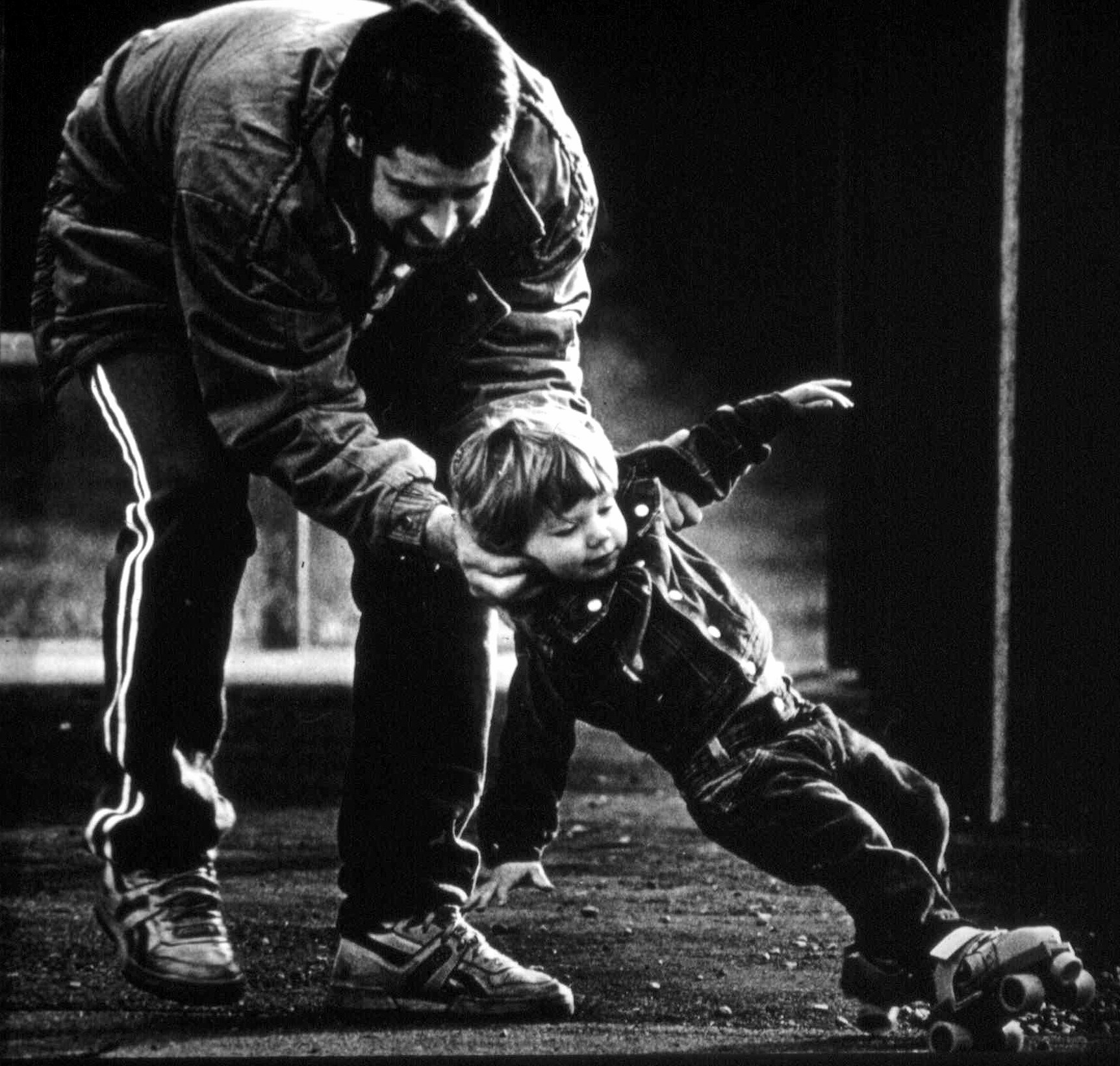
Learning to skate.

We had a family tradition to come to this park on Father’s day, and it was always a nice spot to look for people just having fun.

In this case, I was working for a newspaper in Tacoma, and was shooting what we called “feature” shots, and found myself drawn to that park.

I saw a father teaching his daughter how to roller skate – with these huge hurking skates that just really didn’t do much more than make noise, but by golly, they were skates, and she wanted to try them, so try them they did.

I talked with the dad for a little bit, asking if it was okay if I shoot, and when he said yes, I walked across the parking lot and started shooting with my 300 – that way I wouldn’t interfere with what was happening, and the pictures were more spontaneous.

I knew, just knew she was going to fall – and was just waiting when she did, just like her dad was – and we both caught her at the same time.

The thing that got me about this shot was that there isn’t any evidence of fear in her eyes at all, there is just trust.  “Daddy’s going to be there for me, and I’m going to be okay.”

Look again – does she see her father?  No – there’s nothing she can see – it’s all trust – believing that he’ll do what he said he would do.

I’ve learned a couple of really important things from that image,

  1. That trust is a very valuable thing.  Knowing that “Daddy’s going to be there…” is an amazing thing – both from our earthly fathers – daddies – to our Heavenly Father.  If you know – really know that your Father is going to be there, you will have trust – and therefore, no fear.
  2. I also learned that daddies taking the time to take their little girls to the park is just way, way past cool.

Knowing Daddy's arms are there makes all the difference.


Hey all –

Had surgery Monday to get a steel rod shoved into my femur.

Am a little tired today.

Seems to be a bit hard on the family – these events with me either having things put into my body or taken out.  Regardless of why – the pain is always there, and right now, as I write this – it hurts.

I’m going to try to slap my head on a pillow and konk out.

Anything I wrote today (including this) would be written under the influence of some pretty powerful pain killers.

So that said, – I’ll sign off now and try to write something tomorrow.

Take care,

Tom


It was in “Athens-by-God-Ohio” that I met her, the feistiest, orneriest, funniest little old lady (short of my mom) I could ever hope to meet.

Cleo was 88, and I was there in Grad school a number of years ago, getting my master’s degree in photojournalism – and I was there without a car.  This limited the stories I could do to pretty much walking or busing distance, and I found that Cleo lived just down the street.

Cleo was as independent as they come, and lived alone, in her own house.  She did her own grocery shopping, did her own chores, and spent occasional afternoons at the senior center in town playing cards or just reminiscing with the dwindling group of friends her own age she could relate to.

Her kids thought she was too old to live by herself, so they decided that she needed to be moved into a nursing home.

In Columbus.

68 miles away.

She disagreed, but it seemed that they were pretty insistent, and they moved her there.

Remember “feisty”?

Well, she promptly hopped a Greyhound back to Athens.

They didn’t mess with her anymore after that.

In talking to her, I found that she did her chores on Saturday, and since I was trying to find a story – I thought that it would be interesting to see what kinds of stories could be told in the pictures I could get of her doing that – so I made an appointment with her for Saturday morning around 10:00.  After we talked and joked a little, I told her that her job was to ignore me, and to just do what she would normally do.

And she did..

She swept.

She dusted.

…and she mopped.

Now when she mopped, she put on these old floppy galoshes, grabbed a bucket of water and whatever cleaner she used, and sloshed water on the floor and mopped it up.  There was no grace to the movements, no pretense.  She wasn’t putting on a show for me, in fact, she was in her own little world, and completely ignoring me, which was just perfect.

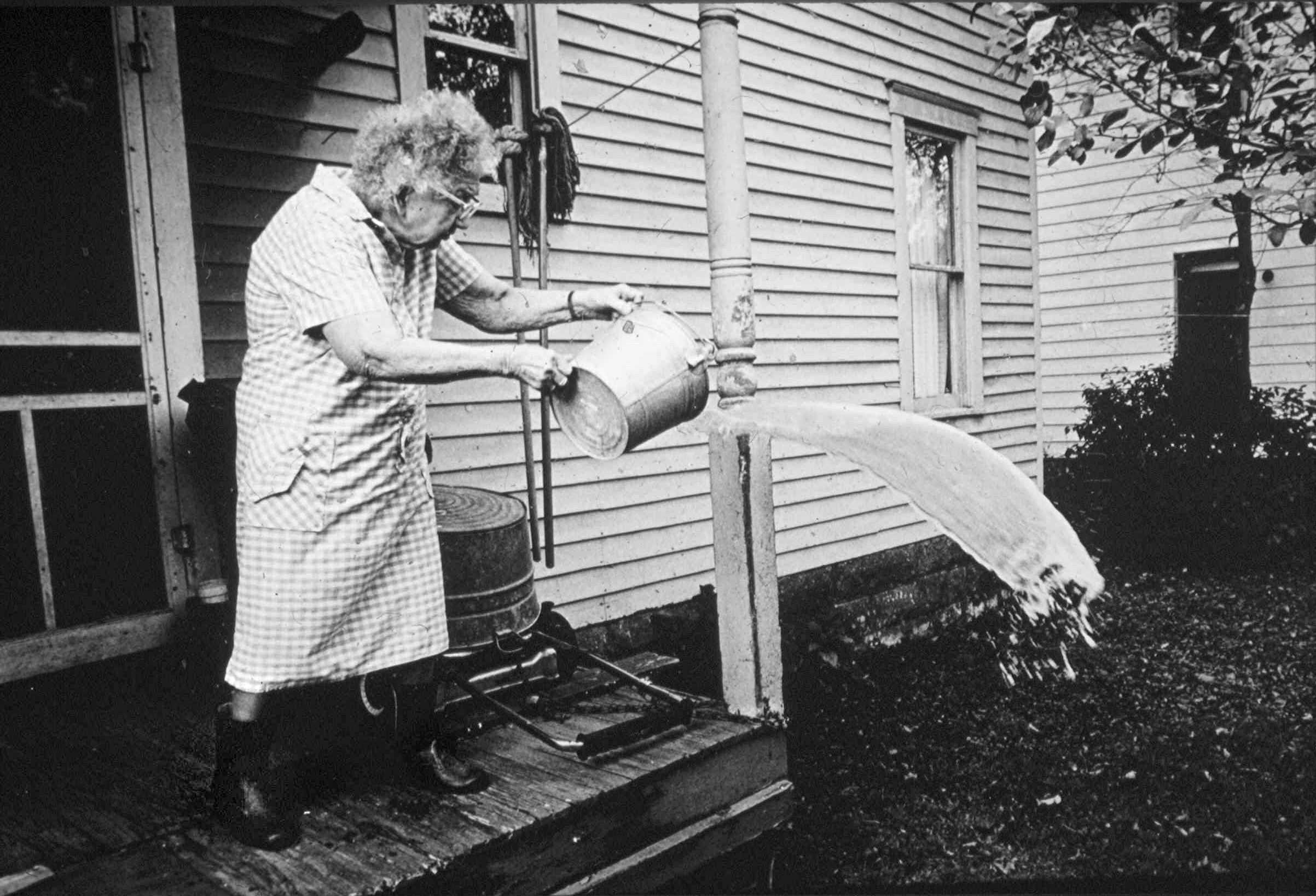
I took some pictures of the mop and the galoshes, thinking that would make a good detail shot, and then, as I was focusing, she picked up the bucket and started for the back door.  I followed, getting a shot of her opening the old, dilapidated screen door, and at that moment, the light came on in my head – she was going to throw the water off the back porch!

I literally jumped past her as she hung the mop onto a string, spinning 180 degrees in mid air so I landed facing her somewhere in the middle of the little back yard.  I must have instinctively focused the lens (a 24mm Nikkor) somewhere in mid air because I don’t remember doing it.  I hammered down on the shutter release for the motor drive of my Nikon FM-2 just as she did her back swing to lob the water off the porch, and got a series of 5 shots of the water sloshing out of the bucket into the yard.

Number 3 was the best.

1/250th of a second at f/8.  It wasn’t an easy print.  I printed it as high contrast as I could get – but that meant that the highlights (specifically her right arm, where the sleeve ends and the arm begins) were blasted out pure white and needed to be burned down so you could see detail.  I dodged out the galoshes, making sure you could see them, and used a touch of potassium ferricyanide on the wet mop hanging on the string to make it less of a blob.  I burned the wall of her house down a little darker (photographically, not in real life) so it would fade into the background a little, bringing the water up a bit in the process.

She was 88 years old back in 1987, so I’m sure she’s gone now, but she was a neat lady.  I’m glad to have known her.

Cleo and mop

Cleo throwing the mop water out. © 1987 Tom Roush


Many years ago, my mom and dad decided they wanted a fish pond in the back yard.  Now since fish ponds aren’t something you can just get at the local hardware store, it had to be “assembled” and “installed”.
Now installing a fish pond involves removing a lot of dirt out from where the fish pond is about to be, and it is definitely one of those things that involves sweat equity.  By the time you’re done, those fish better dang well be happy they’re there, because it took a lot of work to get them there.  She’d done a good bit, if not all of the work to do the installation – and had a vested interest in keeping those fish alive.

On the flip side of things, while gold fish aren’t really all that expensive, the idea of something taking the fish that, say, hadn’t earned the fish with that sweat equity, that just – well – it irritated mom.

A lot.

And one day, a poor, unfortunate creature made the incredibly bad decision to go fishing.

Now some of the creatures that had gone fishing in mom’s fish pond were raccoons, and they were moderately successful.  Some of the creatures were neighborhood cats, who just couldn’t seem to ignore the little orange – what would you call them, “containers of food”? – swimming  around in there.

Note – the image you have in your mind of these creatures fishing does not involve little raccoons or kitty cats sitting there in little kitty sized chairs, with kitty or raccoon sized fishing poles, waiting for the little fishies to bite.  They got a little more intimately involved than that, and got very close to the water, and then just scooped the fish out with their claws.  Kind of like combing some grunk out of your hair, only instead of hair, it was water, and instead of grunk it was a fish.

But this day was different.

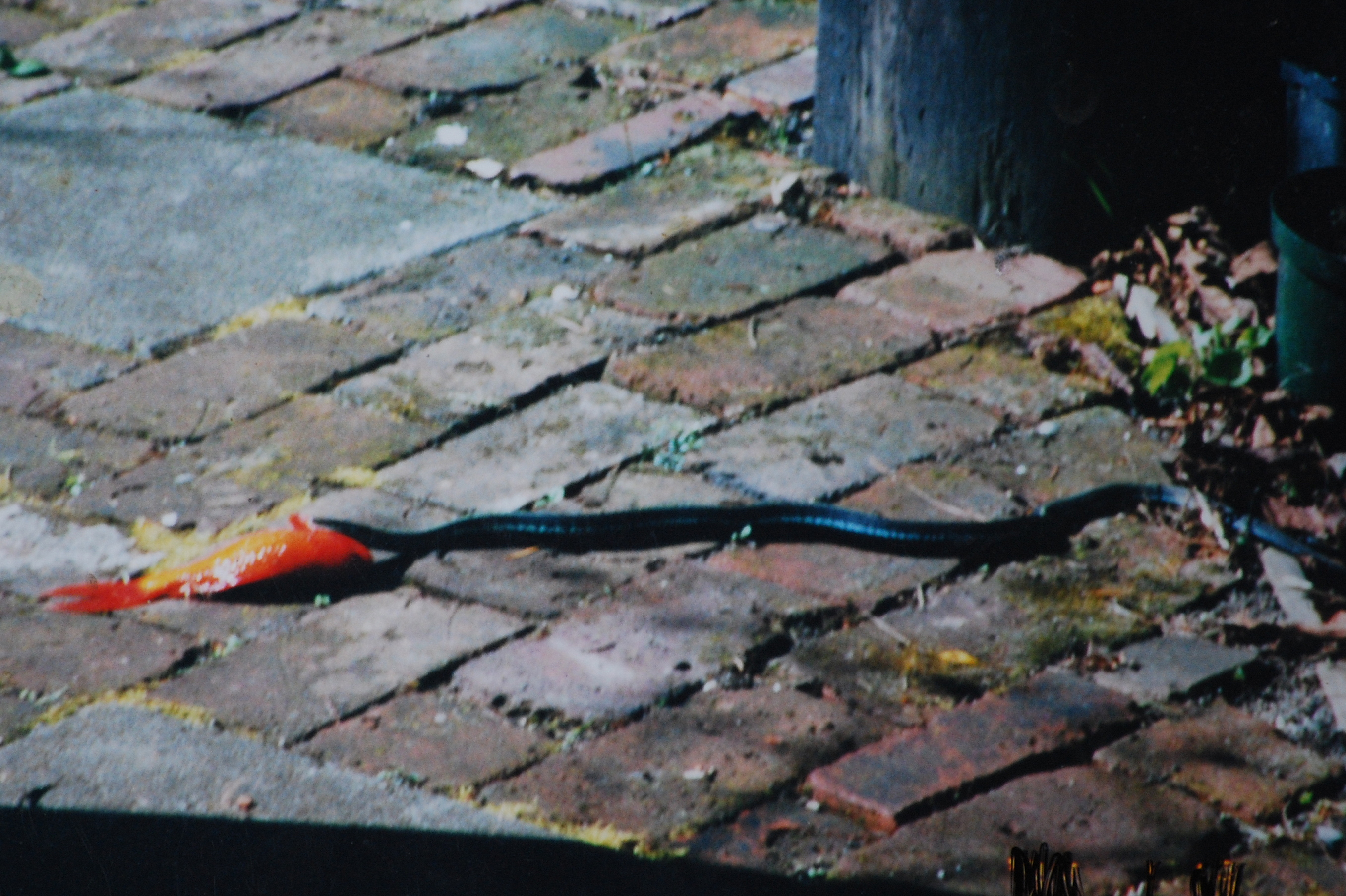
This day the creature was running a little short on claws, and actually, a little short on fur.  See, one of the creatures that apparently liked hanging around mom’s fish pond watching said fish was a fairly large garter snake.

Now garter snakes aren’t poisonous, we used to play with them when we were kids, my cousin, bless her fuzzy little heart, would find baby ones and put them in her pocket, then come into the house with her hands full (note: her hands were ALWAYS full in these situations) and ask her mom, “Mommy, can you get the dime out of my pocket?” (it didn’t matter what she asked for – the goal was to get her mom’s hands in her pocket.)  Just so you know, her mom HATED snakes.  Her mom reached into her pocket expecting to find a dime, and instead found something that gave her an absolutely astonishing case of the heebie jeebies as she found, with her fingers, an itty bitty snake.

The polite thing to say here at this point is that my cousin laughed.

A lot.

And my aunt freaked…

A lot.

It’s one of those things you can look back on and laugh.

Well, my cousin can, not sure if my aunt can.

And that’s the kind of stuff we did as kids with garter snakes.

But… this is my mom’s story…

My mom was a little different when it came to snakes, and one day she’d found that not only was her fish pond short one fish, but the creature that had gone fishing had done so without a pole of any kind…

It was the snake.

And it most definitely upset mom.  That was HER fish, from HER pond, and no dang snake was going to take that fish from her without a fight.

So she did the first thing she knew she needed to do.

She got her camera, and took a picture – just to prove she wasn’t telling a “fish tale”.

Then she got the pitchfork – mom’s goal was to scoop the snake up and fling it away from the fish pond.

However, snakes are very good at slithering, and slithering snakes sneak stealthily away from (quick, what’s a word for pitchfork that starts with ‘s’?”).  Okay, let’s see if we have all this right…

  • Get picture of snake trying to eat goldfish… Check…
  • Got goldfish out of snake and back in water…. In progress.
  • Oh – yeah… Wail on snake with pitchfork… Not checked…

See, it was only then, after she’d gotten a picture of it that she realized scooping said snake up was not going to work, and the snake made what might have been a bit of a mistake somewhere in there.

See, mom wanted the snake gone… She didn’t necessarily want it dead, she just wanted it gone. She had more invested in her fish (by a couple of bucks) than she did in the snake, and so among other things, it was simple economics…

The snake needed to go.

But the snake didn’t go, and then it looked up at her, and then, suddenly, thousands of years of history of women and snakes converged into one moment in time.  I’m sure that if Eve had had the same pitchfork Mom did, the whole Garden of Eden thing would have been a WHOLE lot different.

Mom started absolutely wailing on that snake as if it was the son of Beelzebub himself.  (Come to think of it…J).

This snake did not know what hit it.

In fact this snake didn’t know what KEPT hitting it, but it most definitely let go of the fish.

The slithering snake dropped the goldfish right about then – so she snagged it and threw it back into the pond, where it swam speedily away…

Mom tossed the fish back into the pond, then grabbed the snake by the tail.  It was as long as from her waist to the ground.  It then made the mistake of looking up at her – with goldfish scales in its mouth – and it hissed.

Bad snake…

And the pitchfork was used, once again, for a purpose for which it was not designed, but was quite suitable for.

The snake, by that point, was getting to be pretty ambivalent about the whole thing.  In fact, with apologies to Johnny Hart, trying to slither with 432 slipped disks was a bit of a challenge, and it was then that she carried it a few hundred feet away – across a little creek, and hucked the snake over there like Indiana Jones would have flung his whip.

And the funny thing is – that snake never bothered mom or her fish again…

Go figure.

Heeere snakey snakey snakey....

One live snake… One live goldfish… (this will soon change)


So my neighbor walks up to the fence and his jaw drops.

There I am, kneeling in the driveway, a Swiss army knife by my side, jumper cables in my hands, one end hooked to the battery of my 41 year old car, and the other end hooked to mother of all bottle rockets wired up, ready to go.

And he wanted to know what I was doing…

Sigh…

(Note – it flew a LONG way) 🙂


A few years ago, I worked at Microsoft in a department that was producing a huge product, one that took a couple of years to build.  There was this time, during a release cycle, that we called ‘crunch mode’ – kind of an ‘all hands on deck’ type of a thing, where dinner was brought in so we didn’t feel we had to go home to eat with our families, and could work a few more hours.  Several of us would joke, wryly, that we only worked half days at Microsoft… You know… 12 hours on… 12 hours off… Fridays were greeted with “Thank God it’s Friday, only two more workdays till Monday!”

There are some who would have said the schedule was brutal.

There is every likelihood that they would have been right.

Crunch mode lasted for months.  It was, to put it mildly, very wearing on folks, and their families

Now Microsoft, to its credit, realized that this constant ‘crunch mode’ was hard on morale, and as a result, whenever there was any kind of milestone achievement, they’d have a party.  When we shipped a product, oh Lordy, you haven’t seen a party till you’ve seen Microsoft put on a party.

So after about a year of crunch mode, we shipped a version of Site Server, and had what they called a “ship” party at a park at the south end of Lake Sammamish.

If you wanted to, you could take the afternoon off, go play games, go water skiing, or ride a jet ski, or just hang out by the grill where they were barbequeing herds of formerly wild animals, grilling fields of corn on the cob, and mixing up just-shy-of-Olympic-sized swimming pools of cole slaw.

It was, in a word, impressive.

When I got there, some of my coworkers were slicing through the water behind the ski boat, and all three of the jet skis were out there cutting swaths into the lake.

My boss’s boss (Mike) was eating with a friend at one of the picnic tables, saw me wandering in, and suggested I go play, as I’d been working pretty hard.

I looked out at the jet skis, and realized, with a start, that…

–          while I’d never ridden one,

–          kind of thought they were a rich person’s toy,

–          and couldn’t possibly imagine buying one…

…deep, deep inside, I REALLY wanted to ride one.

And there was absolutely nothing keeping me from riding this one.

Heh…

So I went out there to see what it would take to make this happen, and it turned out all I had to do was fill out some paperwork, wade out into the water, and get on.

Well, I was wearing a pair of boots, so that wouldn’t do, so I took them and my socks off, then scrunched my pants up so they wouldn’t get wet, signed the paperwork, and waded out to climb on.

Once on, I was given an astoundingly brief set of instructions,

“Squeeze this to go, let up to stop.”

“Go easy on it till you get into the deep water, we don’t want to be sucking rocks into the impeller”

“Don’t do donuts”, and

“It won’t steer unless you’re hitting the gas”.

“You’ve got 10 minutes.  Go.”

Kind of dazed, I chugged out into the deep water, conscious that the three cylinder, two stroke engine sounded an awful lot like my old Saab, and decided to make the most of my 10 minutes.

The waves were lapping gently at the hull, the ski boat was doing a circuit, and I was trying to get used to the idea that this thing underneath me that was moving in such an unsteady way, was actually safe.

“Okay – here goes nothing…”

I hit the gas.

Oh…………….

My………………………….

GOOOOOOOOOOOOOOSSSSSSHHHHHHHH!!!!!!!!!!!!!!!!!!!!!!!!

The acceleration was unbelievable.  I was at 50 mph before I knew what had happened.

I reached back and grabbed my eyeballs before they got lost in the lake.

The handlebars, which until moments earlier, had moved freely in my hands, now felt like they’d been dropped into quick drying concrete.

The air, which until moments earlier, had only been something I was breathing, was now trying to rip my glasses off my head.

The water, which until moments earlier, had been something you could dive into, was now the consistency of granite as the jet ski skittered and bounced across it.

And the jet ski itself, which until moments earlier, had been this unsteady, gangly kid at his first time on a bike, was now this fierce monster, ready to conquer anything in front of it.

The speed slowly crept to 60, and I saw I’d be crossing the wake of the ski boat, so I slowed down and tried to turn a little bit.

This was when I remembered the instructions “it won’t steer unless you’re hitting the gas.”

Coasting straight at something while you’ve got the steering turned hard to one side is a little disconcerting.

I hit the gas, and the strange thing was it steered from the rear, like a turbocharged forklift – a little unusual if you’re used to things steering from the front, but the fellow was right, it did not steer unless you hit the gas.

I suddenly understood the allure of these things… I could now say I had ridden one, and, given the price tag, still thought they were a more of a rich person’s toy, and still couldn’t imagine buying one. But wow… I definitely understood why people bought them.

I know I used up more than my allotted 10 minutes, but finally headed back in.  They waved me to slow down early, and I idled in, the adrenaline still pumping, my hair firmly blown back, and a grin superglued to my face.

A line was thrown out for me to catch, and I was pulled the rest of the way to the dock.

When I got off, I had to step into the water again and wade back to shore and then up to the picnic table where I’d left my boots and socks and everything.  When I put my boots on, I noticed that my pants had skootched down a little bit while I was out on the lake, and the bottom two inches or so had gotten wet as I waded back to shore.

–          Now have you ever had a snappy comeback to a question, just perfect, witty, urbane, amusing – but thought of it an hour, or a day, or a week too late?

–          I am the master of coming up with a snappy comeback at least an hour too late.  In fact, sometimes my brain chews on something for months, honing it until it comes up with an amazing, but completely useless comment because it’s too stinking late.

–          For once in my life, I did not have that problem.

Mike was still sitting there with his buddy when I walked by, with my two inches of wet jeans.

“Whatcha been doin?”

“Water Skiing.”

Mike’s buddy’s jaw dropped.

Then Mike, bless him, ‘explained’ with an absolutely straight face, “He’s very good.”

And as I walked away, I couldn’t help but smile.

==


Have you heard the story of the prodigal son?

It’s in Luke 15:11-32.

Read it – then read verse 20 again.

“But while he was still a long way off, his father saw him and was filled with compassion for him; he ran to his son, threw his arms around him and kissed him.”

Why did he do that?

Let me tell you a story that might help you understand.

One day I got home before my son did, and for the first time in a long time, I would be able to make him an after school snack, and just sit with him while he ate and talked about his day.

I stood at the window, waiting, watching, remembering.

This was my son, the one I’d fed from a bottle.

The one I’d changed thousands of diapers on.

The one I’d burped and who’d burped on me.
My son.

The one whose first steps I saw.

The one I’d played with and loved and taught to ride a bike.

The one whose skinned knees I cleaned and bandaged.

My son.

He was the one I’d seen grow as a cub scout, as a young soccer player, soon to be a football player, and later on, an Eagle Scout.

My son.

And while looking out the window, waiting for him, I slowly began to understand what verse 20 means.

I stood there – yearning for a chance to share some time with him, and suddenly I understood why the father of the prodigal son “saw him while he was a long way off”.

He couldn’t see him from “a long way off” unless he was actively watching for him.

And as I was standing there, it was as if thousands of years vanished in a kinship as two fathers stood, waiting for their sons. The sons they loved – we loved, and cherished, and wanted the best for. I could feel him, and almost see him standing there, next to me, the prodigal son’s father.

And I wondered…

How long had he been doing that?

How many days had he stood there, watching, waiting, hoping?

The father didn’t know all the son had done while he was gone – it didn’t matter. What mattered was that he had returned. That – that was worth celebrating!

He couldn’t slaughter the fatted calf unless he had one! That meant, in all that watching and waiting, he was expecting the best! He was expecting his son to come home.

He slaughtered the fatted calf to celebrate his son’s return.

I fixed an after school snack for my hungry boy.

And I understood, as I sat there, with my son, chatting about his day, why the prodigal son’s father stood there and watched for his.

He loved him. He cherished him. He wanted what was best for him. He wanted – he wanted to spend time with him.

And I realized that there are times when we go off on our merry way – wandering through the fields of pigs in our lives (verse 16) – that our Father is standing on His front porch, watching, waiting, pacing…

Waiting for us to come home so He can slaughter the fatted calf for a celebration….

…or sit at the kitchen table after school and share a baloney sandwich with us.


When I was a kid – growing up in Roy, Washington, the things we did for fun were limited not by batteries, but by our imagination.  Electronics like video games and the like were simply not a part of the definition of fun.

Gasoline, heavy metal, and explosives were – but I’m getting ahead of myself…

It’s one of those things you talk about to your kids when you’re a grown up, you know, the “Back when I was a kid…” kinds of things –

One of the things I’d do often was ride the bike I used on my paper route out onto Fort Lewis, over by Chambers Lake, and just explore.  One of my customers was also a friend.  He had this late ‘60’s blue iron monster of a car.  No idea what the make was, and it had no distinguishing characteristics other than the following:

  1. It was blue.
  2. It had 4 doors.
  3. It had a V-8 engine.
  4. It had a suspension that rivaled the stiffness of the Sta-Puf Marshmallow® man.

Now there were two types of roads on Fort Lewis:

  1. The kind that had been surveyed, graded, paved, and marked by professionals, and had speed limit signs to keep you on the straight and narrow, so to speak….
  2. The kind that were unsurveyed, ungraded, unpaved, and were made by a teenager driving an M-60 tank. They most definitely didn’t have speed limit signs, because the roads were so rough that a sane person didn’t need them.

Now, sanity aside, guess which ones were the most fun to drive on?

…and guess whose car was just a touch inadequate to use on said roads?

Yup – My buddy Mike’s car with its Marshmallow Suspension just didn’t do too well out there … In fact – there was this one place where – well, the road wasn’t even a road… See, the water going out of Chambers Lake goes into what’s called Muck Creek… And just as it does – it goes under one of the paved roads.  The thing about this road and the bridge is neither of them were stressed for 60 ton M-60 tanks to drive across – so the Army had put this ford in beside the bridge for the tanks to cross the creek on.  Understand, this isn’t a ford as in Ford car – but ford as in “shallow spot in the stream” – they’d put huge blocks of concrete down so you could drive across/through the creek to get to the other side without sinking in.

That is, if you were driving a tank.

Now somehow, Mike and I had decided, in that synergistic stupidity that only happens when young males make decisions together, in which the decisions made by a group of young males are far, far superior in both the quality and quantity of their stupidity than any one young male could possibly achieve on his own, that his car would be an absolutely optimal piece of equipment to get stuc – er – to drive through said creek, across the ford and up the other side. The fact that a perfectly good bridge was right there was completely irrelevant. Oh – I didn’t mention the fact that the banks of the creek at that point were actually rather steep, the rocks in that area were all round – like ball bearings, and scraping the bottom of the car on those rocks as you went down was to be expected.

That is, if you weren’t driving a tank.

So, Mike driving, we slowly coaxed the car down until water was washing over the tires – and then started up the other side – at which point things started scraping again and those old tires really didn’t work too well.  Now, being guys, the mentality there was simple: If a little power wasn’t getting us up the other side of the creek, well, more power would be better.

Right?

Riiiiiight….

Mike’s old, smooth tires on the smooth, wet rocks of the creek bank simply didn’t offer any traction, and try as he might, all that hitting the gas did was dry off the rocks as the tires started steaming the creek water off them.

Hmmm…

While we were trying to figure our way out of this conundrum, lo and behold a couple of guys showed up… in a tricked out 1954 GMC suburban… (by ‘tricked out’ I mean it actually still had functional paint and had mag wheels.  Think about what kind of surface mag wheels are good for – if “round wet rocks” isn’t at the top of your list, you’re on the right track…)

So these guys figured they were going to be our heroes and save the day…

They backed their suburban down the bank in front of the Marshmallow Mobile®, tied a rope to it, hit the gas, and promptly got stuck up to their axles.

So – big picture here – the Marshmallow Mobile® is in the middle of the creek.  A rope’s tying it to the Suburban on the bank.  Both of them hitting the gas only gets them up as far as – well, both of them getting stuck a little further up the bank.

Wait – it gets better…

Lots of testosterone fueled pondering ensued – which was interrupted by a third vehicle driving by, seeing the commotion, and the driver realizing that he, being far more manly than these poor, wretched peasants stuck in the creek, would be far better able to get us out than we were…

Little did he know…

To be honest, I don’t remember the kind of car that that one was – all I remember is standing on the bridge, looking down at three vehicles, all tied together, with their 3 V-8 engines putting out several hundred horsepower, and the only achievement was that the gas was being turned into smoke and steam from the tires on the wet rocks.

After a few minutes of this I realized that clearly the thing that was missing wasn’t power, it was traction.  So I walked over to my Grampa’s farm (my options being rather limited since all available vehicles were busy either farting exhaust bubbles into the creek or redistributing the gravel on the bank) to see if I could borrow one of his tractors to help pull the folks (and my buddy Mike and his Marshmallow-Mobile®) out.

Grampa wasn’t there – in fact, nobody was, so in my (ahem) Infinite Teenage Wisdom ®, I figured forgiveness would be far easier to obtain than permission, so I ‘borrowed’ one.  This was an old Ford Tractor that had a transmission with 12 speeds forward and 3 in reverse.  First, as you might imagine, was pretty low.

When I got back to the bridge – all the cars were tied together right where I’d left them, just like the children’s story, the “Little Engine that Could” – only with three stuck locomotives and no caboose.  I looped a chain from the back of the tractor to frame of the car in the front, put the tractor in first, and, with 3 V-8 engines roaring plus a little 34 horsepower tractor chugging – everyone doing the delicate gas pedal dance of hitting the gas hard enough to try to move, but not enough to run into the person in front of them (it was a bit of a challenge), our little choo-choo-train of cars made it out of the creek.

We untied the ropes, unhooked the chains, and went our separate ways.  I took the tractor back to Grampa’s and put it back in EXACTLY the same spot it had been in (still nobody home).

And… I never volunteered to ride in the Marshmallow Mobile® again.

Come to think of it, I don’t think I was ever asked to.

Moral to the story?

Heck, when I started writing, I was just writing for fun, and I didn’t think there would be one – but I guess there is one, and that’s this:

Raw power will not always get you out of the trouble that gravity can get you into.  Sometimes it’s the steady application of a very small amount of power in exactly the right place that will do the trick, rather than hundreds of snorting, whinnying, or roaring horses applied in the wrong place or the wrong way.


Another one of the stories I told Michael about his heritage, this one about his Grampa, his step-great-Grampa, if there is such a thing, and a B-52.

My dad was stationed at Castle Air Force Base in Merced, California in 1967, where the 93rd Bombardment Group was based.  The 93rd at the time flew B-52’s, and they trained pilots and crews both in the planes and with simulators.  They did this 24 hours a day, seven days a week.  When they weren’t flying the airplanes, these pilots and crews were in the simulators, practicing.

And my dad fixed those simulators.

A few hours north of Merced is Santa Rosa, where dad’s mom and stepdad lived.  Dad’s stepdad, we’ll call him “Grampa Bill” fancied himself to be an artist and photographer.  This is a point that could be argued pretty heavily.  And, it turns out, when dad and mom were a young couple and dad was stationed elsewhere, Grampa Bill wanted to take some photographs of mom that could at the very least be described as ‘inappropriate’.  I won’t go into any more detail other than to say that when dad found out, he stormed in to see his commander and asked if he could have some leave so that he could go pour a goodly amount of chlorine into the gene pool.  His commander declined the request, but sent someone to check on mom.  She was fine, but that incident cemented the relationship between dad and Grampa Bill into something very, very simple: Dad hated Grampa Bill, with a passion. And honestly, as I see it, he was right.

Now it’s not that he could have done anything about it overtly, but as the years went by — well, you’ve likely found out at some point in your life, there is this thing that’s known by several names…

Some call it “The Golden Rule”,

Some call it “What goes around, comes around.”

And some call it “Karma.”

And when you find yourself watching, almost from the outside,

…how “The Golden Rule” is turning things toward you,

…and you find that things that have gone around are coming around,

…or, put another way, watching Karma setting up a situation for you – whatever you call it, it’s almost impossible not to smile.

Such was the case with dad and Grampa Bill.

Dad worked with or near airplanes.

Grampa Bill wanted to take pictures of airplanes.

More specifically, he wanted to take a picture of a B-52, taking off.

…and dad could make that happen.

Now the thing was, Grampa Bill didn’t want to get a picture with a little camera he’d be holding in his hand. He wanted to shoot the picture with a camera that looked like a small accordion and came in a small suitcase. It was a film camera, the kind that uses film not in rolls, but in sheets, 4 inches by 5 inches in size.  You had to look through the actual camera, not a viewfinder, and to be able to see the picture you were about to take, you had to have your head under a dark cloth to focus and frame the shot on the ground glass (think frosted glass) in the back of the camera.  This image you saw on the ground glass would be upside down and backwards.  When you were satisfied that it was framed right, you shoved a film holder into the back of the camera by the ground glass and from there on out you couldn’t see through it.  You closed the open shutter and pulled out the slide protecting the film from stray light.  Then and only then was everything set.  If you opened the shutter at that point, the film would be exposed, and you’d have your picture.

It was, as you can imagine, not a fast process, and you can probably figure out that it’s not a camera you would use to take images of, say, moving objects.

Like, say…

A B-52…

Taking off…

Toward you…

But that’s precisely what Grampa Bill wanted to do.

At Castle Air Force Base.

Where dad worked.

Where they flew B-52’s.

And…

…and an absolutely evil plot started festering in dad’s brain.

See, dad knew several things that Grampa Bill didn’t know:

He knew how much of the runway the plane would use up to do a normal takeoff.

He knew that aerodynamically, while most planes take off with their noses pointed to the sky, when a B-52 takes off, the pilot actually has to aim the plane 2 degrees nose down to climb for the first little bit.

More importantly, Dad knew the pilots flying these planes.

Now, if you happen to be standing at the end of a runway – and on the other end there’s a half million pounds of raw power accelerating directly toward you out of a black wall of smoke created by not 1, not 2, but 8 of some of the most powerful jet engines of the time, there’s a good chance you’re going to leave something in your pants as it goes overhead – liquid or solid, doesn’t matter.

If the person you asked to get you to this position knew the pilot, and also had a years long score to settle with you, those chances would likely lean toward the solid, and it would best be time to start digging yourself a hole.

Remember?

Dad worked on the B-52 flight simulators – so he knew, and was acquainted with, all the pilots who trained in them.

And he knew this one.

Dad had explained to the pilot that he’d be out there one Sunday with his step dad, who wanted to take a photo of this takeoff, and as a last request, said to him, “Do you think you could keep it on the ground a little longer this time?”

There was a look between them, and as is often the case, words were not exchanged, in that guy to guy way we men often communicate. But the pilot clearly understood what was meant, and he did indeed agree to keep it down on the ground…

…a little longer.

Every Air Force base has what they call a ‘perimeter road’ – a road that goes around the perimeter of the airfield.  You are not supposed to get any closer to the runway than that road, and even while you’re on it, you’re not supposed to stop once you cross under the flight path.

Dad and Grampa Bill got into one of the Air Force trucks and headed out toward the runway.

Grampa Bill was having trouble believing his good fortune.

Dad turned the truck off the perimeter road and up toward the runway, where there was a sign that started off with, “Authorized Personnel Only” and got significantly more threatening with every word, ending in something along the lines of “Deadly Force Authorized”.

They drove past the sign.

Dad drove Grampa Bill out to the end of the runway to pick out a good vantage point to take the picture from.

Grampa Bill’s excitement grew.  This was better than he’d hoped.  He’d be allowed to get far, far closer than he’d dare dreamed.

In taking him past the signs, dad also took him in past the approach lights at the end of the runway, so they wouldn’t clutter up the picture.

When they stopped, he was almost beside himself. Grampa Bill proudly set up his camera, meticulously judging exposure, focus, depth of field, while 2 miles away, the B-52’s pilot got the his bird into takeoff position.

He’d finished the pre-takeoff checklist with his copilot and pushed the 8 throttles to takeoff power.  The plane shook as the jet exhaust made a black wall of smoke behind it.

It took a few seconds for the thrust to build and the sound to reach the far end of the runway, but once it got there, the deep rumble of raw power stayed, getting louder with each passing second.

The pilot held the plane back with its huge brakes and waited till they and all systems were cleared for takeoff.

He’d told his copilot what was happening, and while they didn’t deviate from the checklists or official cockpit language, they did share a grin under their oxygen masks.

They were given clearance, and the plane started to roll.

Grampa Bill sensed the movement and tried to hold his excitement down.  The ability to stand right at the end of a runway while an airplane, not just an airplane, but the mighty B-52 took off directly overhead was an astoundingly rare treat.

Nearby, Dad stood by, calmly leaning against the front fender of the truck, also conscious of the opportunity of an astoundingly rare treat.

Now depending on its load, a B-52 has a takeoff speed of about 163 mph, and its wings sag when it’s on the ground, to the point where the engineers at Boeing designed extra landing gear out there just to support the wingtips.  As the plane accelerates, those wings start to fly themselves first, before they create enough lift to take the plane up with them.  They have a range of about 22 feet of ‘flap’ at the tips – so as the plane got closer, and faster, and bigger, and louder, those wings started flying,

But the nose was still pointed directly at Grampa Bill.

And his camera…

On the Tripod…

At the end of the runway…

The pilot, a major, kept the plane on the centerline, and felt the yoke slowly come alive in his hands as the 8 engines overcame inertia and brought them ever closer to takeoff speed.

Grampa Bill saw the tremendous contrast between the black wall of smoke, the white and silver plane, and the incredibly bright landing lights and wondered, for a split second, how that would affect the exposure setting on the camera.

The pilot felt the rumbling cease and the plane smooth out as the wheels left the pavement – and then aimed the nose down the 2 degrees, at a small tripod with a black box on it just off the end of the runway, to start the climb.

At that moment, Grampa Bill’s thoughts of exposure, focus, and timing were suddenly replaced with a rather urgent need to decide between liquid and solid.

Beside the tripod, Grampa Bill tried to be manly and stand his ground, but from his angle, the plane just couldn’t climb fast enough, it wasn’t even aimed up – in fact, it looked like it was actually aimed down, right at him. Those 8 engines, inhaling more air in a second than he breathed in a year, looked like they were going to inhale him, vaporize him, and blast the remaining bits into that huge wall of smoke behind the plane.

In the cockpit, the pilot thought he saw movement near the tripod just before it disappeared below his windscreen.

Below, the plane’s shadow passed with the fury of a tornado, the violence of an earthquake, and the heat of a blast furnace.  The jet blast tore the canvas top off the truck they’d driven out to the runway in, knocked the camera and tripod over, and sent them all diving for whatever cover they could find.  (This being an airbase, the only cover available was the truck they’d come out in).

And in the decision between liquid and solid, a compromise was made.

Both.

The last time I saw them, all the pictures Grampa Bill had taken were being stored in boxes in a chest of drawers in the attic.  They’re 4 x 5 negatives – or sometimes 4 x 5 positives.  I’ve looked through them all.

And there’s no picture of a B-52.

I still find myself smiling at that…

And somehow, I think those many years ago, under that truck, his ears still ringing, my dad smiled, too…

(C) 2010 – Tom Roush

(note: here’s a short 2 minute video of several B-52’s taking off – from beside the runway – not at the end of it, and they’re taking of higher than the Major did – but it’ll give you an idea of what it was like.


I was talking to my mom the other day about an email we’d both received – about an American soldier in WWII and how he had done brave things on the battlefield. For example, killing the enemy, saving his compatriots, just doing what soldiers do.

And she, having grown up in Germany during World War II, sent me this note:

You know Tom-Son, looking at war and the so-called ‘victories’ from both sides, something became clear to me during that war. I was between 10 and 14. In school we talked about how many air planes had been shot down, how many ‘Panzer’ (tanks) or ‘Gefangene’ (captured, how many ‘enemy soldiers’ were killed, until…

Pastor Gotthilf Hoelzer one day somberly made the remark

“THEY WERE ALL THE SON OF A MOTHER”

That brought those ‘victories’ into perspective.

During the war, there was no TV. Everyone who had one huddled around a radio in the evenings to hear the “special bulletins”, the “Sondermeldungen”, to hear how the war was going.

Mom was born in 1929, in Germany, at the height of the Depression.  This is the Depression that Hitler got Germany out of.  The Depression where he convinced many people that he was the right person to be their “leader” – their “Führer” – before things went completely crazy.  The unemployment situation was absolutely dire, and mom’s parents – my grandparents – had found employment by working at the milk “Sammelstelle” – a collection station where the farmers would bring their milk to be processed and sent to the larger dairies.

Mom told me just a short paragraph of a story – a story that boils down to six words, but at the same time, could not be told in a hundred lifetimes:

“I remember one family on our ‘milk run’ in Hanseatenstrasse. Their soldier was there when Stalingrad was surrnounded and was expected to be taken by the Russians. The German troops were trapped. The adults of that family were huddled around their radio to listen to the ‘Sondermeldungen,’ knowing that they would not see their man come back.  They were all crying. Their little girl did not understand and she said : “Lasset me doch au mit-heula’. (essentially: “Tell me what’s going on so I can cry with you”)  She sensed that all those hearts around her were breaking and she wanted to know why…

It was most likely that the adults were crying about her Dad.”

And a flood of images came to my mind.

…the chores still needed to be done, but they were rushed so that everyone could gather around the radio to hear the news of the day.  The husband, the father, the brother, the son of someone in that room, was in Stalingrad.  Hitler himself had ordered that there would be no surrender. The 6th Army of the Wehrmacht, which had stormed into the city that summer was either decimated or being left there to die.

In that moment, the adults realized that their son would not come home.  His father, who up until that moment had been looking forward to sitting down with him and hearing his stories, and in hearing them, would relive some of his own battles in WWI.  But he realized as he listened to this news, that he would not hear them, or his son’s voice, ever again.  He remembered back, remembered seeing his wide open, trusting eyes as he, like all fathers, tossed his little boy into the air and caught him again and again, his laughter ringing like a joyous bell.  He remembered his birthdays, his baptism and confirmation in the church, and his marriage at the little town church flooded his mind as the tears flooded his eyes.  He remembered how he was able to sit down, after a hard day’s work, and celebrate that German tradition of ‘Feierabend’ which, while hard to translate into English, can best be summarized by the meaning behind the phrase “It’s Miller Time” .The work is done, it’s time to rest.  He’d been looking forward to the end of the war, to be able to have a huge Feierabend with his son, because the work – the war, would be over.

But there would not be any more Feierabends with his son.

Not now.

Not ever.

And he wept.

Unashamedly, he wept.

For the companionship he would no longer have with his son, for the laughter they would no longer share, for this stupid war that was taking thousands of sons from their fathers.

The enormity of what he was hearing on the radio was too much to bear.  He tried to read his wife’s expression, and saw the sorrow of a mother who’s being told she’s lost her only son.  She was inconsolable.  The words she heard from the radio, those of victories for the fatherland, of bravery and sacrifice, were overcome by her own memories.  As she sat there, the words turning into a dull buzz in the background, she remembered the moment when she knew she was going to have a son, the first spark of life inside her.  She remembered waiting to be sure, and then remembered the simultaneous look of shock, doubt, surprise, and joy in her husband’s eyes as he realized he was going to be a father. She remembered sharing that special communion a mother has with her child as she nursed him. She remembered his first day of school and his last.  She remembered the gleam in his eye when he told her about that very special girl, the one he wanted to become his wife. She remembered their wedding day, and how this girl became part of their family.

She remembered his laugh, that belly laugh that can only come from the absolute, unrestrained joy of a little boy, and how it had gotten so much lower in tone over the years, but still, the joy was there.  She loved to watch, and listen, as he and that special girl laughed together.

And she realized that she would never hear that laugh again, not from her son, and not from that special girl.

Not now.

Not ever.

And she wept.

Unashamedly, she wept.

For the companionship she would no longer have with her son, for the laughter they would no longer share, for this stupid war that was taking thousands of sons from their mothers.

She held that special girl in her arms, trying to support her, as she was lost in her own thoughts of him.

He’d been in her class, in school.  They’d grown up together. They’d laughed and had a history together that started long before the day they walked down the aisle. And as her vision blurred with tears, she saw images she knew she’d never see again.

She remembered the bashful look in her husband’s eyes the first time he talked to her, the nervous look on the day he proposed to her, and the confident, anything but bashful, look on the day they were married. A part of her smiled at that memory.

She remembered the moment when she realized she was going to have his child. She remembered waiting to be sure, and then remembered the simultaneous look of shock, doubt, surprise, and joy in her husband’s eyes as he realized he was going to be a father.

She remembered seeing her daughter’s wide open, trusting eyes as he, like all fathers, tossed his little girl into the air and caught her again and again, her laughter ringing like a joyous bell.  She remembered the tough times, and how hard he worked to keep food on the table, and a roof over their heads and how he, despite the Depression, had kept them fed. She remembered quiet evenings sitting by lamp light, quietly sewing, or reading, no words, just companionship, and how much that meant to her.

She remembered when everyone had chipped in and bought the radio, and how it had filled the room with music and laughter; how they had invited friends over and they were able to dance as if they had their own orchestra.

She remembered the light in his eyes as he saw his daughter take her first steps, and how once that happened, there was no stopping her.

And she remembered trying to decide whether to be proud or horrified, or both, when the draft notice came in the mail. She remembered her guarded tears as a train took him to parts unknown for basic training, and the anguished tears she shared with his mother after the train was gone, and they knew he wouldn’t see them.

She remembered that first visit home – how he’d changed, and how proud he looked in that uniform.  There was still a sense of pride in her, but there was also an uneasiness that that took quite a bit of strength to keep from turning into outright terror at the things that can happen to a soldier, both to him and by him.

She remembered looking at his hands, the ones that had recently held a new life, wondering if they would be asked – or ordered – to take a life.

She remembered the next trip – the last one – in spring, when he wasn’t allowed to tell her where he was going.  She remembered holding him fiercely, and how, as she looked into his eyes, she saw the love, the caring, the gentleness of the man she knew, and she remembered, how the sound of the train whistle changed that completely.  She saw the eyes of her husband turn from the look of one who gives and nurtures life, into the look of a soldier, one who takes it.

She remembered recoiling at the shock of this transformation, and how he had pulled away from her. Both of them had brave faces, both had heavy hearts. He turned, walked toward the train, and only once turned to look back.  In that moment, she saw, for a split second, the eyes of her husband saying goodbye. Neither of them knew it would be their last .

At first, the radio reports and the newspaper accounts were all full of victories and successes. Then, as the months wore on, September came and went.  Hitler had said that Stalingrad would have fallen by then, but it hadn’t.  October came, November came, the Russian winter came, and the news then was that the 6th army had been cut off and surrounded.  The news reports confidently said that a relief force was fighting its way down to help them, but the Russians fought them off.  Then Goering said he’d resupply what remained of the army with 750 tons of supplies a day, by air. But there weren’t enough airplanes left to even get one third of that, and like so many other things in this war that they’d been led to believe were necessary and would succeed, this had failed as well.

They’d been listening warily to every  news report, wondering how much of what they were hearing was the truth and how much was lies. They would get bits and pieces of information about what was happening, and it would, all culminate in an overwhelming sense of dread as the news reports came in. Every night, they sat by the radio – the thing that had brought so much joy, laughter, and music, but now it brought nothing but strident propaganda and death.

And then the news reports stopped altogether.

She wasn’t sure exactly of the moment it happened, but somewhere in those weeks of silence from the eastern front that cold winter, she knew. She knew she would never see her husband again.  She knew she would never hear his laughter again, or see the look of love in his eyes as she felt his love inside her.  She knew she would raise their daughter without him.  She knew that she would never again be able to drowsily reach over to his side of their bed and feel his warmth, or hear his soft breathing.  She knew now that she would miss even his irritating habits, like cutting his fingernails with his pocket knife. She would never have to ask him to clean up the cut off fingernails again, or clean his dishes off the kitchen table after dinner.  She knew she’d never hear him say grace in that wonderful way he said it, thanking God for the simplest of meals, as if it were a feast, fit for a king.  He made her so proud when he did that.  He was grateful, even for the little things.  She remembered that. Oh, what she’d do for those little things – to hear him say grace again, to hear his breathing, to hear him tell her what a good breakfast she’d made, to feel him lift her off the floor in that all enveloping hug he’d always used to say good bye.  And she realized, with a start, that when he’d said goodbye that last time, at the train station, that he hadn’t lifted her up like he always did as he said goodbye…

Somehow she knew that from that moment, nothing would ever be the same.

The news reports 3 weeks later confirmed it.

She would not hear his voice again.

Not now.

Not ever.

And she wept.

Unashamedly, she wept.

For the companionship she would no longer have with her husband, for the laughter they would no longer share, for this stupid war that was taking thousands of husbands from their wives.

She remembered her first married Christmas without him, just a few weeks earlier.  They were supposed to be done with Stalingrad by September, and here it was more than 3 months later.  They did what they could to make it a joyous Christmas, with Mama, and Oma, and Opa, but it seemed hollow.  Through it all, the church service on Christmas Eve, and the “Heiliger Abend” later at home, her – their – daughter kept looking at the door, and kept asking, “Wo ist Papa?” (Where’s Papa?)

Christmas and New Year’s came and went, and still no news.

Finally, in late January, there was news.

No, not just news.

The News.

The regular radio programming was interrupted by music, and then, The News.

The relief force had failed.

Goering’s Luftwaffe had failed.

Stalingrad had fallen.

It was so hard to look her daughter in the eye as she tried to give her the news that so many mothers had had to give their children over the last few years, that their father had joined the thousands, the millions, who had “fallen” in the war.  They used that word, in their dialect, “Er isch g’falla” – “Er ist gefallen” – “He fell”.

It didn’t mean that he’d fallen.

It meant, quite simply, that he’d been killed.

Stalingrad had fallen.

A son, a husband, a father, had fallen.

And she wept – for him, how cold and brutal it must have been – she couldn’t imagine and didn’t want to.

She wept, for her daughter, who would never again feel the gentle touch of her father’s rough, work worn hand, hear his laugh, hear his deep voice call her name.

She wept for his parents, now across the room together, but each suffering their own world of pain, realizing their legacy was at an end.

And she wept for herself, that she would not be able to grow old together with him.

And as her daughter said, “Lasset me doch au mit-heula” – “Lass mich doch auch mit heulen” – “Tell me what’s going on, so I can cry with you” – she held her, hugged her, lifted her up off the floor like her father used to, like her husband used to, and as the radio droned on in the background, mother and daughter melted into each other, and the little girl finally understood.

She would not hear his voice again.

Not now.

Not ever.

And she wept.

Unashamedly, she wept.

For the companionship she would no longer have with her Papa, for the laughter they would no longer share, for this stupid war that was taking thousands of Papas from their little girls.

Her mother realized she would not be the only child who lived through that war who lost a father.  But even still – for months afterwards, the little girl would stand at the window every day, waiting for her Papa.  She wanted her Papa to know that he wasn’t alone, that she was there, waiting for him, that his little girl hadn’t forgotten him.

The finality of it all, the stupidity of it all, the arrogance of it all, was just too much.  Every day there’d been reports of so and so many thousands of the enemies killed – and she realized, that for every one of them, every one of them, this act was being played out, too… Every day, in Germany, in Russia, in countries far and wide in this war, in living rooms and kitchens, in barns and shops, in factories and train stations, someone was getting news that a beloved part of their life had been savagely torn from their heart.

Of the million soldiers in the Wehrmacht, The German 6th Army, 750,000 had been killed or wounded.  Many more simply froze or starved to death.  After the siege, the 91,000 left in the city had surrendered.  Of those, only 6,000 would ever see what they knew as the fatherland again.

Mom went on:

On the one side of the house  was Karl Beisswenger (with 3 children) and on the other, my cousin Karl Klotz (2 children, Kurt u. Elsbeth), who never came back from that war. And upstairs, it was Paule Rosenberger’s father.

That’s the face of war.

No, only part of the face of war.

That’s not mentioning the dead from the ‘Bomben-angriffe’. (Bombing attacks)

I better not get into that.

War is Hell.

On both sides.

Mom

The images came unbidden – in the blink of an eye, if you will.  A story that could be told in six words – but at the same time, could not be told in a hundred lifetimes.

Tom Roush

Archives