
You are currently browsing the category archive for the ‘Uncategorized’ category.
After a wonderfully busy Saturday that made me want to spend Sunday being comatose, Michael (my six year old) came up to me, with far more energy than children should be allowed to have on a Sunday afternoon, and said, “I want to go treasure hunting.”
“…and just where do you want to do this?” said I (trying to maintain my important job of holding one end of the couch down)
“In the back yard. You draw the map.”
— Now let’s see if we can follow the logic here…
“I draw the map, put an “x-marks” on it somewhere, and we dig there and we find treasure?”
“Yes, we find treasure there.”
“So what if I put an “x-marks” over here?, will we find treasure?”
“Uh huh.”
“So if I draw a bunch of maps, each with an “x-marks” in a different place, we’ll find treasure all over the place, right?”
“Right.”
I could feel my hold on the couch slipping…
“So even without a map, there would be treasure anywhere we dig under the back yard…”
I drew a map.
I had him go out and measure off paces, from the gate, to the sandbox, to the slide, to the fence, and as he came back each time, we made one more measurement on the map.
We went out, got our digging tools, and started pacing. We ended up in the shade by the fence in the back yard, in a spot where he’d dug many times before, and started digging.
He dug a bit, then I dug, and we chatted about life, how things were going, the boat ride we’d taken Saturday (where he’d actually driven the boat). Since it was hot, we decided to put some water into the hole, so many trips with buckets later, we had it full.
I asked him if he wanted to take his shoes off.
He knew what that meant, and with a big smile he took his shoes and socks off and stuck his little feet into the muddy water.
I joined him a couple of minutes later (having gotten a couple more buckets of water in the meantime)
So we sat there, our feet invisible under the surface, talking, giggling about how icky our feet were, what mom would say if she saw us, why there were pine needles growing out of our toes, stuff like that…
And I realized something…the time we were spending together on a warm, lazy, sunny Sunday afternoon, was wonderful.
Michael was right.
There was treasure in our back yard, anywhere we dug.
Because the treasure wasn’t gold or silver…
…it was time.
I was at church this morning – sitting in my usual spot up in the balcony, when Pastor Dan started to talk about Holy Communion – and about forgiveness.
I’d heard it before – but something clicked this morning, and to explain it, I have to tell a little story…
Where I work, there’s this concept of “No worries” – almost like the “Hakuna matata” bit you hear in “Lion King”. Examples of how you might find it used would be like this:
You, talking to boss, needing to take the day off on short notice, “Hey – um – I’m sorry, but I need to take my outer Mongolian wombat to the vet.”
“Oh, no worries!”
Hmm…
You, after something had muffed up… “… so that’s where we stand. It’s broken, and this is what it’ll take to fix it.”
“Okay – no worries – we’ll fix it and get it done.”
You, after you muffed something up. “Hey – I – um – I muffed this up – and we’ll have lost some information…” and as you’re standing there ready to flog yourself for muffing something up, your boss says, “No worries, let’s figure out what it takes to make sure it doesn’t happen again and move on.”
Something about this is feeling familiar, but I can’t put my finger on it.
I’d been in work environments where the attitude is quite a bit different – where you had to watch your back every minute, where the only time you’d feel someone’s hand patting you on the back was when there was a knife in it. It wasn’t a pleasant situation in the least.
In fact, it took me about 4 months of working where I work now to understand that someone patting you on the back could literally be doing just that… Patting you on the back…
And after awhile – I realized that this whole concept of “No worries” was just that… If you heard those words from someone, they truly meant “No (zero, zilch, nada) worries.”
The problem would be dealt with – and then the issue, the ‘transgression’ if you will, forgotten.
* Poof! *
Gone.
No.
Worries.
Period.
This is still sounding familiar, but I still can’t put my finger on it.
…
Waitaminute!
Hmm…
The problem dealt with… the transgression… forgotten…
Haven’t I heard words like that before?
Wait – wait… seems this was written about a LONG time ago, in a country far, far away, by a guy who used to chase sheep around the countryside…
Yeah… Book of Psalms – chapter 103…
12 as far as the east is from the west,
so far has he removed our transgressions from us.
“But wait.” (in the immortal words of Monty Python) “there’s more…”
Paul’s letter to the Hebrews… chapter 10 (he wrote long letters) verse 17 – plus or minus a couple…
Hmm… There’s still something out there that I’m missing…
<shuffle shuffle> – yeah, here it is…
…so this whole “no worries” thing – the deal is, I let my boss know either I muffed something up – or it got muffed up, or it muffed itself up (computers are very creative when it comes muffing things up). And he says, “No worries, let’s figure out what it takes to make sure it doesn’t happen again – and then move on.
Wait – so I don’t have to keep beating myself over the head with my own failure?
…and this whole forgiveness thing…
So the deal is, I let God know either I muffed something up, or it got muffed up, or it muffed itself up (people are very creative when it comes to muffing things up). And God, even when we muff it up ourselves, goes, “No worries, let’s figure out what it takes to make sure it doesn’t happen again and move on.” In fact, in that story those quotes are from – you can find the whole story here. Jesus Himself says to a gal who was caught “in the act” of a pretty serious sin, “No worries, let’s figure out what it takes to make sure it doesn’t happen again, and move on.” But think about it – the people accusing her said she was caught “in the very act.” Um… you don’t do *that* kind of sin all by yourself, so it’s clear that she “had help” muffing up – but they were going to make her pay the price, and the guy gets away scot free. But Jesus saw right through that, all the way to the bit about “It kind of makes sense that those accusing her may have had a little experience with that particular sin” – because of what happened next.
What happened next?
He wrote in the dirt, it’s never clearly stated what He actually wrote, but her accusers left, starting from the oldest to the youngest after He started writing. Yathink maybe He was writing the names of the people who’d already done *this* particular sin?
So they left – and there’s no one left to accuse her.
And Jesus quite literally saved her life, because they were looking to stone her – and kill her. And he said, “No worries… Go – try to do better.”
And He forgave her.
Wow.
No worries.
Can you imagine how hard it would have been to accept forgiveness at that level? But that’s what He told her to do.
And hard as it is sometimes, I’m supposed to accept this whole forgiveness thing, whether it’s from my boss at work, or from God.
And I’m supposed to do my best to learn from the mistake, and move on…
Because my boss isn’t accusing me of anything…
And God isn’t accusing me of anything…
Hmmm…
No worries.
Cool.
Plumbing.
The bane of the homeowner.
A few years ago, I learned that you can’t call the landlord, or the property manager, or your folks. Unless you want to pay the price of a plumber, the job’s yours.
We learned in our house that very small things can cause very large problems.
It all started with the kitchen sink, which has one of those little screens to keep the crud from going down the drain.
Well sometimes it’s easier to flush the crud down the drain than it is to try to pick it out of the screen thing, so I’ve learned that jabbing it with a fork and then giving a good twist means the screen will pop up, the crud will go down, and there will be peace in the world.
There is, naturally, a warning to go along with this, that being that you don’t want things to go down the drain that the screen was meant to trap… So you have to be careful. Twice I had to take the drain apart when a fork or a spoon went down there.
But forks and spoons have built in safety features. They’re straight, and the trap under the sink isn’t, so they stay.
Now imagine, if you will, that you’re running low on dish washing liquid, and to do the dishes you’ve taken the top off the bottle to pour water in and get all the dishwashing liquid out.
Imagine, if you will, that after the dishes were done, the drain seemed to drain a lot slower…
So I figure, hey, there’s something stuck in there… So I pull out the plunger and go at it like I was trying to win a butter churning contest.
No luck.
I pull the drain apart.
Can’t find anything.
I run the snake down.
Nothing.
I put the sink back together and try it again.
Still slow. I mean, if you left it there overnight, it would drain out, but otherwise it would start off fine and then act like it had hit a brick wall, well, more like a rubber wall, because it would go down, stop, and then start slowly coming back up again, almost like an echo.
Hmmmm…
Then the bathroom sink started draining really slow.
So I took that apart…
…and ran the snake down…
— and nothing…
Okay, I’d spent about 8 hours of a weekend under kitchen and bathroom sinks, ripping plumbing out and getting absolutely nowhere.
So I did the ever popular male thing, if it doesn’t work, get a bigger hammer.
I attached a hose to the sink downstairs.
I ran it up to the kitchen sink, and had my 7 year old son Michael go downstairs, with the instructions, “Turn it on when I thump once on the floor, turn it off when I thump twice.”
So Michael the Helper trotted downstairs, all full of pride that he was helping solve this Major Household Problem.
I wrapped a towel around the end of the hose to make a seal, rammed it down the kitchen drain, and then thumped on the floor.
The hose gurgled, and hissed, and burped, and wiggled around as the water came up, and then like a cannon blasted water down
the drain.
I didn’t hear or feel anything give way, I didn’t hear or feel any kind of a plug, or for that matter resistance…
So I thought I’d fixed it.
I thumped twice, and the water stopped.
I pulled the hose out and water started coming back up, like that echo I’d seen earlier, only this time it was much bigger…
Hmmm…
I rammed the hose down again, and thumped…
… and the water started again…
And I kept at it until I heard this little voice from downstairs, “Papa-a-a-a-a? How come the ceiling is dripping?”
Uh – oh…
It was at this point that I instinctively knew what had happened.
The pipes were set up like a T, with the kitchen on the right side and the bathroom on the left side. Whatever was plugging things up was down on the vertical part of the T, and in essence, that one thing was plugging both drains.
You will see this material again.
I ran downstairs, and yes indeed, the ceiling was dripping, right from where the bathroom was.
I ran upstairs, and into the bathroom.
Or what had been the bathroom…
See, when I’d blasted the water down the kitchen sink and it couldn’t go anywhere, Mount Vesuvius erupted in the bathroom sink, cleaning all the crud in the drain on the way out and distributing it evenly all over the bathroom, and of course what didn’t stay in the bathroom went downstairs.
Oh good…
So now the bathroom sink’s full of brown crud, that echo effect has the kitchen sink in the same condition, and I obviously haven’t come anywhere near solving the problem, I’ve only made it worse…
But at least this time I know where the problem is, right?
Right.
So I go downstairs where Michael was, stepped around where the ceiling was still dripping, looked up and saw that there was a cleanout plug on the pipe that had to have the problem.
So I got this huge wrench and reefed on it.
No dice.
Bigger hammer time. (I’m a guy, remember?)
So I put a pipe on the end of the wrench and tried to do a chinup on it.
Of course that’s when it broke loose.
So I got back up on the chair, carefully, and started loosening it to take it all the way off to see where the problem was. Just to be safe, I got a bucket to catch any water that might dribble out.
While I was loosening it, Michael, who’d gone upstairs, came down, and Alyssa, 12, came over to see what was going on.
The next part happened in slow motion.
As I was unscrewing the last little bit, the water (and black, unmentionable, icky crud) from the kitchen sink, the bathroom sink, and all the pipes in between finally found a place to go.
My face happened to be about 4 inches from that spot.
My eyes, ears, nose, and throat were filled with water so black it was opaque. In the background, through the gurgling, I heard the the sound of two children laughing like only children can laugh.
They still talk about it, and the stains in the shirt are still there.
Oh, and I found the lid to the dishwashing liquid.
So I’m out for a doctor prescribed walk – down by Shilshole Bay marina on Puget Sound.
As I often do in places like this, I close my eyes and just listen, to see with my ears, and find the waves gently lapping at the hulls of hundreds of sailboats.
There’s a train, with eight locomotives idling on the tracks across the street.
Two seagulls are fighting over a little piece of something or other…
A couple of Canada geese fly by, encouraging each other along with their honks. In the background to the west are the sea lions, occasionally barking…
The lines of the sailboats creak just slightly as they hold the masts straight, and I open my eyes to see that the weathervanes are all in formation, sniffing at the breeze.
Into this nautical environment walk two characters straight out of central casting for Moby Dick. The one on the left has this mop of a beard that’s just asking to be wrung out.
The one on the right has this little cap that makes me think of the skipper on Gilligan’s Island…
The conversation they’re having with their hands draws me in, making me wonder what conversation they’re having with their voices, so I wait, wondering what kind of shipboard drama is being recounted, what story is being remembered, what adventure is being relived.
They get closer, and the story in my imagination are shattered by reality as the only words I actually hear from them are, “…well, have you tried Linux on that system?”
The picture at the end of this story was shot in Grad School – Ohio University, sometime around 1988 or so.
I had a friend and classmate, Johnny Crawford, a wonderful shooter from the Atlanta Journal Constitution, who was truly a lot of fun to be with – but he had this one habit that just got to me after awhile… it was his penchant for saying, “Tom, you ain’t lived till you’ve…” – and then fill in the blank with something that he’d done and he knew I hadn’t.
Understand, he wasn’t gloating, he wasn’t being mean, he was just telling me how cool it was to have been able to do something he had done, and, in his eyes, I hadn’t lived till I’d done one of those things.
Well one day he says, “Tom, you ain’t lived till you’ve shot F-15’s bein’ refueled.” – now of course I knew that he wasn’t talking about F-15’s being refueled on the ground, he was talking about that complicated aerial ballet that means you’ve got two airplanes flying around 250 – 300 mph within about 40 feet of each other, pumping highly refined kerosene from one to another at a rate of about 6,500 pounds a minute. This is enough fuel in one minute to run your average family car for a year.
Uh… Yeah…
Eventually I got a little tired of never having lived – so I needed to figure out where I could find a refueling base, because that’s where I’d need to go to get onto a KC-135 refueling plane to take that shot that was going to ensure that I lived. I went to the library, and checked out a book about the military, and it gave me the location of all the bases in the United States. And funny thing, but there was a base with a KC-135 wing 68 miles away, the 121st Air Refueling Wing of the Ohio Air National Guard.
Hmmm…
Now anyone who knows me knows I am just plain dangerous with a telephone. My wife says I can talk to anyone, and sometime I just end up sweet talking my way into things that even I end up baffled at once everything’s all said and done. She once complained that I could get into a 20 minute conversation with a telephone operator. (She was wrong… it was 45 minutes, and I did, actually, the telephone operator used to be an air traffic controller when Reagan was presi – well, that’s not important right now). So about 3 telephone calls later, I’m on the phone with the PAO (public affairs officer) of Rickenbacker Air National Guard base, in Columbus, Ohio. I explain to him that I’m a grad student in photojournalism at Ohio University and that I’m working on a story on the Air National Guard (partially true, well, I was starting it – and a picture was worth a thousand words, right?) and was wondering if there was any chance of getting up on a refueling mission to take some pictures. So – after talking about that and security and stuff for a bit, he suddenly said, “How’s next Tuesday?”
Next…
What!? –
It had to be harder than this…
It just had to be.
Nope. Tuesday it was…
Plane took off at 10:00. We’d be refueling some Missouri Air National Guard F-4 fighters who were on a training mission. I had to be there 2 hours earlier, which meant I had to leave an hour before that, and so on. I borrowed a car from a friend and found the airbase, talked my way into see the right people, made the right introductions, signed the right paperwork, and out the door I went, still completely baffled… It just had to be harder than this…
One of the things to understand about military planes is that they are generally not built for comfort, so the plane was loud. This being an Air National Guard plane – the same folks had flown this same plane for years, so to them it wasn’t much different than you or I driving down to the store to get a quart of milk. However, they’re going a little faster, they have 4 engines pushing them along, and the store’s a lot further away. At one point, I was up in the cockpit and the navigator did some calculating, and noticed that if we continued at the rate we were going, we would be late to meet the planes we were to refuel, and since we were the only gas station around, us being late could easily mean those flying jet fighters would fly about as well as crowbars, and that’s not good. So he saw we were going 300 mph, and told the pilot to bump it up to 330. The pilot reached up and wrapped his hands around the 4 throttles and – well, ‘bumped’ them up a bit. I had no idea a plane that big, could accelerate that fast at that speed. I was watching the airspeed indicator, and we went from 300 to 330 in a blink. I was very glad I’d been holding onto something when he did it or I would have ended up in the back of the plane.
We got to the refueling zone – and I was told that the way the refueling is done, is that the pilots of the tanker, and the pilots of the planes needing the fuel fly directly at each other, the tanker flying 1000 feet higher. When they get close, they both head in the same direction – so, say the tanker I’m in is flying east. The planes needing the fuel are flying west, toward each other, and at a given point, everyone heads north, so that the F-4’s are below and behind the tanker. Our call sign was Pearl 07. Theirs were Misty 41 and 42.
The weird thing, for lack of a better word, about all this is that it was happening in three dimensions. I mean, if you’re here on the ground, and you point to something, your arm is generally parallel to the ground or close to it, because whatever you’re pointing at is usually on that same ground, or close to it. When I saw these planes – I was in the back of thfe tanker, looking out the back – and they were swooping in from the right, and they were off to the right, and down. Not just ‘over’ but ‘down’. One of the planes was leaving what looked like a white smoke trail, and I heard over the radio, “Pearl 07, Misty 41, I’ve got a fuel leak, returning to base…”
I don’t know about you, but a fuel leak you can see at 300 miles an hour must be a pretty significant fuel leak… He left.
Misty 42 came closer – into what they call the pre-connect area in the back of the plane, and just stayed there for a bit – I was amazed at how big the thing was, and had the widest lens I had on my camera (a Nikkor 24mm ) – I was framing the shot when Gus (the boom operator) said, “Misty 42, forward 50” – meaning he needed to come forward 50 feet to get into the area where the boom could connect. Now I don’t know why I wasn’t expecting much acceleration out of that plane – I mean the plane can go twice the speed of sound, for crying out loud – but when he came forward that 50 feet, it was like he’d been shot out of a cannon, and then he stopped, parked right where he needed to be. Somewhere in there, just before he hooked up I reflexively squeezed off a shot, and that was the only shot I got that was worth anything – after that he was just too close.
He took 3,000 pounds of fuel, I don’t know why I remember that. He wasn’t there very long, and then, since Misty 41 had already left, Misty 42 peeled off in ways I’ve only seen in movies – and there just isn’t a comparison to seeing it in real life, as opposed to seeing it on a screen, where, no matter how much they try to show the three dimensions of what’s happening up there, it’s still a two dimensional screen. It just doesn’t cut it. It was so, incredibly, cool.
We turned back east and headed back over Illinois, Indiana, bits and pieces of Kentucky, and finally made it down out of the wonderful sunlight, down through the clouds, and into a rainy Ohio afternoon.
We debriefed, I headed back toward Athens in my borrowed car with an exhaust leak, and stopped at a Burger King on the way to get a late lunch while I had the color film developed next door. What I didn’t know is that this particular film developing process didn’t use fresh chemicals for each batch of film. They used them until the film didn’t come out good anymore, and then changed the chemicals.
Guess whose film was the last one through that batch of chemistry? The prints just didn’t look quite right. It turned out that the film, though developed, was simply not printable in color, the three colors (cyan, magenta and yellow) didn’t develop at the same rate – and there just wasn’t a way to color balance all of the colors at the same time. After a lot of thought and frustration (considering what I’d gone through to get this picture) I ended up out of pure frustration printing it in black and white.
This, surprisingly, was a dang good idea…
Of course, by now it had been a long day, lots of driving, lots of flying, and because of the car, lots of carbon monoxide, and now I had to go to the darkroom on campus to print the pictures. Of course, it was always a social event because there were 50 enlargers in the darkroom, and everyone was working on their own images, and every now and then, you’d go out into a finishing area and look at them in white light instead of the orange safelights, to see what the thing really looked like, wash it off, spot correct dust, etc…
…and, if you had a particularly good one, you might find yourself examining it a little longer out there where other people could see it, if you know what I mean…
One of the things in that original image was that there was this huge black area in the bottom right of the picture, part of the inside of the plane that that wide lens caught. I was trying to figure out how to make the picture work without cropping too much, and yet that black area just sucked your eye right down there when one of my classmates walked up and saw the picture.
“Wow! Cool picture! Who take that?” (he was from China, and this is how he talked)
“I did.”
“No, Tom, you not take that picture, don’t joke… Who take that picture?”
“Seriously, I did.”
He could see I wasn’t joking – honestly, by that time, I was too tired to joke.
“Okay, fine… Where you take that picture?”
… but I wasn’t too tired to string him along a little and mess with him…
“Missouri.” (understand, Missouri is three states west of Ohio, easily a day’s drive)
“Missouri? No, Tom… You joking again. Where you take the picture?”
“Okay, I’ll be more specific… 26,000 feet above Fredericktown, Missouri.”
There was a look of consternation on his face, and finally resignation as he realized I wasn’t kidding.
“Okay Tom, you not joking this time… When you take the picture?”
– This one was like feeding a straight line to a comedian, and the only thing I could do was the last thing he’d expect.
I looked at my watch.
His eyes got real big, then he just threw up his hands and gave up. The thing is, at the time he asked the question, I’d taken the picture about 6 hours ago – so the most logical thing to do was to look at my watch and find out how to answer his question.
I was so hoping Johnny would come by so I could tell him I’d lived. He did, later – but the reaction from my classmate was the best.
That said, below is the shot of Misty 42.
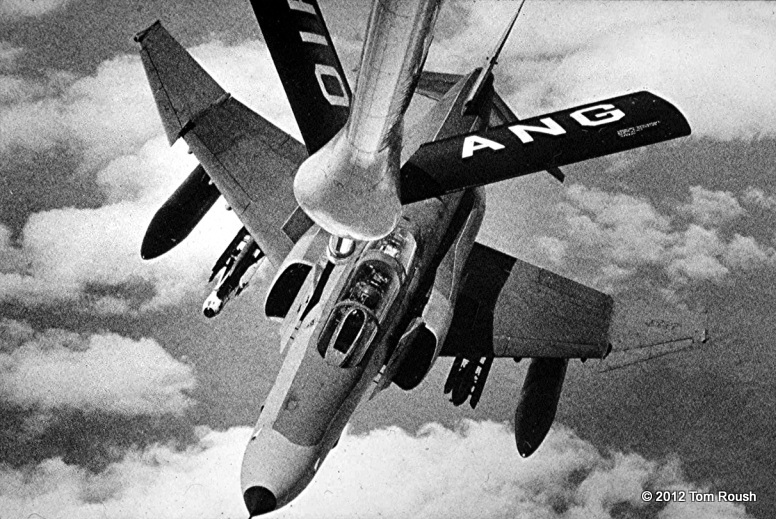
Misty 42 – an F-4 flown my the Missouri Air National Guard. Photo by Tom Roush – from an Ohio Air National Guard KC-135.
…and just recently I found a video that someone else had taken that’s pretty accurate for what it was like.
The above shot would have been taken just before the video starts.
PS – years later – I got back in touch with him and sent him this story.
His response: “Tom, you have Lived!”
🙂
I’ve got my ‘every six months’ checkup going on to see if the cancer they killed in me a few years back is still dead. I had it twice – between two of the checkups it came back – so I don’t – shall we say, ‘count my chickens before they hatch’.
As a result, these checkups are generally preceded by two weeks of anxiety that builds and builds and builds until I get the results back.
I mentioned to a fellow at work that it was happening, and he said, “So, you must be used to it by now.”
I thought about that for a moment, and then realized that it’s not something you “get” used to…
I tried to find a way to explain it – and finally told him this:
“It’s like every six months, someone holds a gun to your head, and they slowly squeeze the trigger. You can hear the springs in the gun compressing, you feel the muzzle shake a little as their muscles quiver, and you tense up, anticipating the explosion. Adrenaline pours through your body. You try to keep from shaking, from crying, because the gun exploded twice before, and you don’t want to go through that again.
This time, there’s a loud “click” of the hammer slamming down on an empty chamber. Just that sound explodes in your ears. Every muscle in your body jolts tight as the sound echoes – then rings away.
No bullet this time.
Good.
But it takes awhile to recover.
And no… you don’t ever get used to it.
Heh…
MSN had this question on their website awhile back – and I had to answer, “Uh, yeah.”
Years ago, I was working in Tacoma Washington as a photojournalist when I saw smoke coming from the south… Not just a little smoke, but a huge amount of it – forest fire size. I checked with my editor, and they cleared me to go shoot it. I filled up the tank of the company’s Corolla I’d been assigned, and headed south.
Thing is, to get there (Morton) from Tacoma was about an hour and a half or so, so I wasn’t able to go instantly, but I followed my nose and eventually came across a sign spray painted on a 4 x 8 sheet of plywood:
← Forest Fire
– it had an arrow pointing left. I took that road, and drove for miles on a logging road laid through the forest like a broken suspender. Finally came to a clearing with a pond where a helicopter was dipping water – I got a few shots of that with a 50 mm lens because it was quite literally right in front of me, then just as he pulled out – an aerial tanker shot out from behind a hillside in the distance – dumping his load of red fire retardant onto the fire. It was amazing, hillside… smoke… tanker… red stuff… I swung the camera up and got the picture – but because I still had the 50mm lens on, it was a teensy bit of an image – I’d needed a telephoto for that, and that was still in the case in the back seat of the car.
So I did what’s normal for firefighters, ambulance drivers, cops, and journalists, and drove toward the flames.
I kept seeing signs for the tanker trucks, and the trucks themselves, often feeling them before I saw them, rolling earthquakes coming down the mountain to refill themselves with more water from wherever they could get it.
The newspaper I worked for had radios in all the cars, and they worked on a repeater system, a lot like cell towers. You’d grab the mike, push the talk button, and wait for the chirp to tell you the repeater was in range, and then you’d start talking. If you were out of range, you’d get the obnoxious “braaap” instead of the chirp. By this time all I heard was “braaap.” I was on my own. I made it around the edge of this box canyon and was heading up a ridge. The next turn would have put me on the hillside that tanker had hit. It was around this time that the car started handling a little differently… Mushy in the rear end, drifting to the right. (toward the box canyon).
Uh oh…
This was followed by the sound and sparks of the rim of the wheel hitting the sharp rocks on the road that had flattened the tire.
I couldn’t control the car very well, the rim wasn’t giving me anything in the way of traction, so I had to stop – in the middle of a hill, flaming box canyon down to my right, smoldering hillside up to my left. I tried to change the tire – but given where I was, any tanker truck careening around the curve down the hill would see me at the last second, before there was too much time to avoid a collision….
And… That would make the forest fire a bit worse.
This would be bad.
I squeezed the car off to the side as far as I could, and hit the ground with the dedication and intent of an Indy pit crew.
Except, they jack up on level concrete.
I didn’t have that.
They have these pneumatic insta-jacks.
I didn’t.
They have air wrenches.
I had a big bent wire with a socket welded to the end of it.
I was jacking up a company car, on a hill, with a flat, so it was hard to even get the jack under there, and once I got it up, it desperately wanted to fall off. Most of the things that I would have used to brace the car to keep it from rolling were on fire, so that limited my options a bit. Understand, at this point I was feverishly working on getting the car into the air, had my back to the canyon now, so all I saw reflected in the car fender was embers.
Oh good…
The smoke was getting a little thicker, and to say that there was a touch of urgency in my actions might be considered an understatement. My main concern at that time was being hit by an out of control tanker truck – well, the forest fire was a bit of a concern, too. I wasn’t in it, mind you, but any place I could run to avoid a collision with the aforementioned truck was also on fire.
Right…
Oh, the other thing Indy pit crews have is tires with air in them. I’d gotten the spare out of the trunk – and it was then that I discovered that it was low. Not flat, but low enough to keep me from driving the car very fast on this or any road, much less a dirt one with sharp tire eating rocks on it.
At this point, it was quite clear that getting photos of the forest fire was rather secondary to me getting myself out of there.
So if it isn’t clear yet, I’m in the middle of a hill, on a dirt road, smoldering canyon to my right, hill to my left, road up ahead turns left out of sight, and since the road wasn’t wide enough to do a three point turn, the only way I could get out was to back out down the hill on an almost flat tire until I could find a spot to turn around. So I did that, backed up for about ¾ of a mile – then drove far, far slower than I wanted to as I was getting out – leaving the smoldering hillsides in my rear view mirror.
What I didn’t know then – at least until the next day – is that among all the burning stuff was some poison oak. I was wearing contact lenses at the time, and whatever was in the poison oak got into them. The next day – I only had to put the contacts in and I felt like my eyes were on fire. Ended up going to a clinic then to get things taken care of, but enough of the oils in the poison oak had gotten into the soft contacts that they were completely shot.
So: did I get the picture and did it make the paper?
Well, I got pictures. Not the dramatic ones I wanted, but I got something , but the most important bit was that I got out.
Part 2…
I had to drive quite awhile on that tire – remember, it’s not completely full of air – so the car’s lurching about as I have to drive slow so as not to overheat it and blow that one, too.
Eventually I found a gas station in Elbe, and filled up the (by now) very hot tire there. As I left, I saw an absolute herd of emergency vehicles heading the other way.
Knowing I had to get the film back to the paper, I tried to reach them on the radio: “Braaaap” – no go. I found a payphone. No go. Every number I called at the paper was simply unavailable and I couldn’t reach them by radio.
Then I heard on the scanner that this was a fatal accident, and the paper generally wanted images of fatal accidents, so I kept trying to call, and eventually gave up and chased the State Patrol and the aid cars and the various official vehicles. They left the main road and headed down a gravel forest service road at high speed. I stayed glued to them, because otherwise I’d be completely lost. I heard the EMT’s talking to each other on the scanner, “Who’s that in the little brown car? Is he with us?” “Nah, he’s not with us, must be some sort of vulture from the media.”
Oh good… I was a vulture.
We all got to the scene of the accident – and it was striking how innocuous the road looked. It didn’t look like you could kill yourself on this road, but someone drove their last mile here. It swept gently left, then gently right, and as it was gravel, you could see exactly what had happened. The fellow was going too fast, and started sliding on the left turn, then finally caught it, and overcorrected too late when the road swung right. The truck was on its side in the middle of the road and by now it was getting quite dark. I should have been back at the paper hours ago.
I was living at home with my folks at the time, and knew that they’d be worried if I didn’t show up and didn’t call to tell them why. I was trying to figure out how to do that when one of the staters walked up to me and asked if I could take some photos of the accident scene for them. I saw my chance: “Sure – as long as I can talk you into calling my folks and letting them know I’m okay… – just – when you call, don’t immediately identify yourselves as “hi, I’m Sgt. Smith from the Washington State Patrol and I’m calling about your son, who’s at the scene of an accident…” – that would freak them right out…
Call ‘em – let ‘em know I’m okay – and I’ll shoot what you want. Deal?
“Deal.”
So I shot, then headed back to the car, and drove as fast as I could to get back to the paper to process the film of the forest fire and accident. Of course, I didn’t want to drive so fast that I’d see the same Staters again.
I kept hitting the microphone switch, waiting for the little ‘chirp chirp’ that told me I’d hit the repeater, because once I’d hit that, I knew I’d be able to talk to the paper.
It took about 30 minutes of fast driving before I got a chirp, and 10 more before I got it reliably. Once there, I got through to the chief photographer, who told me to call him when I was closer – I’d missed the color deadline, we’d see if I could get there in time to do the black and white deadline.
By the time I got to – let’s call it ‘civilization’ – I’d missed the black and white deadline, too, so what this meant is that the photos I’d taken would never see print.
When he knew where I was, he told me to just head home – which saved me about 40 miles of driving.
I went home, and got there somewhere between 9 and 10 – and took the contacts out and crashed.
Part 3
Next day – when I put the contacts in – all the oils from the burning poison oak were like red hot pokers in my eyes – and it was almost impossible to see – and for a photographer, that’s kind of a bad thing. I went to a clinic where we decided the contacts were a lost cause, and that if I was ever near a forest fire again, I should do what I could to stay upwind of it.
It seemed like a good idea.
Is there a moral to this? I didn’t think of any while writing this – but I feel I need to tie it all together somehow.
Well, I suppose there’s several morals:
- Be prepared. This might sound like a little Boy Scout thing – but there’s a lot of truth to it. Make sure you’ve got air in your spare, make sure you’ve got a jack handle. I know of one person who decided that to get better mileage, he’d dump the spare and the jack, “because he had roadside assistance on his cell phone”. That just wouldn’t have worked out there.
- Make sure the folks who care about you know where you are. It’s just not cool to make people worry unnecessarily.
- When shooting forest fires… Shoot from the upwind side.
…and stay away from the poison oak. It’s nasty…
(c) Tom Roush 2009
A number of years ago, in my first job in IT, I worked for a local health care cooperative automating the data gathering of an outbound call center.
That sounds nice and sophisticated. What really happened was that I worked in a group with a bunch of little old ladies –meant in the dearest sense you could mean it – they were little, and old, and ladies. Imagine working with your mom or grandma to get the picture. They made calls to new members in the various regions to inform them of the possibilities they could expect with their new membership. My job was to automate the data gathering of the department. Each telephone call was logged, categorized, and eventually summarized so the region could be billed for the work done on their behalf.
How this was done was simple: Paper, pencil, and a bunch of little hash marks: IIIII IIIII IIIII. Each hash mark represented one telephone call – which could take place in seconds, or many minutes. They were valuable hash marks.
My job – summarize it so those hash marks could be turned into money at the end of the quarter.
I was given the process, and as I sat there with a solar powered calculator adding hash marks for weeks every quarter while a $2000.00 computer sitting on my desk burned electrons, I had this strange idea that “there’s GOT to be a better way than this.” This is where the automation came in. But automating it so a bunch of little old ladies could use it – correction – would use it – was key.
I’d been told that for this data gathering project, I would not be allowed to use a database, I would have to use Microsoft’s Excel. (that’s another story for another time) And so, technically, I had to make Excel look and act like a database, but more importantly, I had to get these little old ladies (who can be mighty stubborn, I might add) to go from things they could see and feel (pencil and paper) to things they couldn’t (electrons).
One of the little old ladies was named Georgiana. She had been diagnosed with ADD, and was quite aware of it, so she worked hard, with stacks of post-it notes all over to help keep herself on track. She also was an absolute delight to work with, and would tell me any time some code I wrote didn’t make sense. Conversely, if it did make sense, and she understood it, she would let me know – and then I knew everyone else would understand it as well.
So Georgiana became my canary in the coal mine. She would not only tell me when she didn’t understand how some functionality was supposed to work, she would also tell me when the others had trouble.
And as a result, that trouble, whatever it was, would get fixed. In human terms, they’d understand it better. In business terms, their productivity would go up. In human terms, they’d have less frustration. In business terms, there’d be fewer impediments to them doing their jobs.
All because the code was written with the customer in mind.
I wrote thousands of lines of code for that project. It eventually became a distributed data repository, on two separate, totally incompatible networks, that could quite literally only communicate via email, so the calculations happened via Excel formulas, daily reporting happened via distributed Excel and Outlook macros and Novell Groupwise automation, and summarization and reporting at the end of the quarter was done with Excel macros and linking and embedding the results into Word. This took the generation of the report down from weeks to two hours, which I thought was a bit of an accomplishment – but it became very clear to me that no matter how wonderful, how exciting, how shiny, sparkly or technically brilliant the code was, if I didn’t listen to my customers – if my code didn’t solve the problems they were facing on a daily basis, then they wouldn’t use it. If it didn’t do what the customer wanted, then all the effort I put into it was a complete and utter waste of time, both mine and the user’s. I’ll tell that story some other time – but over time, I realized that more and more, the code I wrote was written with one little old lady in mind.
It’s been 15 years now, but in every line of code I write now is a little bit written for Georgiana.
(c) Tom Roush 2009

 Tom Roush's Blog